
| REPORT ATTRIBUTE | DETAILS |
|---|---|
| Historical Period | 2020-2023 |
| Base Year | 2024 |
| Forecast Period | 2025-2032 |
| Destemmer Machine Market Size 2024 | USD 781 million |
| Destemmer Machine Market, CAGR | 5.28% |
| Destemmer Machine Market Size 2032 | USD 1,178 million |
Market Overview
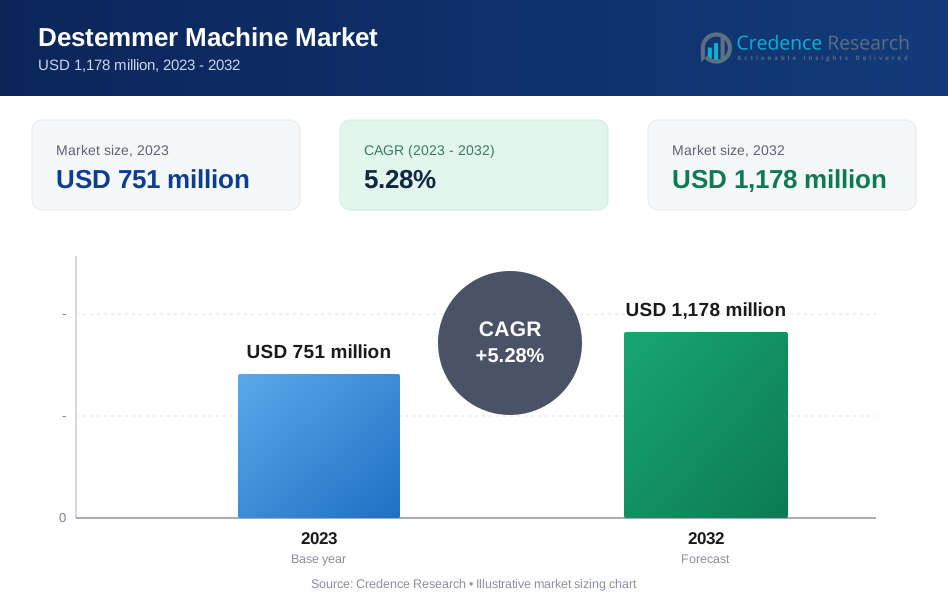
The Global Destemmer Machine Market is projected to grow from USD 781 million in 2024 to an estimated USD 1,178 million based on 2032, with a compound annual growth rate (CAGR) of 5.28% from 2025 to 2032.
Market drivers include rising wine consumption globally, especially in emerging economies such as China, Brazil, and India. The demand for efficient and hygienic processing equipment is prompting wineries to invest in advanced destemming technology. Trends such as sustainable winemaking and low-intervention practices are also encouraging the use of machines that reduce grape damage and preserve natural characteristics. Technological advancements like programmable logic controls (PLCs) and integration with sorting systems are further enhancing product appeal.
Geographically, Europe dominates the destemmer machine market due to its well-established wine industry and presence of leading manufacturers in countries like Italy, France, and Spain. North America follows closely, driven by vineyard expansion in the U.S. and Canada. Asia Pacific is expected to witness the fastest growth, propelled by rising wine production in China and Australia. Key players in the market include Bucher Vaslin, Pellenc, Zambelli Enotech, Scharfenberger, and Mori-Tem.
Market Insights
- The market is projected to grow from USD 781 million in 2024 to USD 1,178 million by 2032, with a CAGR of 5.28%.
- Rising global wine consumption and expanding vineyard areas drive demand for efficient destemming equipment.
- Increasing preference for premium and sustainable wines encourages adoption of advanced, low-damage destemmer machines.
- High capital investment and maintenance costs limit market penetration among small-scale wineries.
- Europe dominates the market due to its established wine industry and leading equipment manufacturers.
- Asia Pacific shows the fastest growth, supported by expanding wine production in China, Australia, and India.
- Technological advancements and integration with sorting systems enhance product appeal and operational efficiency.
Market Drivers
Expansion of the Global Wine Industry Increases Equipment Demand
The Global Destemmer Machine Market benefits from the continuous growth of the global wine industry. Countries such as the United States, France, Italy, and Australia are expanding their vineyards to meet domestic and export demand. This expansion creates a pressing need for efficient grape processing equipment to maintain consistent quality. Destemmer machines streamline operations by separating stems while minimizing berry damage. Wine producers adopt automated systems to reduce manual labor and increase throughput. Rising production volumes directly influence the demand for modern destemming solutions.
- For instance, in 2023, global wine production reached approximately 237 million hectoliters, with Italy producing over 47 million hectoliters and France over 45 million hectoliters, driving significant demand for grape processing equipment such as destemmer machines.
Shift Toward Premium Wine Quality Encourages Automation
Wineries increasingly focus on improving product quality to cater to the premium wine segment. The Global Destemmer Machine Market gains from this shift, as high-end wines require precise handling of grapes to preserve flavor and structure. Automated destemming machines offer better control over berry integrity and reduce contamination risks. This level of precision supports consistent fermentation outcomes and enhances brand reputation. Wineries seek machines that deliver gentle but effective stem removal. It helps ensure a cleaner must and better wine clarity.
- For instance, a leading Italian equipment manufacturer reported supplying over 1,200 automated destemmer machines to premium wineries in Europe and North America in a single year to meet the growing demand for precision grape processing.
Rising Labor Costs and Need for Operational Efficiency Support Mechanization
The rising cost of skilled labor in traditional wine-producing regions encourages the adoption of automated equipment. The Global Destemmer Machine Market grows as producers look for cost-effective alternatives to manual destemming. Automation enables faster processing during peak harvest periods when labor availability is limited. It improves workplace safety and reduces reliance on seasonal workers. The ability to operate machinery with minimal training also increases its appeal. It supports scalable production across small and large wineries.
Integration of Smart Technology Enhances Performance and Control
Manufacturers are incorporating advanced technologies to improve machine functionality. The Global Destemmer Machine Market benefits from innovations like programmable logic controllers, variable speed drives, and remote monitoring systems. These features allow greater customization and process control during grape processing. Wineries value machines that adapt to different grape varieties and yield consistent output. Smart systems also support predictive maintenance, reducing downtime. It helps ensure continuous operation during critical production phases.
Market Trends
Growing Preference for Gentle Destemming to Preserve Grape Integrity
Wineries increasingly seek destemmer machines that handle grapes delicately without compromising productivity. The Global Destemmer Machine Market reflects this shift, with manufacturers developing equipment that minimizes berry breakage and preserves juice quality. Gentle destemming supports premium wine production by maintaining the fruit's natural character. Equipment with adjustable settings allows wineries to customize pressure and rotation based on grape variety and condition. This trend supports broader goals of low-intervention and natural winemaking. It aligns with the rising consumer demand for artisanal and organic wines.
- For instance, over 2,500 wineries in Europe and North America adopted gentle destemming technologies in 2024, reflecting a clear shift toward quality-focused production methods.
Rise of Compact and Mobile Destemmer Units for Small-Scale Producers
Small and mid-sized wineries are gaining market share, particularly in emerging wine-producing regions. The Global Destemmer Machine Market adapts to this shift with a growing portfolio of compact, portable, and energy-efficient models. These units are easier to transport and install, making them ideal for decentralized operations and boutique vineyards. Manufacturers focus on modular designs that combine destemming with crushing and sorting functionalities. This approach reduces capital investment and simplifies workflow. It supports market inclusivity by making automation accessible to smaller producers.
- For example, in 2024, more than 1,200 compact destemmer units were sold to small-scale wineries globally, enabling broader access to automation and supporting the growth of boutique wine production.
Integration with Optical Sorting and Automation Enhances Process Control
Technology integration is becoming central to destemming systems, improving overall operational precision. The Global Destemmer Machine Market sees a strong movement toward pairing destemmers with optical sorters, conveyors, and automated quality control modules. These systems detect and remove unwanted materials like under-ripe grapes, leaves, or stems. Enhanced sorting improves must quality and reduces waste during downstream processes. Integration also minimizes manual inspection, speeding up production cycles. It reflects the broader trend of smart winery automation.
Focus on Sustainable Materials and Energy Efficiency in Machine Design
Environmental sustainability influences new equipment development across winemaking facilities. The Global Destemmer Machine Market responds with machines designed to reduce energy and water usage. Manufacturers now use recyclable materials and introduce features that limit waste during cleaning and operation. Eco-friendly designs appeal to wineries pursuing green certifications and sustainable branding. Machines that operate quietly and use less power meet growing regulatory and consumer expectations. It supports long-term cost savings and environmental responsibility across the industry.
Market Challenges
High Capital Investment and Maintenance Costs Limit Adoption Among Small Wineries
The Global Destemmer Machine Market faces challenges due to the high initial cost of advanced machinery. Small and mid-sized wineries often struggle to allocate budgets for automated systems, especially in developing regions. Maintenance expenses, spare parts, and technical servicing further add to the operational burden. These financial constraints discourage early adoption and delay upgrades to more efficient systems. Many producers continue using manual or semi-automatic equipment to avoid capital strain. It slows market penetration in segments with significant growth potential.
- For instance, according to industry surveys, the average price of an automated destemmer machine suitable for a mid-sized winery in 2024 ranged from $18,000 to $35,000, while annual maintenance and spare parts costs could add another $2,500 to $5,000 per machine, making it a major investment hurdle for smaller producers.
Lack of Technical Expertise and Infrastructure in Emerging Wine Regions
Limited access to technical knowledge and skilled personnel hampers efficient use of destemmer machines in some regions. The Global Destemmer Machine Market finds it difficult to grow in areas lacking training programs or support infrastructure. Improper installation or handling reduces machine performance and shortens its service life. Wineries operating in rural or remote locations also face issues with after-sales support and spare part availability. Without proper integration into the production process, even advanced machines fail to deliver expected returns. It creates a barrier to widespread technological advancement in the wine industry.
Market Opportunities
Expansion of Emerging Wine Markets Creates Strong Demand Potential
The Global Destemmer Machine Market holds strong growth opportunities in emerging wine-producing countries. Regions such as South Africa, Chile, India, and China are expanding vineyard acreage and modernizing production. These markets require cost-effective, scalable equipment to meet rising domestic and export demands. Destemmer manufacturers can tap into this opportunity by offering compact, modular machines suited for developing infrastructure. Government initiatives to support agricultural mechanization further encourage adoption. It strengthens the market presence of international brands entering these regions.
Product Customization and Smart Technology Integration Offer Competitive Edge
Wineries increasingly seek machines tailored to specific grape varieties, volumes, and production styles. The Global Destemmer Machine Market can grow by offering customizable features, smart controls, and real-time monitoring capabilities. Integration with IoT and automation platforms enhances machine value and user experience. Predictive maintenance, remote diagnostics, and programmable settings appeal to large wineries with complex operations. Offering training, multilingual support, and mobile-friendly interfaces creates added value. It positions suppliers to meet evolving customer expectations in a competitive landscape.
Market Segmentation Analysis
By Product Type
The Global Destemmer Machine Market includes traditional, modern, hybrid, electric, and manual destemmer machines. Modern and electric variants dominate due to their efficiency and integration with automated processing lines. Hybrid machines offer a balance between automation and manual control, making them ideal for medium-scale operations. Manual machines still hold relevance in low-volume settings or for artisanal producers. Traditional models are gradually losing share due to technological advancements. It reflects a clear shift toward energy-efficient and precision-driven equipment.
- For instance, a leading manufacturer reports that their electric destemmer machines can process up to 3,300 pounds of grapes per hour, illustrating the high efficiency and throughput of modern equipment compared to manual or traditional models
By Application
Wine production represents the primary application segment, driving most of the market demand. Destemmer machines also serve fruit juice producers and food manufacturers seeking consistent pulp quality. Their use in distilled spirits and agricultural research is growing, with a focus on innovation and raw material control. Research institutions value the equipment for experimental studies and process optimization. It positions destemmers as versatile tools across beverage and food sectors.
- For instance, global wine production reached 242 million hectoliters in 2016, with the majority of large-scale wineries employing destemmer machines to efficiently process high volumes of grapes and maintain product quality
By End-User
Wineries lead the end-user segment, followed by fruit processing companies and food and beverage manufacturers. Agricultural research institutions rely on specialized machines for testing and development. Small-scale farmers and hobbyists use compact or manual units for limited production. The Global Destemmer Machine Market caters to a wide range of users by offering scalable product configurations. It supports adoption across both industrial and non-industrial settings.
By Automation Level
Fully automated destemmer machines gain traction among commercial wineries due to their precision and labor savings. Semi-automated systems appeal to mid-sized producers seeking balance between manual oversight and operational efficiency. Manual machines remain relevant in small-scale operations with budget constraints. It reflects diverse preferences based on scale, budget, and production goals.
By Operating Capacity
High-capacity machines dominate in large wineries and processing plants with heavy seasonal loads. Medium-capacity models serve regional wineries and specialty producers. Low-capacity machines are ideal for research labs, boutique vineyards, and personal use. The market accommodates varying production needs by offering machines across all capacity ranges.
Segments
Based on Product Type
- Traditional Destemmer Machines
- Modern Destemmer Machines
- Hybrid Destemmer Machines
- Electric Destemmer Machines
- Manual Destemmer Machines
Based on Application
- Wine Production
- Fruit Juice Production
- Food Industry
- Distilled Spirits Production
- Research and Development in Agricultural Studies
Based on End-User
- Winery Operators
- Fruit Processing Companies
- Food and Beverage Manufacturers
- Agricultural Research Institutions
- Small-Scale Farmers and HobBased onists
Based on Automation Level
- Fully Automated Destemmer Machines
- Semi-Automated Destemmer Machines
- Manual Destemmer Machines
Based on Operating Capacity
- Low Capacity Destemmer Machines (1-100 kg/hour)
- Medium Capacity Destemmer Machines (100-500 kg/hour)
- High Capacity Destemmer Machines (500+ kg/hour)
Based on Region
- North America
- U.S.
- Canada
- Mexico
- Europe
- UK
- France
- Germany
- Italy
- Spain
- Russia
- Belgium
- Netherlands
- Austria
- Sweden
- Poland
- Denmark
- Switzerland
- Rest of Europe
- Asia Pacific
- China
- Japan
- South Korea
- India
- Australia
- Thailand
- Indonesia
- Vietnam
- Malaysia
- Philippines
- Taiwan
- Rest of Asia Pacific
- Latin America
- Brazil
- Argentina
- Peru
- Chile
- Colombia
- Rest of Latin America
- Middle East
- UAE
- KSA
- Israel
- Turkey
- Iran
- Rest of Middle East
- Africa
- Egypt
- Nigeria
- Algeria
- Morocco
- Rest of Africa
Regional Analysis
Europe Destemmer Machine Market
Europe holds the largest share in the Global Destemmer Machine Market, accounting for approximately 38% of global revenue. Countries such as Italy, France, and Spain drive market dominance due to their established wine production infrastructure. Strong export volumes and a tradition of quality winemaking create high demand for advanced destemming equipment. European manufacturers lead in innovation and offer a wide product range tailored to varied vineyard scales. The region also benefits from strong technical expertise and regulatory support. It remains a hub for premium machine development and export.
North America Destemmer Machine Market
North America contributes nearly 24% to the global market, with the United States as a key player. California’s wine industry continues to invest in automated and sustainable equipment. Canadian vineyards are expanding, increasing demand for compact and energy-efficient machines. Strong awareness of precision winemaking supports the uptake of smart and hybrid destemmer systems. The region also values after-sales service and equipment customization. It maintains steady growth driven by advanced technology adoption.
Asia Pacific Destemmer Machine Market
Asia Pacific represents around 18% of the market and shows the fastest growth rate among all regions. China, Australia, and India lead the expansion due to rising wine consumption and vineyard development. Governments in emerging markets support mechanized agriculture, creating favorable conditions for equipment suppliers. The region demands both low-cost manual machines and high-capacity automated systems. Growing wine tourism in countries like Japan and South Korea adds to production incentives. It offers significant potential for long-term investment and market entry.
Latin America Destemmer Machine Market
Latin America captures approximately 10% of the global market, led by Argentina and Chile. Both countries are major wine exporters and invest in modern winemaking equipment to stay competitive. Adoption of destemmer machines is increasing due to a focus on quality enhancement. Smaller producers seek flexible and affordable models to upgrade manual operations. The market also gains from partnerships with European equipment suppliers. It supports steady growth through expanding production capacity.
Middle East and Africa Destemmer Machine Market
The Middle East and Africa region accounts for nearly 6% of the global market. South Africa leads the segment with a developed wine sector and rising exports. Other countries in the region are gradually adopting mechanized solutions in agriculture and beverage production. Limited infrastructure and capital investment slow down market penetration. The demand remains moderate, driven by tourism and niche vineyard developments. It presents long-term growth prospects with infrastructure improvement.
Key players
- DELLA TOFFOLA GROUP
- MORI-TEM Srl
- VLS Technologies
- Enotecnica Pillan
- Zhengzhou Azeus Machinery Co., Ltd
- Economy Engineering Company
- ZTI Smart Machines
- Xinxiang Sanfeng Machinery Co., Ltd
Competitive Analysis
The Global Destemmer Machine Market features a mix of established European manufacturers and emerging Asian suppliers. Companies like DELLA TOFFOLA GROUP, MORI-TEM Srl, and VLS Technologies maintain leadership through innovation, advanced automation, and product customization. These firms cater to high-end wineries requiring precision and reliability. Chinese and Indian players, such as Zhengzhou Azeus Machinery Co., Ltd and Economy Engineering Company, focus on affordable, compact machines suitable for small to mid-sized operations. ZTI Smart Machines and Enotecnica Pillan offer modular and semi-automated options, appealing to growing producers seeking flexibility. Xinxiang Sanfeng Machinery Co., Ltd extends competitive pricing and regional accessibility. The market remains moderately fragmented, with players competing on technology, service, and pricing. It encourages constant product evolution and strategic alliances to meet diverse production needs across global regions.
Recent Developments
- In May 2024, VLS Technologies expanded its offerings to include integrated filtration and cooling systems for winemaking.
Market Concentration and Characteristics
The Global Destemmer Machine Market shows moderate concentration, with a few dominant players from Europe and a growing number of regional manufacturers in Asia. It features a mix of premium, technologically advanced systems and cost-effective manual or semi-automated machines. The market caters to both large-scale commercial wineries and small-scale or artisanal producers, reflecting high product diversity. Demand varies by region, driven by production volume, labor availability, and technological adoption. Product customization, energy efficiency, and ease of integration into existing lines define key characteristics. It supports both traditional winemaking and modern, automated operations, making flexibility a critical competitive factor.
Report Coverage
The research report offers an in-depth analysis based on Product Type, Application, End-User, Automation Level, Operating Capacity and Region. It details leading market players, providing an overview of their business, product offerings, investments, revenue streams, and key applications. Additionally, the report includes insights into the competitive environment, SWOT analysis, current market trends, as well as the primary drivers and constraints. Furthermore, it discusses various factors that have driven market expansion in recent years. The report also explores market dynamics, regulatory scenarios, and technological advancements that are shaping the industry. It assesses the impact of external factors and global economic changes on market growth. Lastly, it provides strategic recommendations for new entrants and established companies to navigate the complexities of the market.
Future Outlook
- Global vineyard areas continue rising, fueling demand for mechanical destemming. Producers across emerging and established regions require reliable, high-capacity solutions.
- IoT-enabled destemmer machines gain traction through remote monitoring and data-driven maintenance. Wineries benefit from reduced downtime and process transparency.
- Environmental regulations and consumer pressure push for low-energy, water-efficient machines. Destemmers with eco-friendly designs become more widely accepted.
- Portable, lower-capacity destemmers become popular in small-scale facilities. These machines offer operational efficiency and fit limited space or budget constraints.
- Destemmer systems linked with sensors and AI deliver enhanced fruit sorting. Wineries achieve consistency through precise automation and real-time adjustments.
- Equipment manufacturers offer bespoke configurations tailored to local grape types. Custom features help optimize yield and protect berry integrity.
- Vineyards demand full-service packages, including training and spare parts. Suppliers invest in local service networks to improve customer loyalty.
- Local manufacturers begin offering competitive, cost-effective models. This diversification strengthens supply chains and broadens regional choices.
- Shared-service destemmer options appear in cooperative winery groups. Smaller operators access high-end machinery without heavy investment
- Manufacturers release modular destemmer systems that support future add-ons. Operators gain flexibility to scale and adopt new technology affordably.
Request a Free Sample
Fill in your details and we'll send you a free sample report.
- Sample data tables & charts
- Research methodology
Need a Custom Version of This Report?
Tailor the scope, geography, or segments to your exact requirements.
- Custom geography or segment scope
- Direct access to our analyst team
Frequently Asked Questions
What was the market size of the Global Destemmer Machine Market in 2023 and what is it expected to reach by 2032?
What is the primary function of a destemmer machine in wine production?
What are the key trends influencing the destemmer machine market?
Who are the major players in the Global Destemmer Machine Market?
Table of Content
Chapter 1. Report Introduction
- 1.1 Report Description & Purpose
- 1.1.1 Report Title & Market Definition
- 1.1.2 Unique Selling Propositions (USP) & Key Differentiators
- 1.1.3 Value Proposition for Stakeholders
- 1.2 Research Objectives
- 1.2.1 Market Sizing Objectives (Volume & Revenue)
- 1.2.2 Segmentation Objectives
- 1.2.3 Competitive Intelligence Objectives
- 1.2.4 Forecast & Scenario Objectives
- 1.3 Report Scope
- 1.3.1 Destemmer Machine Scope – Types & Subtypes Covered
- 1.3.2 Geographic Scope – Regions & Countries Covered
- 1.3.3 Historical Period, Base Year & Forecast Period (2023; forecast to 2032)
- 1.3.4 Inclusions & Exclusions
- 1.4 HS Code & Classification Framework
- 1.5 Currency, Units & Pricing Basis
- 1.6 Target Stakeholders
- 1.7 Limitations & Assumptions
Chapter 2. Executive Summary
- 2.1 Global Destemmer Machine Market Snapshot
- 2.1.1 Market Size – Historical (2023) & Forecast (2023-2032) (2023: USD 751 million → 2032: USD 1,178 million)
- 2.1.2 Volume & Revenue – Global Totals
- 2.1.3 Key Market Highlights – Top Five Facts
- 2.2 Destemmer Machine Market Segmentation Snapshot
- 2.2.1 Market Split by Region – 2023 vs. 2032
- 2.3 Competitive Snapshot
- 2.3.1 Top 10 Players by Revenue Share – 2023
- 2.3.2 Top 10 Players by Volume Share – 2023
- 2.3.3 Recent Strategic Developments (18-Month Summary)
- 2.4 Key Investment Highlights & Strategic Conclusions
Chapter 3. Destemmer Machine Market Dynamics & Industry Analysis
- 3.1 Market Overview & Context
- 3.1.1 Destemmer Machine Market Position in the Broader Automotive Value Chain
- 3.1.2 OEM vs. Replacement Market Dynamics
- 3.1.3 Market Maturity & Development Stage by Region
- 3.2 Destemmer Machine Market Drivers
- 3.3 Destemmer Machine Market Restraints & Challenges
- 3.4 Destemmer Machine Market Opportunities
- 3.5 Porter's Five Forces Analysis
- 3.5.1 Threat of New Entrants
- 3.5.2 Bargaining Power of Suppliers
- 3.5.3 Bargaining Power of Buyers
- 3.5.4 Threat of Substitutes
- 3.5.5 Competitive Rivalry – Intensity Assessment
- 3.6 Destemmer Machine Value Chain Analysis
- 3.6.1 Upstream – Raw Material/Input Suppliers
- 3.6.1.1 Raw Material/Input 1
- 3.6.1.2 Raw Material/Input 2
- 3.6.1.3 Raw Material/Input 3
- 3.6.2 Midstream – Production/Manufacturing/Service Delivery
- 3.6.2.1 Production/Process Overview
- 3.6.2.2 Key Facility Locations & Capacity by Manufacturer
- 3.6.3 Downstream – Distribution & End Consumer
- 3.6.3.1 Primary Channel – B2B/OEM
- 3.6.3.2 Secondary Channels – Dealer, Retail, Online, Direct
- 3.6.4 Value Chain Profitability Analysis
- 3.6.1 Upstream – Raw Material/Input Suppliers
- 3.7 PESTEL Analysis
- 3.7.1 Political Factors
- 3.7.2 Economic Factors
- 3.7.3 Social Factors
- 3.7.4 Technological Factors
- 3.7.5 Environmental Factors
- 3.7.6 Legal Factors
- 3.8 Destemmer Machine Supply Chain Analysis
- 3.8.1 Raw Material/Input Supply Risk Assessment
- 3.8.2 Manufacturing Concentration Risk (Geographic Exposure)
- 3.8.3 Trade Disruption Impact Analysis
- 3.9 Regulatory & Policy Landscape
Note: The regulatory and policy landscape section covers regulations based on their applicability to the market, Destemmer Machine category, geography, and scope of the study. Only regulatory frameworks with a material impact on operations, compliance, trade, sustainability, or market access are analyzed in detail.
Chapter 4. Key Investment Pockets & Opportunity Analysis
- 4.1 Destemmer Machine Market Attractiveness Analysis
- 4.1.1 By Region – Investment Attractiveness Matrix (Volume × CAGR)
- 4.2 Absolute Revenue Growth Opportunity
- 4.2.1 By Region – Absolute USD Growth Through 2032
- 4.3 Incremental Volume Opportunity
- 4.3.1 By Region – Incremental Volume Through 2032
- 4.3.2 Segment – Incremental Volume
- 4.4 Emerging Submarket Opportunity Deep Dive (Subject to Applicability)
- 4.5 Emerging Market Opportunity Scorecards
- 4.5.1 United States
- 4.5.2 Europe
- 4.5.3 Asia
- 4.5.4 Middle East & Africa
Note: Emerging Market Opportunity Scorecards will be included based on relevance and strategic importance. Regions listed are indicative and may vary depending on data availability and market dynamics.
Chapter 5. Destemmer Machine Import-Export Analysis & Trade Flows
- 5.1 Global Trade Overview
- 5.1.1 Global Export Value by Country (2023)
- 5.1.2 Global Export Volume by Country (2023)
- 5.1.3 Global Import Value by Country (2023)
- 5.1.4 Global Import Volume by Country (2023)
- 5.1.5 Net Trade Balance by Country (2023)
- 5.2 Export Analysis – Segment
- 5.2.1 Type 1 (HS Code)
- 5.2.2 Type 2 (HS Code)
- 5.2.3 Type 3 (HS Code)
- 5.2.4 Type 4 (HS Code)
- 5.2.5 Type 5 (HS Code)
- 5.3 Import Analysis – Segment
- 5.3.1 Type 1 (HS Code)
- 5.3.2 Type 2 (HS Code)
- 5.3.3 Type 3 (HS Code)
- 5.3.4 Type 4 (HS Code)
- 5.3.5 Type 5 (HS Code)
- 5.4 Average Unit Trade Prices
- 5.4.1 Average Export Price – Segment & Country
- 5.4.2 Average Import Price – Segment & Source Country
- 5.4.3 Price Trends (2023)
- 5.5 Key Trade Route Analysis
- 5.5.1 Trade Route 1
- 5.5.2 Trade Route 2
- 5.5.3 Trade Route 3
- 5.5.4 Trade Route 4
- 5.5.5 Trade Route 5
- 5.6 Trade Policy Impact Assessment
- 5.6.1 US Anti-Dumping & Section 301 Tariffs
- 5.6.2 EU Customs Union Impact
- 5.6.3 Major Free Trade Agreements
- 5.6.4 USMCA Rules of Origin
Note: Trade policy analysis will be included only where relevant to the Destemmer Machine market.
Chapter 6. Competitive Landscape & Company Benchmarking
- 6.1 Destemmer Machine Market Concentration & Structure
- 6.1.1 Herfindahl-Hirschman Index (HHI) – vs. 2023
- 6.1.2 Tier 1, Tier 2 & Tier 3 Market Structure
- 6.1.3 Global, Regional & Local Player Dynamics
- 6.2 Destemmer Machine Market Share Analysis – 2023
- 6.2.1 Global Revenue Share by Company
- 6.2.2 Global Volume Share by Company
- 6.2.3 Regional Revenue Share
- 6.2.4 Market Share Evolution ( vs. 2023)
- 6.2.5 OEM Segment Share by Company
- 6.2.6 Replacement Segment Share by Company
- 6.3 Production/Delivery Capacity & Facility Analysis
- 6.3.1 Global Installed Capacity
- 6.3.2 Capacity Utilization Rates
- 6.3.3 Production/Output Volume
- 6.3.4 Facility Locations & Capacity Map
- 6.3.5 Planned Capacity Additions
- 6.4 Destemmer Machine Competitive Benchmarking Matrix
- 6.4.1 Revenue, Volume, CAGR & Profitability Comparison
- 6.4.2 Channel Revenue Mix
- 6.4.3 Geographic Revenue Exposure
- 6.4.4 R&D Intensity
- 6.4.5 Sustainability Maturity
- 6.5 Strategic Developments in Destemmer Machine (Last 24 Months)
- 6.5.1 Mergers, Acquisitions & Divestments
- 6.5.2 New Destemmer Machine Launches
- 6.5.3 Facility Expansions
- 6.5.4 Strategic Alliances, Joint Ventures & Partnerships
- 6.5.5 Distribution Expansion & Market Entry
- 6.5.6 Sustainability & ESG Initiatives
- 6.6 Competitive Strategy Mapping
- 6.6.1 Leader, Challenger, Follower & Niche Classification
- 6.6.2 Pricing Strategy Comparison
- 6.6.3 Channel Strategy Matrix
Note: Strategic developments are included based on their materiality and the availability of reliable information.
Chapter 7. Global Destemmer Machine Market – By Distribution Channel
- 7.1 Segment Overview
- 7.1.1 Volume & Revenue Split by Channel (2023 & 2032)
- 7.1.2 Channel Mix Evolution (2023-2032)
Chapter 8. Regional Market Analysis – Global Overview
- 8.1 Global Regional Overview
- 8.1.1 Regional Volume Share
- 8.1.2 Regional Revenue Share
- 8.1.3 Regional Volume by Region
- 8.1.4 Regional Revenue by Region
- 8.1.5 Regional Forecast Through 2032
- 8.2 Cross-Regional Segment Analysis
- 8.2.1 By Distribution Channel
- 8.2.2 By Brand/Price Tier
Chapter 9. North America Destemmer Machine Market
- 9.1 United States
- 9.2 Canada
- 9.3 Mexico
Chapter 10. Europe Destemmer Machine Market
- 10.1 Germany
- 10.2 France
- 10.3 Italy
- 10.4 United Kingdom
- 10.5 Spain
- 10.6 Poland
- 10.7 Russia
- 10.8 Netherlands
- 10.9 Belgium
- 10.10 Sweden
- 10.11 Denmark
- 10.12 Norway
- 10.13 Rest of Europe
Chapter 11. Asia Pacific Destemmer Machine Market
- 11.1 China
- 11.2 India
- 11.3 Japan
- 11.4 South Korea
- 11.5 Thailand
- 11.6 Indonesia
- 11.7 Vietnam
- 11.8 Malaysia
- 11.9 Australia
- 11.10 Rest of Asia Pacific
Chapter 12. Latin America Destemmer Machine Market
- 12.1 Brazil
- 12.2 Argentina
- 12.3 Colombia
- 12.4 Chile
- 12.5 Rest of Latin America
Chapter 13. Middle East Destemmer Machine Market
- 13.1 Saudi Arabia
- 13.2 United Arab Emirates
- 13.3 Turkey
- 13.4 Israel
- 13.5 Iran
- 13.6 Rest of the Middle East
Chapter 14. Africa Destemmer Machine Market
- 14.1 South Africa
- 14.2 Egypt
- 14.3 Nigeria
- 14.4 Morocco
- 14.5 Rest of Africa
Chapter 15. Destemmer Machine Company Profiles
- 15.1 [Company 01]
- 15.1.1 Company Overview
- 15.1.2 Key Management Personnel
- 15.1.3 Products & Services Portfolio
- 15.1.4 Financial Performance
- 15.1.5 Key Market Focus & Geographic Presence
- 15.1.6 Recent Developments & Strategic Initiatives
Note: The company profile list is preliminary and may change based on research findings, market developments, data availability, and client requirements.
Chapter 16. Appendices
- Appendix A – List of Abbreviations & Acronyms
- Appendix B – Industry Classification Code Reference – Full Series
- Appendix C – Production & Capacity Data Tables
- Appendix D – End-Use & Demand Base Tables
- Appendix E – Consumption & Replacement Rate Assumptions
- Appendix F – ASP Reference Tables
- Appendix G – Manufacturing & Facility Database
- Appendix H – Import-Export Data Tables
- Appendix I – Regulatory Summary Tables
- Appendix J – Primary Research Participant List (Anonymized)
- Appendix K – Primary Research Questionnaire Framework
- Appendix L – Data Sources & Bibliography
- Appendix M – Market Size Divergence & Source Comparison
Chapter 17. Research Methodology
- 17.1 Research Framework & Philosophy
- 17.2 Secondary Research – Sources, Hierarchy & Data Extraction
- 17.3 Data Modeling – Bottom-Up & Top-Down Market Sizing
- 17.4 Primary Research – Stakeholder Framework, LOI & Sample Sizes
- 17.5 Forecast Methodology – Regression, Scenario & Sensitivity Analysis
- 17.6 Quality Control – Four-Layer Validation Framework
- 17.7 Limitations & Standard Assumptions
- 17.8 Disclaimer
