
Market Overview:
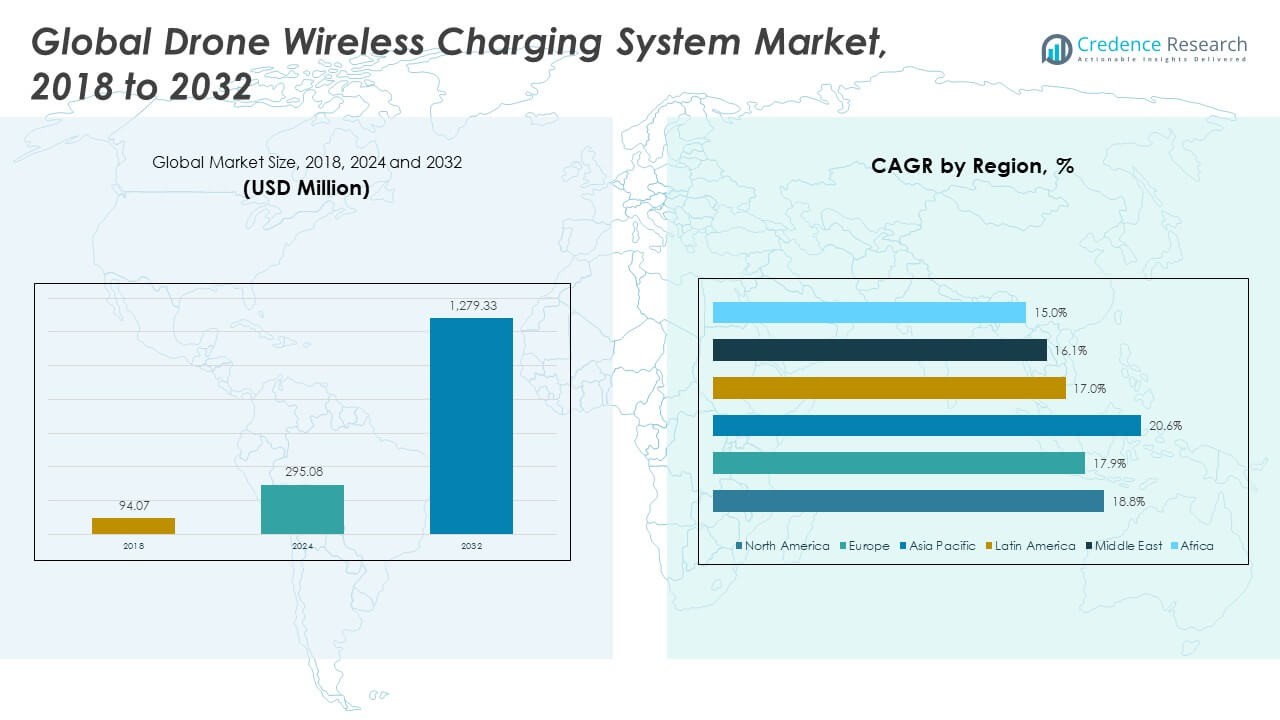
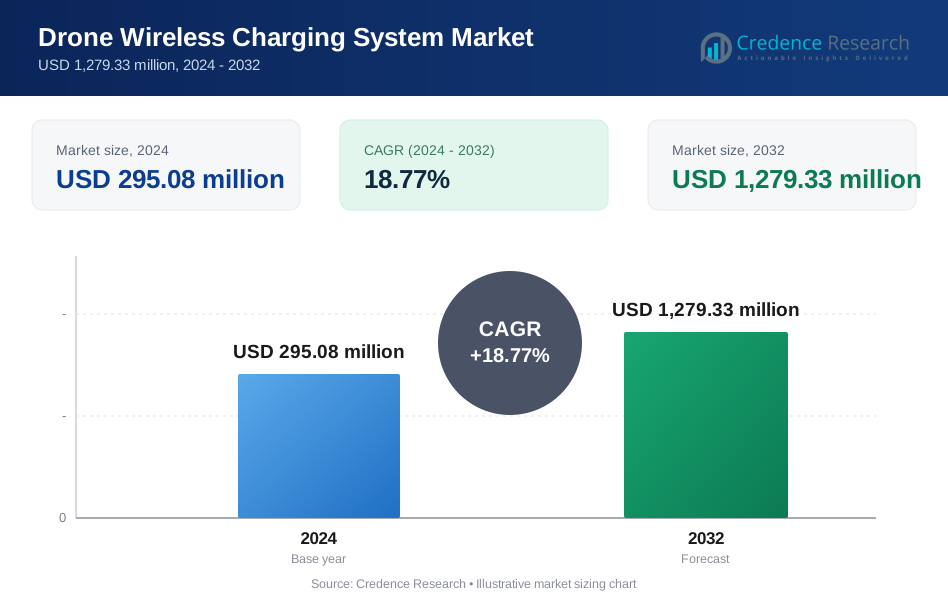
The Global Drone Wireless Charging System Market size was valued at USD 94.07 million in 2018 to USD 295.08 million in 2024 and is anticipated to reach USD 1,279.33 million by 2032, at a CAGR of 18.77% during the forecast period.
| REPORT ATTRIBUTE | DETAILS |
|---|---|
| Historical Period | 2020-2023 |
| Base Year | 2024 |
| Forecast Period | 2025-2032 |
| Drone Wireless Charging System Market Size 2024 | USD 295.08 Million |
| Drone Wireless Charging System Market, CAGR | 18.77% |
| Drone Wireless Charging System Market Size 2032 | USD 1,279.33 Million |
Strong adoption comes from rising drone use in inspection, delivery, and security work. Automated charging helps operators extend flight cycles with minimal downtime. Companies prefer wireless pads because they reduce maintenance and improve safety in outdoor sites. Wider drone fleets in energy, mining, and agriculture raise the need for quick turnaround. Autonomous platforms gain traction as missions shift toward real-time data capture. New designs improve charging alignment and reduce operational delays. Regulatory support for BVLOS missions strengthens interest in automated power systems.
North America leads due to advanced drone ecosystems and strong investment from delivery and defense users. Europe follows with fast deployment across utilities and public safety programs. Asia Pacific emerges as the fastest-growing region due to expanding commercial drone operations in China, Japan, and South Korea. These countries scale autonomous fleets for mapping, logistics, and industrial monitoring. Middle East markets explore systems for security and oilfield inspection. Latin America increases adoption across agriculture and infrastructure surveillance. Global momentum rises as regions push for continuous drone availability.
Market Insights:
- The Global Drone Wireless Charging System Market stood at USD 94.07 million in 2018, reached USD 295.08 million in 2024, and is projected to hit USD 1,279.33 million by 2032, expanding at a CAGR of 18.77% driven by autonomous drone operations and long-mission efficiency requirements.
- North America (42.29%), Europe (27.82%), and Asia Pacific (21.25%) lead global share due to strong adoption across logistics, inspection, and public-safety missions. These regions maintain advanced drone ecosystems, supportive regulatory pilots, and higher infrastructure spending.
- Asia Pacific, with a 25% share, remains the fastest-growing region powered by rapid industrial drone deployment in China, Japan, and South Korea. Growth strengthens through smart-city investments, agriculture automation, and expanding commercial drone corridors.
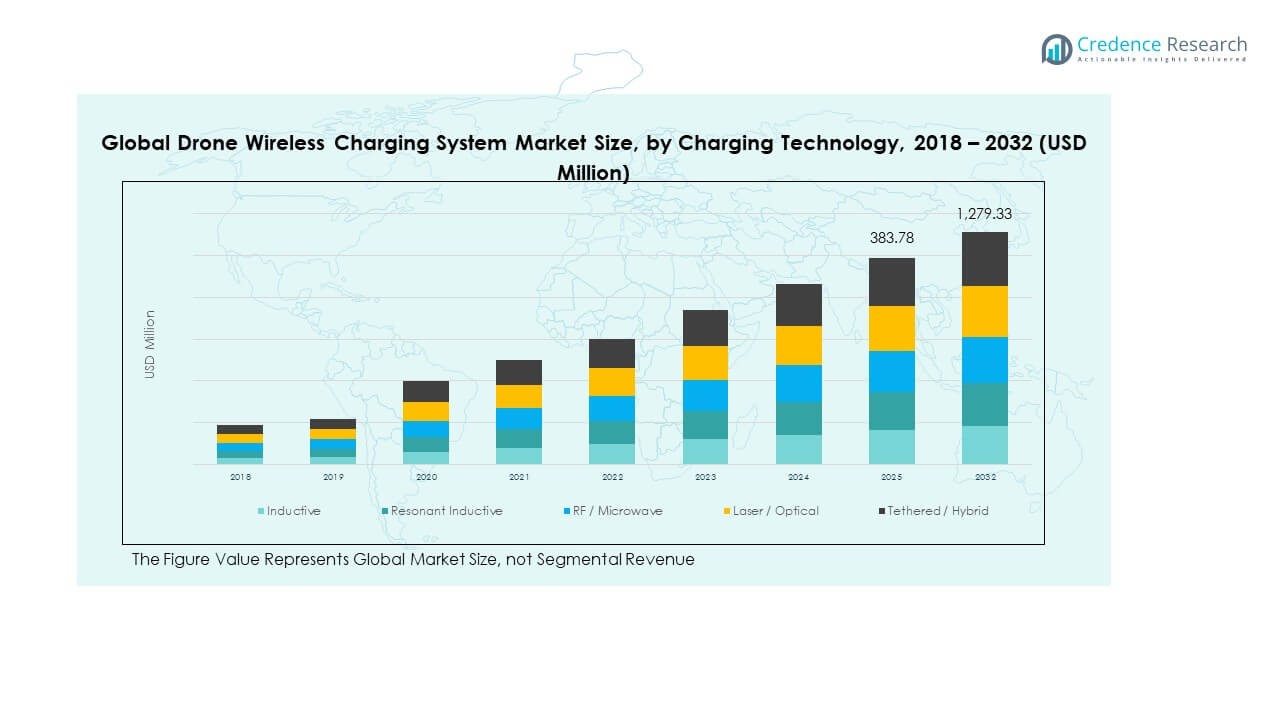
- Inductive charging contributes the highest segment share in the chart, accounting for about 40%, due to its proven stability, easy hardware integration, and strong compatibility with commercial UAV fleets.
- Resonant inductive, RF/microwave, laser/optical, and tethered/hybrid formats collectively hold 60 of segment distribution, supported by applications that require higher tolerance, longer range, or continuous power delivery across industrial and defense missions.
 Market Drivers:
Rising Need for Automated Power Delivery Across Expanding Drone Fleets
The Global Drone Wireless Charging System Market gains momentum due to strong demand for automated power delivery across fast-growing drone fleets. Many operators deploy autonomous pads to reduce downtime in time-critical missions. Firms use these systems to support continuous inspection cycles across energy and utility sites. Logistics companies apply automated charging to stabilize long delivery routes. Defense agencies adopt contactless power systems to improve mission readiness. Research groups refine alignment modules to boost charging precision under outdoor conditions. Strong operational loads push users to upgrade static charging docks. Large enterprises view automation as a way to lift drone uptime and lower manual intervention.
- For instance, WiBotic’s PowerPad Pro enables autonomous charging with up to 300 watts of wireless output, supporting round-the-clock fleet operation.
Growth in Data-Intensive Drone Applications That Require Continuous Field Operation
High-resolution mapping and surveillance tasks raise demand for uninterrupted drone cycles. Many industries need rapid relaunch across remote work zones. The market supports these needs through wireless pads that improve turnaround time. It helps operators handle long schedules in construction and mining. Automated charging cuts operator fatigue and reduces hardware wear. Sensor-heavy drones need consistent power to support dense data capture. Mission planners deploy multiple pads to scale fleet efficiency. Firms rely on reliable charging stations to maintain analytics workflows.
- For instance, WiBotic's power optimization software and wireless charging solutions are designed to maximize robot fleet uptime and improve battery longevity by protecting against unsafe charging conditions and reducing physical connector wear and tear.
Rising Commercial Deployment Across Logistics, Security, Energy, and Agriculture Sectors
Commercial sectors adopt wireless charging to handle heavy drone workloads. Delivery firms need stable power support to manage same-day and last-mile operations. Security agencies use autonomous pads for round-the-clock patrol duties. Energy firms depend on nonstop inspection missions across pipelines and grids. Agriculture users adopt drones that need frequent relaunch to monitor crops. It strengthens operational capacity in wide terrain coverage tasks. Standardized charging hardware supports easier fleet expansion. Sector-level adoption raises long-term demand for automated power solutions.
Technological Improvements That Enhance Efficiency, Durability, and Charging Accuracy
New pad designs improve thermal performance and reduce energy loss. Sealed outdoor units support reliable operation in rain, dust, and heat. Advanced control systems improve alignment between drone receivers and charging plates. It helps minimize energy waste and improves charging speed. Many firms refine materials to extend hardware lifespan. System integrators include remote monitoring options to improve maintenance. Strong integration with drone software enables smoother landing and alignment. Growing innovation encourages faster adoption across industrial users.
 Market Trends:
Expansion of Fully Autonomous Drone Infrastructure Across Industrial and Urban Zones
The Global Drone Wireless Charging System Market observes strong interest in fully autonomous flight corridors. Operators deploy dock-and-charge stations along mission routes. Urban developers test rooftop charging nodes for delivery networks. Industrial hubs use automated depots to link inspection sites. Fleet operators design routes that depend on machine-driven relaunch cycles. New software manages pad availability and usage timing. It encourages growth in automated fleet orchestration. Many governments support trials for continuous drone mobility.
- For instance, Heisha Tech’s DNEST system integrates rooftop drone housing with automated charging, supporting over 200 consecutive autonomous flights.
Shift Toward Interoperable Charging Standards for Multi-Vendor Fleets
Enterprises demand charging hardware that supports different drone platforms. Manufacturers explore universal interfaces to reduce compatibility issues. Shared standards simplify procurement across large fleets. Interoperable pads improve scalability in multi-mission environments. Drone-agnostic systems lift adoption across logistics and public service users. It supports easier integration with legacy drones. Unified protocols help cut long training cycles for operators. The trend improves long-term fleet flexibility.
- For instance, Powercast’s PowerSpot transmitter uses the 915 MHz ISM band to support any compatible RF-charging drone receiver.
Increased Integration of AI-Driven Landing, Alignment, and Diagnostics Tools
AI tools guide drones toward precise alignment on charging pads. Algorithms reduce landing errors in windy or uneven sites. Self-learning software improves pad targeting over time. It strengthens reliability in autonomous missions. Predictive diagnostics detect faults before downtime occurs. AI-linked controllers optimize charging cycles for battery health. It allows users to schedule relaunches with better accuracy. Strong interest grows across high-automation industries.
Rising Development of Ruggedized Outdoor Charging Platforms for Harsh Field Conditions
Manufacturers create hardened platforms to support drones in extreme environments. Weather-sealed units operate in heat, dust, and high humidity. Heavy-duty frames reduce damage during rough landings. It expands deployment across oilfields, mining zones, and border sites. Rugged pads help agencies maintain missions throughout seasonal changes. Strong mechanical support improves drone stability. Field users value systems that cut maintenance risks. Adoption rises across remote-area operations.
Market Challenges Analysis:
Technical Limitations Linked to Alignment, Power Transfer Efficiency, and System Reliability
The Global Drone Wireless Charging System Market faces technical issues tied to alignment and energy transfer. Many drones struggle to achieve perfect pad positioning in windy zones. Efficiency drops when gaps increase between coils. It challenges operators that run large fleets in outdoor sites. Hardware components face stress in high-temperature regions. Reliability issues arise when dust, vibration, or moisture disrupt connections. Maintenance teams spend extra time on environmental protection steps. Users need systems with stronger tolerance for field variation. These challenges slow adoption in rugged operations.
High Capital Costs, Limited Standards, and Complex Regulatory Approvals
Operators face steep investment needs for pad networks across large areas. Many small firms struggle to justify capital spending. Lack of firm industry standards increases integration risk across fleets. It reduces confidence among first-time users. Approval pathways differ across countries and delay deployments. Safety rules restrict use near public zones. Firms need long testing cycles to meet compliance demands. These factors create barriers for early expansion.
Market Opportunities:
Rising Demand for Scalable Autonomous Charging Networks Across Commercial and Government Sectors
The Global Drone Wireless Charging System Market gains expansion potential through scalable network deployments. Many cities plan corridor-based drone routes for logistics. Industrial groups explore multi-pad grids for large inspection areas. It supports continuous missions without manual charging labor. Drone ports in smart cities create strong commercial opportunities. Energy utilities need networked pads to cover long pipeline spans. Defense users invest in remote-area automation. These needs open wide adoption pathways.
Growth in Advanced Charging Technologies That Enable Faster Cycles and Enhanced Operational Safety
New coil designs shorten charging cycles for high-duty drones. Improved materials lift durability across extended use. Smart controllers protect batteries under varied loads. It helps operators extend hardware life. AI tools refine landing accuracy and reduce risk. Shared standards improve fleet compatibility. These advancements help firms adopt automated power solutions with lower uncertainty.
Market Segmentation Analysis:
By Charging Application
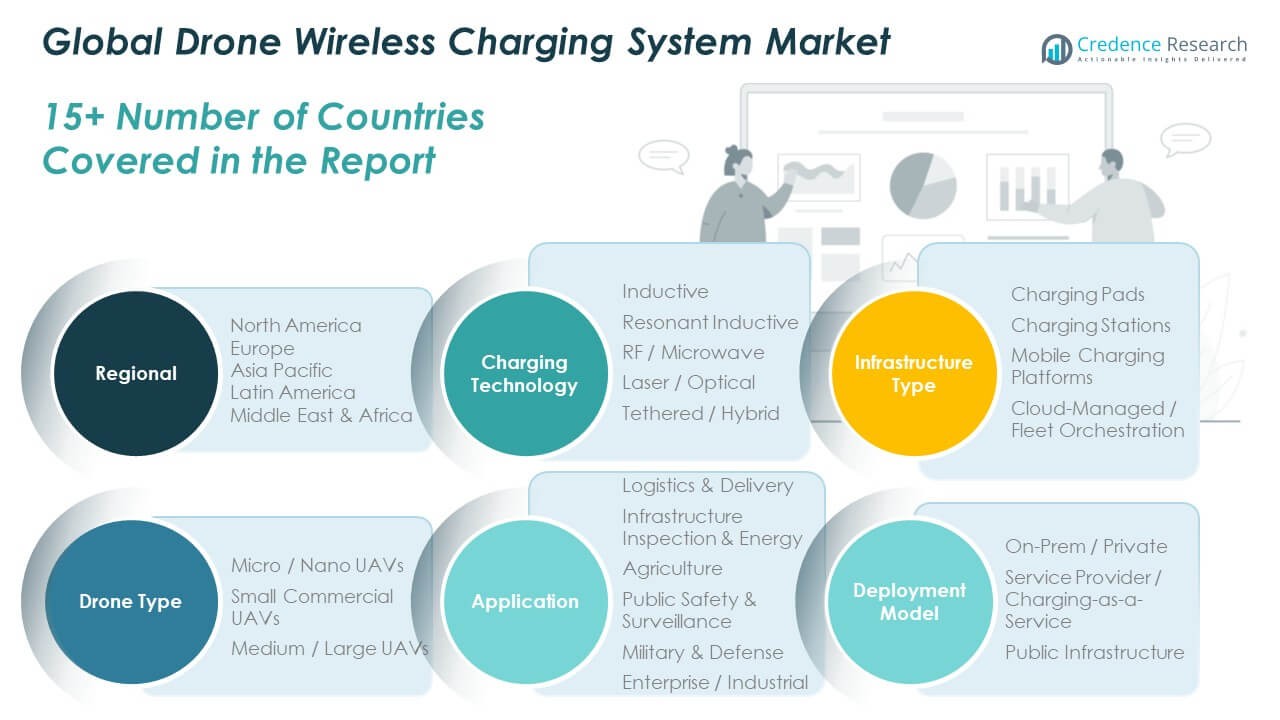
The Global Drone Wireless Charging System Market expands through strong adoption across multiple charging modes. Inductive systems lead due to stable performance and easy integration with compact drones. Resonant inductive units support longer gaps and higher tolerance during landing. RF or microwave solutions attract interest for uninterrupted mid-air charging experiments. Laser or optical systems offer long-range potential for high-altitude platforms. Tethered or hybrid formats support missions that need constant power. Each method serves different operational loads across commercial and defense missions. Firms pick solutions that match mission length and terrain exposure.
- For instance, PowerLight Technologies delivered laser-based wireless power over 600 meters to sustain UAV flight.
By Infrastructure Type
Charging pads dominate due to simple deployment and low maintenance needs. Charging stations gain traction in logistics hubs and surveillance networks that rely on fixed relaunch points. Mobile charging platforms support inspection tasks across large industrial assets. It helps operators maintain uptime where permanent infrastructure is limited. Cloud-managed or fleet-orchestration systems support remote monitoring and automation. Centralized control allows smoother pad scheduling and alignment management. Diverse infrastructure formats support rapid scaling of drone fleets. Users select layouts based on fleet size and mission density.
- For instance, Heisha’s mobile base stations integrate heating, cooling, and charging modules to support continuous outdoor missions.
By Drone Type
Micro and nano UAVs benefit from compact pads that handle light landing loads. Small commercial UAVs create high demand for mid-capacity charging docks. Medium or large UAVs need rugged hardware to support heavier frames. It drives interest in high-power stations with reinforced landing surfaces. Different drone classes influence power ratings and pad geometry. Commercial fleets rely on mixed drone categories for varied missions. Segment diversity pushes vendors to offer customizable systems. Operators match charging profiles with payload and endurance targets.
By Application and Deployment Model
Logistics and delivery users adopt automated pads to keep routes efficient. Infrastructure inspection and energy clients install stations near pipelines and grids. Agriculture users value remote pads for crop monitoring cycles. Public safety and surveillance agencies depend on rapid relaunch needs. Military and defense users require rugged systems for field conditions. Enterprise users adopt scalable charging grids. Deployment models range from on-prem private systems to service-provider and public infrastructure setups. It creates flexible adoption paths for varied operational budgets.
 Segmentation:
By Charging Application
- Inductive
- Resonant Inductive
- RF / Microwave
- Laser / Optical
- Tethered / Hybrid
By Infrastructure Type
- Charging Pads
- Charging Stations
- Mobile Charging Platforms
- Cloud-Managed / Fleet Orchestration
By Drone Type
- Micro / Nano UAVs
- Small Commercial UAVs
- Medium / Large UAVs
By Application
- Logistics & Delivery
- Infrastructure Inspection & Energy
- Agriculture
- Public Safety & Surveillance
- Military & Defense
- Enterprise / Industrial
By Deployment Model
- On-Prem / Private
- Service Provider / Charging-as-a-Service
- Public Infrastructure
By Region
- North America
- U.S.
- Canada
- Mexico
- Europe
- Germany
- France
- U.K.
- Italy
- Spain
- Rest of Europe
- Asia Pacific
- China
- Japan
- India
- South Korea
- South-east Asia
- Rest of Asia Pacific
- Latin America
- Brazil
- Argentina
- Rest of Latin America
- Middle East & Africa
- GCC Countries
- South Africa
- Rest of the Middle East and Africa
Regional Analysis:
North America
The North America Drone Wireless Charging System Market size was valued at USD 40.20 million in 2018 to USD 124.76 million in 2024 and is anticipated to reach USD 542.45 million by 2032, at a CAGR of 18.8 during the forecast period. North America holds about 42.29% share of the Global Drone Wireless Charging System Market in 2024. The region benefits from strong adoption across logistics, energy, defense, and public safety users. It leads in regulatory pilots for automated drone corridors. Firms deploy wireless pads to support continuous inspection cycles. Large drone fleets push operators to invest in automated infrastructure. It supports faster relaunch needs for security and monitoring work. Strong technology ecosystems in the U.S. lift demand for advanced charging platforms. Canada expands use across agriculture and resource sectors.
Europe
The Europe Drone Wireless Charging System Market size was valued at USD 27.14 million in 2018 to USD 82.10 million in 2024 and is anticipated to reach USD 335.48 million by 2032, at a CAGR of 17.9 during the forecast period. Europe accounts for 27.82% of the Global Drone Wireless Charging System Market in 2024. The region sees rapid adoption across utilities, transport hubs, and municipal surveillance programs. EU-backed automation projects encourage interest in drone docking systems. Industrial sites deploy pads to reduce manual intervention during inspection tasks. It supports logistics expansion linked to urban delivery trials. Strong engineering capabilities improve integration with European drone platforms. Germany, France, and the U.K. lead adoption trends. Southern Europe adds demand through agriculture-focused missions.
Asia Pacific
The Asia Pacific Drone Wireless Charging System Market size was valued at USD 18.48 million in 2018 to USD 62.73 million in 2024 and is anticipated to reach USD 307.32 million by 2032, at a CAGR of 20.6 during the forecast period. Asia Pacific holds around 21.25% share of the Global Drone Wireless Charging System Market in 2024. China drives strong demand through large-scale drone deployment in logistics and inspection. Japan and South Korea adopt wireless charging to support precision operations. It helps regional operators handle dense industrial and urban workloads. Government-backed smart city programs raise interest in automated drone ports. India increases use across agriculture and infrastructure mapping. Rapid manufacturing capabilities support cost-effective charging hardware. The region shows the fastest expansion due to high commercial drone activity.
Latin America
The Latin America Drone Wireless Charging System Market size was valued at USD 4.45 million in 2018 to USD 13.80 million in 2024 and is anticipated to reach USD 52.96 million by 2032, at a CAGR of 17.0 during the forecast period. Latin America accounts for 4.68% of the Global Drone Wireless Charging System Market in 2024. Adoption grows across agriculture, mining, and utility inspection. Countries deploy automated pads to manage long-distance field missions. It supports faster relaunch cycles in remote zones. Brazil leads regional adoption, followed by Mexico and Chile. Demand rises from infrastructure and energy operators. Public safety agencies explore autonomous fleets for surveillance. Limited manual access in rural areas drives interest in contactless charging.
Middle East
The Middle East Drone Wireless Charging System Market size was valued at USD 2.48 million in 2018 to USD 7.06 million in 2024 and is anticipated to reach USD 25.51 million by 2032, at a CAGR of 16.1 during the forecast period. The Middle East represents 2.39% of the Global Drone Wireless Charging System Market in 2024. The region deploys autonomous drones for security, oilfield inspection, and border monitoring. Governments invest in advanced pads to support always-on surveillance. It strengthens uptime for missions across desert environments. High temperatures increase interest in ruggedized charging platforms. UAE and Saudi Arabia lead market expansion. Infrastructure megaprojects lift demand for automated aerial monitoring. Energy producers rely on drones for pipeline and facility checks.
Africa
The Africa Drone Wireless Charging System Market size was valued at USD 1.32 million in 2018 to USD 4.63 million in 2024 and is anticipated to reach USD 15.61 million by 2032, at a CAGR of 15.0 during the forecast period. Africa holds about 1.57% share of the Global Drone Wireless Charging System Market in 2024. Adoption grows across agriculture, wildlife monitoring, and public safety. It helps operators manage wide-area missions with limited manual support. Countries explore automated pads to support healthcare drone corridors. South Africa leads regional deployment for mining and inspection needs. East Africa expands drone logistics for medical supply delivery. Rugged terrain drives need for field-ready charging systems. Market growth stays steady due to rising interest in autonomous infrastructure.
Key Player Analysis:
- WiBotic Inc.
- Skysense, Inc.
- Powercast Corporation
- Heisha Technology
- AeroVironment
- Drone Volt
- Witricity Corporation
Competitive Analysis:
The Global Drone Wireless Charging System Market features strong competition among technology innovators that focus on automated power delivery, fleet management, and long-range charging support. Leading firms advance coil efficiency, ruggedized pad design, and intelligent alignment tools. It strengthens product differentiation in markets that demand high reliability and low maintenance. Partnerships with drone manufacturers support deeper integration across commercial and defense fleets. Start-ups drive innovation through flexible charging stations and modular platforms. Established vendors expand global footprints through regional pilots and strategic collaborations. Competitive intensity rises as firms target logistics, energy, security, and infrastructure users. Ongoing investment in AI-driven landing and alignment features shapes the next wave of autonomous charging systems.
Recent Developments:
- Drone Volt - In November 2025, Drone Volt demonstrated its leadership at MILIPOL Paris 2025 with record results and operational demonstrations. The company unveiled the integration of PROENGIN's AP4C+ sensor on the KOBRA drone for remote CBRNe detection and highlighted its HIGH-DRA decontamination solution. Drone Volt reported strong financial performance with 2024 revenue of €32.7 million, representing 36% growth from 2023 (€24.0 million), driven by high-margin, high-value-added activities.
- Skysense, Inc. - In October 2025, Skysense announced a partnership with BYD Energy Storage to deploy 300 MWh of battery energy storage capacity through 2026 in Mexico and Latin America. While this particular development focuses on energy storage systems rather than direct drone charging applications, it demonstrates Skysense's expansion into the renewable energy and storage sector aligned with broader infrastructure development trends in Latin America.
- Powercast Corporation - In May 2025, Powercast won the Best New Product award at the RFID Journal Awards 2025 for its wirelessly powered, battery-free RAIN RFID Sensor Tags for data centers. The award-winning technology enables energy harvesting capabilities that open new applications in healthcare, pharmaceuticals, food supply chains, and data center asset management, expanding wireless power solutions beyond traditional charging applications.
- Heisha Technology - In April 2025, Heisha launched a Revolutionary Outdoor Wireless Charging Dock for Robotic Dogs, featuring weatherproof, energy-efficient design with IP54-rated housing, smart auto-docking capabilities, and rapid charging 30% faster than traditional wired solutions. In March 2025, Heisha unveiled the Portable Drone Dock—a luggage-style mobile base station engineered exclusively for the DJI Mavic 3 Enterprise series, enabling 60-second deployment with all-in-one portability combining storage, charging, and launch capabilities. Additionally, Heisha launched the ACK2000, an autonomous power and charging kit for DJI M400 industrial drones, designed for industries requiring 24/7 autonomous operations.
Report Coverage:
The research report offers an in-depth analysis based on Charging Application, Infrastructure Type, Drone Type, Application, and Deployment Model. It details leading market players, providing an overview of their business, product offerings, investments, revenue streams, and key applications. Additionally, the report includes insights into the competitive environment, SWOT analysis, current market trends, as well as the primary drivers and constraints. Furthermore, it discusses various factors that have driven market expansion in recent years. The report also explores market dynamics, regulatory scenarios, and technological advancements that are shaping the industry. It assesses the impact of external factors and global economic changes on market growth. Lastly, it provides strategic recommendations for new entrants and established companies to navigate the complexities of the market.
Future Outlook:
- Growth strengthens through expanding autonomous drone operations across industrial and urban zones.
- Wireless pad deployment rises through integration with advanced logistics corridors.
- AI-driven landing and alignment systems improve reliability in remote and congested areas.
- Rugged charging platforms gain traction in energy, mining, and defense missions.
- Cloud-managed orchestration tools support large, distributed drone fleets.
- Long-range charging technologies create new use cases for high-endurance drones.
- Service-provider charging models expand adoption among small and mid-size users.
- Smart city plans accelerate interest in public drone infrastructure nodes.
- Regulatory clarity supports BVLOS expansion and automated relaunch cycles.
- Cross-industry partnerships drive innovation in materials, power delivery, and software control.
Request a Free Sample
Fill in your details and we'll send you a free sample report.
- Sample data tables & charts
- Research methodology
Need a Custom Version of This Report?
Tailor the scope, geography, or segments to your exact requirements.
- Custom geography or segment scope
- Direct access to our analyst team
Frequently Asked Questions
What is the current market size for the Global Drone Wireless Charging System Market, and what is its projected size in 2032?
At what Compound Annual Growth Rate is the Global Drone Wireless Charging System Market projected to grow between 2025 and 2032?
Which Global Drone Wireless Charging System Market segment held the largest share in 2024?
What are the primary factors fueling the growth of the Global Drone Wireless Charging System Market?
Who are the leading companies in the Global Drone Wireless Charging System Market?
Which region commanded the largest share of the Global Drone Wireless Charging System Market in 2024?
Table of Content
Chapter 1. Report Introduction
- 1.1 Report Description & Purpose
- 1.1.1 Report Title & Market Definition
- 1.1.2 Unique Selling Propositions (USP) & Key Differentiators
- 1.1.3 Value Proposition for Stakeholders
- 1.2 Research Objectives
- 1.2.1 Market Sizing Objectives (Volume & Revenue)
- 1.2.2 Segmentation Objectives
- 1.2.3 Competitive Intelligence Objectives
- 1.2.4 Forecast & Scenario Objectives
- 1.3 Report Scope
- 1.3.1 Drone Wireless Charging System Scope – Types & Subtypes Covered
- 1.3.2 Geographic Scope – Regions & Countries Covered
- 1.3.3 Historical Period, Base Year & Forecast Period (2024; forecast to 2032)
- 1.3.4 Inclusions & Exclusions
- 1.4 HS Code & Classification Framework
- 1.5 Currency, Units & Pricing Basis
- 1.6 Target Stakeholders
- 1.7 Limitations & Assumptions
Chapter 2. Executive Summary
- 2.1 Global Drone Wireless Charging System Market Snapshot
- 2.1.1 Market Size – Historical (2024) & Forecast (2024-2032) (2024: USD 295.08 million → 2032: USD 1,279.33 million)
- 2.1.2 Volume & Revenue – Global Totals
- 2.1.3 Key Market Highlights – Top Five Facts
- 2.2 Drone Wireless Charging System Market Segmentation Snapshot
- 2.2.1 Market Split by Region – 2024 vs. 2032
- 2.3 Competitive Snapshot
- 2.3.1 Top 10 Players by Revenue Share – 2024
- 2.3.2 Top 10 Players by Volume Share – 2024
- 2.3.3 Recent Strategic Developments (18-Month Summary)
- 2.4 Key Investment Highlights & Strategic Conclusions
Chapter 3. Drone Wireless Charging System Market Dynamics & Industry Analysis
- 3.1 Market Overview & Context
- 3.1.1 Drone Wireless Charging System Market Position in the Broader Automotive Value Chain
- 3.1.2 OEM vs. Replacement Market Dynamics
- 3.1.3 Market Maturity & Development Stage by Region
- 3.2 Drone Wireless Charging System Market Drivers
- 3.3 Drone Wireless Charging System Market Restraints & Challenges
- 3.4 Drone Wireless Charging System Market Opportunities
- 3.5 Porter's Five Forces Analysis
- 3.5.1 Threat of New Entrants
- 3.5.2 Bargaining Power of Suppliers
- 3.5.3 Bargaining Power of Buyers
- 3.5.4 Threat of Substitutes
- 3.5.5 Competitive Rivalry – Intensity Assessment
- 3.6 Drone Wireless Charging System Value Chain Analysis
- 3.6.1 Upstream – Raw Material/Input Suppliers
- 3.6.1.1 Raw Material/Input 1
- 3.6.1.2 Raw Material/Input 2
- 3.6.1.3 Raw Material/Input 3
- 3.6.2 Midstream – Production/Manufacturing/Service Delivery
- 3.6.2.1 Production/Process Overview
- 3.6.2.2 Key Facility Locations & Capacity by Manufacturer
- 3.6.3 Downstream – Distribution & End Consumer
- 3.6.3.1 Primary Channel – B2B/OEM
- 3.6.3.2 Secondary Channels – Dealer, Retail, Online, Direct
- 3.6.4 Value Chain Profitability Analysis
- 3.6.1 Upstream – Raw Material/Input Suppliers
- 3.7 PESTEL Analysis
- 3.7.1 Political Factors
- 3.7.2 Economic Factors
- 3.7.3 Social Factors
- 3.7.4 Technological Factors
- 3.7.5 Environmental Factors
- 3.7.6 Legal Factors
- 3.8 Drone Wireless Charging System Supply Chain Analysis
- 3.8.1 Raw Material/Input Supply Risk Assessment
- 3.8.2 Manufacturing Concentration Risk (Geographic Exposure)
- 3.8.3 Trade Disruption Impact Analysis
- 3.9 Regulatory & Policy Landscape
Note: The regulatory and policy landscape section covers regulations based on their applicability to the market, Drone Wireless Charging System category, geography, and scope of the study. Only regulatory frameworks with a material impact on operations, compliance, trade, sustainability, or market access are analyzed in detail.
Chapter 4. Key Investment Pockets & Opportunity Analysis
- 4.1 Drone Wireless Charging System Market Attractiveness Analysis
- 4.1.1 By Region – Investment Attractiveness Matrix (Volume × CAGR)
- 4.2 Absolute Revenue Growth Opportunity
- 4.2.1 By Region – Absolute USD Growth Through 2032
- 4.3 Incremental Volume Opportunity
- 4.3.1 By Region – Incremental Volume Through 2032
- 4.3.2 Segment – Incremental Volume
- 4.4 Emerging Submarket Opportunity Deep Dive (Subject to Applicability)
- 4.5 Emerging Market Opportunity Scorecards
- 4.5.1 United States
- 4.5.2 Europe
- 4.5.3 Asia
- 4.5.4 Middle East & Africa
Note: Emerging Market Opportunity Scorecards will be included based on relevance and strategic importance. Regions listed are indicative and may vary depending on data availability and market dynamics.
Chapter 5. Drone Wireless Charging System Import-Export Analysis & Trade Flows
- 5.1 Global Trade Overview
- 5.1.1 Global Export Value by Country (2024)
- 5.1.2 Global Export Volume by Country (2024)
- 5.1.3 Global Import Value by Country (2024)
- 5.1.4 Global Import Volume by Country (2024)
- 5.1.5 Net Trade Balance by Country (2024)
- 5.2 Export Analysis – Segment
- 5.2.1 Type 1 (HS Code)
- 5.2.2 Type 2 (HS Code)
- 5.2.3 Type 3 (HS Code)
- 5.2.4 Type 4 (HS Code)
- 5.2.5 Type 5 (HS Code)
- 5.3 Import Analysis – Segment
- 5.3.1 Type 1 (HS Code)
- 5.3.2 Type 2 (HS Code)
- 5.3.3 Type 3 (HS Code)
- 5.3.4 Type 4 (HS Code)
- 5.3.5 Type 5 (HS Code)
- 5.4 Average Unit Trade Prices
- 5.4.1 Average Export Price – Segment & Country
- 5.4.2 Average Import Price – Segment & Source Country
- 5.4.3 Price Trends (2024)
- 5.5 Key Trade Route Analysis
- 5.5.1 Trade Route 1
- 5.5.2 Trade Route 2
- 5.5.3 Trade Route 3
- 5.5.4 Trade Route 4
- 5.5.5 Trade Route 5
- 5.6 Trade Policy Impact Assessment
- 5.6.1 US Anti-Dumping & Section 301 Tariffs
- 5.6.2 EU Customs Union Impact
- 5.6.3 Major Free Trade Agreements
- 5.6.4 USMCA Rules of Origin
Note: Trade policy analysis will be included only where relevant to the Drone Wireless Charging System market.
Chapter 6. Competitive Landscape & Company Benchmarking
- 6.1 Drone Wireless Charging System Market Concentration & Structure
- 6.1.1 Herfindahl-Hirschman Index (HHI) – vs. 2024
- 6.1.2 Tier 1, Tier 2 & Tier 3 Market Structure
- 6.1.3 Global, Regional & Local Player Dynamics
- 6.2 Drone Wireless Charging System Market Share Analysis – 2024
- 6.2.1 Global Revenue Share by Company
- 6.2.2 Global Volume Share by Company
- 6.2.3 Regional Revenue Share
- 6.2.4 Market Share Evolution ( vs. 2024)
- 6.2.5 OEM Segment Share by Company
- 6.2.6 Replacement Segment Share by Company
- 6.3 Production/Delivery Capacity & Facility Analysis
- 6.3.1 Global Installed Capacity
- 6.3.2 Capacity Utilization Rates
- 6.3.3 Production/Output Volume
- 6.3.4 Facility Locations & Capacity Map
- 6.3.5 Planned Capacity Additions
- 6.4 Drone Wireless Charging System Competitive Benchmarking Matrix
- 6.4.1 Revenue, Volume, CAGR & Profitability Comparison
- 6.4.2 Channel Revenue Mix
- 6.4.3 Geographic Revenue Exposure
- 6.4.4 R&D Intensity
- 6.4.5 Sustainability Maturity
- 6.5 Strategic Developments in Drone Wireless Charging System (Last 24 Months)
- 6.5.1 Mergers, Acquisitions & Divestments
- 6.5.2 New Drone Wireless Charging System Launches
- 6.5.3 Facility Expansions
- 6.5.4 Strategic Alliances, Joint Ventures & Partnerships
- 6.5.5 Distribution Expansion & Market Entry
- 6.5.6 Sustainability & ESG Initiatives
- 6.6 Competitive Strategy Mapping
- 6.6.1 Leader, Challenger, Follower & Niche Classification
- 6.6.2 Pricing Strategy Comparison
- 6.6.3 Channel Strategy Matrix
Note: Strategic developments are included based on their materiality and the availability of reliable information.
Chapter 7. Global Drone Wireless Charging System Market – By Distribution Channel
- 7.1 Segment Overview
- 7.1.1 Volume & Revenue Split by Channel (2024 & 2032)
- 7.1.2 Channel Mix Evolution (2024-2032)
Chapter 8. Regional Market Analysis – Global Overview
- 8.1 Global Regional Overview
- 8.1.1 Regional Volume Share
- 8.1.2 Regional Revenue Share
- 8.1.3 Regional Volume by Region
- 8.1.4 Regional Revenue by Region
- 8.1.5 Regional Forecast Through 2032
- 8.2 Cross-Regional Segment Analysis
- 8.2.1 By Distribution Channel
- 8.2.2 By Brand/Price Tier
Chapter 9. North America Drone Wireless Charging System Market
- 9.1 United States
- 9.2 Canada
- 9.3 Mexico
Chapter 10. Europe Drone Wireless Charging System Market
- 10.1 Germany
- 10.2 France
- 10.3 Italy
- 10.4 United Kingdom
- 10.5 Spain
- 10.6 Poland
- 10.7 Russia
- 10.8 Netherlands
- 10.9 Belgium
- 10.10 Sweden
- 10.11 Denmark
- 10.12 Norway
- 10.13 Rest of Europe
Chapter 11. Asia Pacific Drone Wireless Charging System Market
- 11.1 China
- 11.2 India
- 11.3 Japan
- 11.4 South Korea
- 11.5 Thailand
- 11.6 Indonesia
- 11.7 Vietnam
- 11.8 Malaysia
- 11.9 Australia
- 11.10 Rest of Asia Pacific
Chapter 12. Latin America Drone Wireless Charging System Market
- 12.1 Brazil
- 12.2 Argentina
- 12.3 Colombia
- 12.4 Chile
- 12.5 Rest of Latin America
Chapter 13. Middle East Drone Wireless Charging System Market
- 13.1 Saudi Arabia
- 13.2 United Arab Emirates
- 13.3 Turkey
- 13.4 Israel
- 13.5 Iran
- 13.6 Rest of the Middle East
Chapter 14. Africa Drone Wireless Charging System Market
- 14.1 South Africa
- 14.2 Egypt
- 14.3 Nigeria
- 14.4 Morocco
- 14.5 Rest of Africa
Chapter 15. Drone Wireless Charging System Company Profiles
- 15.1 [Company 01]
- 15.1.1 Company Overview
- 15.1.2 Key Management Personnel
- 15.1.3 Products & Services Portfolio
- 15.1.4 Financial Performance
- 15.1.5 Key Market Focus & Geographic Presence
- 15.1.6 Recent Developments & Strategic Initiatives
Note: The company profile list is preliminary and may change based on research findings, market developments, data availability, and client requirements.
Chapter 16. Appendices
- Appendix A – List of Abbreviations & Acronyms
- Appendix B – Industry Classification Code Reference – Full Series
- Appendix C – Production & Capacity Data Tables
- Appendix D – End-Use & Demand Base Tables
- Appendix E – Consumption & Replacement Rate Assumptions
- Appendix F – ASP Reference Tables
- Appendix G – Manufacturing & Facility Database
- Appendix H – Import-Export Data Tables
- Appendix I – Regulatory Summary Tables
- Appendix J – Primary Research Participant List (Anonymized)
- Appendix K – Primary Research Questionnaire Framework
- Appendix L – Data Sources & Bibliography
- Appendix M – Market Size Divergence & Source Comparison
Chapter 17. Research Methodology
- 17.1 Research Framework & Philosophy
- 17.2 Secondary Research – Sources, Hierarchy & Data Extraction
- 17.3 Data Modeling – Bottom-Up & Top-Down Market Sizing
- 17.4 Primary Research – Stakeholder Framework, LOI & Sample Sizes
- 17.5 Forecast Methodology – Regression, Scenario & Sensitivity Analysis
- 17.6 Quality Control – Four-Layer Validation Framework
- 17.7 Limitations & Standard Assumptions
- 17.8 Disclaimer
