
Market Overview:
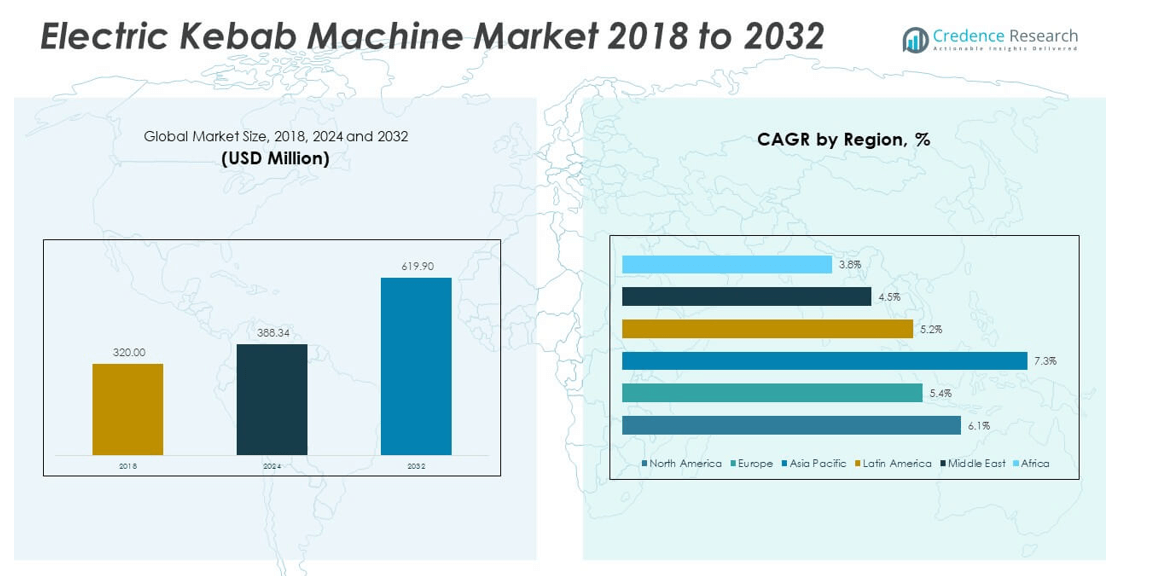
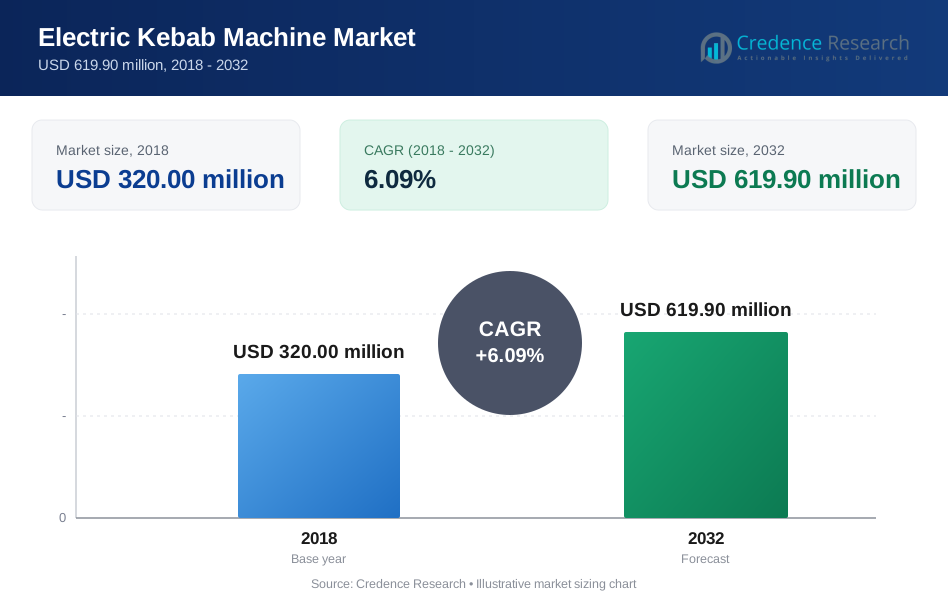
The Global Electric Kebab Machine Market size was valued at USD 320.00 million in 2018 to USD 388.34 million in 2024 and is anticipated to reach USD 619.90 million by 2032, at a CAGR of 6.09% during the forecast period.
| REPORT ATTRIBUTE | DETAILS |
|---|---|
| Historical Period | 2020-2023 |
| Base Year | 2024 |
| Forecast Period | 2025-2032 |
| Electric Kebab Machine Market Size 2024 | USD 388.34 million |
| Electric Kebab Machine Market , CAGR | 6.09% |
| Electric Kebab Machine Market Size 2032 | USD 619.90 million |
The market is driven by rising demand for convenient cooking appliances in both households and foodservice sectors. Increasing urbanization, growth of quick-service restaurants, and rising consumer preference for energy-efficient equipment boost adoption. Manufacturers are focusing on product innovation, such as automatic rotation features and temperature control, to improve efficiency. Growing interest in home cooking appliances that support grilled and healthier meals also drives sales. Rising disposable income and lifestyle changes further support the market’s expansion across different consumer segments.
Regionally, Europe leads the market due to the strong popularity of kebab-based cuisine and established foodservice networks. North America shows significant adoption with the growing demand for fast-casual dining and multicultural food offerings. Asia-Pacific emerges as the fastest-growing region, supported by rapid urbanization, expanding restaurant chains, and changing food preferences. The Middle East also plays a vital role, driven by cultural significance of kebab dishes and rising modernization of cooking equipment.
Market Insights:
- The Global Electric Kebab Machine Market size was USD 320.0 million in 2018, USD 388.34 million in 2024, and is projected to reach USD 619.9 million by 2032, growing at a CAGR of 6.09%.
- Europe held 17.3% of the market share in 2024, driven by cultural integration of kebab cuisine, advanced foodservice infrastructure, and high adoption of modern appliances.
- North America accounted for 20.2% of the market share in 2024, supported by a strong quick-service restaurant network and multicultural food consumption. Asia Pacific followed closely with 17.0%, backed by urbanization, disposable incomes, and expanding foodservice chains.
- Asia Pacific is the fastest-growing region with 7.3% CAGR, fueled by increasing adoption in China, India, and Japan, along with the rising influence of international cuisines.
- By voltage segment, 220 Volts machines represented the largest share in 2024 at 42%, while 110 Volts followed at 28%, supported by their use in households and restaurants across North America and Europe.
Market Drivers:
Rising Popularity of Quick-Service and Casual Dining Outlets Driving Product Demand:
The Global Electric Kebab Machine Market benefits from the expansion of quick-service restaurants and casual dining outlets worldwide. Food chains and independent eateries prefer automated kebab machines to maintain consistency and speed in cooking. These machines save labor costs by reducing manual effort while ensuring uniform roasting. Growing urban populations and busy lifestyles are increasing the demand for ready-to-eat and grilled foods. Consumers seek convenience, flavor, and healthier cooking options, which electric machines deliver with controlled heating. Manufacturers focus on designs that integrate efficiency with energy savings to attract more commercial buyers. It is supported by rising demand for automation in professional kitchens. This trend creates a sustained growth cycle for commercial adoption of kebab machines.
- For instance, the ElectMax EKB-2 electric kebab machine features a 795mm spit length with a cooking capacity of 45kg per cycle, powered by 415V and 9.9kW, designed for high-volume output with six high-efficiency heating elements ensuring even grilling, and precise heat management via three control knobs, backed by a 2-year parts and labor warranty.
Increasing Household Adoption Due To Lifestyle Shifts and Health-Oriented Cooking Preferences:
The Global Electric Kebab Machine Market is expanding as more households adopt compact and efficient models. Consumers increasingly prefer preparing grilled meals at home for health and taste reasons. Urban families view kebab machines as modern appliances that simplify cooking while enhancing flavor. Demand rises with the growing popularity of home-hosted gatherings and social cooking experiences. Health-focused buyers are drawn to machines that reduce oil consumption while maintaining taste. Manufacturers release affordable and stylish units for household users, making them accessible across income groups. It is strengthened by rising disposable income in developing regions. This shift is encouraging broader acceptance of kebab machines outside professional kitchens.
- For instance, North American household appliances run on 110V and are designed to be convenient, the voltage standard is a historical artifact. For high-power appliances, a higher voltage is actually more efficient, and the "user-friendly features" are a function of modern appliance design.
Technological Innovations in Design and Functionality Supporting Broader Market Expansion:
The Global Electric Kebab Machine Market is influenced by continuous innovation in product design and features. Manufacturers incorporate adjustable heat controls, automatic rotation systems, and smart timers. These features enhance efficiency and meet evolving consumer expectations for convenience. Compact and portable designs expand usability for small restaurants and households. Integration of energy-efficient components reduces operating costs and appeals to sustainability-conscious buyers. Brands invest in durable materials such as stainless steel to extend machine lifespan. It is supported by innovation cycles that enhance product reliability and brand loyalty. Technology-driven improvements increase adoption rates in both mature and emerging markets.
Growing Influence of Rising Disposable Incomes and Expanding Food Culture Worldwide:
The Global Electric Kebab Machine Market gains momentum from higher disposable incomes and changing food preferences. Consumers in emerging economies are adopting global cuisines faster than before. Kebab dishes hold strong cultural value in the Middle East and Europe, which drives traditional demand. In regions like Asia-Pacific and North America, kebabs are growing in popularity through street food and restaurant chains. Rising income allows households to invest in specialized appliances for cooking variety. It is further boosted by increasing participation in international food festivals and culinary shows. The cross-cultural exchange of cuisines makes kebabs a global favorite. This cultural acceptance expands the appeal of kebab machines worldwide.
Market Trends:
Adoption of Smart Kitchen Appliances With Integrated Connectivity Features:
The Global Electric Kebab Machine Market is witnessing growth from the rise of smart kitchen technologies. Manufacturers are designing machines that integrate with mobile applications for temperature and time control. This connectivity allows users to monitor and adjust cooking remotely. The demand for automation is strong in both residential and commercial sectors. Consumers expect precision cooking and time-saving features in modern appliances. Connected machines appeal to tech-savvy households and commercial outlets alike. It is strengthened by the global smart home ecosystem, which encourages cross-device integration. This trend expands the market’s reach among early adopters of innovative appliances.
- For instance, Silicon Labs’ SiWx917 module supports the latest Matter 1.4 specification, enabling seamless integration of smart kitchen devices with ecosystems like Google Home and Amazon Alexa, allowing remote temperature and timer adjustments via smartphone apps with Wi-Fi 6 and Bluetooth LE technologies.
Expansion of Eco-Friendly and Energy-Efficient Appliances in Response to Sustainability Goals:
The Global Electric Kebab Machine Market reflects a growing preference for eco-friendly appliances. Consumers prefer machines designed to consume less electricity while maintaining high output. Manufacturers are adopting sustainable materials to meet regulatory and consumer expectations. Stainless steel and recyclable components improve product life cycles. Governments encourage energy efficiency in appliances through standards and certifications. It is reinforced by buyers who prioritize reduced carbon footprints in their kitchens. Brands promoting green technology gain a competitive edge in consumer markets. This trend positions sustainability as a key selling point across regions.
- For instance, Energy Star standards for kitchen appliances have led to energy consumption reductions of up to 50%, and similarly, electric kebab machines are now incorporating energy regulators and stainless steel with recyclable parts to reduce environmental impact while maintaining performance.
Integration of Multi-Functional Features to Broaden Product Appeal and Usability:
The Global Electric Kebab Machine Market is seeing increased demand for multi-functional appliances. Buyers prefer machines that combine kebab roasting with grilling or toasting. This integration reduces the need for multiple appliances in compact kitchens. Restaurants favor multi-use equipment to optimize space and cost efficiency. Manufacturers highlight versatility to appeal to diverse cooking needs. It is reinforced by rising consumer interest in appliances that maximize convenience. Compact, multifunctional machines gain popularity in urban apartments with limited kitchen space. This adaptability strengthens product placement in both retail and commercial markets.
Growing Online Retail and E-Commerce Platforms Driving Wider Product Access Globally:
The Global Electric Kebab Machine Market benefits from the expansion of e-commerce distribution. Online platforms showcase product variety and competitive pricing to attract buyers. Households prefer browsing and comparing appliances digitally before purchase. Digital reviews and influencer endorsements shape consumer trust and choices. Manufacturers collaborate with leading e-commerce sites for global reach. It is strengthened by cross-border sales and international shipping services. Commercial buyers also source bulk orders through digital channels for cost advantages. This trend drives brand visibility and market penetration across regions.
Market Challenges Analysis:
High Initial Costs and Maintenance Requirements Limiting Broader Consumer Adoption:
The Global Electric Kebab Machine Market faces hurdles due to high upfront investment. Many small restaurants hesitate to adopt these machines because of price sensitivity. Maintenance costs and spare part availability also raise ownership expenses. Households in emerging regions consider them luxury items rather than essential appliances. It is reinforced by limited awareness of long-term cost savings. Consumers may prefer cheaper alternatives like manual grills, which slows adoption. Limited financing or installment options make accessibility difficult for low-income buyers. These financial barriers restrict penetration across wider demographics.
Stringent Regulations and Intense Competition Affecting Market Growth and Profitability:
The Global Electric Kebab Machine Market encounters challenges from compliance with energy and safety standards. Manufacturers must adapt products to varying regional regulations, which increases costs. Compliance testing slows product launches in new markets. It is further complicated by strong competition among global and local brands. Price wars reduce margins, especially in mass-market segments. Counterfeit products also damage brand reputation and consumer trust. Supply chain disruptions and raw material costs add pressure. These combined factors make sustainable growth difficult for smaller players.
Market Opportunities:
Emerging Demand From Developing Economies With Expanding Foodservice Sectors:
The Global Electric Kebab Machine Market has strong opportunities in developing economies. Rapid urbanization drives demand for modern cooking appliances in commercial kitchens. Street food culture and expanding restaurant chains adopt electric machines for efficiency. It is supported by governments promoting foodservice infrastructure investments. Rising incomes encourage households to try international cuisines. The growing middle-class population values convenience and healthier cooking. Manufacturers offering affordable models can capture large untapped markets. This expansion creates a path for sustainable growth in new regions.
Product Innovation and Expansion Into New Culinary Applications Creating Fresh Revenue Streams:
The Global Electric Kebab Machine Market holds opportunities in innovation and diversified applications. Machines designed for multifunctional cooking attract wider audiences. Restaurants demand flexible appliances to serve varied menus. It is supported by technological upgrades like digital controls and automation. Manufacturers exploring portable and compact models reach urban buyers. Brands expanding into fusion food markets capture young, experimental consumers. Collaborations with culinary schools and chefs enhance brand credibility. These opportunities position the market for long-term growth across industries.
Market Segmentation Analysis:
By Voltage Segment
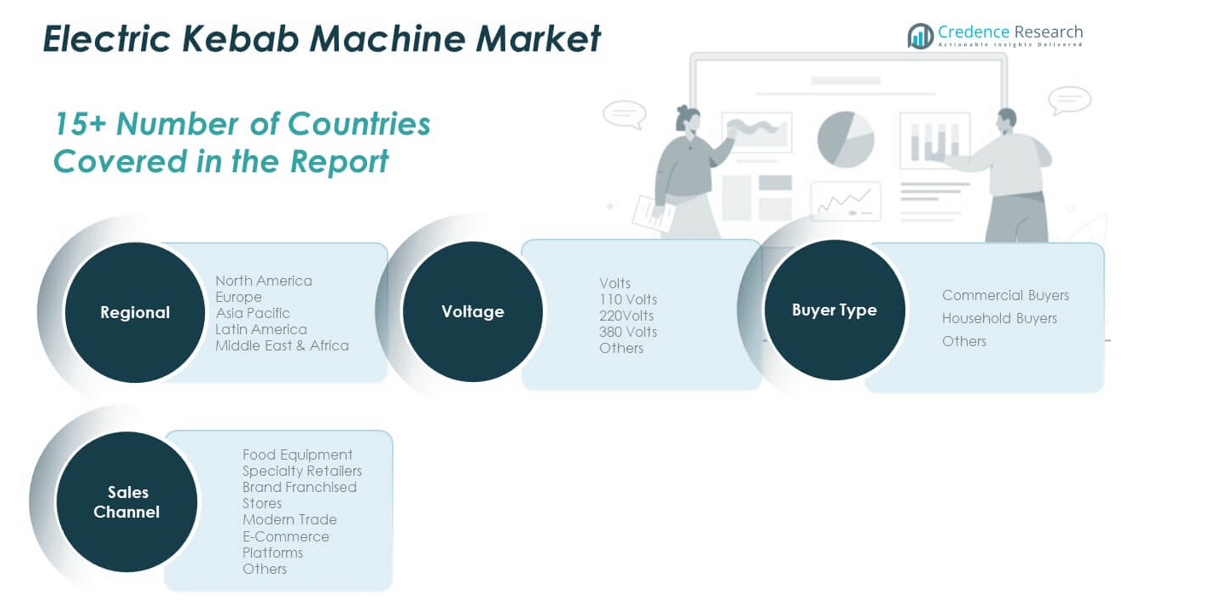
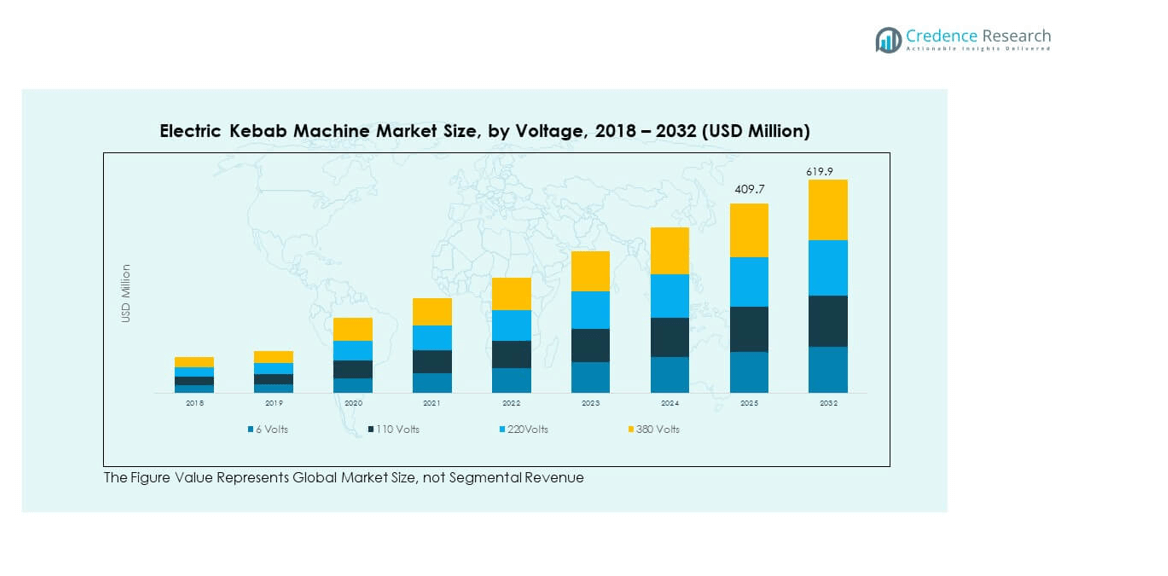
The Global Electric Kebab Machine Market is segmented by voltage into 6 Volts, 110 Volts, 220 Volts, 380 Volts, and Others. The 220 Volts category dominates due to its suitability for commercial kitchens and foodservice establishments. Machines in the 110 Volts range cater to household buyers in regions such as North America. High-capacity 380 Volts models serve industrial kitchens and large-scale restaurants requiring continuous output. The 6 Volts and Others segments remain niche, often targeting portable or specialty appliances. It is influenced by regional electricity standards, which shape product preferences and distribution.
- For instance, commercial kebab machines commonly use 415V power supply with a capacity around 9.9kW to deliver rapid, even cooking in professional kitchens, such as seen in the ElectMax EKB-2 model.
By Buyer Type
The Global Electric Kebab Machine Market is divided into commercial buyers, household buyers, and others. Commercial buyers hold the largest share, driven by quick-service restaurants, street food vendors, and hotels. These buyers prioritize durability, efficiency, and automation features to serve high customer volumes. Household buyers are a growing segment, supported by rising disposable incomes and interest in healthier home cooking. Others include institutional kitchens and catering services, contributing steady demand. It is shaped by evolving consumer lifestyles and the expansion of global food cultures.
- For instance, hospitality settings regularly invest in industrial-grade machines with capacities well over 45 kg to handle high volumes efficiently.
By Sales Channel
The Global Electric Kebab Machine Market is categorized by sales channel into food equipment specialty retailers, brand franchised stores, modern trade, e-commerce platforms, and others. Specialty retailers and franchised stores dominate commercial procurement due to trust and after-sales service. Modern trade outlets support both household and small restaurant buyers. E-commerce platforms expand global reach by offering diverse product ranges and competitive pricing. Others include direct distributors and wholesale channels serving institutional buyers. It is influenced by digital transformation and shifting consumer purchasing behavior worldwide.
Segmentation:
- By Voltage Segment
- 6 Volts
- 110 Volts
- 220 Volts
- 380 Volts
- Others
- By Buyer Type
- Commercial Buyers
- Household Buyers
- Others
- By Sales Channel
- Food Equipment Specialty Retailers
- Brand Franchised Stores
- Modern Trade
- E-Commerce Platforms
- Others
- By Region
- North America
- U.S.
- Canada
- Mexico
- Europe
- UK
- France
- Germany
- Italy
- Spain
- Russia
- Rest of Europe
- Asia Pacific
- China
- Japan
- South Korea
- India
- Australia
- Southeast Asia
- Rest of Asia Pacific
- Latin America
- Brazil
- Argentina
- Rest of Latin America
- Middle East
- GCC Countries
- Israel
- Turkey
- Rest of Middle East
- Africa
- South Africa
- Egypt
- Rest of Africa
- North America
Regional Analysis:
North America
The North America Global Electric Kebab Machine Market size was valued at USD 104.68 million in 2018 to USD 124.11 million in 2024 and is anticipated to reach USD 198.81 million by 2032, at a CAGR of 6.1% during the forecast period. North America holds a significant share of the Global Electric Kebab Machine Market, supported by a strong network of quick-service restaurants and multicultural food chains. The U.S. drives regional growth with its high adoption of kitchen automation and demand for grilled cuisines. Canada follows with steady growth in specialty restaurants and household appliance adoption. Mexico contributes with rising demand in urban centers driven by modern foodservice infrastructure. It is supported by consumer preference for healthier, grilled food options and rising household appliance sales. E-commerce platforms expand market penetration across the region. Increasing disposable incomes and strong restaurant culture strengthen the regional footprint. North America accounts for nearly 20.2% of the overall market share.
Europe
The Europe Global Electric Kebab Machine Market size was valued at USD 91.20 million in 2018 to USD 106.70 million in 2024 and is anticipated to reach USD 161.64 million by 2032, at a CAGR of 5.4% during the forecast period. Europe dominates the Global Electric Kebab Machine Market due to the cultural integration of kebab cuisine into mainstream dining. Germany, the UK, and France represent leading markets, supported by strong restaurant demand and established fast-food culture. Mediterranean countries, including Italy and Spain, maintain steady consumption driven by traditional grilling methods and rising adoption of electric models. Eastern Europe shows gradual growth with expanding street food and retail presence. It is supported by favorable regulatory frameworks and the demand for energy-efficient appliances. Household adoption rises with compact designs suited for urban living. Europe accounts for nearly 17.3% of the overall market share.
Asia Pacific
The Asia Pacific Global Electric Kebab Machine Market size was valued at USD 84.80 million in 2018 to USD 107.12 million in 2024 and is anticipated to reach USD 187.40 million by 2032, at a CAGR of 7.3% during the forecast period. Asia Pacific is the fastest-growing region in the Global Electric Kebab Machine Market, driven by rising urbanization and expanding foodservice industries. China leads the region with growing adoption in both restaurants and households. Japan and South Korea emphasize compact and high-tech appliances to meet urban consumer preferences. India shows rapid growth fueled by changing food habits and the popularity of kebab-style cuisine in both street food and modern outlets. Australia contributes through increasing multicultural demand and advanced retail networks. It is supported by growing disposable incomes and the influence of global cuisines. Asia Pacific accounts for nearly 17.0% of the overall market share.
Latin America
The Latin America Global Electric Kebab Machine Market size was valued at USD 22.72 million in 2018 to USD 27.34 million in 2024 and is anticipated to reach USD 40.83 million by 2032, at a CAGR of 5.2% during the forecast period. Latin America presents steady growth in the Global Electric Kebab Machine Market, supported by rising demand for grilled food and urban dining culture. Brazil dominates with strong restaurant growth and rising interest in home-use appliances. Argentina contributes through increasing consumer spending on modern kitchen equipment. Mexico and other regional markets benefit from cultural exchange and urban expansion. It is strengthened by the penetration of e-commerce platforms and specialty retailers. Compact and affordable models attract middle-class households. Regional governments promoting foodservice modernization support expansion. Latin America accounts for nearly 8.2% of the overall market share.
Middle East
The Middle East Global Electric Kebab Machine Market size was valued at USD 10.40 million in 2018 to USD 11.69 million in 2024 and is anticipated to reach USD 16.49 million by 2032, at a CAGR of 4.5% during the forecast period. The Middle East is a culturally strong market for kebab-based cuisine, making it a vital region in the Global Electric Kebab Machine Market. Turkey and GCC countries lead with extensive use in restaurants and foodservice outlets. Israel contributes through innovation in compact and modern cooking equipment. Traditional demand for kebabs aligns with increasing adoption of efficient electric machines. It is supported by investments in hospitality and quick-service dining. Urbanization and rising disposable incomes boost household adoption. Retail expansion and tourism growth strengthen appliance sales. The Middle East accounts for nearly 4.9% of the overall market share.
Africa
The Africa Global Electric Kebab Machine Market size was valued at USD 7.20 million in 2018 to USD 11.38 million in 2024 and is anticipated to reach USD 15.73 million by 2032, at a CAGR of 3.8% during the forecast period. Africa represents an emerging region in the Global Electric Kebab Machine Market with rising potential in urban centers. South Africa leads the market due to strong retail presence and modern foodservice demand. Egypt contributes through cultural affinity for kebab-style cuisine and urban dining growth. Other countries in Sub-Saharan Africa show gradual adoption supported by rising incomes. It is influenced by growing e-commerce penetration and affordable models introduced by global brands. Limited infrastructure challenges slow growth in rural areas. Expanding street food culture supports demand for cost-efficient electric appliances. Africa accounts for nearly 5.4% of the overall market share.
Key Player Analysis:
- Pasfil Makine San. and Tic. Ltd.
- Nisbets Plc
- Adexa Direct Ltd.
- TurcoBazaar Limited
- Archway Kebab Machines
- Maxima - Spangenberg International B.V.
- Astar Kitchen Equipment Co., Ltd.
- NutriChef Kitchen, LLC
- HURAKAN
- American Grills
Competitive Analysis:
The Global Electric Kebab Machine Market is highly competitive with the presence of established international players and regional manufacturers. Companies focus on product innovation, durability, and energy efficiency to attract both commercial and household buyers. Strategic pricing, distribution partnerships, and expansion into e-commerce platforms strengthen market positioning. It is shaped by technological upgrades, including automation features, compact designs, and smart connectivity. Regional players offer cost-effective models to compete with global brands. Established companies focus on acquisitions and collaborations to expand their footprint in emerging economies. The market also reflects strong demand from foodservice chains and household users, driving manufacturers to diversify product offerings. Competitive intensity remains high, with both innovation and affordability shaping leadership positions.
Recent Developments:
- In May 2024, Bunzl plc completed the acquisition of Nisbets, a prominent omnichannel distributor of catering equipment and consumables based in the UK, strengthening its position in the catering equipment sector. This acquisition included the integration of Nisbets' experienced management team and digital expertise to expand market reach and service capabilities.
- In April 2025, Maxima - Spangenberg International B.V. announced a moderate revenue growth for 2024 with a continued focus on store network expansion and private label development across Baltic and European markets, though no specific electric kebab machine product launch was disclosed.
- NutriChef Kitchen, LLC introduced new kitchen appliances, including portable electric rice cookers and grill products in 2024-2025, aiming to create healthier cooking lifestyles, without a specific update on kebab machines.
Report Coverage:
The research report offers an in-depth analysis based on voltage and buyer type segments. It details leading market players, providing an overview of their business, product offerings, investments, revenue streams, and key applications. Additionally, the report includes insights into the competitive environment, SWOT analysis, current market trends, as well as the primary drivers and constraints. Furthermore, it discusses various factors that have driven market expansion in recent years. The report also explores market dynamics, regulatory scenarios, and technological advancements that are shaping the industry. It assesses the impact of external factors and global economic changes on market growth. Lastly, it provides strategic recommendations for new entrants and established companies to navigate the complexities of the market.
Future Outlook:
- Rising demand for energy-efficient machines will support long-term adoption.
- Compact and multifunctional models will attract household buyers.
- Automation and smart connectivity will become key differentiators.
- Growth of quick-service restaurants will boost commercial demand.
- E-commerce platforms will drive faster product penetration.
- Regional manufacturers will compete through low-cost offerings.
- Product durability and safety features will shape consumer trust.
- Cultural preference for kebab cuisine will sustain demand globally.
- Regulatory focus on energy standards will influence product design.
- Emerging economies will provide untapped growth opportunities.
Request a Free Sample
Fill in your details and we'll send you a free sample report.
- Sample data tables & charts
- Research methodology
Need a Custom Version of This Report?
Tailor the scope, geography, or segments to your exact requirements.
- Custom geography or segment scope
- Direct access to our analyst team
Frequently Asked Questions
What is the current market size for Global Electric Kebab Machine Market, and what is its projected size in 2032?
At what Compound Annual Growth Rate is the Global Electric Kebab Machine Market projected to grow between 2025 and 2032?
Which Global Electric Kebab Machine Market segment held the largest share in 2024?
What are the primary factors fueling the growth of the Global Electric Kebab Machine Market?
Who are the leading companies in the Global Electric Kebab Machine Market?
Table of Content
Chapter 1. Report Introduction
- 1.1 Report Description & Purpose
- 1.1.1 Report Title & Market Definition
- 1.1.2 Unique Selling Propositions (USP) & Key Differentiators
- 1.1.3 Value Proposition for Stakeholders
- 1.2 Research Objectives
- 1.2.1 Market Sizing Objectives (Volume & Revenue)
- 1.2.2 Segmentation Objectives
- 1.2.3 Competitive Intelligence Objectives
- 1.2.4 Forecast & Scenario Objectives
- 1.3 Report Scope
- 1.3.1 Electric Kebab Machine Scope – Types & Subtypes Covered
- 1.3.2 Geographic Scope – Regions & Countries Covered
- 1.3.3 Historical Period, Base Year & Forecast Period (2018; forecast to 2032)
- 1.3.4 Inclusions & Exclusions
- 1.4 HS Code & Classification Framework
- 1.5 Currency, Units & Pricing Basis
- 1.6 Target Stakeholders
- 1.7 Limitations & Assumptions
Chapter 2. Executive Summary
- 2.1 Global Electric Kebab Machine Market Snapshot
- 2.1.1 Market Size – Historical (2018) & Forecast (2018-2032) (2018: USD 320.00 million → 2032: USD 619.90 million)
- 2.1.2 Volume & Revenue – Global Totals
- 2.1.3 Key Market Highlights – Top Five Facts
- 2.2 Electric Kebab Machine Market Segmentation Snapshot
- 2.2.1 Market Split by Region – 2018 vs. 2032
- 2.3 Competitive Snapshot
- 2.3.1 Top 10 Players by Revenue Share – 2018
- 2.3.2 Top 10 Players by Volume Share – 2018
- 2.3.3 Recent Strategic Developments (18-Month Summary)
- 2.4 Key Investment Highlights & Strategic Conclusions
Chapter 3. Electric Kebab Machine Market Dynamics & Industry Analysis
- 3.1 Market Overview & Context
- 3.1.1 Electric Kebab Machine Market Position in the Broader Automotive Value Chain
- 3.1.2 OEM vs. Replacement Market Dynamics
- 3.1.3 Market Maturity & Development Stage by Region
- 3.2 Electric Kebab Machine Market Drivers
- 3.3 Electric Kebab Machine Market Restraints & Challenges
- 3.4 Electric Kebab Machine Market Opportunities
- 3.5 Porter's Five Forces Analysis
- 3.5.1 Threat of New Entrants
- 3.5.2 Bargaining Power of Suppliers
- 3.5.3 Bargaining Power of Buyers
- 3.5.4 Threat of Substitutes
- 3.5.5 Competitive Rivalry – Intensity Assessment
- 3.6 Electric Kebab Machine Value Chain Analysis
- 3.6.1 Upstream – Raw Material/Input Suppliers
- 3.6.1.1 Raw Material/Input 1
- 3.6.1.2 Raw Material/Input 2
- 3.6.1.3 Raw Material/Input 3
- 3.6.2 Midstream – Production/Manufacturing/Service Delivery
- 3.6.2.1 Production/Process Overview
- 3.6.2.2 Key Facility Locations & Capacity by Manufacturer
- 3.6.3 Downstream – Distribution & End Consumer
- 3.6.3.1 Primary Channel – B2B/OEM
- 3.6.3.2 Secondary Channels – Dealer, Retail, Online, Direct
- 3.6.4 Value Chain Profitability Analysis
- 3.6.1 Upstream – Raw Material/Input Suppliers
- 3.7 PESTEL Analysis
- 3.7.1 Political Factors
- 3.7.2 Economic Factors
- 3.7.3 Social Factors
- 3.7.4 Technological Factors
- 3.7.5 Environmental Factors
- 3.7.6 Legal Factors
- 3.8 Electric Kebab Machine Supply Chain Analysis
- 3.8.1 Raw Material/Input Supply Risk Assessment
- 3.8.2 Manufacturing Concentration Risk (Geographic Exposure)
- 3.8.3 Trade Disruption Impact Analysis
- 3.9 Regulatory & Policy Landscape
Note: The regulatory and policy landscape section covers regulations based on their applicability to the market, Electric Kebab Machine category, geography, and scope of the study. Only regulatory frameworks with a material impact on operations, compliance, trade, sustainability, or market access are analyzed in detail.
Chapter 4. Key Investment Pockets & Opportunity Analysis
- 4.1 Electric Kebab Machine Market Attractiveness Analysis
- 4.1.1 By Region – Investment Attractiveness Matrix (Volume × CAGR)
- 4.2 Absolute Revenue Growth Opportunity
- 4.2.1 By Region – Absolute USD Growth Through 2032
- 4.3 Incremental Volume Opportunity
- 4.3.1 By Region – Incremental Volume Through 2032
- 4.3.2 Segment – Incremental Volume
- 4.4 Emerging Submarket Opportunity Deep Dive (Subject to Applicability)
- 4.5 Emerging Market Opportunity Scorecards
- 4.5.1 United States
- 4.5.2 Europe
- 4.5.3 Asia
- 4.5.4 Middle East & Africa
Note: Emerging Market Opportunity Scorecards will be included based on relevance and strategic importance. Regions listed are indicative and may vary depending on data availability and market dynamics.
Chapter 5. Electric Kebab Machine Import-Export Analysis & Trade Flows
- 5.1 Global Trade Overview
- 5.1.1 Global Export Value by Country (2018)
- 5.1.2 Global Export Volume by Country (2018)
- 5.1.3 Global Import Value by Country (2018)
- 5.1.4 Global Import Volume by Country (2018)
- 5.1.5 Net Trade Balance by Country (2018)
- 5.2 Export Analysis – Segment
- 5.2.1 Type 1 (HS Code)
- 5.2.2 Type 2 (HS Code)
- 5.2.3 Type 3 (HS Code)
- 5.2.4 Type 4 (HS Code)
- 5.2.5 Type 5 (HS Code)
- 5.3 Import Analysis – Segment
- 5.3.1 Type 1 (HS Code)
- 5.3.2 Type 2 (HS Code)
- 5.3.3 Type 3 (HS Code)
- 5.3.4 Type 4 (HS Code)
- 5.3.5 Type 5 (HS Code)
- 5.4 Average Unit Trade Prices
- 5.4.1 Average Export Price – Segment & Country
- 5.4.2 Average Import Price – Segment & Source Country
- 5.4.3 Price Trends (2018)
- 5.5 Key Trade Route Analysis
- 5.5.1 Trade Route 1
- 5.5.2 Trade Route 2
- 5.5.3 Trade Route 3
- 5.5.4 Trade Route 4
- 5.5.5 Trade Route 5
- 5.6 Trade Policy Impact Assessment
- 5.6.1 US Anti-Dumping & Section 301 Tariffs
- 5.6.2 EU Customs Union Impact
- 5.6.3 Major Free Trade Agreements
- 5.6.4 USMCA Rules of Origin
Note: Trade policy analysis will be included only where relevant to the Electric Kebab Machine market.
Chapter 6. Competitive Landscape & Company Benchmarking
- 6.1 Electric Kebab Machine Market Concentration & Structure
- 6.1.1 Herfindahl-Hirschman Index (HHI) – vs. 2018
- 6.1.2 Tier 1, Tier 2 & Tier 3 Market Structure
- 6.1.3 Global, Regional & Local Player Dynamics
- 6.2 Electric Kebab Machine Market Share Analysis – 2018
- 6.2.1 Global Revenue Share by Company
- 6.2.2 Global Volume Share by Company
- 6.2.3 Regional Revenue Share
- 6.2.4 Market Share Evolution ( vs. 2018)
- 6.2.5 OEM Segment Share by Company
- 6.2.6 Replacement Segment Share by Company
- 6.3 Production/Delivery Capacity & Facility Analysis
- 6.3.1 Global Installed Capacity
- 6.3.2 Capacity Utilization Rates
- 6.3.3 Production/Output Volume
- 6.3.4 Facility Locations & Capacity Map
- 6.3.5 Planned Capacity Additions
- 6.4 Electric Kebab Machine Competitive Benchmarking Matrix
- 6.4.1 Revenue, Volume, CAGR & Profitability Comparison
- 6.4.2 Channel Revenue Mix
- 6.4.3 Geographic Revenue Exposure
- 6.4.4 R&D Intensity
- 6.4.5 Sustainability Maturity
- 6.5 Strategic Developments in Electric Kebab Machine (Last 24 Months)
- 6.5.1 Mergers, Acquisitions & Divestments
- 6.5.2 New Electric Kebab Machine Launches
- 6.5.3 Facility Expansions
- 6.5.4 Strategic Alliances, Joint Ventures & Partnerships
- 6.5.5 Distribution Expansion & Market Entry
- 6.5.6 Sustainability & ESG Initiatives
- 6.6 Competitive Strategy Mapping
- 6.6.1 Leader, Challenger, Follower & Niche Classification
- 6.6.2 Pricing Strategy Comparison
- 6.6.3 Channel Strategy Matrix
Note: Strategic developments are included based on their materiality and the availability of reliable information.
Chapter 7. Global Electric Kebab Machine Market – By Distribution Channel
- 7.1 Segment Overview
- 7.1.1 Volume & Revenue Split by Channel (2018 & 2032)
- 7.1.2 Channel Mix Evolution (2018-2032)
Chapter 8. Regional Market Analysis – Global Overview
- 8.1 Global Regional Overview
- 8.1.1 Regional Volume Share
- 8.1.2 Regional Revenue Share
- 8.1.3 Regional Volume by Region
- 8.1.4 Regional Revenue by Region
- 8.1.5 Regional Forecast Through 2032
- 8.2 Cross-Regional Segment Analysis
- 8.2.1 By Distribution Channel
- 8.2.2 By Brand/Price Tier
Chapter 9. North America Electric Kebab Machine Market
- 9.1 United States
- 9.2 Canada
- 9.3 Mexico
Chapter 10. Europe Electric Kebab Machine Market
- 10.1 Germany
- 10.2 France
- 10.3 Italy
- 10.4 United Kingdom
- 10.5 Spain
- 10.6 Poland
- 10.7 Russia
- 10.8 Netherlands
- 10.9 Belgium
- 10.10 Sweden
- 10.11 Denmark
- 10.12 Norway
- 10.13 Rest of Europe
Chapter 11. Asia Pacific Electric Kebab Machine Market
- 11.1 China
- 11.2 India
- 11.3 Japan
- 11.4 South Korea
- 11.5 Thailand
- 11.6 Indonesia
- 11.7 Vietnam
- 11.8 Malaysia
- 11.9 Australia
- 11.10 Rest of Asia Pacific
Chapter 12. Latin America Electric Kebab Machine Market
- 12.1 Brazil
- 12.2 Argentina
- 12.3 Colombia
- 12.4 Chile
- 12.5 Rest of Latin America
Chapter 13. Middle East Electric Kebab Machine Market
- 13.1 Saudi Arabia
- 13.2 United Arab Emirates
- 13.3 Turkey
- 13.4 Israel
- 13.5 Iran
- 13.6 Rest of the Middle East
Chapter 14. Africa Electric Kebab Machine Market
- 14.1 South Africa
- 14.2 Egypt
- 14.3 Nigeria
- 14.4 Morocco
- 14.5 Rest of Africa
Chapter 15. Electric Kebab Machine Company Profiles
- 15.1 [Company 01]
- 15.1.1 Company Overview
- 15.1.2 Key Management Personnel
- 15.1.3 Products & Services Portfolio
- 15.1.4 Financial Performance
- 15.1.5 Key Market Focus & Geographic Presence
- 15.1.6 Recent Developments & Strategic Initiatives
Note: The company profile list is preliminary and may change based on research findings, market developments, data availability, and client requirements.
Chapter 16. Appendices
- Appendix A – List of Abbreviations & Acronyms
- Appendix B – Industry Classification Code Reference – Full Series
- Appendix C – Production & Capacity Data Tables
- Appendix D – End-Use & Demand Base Tables
- Appendix E – Consumption & Replacement Rate Assumptions
- Appendix F – ASP Reference Tables
- Appendix G – Manufacturing & Facility Database
- Appendix H – Import-Export Data Tables
- Appendix I – Regulatory Summary Tables
- Appendix J – Primary Research Participant List (Anonymized)
- Appendix K – Primary Research Questionnaire Framework
- Appendix L – Data Sources & Bibliography
- Appendix M – Market Size Divergence & Source Comparison
Chapter 17. Research Methodology
- 17.1 Research Framework & Philosophy
- 17.2 Secondary Research – Sources, Hierarchy & Data Extraction
- 17.3 Data Modeling – Bottom-Up & Top-Down Market Sizing
- 17.4 Primary Research – Stakeholder Framework, LOI & Sample Sizes
- 17.5 Forecast Methodology – Regression, Scenario & Sensitivity Analysis
- 17.6 Quality Control – Four-Layer Validation Framework
- 17.7 Limitations & Standard Assumptions
- 17.8 Disclaimer
