Market Overview
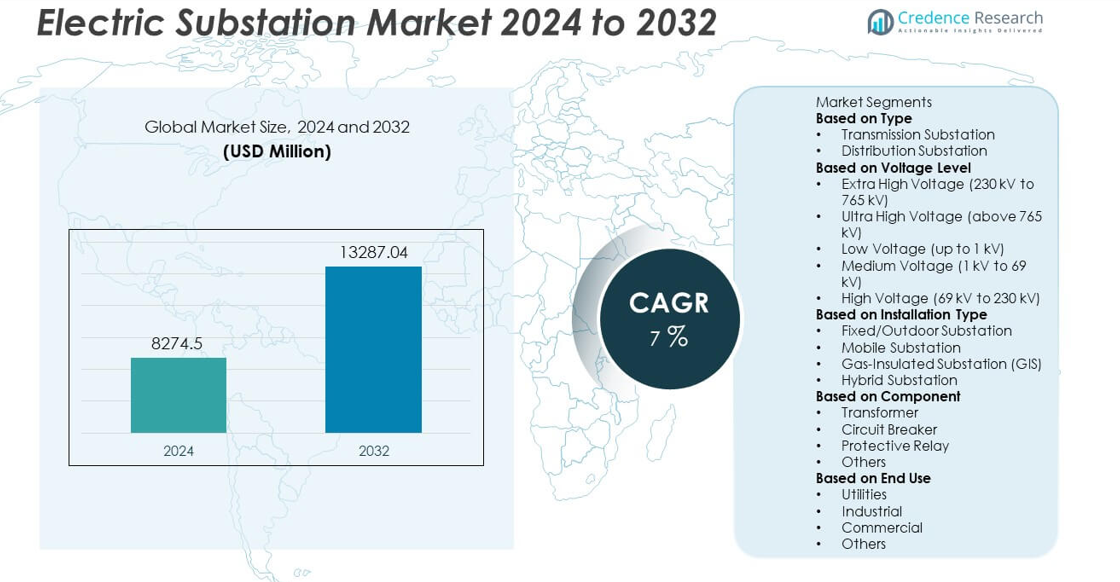
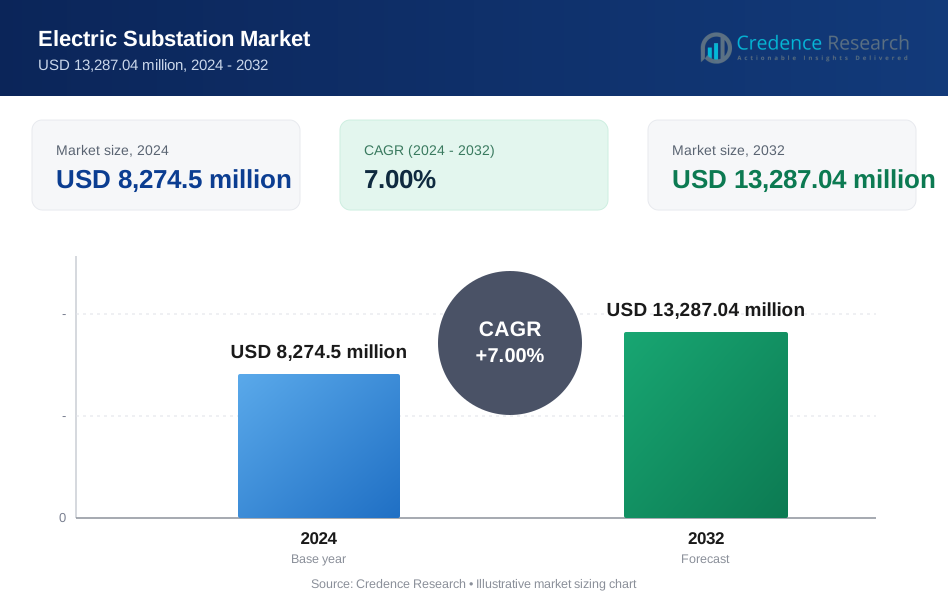
The Electric Substation Market was valued at USD 8,274.5 million in 2024 and is projected to reach USD 13,287.04 million by 2032, expanding at a CAGR of 7 % during the forecast period.
| REPORT ATTRIBUTE | DETAILS |
|---|---|
| Historical Period | 2020-2023 |
| Base Year | 2024 |
| Forecast Period | 2025-2032 |
| Electric Substation Market Size 2024 | USD 8,274.5 million |
| Electric Substation Market, CAGR | 7% |
| Electric Substation Market Size 2032 | USD 13,287.04 million |
The Electric Substation Market is dominated by key players including Schneider, ABB, Eaton, CG, Siemens, Mitsubishi, Toshiba, General Electric, Caverion, and Larsen & Toubro. These companies lead the market through advanced automation technologies, strong engineering expertise, and large-scale infrastructure projects. Asia-Pacific emerged as the leading region with a 36 percent market share in 2024, driven by expanding industrialization and renewable energy integration. North America followed with 29 percent, supported by grid modernization initiatives and high-voltage upgrades. Europe accounted for 23 percent, focusing on sustainable transmission networks and cross-border power connectivity.
Market Insights
- The Electric Substation Market was valued at USD 8,274.5 million in 2024 and is projected to reach USD 13,287.04 million by 2032, growing at a CAGR of 7 percent.
- Growing demand for reliable power transmission and increasing renewable energy integration are major market drivers, supported by grid modernization and urban infrastructure expansion.
- The market is witnessing trends such as digital substation deployment, automation, and adoption of gas-insulated designs to improve efficiency and reduce maintenance needs.
- Key players including Schneider, ABB, Siemens, Mitsubishi, and General Electric are focusing on smart grid technology, innovation, and strategic collaborations to strengthen global presence.
- Asia-Pacific led the market with a 36 percent share in 2024, followed by North America with 29 percent and Europe with 23 percent, while the distribution substation segment dominated with 63 percent share due to its vital role in regional power distribution networks.
Market Segmentation Analysis:
By Type
The distribution substation segment dominated the Electric Substation Market in 2024, accounting for 63 percent of the total share. Its dominance is driven by the rapid expansion of urban and rural electricity distribution networks. Growing electricity demand from residential, commercial, and industrial users has boosted investment in reliable power delivery infrastructure. Utilities are focusing on modernizing aged distribution grids to improve efficiency and reduce transmission losses. The integration of smart meters, automation systems, and digital control units further strengthens the performance and reliability of distribution substations worldwide.
- For instance, Schneider Electric has deployed digital distribution substations under its EcoStruxure Grid program, each utilizing IoT-enabled sensors to enable capabilities such as predictive maintenance, real-time monitoring, and remote fault isolation across regional electricity networks. The program leverages IoT, analytics, and other technologies to help utilities improve reliability and efficiency.
By Voltage Level
The high voltage (69 kV to 230 kV) segment held the largest share of 41 percent in 2024, driven by strong demand for efficient long-distance power transmission. These substations are essential for connecting generation plants to regional distribution grids. Growing industrialization and cross-border electricity trade are fueling investment in high-voltage infrastructure. Governments in North America, Europe, and Asia-Pacific are prioritizing grid reliability and renewable integration through voltage upgrades. The rising deployment of high-voltage substations supports reduced transmission losses and enhanced network stability across major power corridors.
- For instance, a utility in the Philippines commissioned a new gas-insulated substation, integrating digital control relays for grid stability. The installation, which included GIS switchgear and transformers, improves energy transmission efficiency and system redundancy in parts of Luzon.
By Installation Type
The gas-insulated substation (GIS) segment led the market with a 47 percent share in 2024, owing to its compact design, high reliability, and superior performance in urban and space-constrained areas. GIS technology minimizes maintenance needs and provides strong resistance to pollution, moisture, and environmental stress. Increasing renewable integration and urban power demand are encouraging utilities to adopt GIS systems for enhanced efficiency. Countries in Asia-Pacific and the Middle East are investing heavily in GIS projects to modernize their transmission networks and ensure uninterrupted power supply in densely populated regions.
Key Growth Drivers
Expansion of Renewable Energy Integration
The rapid integration of renewable energy sources such as solar and wind is a major growth driver for the Electric Substation Market. Rising renewable generation requires efficient transmission and grid stability, increasing demand for advanced substations. Utilities are investing in flexible, automated systems capable of managing variable power flows. Digital substations enable real-time monitoring and optimized power distribution. Governments worldwide are funding grid modernization projects to enhance renewable integration, accelerating the need for high-capacity, smart substations across both urban and remote locations.
- For instance, ABB (now Hitachi Energy) supplied equipment for the Hornsea 2 offshore wind farm in the UK, which has a total capacity of 1.32 GW. ABB provided high-voltage gas-insulated switchgear (GIS) for the substation to help transmit power to the onshore grid.
Rising Demand for Reliable Power Transmission
Increasing global electricity consumption is driving investments in robust transmission and distribution infrastructure. Substations serve as critical nodes for voltage transformation and efficient energy transfer across large networks. Population growth, industrial expansion, and electrification of transport sectors have intensified the need for uninterrupted power supply. Utilities are upgrading aging networks with high-voltage substations to ensure stability and minimize power losses. This demand for reliability continues to push utilities and governments toward modern, digitally controlled substation installations.
- For instance, L&T Construction commissioned India's first 765 kV gas-insulated substation (GIS) in Pune, Maharashtra, in partnership with Hyosung. The facility was part of a larger transmission scheme that included a 2x1500 MVA 765/400 kV Air Insulated Substation in Rajasthan, supporting long-distance power transmission and strengthening connectivity between regional grids.
Modernization of Aging Grid Infrastructure
Aging transmission networks in developed and emerging regions are undergoing large-scale modernization. Many existing substations are reaching operational limits, requiring replacement with more efficient and automated systems. The adoption of gas-insulated and hybrid substations is growing due to their compactness and lower maintenance needs. Upgrades focus on improving grid resilience, fault detection, and operational safety. Governments and utilities are allocating significant investments to replace outdated infrastructure, ensuring long-term reliability and improved energy efficiency across national grids.
Key Trends and Opportunities
Adoption of Smart and Digital Substations
Digital transformation is reshaping substation operations through automation, IoT, and AI integration. Smart substations use digital relays, sensors, and communication systems to enhance real-time data analysis and predictive maintenance. This shift reduces downtime and improves grid flexibility. Manufacturers are focusing on interoperable platforms for remote control and diagnostics. The growing emphasis on intelligent power management and grid optimization is creating new opportunities for digital substation deployment, particularly in technologically advanced economies.
- For instance, Siemens Energy, in collaboration with Norwegian utilities like BKK Nett and Glitre Energi Nett, has implemented digital technologies in substations across Norway. These projects, which often use the IEC 61850 protocol for intelligent electronic devices, leverage AI-driven data analytics and condition monitoring to improve grid reliability and efficiency.
Shift Toward Compact and Gas-Insulated Designs
Gas-insulated substations are becoming a preferred choice in urban and industrial areas where space and reliability are critical. Their ability to operate efficiently in harsh environments with minimal maintenance drives adoption. The technology also reduces environmental exposure and improves operational safety. Governments are promoting GIS installations as part of sustainable infrastructure programs. This shift presents strong opportunities for equipment manufacturers specializing in high-voltage, compact, and eco-efficient substation technologies.
- For instance, Hitachi Energy delivered a 400 kV gas-insulated substation in Dubai’s Jebel Ali area, designed with 80% smaller footprint compared to conventional AIS systems. The substation houses 28 GIS bays using fluoronitrile-based insulation that cuts SF₆ gas use by 85 tons annually while maintaining the same dielectric performance and operational reliability.
Key Challenges
High Initial Investment and Installation Costs
Electric substations, especially digital and gas-insulated types, involve significant upfront costs for equipment, installation, and technology integration. Developing countries often face financial constraints that delay modernization projects. Long project timelines and complex regulatory approvals further increase expenses. Manufacturers are exploring modular designs to lower costs and simplify setup. However, the high capital requirement remains a major barrier to widespread substation adoption in cost-sensitive regions.
Complex Maintenance and Technical Skill Requirements
Modern substations require skilled personnel for installation, operation, and maintenance. The integration of automation, sensors, and digital systems increases technical complexity. Inadequate workforce training and limited technical expertise can lead to operational inefficiencies and equipment downtime. Developing nations, in particular, face a shortage of qualified engineers to manage advanced substations. Utilities are investing in training programs and digital monitoring tools to overcome this challenge, but workforce development remains a key limiting factor for efficient grid modernization.
Regional Analysis
North America
North America held a market share of 29 percent in 2024, driven by strong investments in grid modernization and renewable integration. The United States and Canada are upgrading aging transmission infrastructure to support electric vehicle expansion and decentralized power generation. The presence of key utility providers and advanced automation technologies supports large-scale digital substation deployment. Government initiatives promoting reliable and resilient grids further strengthen market growth. Continuous innovation in smart grid solutions and the integration of high-voltage substations ensure sustained development across industrial and residential applications in the region.
Europe
Europe accounted for 23 percent of the Electric Substation Market in 2024, supported by robust investments in renewable energy and cross-border power networks. Countries such as Germany, France, and the United Kingdom are focusing on grid stability and efficient electricity transmission. The region’s commitment to carbon neutrality and the adoption of advanced digital substations enhance operational performance. Ongoing modernization of distribution networks and large-scale offshore wind integration are accelerating infrastructure upgrades. Government-backed funding and collaborative research programs continue to drive the adoption of sustainable substation technologies across Europe.
Asia-Pacific
Asia-Pacific dominated the market with a 36 percent share in 2024, fueled by expanding urbanization, industrialization, and power demand in China, India, and Japan. Growing renewable energy installations and rural electrification initiatives are increasing substation deployment across the region. Governments are investing in advanced grid networks to handle rising energy loads and ensure reliability. The development of high-voltage transmission corridors and large-scale renewable integration projects is driving growth. The presence of cost-effective manufacturers and rapid infrastructure development further enhance the market’s expansion across emerging Asia-Pacific economies.
Middle East and Africa
The Middle East and Africa captured 7 percent of the global market share in 2024, supported by large-scale oil and gas infrastructure projects and renewable energy initiatives. Countries such as Saudi Arabia, the UAE, and South Africa are expanding transmission capacity to meet industrial and urban electricity needs. Investments in gas-insulated substations and hybrid designs are growing to enhance grid resilience in harsh environments. Government strategies promoting energy diversification and electrification of remote regions continue to drive substation installations across both developed and developing parts of the region.
Latin America
Latin America accounted for 5 percent of the global Electric Substation Market in 2024, led by infrastructure expansion and renewable power generation projects in Brazil and Mexico. Increasing government focus on energy reliability and regional interconnection supports steady growth. Investments in solar and wind energy integration are encouraging the construction of new substations and modernization of existing networks. Utility companies are adopting automated and digital control systems to improve efficiency and safety. Continued economic recovery and energy reforms are expected to drive further substation deployment across Latin America.
Market Segmentations:
By Type
- Transmission Substation
- Distribution Substation
By Voltage Level
- Extra High Voltage (230 kV to 765 kV)
- Ultra High Voltage (above 765 kV)
- Low Voltage (up to 1 kV)
- Medium Voltage (1 kV to 69 kV)
- High Voltage (69 kV to 230 kV)
By Installation Type
- Fixed/Outdoor Substation
- Mobile Substation
- Gas-Insulated Substation (GIS)
- Hybrid Substation
By Component
- Transformer
- Circuit Breaker
- Protective Relay
- Others
By End Use
- Utilities
- Industrial
- Commercial
- Others
By Geography
- North America
- U.S.
- Canada
- Mexico
- Europe
- Germany
- France
- U.K.
- Italy
- Spain
- Rest of Europe
- Asia Pacific
- China
- Japan
- India
- South Korea
- South-east Asia
- Rest of Asia Pacific
- Latin America
- Brazil
- Argentina
- Rest of Latin America
- Middle East & Africa
- GCC Countries
- South Africa
- Rest of the Middle East and Africa
Competitive Landscape
The competitive landscape of the Electric Substation Market includes major players such as Schneider, ABB, Eaton, CG, Siemens, Mitsubishi, Toshiba, General Electric, Caverion, and Larsen & Toubro. These companies lead the market through strong technological capabilities, extensive product portfolios, and global service networks. They are focusing on developing smart and digital substations integrated with IoT, AI, and advanced automation systems to enhance grid reliability and efficiency. Strategic partnerships, acquisitions, and renewable-focused infrastructure projects are key approaches used to expand market presence. Manufacturers are prioritizing sustainable solutions, including gas-insulated and hybrid substations, to address space limitations and environmental concerns. Continuous investment in research, software-based grid management, and modular substation technologies strengthens competitiveness across global and regional markets.
Key Player Analysis
Recent Developments
- In July 2025, ABB completed the electrical substation scope for Dogger Bank C, floating out the substation for offshore installation in the UK.
- In June 2025, ABB secured a contract to design and build substation automation and eHouses for Petrobras FPSOs, using IEC 61850 standards.
- In March 2025, Siemens announced at DISTRIBUTECH its showcase of digital substation technology combining protection relays, intelligent control, and secure communications.
- In March 2025, Schneider Electric launched its One Digital Grid Platform to enable AI-driven grid resilience and interoperability across substations
Report Coverage
The research report offers an in-depth analysis based on Type, Voltage Level, Installation Type, Component, End Use and Geography. It details leading market players, providing an overview of their business, product offerings, investments, revenue streams, and key applications. Additionally, the report includes insights into the competitive environment, SWOT analysis, current market trends, as well as the primary drivers and constraints. Furthermore, it discusses various factors that have driven market expansion in recent years. The report also explores market dynamics, regulatory scenarios, and technological advancements that are shaping the industry. It assesses the impact of external factors and global economic changes on market growth. Lastly, it provides strategic recommendations for new entrants and established companies to navigate the complexities of the market.
Future Outlook
- The market will grow steadily due to rising electricity demand and urban expansion.
- Integration of renewable energy sources will drive advanced substation installations.
- Digital and smart substations will become standard across transmission networks.
- Gas-insulated substations will gain popularity for compact and low-maintenance operation.
- Governments will invest heavily in grid modernization and energy security.
- Automation and IoT technologies will enhance monitoring and operational efficiency.
- Manufacturers will focus on modular and hybrid designs for flexible deployment.
- Emerging economies will experience strong growth through electrification projects.
- Collaboration between utilities and technology firms will accelerate innovation.
- Asia-Pacific will remain the leading market supported by industrialization and power infrastructure development.
Request a Free Sample
Fill in your details and we'll send you a free sample report.
- Sample data tables & charts
- Research methodology
Market Dynamics
Expansion of Renewable Energy Integration
The rapid growth of solar and wind power generation is increasing the need for advanced substations capable of managing variable and distributed energy sources. Utilities are investing in flexible, automated substations to ensure grid stability and efficient transmission of renewable energy.
Modernization of Aging Grid Infrastructure
Many existing substations are outdated and reaching their operational limits, prompting utilities and governments to invest in modern, automated, and gas-insulated substations. These upgrades improve grid resilience, reduce maintenance needs, and enhance operational safety.
Grid Automation and Digitalization
The adoption of digital substations with IoT, AI, and advanced automation technologies is transforming grid management. Real-time monitoring, predictive maintenance, and remote diagnostics are improving efficiency and reliability, driving demand for smart substation solutions.
Urbanization and Industrialization
Rapid urban and industrial expansion, especially in Asia-Pacific, is increasing electricity demand and necessitating the deployment of new substations. Investments in distribution and high-voltage substations are critical to support growing residential, commercial, and industrial power needs.
Government Initiatives and Grid Modernization Policies
Governments worldwide are funding grid modernization projects and mandating the integration of renewable energy, which accelerates the deployment of advanced substations. Regulatory support and incentives for smart grid and energy security initiatives further stimulate market growth.
Need a Custom Version of This Report?
Tailor the scope, geography, or segments to your exact requirements.
- Custom geography or segment scope
- Direct access to our analyst team
Frequently Asked Questions
What is the current market size for the Electric Substation market, and what is its projected size in 2032?
At what Compound Annual Growth Rate is the Electric Substation market projected to grow between 2025 and 2032?
Which Electric Substation market segment held the largest share in 2024?
What are the primary factors fueling the growth of the Electric Substation market?
Who are the leading companies in the Electric Substation market?
Table of Content
Chapter 1 Market Segmentation
- 1.1 Segmentation Framework
- 1.1.1 Product and Service Classification
- 1.1.2 Application and End-Use Classification
- 1.1.3 Technology and Solution Classification
- 1.1.4 Customer and Distribution Channel Classification
- 1.1.5 Geographic Segmentation
- 1.1.6 Market Segment Definitions and Boundaries
- 1.2 By Type
- 1.2.1 Transmission Substation
- 1.2.2 Distribution Substation
- 1.3 By End Use
- 1.3.1 Utilities
- 1.3.2 Industrial
- 1.3.3 Commercial
- 1.3.4 Others
- 1.4 By Voltage Level
- 1.4.1 Extra High Voltage (230 kV to 765 kV)
- 1.4.2 Ultra High Voltage (above 765 kV)
- 1.4.3 Low Voltage (up to 1 kV)
- 1.4.4 Medium Voltage (1 kV to 69 kV)
- 1.4.5 High Voltage (69 kV to 230 kV)
- 1.5 By Installation Type
- 1.5.1 Fixed/Outdoor Substation
- 1.5.2 Mobile Substation
- 1.5.3 Gas-Insulated Substation (GIS)
- 1.5.4 Hybrid Substation
Chapter 2 Introduction
- 2.1 Report Objectives and Scope
- 2.2 Product Definition and Industry Terminology
- 2.3 Market Inclusions and Exclusions
- 2.4 Research Process
- 2.4.1 Primary Research and Expert Interviews
- 2.4.2 Secondary Research and Source Review
- 2.4.3 Top-Down and Bottom-Up Estimation
- 2.4.4 Data Triangulation and Verification
- 2.5 Market Size Measurement Basis
- 2.5.1 2024: USD 8,274.5 million → 2032: USD 13,287.04 million
- 2.6 Historical and Forecast Reference Periods
- 2.6.1 Base Year: 2024
- 2.6.2 Forecast Period: 2024-2032
- 2.7 Research Assumptions and Limitations
Chapter 3 Executive Summary
- 3.1 Market Snapshot and Key Findings
- 3.2 Base-Year Market Size, 2024
- 3.3 Forecast Market Size, 2032
- 3.4 Revenue and Volume Growth Outlook
- 3.5 Key Demand and Supply Indicators
- 3.6 Leading Market Segments
- 3.7 Fastest-Growing Market Opportunities
- 3.8 Regional Performance Highlights
- 3.9 Technology and Industry Transformation
- 3.10 Competitive Landscape Summary
- 3.11 Analyst View and Strategic Implications
Chapter 4 Global Electric Substation Market Trends and Developments
- 4.1 Historical Industry Development
- 4.2 Recent Market Trends and Developments
- 4.3 Demand and Customer Behavior Trends
- 4.4 Technology and Product Innovation
- 4.5 Artificial Intelligence, Automation and Digitalization
- 4.6 Local Manufacturing and Supply Chain Realignment
- 4.7 Industry Partnerships, Mergers and Acquisitions
- 4.8 Sustainability and Circular Economy Developments
- 4.9 Government and Private Sector Investment Trends
- 4.10 Emerging Business Models and Commercialization
- 4.11 Industry Developments and Announcements
Chapter 5 Global Electric Substation Market Production, Supply and Demand Analysis
- 5.1 Demand Trend and Consumption Analysis
- 5.2 Demand Forecast, 2024-2032
- 5.3 Production and Output Trend
- 5.4 Production and Output Forecast, 2024-2032
- 5.5 Installed Capacity and Capacity Utilization
- 5.6 Company-Wise Production Plants and Statistics
- 5.6.1 Installed Production Capacity
- 5.6.2 Actual Production
- 5.6.3 Planned Capacity and Expansion Targets
- 5.7 Supply Chain Structure and Procurement Trends
- 5.8 Supply-Demand Gap and Bottlenecks
- 5.9 Import Dependence and Sourcing Structure
- 5.10 Contract Manufacturing and Outsourcing
- 5.11 Regional Supply and Demand Concentration
Chapter 6 Global Electric Substation Market Pricing Analysis
- 6.1 Pricing Structure and Measurement
- 6.2 Historical Pricing Trends
- 6.3 Pricing Outlook, 2024-2032
- 6.4 Average Selling Price and Unit Economics
- 6.5 Pricing by Product and Market Segment
- 6.6 Geographic Pricing Differences
- 6.7 Key Input, Energy, Labor and Logistics Costs
- 6.8 Contract Pricing and Purchasing Models
- 6.9 Pricing Sensitivity and Competitive Positioning
- 6.10 Price, Margin and Profitability Implications
Chapter 7 Global Electric Substation Market Dynamics
- 7.1 Market Growth Drivers
- 7.1.1 Demand-Side Drivers
- 7.1.2 Technology and Innovation Drivers
- 7.1.3 Infrastructure and Investment Drivers
- 7.1.4 Regulatory and Policy Drivers
- 7.2 Market Restraints
- 7.2.1 Cost and Affordability Constraints
- 7.2.2 Technology and Adoption Barriers
- 7.2.3 Supply Chain and Operational Constraints
- 7.3 Market Challenges
- 7.3.1 Competitive Pressure and Margin Erosion
- 7.3.2 Skills, Infrastructure and Implementation Gaps
- 7.4 Emerging Market Opportunities
- 7.5 Market Dynamics Impact and Time-Horizon Assessment
Chapter 8 Global Electric Substation Value Chain Analysis
- 8.1 Industry Value Chain Overview
- 8.2 Upstream Suppliers and Critical Inputs
- 8.3 Technology and Component Providers
- 8.4 Manufacturing or Service Delivery
- 8.5 Distribution, Channel Partners and Integrators
- 8.6 Downstream Applications and End Users
- 8.7 Value Addition and Profit Pools
- 8.8 Vertical Integration and Outsourcing
- 8.9 Supplier Concentration and Risk
- 8.10 Supply Chain Localization and Resilience
Chapter 9 Global Electric Substation Market Regulations and Policies
- 9.1 Relevant Laws, Standards and Compliance Frameworks
- 9.2 Product, Service, Safety and Quality Requirements
- 9.3 Government Policies, Incentives and Subsidies
- 9.4 Imports, Exports and Trade Barriers
- 9.5 Public Procurement and Local Content Requirements
- 9.6 Environmental and Sustainability Compliance
- 9.7 Upcoming Policy Changes and Market Implications
Chapter 10 Global Electric Substation Market Hotspots and Opportunities
- 10.1 Market Opportunity Mapping and Growth Hotspots
- 10.2 High-Growth Applications and Customer Groups
- 10.3 Underserved Markets and White-Space Opportunities
- 10.4 Emerging Technology and Product Opportunities
- 10.5 New Capacity and Investment Hotspots
- 10.6 Market Entry and Expansion Opportunities
- 10.7 Distribution and Partnership Opportunities
- 10.8 Near-Term and Long-Term Commercial Potential
- 10.9 Opportunity Attractiveness and Execution Risks
Chapter 11 Global Electric Substation Market Outlook, 2024-2032
- 11.1 Market Size and Analysis
- 11.1.1 Revenue (Market Measurement: 2024: USD 8,274.5 million → 2032: USD 13,287.04 million)
- 11.1.2 Market Volume and Quantity Sold
- 11.1.3 Historical Market Size
- 11.1.4 Base-Year Market Size, 2024
- 11.2 Market Forecast, 2024-2032
- 11.2.1 Revenue Forecast to 2032
- 11.2.2 Volume Forecast to 2032
- 11.2.3 CAGR and Year-on-Year Growth
- 11.2.4 Incremental Revenue Opportunity
- 11.3 Forecast Assumptions and Scenario Analysis
- 11.3.1 Base-Case Forecast
- 11.3.2 Optimistic and Conservative Scenarios
- 11.3.3 Technology, Pricing and Policy Sensitivities
- 11.4 Market Attractiveness and Growth Outlook
Chapter 12 Global Electric Substation Market Segmentation and Outlook
- 12.1 Segmentation Summary and Market Shares, 2024
- 12.2 Largest and Fastest-Growing Segments
- 12.3 By Type - Market Size and Forecast, 2024-2032
- 12.3.1 Segment Definition and Scope
- 12.3.2 Historical Market Size
- 12.3.3 Revenue Forecast, 2024-2032
- 12.3.4 Volume Forecast, 2024-2032
- 12.3.5 Base-Year Market Share, 2024
- 12.3.6 Segment CAGR and Growth Drivers
- 12.3.7 Subsegment Market Size and Forecast
- 12.3.7.1 Transmission Substation
- 12.3.7.2 Distribution Substation
- 12.3.8 Subsegment Pricing and Adoption Trends
- 12.3.9 Leading Suppliers and Competition
- 12.3.10 Regional Demand and Opportunities
- 12.4 By End Use - Market Size and Forecast, 2024-2032
- 12.4.1 Segment Definition and Scope
- 12.4.2 Historical Market Size
- 12.4.3 Revenue Forecast, 2024-2032
- 12.4.4 Volume Forecast, 2024-2032
- 12.4.5 Base-Year Market Share, 2024
- 12.4.6 Segment CAGR and Growth Drivers
- 12.4.7 Subsegment Market Size and Forecast
- 12.4.7.1 Utilities
- 12.4.7.2 Industrial
- 12.4.7.3 Commercial
- 12.4.7.4 Others
- 12.4.8 Subsegment Pricing and Adoption Trends
- 12.4.9 Leading Suppliers and Competition
- 12.4.10 Regional Demand and Opportunities
- 12.5 By Voltage Level - Market Size and Forecast, 2024-2032
- 12.5.1 Segment Definition and Scope
- 12.5.2 Historical Market Size
- 12.5.3 Revenue Forecast, 2024-2032
- 12.5.4 Volume Forecast, 2024-2032
- 12.5.5 Base-Year Market Share, 2024
- 12.5.6 Segment CAGR and Growth Drivers
- 12.5.7 Subsegment Market Size and Forecast
- 12.5.7.1 Extra High Voltage (230 kV to 765 kV)
- 12.5.7.2 Ultra High Voltage (above 765 kV)
- 12.5.7.3 Low Voltage (up to 1 kV)
- 12.5.7.4 Medium Voltage (1 kV to 69 kV)
- 12.5.7.5 High Voltage (69 kV to 230 kV)
- 12.5.8 Subsegment Pricing and Adoption Trends
- 12.5.9 Leading Suppliers and Competition
- 12.5.10 Regional Demand and Opportunities
- 12.6 By Installation Type - Market Size and Forecast, 2024-2032
- 12.6.1 Segment Definition and Scope
- 12.6.2 Historical Market Size
- 12.6.3 Revenue Forecast, 2024-2032
- 12.6.4 Volume Forecast, 2024-2032
- 12.6.5 Base-Year Market Share, 2024
- 12.6.6 Segment CAGR and Growth Drivers
- 12.6.7 Subsegment Market Size and Forecast
- 12.6.7.1 Fixed/Outdoor Substation
- 12.6.7.2 Mobile Substation
- 12.6.7.3 Gas-Insulated Substation (GIS)
- 12.6.7.4 Hybrid Substation
- 12.6.8 Subsegment Pricing and Adoption Trends
- 12.6.9 Leading Suppliers and Competition
- 12.6.10 Regional Demand and Opportunities
- 12.7 Segment Growth Comparison
- 12.8 Segment Attractiveness and Priority Matrix
Chapter 13 Global Electric Substation End-Use and Application Market Outlook
- 13.1 End-Use Industry and Customer Demand Structure
- 13.2 Leading Applications and Customer Groups
- 13.3 End-Use Market Size, Share and Forecast
- 13.4 Major End-Use Industry Deep Dives
- 13.4.1 Customer Requirements and Use Cases
- 13.4.2 Demand and Replacement Cycles
- 13.4.3 Technical and Regulatory Considerations
- 13.4.4 Purchasing and Procurement Models
- 13.4.5 Leading Vendors and Distribution Channels
- 13.4.6 Forecast and Commercial Opportunities
- 13.5 Emerging Applications and Cross-Segment Demand
- 13.6 End-Use Industry Investment Priorities
Chapter 14 Global Electric Substation Geographic Market Outlook, 2024-2032
- 14.1 Regional Market Size and Share, 2024
- 14.2 Regional Market Forecast, 2024-2032
- 14.3 Regional Pricing, Production and Demand Differences
- 14.4 North America
- 14.4.1 United States
- 14.4.2 Canada
- 14.4.3 Mexico
- 14.5 Europe
- 14.5.1 Germany
- 14.5.2 France
- 14.5.3 Italy
- 14.5.4 United Kingdom
- 14.5.5 Spain
- 14.5.6 Poland
- 14.5.7 Russia
- 14.5.8 Netherlands
- 14.5.9 Belgium
- 14.5.10 Sweden
- 14.5.11 Denmark
- 14.5.12 Norway
- 14.5.13 Rest of Europe
- 14.6 Asia Pacific
- 14.6.1 China
- 14.6.2 India
- 14.6.3 Japan
- 14.6.4 South Korea
- 14.6.5 Thailand
- 14.6.6 Indonesia
- 14.6.7 Vietnam
- 14.6.8 Malaysia
- 14.6.9 Australia
- 14.6.10 Rest of Asia Pacific
- 14.7 Latin America
- 14.7.1 Brazil
- 14.7.2 Argentina
- 14.7.3 Colombia
- 14.7.4 Chile
- 14.7.5 Rest of Latin America
- 14.8 Middle East
- 14.8.1 Saudi Arabia
- 14.8.2 United Arab Emirates
- 14.8.3 Turkey
- 14.8.4 Israel
- 14.8.5 Iran
- 14.8.6 Rest of the Middle East
- 14.9 Africa
- 14.9.1 South Africa
- 14.9.2 Egypt
- 14.9.3 Nigeria
- 14.9.4 Morocco
- 14.9.5 Rest of Africa
- 14.10 Regional Investment, Policy and Supply Chain Differences
- 14.11 Regional Competitive Landscape
- 14.12 Geographic Growth Hotspots
Chapter 15 Global Electric Substation Technology, Innovation and Sustainability Outlook
- 15.1 Technology Landscape and Maturity
- 15.2 Product, Process and Service Innovation
- 15.3 AI, Automation and Digital Tools in the Industry
- 15.4 Technology Adoption and Performance Benchmarking
- 15.5 Innovation Pipeline and R&D Investment
- 15.6 Patent and Intellectual Property Trends
- 15.7 Energy Efficiency and Resource Management
- 15.8 Sustainability, Recycling and Circularity
- 15.9 Technology Roadmap, 2024-2032
- 15.10 Risks of Obsolescence and Technology Substitution
Chapter 16 Global Electric Substation Market Key Strategic Imperatives
- 16.1 Growth and Market Entry Priorities
- 16.2 High-Return Products and Segments
- 16.3 Pricing, Profitability and Cost Optimization
- 16.4 Technology Investment and Product Differentiation
- 16.5 Supply Chain Localization and Resilience
- 16.6 Distribution and Customer Acquisition
- 16.7 Partnership, Acquisition and Capacity Strategy
- 16.8 Regional Expansion Priorities
- 16.9 Short-, Medium- and Long-Term Actions
Chapter 17 Competition Outlook
- 17.1 Industry Competition Characteristics
- 17.2 Market Structure and Concentration
- 17.3 Market Share and Competitive Positioning, 2024
- 17.4 Company-Wise Revenue and Product Benchmarking
- 17.5 Production and Service Capacity Benchmarking
- 17.6 Technology, Pricing and Differentiation
- 17.7 Regional Footprint and Distribution Strength
- 17.8 Mergers, Acquisitions and Strategic Alliances
- 17.9 New Entrants and Competitive Threats
- 17.10 Porter's Five Forces and Industry Attractiveness
- 17.11 Competitive Outlook, 2024-2032
Chapter 18 Company Profiles
- 18.1 Company Coverage and Selection Criteria
- 18.2 Schneider
- 18.2.1 Business Description
- 18.2.2 Company Ownership and Geographic Presence
- 18.2.3 Product and Service Portfolio
- 18.2.4 Manufacturing and Operating Footprint
- 18.2.5 Production Capacity and Expansion Plans
- 18.2.6 Financial Performance and Investment
- 18.2.7 Market Share and Competitive Position
- 18.2.8 Technology and Innovation Capabilities
- 18.2.9 Strategic Alliances or Partnerships
- 18.2.10 Recent Developments
- 18.2.11 Growth Strategy and Outlook
- 18.3 ABB
- 18.4 Eaton
- 18.5 CG
- 18.6 Siemens
- 18.7 Mitsubishi
- 18.8 Toshiba
- 18.9 General Electric
- 18.10 Caverion
- 18.11 Larsen & Toubro
- 18.12 Other Relevant Market Participants
Note: Every listed company is profiled on the structure shown under the first company. The company list is preliminary and may change based on research findings, market developments, data availability and client requirements.
Chapter 19 Disclaimer
- 19.1 Research and Forecast Disclaimer
- 19.2 Data Source and Estimation Limitations
Note: The depth of individual sections depends on data availability for this market. Volume, capacity, trade and other unit-based metrics are included where applicable.