
Market overview
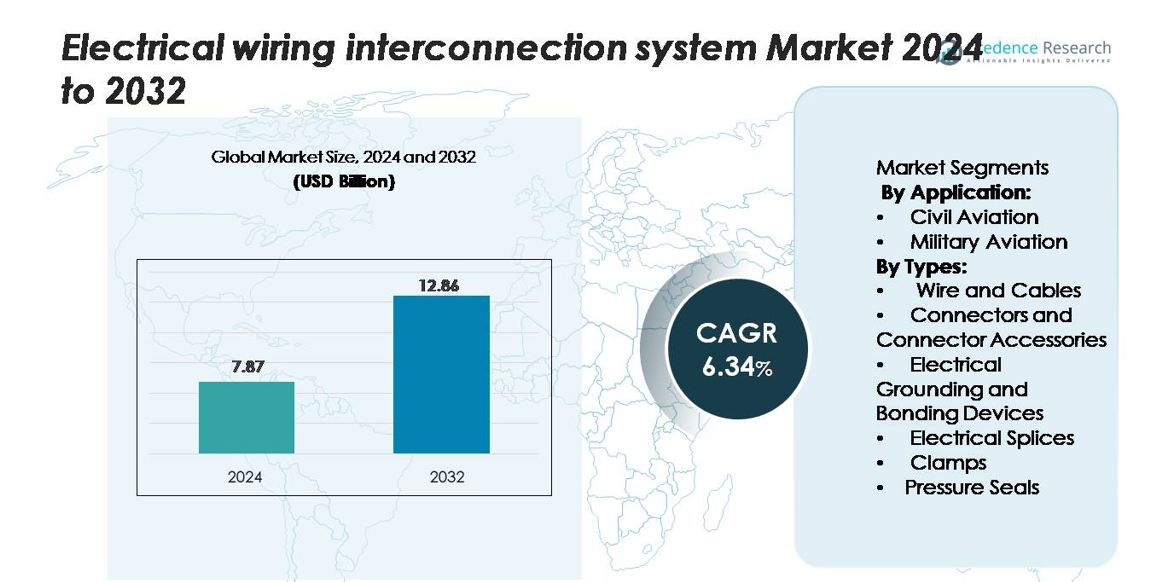
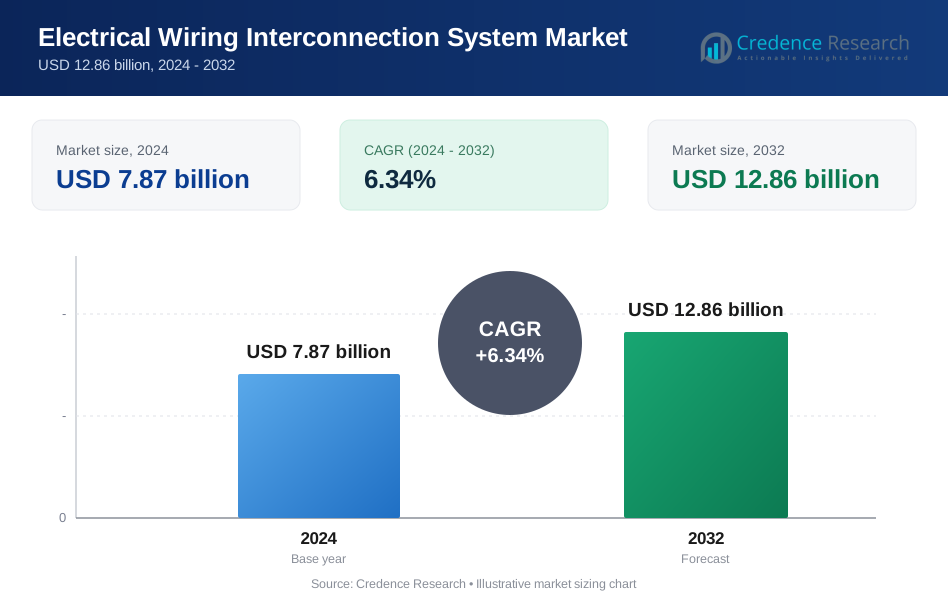
Electrical Wiring Interconnection System market size was valued at USD 7.87 billion in 2024 and is expected to reach USD 12.86 billion by 2032, growing at a CAGR of 6.34% during the forecast period.
| REPORT ATTRIBUTE | DETAILS |
|---|---|
| Historical Period | 2020-2023 |
| Base Year | 2024 |
| Forecast Period | 2025-2032 |
| Electrical Wiring Interconnection System Market Size 2024 | USD 7.87 billion |
| Electrical Wiring Interconnection System Market, CAGR | 6.34% |
| Electrical Wiring Interconnection System Market Size 2032 | USD 12.86 billion |
The Electrical Wiring Interconnection System market includes strong participation from global aerospace suppliers and cable manufacturers. Leading companies focus on lightweight wiring, high-density connectors, grounding systems, and fiber-optic data links that support modern avionics and in-flight connectivity. Long-term partnerships with major aircraft OEMs help secure production and aftermarket contracts across commercial and military fleets. North America leads the global market with 35% share in 2024, supported by advanced manufacturing hubs, defense spending, and fleet modernization. Europe follows with about 28% share due to strong OEM presence and sustainability-focused innovation, while Asia Pacific holds nearly 26% as the fastest-growing region driven by expanding commercial fleets and regional MRO growth.
Market Insights
- The Electrical Wiring Interconnection System market was valued at USD 7.87 billion in 2024 and is expected to reach USD 12.86 billion by 2032, growing at a CAGR of 6.34%.
- Rising aircraft production, fleet modernization, and digital avionics drive strong demand for lightweight wiring, fiber-optic cables, and high-density connectors.
- The market sees increasing adoption of advanced materials, EMI-shielded cables, and predictive maintenance tools, creating opportunities for suppliers offering high-performance and modular wiring systems.
- North America holds 35% of the market, followed by Europe at 28% and Asia Pacific at 26%, while wire and cables remain the dominant product segment with nearly 40% share.
- High installation cost, strict certification requirements, and complex aircraft architectures act as restraints, encouraging OEMs to adopt modular harnesses and advanced routing designs to reduce production time and maintenance delays.
Market Segmentation Analysis:
By Application
Civil aviation accounts for the dominant share of the Electrical Wiring Interconnection System market, holding close to 65% of total demand in 2024. Commercial aircraft production and fleet modernization programs increase the use of advanced wiring harnesses, fiber-optic cables, and lightweight insulation materials. Airlines focus on fuel efficiency, safety, and in-flight connectivity, driving higher adoption of high-density wiring systems. Growth in narrow-body and wide-body deliveries from major OEMs strengthens long-term demand. Military aviation also sees steady growth supported by upgrades in combat aircraft, UAV platforms, and communication systems requiring secure and shielded wiring architectures.
- For instance, Airbus reported installing more than 530 kilometers of wiring on each A350-900 aircraft, including over 100,000 individual cables supporting avionics, power distribution, and cabin systems.
By Types
Wire and cables represent the largest sub-segment, accounting for nearly 40% of the market in 2024 due to extensive use in power transmission, avionics, and communication networks across all aircraft classes. Aircraft manufacturers prefer lightweight, heat-resistant, and EMI-shielded wiring to improve performance and reduce maintenance cycles. Connectors and accessories gain traction as modular and quick-disconnect solutions improve serviceability and reduce assembly time. Electrical grounding devices and splices support safety compliance and stable power flow, while pressure seals and clamps protect wiring from vibration, moisture, and fuel exposure.
- For instance, TE Connectivity reported that its Raychem wire families withstand continuous temperatures up to 260°C and maintain electrical integrity after exposure to 2,000 hours of thermal aging.
Key Growth Drivers
Rising Aircraft Production and Fleet Modernization
Aircraft manufacturers increase production to meet rising passenger traffic and new route expansions. Commercial airlines replace aging fleets to improve fuel efficiency, safety, and cabin connectivity. Modern aircraft use high-density wiring, lightweight insulation, and fiber-optic solutions. These components reduce weight, cut fuel burn, and improve data transmission. New aircraft platforms also offer advanced avionics, entertainment systems, and fly-by-wire controls that need reliable wiring networks. Maintenance, repair, and overhaul (MRO) providers upgrade wiring during periodic inspections, strengthening aftermarket demand. Military fleets also adopt upgraded wiring for radar, sensors, and electronic warfare systems. This combined production and upgrade cycle drives large and recurring demand for interconnection systems.
- For instance, Boeing utilized an innovative 'more-electric' design in the 787 Dreamliner to significantly reduce the total length of individual wires compared to older aircraft. The total length of wiring in a 787 is approximately 60 to 70 miles (around 100 kilometers), supporting flight controls, power distribution, and digital cabin systems.
Growth in Electrification and Digital Avionics
Aviation systems adopt digital cockpit technologies, satellite communication, and smart navigation suites. These systems require secure data transfer and EMI-shielded wiring. Electric aircraft concepts, hybrid propulsion, and more-electric aircraft architectures increase wiring density throughout airframes. Power transmission lines, battery management lines, and thermal management circuits expand wiring needs. OEMs invest in improved cable routing, fault detection, and high-voltage connectors. Civil helicopters, UAVs, and advanced air mobility vehicles also use compact wiring modules and data buses. The shift toward digital control and electric propulsion raises long-term wiring demand in both commercial and military sectors.
Growing Emphasis on Safety and Reliability Standards
Regulators enforce strict rules on fire resistance, insulation, grounding, and shielding. Airlines demand wiring systems that lower fire risks, prevent electrical faults, and withstand vibration, heat, and moisture. Modern systems offer fault detection, arc protection, and lightweight shielding materials. High-reliability wiring reduces downtime and supports operational safety. OEMs adopt new materials such as PTFE insulation, nickel-coated conductors, and fiber-optic cable assemblies. These systems support demanding avionics, radar, and communication workloads without signal loss. As safety standards tighten worldwide, suppliers gain steady demand for certified, aircraft-grade wiring solutions.
Key Trends & Opportunities
Adoption of Lightweight Materials and Fiber-Optic Wiring
Aircraft OEMs reduce airframe weight to improve efficiency and payload capacity. Lightweight wiring reduces fuel cost and supports sustainable goals. Fiber-optic cables replace copper in several communication and sensor networks. They offer faster transmission, low signal loss, and immunity to electromagnetic interference. Wiring harness suppliers develop heat-resistant, flame-retardant, and flexible cable jackets for harsh conditions. Composite clamps, shielded splices, and quick-lock connectors improve maintenance speed. This shift creates opportunities for suppliers offering advanced materials and compact cable assemblies.
- For instance, Amphenol's high-speed fiber-optic interconnects, such as the ARINC 801 series, are designed to support data rates of 10 Gbps and beyond over multimode fiber, with the termini typically exhibiting insertion loss below 0.3 dB per mated pair, ensuring reliable performance in demanding avionics systems.
Expansion of Digital Maintenance and Health Monitoring Systems
Airlines adopt predictive maintenance to reduce component failures. Smart sensors, diagnostic software, and digital inspection tools monitor wiring health. Fault mapping systems predict insulation wear, grounding issues, and heat damage. MRO teams use automated routing and digital scanning to cut inspection time. OEMs integrate modular wiring blocks and quick-disconnect terminals to simplify servicing. This trend supports new business opportunities in software tools, maintenance contracts, and retrofitting of aging fleets.
- For instance, InterConnect Wiring specializes in the manufacturing and analysis of aircraft wiring harnesses, and has published studies on detecting faults and degradation mechanisms in wiring, often in conjunction with other testing methods or equipment.
Key Challenges
High Installation and Certification Costs
Aircraft wiring requires precise routing, shielding, and full certification. Certification follows strict testing for fire safety, EMI, and durability. Installation demands skilled labor, advanced tooling, and complex assembly processes. Any wiring issue can delay aircraft delivery or trigger costly maintenance. High material cost and long validation cycles challenge new suppliers. MRO tasks also take time because wires run through tight spaces. These factors increase cost pressure for OEMs and operators.
Complexity in Modern Aircraft Architectures
New aircraft platforms carry dense electronic systems and data networks. Wiring runs across wings, fuselage, cabin, and landing gear. Complex routing increases design time and risk of weight growth. EMI shielding, moisture protection, and grounding must meet strict standards. Integrating power lines, data cables, and avionics connectors without interference is difficult. OEMs need advanced 3D modeling, simulation, and modular harness systems. The complexity slows production and increases engineering workload for suppliers.
Regional Analysis
North America
North America holds the largest share of the Electrical Wiring Interconnection System market at nearly 35% in 2024, driven by strong aircraft production, defense spending, and constant fleet upgrades. The United States leads with major OEMs, MRO hubs, and aerospace suppliers focusing on lightweight wiring, EMI-shielded cables, and fiber-optic data links. The region invests in next-generation military aircraft, UAV programs, and more-electric aircraft platforms, increasing demand for advanced connectors and grounding systems. Strong regulatory standards and adoption of digital maintenance tools support continuous replacement and retrofit activity, strengthening aftermarket demand across commercial and military aviation.
Europe
Europe accounts for close to 28% of the market in 2024, supported by the presence of major aircraft manufacturers, defense contractors, and Tier-1 suppliers. The region focuses on lightweight cabling, high-density connectors, and eco-friendly materials to support sustainability goals. Growing investments in hybrid and electric propulsion aircraft drive higher wiring density and advanced power management circuits. Defense programs, including fighter jets and military transport aircraft, expand demand for shielded cables and radar-grade wiring. Strong MRO networks in France, Germany, and the U.K. encourage upgrades and retrofits, boosting long-term demand for certified wiring solutions.
Asia Pacific
Asia Pacific holds nearly 26% of the global market in 2024 and is the fastest-growing region due to expanding commercial fleets, rising passenger traffic, and new aircraft assembly programs. China, India, Japan, and Southeast Asian countries increase purchases of narrow-body aircraft and regional jets, creating large OEM and aftermarket opportunities. The region invests in modern avionics, in-flight entertainment, and predictive maintenance, boosting demand for high-capacity wiring harnesses, connectors, and grounding systems. Local manufacturing and MRO expansion strengthen supply chains, while military modernization programs in China and India add significant demand for secure communication wiring.
Middle East & Africa
Middle East & Africa account for nearly 6% of the market in 2024, supported by strong airline fleets and airport expansion. Gulf carriers upgrade wide-body aircraft and invest in premium cabin connectivity, driving adoption of fiber-optic wiring and advanced cabin systems. Regional MRO growth in the UAE, Saudi Arabia, and Qatar increases replacement and retrofit demand. Military aviation programs also require shielded wiring for radar, surveillance, and electronic warfare. Africa sees gradual growth due to commercial fleet expansions and infrastructure development, though budget constraints limit large-scale adoption of advanced wiring solutions.
Latin America
Latin America holds close to 5% of the market in 2024, driven by recovering airline orders and modernization of regional jets. Brazil and Mexico lead the demand with aircraft manufacturing, pilot training hubs, and growing MRO activity. Airlines in the region gradually replace aging fleets and adopt digital avionics, increasing need for lightweight wiring, connectors, and fault-resistant cable assemblies. Economic fluctuations limit new aircraft purchases, but aftermarket demand remains steady through maintenance, retrofits, and safety compliance. Government investments in defense aircraft and surveillance fleets also add niche demand for advanced wiring systems across key countries.
Market Segmentations:
By Application
- Civil Aviation
- Military Aviation
By Type
- Wire and Cables
- Connectors and Connector Accessories
- Electrical Grounding and Bonding Devices
- Electrical Splices
- Clamps
- Pressure Seals
By Geography
- North America
- U.S.
- Canada
- Mexico
- Europe
- Germany
- France
- U.K.
- Italy
- Spain
- Rest of Europe
- Asia Pacific
- China
- Japan
- India
- South Korea
- South-east Asia
- Rest of Asia Pacific
- Latin America
- Brazil
- Argentina
- Rest of Latin America
- Middle East & Africa
- GCC Countries
- South Africa
- Rest of the Middle East and Africa
Competitive Landscape
The Electrical Wiring Interconnection System market features a competitive landscape driven by global aerospace OEMs, Tier-1 suppliers, and specialized cable manufacturers. Key companies compete on reliability, material innovation, weight reduction, and compliance with fire and EMI safety standards. Major aircraft suppliers collaborate closely with wiring manufacturers to design harnesses, connectors, and grounding systems tailored for modern avionics, entertainment platforms, and fly-by-wire controls. Suppliers introduce lightweight wires, fiber-optic assemblies, and corrosion-resistant shields to improve fuel efficiency and data integrity. Partnerships with aerospace OEMs secure long-term contracts across commercial and military fleets. Aftermarket players expand MRO services, offering replacement harnesses, retrofitting of aging aircraft, and predictive maintenance tools. Continuous R&D investment helps companies meet evolving regulatory needs while competing for upcoming electric and hybrid aircraft programs.
Key Player Analysis
- GKN Aerospace
- Amphenol
- Co-Operative Industries Aerospace & Defense (Cia&D)
- Latecoere
- TE Connectivity
- Ametek
- Interconnect Wiring
- Ducommun
- UTC (Rockwell Collins)
- Safran
Recent Developments
- In 2024, Ametek announced plans to showcase cutting-edge aerospace innovations at the Farnborough International Airshow, particularly new interconnect and wiring harness solutions.
- In April 2024, Safran Electrical & Power announces the launch of GENeUSCONNECT, a line of high-power electrical harnesses, which completes its range of electrical systems dedicated to the new generations of all-electric and hybrid aircraft.
- In July 2023, TE Connectivity (TE), a world leader in connectors and sensors, has been a driving force behind the new IEC 63171-7 international electrotechnical standard, helping Single Pair Ethernet (SPE) interconnect technology to gain faster acceptance in the industry.
- In March 2023, New surface-mount RF switch connectors from Linx Technologies (Linx), is a part of TE Connectivity (TE), a world leader in connectors and sensors, provide high isolation between ports for improved data accuracy
Report Coverage
The research report offers an in-depth analysis based on Application, Type and Geography. It details leading market players, providing an overview of their business, product offerings, investments, revenue streams, and key applications. Additionally, the report includes insights into the competitive environment, SWOT analysis, current market trends, as well as the primary drivers and constraints. Furthermore, it discusses various factors that have driven market expansion in recent years. The report also explores market dynamics, regulatory scenarios, and technological advancements that are shaping the industry. It assesses the impact of external factors and global economic changes on market growth. Lastly, it provides strategic recommendations for new entrants and established companies to navigate the complexities of the market.
Future Outlook
- Aircraft OEMs will increase adoption of lightweight and heat-resistant wiring to improve fuel efficiency.
- Fiber-optic cables will replace traditional copper lines in high-speed data and communication networks.
- More-electric and hybrid aircraft platforms will raise wiring density across power and control systems.
- Smart harnesses with fault detection and health monitoring will support predictive maintenance.
- Modular connectors and plug-and-play wiring designs will reduce installation time during production.
- Advanced shielding solutions will improve EMI protection for radar, sensors, and digital avionics.
- Defense modernization programs will expand demand for secure and rugged wiring solutions.
- Growing MRO activity will increase replacement and retrofit opportunities for aging aircraft.
- Automation and 3D modeling in wiring design will improve routing accuracy and reduce engineering time.
- Emerging electric air taxis and UAV platforms will create new adoption opportunities for compact wiring systems.
Request a Free Sample
Fill in your details and we'll send you a free sample report.
- Sample data tables & charts
- Research methodology
Need a Custom Version of This Report?
Tailor the scope, geography, or segments to your exact requirements.
- Custom geography or segment scope
- Direct access to our analyst team
Frequently Asked Questions
What is the current market size for the Electrical Wiring Interconnection System market, and what is its projected size in 2032?
At what Compound Annual Growth Rate is the Electrical Wiring Interconnection System market projected to grow between 2025 and 2032?
Which Electrical Wiring Interconnection System segment held the largest share in 2024?
What are the primary factors fueling the growth of the Electrical Wiring Interconnection System market?
Who are the leading companies in the Electrical Wiring Interconnection System market?
Which region commanded the largest share of the Electrical Wiring Interconnection System market in 2024?
Table of Content
Chapter 1. Report Introduction
- 1.1 Report Description & Purpose
- 1.1.1 Report Title & Market Definition
- 1.1.2 Unique Selling Propositions (USP) & Key Differentiators
- 1.1.3 Value Proposition for Stakeholders
- 1.2 Research Objectives
- 1.2.1 Market Sizing Objectives (Volume & Revenue)
- 1.2.2 Segmentation Objectives
- 1.2.3 Competitive Intelligence Objectives
- 1.2.4 Forecast & Scenario Objectives
- 1.3 Report Scope
- 1.3.1 Electrical Wiring Interconnection System Scope – Types & Subtypes Covered
- 1.3.2 Geographic Scope – Regions & Countries Covered
- 1.3.3 Historical Period, Base Year & Forecast Period (2024; forecast to 2032)
- 1.3.4 Inclusions & Exclusions
- 1.4 HS Code & Classification Framework
- 1.5 Currency, Units & Pricing Basis
- 1.6 Target Stakeholders
- 1.7 Limitations & Assumptions
Chapter 2. Executive Summary
- 2.1 Global Electrical Wiring Interconnection System Market Snapshot
- 2.1.1 Market Size – Historical (2024) & Forecast (2024-2032) (2024: USD 7.87 billion → 2032: USD 12.86 billion)
- 2.1.2 Volume & Revenue – Global Totals
- 2.1.3 Key Market Highlights – Top Five Facts
- 2.2 Electrical Wiring Interconnection System Market Segmentation Snapshot
- 2.2.1 Market Split by Region – 2024 vs. 2032
- 2.3 Competitive Snapshot
- 2.3.1 Top 10 Players by Revenue Share – 2024
- 2.3.2 Top 10 Players by Volume Share – 2024
- 2.3.3 Recent Strategic Developments (18-Month Summary)
- 2.4 Key Investment Highlights & Strategic Conclusions
Chapter 3. Electrical Wiring Interconnection System Market Dynamics & Industry Analysis
- 3.1 Market Overview & Context
- 3.1.1 Electrical Wiring Interconnection System Market Position in the Broader Automotive Value Chain
- 3.1.2 OEM vs. Replacement Market Dynamics
- 3.1.3 Market Maturity & Development Stage by Region
- 3.2 Electrical Wiring Interconnection System Market Drivers
- 3.3 Electrical Wiring Interconnection System Market Restraints & Challenges
- 3.4 Electrical Wiring Interconnection System Market Opportunities
- 3.5 Porter's Five Forces Analysis
- 3.5.1 Threat of New Entrants
- 3.5.2 Bargaining Power of Suppliers
- 3.5.3 Bargaining Power of Buyers
- 3.5.4 Threat of Substitutes
- 3.5.5 Competitive Rivalry – Intensity Assessment
- 3.6 Electrical Wiring Interconnection System Value Chain Analysis
- 3.6.1 Upstream – Raw Material/Input Suppliers
- 3.6.1.1 Raw Material/Input 1
- 3.6.1.2 Raw Material/Input 2
- 3.6.1.3 Raw Material/Input 3
- 3.6.2 Midstream – Production/Manufacturing/Service Delivery
- 3.6.2.1 Production/Process Overview
- 3.6.2.2 Key Facility Locations & Capacity by Manufacturer
- 3.6.3 Downstream – Distribution & End Consumer
- 3.6.3.1 Primary Channel – B2B/OEM
- 3.6.3.2 Secondary Channels – Dealer, Retail, Online, Direct
- 3.6.4 Value Chain Profitability Analysis
- 3.6.1 Upstream – Raw Material/Input Suppliers
- 3.7 PESTEL Analysis
- 3.7.1 Political Factors
- 3.7.2 Economic Factors
- 3.7.3 Social Factors
- 3.7.4 Technological Factors
- 3.7.5 Environmental Factors
- 3.7.6 Legal Factors
- 3.8 Electrical Wiring Interconnection System Supply Chain Analysis
- 3.8.1 Raw Material/Input Supply Risk Assessment
- 3.8.2 Manufacturing Concentration Risk (Geographic Exposure)
- 3.8.3 Trade Disruption Impact Analysis
- 3.9 Regulatory & Policy Landscape
Note: The regulatory and policy landscape section covers regulations based on their applicability to the market, Electrical Wiring Interconnection System category, geography, and scope of the study. Only regulatory frameworks with a material impact on operations, compliance, trade, sustainability, or market access are analyzed in detail.
Chapter 4. Key Investment Pockets & Opportunity Analysis
- 4.1 Electrical Wiring Interconnection System Market Attractiveness Analysis
- 4.1.1 By Region – Investment Attractiveness Matrix (Volume × CAGR)
- 4.2 Absolute Revenue Growth Opportunity
- 4.2.1 By Region – Absolute USD Growth Through 2032
- 4.3 Incremental Volume Opportunity
- 4.3.1 By Region – Incremental Volume Through 2032
- 4.3.2 Segment – Incremental Volume
- 4.4 Emerging Submarket Opportunity Deep Dive (Subject to Applicability)
- 4.5 Emerging Market Opportunity Scorecards
- 4.5.1 United States
- 4.5.2 Europe
- 4.5.3 Asia
- 4.5.4 Middle East & Africa
Note: Emerging Market Opportunity Scorecards will be included based on relevance and strategic importance. Regions listed are indicative and may vary depending on data availability and market dynamics.
Chapter 5. Electrical Wiring Interconnection System Import-Export Analysis & Trade Flows
- 5.1 Global Trade Overview
- 5.1.1 Global Export Value by Country (2024)
- 5.1.2 Global Export Volume by Country (2024)
- 5.1.3 Global Import Value by Country (2024)
- 5.1.4 Global Import Volume by Country (2024)
- 5.1.5 Net Trade Balance by Country (2024)
- 5.2 Export Analysis – Segment
- 5.2.1 Type 1 (HS Code)
- 5.2.2 Type 2 (HS Code)
- 5.2.3 Type 3 (HS Code)
- 5.2.4 Type 4 (HS Code)
- 5.2.5 Type 5 (HS Code)
- 5.3 Import Analysis – Segment
- 5.3.1 Type 1 (HS Code)
- 5.3.2 Type 2 (HS Code)
- 5.3.3 Type 3 (HS Code)
- 5.3.4 Type 4 (HS Code)
- 5.3.5 Type 5 (HS Code)
- 5.4 Average Unit Trade Prices
- 5.4.1 Average Export Price – Segment & Country
- 5.4.2 Average Import Price – Segment & Source Country
- 5.4.3 Price Trends (2024)
- 5.5 Key Trade Route Analysis
- 5.5.1 Trade Route 1
- 5.5.2 Trade Route 2
- 5.5.3 Trade Route 3
- 5.5.4 Trade Route 4
- 5.5.5 Trade Route 5
- 5.6 Trade Policy Impact Assessment
- 5.6.1 US Anti-Dumping & Section 301 Tariffs
- 5.6.2 EU Customs Union Impact
- 5.6.3 Major Free Trade Agreements
- 5.6.4 USMCA Rules of Origin
Note: Trade policy analysis will be included only where relevant to the Electrical Wiring Interconnection System market.
Chapter 6. Competitive Landscape & Company Benchmarking
- 6.1 Electrical Wiring Interconnection System Market Concentration & Structure
- 6.1.1 Herfindahl-Hirschman Index (HHI) – vs. 2024
- 6.1.2 Tier 1, Tier 2 & Tier 3 Market Structure
- 6.1.3 Global, Regional & Local Player Dynamics
- 6.2 Electrical Wiring Interconnection System Market Share Analysis – 2024
- 6.2.1 Global Revenue Share by Company
- 6.2.2 Global Volume Share by Company
- 6.2.3 Regional Revenue Share
- 6.2.4 Market Share Evolution ( vs. 2024)
- 6.2.5 OEM Segment Share by Company
- 6.2.6 Replacement Segment Share by Company
- 6.3 Production/Delivery Capacity & Facility Analysis
- 6.3.1 Global Installed Capacity
- 6.3.2 Capacity Utilization Rates
- 6.3.3 Production/Output Volume
- 6.3.4 Facility Locations & Capacity Map
- 6.3.5 Planned Capacity Additions
- 6.4 Electrical Wiring Interconnection System Competitive Benchmarking Matrix
- 6.4.1 Revenue, Volume, CAGR & Profitability Comparison
- 6.4.2 Channel Revenue Mix
- 6.4.3 Geographic Revenue Exposure
- 6.4.4 R&D Intensity
- 6.4.5 Sustainability Maturity
- 6.5 Strategic Developments in Electrical Wiring Interconnection System (Last 24 Months)
- 6.5.1 Mergers, Acquisitions & Divestments
- 6.5.2 New Electrical Wiring Interconnection System Launches
- 6.5.3 Facility Expansions
- 6.5.4 Strategic Alliances, Joint Ventures & Partnerships
- 6.5.5 Distribution Expansion & Market Entry
- 6.5.6 Sustainability & ESG Initiatives
- 6.6 Competitive Strategy Mapping
- 6.6.1 Leader, Challenger, Follower & Niche Classification
- 6.6.2 Pricing Strategy Comparison
- 6.6.3 Channel Strategy Matrix
Note: Strategic developments are included based on their materiality and the availability of reliable information.
Chapter 7. Global Electrical Wiring Interconnection System Market – By Distribution Channel
- 7.1 Segment Overview
- 7.1.1 Volume & Revenue Split by Channel (2024 & 2032)
- 7.1.2 Channel Mix Evolution (2024-2032)
Chapter 8. Regional Market Analysis – Global Overview
- 8.1 Global Regional Overview
- 8.1.1 Regional Volume Share
- 8.1.2 Regional Revenue Share
- 8.1.3 Regional Volume by Region
- 8.1.4 Regional Revenue by Region
- 8.1.5 Regional Forecast Through 2032
- 8.2 Cross-Regional Segment Analysis
- 8.2.1 By Distribution Channel
- 8.2.2 By Brand/Price Tier
Chapter 9. North America Electrical Wiring Interconnection System Market
- 9.1 United States
- 9.2 Canada
- 9.3 Mexico
Chapter 10. Europe Electrical Wiring Interconnection System Market
- 10.1 Germany
- 10.2 France
- 10.3 Italy
- 10.4 United Kingdom
- 10.5 Spain
- 10.6 Poland
- 10.7 Russia
- 10.8 Netherlands
- 10.9 Belgium
- 10.10 Sweden
- 10.11 Denmark
- 10.12 Norway
- 10.13 Rest of Europe
Chapter 11. Asia Pacific Electrical Wiring Interconnection System Market
- 11.1 China
- 11.2 India
- 11.3 Japan
- 11.4 South Korea
- 11.5 Thailand
- 11.6 Indonesia
- 11.7 Vietnam
- 11.8 Malaysia
- 11.9 Australia
- 11.10 Rest of Asia Pacific
Chapter 12. Latin America Electrical Wiring Interconnection System Market
- 12.1 Brazil
- 12.2 Argentina
- 12.3 Colombia
- 12.4 Chile
- 12.5 Rest of Latin America
Chapter 13. Middle East Electrical Wiring Interconnection System Market
- 13.1 Saudi Arabia
- 13.2 United Arab Emirates
- 13.3 Turkey
- 13.4 Israel
- 13.5 Iran
- 13.6 Rest of the Middle East
Chapter 14. Africa Electrical Wiring Interconnection System Market
- 14.1 South Africa
- 14.2 Egypt
- 14.3 Nigeria
- 14.4 Morocco
- 14.5 Rest of Africa
Chapter 15. Electrical Wiring Interconnection System Company Profiles
- 15.1 [Company 01]
- 15.1.1 Company Overview
- 15.1.2 Key Management Personnel
- 15.1.3 Products & Services Portfolio
- 15.1.4 Financial Performance
- 15.1.5 Key Market Focus & Geographic Presence
- 15.1.6 Recent Developments & Strategic Initiatives
Note: The company profile list is preliminary and may change based on research findings, market developments, data availability, and client requirements.
Chapter 16. Appendices
- Appendix A – List of Abbreviations & Acronyms
- Appendix B – Industry Classification Code Reference – Full Series
- Appendix C – Production & Capacity Data Tables
- Appendix D – End-Use & Demand Base Tables
- Appendix E – Consumption & Replacement Rate Assumptions
- Appendix F – ASP Reference Tables
- Appendix G – Manufacturing & Facility Database
- Appendix H – Import-Export Data Tables
- Appendix I – Regulatory Summary Tables
- Appendix J – Primary Research Participant List (Anonymized)
- Appendix K – Primary Research Questionnaire Framework
- Appendix L – Data Sources & Bibliography
- Appendix M – Market Size Divergence & Source Comparison
Chapter 17. Research Methodology
- 17.1 Research Framework & Philosophy
- 17.2 Secondary Research – Sources, Hierarchy & Data Extraction
- 17.3 Data Modeling – Bottom-Up & Top-Down Market Sizing
- 17.4 Primary Research – Stakeholder Framework, LOI & Sample Sizes
- 17.5 Forecast Methodology – Regression, Scenario & Sensitivity Analysis
- 17.6 Quality Control – Four-Layer Validation Framework
- 17.7 Limitations & Standard Assumptions
- 17.8 Disclaimer
