
Market Overview:
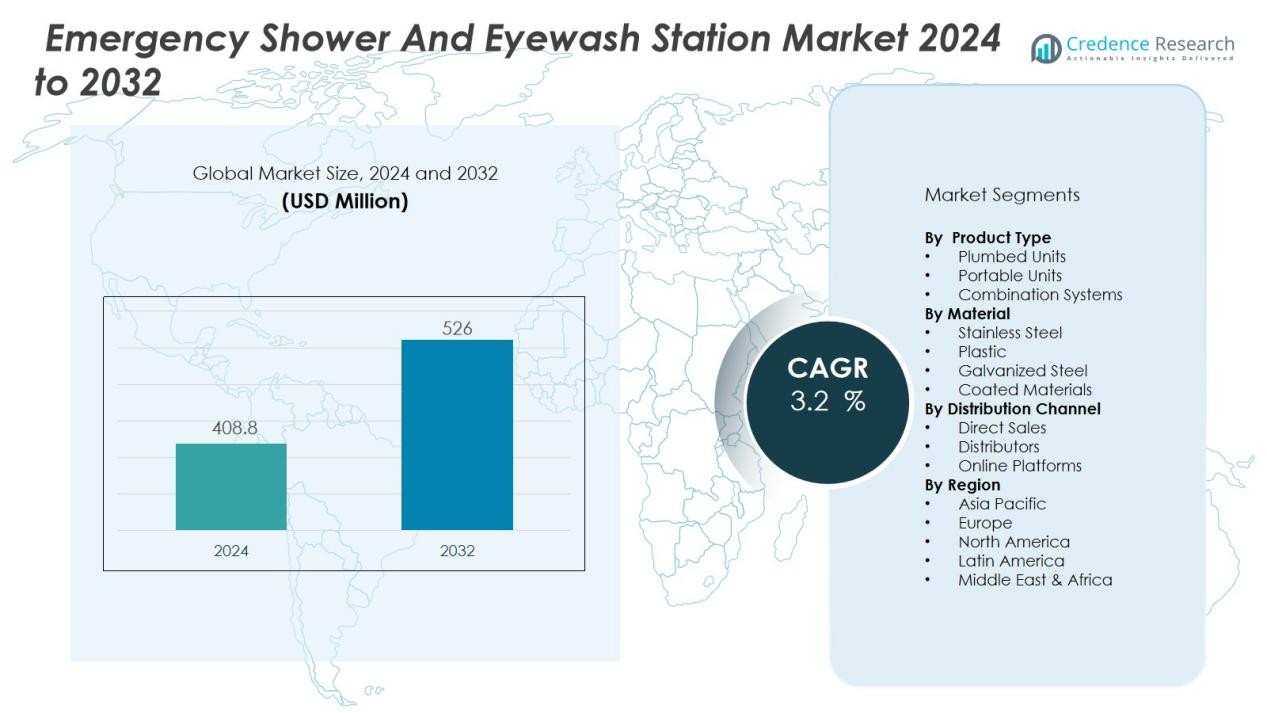
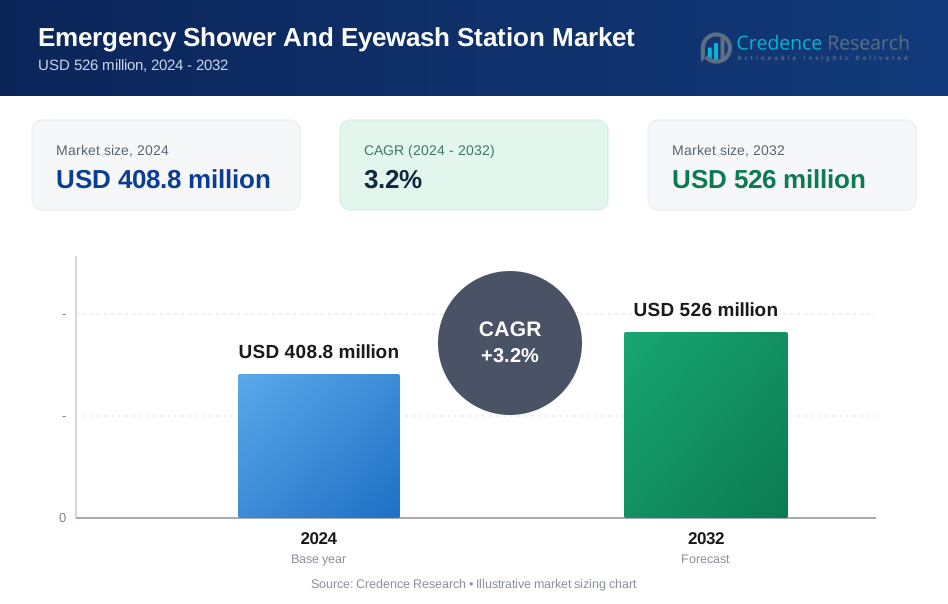
The emergency shower and eyewash station market size was valued at USD 408.8 million in 2024 and is anticipated to reach USD 526 million by 2032, at a CAGR of 3.2 % during the forecast period (2024-2032).
| REPORT ATTRIBUTE | DETAILS |
|---|---|
| Historical Period | 2020-2023 |
| Base Year | 2024 |
| Forecast Period | 2025-2032 |
| Emergency Shower and Eyewash Station Market Size 2024 | USD 408.8 Million |
| Emergency Shower and Eyewash Station Market, CAGR | 3.2 % |
| Emergency Shower and Eyewash Station Market Size 2032 | USD 526 Million |
Market drivers include the growing awareness of occupational hazards, the rise in industrial accidents, and the enforcement of compliance with safety regulations by agencies such as OSHA and ANSI. Companies are prioritizing employee safety by investing in advanced emergency response systems, including plumbed and portable shower and eyewash stations. The integration of features like temperature control, enhanced durability, and easy maintenance is also fueling adoption across end-use industries.
Regionally, North America holds the largest share due to strict safety regulations and the presence of leading manufacturers. Europe follows with strong demand supported by stringent workplace safety norms and industrial infrastructure. Asia-Pacific is projected to record the fastest growth, supported by rapid industrialization, expanding manufacturing bases, and increasing regulatory compliance in countries like China and India. This regional mix is shaping a competitive and evolving global market landscape.
Market Insights:
- The emergency shower and eyewash station market was valued at USD 408.8 million in 2024 and is expected to reach USD 526 million by 2032.
- Strict workplace safety regulations from OSHA, ANSI, and EU drive mandatory adoption across hazardous industries.
- Rising industrial accidents and workplace hazards are pushing employers to invest in advanced safety equipment.
- Manufacturers are focusing on technological advancements such as temperature-controlled systems and smart monitoring solutions.
- High installation costs and maintenance needs remain a barrier for smaller enterprises and cost-sensitive regions.
- North America leads with 42% share, supported by strong regulations and advanced industrial infrastructure.
- Asia-Pacific is the fastest-growing region, driven by rapid industrialization, manufacturing expansion, and stronger compliance standards.
Market Drivers:
Stringent Workplace Safety Regulations Driving Mandatory Adoption:
The emergency shower and eyewash station market is strongly driven by global workplace safety regulations. Agencies such as OSHA, ANSI, and EU standards mandate installation in hazardous environments. Industries handling chemicals, pharmaceuticals, and oil and gas products must comply with these requirements. It ensures consistent demand for reliable safety equipment across both developed and emerging economies.
- For instance, Pfizer conducts comprehensive analytical testing for its COVID-19 vaccine manufacturing, submitting Certificates of Analysis for each drug product lot at least 48 hours prior to vaccine distribution, with their injectable products undergoing 100% visual inspection testing to meet USP <1> Injections standards.
Rising Incidents of Workplace Hazards Increasing Demand:
Industrial accidents involving chemical spills, toxic fumes, and fire hazards continue to increase. The emergency shower and eyewash station market benefits from greater employer focus on minimizing risks. Quick response systems are critical in preventing long-term health damage. It creates a strong case for companies to invest in high-quality emergency equipment to protect their workforce.
- For Instance, In August 2024, Victor Joe Gomez Sr., a contract electrician, was fatally electrocuted at Tesla's Austin Gigafactory. A subsequent OSHA investigation led to three serious safety citations against Tesla in early 2025, with penalties totaling $49,650.
Technological Advancements Enhancing Product Efficiency:
Manufacturers are introducing advanced features such as temperature-controlled water flow, corrosion-resistant materials, and easy installation systems. The emergency shower and eyewash station market is advancing with smart monitoring options that ensure readiness. Such innovations improve user confidence and operational reliability. It positions modern equipment as a vital part of workplace safety strategies.
Expanding Industrialization and Global Infrastructure Development:
Rapid growth in industrial activities across Asia-Pacific, Latin America, and the Middle East boosts installations of safety equipment. The emergency shower and eyewash station market is gaining traction in new manufacturing hubs and infrastructure projects. Governments are enforcing safety norms to align with international standards. It supports large-scale adoption across multiple end-user industries worldwide.
Market Trends:
Integration of Smart Technologies and Product Innovations:
The emergency shower and eyewash station market is experiencing a shift toward advanced technologies that enhance safety and compliance. Manufacturers are adopting smart sensors, automated water flow systems, and self-testing features to improve reliability. Temperature-controlled units are in high demand, particularly in regions with extreme climates. It is driving innovation in product design to ensure consistent performance across diverse work environments. Portable and mobile units are also gaining popularity for temporary worksites and industries with limited infrastructure. The trend highlights a growing emphasis on convenience, efficiency, and adaptability in workplace safety solutions.
- For Instance, Bradley Corporation manufactures a line of Halo™ emergency eyewash and eye/face wash stations that are manually operated and designed to exceed ANSI/ISEA Z358.1 standards.
Growing Sustainability Focus and Customization Demand:
Sustainability is emerging as a key trend, with companies developing water-efficient and eco-friendly emergency equipment. The emergency shower and eyewash station market is seeing greater demand for units built with corrosion-resistant, recyclable, and long-lasting materials. Customization is also rising, with end users seeking tailored designs that fit specific site conditions and industry needs. It is encouraging suppliers to offer modular configurations that enhance flexibility and reduce costs. Increasing collaborations between safety solution providers and industrial clients are driving this trend further. Together, these developments reinforce the market’s evolution toward sustainable, durable, and client-focused safety systems.
- For Instance, In February 2025, Honeywell and AM Green signed a memorandum of understanding to assess the feasibility of producing sustainable aviation fuel and green methanol in India
Market Challenges Analysis:
High Installation Costs and Maintenance Complexity Limiting Adoption:
The emergency shower and eyewash station market faces challenges from high upfront costs and ongoing maintenance needs. Installing plumbed units often requires significant infrastructure investment, which can discourage smaller enterprises. Regular inspections, water testing, and compliance checks further increase operational expenses. It creates a financial burden for organizations with limited budgets. Complex installation processes in remote or temporary sites add to the difficulty. These factors restrict wider adoption, particularly in developing economies where cost sensitivity is high.
Lack of Awareness and Inconsistent Regulatory Enforcement:
Limited awareness among employers about safety compliance continues to hinder market growth. The emergency shower and eyewash station market depends on strong enforcement of workplace safety standards. Inconsistent implementation across regions results in varying levels of adoption. It reduces the urgency for some organizations to prioritize investments in emergency equipment. Inadequate training of staff on proper usage further limits effectiveness. Gaps in regulatory enforcement create uneven demand across global markets, slowing consistent growth potential.
Market Opportunities:
Expanding Industrialization and Growing Safety Investments in Emerging Markets:
The emergency shower and eyewash station market holds significant opportunities in rapidly industrializing regions. Expanding manufacturing sectors in Asia-Pacific, Latin America, and the Middle East are driving new demand. Governments are enforcing stricter occupational safety regulations, creating strong growth potential for safety equipment providers. It positions suppliers to capitalize on rising investments in oil and gas, chemicals, and pharmaceuticals. Increasing focus on workplace safety among multinational corporations operating in these regions also strengthens adoption. These developments highlight emerging markets as a key growth frontier.
Innovation in Portable Solutions and Sustainable Product Designs :
Rising demand for portable and mobile safety units presents new opportunities for manufacturers. The emergency shower and eyewash station market is benefiting from the shift toward lightweight, easy-to-install equipment suited for temporary sites. It opens doors for growth in construction, mining, and field-based industries. Eco-friendly and water-efficient designs are also gaining traction, aligning with global sustainability goals. Companies offering customizable and durable solutions can capture greater market share. This trend creates strong opportunities for innovation-driven players to differentiate in a competitive landscape.
Market Segmentation Analysis:
By Product Type:
The emergency shower and eyewash station market is segmented into plumbed units, portable units, and combination systems. Plumbed units dominate due to their reliability and continuous water supply, making them suitable for large facilities. Portable units are gaining traction in industries such as construction and mining where mobility is critical. It creates opportunities for manufacturers to design lightweight and easy-to-install models. Combination systems offering both shower and eyewash functions are preferred in high-risk industries to ensure full-body protection.
- For instance, Haws offers the Model 7501 portable eyewash station, which weighs just 9 kilograms when empty and can be installed and activated within five minutes at remote worksites.
By Material:
Materials play a vital role in durability and performance across end-use industries. Stainless steel units lead the segment due to their corrosion resistance and long operational life. Plastic-based stations remain popular in cost-sensitive markets and lightweight applications. The emergency shower and eyewash station market is also seeing demand for galvanized and coated materials to withstand harsh chemicals. It ensures reliable performance in oil and gas, chemicals, and pharmaceuticals. Manufacturers continue to innovate with eco-friendly and recyclable materials to align with sustainability trends.
- For instance, SPEAKMAN’s GravityFlo SE-4300 portable eyewash station weighs approximately 10.4 kg when empty, making it suitable for rapid deployment in laboratories and temporary worksites where mobility is paramount.
By Distribution Channel:
Distribution channels are divided into direct sales, distributors, and online platforms. Direct sales dominate in industries requiring tailored solutions and long-term service contracts. Distributors provide access to diverse markets and support rapid adoption in emerging regions. The emergency shower and eyewash station market is also expanding through online platforms that cater to smaller enterprises. It reflects growing demand for cost-effective and quick procurement methods. Digital channels are set to play a greater role in reaching untapped customer segments.
Segmentations:
By Product Type:
- Plumbed Units
- Portable Units
- Combination Systems
By Material:
- Stainless Steel
- Plastic
- Galvanized Steel
- Coated Materials
By Distribution Channel:
- Direct Sales
- Distributors
- Online Platforms
By Region:
- North America
- U.S.
- Canada
- Mexico
- Europe
- Germany
- France
- U.K.
- Italy
- Spain
- Rest of Europe
- Asia Pacific
- China
- Japan
- India
- South Korea
- South-east Asia
- Rest of Asia Pacific
- Latin America
- Brazil
- Argentina
- Rest of Latin America
- Middle East & Africa
- GCC Countries
- South Africa
- Rest of the Middle East and Africa
Regional Analysis:
North America:
North America accounts for 42% market share in the emergency shower and eyewash station market. The region benefits from strict workplace safety standards enforced by OSHA and ANSI regulations. Industrial sectors such as chemicals, pharmaceuticals, and oil and gas drive strong demand for advanced safety equipment. It supports continuous replacement and upgrade cycles, ensuring steady sales growth. Companies in the region are also adopting smart safety solutions with temperature control and self-testing features. Strong investments in infrastructure and industrial expansions further sustain the dominance of North America.
Europe:
Europe holds 28% market share, supported by stringent EU workplace safety directives. Industries such as manufacturing, energy, and construction remain key adopters of safety stations. The emergency shower and eyewash station market benefits from rising R&D investments and advanced industrial infrastructure in the region. It encourages companies to integrate eco-friendly and durable designs aligned with sustainability goals. Demand is strong in Germany, France, and the UK, driven by strict compliance norms. Continuous emphasis on worker safety across industrial sectors reinforces steady growth prospects in Europe.
Asia-Pacific:
Asia-Pacific captures 21% market share, driven by rapid industrialization and rising enforcement of safety standards. The emergency shower and eyewash station market gains momentum from expanding pharmaceutical, oil and gas, and construction industries in China and India. It benefits from increasing investments by multinational corporations establishing manufacturing bases in the region. Governments are strengthening safety frameworks, which is improving adoption across multiple industries. Local and international manufacturers are expanding distribution networks to meet rising demand. Strong economic growth and industrial development make Asia-Pacific a critical growth engine for the global market.
Key Player Analysis:
- Aqua Safety Showers
- Dragerwerk
- Bradley Company
- Denios
- Encon Safety Products
- Gelis
- FSP-Tech
- Guardian Equipment
- Haws
- Honeywell International
- Hughes Safety Showers
- Justrite
Competitive Analysis:
The emergency shower and eyewash station market is highly competitive, shaped by global and regional players offering diverse product portfolios. Key companies include Aqua Safety Showers, Dragerwerk, Bradley Company, Denios, Encon Safety Products, Gelis, and FSP-Tech, each focusing on safety compliance and product innovation. It is driven by growing demand for reliable and durable solutions across industries such as oil and gas, chemicals, and pharmaceuticals. Manufacturers compete on quality, advanced features, and after-sales support to strengthen market presence. Partnerships with industrial clients and distributors expand access to emerging regions, while product customization improves competitiveness. The market also favors companies investing in sustainable materials and smart technologies, ensuring alignment with evolving industry needs.
Recent Developments:
- In April 2025, Drägerwerk AG & Co. KGaA reported a record order intake for medical technology products, reaching the highest levels since 2020, with strong demand across its product portfolio.
- In July 2025, Drägerwerk received Frost & Sullivan’s 2025 Global Company of the Year recognition for excellence and innovation in respiratory devices.
- In January 2025, Denios introduced a new product line of non-sparking tools designed for safe operations in hazardous environments such as chemical plants and grain silos.
Report Coverage:
The research report offers an in-depth analysis based on Product Type, Material, Distribution Channel and Region. It details leading Market players, providing an overview of their business, product offerings, investments, revenue streams, and key applications. Additionally, the report includes insights into the competitive environment, SWOT analysis, current Market trends, as well as the primary drivers and constraints. Furthermore, it discusses various factors that have driven Market expansion in recent years. The report also explores Market dynamics, regulatory scenarios, and technological advancements that are shaping the industry. It assesses the impact of external factors and global economic changes on Market growth. Lastly, it provides strategic recommendations for new entrants and established companies to navigate the complexities of the Market.
Future Outlook:
- The emergency shower and eyewash station market will continue to grow with stronger regulatory enforcement across industries.
- Rising awareness of workplace safety will drive organizations to invest in advanced safety equipment.
- Technological integration such as smart monitoring systems will enhance reliability and compliance tracking.
- Portable and mobile units will see higher adoption in construction, mining, and temporary industrial sites.
- Sustainability-focused designs using water-efficient and recyclable materials will gain greater preference.
- Emerging markets in Asia-Pacific, Latin America, and the Middle East will present strong expansion opportunities.
- Manufacturers will focus on customization and modular solutions to meet diverse industry needs.
- Partnerships between safety equipment providers and large industrial operators will strengthen market penetration.
- Ongoing innovation in user-friendly and cost-effective designs will improve accessibility for small enterprises.
- The global market landscape will become more competitive with regional players challenging established brands.
Request a Free Sample
Fill in your details and we'll send you a free sample report.
- Sample data tables & charts
- Research methodology
Need a Custom Version of This Report?
Tailor the scope, geography, or segments to your exact requirements.
- Custom geography or segment scope
- Direct access to our analyst team
Frequently Asked Questions
What is the current market size for the Emergency Shower and Eyewash Station Market, and what is its projected size in 2032?
At what Compound Annual Growth Rate is the Emergency Shower and Eyewash Station Market projected to grow between 2024 and 2032?
Which Emergency Shower and Eyewash Station Market segment held the largest share in 2024?
What are the primary factors fueling the growth of the Emergency Shower and Eyewash Station Market?
Who are the leading companies in the Emergency Shower and Eyewash Station Market?
Which region commanded the largest share of the Emergency Shower and Eyewash Station Market in 2024?
Table of Content
Chapter 1. Report Introduction
- 1.1 Report Description & Purpose
- 1.1.1 Report Title & Market Definition
- 1.1.2 Unique Selling Propositions (USP) & Key Differentiators
- 1.1.3 Value Proposition for Stakeholders
- 1.2 Research Objectives
- 1.2.1 Market Sizing Objectives (Volume & Revenue)
- 1.2.2 Segmentation Objectives
- 1.2.3 Competitive Intelligence Objectives
- 1.2.4 Forecast & Scenario Objectives
- 1.3 Report Scope
- 1.3.1 Emergency Shower And Eyewash Station Scope – Types & Subtypes Covered
- 1.3.2 Geographic Scope – Regions & Countries Covered
- 1.3.3 Historical Period, Base Year & Forecast Period (2024; forecast to 2032)
- 1.3.4 Inclusions & Exclusions
- 1.4 HS Code & Classification Framework
- 1.5 Currency, Units & Pricing Basis
- 1.6 Target Stakeholders
- 1.7 Limitations & Assumptions
Chapter 2. Executive Summary
- 2.1 Global Emergency Shower And Eyewash Station Market Snapshot
- 2.1.1 Market Size – Historical (2024) & Forecast (2024-2032) (2024: USD 408.8 million → 2032: USD 526 million)
- 2.1.2 Volume & Revenue – Global Totals
- 2.1.3 Key Market Highlights – Top Five Facts
- 2.2 Emergency Shower And Eyewash Station Market Segmentation Snapshot
- 2.2.1 Market Split by Region – 2024 vs. 2032
- 2.3 Competitive Snapshot
- 2.3.1 Top 10 Players by Revenue Share – 2024
- 2.3.2 Top 10 Players by Volume Share – 2024
- 2.3.3 Recent Strategic Developments (18-Month Summary)
- 2.4 Key Investment Highlights & Strategic Conclusions
Chapter 3. Emergency Shower And Eyewash Station Market Dynamics & Industry Analysis
- 3.1 Market Overview & Context
- 3.1.1 Emergency Shower And Eyewash Station Market Position in the Broader Automotive Value Chain
- 3.1.2 OEM vs. Replacement Market Dynamics
- 3.1.3 Market Maturity & Development Stage by Region
- 3.2 Emergency Shower And Eyewash Station Market Drivers
- 3.3 Emergency Shower And Eyewash Station Market Restraints & Challenges
- 3.4 Emergency Shower And Eyewash Station Market Opportunities
- 3.5 Porter's Five Forces Analysis
- 3.5.1 Threat of New Entrants
- 3.5.2 Bargaining Power of Suppliers
- 3.5.3 Bargaining Power of Buyers
- 3.5.4 Threat of Substitutes
- 3.5.5 Competitive Rivalry – Intensity Assessment
- 3.6 Emergency Shower And Eyewash Station Value Chain Analysis
- 3.6.1 Upstream – Raw Material/Input Suppliers
- 3.6.1.1 Raw Material/Input 1
- 3.6.1.2 Raw Material/Input 2
- 3.6.1.3 Raw Material/Input 3
- 3.6.2 Midstream – Production/Manufacturing/Service Delivery
- 3.6.2.1 Production/Process Overview
- 3.6.2.2 Key Facility Locations & Capacity by Manufacturer
- 3.6.3 Downstream – Distribution & End Consumer
- 3.6.3.1 Primary Channel – B2B/OEM
- 3.6.3.2 Secondary Channels – Dealer, Retail, Online, Direct
- 3.6.4 Value Chain Profitability Analysis
- 3.6.1 Upstream – Raw Material/Input Suppliers
- 3.7 PESTEL Analysis
- 3.7.1 Political Factors
- 3.7.2 Economic Factors
- 3.7.3 Social Factors
- 3.7.4 Technological Factors
- 3.7.5 Environmental Factors
- 3.7.6 Legal Factors
- 3.8 Emergency Shower And Eyewash Station Supply Chain Analysis
- 3.8.1 Raw Material/Input Supply Risk Assessment
- 3.8.2 Manufacturing Concentration Risk (Geographic Exposure)
- 3.8.3 Trade Disruption Impact Analysis
- 3.9 Regulatory & Policy Landscape
Note: The regulatory and policy landscape section covers regulations based on their applicability to the market, Emergency Shower And Eyewash Station category, geography, and scope of the study. Only regulatory frameworks with a material impact on operations, compliance, trade, sustainability, or market access are analyzed in detail.
Chapter 4. Key Investment Pockets & Opportunity Analysis
- 4.1 Emergency Shower And Eyewash Station Market Attractiveness Analysis
- 4.1.1 By Region – Investment Attractiveness Matrix (Volume × CAGR)
- 4.2 Absolute Revenue Growth Opportunity
- 4.2.1 By Region – Absolute USD Growth Through 2032
- 4.3 Incremental Volume Opportunity
- 4.3.1 By Region – Incremental Volume Through 2032
- 4.3.2 Segment – Incremental Volume
- 4.4 Emerging Submarket Opportunity Deep Dive (Subject to Applicability)
- 4.5 Emerging Market Opportunity Scorecards
- 4.5.1 United States
- 4.5.2 Europe
- 4.5.3 Asia
- 4.5.4 Middle East & Africa
Note: Emerging Market Opportunity Scorecards will be included based on relevance and strategic importance. Regions listed are indicative and may vary depending on data availability and market dynamics.
Chapter 5. Emergency Shower And Eyewash Station Import-Export Analysis & Trade Flows
- 5.1 Global Trade Overview
- 5.1.1 Global Export Value by Country (2024)
- 5.1.2 Global Export Volume by Country (2024)
- 5.1.3 Global Import Value by Country (2024)
- 5.1.4 Global Import Volume by Country (2024)
- 5.1.5 Net Trade Balance by Country (2024)
- 5.2 Export Analysis – Segment
- 5.2.1 Type 1 (HS Code)
- 5.2.2 Type 2 (HS Code)
- 5.2.3 Type 3 (HS Code)
- 5.2.4 Type 4 (HS Code)
- 5.2.5 Type 5 (HS Code)
- 5.3 Import Analysis – Segment
- 5.3.1 Type 1 (HS Code)
- 5.3.2 Type 2 (HS Code)
- 5.3.3 Type 3 (HS Code)
- 5.3.4 Type 4 (HS Code)
- 5.3.5 Type 5 (HS Code)
- 5.4 Average Unit Trade Prices
- 5.4.1 Average Export Price – Segment & Country
- 5.4.2 Average Import Price – Segment & Source Country
- 5.4.3 Price Trends (2024)
- 5.5 Key Trade Route Analysis
- 5.5.1 Trade Route 1
- 5.5.2 Trade Route 2
- 5.5.3 Trade Route 3
- 5.5.4 Trade Route 4
- 5.5.5 Trade Route 5
- 5.6 Trade Policy Impact Assessment
- 5.6.1 US Anti-Dumping & Section 301 Tariffs
- 5.6.2 EU Customs Union Impact
- 5.6.3 Major Free Trade Agreements
- 5.6.4 USMCA Rules of Origin
Note: Trade policy analysis will be included only where relevant to the Emergency Shower And Eyewash Station market.
Chapter 6. Competitive Landscape & Company Benchmarking
- 6.1 Emergency Shower And Eyewash Station Market Concentration & Structure
- 6.1.1 Herfindahl-Hirschman Index (HHI) – vs. 2024
- 6.1.2 Tier 1, Tier 2 & Tier 3 Market Structure
- 6.1.3 Global, Regional & Local Player Dynamics
- 6.2 Emergency Shower And Eyewash Station Market Share Analysis – 2024
- 6.2.1 Global Revenue Share by Company
- 6.2.2 Global Volume Share by Company
- 6.2.3 Regional Revenue Share
- 6.2.4 Market Share Evolution ( vs. 2024)
- 6.2.5 OEM Segment Share by Company
- 6.2.6 Replacement Segment Share by Company
- 6.3 Production/Delivery Capacity & Facility Analysis
- 6.3.1 Global Installed Capacity
- 6.3.2 Capacity Utilization Rates
- 6.3.3 Production/Output Volume
- 6.3.4 Facility Locations & Capacity Map
- 6.3.5 Planned Capacity Additions
- 6.4 Emergency Shower And Eyewash Station Competitive Benchmarking Matrix
- 6.4.1 Revenue, Volume, CAGR & Profitability Comparison
- 6.4.2 Channel Revenue Mix
- 6.4.3 Geographic Revenue Exposure
- 6.4.4 R&D Intensity
- 6.4.5 Sustainability Maturity
- 6.5 Strategic Developments in Emergency Shower And Eyewash Station (Last 24 Months)
- 6.5.1 Mergers, Acquisitions & Divestments
- 6.5.2 New Emergency Shower And Eyewash Station Launches
- 6.5.3 Facility Expansions
- 6.5.4 Strategic Alliances, Joint Ventures & Partnerships
- 6.5.5 Distribution Expansion & Market Entry
- 6.5.6 Sustainability & ESG Initiatives
- 6.6 Competitive Strategy Mapping
- 6.6.1 Leader, Challenger, Follower & Niche Classification
- 6.6.2 Pricing Strategy Comparison
- 6.6.3 Channel Strategy Matrix
Note: Strategic developments are included based on their materiality and the availability of reliable information.
Chapter 7. Global Emergency Shower And Eyewash Station Market – By Distribution Channel
- 7.1 Segment Overview
- 7.1.1 Volume & Revenue Split by Channel (2024 & 2032)
- 7.1.2 Channel Mix Evolution (2024-2032)
Chapter 8. Regional Market Analysis – Global Overview
- 8.1 Global Regional Overview
- 8.1.1 Regional Volume Share
- 8.1.2 Regional Revenue Share
- 8.1.3 Regional Volume by Region
- 8.1.4 Regional Revenue by Region
- 8.1.5 Regional Forecast Through 2032
- 8.2 Cross-Regional Segment Analysis
- 8.2.1 By Distribution Channel
- 8.2.2 By Brand/Price Tier
Chapter 9. North America Emergency Shower And Eyewash Station Market
- 9.1 United States
- 9.2 Canada
- 9.3 Mexico
Chapter 10. Europe Emergency Shower And Eyewash Station Market
- 10.1 Germany
- 10.2 France
- 10.3 Italy
- 10.4 United Kingdom
- 10.5 Spain
- 10.6 Poland
- 10.7 Russia
- 10.8 Netherlands
- 10.9 Belgium
- 10.10 Sweden
- 10.11 Denmark
- 10.12 Norway
- 10.13 Rest of Europe
Chapter 11. Asia Pacific Emergency Shower And Eyewash Station Market
- 11.1 China
- 11.2 India
- 11.3 Japan
- 11.4 South Korea
- 11.5 Thailand
- 11.6 Indonesia
- 11.7 Vietnam
- 11.8 Malaysia
- 11.9 Australia
- 11.10 Rest of Asia Pacific
Chapter 12. Latin America Emergency Shower And Eyewash Station Market
- 12.1 Brazil
- 12.2 Argentina
- 12.3 Colombia
- 12.4 Chile
- 12.5 Rest of Latin America
Chapter 13. Middle East Emergency Shower And Eyewash Station Market
- 13.1 Saudi Arabia
- 13.2 United Arab Emirates
- 13.3 Turkey
- 13.4 Israel
- 13.5 Iran
- 13.6 Rest of the Middle East
Chapter 14. Africa Emergency Shower And Eyewash Station Market
- 14.1 South Africa
- 14.2 Egypt
- 14.3 Nigeria
- 14.4 Morocco
- 14.5 Rest of Africa
Chapter 15. Emergency Shower And Eyewash Station Company Profiles
- 15.1 [Company 01]
- 15.1.1 Company Overview
- 15.1.2 Key Management Personnel
- 15.1.3 Products & Services Portfolio
- 15.1.4 Financial Performance
- 15.1.5 Key Market Focus & Geographic Presence
- 15.1.6 Recent Developments & Strategic Initiatives
Note: The company profile list is preliminary and may change based on research findings, market developments, data availability, and client requirements.
Chapter 16. Appendices
- Appendix A – List of Abbreviations & Acronyms
- Appendix B – Industry Classification Code Reference – Full Series
- Appendix C – Production & Capacity Data Tables
- Appendix D – End-Use & Demand Base Tables
- Appendix E – Consumption & Replacement Rate Assumptions
- Appendix F – ASP Reference Tables
- Appendix G – Manufacturing & Facility Database
- Appendix H – Import-Export Data Tables
- Appendix I – Regulatory Summary Tables
- Appendix J – Primary Research Participant List (Anonymized)
- Appendix K – Primary Research Questionnaire Framework
- Appendix L – Data Sources & Bibliography
- Appendix M – Market Size Divergence & Source Comparison
Chapter 17. Research Methodology
- 17.1 Research Framework & Philosophy
- 17.2 Secondary Research – Sources, Hierarchy & Data Extraction
- 17.3 Data Modeling – Bottom-Up & Top-Down Market Sizing
- 17.4 Primary Research – Stakeholder Framework, LOI & Sample Sizes
- 17.5 Forecast Methodology – Regression, Scenario & Sensitivity Analysis
- 17.6 Quality Control – Four-Layer Validation Framework
- 17.7 Limitations & Standard Assumptions
- 17.8 Disclaimer
