
Respiratory Protection Equipment Market Overview:
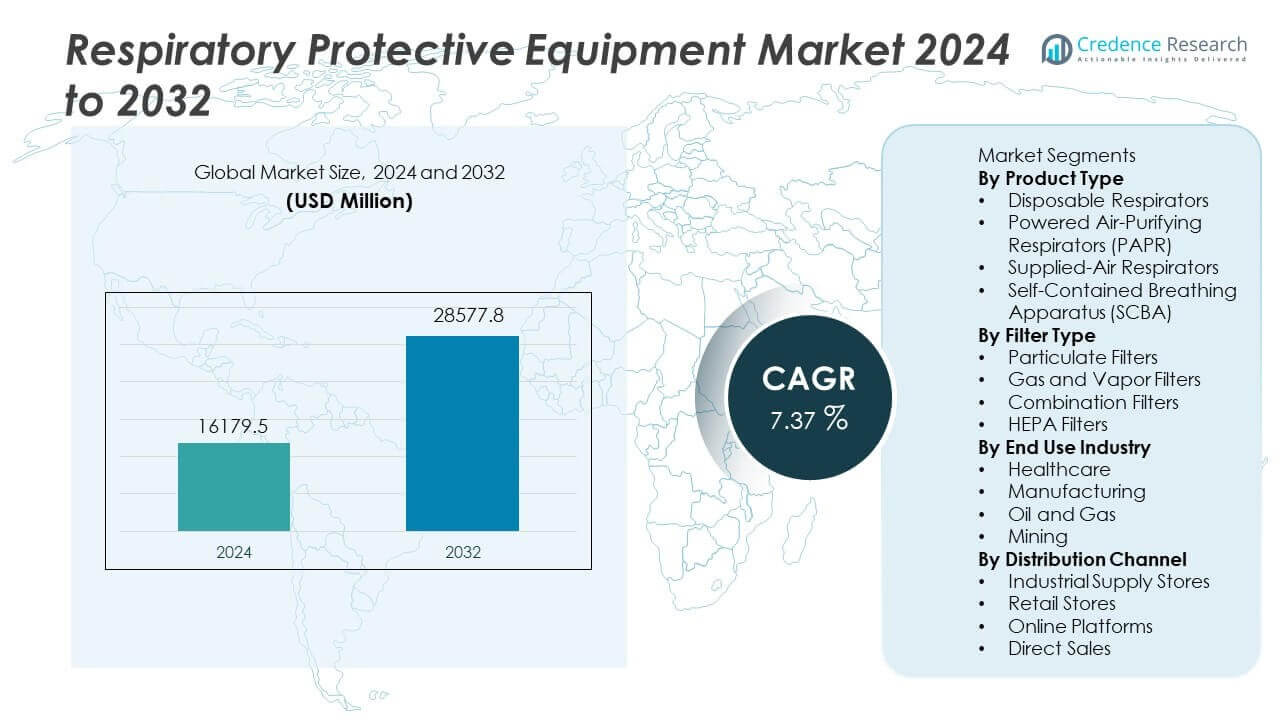
The Respiratory Protective Equipment market reached USD 16,179.5 million in 2024 and is expected to reach USD 28,577.8 million by 2032, expanding at a CAGR of 7.37% during the forecast period.
| REPORT ATTRIBUTE | DETAILS |
|---|---|
| Historical Period | 2020-2023 |
| Base Year | 2024 |
| Forecast Period | 2025-2032 |
| Respiratory Protection Equipment Market Size 2024 | USD 16,179.5 million |
| Respiratory Protection Equipment Market, CAGR | 7.37% |
| Respiratory Protection Equipment Market Size 2032 | USD 28,577.8 million |
Respiratory Protection Equipment Market Insights
- Demand increases as industrial workplaces adopt disposable respirators that hold 48% share, while particulate filters lead filtration with 44% share driven by occupational dust control and medical safety requirements.
- Key trends include wider use of powered air-purifying respirators, digital fit-testing systems, and reusable products supporting sustainability goals and long-term workplace protection.
- Competition remains strong as manufacturers expand high-performance air-purifying designs, invest in reusable equipment, and develop advanced particulate and gas filtration technologies for hazardous operating environments.
- North America holds 34% share, followed by Europe at 30% and Asia Pacific at 27%, supported by strict safety standards, growing healthcare demand, and rising industrialization across regional markets.
Respiratory Protection Equipment Market Segmentation Analysis:
By Product Type Disposable respirators lead this segment with near 48% share, driven by wide adoption across healthcare, industrial workplaces, and emergency response situations. These respirators suit short-term protection needs and provide cost-efficient barrier filtration against dust, aerosols, and airborne pathogens. Powered air-purifying respirators hold near 23% share due to increasing use in chemical handling and heavy industrial environments that require continuous airflow and higher comfort levels. Supplied-air respirators capture near 17% share, supported by use in hazardous confined spaces. Self-contained breathing apparatus holds near 12% share, mainly deployed in firefighting and emergency rescue operations.
- For instance, Honeywell’s PAPR systems use airflow rates above 170 liters per minute, improving breathing comfort during long shifts in chemical plants.
By Filter Type Particulate filters dominate the filter segment with near 44% share due to extensive use in healthcare, medical safety, and industrial dust control applications. Gas and vapor filters follow with near 26% share, driven by chemical processing, oil and gas production, and hazardous fumes exposure. Combination filters represent near 19% share, designed for multi-hazard environments that require protection against both particulate and chemical contaminants. HEPA filters hold near 11% share, supported by high-efficiency filtration needs in biohazard and clinical laboratories. Growing concern over airborne diseases accelerates adoption of particulate respiratory protection.
- For instance, Kimberly-Clark also launched medical respirators using HEPA-grade filtration media designed to meet NIOSH 42 CFR Part 84 requirements.
By End Use Industry
Healthcare leads the end-use segment with near 41% share, supported by medical respiratory protection needs across infection control, surgical operations, and pandemic preparedness initiatives. Manufacturing follows with near 28% share, driven by occupational safety standards and exposure to dust, welding fumes, and industrial particulates. Oil and gas hold near 18% share, supported by hazardous gas emissions and chemical processing environments requiring advanced respiratory safety equipment. Mining captures near 13% share, driven by dust and toxic gas exposure in underground and surface extraction operations. Growing workplace safety rules and global respiratory health concerns drive broad equipment adoption across industries.
Key Growth Drivers
Rising Occupational Health Concerns
Growing exposure to airborne contaminants in manufacturing, construction, mining, and chemical processing increases demand for respiratory protective equipment. Workers face higher risks from fine dust, toxic vapors, and industrial fumes that create serious respiratory hazards. Employers adopt safety standards to comply with national occupational health regulations, which drives steady equipment replacement cycles. Healthcare institutions also increase respirator use due to infectious disease threats. These shifts support long-term demand for disposable respirators, full-face protection, and powered air-purifying systems across developed and developing industries.
- For instance, 3M expanded its global respirator output to more than 2.5 billion units between 2020 and 2022 to meet rising industrial and clinical demand, while Honeywell ramped PAPR production capacity by 70,000 units per quarter during the same period, supported by NIOSH certified industrial adoption across chemical and mining sites.
Expansion of Healthcare and Emergency Response Use
Healthcare remains a critical growth area due to respiratory disease outbreaks and hospital infection control standards. Hospitals invest in disposable and reusable respiratory devices to protect clinical staff from airborne pathogens and infectious droplets. Pandemic preparedness programs encourage public health authorities to maintain large emergency stockpiles of respirators. Strengthening global health surveillance systems also drive procurement of high-efficiency protective equipment. Growing focus on airborne viral transmission continues to expand respirator adoption in public and private healthcare systems.
- For instance, Medline Industries supplied medical respirators to US hospitals during public health emergencies, and Dräger shipped emergency SCBA units to European response agencies for disaster and medical preparedness according to corporate safety disclosures.
Stringent Workplace Safety Regulations
Regulatory bodies enforce air quality and worker protection standards in industrial workplaces, which drives mandatory use of respiratory protection equipment. Oil and gas, chemicals, and heavy manufacturing operations integrate supplied-air and powered respirators into safety guidelines. Global safety agencies introduce strict limits for occupational exposure to hazardous materials. Companies invest in advanced filtration and air-purifying technologies that meet regulatory standards. These rules support sustained equipment demand across industrial sectors with high exposure risk.
Key Trends and Opportunities
Growth of Powered Air-Purifying Respirators and Smart Monitoring
Industry adoption of powered air-purifying respirators expands because they offer continuous airflow, low breathing resistance, and improved comfort during extended operations. Smart monitoring and digital sensors enhance performance by tracking filter status and air quality in real time. These developments create opportunities in chemical processing, heavy manufacturing, and emergency response applications. Manufacturers also develop integrated face shields and helmets, supporting broader use in hazardous environments.
- For instance, Dräger launched PAPR helmets certified under EN 12941 that maintain continuous protection for eight operating hours.
Increasing Demand for Reusable and Sustainable Products
Growing sustainability focus encourages adoption of reusable respirators with replaceable filters that reduce waste and lower long-term cost. Hospitals and industrial buyers explore reusable systems to control procurement spending and environmental impact. Manufacturers invest in advanced materials that improve durability and cleaning performance. Growing interest in circular design creates opportunities for reusable powered devices and recyclable filtration components.
- For instance, Uvex Safety offers various respiratory protection products for use in industrial environments, including some reusable masks designed for multiple shifts, which must be appropriately cleaned after each use.
Key Challenges
High Cost of Advanced Respiratory Systems
Powered respirators, supplied-air systems, and self-contained breathing apparatus require major investment and ongoing maintenance, creating adoption barriers for small businesses. Limited budgets restrict use of advanced equipment in emerging markets and industrial sectors with cost pressure. Companies must also manage fit testing, training, and replacement schedules, which increases operational cost.
Limited Awareness in Developing Regions
Many developing countries have lower awareness of occupational respiratory hazards, which reduces adoption of certified protective equipment. Informal industries often rely on low-grade masks that fail to meet regulatory standards. Weak enforcement of workplace safety rules further limits broader use. These challenges slow market penetration across low-income regions and require greater training and safety education investments.
Regional Analysis
North America
North America holds near 34% share, driven by strong occupational safety regulations, advanced healthcare systems, and rising respiratory protection demand across manufacturing and oil and gas sectors. The United States leads adoption due to strict OSHA standards and increased healthcare procurement for infectious disease control. Rising industrial automation and safety compliance programs encourage companies to integrate powered air-purifying respirators and advanced particulate systems in hazardous workplaces. Healthcare institutions remain major buyers, supported by preparedness planning and infection prevention measures. Continuous focus on workforce protection sustains long-term market growth.
Europe
Europe accounts for near 30% share, supported by stringent workplace safety legislation and strong adoption of certified protective equipment across industrial environments. Germany, the United Kingdom, and France invest in advanced respirators for chemical handling, metal processing, and healthcare operations. The region places high emphasis on respiratory safety through regulatory requirements that mandate certified filtration standards. Growing use of reusable respirators supports sustainability goals in industrial and medical sectors. Government health agencies continue promoting respiratory protection in occupational health programs.
Asia Pacific
Asia Pacific holds near 27% share, driven by expanding industrial manufacturing, mining, and chemical production across China, India, and Japan. Rapid industrial growth increases exposure to airborne contaminants, which supports adoption of disposable and powered air-purifying respirators. Healthcare systems expand procurement for infectious disease control, especially following pandemic-driven awareness. Japan remains a leading adopter of advanced respiratory technology due to strong regulatory compliance. Continued industrialization and rising workplace safety awareness support significant future growth across regional end users.
Latin America
Latin America holds near 6% share, influenced by expanding industrial sectors and rising adoption of personal protective equipment across oil, gas, and mining operations. Brazil leads market development through regulatory focus on workforce protection in heavy industry. Mexico expands occupational safety initiatives, supporting demand for disposable respirators in manufacturing and healthcare. Budget constraints limit adoption of high-cost equipment, yet increasing awareness of respiratory hazards supports gradual market penetration. Rising industrial infrastructure investment continues strengthening long-term demand.
Middle East and Africa
Middle East and Africa represent near 3% share, driven by oil and gas extraction sectors and increasing safety requirements in chemical and industrial facilities. Gulf countries invest in high-grade respiratory equipment for refinery and hazardous gas exposure environments. Africa expands PPE use in mining and healthcare, yet limited awareness and cost barriers slow widespread adoption. Growing infrastructure projects and industrial investment create opportunities for powered respirators and supplied-air systems. Long-term growth depends on stronger regulatory enforcement and workforce training programs.
Respiratory Protection Equipment Market Segmentations:
By Product Type
- Disposable Respirators
- Powered Air-Purifying Respirators (PAPR)
- Supplied-Air Respirators
- Self-Contained Breathing Apparatus (SCBA)
By Filter Type
- Particulate Filters
- Gas and Vapor Filters
- Combination Filters
- HEPA Filters
By End Use Industry
- Healthcare
- Manufacturing
- Oil and Gas
- Mining
By Distribution Channel
- Industrial Supply Stores
- Retail Stores
- Online Platforms
- Direct Sales
By Geography
- North America
- U.S.
- Canada
- Mexico
- Europe
- Germany
- France
- U.K.
- Italy
- Spain
- Rest of Europe
- Asia Pacific
- China
- Japan
- India
- South Korea
- South-east Asia
- Rest of Asia Pacific
- Latin America
- Brazil
- Argentina
- Rest of Latin America
- Middle East & Africa
- GCC Countries
- South Africa
- Rest of the Middle East and Africa
Competitive Landscape
Competitive landscape includes 3M Company, Honeywell International Inc., MSA Safety Incorporated, Drägerwerk AG & Co. KGaA, Kimberly-Clark Corporation, Alpha Pro Tech Ltd., Amazone Filters Private Limited, Bullard, Uvex Safety Group, and Moldex-Metric Inc. Leading companies focus on high-performance respiratory protection across healthcare, manufacturing, oil and gas, and industrial sectors. Many manufacturers invest in powered air-purifying respirators, advanced particulate filters, and reusable protective systems designed for long-duration use. Partnerships with healthcare systems and industrial clients support long-term supply agreements and continuous product upgrades. Several companies expand training and fit-testing services to support regulatory compliance in hazardous workplaces. Digital monitoring and smart respirator designs also emerge as competitive differentiators. Continuous innovation in filtration performance, comfort, and fit supports stronger market presence across global end users.
Key Player Analysis
- 3M Company
- Honeywell International Inc.
- MSA Safety Incorporated
- Drägerwerk AG & Co. KGaA
- Kimberly-Clark Corporation
- Alpha Pro Tech Ltd.
- Amazone Filters Private Limited
- Bullard
- Uvex Safety Group
- Moldex-Metric Inc.
Recent Developments
- In March 2025, Dräger unveiled ProAir, a purpose-designed next-generation NIOSH-certified closed-circuit breathing apparatus (CCBA) for sustained use in federal high-risk operations.
- In July 2024, Ansell Limited completed the acquisition of Kimberly-Clark's Personal Protective Equipment (KCPPE) business, further extending its global stature on personal protection solutions.
Report Coverage
The research report offers an in-depth analysis based on Product Type, Filter Type, End Use Industry, Distribution Channel and Geography. It details leading market players, providing an overview of their business, product offerings, investments, revenue streams, and key applications. Additionally, the report includes insights into the competitive environment, SWOT analysis, current market trends, as well as the primary drivers and constraints. Furthermore, it discusses various factors that have driven market expansion in recent years. The report also explores market dynamics, regulatory scenarios, and technological advancements that are shaping the industry. It assesses the impact of external factors and global economic changes on market growth. Lastly, it provides strategic recommendations for new entrants and established companies to navigate the complexities of the market.
Future Outlook
- Industrial sectors will increase investments in advanced respiratory systems.
- Healthcare demand will remain strong due to infectious disease concerns.
- Powered air-purifying respirators will gain wider adoption in hazardous sites.
- Digital fit-testing and monitoring features will improve workplace compliance.
- Reusable respirators will expand due to sustainability and cost efficiency.
- High-efficiency particulate filtration will become standard in medical settings.
- Construction and mining sectors will adopt stricter respiratory safety rules.
- Regional safety regulations will drive upgrades in industrial workplaces.
- Smart respirators will grow through integration of sensors and wear monitoring.
- Emerging markets will expand usage through rising awareness of occupational hazards.
Request a Free Sample
Fill in your details and we'll send you a free sample report.
- Sample data tables & charts
- Research methodology
Need a Custom Version of This Report?
Tailor the scope, geography, or segments to your exact requirements.
- Custom geography or segment scope
- Direct access to our analyst team
Frequently Asked Questions
What is the current market size for the Respiratory Protective Equipment market, and what is its projected size in 2032?
At what Compound Annual Growth Rate is the Respiratory Protective Equipment market projected to grow between 2024 and 2032?
Which Respiratory Protective Equipment market segment held the largest share in 2024?
What are the primary factors fueling the growth of the Respiratory Protective Equipment market?
Who are the leading companies in the Respiratory Protective Equipment market?
Which region commanded the largest share of the Respiratory Protective Equipment market in 2024?
Table of Content
Chapter 1. Report Introduction
- 1.1 Report Description & Purpose
- 1.1.1 Report Title & Market Definition
- 1.1.2 Unique Selling Propositions (USP) & Key Differentiators
- 1.1.3 Value Proposition for Stakeholders
- 1.2 Research Objectives
- 1.2.1 Market Sizing Objectives (Volume & Revenue)
- 1.2.2 Segmentation Objectives
- 1.2.3 Competitive Intelligence Objectives
- 1.2.4 Forecast & Scenario Objectives
- 1.3 Report Scope
- 1.3.1 Respiratory Protective Equipment Scope – Types & Subtypes Covered
- 1.3.2 Geographic Scope – Regions & Countries Covered
- 1.3.3 Historical Period, Base Year & Forecast Period (2024; forecast to 2032)
- 1.3.4 Inclusions & Exclusions
- 1.4 HS Code & Classification Framework
- 1.5 Currency, Units & Pricing Basis
- 1.6 Target Stakeholders
- 1.7 Limitations & Assumptions
Chapter 2. Executive Summary
- 2.1 Global Respiratory Protective Equipment Market Snapshot
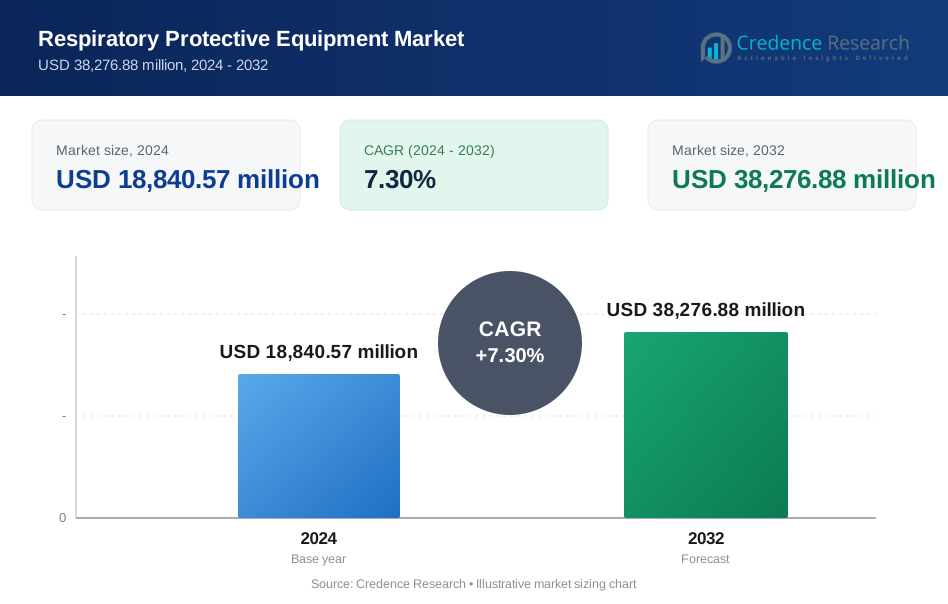
- 2.1.1 Market Size – Historical (2024) & Forecast (2024-2032) (2024: USD 18,840.57 million → 2032: USD 38,276.88 million)
- 2.1.2 Volume & Revenue – Global Totals
- 2.1.3 Key Market Highlights – Top Five Facts
- 2.2 Respiratory Protective Equipment Market Segmentation Snapshot
- 2.2.1 Market Split by Region – 2024 vs. 2032
- 2.3 Competitive Snapshot
- 2.3.1 Top 10 Players by Revenue Share – 2024
- 2.3.2 Top 10 Players by Volume Share – 2024
- 2.3.3 Recent Strategic Developments (18-Month Summary)
- 2.4 Key Investment Highlights & Strategic Conclusions
Chapter 3. Respiratory Protective Equipment Market Dynamics & Industry Analysis
- 3.1 Market Overview & Context
- 3.1.1 Respiratory Protective Equipment Market Position in the Broader Automotive Value Chain
- 3.1.2 OEM vs. Replacement Market Dynamics
- 3.1.3 Market Maturity & Development Stage by Region
- 3.2 Respiratory Protective Equipment Market Drivers
- 3.3 Respiratory Protective Equipment Market Restraints & Challenges
- 3.4 Respiratory Protective Equipment Market Opportunities
- 3.5 Porter's Five Forces Analysis
- 3.5.1 Threat of New Entrants
- 3.5.2 Bargaining Power of Suppliers
- 3.5.3 Bargaining Power of Buyers
- 3.5.4 Threat of Substitutes
- 3.5.5 Competitive Rivalry – Intensity Assessment
- 3.6 Respiratory Protective Equipment Value Chain Analysis
- 3.6.1 Upstream – Raw Material/Input Suppliers
- 3.6.1.1 Raw Material/Input 1
- 3.6.1.2 Raw Material/Input 2
- 3.6.1.3 Raw Material/Input 3
- 3.6.2 Midstream – Production/Manufacturing/Service Delivery
- 3.6.2.1 Production/Process Overview
- 3.6.2.2 Key Facility Locations & Capacity by Manufacturer
- 3.6.3 Downstream – Distribution & End Consumer
- 3.6.3.1 Primary Channel – B2B/OEM
- 3.6.3.2 Secondary Channels – Dealer, Retail, Online, Direct
- 3.6.4 Value Chain Profitability Analysis
- 3.6.1 Upstream – Raw Material/Input Suppliers
- 3.7 PESTEL Analysis
- 3.7.1 Political Factors
- 3.7.2 Economic Factors
- 3.7.3 Social Factors
- 3.7.4 Technological Factors
- 3.7.5 Environmental Factors
- 3.7.6 Legal Factors
- 3.8 Respiratory Protective Equipment Supply Chain Analysis
- 3.8.1 Raw Material/Input Supply Risk Assessment
- 3.8.2 Manufacturing Concentration Risk (Geographic Exposure)
- 3.8.3 Trade Disruption Impact Analysis
- 3.9 Regulatory & Policy Landscape
Note: The regulatory and policy landscape section covers regulations based on their applicability to the market, Respiratory Protective Equipment category, geography, and scope of the study. Only regulatory frameworks with a material impact on operations, compliance, trade, sustainability, or market access are analyzed in detail.
Chapter 4. Key Investment Pockets & Opportunity Analysis
- 4.1 Respiratory Protective Equipment Market Attractiveness Analysis
- 4.1.1 By Region – Investment Attractiveness Matrix (Volume × CAGR)
- 4.2 Absolute Revenue Growth Opportunity
- 4.2.1 By Region – Absolute USD Growth Through 2032
- 4.3 Incremental Volume Opportunity
- 4.3.1 By Region – Incremental Volume Through 2032
- 4.3.2 Segment – Incremental Volume
- 4.4 Emerging Submarket Opportunity Deep Dive (Subject to Applicability)
- 4.5 Emerging Market Opportunity Scorecards
- 4.5.1 United States
- 4.5.2 Europe
- 4.5.3 Asia
- 4.5.4 Middle East & Africa
Note: Emerging Market Opportunity Scorecards will be included based on relevance and strategic importance. Regions listed are indicative and may vary depending on data availability and market dynamics.
Chapter 5. Respiratory Protective Equipment Import-Export Analysis & Trade Flows
- 5.1 Global Trade Overview
- 5.1.1 Global Export Value by Country (2024)
- 5.1.2 Global Export Volume by Country (2024)
- 5.1.3 Global Import Value by Country (2024)
- 5.1.4 Global Import Volume by Country (2024)
- 5.1.5 Net Trade Balance by Country (2024)
- 5.2 Export Analysis – Segment
- 5.2.1 Type 1 (HS Code)
- 5.2.2 Type 2 (HS Code)
- 5.2.3 Type 3 (HS Code)
- 5.2.4 Type 4 (HS Code)
- 5.2.5 Type 5 (HS Code)
- 5.3 Import Analysis – Segment
- 5.3.1 Type 1 (HS Code)
- 5.3.2 Type 2 (HS Code)
- 5.3.3 Type 3 (HS Code)
- 5.3.4 Type 4 (HS Code)
- 5.3.5 Type 5 (HS Code)
- 5.4 Average Unit Trade Prices
- 5.4.1 Average Export Price – Segment & Country
- 5.4.2 Average Import Price – Segment & Source Country
- 5.4.3 Price Trends (2024)
- 5.5 Key Trade Route Analysis
- 5.5.1 Trade Route 1
- 5.5.2 Trade Route 2
- 5.5.3 Trade Route 3
- 5.5.4 Trade Route 4
- 5.5.5 Trade Route 5
- 5.6 Trade Policy Impact Assessment
- 5.6.1 US Anti-Dumping & Section 301 Tariffs
- 5.6.2 EU Customs Union Impact
- 5.6.3 Major Free Trade Agreements
- 5.6.4 USMCA Rules of Origin
Note: Trade policy analysis will be included only where relevant to the Respiratory Protective Equipment market.
Chapter 6. Competitive Landscape & Company Benchmarking
- 6.1 Respiratory Protective Equipment Market Concentration & Structure
- 6.1.1 Herfindahl-Hirschman Index (HHI) – vs. 2024
- 6.1.2 Tier 1, Tier 2 & Tier 3 Market Structure
- 6.1.3 Global, Regional & Local Player Dynamics
- 6.2 Respiratory Protective Equipment Market Share Analysis – 2024
- 6.2.1 Global Revenue Share by Company
- 6.2.2 Global Volume Share by Company
- 6.2.3 Regional Revenue Share
- 6.2.4 Market Share Evolution ( vs. 2024)
- 6.2.5 OEM Segment Share by Company
- 6.2.6 Replacement Segment Share by Company
- 6.3 Production/Delivery Capacity & Facility Analysis
- 6.3.1 Global Installed Capacity
- 6.3.2 Capacity Utilization Rates
- 6.3.3 Production/Output Volume
- 6.3.4 Facility Locations & Capacity Map
- 6.3.5 Planned Capacity Additions
- 6.4 Respiratory Protective Equipment Competitive Benchmarking Matrix
- 6.4.1 Revenue, Volume, CAGR & Profitability Comparison
- 6.4.2 Channel Revenue Mix
- 6.4.3 Geographic Revenue Exposure
- 6.4.4 R&D Intensity
- 6.4.5 Sustainability Maturity
- 6.5 Strategic Developments in Respiratory Protective Equipment (Last 24 Months)
- 6.5.1 Mergers, Acquisitions & Divestments
- 6.5.2 New Respiratory Protective Equipment Launches
- 6.5.3 Facility Expansions
- 6.5.4 Strategic Alliances, Joint Ventures & Partnerships
- 6.5.5 Distribution Expansion & Market Entry
- 6.5.6 Sustainability & ESG Initiatives
- 6.6 Competitive Strategy Mapping
- 6.6.1 Leader, Challenger, Follower & Niche Classification
- 6.6.2 Pricing Strategy Comparison
- 6.6.3 Channel Strategy Matrix
Note: Strategic developments are included based on their materiality and the availability of reliable information.
Chapter 7. Global Respiratory Protective Equipment Market – By Distribution Channel
- 7.1 Segment Overview
- 7.1.1 Volume & Revenue Split by Channel (2024 & 2032)
- 7.1.2 Channel Mix Evolution (2024-2032)
Chapter 8. Regional Market Analysis – Global Overview
- 8.1 Global Regional Overview
- 8.1.1 Regional Volume Share
- 8.1.2 Regional Revenue Share
- 8.1.3 Regional Volume by Region
- 8.1.4 Regional Revenue by Region
- 8.1.5 Regional Forecast Through 2032
- 8.2 Cross-Regional Segment Analysis
- 8.2.1 By Distribution Channel
- 8.2.2 By Brand/Price Tier
Chapter 9. North America Respiratory Protective Equipment Market
- 9.1 United States
- 9.2 Canada
- 9.3 Mexico
Chapter 10. Europe Respiratory Protective Equipment Market
- 10.1 Germany
- 10.2 France
- 10.3 Italy
- 10.4 United Kingdom
- 10.5 Spain
- 10.6 Poland
- 10.7 Russia
- 10.8 Netherlands
- 10.9 Belgium
- 10.10 Sweden
- 10.11 Denmark
- 10.12 Norway
- 10.13 Rest of Europe
Chapter 11. Asia Pacific Respiratory Protective Equipment Market
- 11.1 China
- 11.2 India
- 11.3 Japan
- 11.4 South Korea
- 11.5 Thailand
- 11.6 Indonesia
- 11.7 Vietnam
- 11.8 Malaysia
- 11.9 Australia
- 11.10 Rest of Asia Pacific
Chapter 12. Latin America Respiratory Protective Equipment Market
- 12.1 Brazil
- 12.2 Argentina
- 12.3 Colombia
- 12.4 Chile
- 12.5 Rest of Latin America
Chapter 13. Middle East Respiratory Protective Equipment Market
- 13.1 Saudi Arabia
- 13.2 United Arab Emirates
- 13.3 Turkey
- 13.4 Israel
- 13.5 Iran
- 13.6 Rest of the Middle East
Chapter 14. Africa Respiratory Protective Equipment Market
- 14.1 South Africa
- 14.2 Egypt
- 14.3 Nigeria
- 14.4 Morocco
- 14.5 Rest of Africa
Chapter 15. Respiratory Protective Equipment Company Profiles
- 15.1 [Company 01]
- 15.1.1 Company Overview
- 15.1.2 Key Management Personnel
- 15.1.3 Products & Services Portfolio
- 15.1.4 Financial Performance
- 15.1.5 Key Market Focus & Geographic Presence
- 15.1.6 Recent Developments & Strategic Initiatives
Note: The company profile list is preliminary and may change based on research findings, market developments, data availability, and client requirements.
Chapter 16. Appendices
- Appendix A – List of Abbreviations & Acronyms
- Appendix B – Industry Classification Code Reference – Full Series
- Appendix C – Production & Capacity Data Tables
- Appendix D – End-Use & Demand Base Tables
- Appendix E – Consumption & Replacement Rate Assumptions
- Appendix F – ASP Reference Tables
- Appendix G – Manufacturing & Facility Database
- Appendix H – Import-Export Data Tables
- Appendix I – Regulatory Summary Tables
- Appendix J – Primary Research Participant List (Anonymized)
- Appendix K – Primary Research Questionnaire Framework
- Appendix L – Data Sources & Bibliography
- Appendix M – Market Size Divergence & Source Comparison
Chapter 17. Research Methodology
- 17.1 Research Framework & Philosophy
- 17.2 Secondary Research – Sources, Hierarchy & Data Extraction
- 17.3 Data Modeling – Bottom-Up & Top-Down Market Sizing
- 17.4 Primary Research – Stakeholder Framework, LOI & Sample Sizes
- 17.5 Forecast Methodology – Regression, Scenario & Sensitivity Analysis
- 17.6 Quality Control – Four-Layer Validation Framework
- 17.7 Limitations & Standard Assumptions
- 17.8 Disclaimer
