
Market Overview:
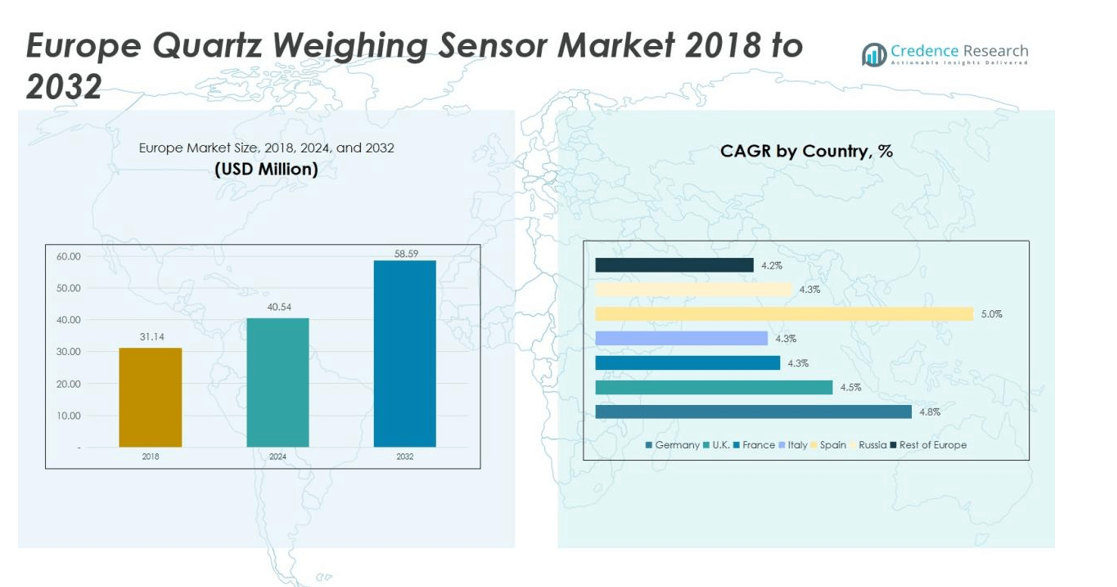
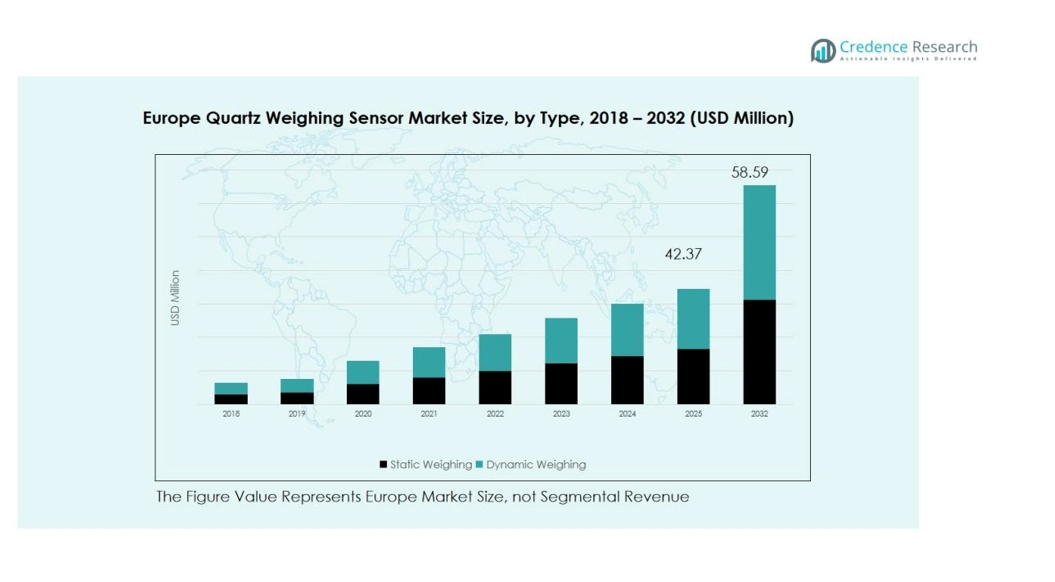
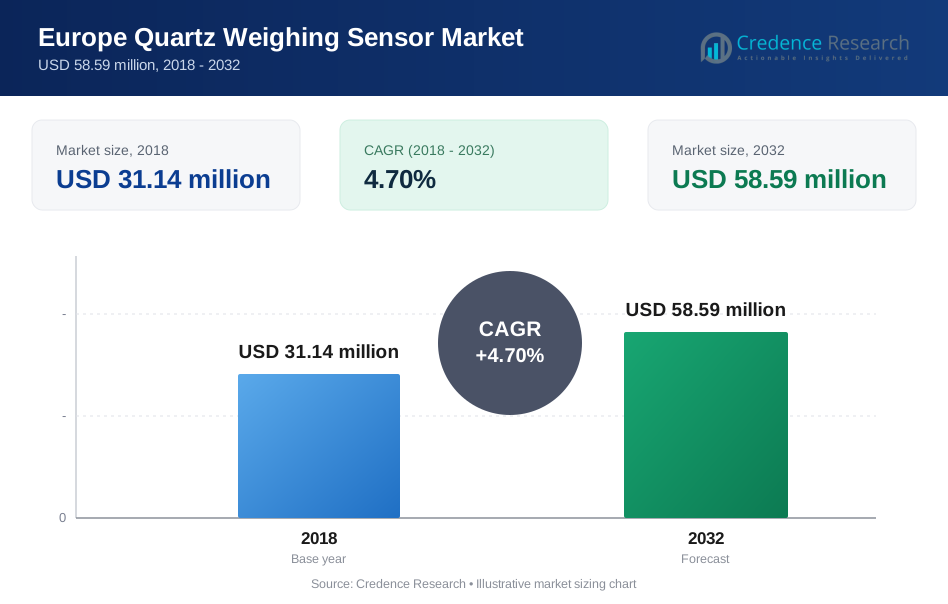
The Europe Quartz Weighing Sensor Market size was valued at USD 31.14 million in 2018 to USD 40.54 million in 2024 and is anticipated to reach USD 58.59 million by 2032, at a CAGR of 4.70% during the forecast period.
| REPORT ATTRIBUTE | DETAILS |
|---|---|
| Historical Period | 2020-2023 |
| Base Year | 2024 |
| Forecast Period | 2025-2032 |
| Europe Quartz Weighing Sensor Market Size 2024 | USD 40.54 million |
| Europe Quartz Weighing Sensor Market, CAGR | 4.70% |
| Europe Quartz Weighing Sensor Market Size 2032 | USD 58.59 million |
The market is primarily driven by advancements in industrial automation, quality control, and laboratory applications. Increasing demand for accurate measurement systems in pharmaceuticals, chemical manufacturing, and food processing enhances the use of quartz-based weighing technologies. The sensors’ ability to deliver stable readings under temperature and vibration fluctuations further supports their integration into precision instruments and automated weighing systems. The rising trend toward IoT-enabled and smart weighing devices is also accelerating market expansion.
Regionally, Western Europe dominates the market, led by Germany, the UK, and France, where strong manufacturing bases and robust R&D capabilities drive technological adoption. Central and Eastern Europe are witnessing steady growth due to expanding industrial infrastructure and government initiatives supporting modernization. Continuous innovation and regional collaborations with sensor manufacturers strengthen Europe’s position as a global hub for advanced quartz weighing technologies.
Market Insights:
- The Europe Quartz Weighing Sensor Market was valued at USD 31.14 million in 2018, growing to USD 40.54 million in 2024, and projected to reach USD 58.59 million by 2032 at a CAGR of 4.70%.
- Western Europe held the largest share at 48% in 2024, driven by strong industrial automation and advanced manufacturing infrastructure.
- Germany accounted for 20% of the regional market, supported by leadership in precision engineering and high R&D investment.
- The U.K. held around 15% share, backed by growing demand from the pharmaceutical and research sectors.
- Central and Eastern Europe are the fastest-growing regions with a combined share of 22%, fueled by industrial modernization and government-backed digital transformation.
- Static weighing sensors dominated the type segment with 62% share in 2024 due to high accuracy and repeatability.
- Industrial applications led the market with 58% share, driven by adoption in pharmaceuticals, chemicals, and food processing industries.
Market Drivers:
Rising Demand for High-Precision Measurement Systems
The Europe Quartz Weighing Sensor Market is driven by the rising need for high-precision measurement in industrial and scientific applications. Industries such as pharmaceuticals, food processing, and chemicals rely on accurate weighing to ensure quality and compliance. Quartz-based sensors offer superior stability, repeatability, and resistance to environmental variations, making them ideal for precision-based operations. It continues to gain adoption across laboratories and automated production setups due to their ability to maintain consistent performance under demanding conditions.
- For Instance, Mettler Toledo's XPR microbalance models are utilized in European pharmaceutical labs, offering measurement repeatability as low as 0.1 µg.
Expanding Industrial Automation and Process Optimization
Rapid automation across European manufacturing sectors is boosting the demand for quartz weighing sensors. Smart factories and Industry 4.0 initiatives are emphasizing accurate and real-time measurement systems for production efficiency. Quartz sensors enable automated monitoring, calibration, and integration with digital control systems, supporting predictive maintenance and reducing operational errors. It strengthens process optimization, helping companies achieve higher output with improved resource utilization.
- For instance, the Kistler Group has deployed over 50,000 Lineas quartz piezoelectric sensors across automated Weigh-In-Motion systems worldwide, which achieve uniform sensitivity verification across the entire sensor length.
Technological Advancements and IoT Integration
Continuous advancements in sensor technology and IoT connectivity are propelling market growth. Modern quartz weighing sensors now feature enhanced response times, self-calibration, and digital signal processing for improved accuracy. Their integration with IoT platforms allows remote data analysis, system diagnostics, and predictive insights. It enables industrial operators to optimize equipment health and streamline workflow management through connected systems.
Growth in R&D and Manufacturing Capabilities Across Europe
Strong R&D capabilities and manufacturing innovation in countries such as Germany, France, and the UK are fueling market expansion. Leading companies are investing in miniaturized, energy-efficient, and vibration-resistant quartz sensor designs. The region’s focus on sustainable industrial modernization supports the development of reliable and durable weighing solutions. It benefits from collaborations between technology developers, research institutions, and industrial users, promoting continuous advancement in precision sensing technologies.
Market Trends:
Integration of Smart Technologies and IoT Connectivity
The Europe Quartz Weighing Sensor Market is witnessing strong adoption of IoT-enabled and smart weighing systems. Manufacturers are incorporating sensors with digital interfaces, allowing seamless data transmission, remote monitoring, and automated calibration. It enables industries to achieve real-time measurement accuracy and process control in critical applications such as pharmaceuticals, chemicals, and food processing. The trend aligns with Europe’s broader digital transformation goals under Industry 4.0. Miniaturization and improved temperature compensation features are also enhancing sensor performance and reliability. The growing preference for automated weighing and control systems supports the steady shift toward smart and connected industrial environments.
- For Instance, Mettler Toledo launched its IND360 automation terminal in December 2022. It delivers communication speeds of 960Hz as an automation transmitter, which Mettler Toledo advertises as 8 to 10 times faster than comparable weighing devices.
Shift Toward Sustainable Manufacturing and Advanced Materials
Rising focus on sustainability and energy efficiency is shaping innovation in quartz weighing sensor design and production. Manufacturers are using eco-friendly materials and energy-efficient fabrication processes to meet European environmental standards. It supports market growth by aligning with regulations promoting green industrial practices. The development of compact and vibration-resistant sensors for harsh industrial environments is also gaining traction. Customization and modular design trends are allowing end-users to integrate weighing sensors into existing systems with minimal modification. The demand for durable, high-performance, and sustainable weighing solutions continues to drive technological evolution and product differentiation across the region.
- For instance, Wipotec developed Active Vibration Compensation (AVC) technology that reduces vibrations to one-tenth of their original value, equivalent to 20 dB attenuation, enabling precise weight measurements even in environments with significant floor vibrations below 10 Hz.
Market Challenges Analysis:
High Production Costs and Price Sensitivity Across Industries
The Europe Quartz Weighing Sensor Market faces challenges due to high production and material costs. Manufacturing quartz sensors requires precision engineering, advanced calibration, and quality control, leading to increased pricing. Many small and medium enterprises in Europe prefer low-cost alternatives, limiting widespread adoption. It struggles to balance performance with affordability in price-sensitive industrial applications. The cost of raw materials and specialized manufacturing equipment further restricts scalability. Continuous innovation is necessary to reduce costs while maintaining sensor reliability and accuracy.
Technical Complexity and Integration Barriers in Legacy Systems
Integrating advanced quartz weighing sensors into existing industrial setups remains a significant challenge. Many European factories still rely on older weighing systems that lack compatibility with modern digital and IoT-enabled sensors. It creates integration difficulties and raises the cost of upgrades or replacements. Technical expertise and specialized calibration skills are also required, which some users lack. Sensor performance can be affected by extreme vibration, temperature fluctuations, and electromagnetic interference in certain industrial environments. Overcoming these technical limitations is vital for expanding sensor adoption and improving operational efficiency.
Market Opportunities:
Rising Adoption of Automation and Smart Manufacturing Systems
The Europe Quartz Weighing Sensor Market presents strong opportunities through the growing shift toward automation and smart factories. Industries across Europe are investing in digital manufacturing technologies to enhance precision, efficiency, and traceability. It benefits from this transition, as quartz sensors enable accurate and real-time monitoring across automated processes. Demand is increasing in sectors such as pharmaceuticals, food production, and specialty chemicals, where precision and compliance are critical. The integration of weighing sensors with IoT and AI-based systems supports data-driven decision-making. Expanding government initiatives promoting Industry 4.0 adoption are creating favorable conditions for new product development and deployment.
Expansion in Emerging End-Use Sectors and R&D Collaborations
Emerging applications in aerospace, biotechnology, and semiconductor manufacturing offer new avenues for market growth. High-precision weighing is essential for advanced material development and nanotechnology research. It creates opportunities for sensor manufacturers to design specialized solutions tailored to scientific and industrial use. Collaborations between European research institutions and sensor developers are fostering technological innovation. Growing focus on miniaturized and energy-efficient sensors aligns with the evolving needs of precision-driven industries. Increasing investment in R&D and cross-industry partnerships continues to open new growth pathways across the region.
Market Segmentation Analysis:
By Type
The Europe Quartz Weighing Sensor Market is segmented into static and dynamic weighing sensors. Static weighing systems hold a dominant share due to their precision in laboratory and industrial measurement applications. These systems are preferred for processes that require high stability and accuracy under controlled environments. Dynamic weighing sensors are gaining traction in automated and continuous production lines. It benefits from increasing demand across manufacturing and logistics operations where real-time measurement and process optimization are essential.
- For Instance, For instance, Mettler-Toledo's XPR micro-analytical balance series, widely used in laboratories, offers models with a readability of 1 µg (0.000001 g). They demonstrate exceptional repeatability, which is a key requirement for precision pharmaceutical and material testing.
By Application
Industrial applications represent the largest share of the market, supported by strong adoption in pharmaceuticals, chemicals, and food processing sectors. Aerospace and scientific research sectors are expanding rapidly, driven by the need for ultra-precise measurement and calibration. It is also seeing emerging use in electronics and material testing facilities, where reliability and responsiveness are critical. The growing use of sensors in R&D environments reinforces their importance in modern industrial ecosystems.
- For Instance, Honeywell has delivered miniature inertial measurement units (MIMUs) to NASA for deep space mission instrumentation, including the OSIRIS-REx mission and the Artemis lunar program.
By Country
Germany leads the regional market, supported by its advanced manufacturing base and technological innovation. The U.K. and France follow, driven by growing investments in automation and precision engineering. Italy and Spain are witnessing steady growth supported by industrial modernization. It continues to expand in Russia and the Rest of Europe, where infrastructure development and smart factory adoption are increasing.
Segmentations:
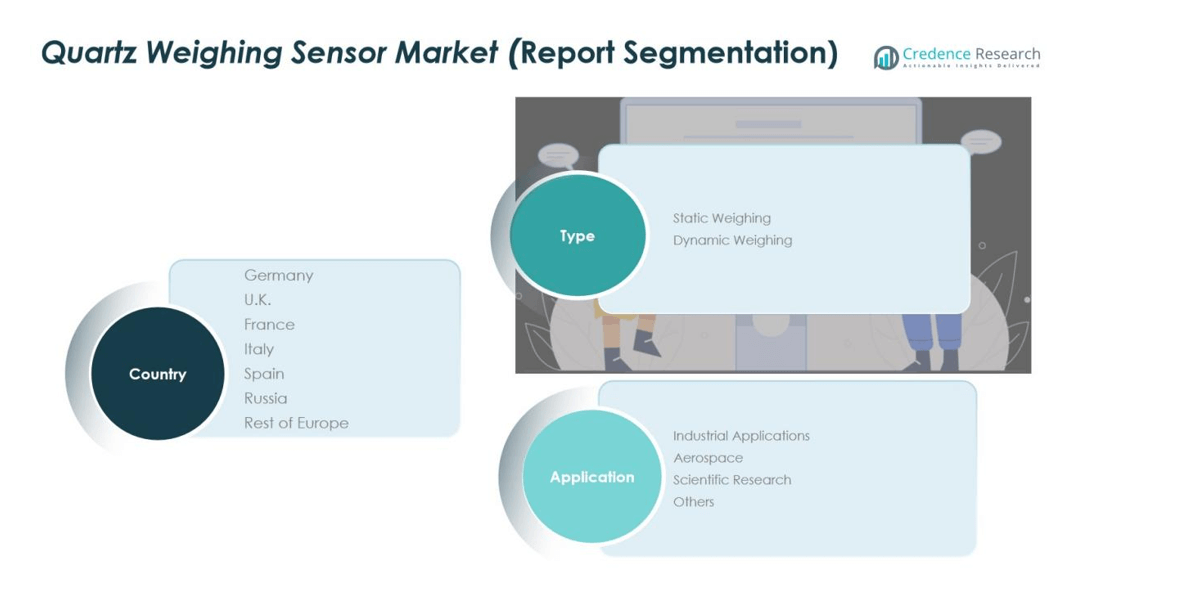
By Type:
- Static Weighing
- Dynamic Weighing
By Application:
- Industrial Applications
- Aerospace
- Scientific Research
- Others
By Country:
- Germany
- K.
- France
- Italy
- Spain
- Russia
- Rest of Europe
Regional Analysis:
Western Europe Leading the Market Landscape
The Europe Quartz Weighing Sensor Market is led by Western Europe, driven by strong industrial and technological bases in Germany, the U.K., and France. Germany remains the largest contributor due to its advanced manufacturing infrastructure and commitment to automation. The U.K. benefits from growing adoption across the pharmaceutical and research sectors. France’s investments in precision measurement and process control systems strengthen its role in regional growth. It continues to witness robust demand from industries prioritizing accuracy, compliance, and operational efficiency.
Emerging Growth Across Southern and Central Europe
Southern Europe, including Italy and Spain, is showing steady progress supported by expanding industrial modernization and adoption of smart manufacturing systems. Italy’s strong automotive and food processing industries drive the deployment of precision weighing technologies. Spain is emphasizing process optimization in its chemical and material handling sectors. It benefits from European Union funding supporting digital transformation and automation. Central Europe also demonstrates potential growth with countries upgrading industrial facilities to meet international quality and efficiency standards.
Expansion Opportunities in Eastern and Northern Europe
Eastern and Northern Europe are emerging as promising regions for future market expansion. Russia and Poland are investing in industrial automation and testing facilities, supporting demand for quartz-based weighing systems. Nordic countries are focusing on high-end applications in biotechnology, research, and clean energy sectors. It benefits from strong innovation ecosystems and sustainability-driven policies. Continuous investments in infrastructure, smart factory development, and precision engineering create new opportunities for quartz sensor manufacturers across Europe.
Key Player Analysis:
- TE Connectivity
- Kistler Group
- PCB Piezotronics
- ChampionX
- Enviko
- Zhengzhou Hengliang Tech Co., Ltd
Competitive Analysis:
The Europe Quartz Weighing Sensor Market is characterized by moderate competition, with both global and regional players focusing on precision, reliability, and technological innovation. Key participants include TE Connectivity, Kistler Group, PCB Piezotronics, ChampionX, Enviko, and Zhengzhou Hengliang Tech Co., Ltd. These companies emphasize advanced sensor design, integration with IoT platforms, and improved temperature stability to enhance performance across industrial and laboratory applications. It continues to see strong investment in R&D, aimed at developing compact, high-sensitivity sensors for demanding environments. Strategic collaborations, product diversification, and regional expansions are common approaches adopted to strengthen market presence. Competition remains driven by technological differentiation and the ability to deliver customized weighing solutions aligned with evolving industrial automation trends in Europe.
Recent Developments:
- In October 2025, TE Connectivity announced it will host its 2025 Investor Day on November 20, 2025, in Philadelphia, where executive leadership will present strategic growth plans across global markets.
- In August 2025, The company announced India's first real-time road quality assessment system, implemented on the Ganga Expressway project through smart measurement technologies supplied by Kistler.
Report Coverage:
The research report offers an in-depth analysis based on Type, Application and Country. It details leading market players, providing an overview of their business, product offerings, investments, revenue streams, and key applications. Additionally, the report includes insights into the competitive environment, SWOT analysis, current market trends, as well as the primary drivers and constraints. Furthermore, it discusses various factors that have driven market expansion in recent years. The report also explores market dynamics, regulatory scenarios, and technological advancements that are shaping the industry. It assesses the impact of external factors and global economic changes on market growth. Lastly, it provides strategic recommendations for new entrants and established companies to navigate the complexities of the market.
Future Outlook:
- The Europe Quartz Weighing Sensor Market will experience steady growth driven by industrial automation and digital transformation across key sectors.
- Rising adoption of IoT-enabled weighing systems will enhance precision monitoring and predictive maintenance capabilities.
- Manufacturers will focus on miniaturized, energy-efficient, and vibration-resistant sensor designs to meet modern industry requirements.
- Integration of sensors into AI-driven and cloud-based platforms will support real-time process optimization.
- Growing demand from pharmaceuticals, chemicals, and food processing industries will continue to drive large-scale deployment.
- Research and development activities will accelerate innovations in material science and sensor performance stability.
- Collaborations between manufacturers, research institutions, and automation firms will foster technology advancement.
- The shift toward sustainable and energy-efficient manufacturing will promote eco-friendly sensor production methods.
- Eastern and Central European countries will emerge as new growth hubs with industrial modernization initiatives.
- The market will remain competitive, with leading players focusing on product differentiation and strategic partnerships to strengthen regional presence.
Request a Free Sample
Fill in your details and we'll send you a free sample report.
- Sample data tables & charts
- Research methodology
Need a Custom Version of This Report?
Tailor the scope, geography, or segments to your exact requirements.
- Custom geography or segment scope
- Direct access to our analyst team
Frequently Asked Questions
What is the current market size for the Europe Quartz Weighing Sensor Market, and what is its projected size in 2032?
At what Compound Annual Growth Rate is the Europe Quartz Weighing Sensor Market projected to grow between 2024 and 2032?
Which segment held the largest share of the Europe Quartz Weighing Sensor Market in 2024?
What are the primary factors fueling the growth of the Europe Quartz Weighing Sensor Market?
Who are the leading companies in the Europe Quartz Weighing Sensor Market?
Which region commanded the largest share of the Europe Quartz Weighing Sensor Market in 2024?
Table of Content
Chapter 1. Report Introduction
- 1.1 Report Description & Purpose
- 1.1.1 Report Title & Market Definition
- 1.1.2 Unique Selling Propositions (USP) & Key Differentiators
- 1.1.3 Value Proposition for Stakeholders
- 1.2 Research Objectives
- 1.2.1 Market Sizing Objectives (Volume & Revenue)
- 1.2.2 Segmentation Objectives
- 1.2.3 Competitive Intelligence Objectives
- 1.2.4 Forecast & Scenario Objectives
- 1.3 Report Scope
- 1.3.1 Europe Quartz Weighing Sensor Scope – Types & Subtypes Covered
- 1.3.2 Geographic Scope – Regions & Countries Covered
- 1.3.3 Historical Period, Base Year & Forecast Period (2018; forecast to 2032)
- 1.3.4 Inclusions & Exclusions
- 1.4 HS Code & Classification Framework
- 1.5 Currency, Units & Pricing Basis
- 1.6 Target Stakeholders
- 1.7 Limitations & Assumptions
Chapter 2. Executive Summary
- 2.1 Global Europe Quartz Weighing Sensor Market Snapshot
- 2.1.1 Market Size – Historical (2018) & Forecast (2018-2032) (2018: USD 31.14 million → 2032: USD 58.59 million)
- 2.1.2 Volume & Revenue – Global Totals
- 2.1.3 Key Market Highlights – Top Five Facts
- 2.2 Europe Quartz Weighing Sensor Market Segmentation Snapshot
- 2.2.1 Market Split by Region – 2018 vs. 2032
- 2.3 Competitive Snapshot
- 2.3.1 Top 10 Players by Revenue Share – 2018
- 2.3.2 Top 10 Players by Volume Share – 2018
- 2.3.3 Recent Strategic Developments (18-Month Summary)
- 2.4 Key Investment Highlights & Strategic Conclusions
Chapter 3. Europe Quartz Weighing Sensor Market Dynamics & Industry Analysis
- 3.1 Market Overview & Context
- 3.1.1 Europe Quartz Weighing Sensor Market Position in the Broader Automotive Value Chain
- 3.1.2 OEM vs. Replacement Market Dynamics
- 3.1.3 Market Maturity & Development Stage by Region
- 3.2 Europe Quartz Weighing Sensor Market Drivers
- 3.3 Europe Quartz Weighing Sensor Market Restraints & Challenges
- 3.4 Europe Quartz Weighing Sensor Market Opportunities
- 3.5 Porter's Five Forces Analysis
- 3.5.1 Threat of New Entrants
- 3.5.2 Bargaining Power of Suppliers
- 3.5.3 Bargaining Power of Buyers
- 3.5.4 Threat of Substitutes
- 3.5.5 Competitive Rivalry – Intensity Assessment
- 3.6 Europe Quartz Weighing Sensor Value Chain Analysis
- 3.6.1 Upstream – Raw Material/Input Suppliers
- 3.6.1.1 Raw Material/Input 1
- 3.6.1.2 Raw Material/Input 2
- 3.6.1.3 Raw Material/Input 3
- 3.6.2 Midstream – Production/Manufacturing/Service Delivery
- 3.6.2.1 Production/Process Overview
- 3.6.2.2 Key Facility Locations & Capacity by Manufacturer
- 3.6.3 Downstream – Distribution & End Consumer
- 3.6.3.1 Primary Channel – B2B/OEM
- 3.6.3.2 Secondary Channels – Dealer, Retail, Online, Direct
- 3.6.4 Value Chain Profitability Analysis
- 3.6.1 Upstream – Raw Material/Input Suppliers
- 3.7 PESTEL Analysis
- 3.7.1 Political Factors
- 3.7.2 Economic Factors
- 3.7.3 Social Factors
- 3.7.4 Technological Factors
- 3.7.5 Environmental Factors
- 3.7.6 Legal Factors
- 3.8 Europe Quartz Weighing Sensor Supply Chain Analysis
- 3.8.1 Raw Material/Input Supply Risk Assessment
- 3.8.2 Manufacturing Concentration Risk (Geographic Exposure)
- 3.8.3 Trade Disruption Impact Analysis
- 3.9 Regulatory & Policy Landscape
Note: The regulatory and policy landscape section covers regulations based on their applicability to the market, Europe Quartz Weighing Sensor category, geography, and scope of the study. Only regulatory frameworks with a material impact on operations, compliance, trade, sustainability, or market access are analyzed in detail.
Chapter 4. Key Investment Pockets & Opportunity Analysis
- 4.1 Europe Quartz Weighing Sensor Market Attractiveness Analysis
- 4.1.1 By Region – Investment Attractiveness Matrix (Volume × CAGR)
- 4.2 Absolute Revenue Growth Opportunity
- 4.2.1 By Region – Absolute USD Growth Through 2032
- 4.3 Incremental Volume Opportunity
- 4.3.1 By Region – Incremental Volume Through 2032
- 4.3.2 Segment – Incremental Volume
- 4.4 Emerging Submarket Opportunity Deep Dive (Subject to Applicability)
- 4.5 Emerging Market Opportunity Scorecards
- 4.5.1 United States
- 4.5.2 Europe
- 4.5.3 Asia
- 4.5.4 Middle East & Africa
Note: Emerging Market Opportunity Scorecards will be included based on relevance and strategic importance. Regions listed are indicative and may vary depending on data availability and market dynamics.
Chapter 5. Europe Quartz Weighing Sensor Import-Export Analysis & Trade Flows
- 5.1 Global Trade Overview
- 5.1.1 Global Export Value by Country (2018)
- 5.1.2 Global Export Volume by Country (2018)
- 5.1.3 Global Import Value by Country (2018)
- 5.1.4 Global Import Volume by Country (2018)
- 5.1.5 Net Trade Balance by Country (2018)
- 5.2 Export Analysis – Segment
- 5.2.1 Type 1 (HS Code)
- 5.2.2 Type 2 (HS Code)
- 5.2.3 Type 3 (HS Code)
- 5.2.4 Type 4 (HS Code)
- 5.2.5 Type 5 (HS Code)
- 5.3 Import Analysis – Segment
- 5.3.1 Type 1 (HS Code)
- 5.3.2 Type 2 (HS Code)
- 5.3.3 Type 3 (HS Code)
- 5.3.4 Type 4 (HS Code)
- 5.3.5 Type 5 (HS Code)
- 5.4 Average Unit Trade Prices
- 5.4.1 Average Export Price – Segment & Country
- 5.4.2 Average Import Price – Segment & Source Country
- 5.4.3 Price Trends (2018)
- 5.5 Key Trade Route Analysis
- 5.5.1 Trade Route 1
- 5.5.2 Trade Route 2
- 5.5.3 Trade Route 3
- 5.5.4 Trade Route 4
- 5.5.5 Trade Route 5
- 5.6 Trade Policy Impact Assessment
- 5.6.1 US Anti-Dumping & Section 301 Tariffs
- 5.6.2 EU Customs Union Impact
- 5.6.3 Major Free Trade Agreements
- 5.6.4 USMCA Rules of Origin
Note: Trade policy analysis will be included only where relevant to the Europe Quartz Weighing Sensor market.
Chapter 6. Competitive Landscape & Company Benchmarking
- 6.1 Europe Quartz Weighing Sensor Market Concentration & Structure
- 6.1.1 Herfindahl-Hirschman Index (HHI) – vs. 2018
- 6.1.2 Tier 1, Tier 2 & Tier 3 Market Structure
- 6.1.3 Global, Regional & Local Player Dynamics
- 6.2 Europe Quartz Weighing Sensor Market Share Analysis – 2018
- 6.2.1 Global Revenue Share by Company
- 6.2.2 Global Volume Share by Company
- 6.2.3 Regional Revenue Share
- 6.2.4 Market Share Evolution ( vs. 2018)
- 6.2.5 OEM Segment Share by Company
- 6.2.6 Replacement Segment Share by Company
- 6.3 Production/Delivery Capacity & Facility Analysis
- 6.3.1 Global Installed Capacity
- 6.3.2 Capacity Utilization Rates
- 6.3.3 Production/Output Volume
- 6.3.4 Facility Locations & Capacity Map
- 6.3.5 Planned Capacity Additions
- 6.4 Europe Quartz Weighing Sensor Competitive Benchmarking Matrix
- 6.4.1 Revenue, Volume, CAGR & Profitability Comparison
- 6.4.2 Channel Revenue Mix
- 6.4.3 Geographic Revenue Exposure
- 6.4.4 R&D Intensity
- 6.4.5 Sustainability Maturity
- 6.5 Strategic Developments in Europe Quartz Weighing Sensor (Last 24 Months)
- 6.5.1 Mergers, Acquisitions & Divestments
- 6.5.2 New Europe Quartz Weighing Sensor Launches
- 6.5.3 Facility Expansions
- 6.5.4 Strategic Alliances, Joint Ventures & Partnerships
- 6.5.5 Distribution Expansion & Market Entry
- 6.5.6 Sustainability & ESG Initiatives
- 6.6 Competitive Strategy Mapping
- 6.6.1 Leader, Challenger, Follower & Niche Classification
- 6.6.2 Pricing Strategy Comparison
- 6.6.3 Channel Strategy Matrix
Note: Strategic developments are included based on their materiality and the availability of reliable information.
Chapter 7. Global Europe Quartz Weighing Sensor Market – By Distribution Channel
- 7.1 Segment Overview
- 7.1.1 Volume & Revenue Split by Channel (2018 & 2032)
- 7.1.2 Channel Mix Evolution (2018-2032)
Chapter 8. Regional Market Analysis – Global Overview
- 8.1 Global Regional Overview
- 8.1.1 Regional Volume Share
- 8.1.2 Regional Revenue Share
- 8.1.3 Regional Volume by Region
- 8.1.4 Regional Revenue by Region
- 8.1.5 Regional Forecast Through 2032
- 8.2 Cross-Regional Segment Analysis
- 8.2.1 By Distribution Channel
- 8.2.2 By Brand/Price Tier
Chapter 9. North America Europe Quartz Weighing Sensor Market
- 9.1 United States
- 9.2 Canada
- 9.3 Mexico
Chapter 10. Europe Europe Quartz Weighing Sensor Market
- 10.1 Germany
- 10.2 France
- 10.3 Italy
- 10.4 United Kingdom
- 10.5 Spain
- 10.6 Poland
- 10.7 Russia
- 10.8 Netherlands
- 10.9 Belgium
- 10.10 Sweden
- 10.11 Denmark
- 10.12 Norway
- 10.13 Rest of Europe
Chapter 11. Asia Pacific Europe Quartz Weighing Sensor Market
- 11.1 China
- 11.2 India
- 11.3 Japan
- 11.4 South Korea
- 11.5 Thailand
- 11.6 Indonesia
- 11.7 Vietnam
- 11.8 Malaysia
- 11.9 Australia
- 11.10 Rest of Asia Pacific
Chapter 12. Latin America Europe Quartz Weighing Sensor Market
- 12.1 Brazil
- 12.2 Argentina
- 12.3 Colombia
- 12.4 Chile
- 12.5 Rest of Latin America
Chapter 13. Middle East Europe Quartz Weighing Sensor Market
- 13.1 Saudi Arabia
- 13.2 United Arab Emirates
- 13.3 Turkey
- 13.4 Israel
- 13.5 Iran
- 13.6 Rest of the Middle East
Chapter 14. Africa Europe Quartz Weighing Sensor Market
- 14.1 South Africa
- 14.2 Egypt
- 14.3 Nigeria
- 14.4 Morocco
- 14.5 Rest of Africa
Chapter 15. Europe Quartz Weighing Sensor Company Profiles
- 15.1 [Company 01]
- 15.1.1 Company Overview
- 15.1.2 Key Management Personnel
- 15.1.3 Products & Services Portfolio
- 15.1.4 Financial Performance
- 15.1.5 Key Market Focus & Geographic Presence
- 15.1.6 Recent Developments & Strategic Initiatives
Note: The company profile list is preliminary and may change based on research findings, market developments, data availability, and client requirements.
Chapter 16. Appendices
- Appendix A – List of Abbreviations & Acronyms
- Appendix B – Industry Classification Code Reference – Full Series
- Appendix C – Production & Capacity Data Tables
- Appendix D – End-Use & Demand Base Tables
- Appendix E – Consumption & Replacement Rate Assumptions
- Appendix F – ASP Reference Tables
- Appendix G – Manufacturing & Facility Database
- Appendix H – Import-Export Data Tables
- Appendix I – Regulatory Summary Tables
- Appendix J – Primary Research Participant List (Anonymized)
- Appendix K – Primary Research Questionnaire Framework
- Appendix L – Data Sources & Bibliography
- Appendix M – Market Size Divergence & Source Comparison
Chapter 17. Research Methodology
- 17.1 Research Framework & Philosophy
- 17.2 Secondary Research – Sources, Hierarchy & Data Extraction
- 17.3 Data Modeling – Bottom-Up & Top-Down Market Sizing
- 17.4 Primary Research – Stakeholder Framework, LOI & Sample Sizes
- 17.5 Forecast Methodology – Regression, Scenario & Sensitivity Analysis
- 17.6 Quality Control – Four-Layer Validation Framework
- 17.7 Limitations & Standard Assumptions
- 17.8 Disclaimer
