
Market Overview
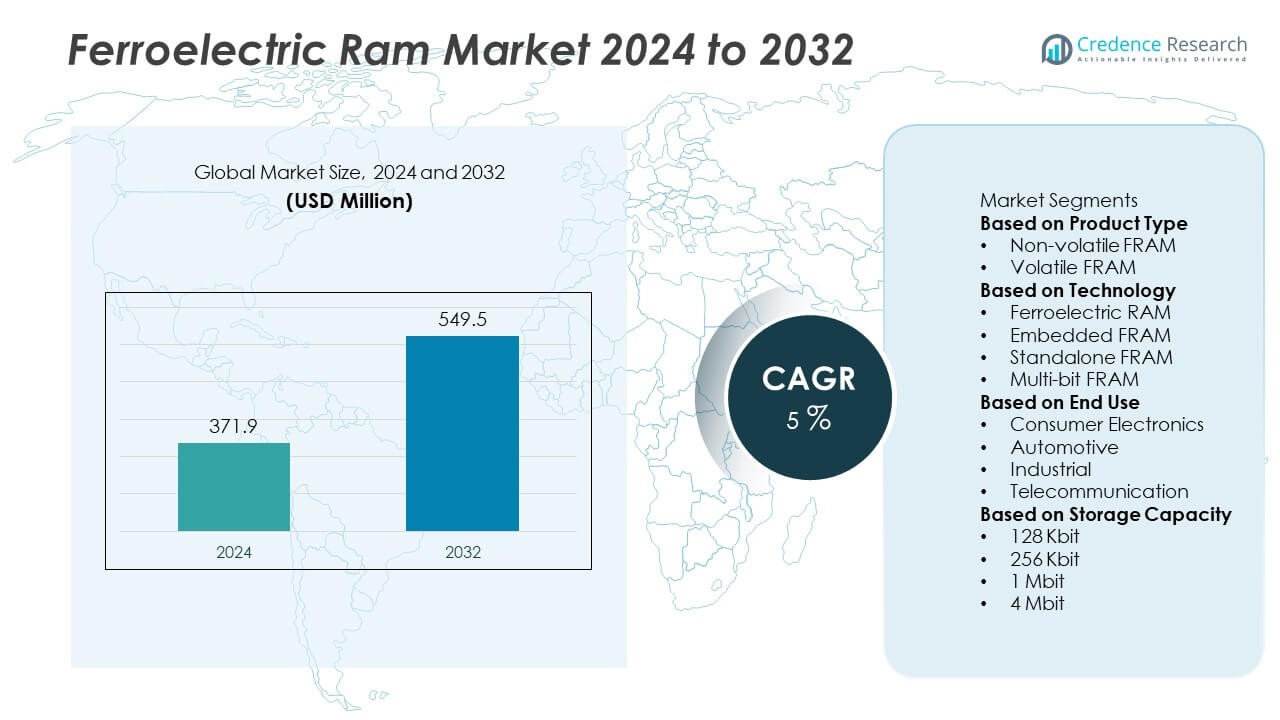
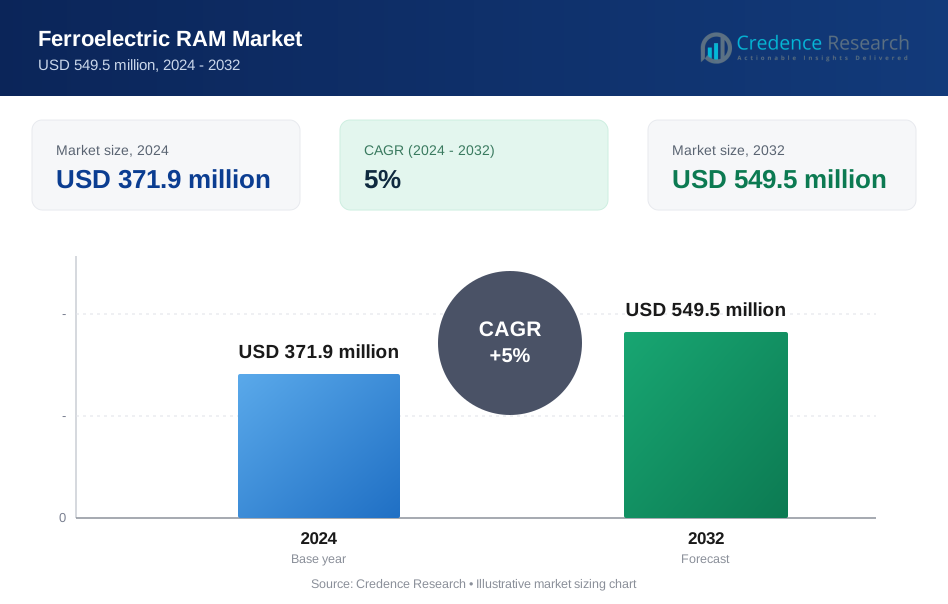
The Ferroelectric RAM Market was valued at 371.9 million in 2024 and is projected to reach 549.5 million by 2032, growing at a CAGR of 5% during the forecast period.| REPORT ATTRIBUTE | DETAILS |
|---|---|
| Historical Period | 2020-2024 |
| Base Year | 2024 |
| Forecast Period | 2025-2032 |
| Ferroelectric RAM Market Size 2024 | USD 371.9 Million |
| Ferroelectric RAM Market, CAGR | 5% |
| Ferroelectric RAM Market Size 2032 | USD 549.5 Million |
Market Insights
- The Ferroelectric RAM Market was valued at USD 371.9 million in 2024 and is projected to reach USD 549.5 million by 2032, growing at a CAGR of 5% during the forecast period.
- Growing demand for high-speed, low-power memory solutions in consumer electronics, automotive, and industrial automation drives the Ferroelectric RAM Market, supporting energy-efficient and reliable performance in critical applications.
- Increasing adoption of LED-based displays, IoT devices, and embedded systems shapes market trends, encouraging manufacturers to integrate smaller, faster, and more durable memory components for optimized performance.
- Leading players such as Fujitsu Limited, Rohm Semiconductor, Cypress Semiconductor, and Texas Instruments strengthen market competition by launching advanced Ferroelectric RAM solutions, expanding production capabilities, and forming strategic alliances for global reach.
- High production costs, technological complexity, and limited compatibility with conventional CMOS processes act as key restraints, slowing adoption in price-sensitive and legacy system applications.
- North America maintains strong demand due to aerospace, defense, and industrial automation applications, while Europe grows steadily with automotive and industrial use. Asia-Pacific emerges as the fastest-growing region, supported by semiconductor manufacturing hubs in Japan, South Korea, and China, along with rising consumer electronics adoption.
- Market expansion opportunities exist in IoT, smart devices, and automotive electronics, where low-power, fast-access memory is critical, encouraging innovation and strategic partnerships among Ferroelectric RAM manufacturers to capture emerging industrial and consumer applications.
Market Drivers
Rising Demand for High-Speed, Low-Power Memory Solutions Across Electronics Sectors The Ferroelectric RAM Market benefits from increasing adoption of high-speed, low-power memory solutions in industrial, automotive, and consumer electronics applications. It provides rapid read/write cycles while maintaining non-volatile data retention, making it suitable for real-time data processing and energy-efficient operations. Growing integration of IoT devices, smart sensors, and embedded systems drives the need for memory solutions that do not compromise performance or power efficiency. Manufacturers develop ferroelectric RAM modules with optimized architecture to support faster data access and reduced energy consumption. Demand in smart home devices and wearable electronics further strengthens its adoption. It supports reliable operations in edge computing applications where data stability is critical. Rising awareness of energy efficiency and device longevity reinforces the market’s growth trajectory.- For instance, Cypress Semiconductor developed the 256 Kbit CY15B104Q ferroelectric RAM with 40-nanosecond access time and ultra-low active current of 10 mA, enabling high-speed data logging in low-power wearable and embedded systems.
- For instance, ROHM Semiconductor’s MR44V064B, used in industrial PLCs, supports 64 Kbit density with a 15 ns access time and 10-year data retention at 85°C, making it ideal for high-frequency write conditions.
Market Trends
Transition Toward Energy-Efficient and Low-Power Memory Solutions Across Industries The Ferroelectric RAM Market shows a clear trend toward energy-efficient memory modules designed for low-power operation. It supports applications in portable electronics, IoT devices, and embedded systems where minimizing energy consumption is critical. Manufacturers focus on optimizing ferroelectric materials to reduce operating voltage and enhance write/read efficiency. Integration in battery-powered devices and edge computing platforms accelerates adoption. It enables designers to develop compact, high-performance solutions without compromising power budgets. Continuous improvements in circuit design and memory management enhance operational efficiency. The demand for sustainable, energy-conscious technology underlines this market trend.- For instance, Infineon Technologies' CY15B102Q 2-Mbit FRAM supports ultra-low power standby current of 1 µA and active current of 10 mA at 40 MHz, with 45 ns read/write speed, enabling efficient memory use in wearable health monitors and smart meters.
- For instance, Fujitsu’s MB85RS2MT FRAM provides 2 Mbit density with an SPI interface, supports operation from –40°C to +125°C, and offers 10 trillion read/write cycles, making it ideal for event data recorders and industrial PLCs exposed to fluctuating power and harsh environmental stress.
Market Challenges Analysis
High Production Costs and Complex Fabrication Processes Limiting Widespread Adoption The Ferroelectric RAM Market faces challenges related to high manufacturing costs and intricate fabrication processes. It requires precise deposition of ferroelectric materials and advanced lithography techniques to ensure memory reliability and performance. Low yield rates in production increase overall costs and limit large-scale adoption, particularly for consumer electronics. Integration with standard CMOS processes poses technical hurdles that necessitate specialized equipment and expertise. Manufacturers must balance performance, density, and cost-efficiency while maintaining quality standards. Limited availability of skilled personnel and advanced fabrication facilities further constrains expansion. These cost and production barriers slow the adoption rate in cost-sensitive markets. Data Retention Limitations and Integration Complexities in High-Performance Systems The Ferroelectric RAM Market encounters challenges in achieving long-term data retention and seamless integration into complex systems. It experiences degradation of ferroelectric properties over multiple write cycles, impacting memory reliability in critical applications. Compatibility with existing memory architectures and embedded systems requires careful design adjustments. Industrial, automotive, and aerospace sectors demand rigorous testing to meet performance and safety standards. Manufacturers must address voltage scaling, thermal stability, and endurance issues to ensure dependable operation. Limited standardization across ferroelectric RAM modules complicates system-level deployment. These technical and integration challenges affect adoption in high-performance and mission-critical environments.Market Opportunities
Expansion in Automotive and Industrial Applications Driving New Adoption Prospects The Ferroelectric RAM Market presents opportunities through growing demand in automotive and industrial sectors. It offers high-speed, non-volatile memory solutions that enhance system reliability in electric vehicles, advanced driver-assistance systems, and industrial automation equipment. Manufacturers can leverage its low power consumption and fast write-read cycles to optimize embedded systems and real-time control applications. Rising adoption of smart factories and connected machinery creates demand for memory technologies capable of handling frequent data updates under harsh conditions. Expansion of autonomous vehicle platforms and industrial IoT devices further strengthens growth potential. Companies investing in durable and energy-efficient ferroelectric RAM solutions gain a competitive edge in these high-growth applications. Integration with Emerging Consumer Electronics and Edge Computing Devices Creating Market Potential The Ferroelectric RAM Market benefits from opportunities in emerging consumer electronics and edge computing applications. It provides reliable non-volatile memory for wearable devices, smartphones, and portable medical equipment, where performance and energy efficiency are critical. Edge computing platforms require fast memory with low latency for real-time data processing, creating demand for ferroelectric RAM integration. Advances in miniaturization and 3D stacking technologies allow developers to implement high-density memory in compact devices. Expansion of smart homes, connected healthcare solutions, and portable electronics accelerates adoption. Manufacturers focusing on scalable and versatile ferroelectric RAM modules can capture significant opportunities in these evolving technology segments.Market Segmentation Analysis:
By Product Type The Ferroelectric RAM Market segments by product type into discrete memory chips and embedded modules. Discrete ferroelectric RAM devices provide flexible integration in existing hardware platforms, allowing manufacturers to enhance system memory without extensive redesigns. Embedded ferroelectric RAM modules find adoption in compact devices requiring efficient non-volatile memory, such as wearables, medical equipment, and IoT applications. It supports high-speed read and write operations, which improves overall device performance while maintaining energy efficiency. Growing demand for miniaturized electronics encourages manufacturers to focus on embedded solutions capable of sustaining frequent data access under limited power constraints.- For instance, Texas Instruments’ MSP430FR5994 MCU integrates 256 KB embedded FRAM with 100 trillion write endurance, an active current of 100 µA/MHz, and wake-up time under 6 µs, enabling reliable high-speed data handling in portable biosensors and edge analytics devices.
- For instance, GlobalFoundries and Fraunhofer IPMS demonstrated a 28 nm FeFET memory integrated on standard CMOS with write latency below 10 ns, read access time of 6 ns, and data retention exceeding 10⁵ seconds at 85°C, showing strong potential for embedded non-volatile memory in AI accelerators and edge processors.
Segments:
Based on Product Type- Non-volatile FRAM
- Volatile FRAM
- Ferroelectric RAM
- Embedded FRAM
- Standalone FRAM
- Multi-bit FRAM
- Consumer Electronics
- Automotive
- Industrial
- Telecommunication
- 128 Kbit
- 256 Kbit
- 1 Mbit
- 4 Mbit
- North America
- U.S.
- Canada
- Mexico
- Europe
- UK
- France
- Germany
- Italy
- Spain
- Russia
- Belgium
- Netherlands
- Austria
- Sweden
- Poland
- Denmark
- Switzerland
- Rest of Europe
- Asia Pacific
- China
- Japan
- South Korea
- India
- Australia
- Thailand
- Indonesia
- Vietnam
- Malaysia
- Philippines
- Taiwan
- Rest of Asia Pacific
- Latin America
- Brazil
- Argentina
- Peru
- Chile
- Colombia
- Rest of Latin America
- Middle East
- UAE
- KSA
- Israel
- Turkey
- Iran
- Rest of Middle East
- Africa
- Egypt
- Nigeria
- Algeria
- Morocco
- Rest of Africa
Regional Analysis
North America North America accounts for approximately 32% of the Ferroelectric RAM Market, led by the United States and Canada. It benefits from a strong semiconductor manufacturing ecosystem, advanced electronics R&D infrastructure, and early adoption of next-generation memory technologies. Major tech hubs in California, Texas, and Ontario house companies investing in high-performance memory solutions for consumer electronics, automotive, and defense sectors. It experiences consistent demand from data centers and AI-driven applications that require low-latency, non-volatile memory solutions. Government initiatives supporting innovation in electronics and memory technology further strengthen adoption. Companies in this region focus on integrating ferroelectric RAM into IoT devices and high-speed computing platforms. North America remains a key driver for market development and technological advancement. Europe Europe captures around 25% of the market, with Germany, France, and the United Kingdom leading adoption. Industrial automation, automotive electronics, and smart manufacturing systems drive demand for ferroelectric RAM. It supports electric vehicle platforms, advanced driver-assistance systems, and renewable energy infrastructure with reliable, low-power memory solutions. European manufacturers prioritize energy-efficient and durable memory devices that comply with stringent regional standards. Research investments in FeFET-based and embedded ferroelectric RAM further stimulate technological adoption. The presence of semiconductor clusters in Germany and the Netherlands enhances production capabilities. Europe maintains steady market growth with a focus on high-performance and safety-critical applications. Asia-Pacific Asia-Pacific holds an estimated 30% market share, fueled by China, Japan, South Korea, and India. It benefits from rising smartphone penetration, increasing consumer electronics production, and government-backed semiconductor initiatives. It supports high-volume manufacturing of embedded ferroelectric RAM for smartphones, IoT devices, wearables, and automotive electronics. The region experiences strong growth due to large-scale investments in memory manufacturing facilities and research collaborations. Japanese and South Korean companies lead in technological innovations for high-speed, energy-efficient ferroelectric RAM modules. China focuses on self-reliance in memory technology, enhancing local production and adoption. Asia-Pacific remains the most dynamic region, driving global market expansion. Latin America Latin America accounts for roughly 7% of the market, concentrated in Brazil, Mexico, and Argentina. It primarily adopts ferroelectric RAM in industrial automation, telecom infrastructure, and energy management systems. It benefits from modernization projects in manufacturing plants and expansion of smart grid solutions. Companies focus on delivering cost-effective, reliable memory solutions for remote and harsh operating conditions. Partnerships with global memory manufacturers enhance technology transfer and market penetration. Latin America continues to adopt ferroelectric RAM selectively, targeting niche high-reliability applications. Middle East & Africa The Middle East & Africa region holds approximately 6% market share, led by the UAE, Saudi Arabia, and South Africa. It relies on industrial automation, oil and gas, and defense applications for ferroelectric RAM adoption. It supports mission-critical electronics where reliability under extreme temperatures and power interruptions is essential. Regional governments promote smart manufacturing and defense technology initiatives, encouraging adoption. Collaborations with international memory solution providers drive technology integration. The region gradually strengthens its position through infrastructure modernization and strategic investments in electronics manufacturing.Key Player Analysis
- Winbond Electronics
- Infineon Technologies
- Cypress Semiconductor
- Texas Instruments
- NXP Semiconductors
- Alliance Memory
- Fujitsu Limited
- Rohm Semiconductor
- Silicon Storage Technology
- Nippon Electric Glass
Competitive Analysis
The Ferroelectric RAM Market demonstrates intense competition among leading players including Nippon Electric Glass, Rohm Semiconductor, Fujitsu Limited, Silicon Storage Technology, Cypress Semiconductor, Winbond Electronics, Infineon Technologies, NXP Semiconductors, Alliance Memory, and Texas Instruments, who focus on technological innovation, product differentiation, and strategic collaborations to maintain a competitive edge. These companies invest in advanced fabrication techniques, low-power designs, and high-speed memory solutions to serve consumer electronics, automotive, industrial automation, and IoT applications. Fujitsu Limited leads in high-reliability memory for industrial and automotive sectors, leveraging rigorous quality control and R&D initiatives. Rohm Semiconductor develops scalable Ferroelectric RAM architectures for embedded systems, enabling energy-efficient performance. Texas Instruments and Cypress Semiconductor integrate Ferroelectric RAM with microcontrollers and SoCs, enhancing compatibility. Nippon Electric Glass supplies substrate and material technologies that improve device stability. Winbond Electronics and Silicon Storage Technology offer cost-effective solutions for emerging markets, while Infineon Technologies and NXP Semiconductors focus on automotive and industrial control systems. Alliance Memory targets specialized applications requiring high endurance and reliability.Recent Developments
- In May 2025, NXP launched a new FeRAM product with enhanced radiation tolerance for aerospace applications, achieving data retention over 15 years under extreme conditions.
- In November 2024, Texas Instruments unveiled a 4 Mb FeRAM chip with ultra-low standby power of 2 µA, specifically designed for medical device applications requiring non-volatile memory.
- In July 2024, Infineon introduced a FeRAM solution targeting automotive safety systems, featuring 2 Mb density and ultra-fast write speeds of 150 ns, optimized for high-temperature environments.
Market Concentration & Characteristics
The Ferroelectric Ram Market exhibits a moderately concentrated structure, dominated by a mix of global semiconductor leaders and specialized memory solution providers. It is characterized by high technological intensity, where innovation in low-power consumption, high-speed write/read cycles, and enhanced endurance determines competitive advantage. Companies focus on developing FeRAM modules for diverse applications, including automotive, industrial automation, IoT devices, and aerospace systems, reflecting the market’s broad end-use spectrum. Strategic collaborations and licensing agreements play a key role in accelerating product development and expanding geographic reach. Continuous investments in research and development drive miniaturization, improved reliability, and higher integration with microcontrollers. The market demonstrates dynamic competition, with incumbents leveraging established manufacturing capabilities while new entrants adopt niche strategies targeting specific application segments. Regulatory compliance and standardization of interfaces further influence market behavior, guiding product designs and ensuring compatibility across industries. Overall, the Ferroelectric Ram Market combines technological sophistication with strategic partnerships, creating a landscape where innovation, reliability, and application-specific optimization shape growth and market positioning.Report Coverage
The research report offers an in-depth analysis based on Product Type, Technology, End Use, Storage Capacity and Geography. It details leading market players, providing an overview of their business, product offerings, investments, revenue streams, and key applications. Additionally, the report includes insights into the competitive environment, SWOT analysis, current market trends, as well as the primary drivers and constraints. Furthermore, it discusses various factors that have driven market expansion in recent years. The report also explores market dynamics, regulatory scenarios, and technological advancements that are shaping the industry. It assesses the impact of external factors and global economic changes on market growth. Lastly, it provides strategic recommendations for new entrants and established companies to navigate the complexities of the market.Future Outlook
- The Ferroelectric Ram Market will continue to grow with rising demand for low-power, high-speed memory solutions.
- Increasing adoption in automotive electronics will drive further market expansion.
- Integration with IoT devices will enhance the need for reliable non-volatile memory.
- Continuous innovation in high-density FeRAM chips will support advanced industrial applications.
- Collaboration between semiconductor manufacturers will accelerate new product development.
- Expansion in emerging markets will create new adoption opportunities across industries.
- Miniaturization and integration with microcontrollers will improve device performance and efficiency.
- Growing use in aerospace and defense systems will strengthen market demand.
- Regulatory compliance and standardization will guide product designs and industry adoption.
- Rising focus on energy-efficient and sustainable memory solutions will shape future market trends.
Request a Free Sample
Fill in your details and we'll send you a free sample report.
- Sample data tables & charts
- Research methodology
Need a Custom Version of This Report?
Tailor the scope, geography, or segments to your exact requirements.
- Custom geography or segment scope
- Direct access to our analyst team
Frequently Asked Questions
What is the current market size for Ferroelectric RAM, and what is its projected size in 2032?
At what Compound Annual Growth Rate is the Ferroelectric RAM Market projected to grow between 2025 and 2032?
Which Ferroelectric RAM Market segment held the largest share in 2024?
Which Ferroelectric RAM Market segment held the largest share in 2024?
What are the primary factors fueling the growth of the Ferroelectric RAM Market?
Who are the leading companies in the Ferroelectric RAM Market?
Which region commanded the largest share of the Ferroelectric RAM Market in 2024?
Table of Content
Chapter 1. Report Introduction
- 1.1 Report Description & Purpose
- 1.1.1 Report Title & Market Definition
- 1.1.2 Unique Selling Propositions (USP) & Key Differentiators
- 1.1.3 Value Proposition for Stakeholders
- 1.2 Research Objectives
- 1.2.1 Market Sizing Objectives (Volume & Revenue) (Volume Where Applicable)
- 1.2.2 Segmentation Objectives
- 1.2.3 Competitive Intelligence Objectives
- 1.2.4 Forecast & Scenario Objectives
- 1.3 Report Scope
- 1.3.1 Ferroelectric RAM Scope – Segments & Subsegments Covered
- 1.3.2 Geographic Scope – Regions & Countries Covered
- 1.3.3 Historical Period, Base Year & Forecast Period (2024; forecast to 2032)
- 1.3.4 Inclusions & Exclusions
- 1.4 Industry Classification & Applicable Codes
- 1.5 Currency, Measurement Units & Valuation Basis
- 1.6 Target Stakeholders
- 1.7 Limitations & Assumptions
Chapter 2. Executive Summary
- 2.1 Global Ferroelectric RAM Market Snapshot
- 2.1.1 Market Size – Historical (2024) & Forecast (2024-2032) (2024: USD 371.9 million → 2032: USD 549.5 million)
- 2.1.2 Volume & Revenue – Global Totals (Volume Where Applicable)
- 2.1.3 Key Market Highlights – Top Five Facts
- 2.2 Ferroelectric RAM Market Segmentation Snapshot
- 2.2.1 Market Split by Region – 2024 vs. 2032
- 2.3 Competitive Snapshot
- 2.3.1 Top 10 Players by Revenue Share – 2024
- 2.3.2 Top 10 Players by Volume Share – 2024 (Volume Where Applicable)
- 2.3.3 Recent Strategic Developments (18-Month Summary)
- 2.4 Key Investment Highlights & Strategic Conclusions
Chapter 3. Ferroelectric RAM Market Dynamics & Industry Analysis
- 3.1 Market Overview & Context
- 3.1.1 Ferroelectric RAM Market Position in the Broader Industry Value Chain
- 3.1.2 Demand Structure & Purchasing Dynamics
- 3.1.3 Market Maturity & Development Stage by Region
- 3.2 Ferroelectric RAM Market Drivers
- 3.3 Ferroelectric RAM Market Restraints & Challenges
- 3.4 Ferroelectric RAM Market Opportunities
- 3.5 Porter's Five Forces Analysis
- 3.5.1 Threat of New Entrants
- 3.5.2 Bargaining Power of Suppliers
- 3.5.3 Bargaining Power of Buyers
- 3.5.4 Threat of Substitutes
- 3.5.5 Competitive Rivalry – Intensity Assessment
- 3.6 Ferroelectric RAM Value Chain Analysis
- 3.6.1 Upstream – Key Inputs, Resources & Suppliers
- 3.6.1.1 Key Input/Resource 1
- 3.6.1.2 Key Input/Resource 2
- 3.6.1.3 Key Input/Resource 3
- 3.6.2 Midstream – Core Operations & Value Creation
- 3.6.2.1 Operating Model & Process Overview
- 3.6.2.2 Key Operating Locations & Capabilities by Company
- 3.6.3 Downstream – Market Channels & End Users
- 3.6.3.1 Direct Sales & Customer Engagement Channels
- 3.6.3.2 Indirect Sales, Intermediaries & Partner Channels
- 3.6.4 Value Chain Profitability Analysis
- 3.6.1 Upstream – Key Inputs, Resources & Suppliers
- 3.7 PESTEL Analysis
- 3.7.1 Political Factors
- 3.7.2 Economic Factors
- 3.7.3 Social Factors
- 3.7.4 Technological Factors
- 3.7.5 Environmental Factors
- 3.7.6 Legal Factors
- 3.8 Ferroelectric RAM Supply Chain Analysis
- 3.8.1 Critical Input & Resource Availability Risk Assessment
- 3.8.2 Supplier & Operational Concentration Risk (Geographic Exposure)
- 3.8.3 Supply & Service Disruption Impact Analysis
- 3.9 Regulatory & Policy Landscape
Note: The regulatory and policy landscape section covers regulations based on their applicability to the market, Ferroelectric RAM category, geography, and scope of the study. Only regulatory frameworks with a material impact on operations, compliance, trade, sustainability, or market access are analyzed in detail.
Chapter 4. Key Investment Pockets & Opportunity Analysis
- 4.1 Ferroelectric RAM Market Attractiveness Analysis
- 4.1.1 By Region – Investment Attractiveness Matrix (Market Size × CAGR)
- 4.2 Absolute Revenue Growth Opportunity
- 4.2.1 By Region – Absolute Revenue Growth Through 2032
- 4.3 Incremental Demand Opportunity
- 4.3.1 By Region – Incremental Demand Through 2032
- 4.3.2 Segment – Incremental Demand
- 4.4 Emerging Submarket Opportunity Deep Dive (Subject to Applicability)
- 4.5 Priority Market Opportunity Scorecards
- 4.5.1 United States
- 4.5.2 Europe
- 4.5.3 Asia
- 4.5.4 Middle East & Africa
Note: Priority market opportunity scorecards reflect the geographic scope and strategic relevance of the study. Listed markets are indicative and may be adapted to the industry.
Chapter 5. Ferroelectric RAM Cross-Border Trade & Market Access Analysis
- 5.1 International Trade & Cross-Border Activity Overview
- 5.1.1 Global Export Value by Country (2024)
- 5.1.2 Global Export Volume by Country (2024) (Volume Where Applicable)
- 5.1.3 Global Import Value by Country (2024)
- 5.1.4 Global Import Volume by Country (2024) (Volume Where Applicable)
- 5.1.5 Net Trade Balance by Country (2024)
- 5.2 Export Analysis – Segment
- 5.2.1 Category 1 (Applicable Classification Code)
- 5.2.2 Category 2 (Applicable Classification Code)
- 5.2.3 Category 3 (Applicable Classification Code)
- 5.2.4 Category 4 (Applicable Classification Code)
- 5.2.5 Category 5 (Applicable Classification Code)
- 5.3 Import Analysis – Segment
- 5.3.1 Category 1 (Applicable Classification Code)
- 5.3.2 Category 2 (Applicable Classification Code)
- 5.3.3 Category 3 (Applicable Classification Code)
- 5.3.4 Category 4 (Applicable Classification Code)
- 5.3.5 Category 5 (Applicable Classification Code)
- 5.4 Cross-Border Pricing & Transaction Benchmarks
- 5.4.1 Export Pricing – Segment & Country
- 5.4.2 Import Pricing – Segment & Source Country
- 5.4.3 Price Trends (2024)
- 5.5 Key Cross-Border Trade & Delivery Routes
- 5.5.1 Cross-Border Trade/Delivery Route 1
- 5.5.2 Cross-Border Trade/Delivery Route 2
- 5.5.3 Cross-Border Trade/Delivery Route 3
- 5.5.4 Cross-Border Trade/Delivery Route 4
- 5.5.5 Cross-Border Trade/Delivery Route 5
- 5.6 Trade Policy & Market Access Impact Assessment
- 5.6.1 Tariff & Non-Tariff Barriers
- 5.6.2 Regional Trade & Economic Integration Frameworks
- 5.6.3 Bilateral & Multilateral Trade Agreements
- 5.6.4 Cross-Border Operating, Licensing & Localization Requirements
Note: This chapter applies where cross-border trade or delivery is relevant to Ferroelectric RAM. Goods, services, and digital offerings are assessed using applicable classifications and transaction measures. Import-export volumes, trade balances, and route analyses are included only where meaningful to the market.
Chapter 6. Competitive Landscape & Company Benchmarking
- 6.1 Ferroelectric RAM Market Concentration & Structure
- 6.1.1 Herfindahl-Hirschman Index (HHI) – vs. 2024
- 6.1.2 Leading, Mid-Sized & Emerging Player Structure
- 6.1.3 Global, Regional & Local Player Dynamics
- 6.2 Ferroelectric RAM Market Share Analysis – 2024
- 6.2.1 Global Revenue Share by Company
- 6.2.2 Global Volume Share by Company (Volume Where Applicable)
- 6.2.3 Regional Revenue Share
- 6.2.4 Market Share Evolution ( vs. 2024)
- 6.2.5 Company Market Share by Key Segment
- 6.2.6 Company Market Share by Customer Group
- 6.3 Operating Scale, Capacity & Infrastructure Analysis
- 6.3.1 Global Operating Scale & Supply Capacity
- 6.3.2 Resource Utilization & Operating Efficiency
- 6.3.3 Output, Service Delivery & Activity Metrics
- 6.3.4 Operating Footprint & Infrastructure Map
- 6.3.5 Planned Operational & Capacity Expansion
- 6.4 Ferroelectric RAM Competitive Benchmarking Matrix
- 6.4.1 Revenue, Growth, Profitability & Operating Metric Comparison
- 6.4.2 Channel Revenue Mix
- 6.4.3 Geographic Revenue Exposure
- 6.4.4 R&D Intensity
- 6.4.5 Sustainability Maturity
- 6.5 Strategic Developments in Ferroelectric RAM (Last 24 Months)
- 6.5.1 Mergers, Acquisitions & Divestments
- 6.5.2 New Products, Services & Solutions in Ferroelectric RAM
- 6.5.3 Operational & Infrastructure Expansions
- 6.5.4 Strategic Alliances, Joint Ventures & Partnerships
- 6.5.5 Distribution Expansion & Market Entry
- 6.5.6 Sustainability & ESG Initiatives
- 6.6 Competitive Strategy Mapping
- 6.6.1 Leader, Challenger, Follower & Niche Classification
- 6.6.2 Pricing Strategy Comparison
- 6.6.3 Channel Strategy Matrix
Note: Strategic developments are included based on their materiality and the availability of reliable information.
Chapter 7. Global Ferroelectric RAM Market – By Sales & Delivery Channel
- 7.1 Segment Overview
- 7.1.1 Volume & Revenue Split by Channel (2024 & 2032) (Volume Where Applicable)
- 7.1.2 Channel Mix Evolution (2024-2032)
Chapter 8. Regional Market Analysis – Global Overview
- 8.1 Global Regional Overview
- 8.1.1 Regional Volume Share (Volume Where Applicable)
- 8.1.2 Regional Revenue Share
- 8.1.3 Regional Volume by Region (Volume Where Applicable)
- 8.1.4 Regional Revenue by Region
- 8.1.5 Regional Forecast Through 2032
- 8.2 Cross-Regional Segment Analysis
- 8.2.1 By Sales & Delivery Channel
- 8.2.2 By Competitive Positioning & Price Tier
Chapter 9. North America Ferroelectric RAM Market
- 9.1 United States
- 9.2 Canada
- 9.3 Mexico
Chapter 10. Europe Ferroelectric RAM Market
- 10.1 Germany
- 10.2 France
- 10.3 Italy
- 10.4 United Kingdom
- 10.5 Spain
- 10.6 Poland
- 10.7 Russia
- 10.8 Netherlands
- 10.9 Belgium
- 10.10 Sweden
- 10.11 Denmark
- 10.12 Norway
- 10.13 Rest of Europe
Chapter 11. Asia Pacific Ferroelectric RAM Market
- 11.1 China
- 11.2 India
- 11.3 Japan
- 11.4 South Korea
- 11.5 Thailand
- 11.6 Indonesia
- 11.7 Vietnam
- 11.8 Malaysia
- 11.9 Australia
- 11.10 Rest of Asia Pacific
Chapter 12. Latin America Ferroelectric RAM Market
- 12.1 Brazil
- 12.2 Argentina
- 12.3 Colombia
- 12.4 Chile
- 12.5 Rest of Latin America
Chapter 13. Middle East Ferroelectric RAM Market
- 13.1 Saudi Arabia
- 13.2 United Arab Emirates
- 13.3 Turkey
- 13.4 Israel
- 13.5 Iran
- 13.6 Rest of the Middle East
Chapter 14. Africa Ferroelectric RAM Market
- 14.1 South Africa
- 14.2 Egypt
- 14.3 Nigeria
- 14.4 Morocco
- 14.5 Rest of Africa
Chapter 15. Ferroelectric RAM Company Profiles
- 15.1 [Company 01]
- 15.1.1 Company Overview
- 15.1.2 Key Management Personnel
- 15.1.3 Products & Services Portfolio
- 15.1.4 Financial Performance
- 15.1.5 Key Market Focus & Geographic Presence
- 15.1.6 Recent Developments & Strategic Initiatives
Note: The company profile list is preliminary and may change based on research findings, market developments, data availability, and client requirements.
Chapter 16. Appendices
- Appendix A – List of Abbreviations & Acronyms
- Appendix B – Industry Classification Code Reference – Full Series
- Appendix C – Supply, Output & Operating Capacity Data Tables
- Appendix D – End-Use & Demand Base Tables
- Appendix E – Demand, Adoption & Usage Assumptions
- Appendix F – Pricing & Revenue Metric Reference Tables
- Appendix G – Company Operations & Infrastructure Database
- Appendix H – Cross-Border Trade & Activity Data Tables (Where Applicable)
- Appendix I – Regulatory Summary Tables
- Appendix J – Primary Research Participant List (Anonymized)
- Appendix K – Primary Research Questionnaire Framework
- Appendix L – Data Sources & Bibliography
- Appendix M – Market Size Divergence & Source Comparison
Chapter 17. Research Methodology
- 17.1 Research Framework & Philosophy
- 17.2 Secondary Research – Sources, Hierarchy & Data Extraction
- 17.3 Data Modeling – Bottom-Up & Top-Down Market Sizing
- 17.4 Primary Research – Stakeholder Framework, LOI & Sample Sizes
- 17.5 Forecast Methodology – Regression, Scenario & Sensitivity Analysis
- 17.6 Quality Control – Four-Layer Validation Framework
- 17.7 Limitations & Standard Assumptions
- 17.8 Disclaimer
