
Market Overview:
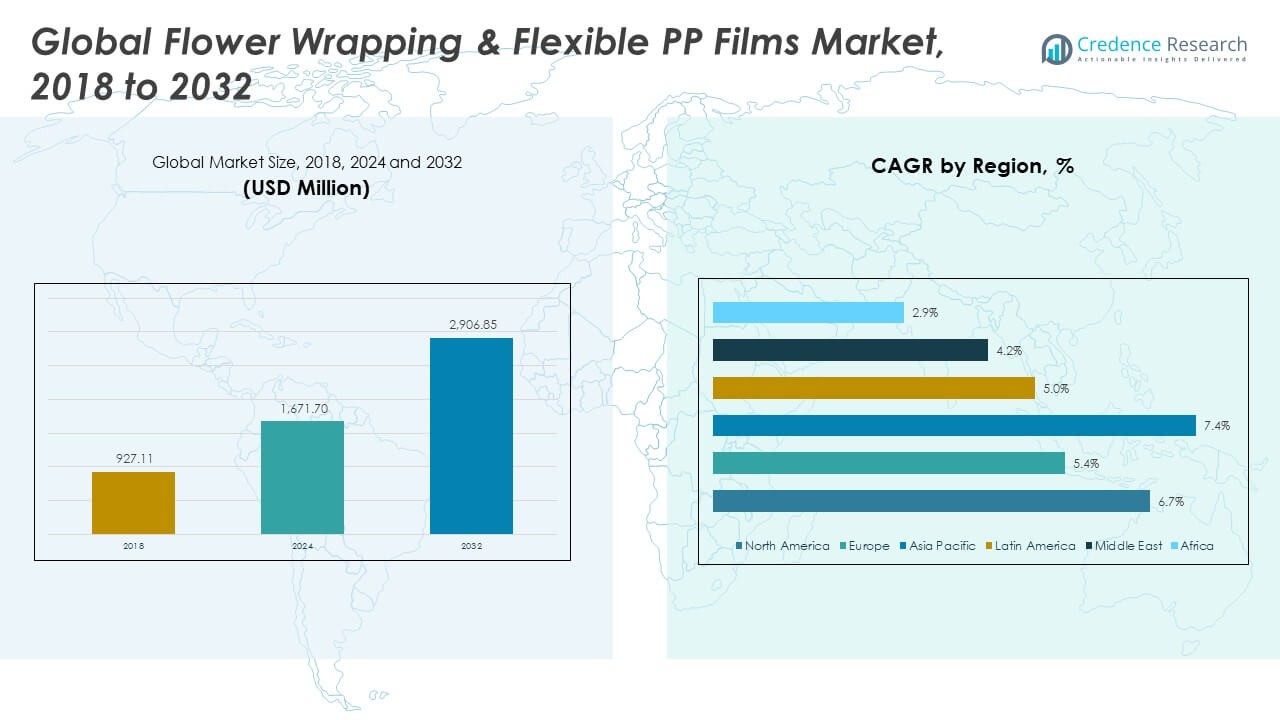
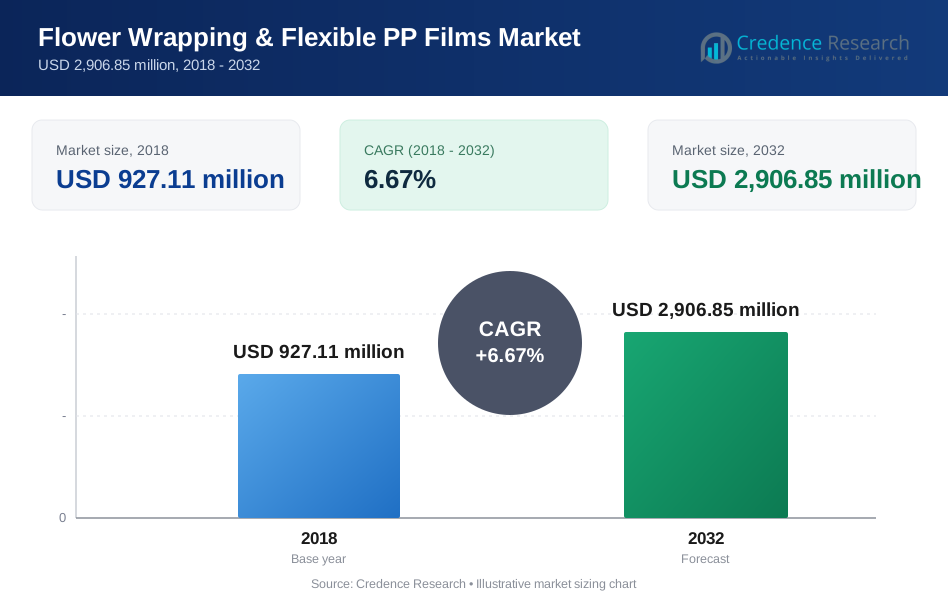
The Global Flower Wrapping & Flexible PP Films Market size was valued at USD 927.11 million in 2018 to USD 1,671.70 million in 2024 and is anticipated to reach USD 2,906.85 million by 2032, at a CAGR of 6.67% during the forecast period.
| REPORT ATTRIBUTE | DETAILS |
|---|---|
| Historical Period | 2020-2023 |
| Base Year | 2024 |
| Forecast Period | 2025-2032 |
| Flower Wrapping & Flexible PP Films Market Size 2024 | USD 1,671.70 Million |
| Flower Wrapping & Flexible PP Films Market, CAGR | 6.67% |
| Flower Wrapping & Flexible PP Films Market Size 2032 | USD 2,906.85 Million |
Strong adoption of PP films in floral packaging fuels steady growth in this market. Retailers prefer durable, transparent, and customizable films that protect flowers during transit and enhance visual quality at display points. E-commerce floral delivery expands the need for moisture-resistant and tear-resistant wraps. Producers invest in high-gloss and embossed textures that support branding needs. Growth in gifting culture encourages more stylized and sustainable wrapping solutions. Lightweight formats support easy handling and lower damage risk during logistics. Demand strengthens across supermarkets, specialty floral shops, and event decorators.
Leading regions include Europe and Asia Pacific due to strong horticulture output and advanced packaging supply chains. Europe benefits from large flower auctions and strong export networks, while Asia Pacific gains traction from rising retail modernization and floral consumption in urban areas. North America shows steady growth due to rising demand for premium decorative wraps and online floral services. Emerging regions in Latin America and the Middle East gain interest due to expanding floriculture hubs. Market growth aligns with better supply chain links and rising aesthetic preferences across all regions.
Market Insights:
- The Global Flower Wrapping & Flexible PP Films Market was valued at USD 927.11 million in 2018, reached USD 1,671.70 million in 2024, and is projected to hit USD 2,906.85 million by 2032, growing at a CAGR of 6.67% due to rising demand for decorative, lightweight, and high-clarity PP films.
- Asia Pacific (46.9%), North America (27.2%), and Europe (17.7%) hold the top three regional shares because of strong floriculture output, well-built supply chains, and high adoption of premium wrapping films across retail and gifting sectors.
- Asia Pacific, the fastest-growing region, maintains its lead with expanding urban consumption, retail modernization, and large floral export hubs that increase long-term PP film demand.
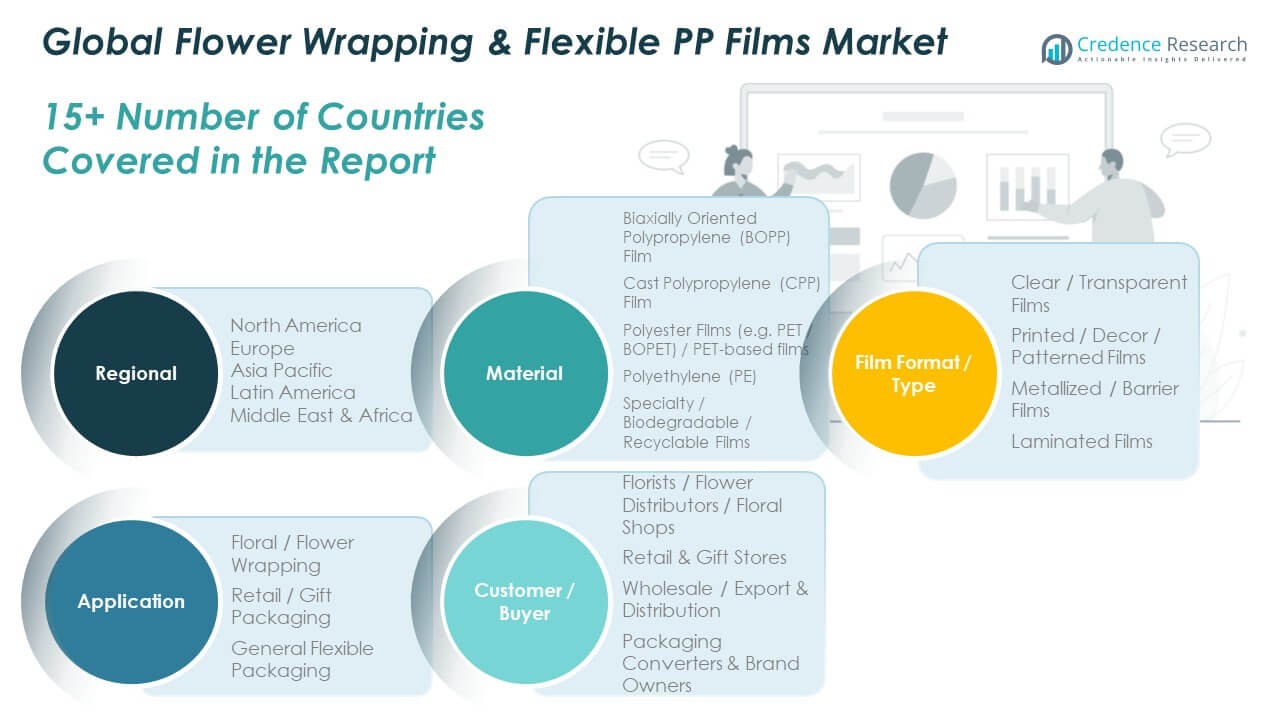
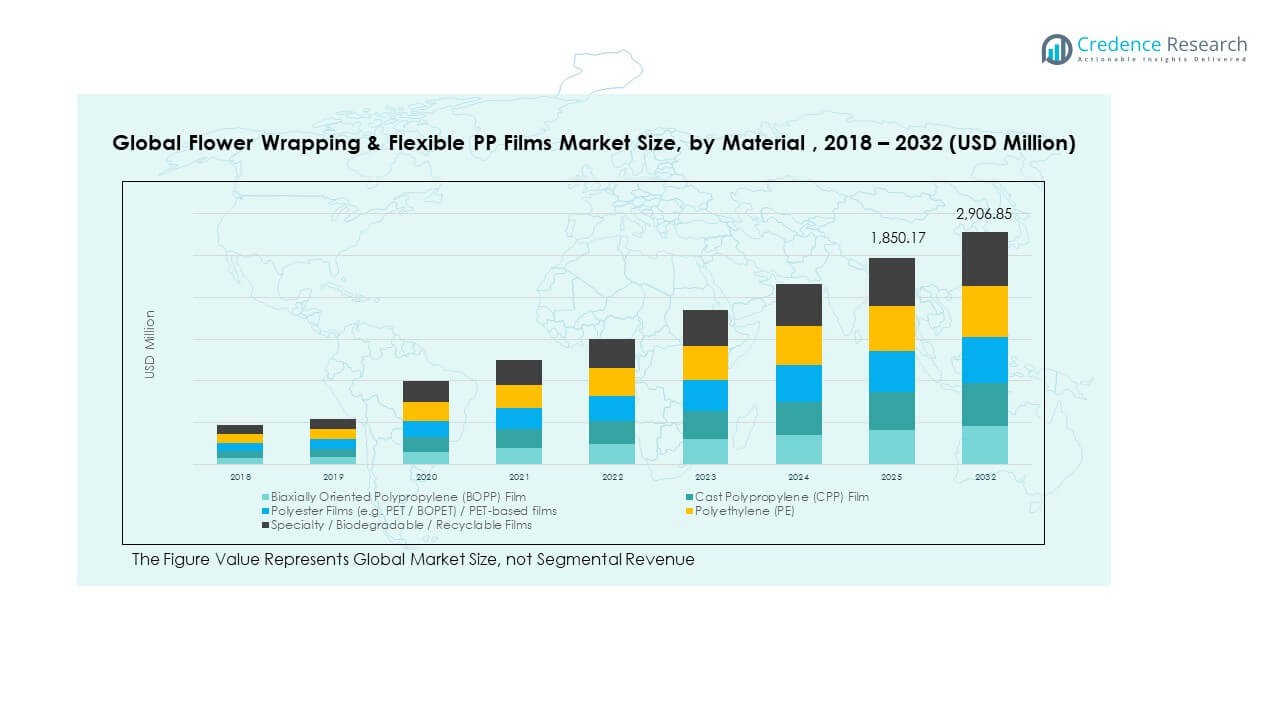
- Segment distribution from the chart shows BOPP Film holding the highest share at roughly 35%, driven by its clarity, printability, and strength across floral and decorative packaging.
- CPP, PET, PE, and Specialty Films collectively form the remaining 65%, with CPP and PE gaining traction for durability, while specialty recyclable films rise due to sustainability preferences.
 Market Drivers:
Rising Demand for High-Clarity and Decorative Films Driven by Retail and Gifting Growth
Strong interest in premium floral presentation drives steady growth in the Global Flower Wrapping & Flexible PP Films Market. Retailers need clear and glossy films to highlight fresh blooms. E-commerce players prefer durable films that protect flowers during transit. Decorative formats lift visual value across bouquets and event displays. Lightweight structures help handlers manage large volumes with ease. Brands pick PP films for their print quality and smooth textures. Custom colors help florists match seasonal themes. The market gains push from rising gifting culture worldwide.
- For instance, Innovia Films’ Propafilm™ ranges offer tensile strength above 120 MPa, improving handling performance.
Expansion of Organized Floral Retail and Rapid Uptake of Ready-to-Display Packaging Formats
Organized retail chains expand floral sections and create new shelf needs for flexible PP films. Stores pick pre-cut sheets and rolls that support speed during busy hours. Event firms demand rugged wraps to protect arrangements. Rising use of bouquet sleeves lifts film consumption. Producers refine barrier features to slow moisture loss. It benefits from longer shelf presence of wrapped flowers. Simple handling methods help retailers manage high peak-season flow. Broader availability encourages new packaging styles in all channels.
- For instance, Jindal Poly Films develops various BOPP film solutions, some of which feature enhanced puncture resistance as a key mechanical property to prevent packaging failures in demanding applications. The value above 250 g, measured using the standard ASTM D3420 test method for film impact-puncture penetration, reflects specific product performance rather than a general specification across all matte grades.
Growing Influence of Branding and Customization Across Floral Display Units
Floral brands require strong visual identity on wrapping films. High-resolution prints help sellers position premium bouquets. PP films deliver sharp color output for holiday themes. Gift shops use embossed patterns to lift buyer interest. Uniform branding supports event planners who manage consistent décor. The segment gains from fast-turn custom orders. It strengthens customer engagement through personalized options. Demand climbs across both large retailers and boutique florists.
Shift Toward Lightweight, Recyclable PP Constructions for Better Sustainability Alignment
Sustainability rules push retailers toward recyclable PP wraps. Lightweight films reduce waste volume across disposal streams. Mono-material designs attract eco-focused buyers. Producers develop cleaner resins to support low-impact packaging. Consumers show rising awareness of green product choices. It gains support from national packaging goals. Transparent labeling of recyclable wraps lifts adoption. The shift encourages broader use across varied bouquet categories.
Market Trends:
Rising Preference for Textured, Patterned, and Specialty Visual Effects in Floral Wrapping
Buyers seek unique visual finishes that lift bouquet appeal. Specialty textures help brands stand out in crowded retail aisles. Pearl, matte, and holographic effects attract premium buyers. Event designers use layered wraps to create curated looks. Floral boutiques tailor seasonal themes through bold prints. It aligns with creative shifts in décor needs. Strong interest in sensory appeal pushes new product lines. Producers scale advanced visual formats to meet broader demand.
- For instance, Mondi does create packaging with haptic (tactile) effects to enhance visual appeal, such as a special 3D varnish that can be applied with significant thickness.
Growth of Automation in Cutting, Sleeving, and Bouquet Handling Across Retail Chains
Retailers adopt automated tools that need uniform PP films. Consistent roll quality improves cut accuracy. Sleeve machines require stable stiffness for smooth entry. High-speed lines reduce labor strain during peak seasons. It supports faster checkout in large supermarkets. Automation drives demand for tight-tolerance films. Standardized sizes allow wide equipment compatibility. Floral suppliers use automation to lift output rates.
- For instance, Brückner’s BOPP technical films reach modulus values above 1,800 MPa, supporting high-speed sleeving. High-speed lines reduce labor strain during peak seasons.
Greater Integration of UV-Resistant and Moisture-Stable Films Supporting Longer Display Life
PP suppliers introduce UV-resistant grades for open-display floral units. Improved stability slows film discoloration under retail lighting. Moisture control features protect delicate stems. Event planners choose stable wraps for outdoor settings. It strengthens product value for long ceremonies. Retailers gain better bouquet performance during long store hours. Enhanced protection lifts consumer satisfaction. The shift fuels interest in function-rich designs.
Rise of Personalization Through Short-Run Digital Printing for Seasonal and Local Events
Digital presses help suppliers create fast-turn designs for local markets. Short runs allow region-specific themes. Local florists request names, messages, and branded elements. Seasonal peaks drive high custom order flow. The trend aligns with rising interest in curated bouquets. It reduces waste linked to unused mass-printed rolls. Flexible printing expands style variety. Retailers improve repeat sales through unique packaging identity.
 Market Challenges Analysis:
Pressure from Sustainability Rules, Material Restrictions, and Shifting Waste-Management Expectations
Sustainability rules create pressure on the Global Flower Wrapping & Flexible PP Films Market. Governments push for cleaner disposal paths. Retailers need recyclable or low-impact wraps. Many suppliers face cost pressure when shifting to improved resins. Buyers demand clear proof of eco-friendly formats. It forces firms to redesign product portfolios. Limited recycling capacity in some regions slows progress. Brands must balance performance with environmental compliance.
Intense Competition, Price Sensitivity, and Volatility in Polypropylene Supply Chains
Competition rises as producers enter with similar film formats. Intense price sensitivity affects margins across many channels. Polypropylene cost swings disrupt planning cycles for suppliers. Retailers negotiate tight pricing every season. It places pressure on producers who invest in new features. Freight delays cause stock gaps during floral peaks. Low differentiation weakens loyalty in crowded markets. Firms must manage cost control without reducing quality.
Market Opportunities:
Expansion of Premium Floral Presentation Through Advanced Print, Texture, and Design Capabilities
Premium bouquet demand creates openings for advanced PP film aesthetics. High-definition print units improve branding output. Texture innovation lifts sensory appeal for buyers. Regional florists seek curated film sets for events. It helps suppliers differentiate through specialty formats. Growing preference for luxury gifting drives interest in bold wrapping designs. Short-run customization attracts boutique retailers. Seasonal trends unlock recurring high-volume orders.
Growth Potential Across Emerging Floral Retail Markets and Rising E-Commerce Fulfillment Needs
Urbanization lifts floral gifting in emerging economies. E-commerce growth creates strong needs for protective and durable PP wraps. Improved logistics networks widen access for mid-size floral brands. It drives adoption of moisture-stable sleeves. Regional horticulture hubs create new demand hotspots. Lightweight PP films support cost-effective transport. Online subscription bouquets lift consistent consumption. Diverse regional growth paths create long-term opportunity.
Market Segmentation Analysis:
By Material
The Global Flower Wrapping & Flexible PP Films Market features strong use of BOPP film due to its clarity and print quality. CPP film supports durable formats for heavy bouquets. PET-based films gain interest from premium displays that need rigidity. PE formats help buyers reduce cost in high-volume packs. Specialty, biodegradable, and recyclable films grow due to rising sustainability needs. It benefits from demand for mono-material structures that improve recovery rates. Brands pick materials that balance strength and visual appeal.
- For instance, DuPont Teijin Films’ Mylar® PET achieves a tensile modulus above 4,000 MPa, a strong indicator of its high stiffness compared to other common polymers. This superior mechanical property often makes PET a more expensive material option; consequently, PE formats (polyethylene) are often chosen instead to help buyers reduce cost in high-volume packaging applications.
By Film Format / Type
Clear films lead due to strong shelf appeal across floral units. Printed and patterned films lift decorative value for seasonal packs. Metallized films support barrier needs in hybrid packaging lines. Laminated films help producers achieve specific stiffness and visual effects. It gains value from formats that meet branding goals. Retailers favor rolls and sheets that deliver smooth handling. Growth links to demand for premium and event-focused packaging styles.
By Application
Floral wrapping holds the largest share due to strong use in bouquets and event décor. Retail and gift packaging expands with gifting growth. General flexible packaging gains traction in hybrid product lines. It covers a wide scope of products that need consistent clarity. Use across supermarkets and specialty floral shops strengthens volume. Application demand aligns with improved film versatility.
By Customer / Buyer
Florists and distributors drive strong demand for decorative sheets. Retail and gift stores seek printed formats for seasonal themes. Wholesale and export channels need durable films for transit. Packaging converters and brand owners focus on customizable structures. It supports diverse customer needs across global supply chains.
Segmentation:
By Material
- Biaxially Oriented Polypropylene (BOPP) Film
- Cast Polypropylene (CPP) Film
- Polyester Films (PET / BOPET / PET-based films)
- Polyethylene (PE)
- Specialty / Biodegradable / Recyclable Films
By Film Format / Type
- Clear / Transparent Films
- Printed / Decor / Patterned Films
- Metallized / Barrier Films
- Laminated Films
By Application
- Floral / Flower Wrapping
- Retail / Gift Packaging
- General Flexible Packaging
By Customer / Buyer
- Florists / Flower Distributors / Floral Shops
- Retail & Gift Stores
- Wholesale / Export & Distribution
- Packaging Converters & Brand Owners
By Region
- North America
- U.S.
- Canada
- Mexico
- Europe
- Germany
- France
- U.K.
- Italy
- Spain
- Rest of Europe
- Asia Pacific
- China
- Japan
- India
- South Korea
- South-east Asia
- Rest of Asia Pacific
- Latin America
- Brazil
- Argentina
- Rest of Latin America
- Middle East & Africa
- GCC Countries
- South Africa
- Rest of the Middle East and Africa
Countries Covered (Examples)
- U.S., Canada, Mexico
- UK, France, Germany, Italy, Spain, Russia, Netherlands, Poland, Sweden, Switzerland, Denmark, Belgium, Austria
- China, Japan, South Korea, India, Australia, Thailand, Indonesia, Vietnam, Malaysia, Philippines, Taiwan
- Brazil, Argentina, Peru, Chile, Colombia
- UAE, KSA, Israel, Turkey, Iran
- South Africa, Egypt, Nigeria, Algeria, Morocco
 Regional Analysis:
North America
The North America Global Flower Wrapping & Flexible PP Films Market size was valued at USD 256.10 million in 2018 to USD 454.20 million in 2024 and is anticipated to reach USD 793.28 million by 2032, at a CAGR of 6.7% during the forecast period. Regional market share 2024: 27.2%. North America holds a strong position due to large floral retail chains and strong gifting culture. Buyers favor high-clarity PP films for premium bouquets in supermarkets and specialty stores. E-commerce adoption strengthens demand for protective wraps that hold shape through transit. Event décor firms request textured and printed films for weddings and corporate settings. It benefits from strong production capabilities and advanced converting operations. Sustainability rules encourage high use of recyclable PP formats. Regional distributors maintain wide networks that support steady demand across urban markets. Growth links to ongoing expansion of seasonal and holiday floral sales.
Europe
The Europe Global Flower Wrapping & Flexible PP Films Market size was valued at USD 173.69 million in 2018 to USD 296.09 million in 2024 and is anticipated to reach USD 468.35 million by 2032, at a CAGR of 5.4% during the forecast period. Regional market share 2024: 17.7%. Europe shows strong traction due to high floral consumption across key markets such as the Netherlands, Germany, and the UK. Major flower auctions drive stable demand for wrapping films with high clarity and rigidity. Buyers focus on recyclable and mono-material PP solutions to meet strict sustainability rules. Retailers pick printed and matte finishes to match seasonal themes. It gains from well-established logistics systems that support fresh flower movement. Local converters offer advanced decorative effects for premium packs. Outdoor events create steady interest for moisture-stable films. Regional demand reflects a balanced mix of retail and export-driven consumption.
Asia Pacific
The Asia Pacific Global Flower Wrapping & Flexible PP Films Market size was valued at USD 419.37 million in 2018 to USD 783.16 million in 2024 and is anticipated to reach USD 1,442.15 million by 2032, at a CAGR of 7.4% during the forecast period. Regional market share 2024: 46.9%. Asia Pacific leads the market due to strong floriculture hubs in China, India, Japan, and Southeast Asia. Rapid urbanization lifts gifting and decorative product demand. Local converters offer a wide range of PP films with strong price competitiveness. Retailers expand floral sections across supermarkets and shopping malls. It benefits from rising event decoration trends across weddings and festivals. E-commerce growth increases use of durable and moisture-stable wraps. Export-driven flower industries support bulk PP film consumption. The region shows the fastest growth due to large population and expanding retail channels.
Latin America
The Latin America Global Flower Wrapping & Flexible PP Films Market size was valued at USD 41.83 million in 2018 to USD 74.45 million in 2024 and is anticipated to reach USD 113.88 million by 2032, at a CAGR of 5.0% during the forecast period. Regional market share 2024: 4.5%. Latin America grows steadily with strong floral export industries in Colombia and Ecuador. Retail gifting trends rise in major urban regions. Buyers prefer cost-effective clear films for bouquets sold through supermarkets and kiosks. It gains support from expanding packaging converter activity across Brazil and Mexico. Local events create demand for printed and decorative formats. Supply chain improvements help reduce transit damage in floral exports. Regional converters add new film grades to match global quality expectations. Growth reflects increasing consumer focus on visually appealing wraps.
Middle East
The Middle East Global Flower Wrapping & Flexible PP Films Market size was valued at USD 24.42 million in 2018 to USD 40.02 million in 2024 and is anticipated to reach USD 57.96 million by 2032, at a CAGR of 4.2% during the forecast period. Regional market share 2024: 2.4%. Middle Eastern consumers show strong preference for premium floral gifting. High-end retail outlets drive demand for printed and metallic PP films. Hospitality and event sectors use decorative wraps for large-scale functions. It benefits from rising import of premium flowers from Africa and Europe. Retailers adopt moisture-stable formats to support long shelf life in warm climates. Growing mall culture boosts flower sales across Gulf countries. Local converters expand capacity for patterned and matte textures. Market growth links to rising disposable income and gifting culture.
Africa
The Africa Global Flower Wrapping & Flexible PP Films Market size was valued at USD 11.69 million in 2018 to USD 23.78 million in 2024 and is anticipated to reach USD 31.24 million by 2032, at a CAGR of 2.9% during the forecast period. Regional market share 2024: 1.4%. Africa shows steady growth supported by expanding floriculture hubs in Kenya, Ethiopia, and South Africa. Export flowers need durable PP films that handle long-distance logistics. Retail floral sections grow in urban supermarkets. It benefits from rising gifting culture in developing cities. Local converters focus on low-cost clear film formats. Specialty printed films gain traction during festive seasons. Infrastructure gaps limit uptake in some regions but improvement trends continue. Regional exports maintain stable demand for strong and transparent wrapping films.
Key Player Analysis:
- Amcor plc
- Berry Global Inc.
- Taghleef Industries
- Jindal Poly Films Ltd.
- Cosmo Films Ltd.
- Innovia Films Ltd.
- Uflex Ltd.
- Polyplex Corporation Ltd.
- Mondi Group
- Coveris Holdings S.A.
Competitive Analysis:
The Global Flower Wrapping & Flexible PP Films Market shows strong competition among global film producers, packaging converters, and regional suppliers. Companies focus on clarity, print performance, and durability to secure high-volume floral and gift packaging orders. Leading firms invest in textured, matte, and specialized decorative films to meet branding needs. It gains steady innovation from advancements in mono-material and recyclable film structures. Global players strengthen market positions through capacity expansions and stronger distribution networks. Niche suppliers target premium applications with unique aesthetics. Competitive pressure encourages product differentiation through barrier upgrades, print quality, and custom designs. Partnerships with floral distributors help firms maintain long-term supply contracts across key markets.
Recent Developments:
- Innovia Films Ltd. made significant strategic investments in sustainable packaging innovation. In June 2025, at Labelexpo, the company unveiled improved and sustainable label materials, highlighting new state-of-the-art technology with a brand-new extrusion line in Germany manufactured to serve European and American markets. Innovia expanded its portfolio to meet the recycled content target of PPWR for BOPP films and demonstrated a thin and floatable shrink film made from low-density polyolefin. In July 2025 at Fachpack, Innovia showcased a full-range of innovative mono-material polypropylene solutions that are PPWR-compliant and engineered for advanced recyclability, including within-mould labelling (IML) films and high-barrier solutions with enhanced BOPP packaging films produced using new state-of-the-art extrusion line in Germany.
- Jindal Poly Films Ltd. announced two significant strategic initiatives in May 2025. The company announced a capacity expansion with new BOPP, PET, and CPP film lines at its Nashik, Maharashtra facility with a capex commitment exceeding INR 700 crore. These new lines, expected to be commissioned within 2-3 years, will add combined capacity of over 115,000 tonnes per annum and feature advanced width and output capabilities with exceptional reliability and process efficiency. Additionally, Jindal Poly Films announced the acquisition of full ownership of Enerlite Solar Films India, a manufacturer of encapsulation films used in photovoltaic modules. JPL previously held a 33.05% stake in Enerlite, and the acquisition was expected to be completed within six months, subject to regulatory approvals.
- Taghleef Industries unveiled a significant product innovation by launching SHAPE360® TDSW, a high-performance floatable white polyolefin TD shrink sleeve label film in May 2025. This new film delivers optimal opacity while maintaining low-density properties essential for recyclability, mirroring its clear counterpart, SHAPE360® TDS. The white polyolefin shrink sleeve film represents a significant leap in labeling innovation, building upon the existing SHAPE360® portfolio which includes clear options in 50, 45, and 42-micron thicknesses. The film offers light protection for light-sensitive products like dairy foods and beverages, floatable film capabilities for efficient clear PET recycling processes, printing flexibility compatible with conventional and digital methods, and superior shrink performance for full-body labeling of various container shapes.
- Amcor plc completed its transformational all-stock merger with Berry Global on April 30, 2025. The definitive merger agreement was announced on November 19, 2024, with Berry shareholders receiving a fixed exchange ratio of 7.25 Amcor shares for each Berry share held. The combined entity operates across 140 countries with approximately 400 production facilities and is expected to generate $650 million in synergies by the end of FY2028, with $260 million in synergy benefits targeted for FY2026 through procurement efficiencies, general and administrative savings, and operational footprint optimization.
Report Coverage:
The research report offers an in-depth analysis based on By Material, By Film Format / Type, By Application, By Customer / Buyer. It details leading market players, providing an overview of their business, product offerings, investments, revenue streams, and key applications. Additionally, the report includes insights into the competitive environment, SWOT analysis, current market trends, as well as the primary drivers and constraints. Furthermore, it discusses various factors that have driven market expansion in recent years. The report also explores market dynamics, regulatory scenarios, and technological advancements that are shaping the industry. It assesses the impact of external factors and global economic changes on market growth. Lastly, it provides strategic recommendations for new entrants and established companies to navigate the complexities of the market.
Future Outlook:
- Demand for sustainable PP films is likely to grow faster than conventional formats.
- Digital printing will gain strong adoption for seasonal and personalized wrapping designs.
- Automated bouquet-handling systems will support consistent demand for uniform roll formats.
- Premium textured and matte finishes will expand in high-margin gifting channels.
- Regional floriculture growth will strengthen supply needs across export hubs.
- E-commerce floral delivery will boost consumption of protective and moisture-stable wraps.
- Mono-material designs will rise due to stronger recycling regulations worldwide.
- Retail chains will increase procurement of standardized film structures for fast handling.
- Adoption of biodegradable grades will rise in regulated markets.
- Producers will expand capacity in Asia to serve high-growth retail and export clusters.
Request a Free Sample
Fill in your details and we'll send you a free sample report.
- Sample data tables & charts
- Research methodology
Need a Custom Version of This Report?
Tailor the scope, geography, or segments to your exact requirements.
- Custom geography or segment scope
- Direct access to our analyst team
Frequently Asked Questions
What is the current market size for the Global Flower Wrapping & Flexible PP Films Market, and what is its projected size in 2032?
At what Compound Annual Growth Rate is the Global Flower Wrapping & Flexible PP Films Market projected to grow between 2025 and 2032?
Which Global Flower Wrapping & Flexible PP Films Market segment held the largest share in 2024?
What are the primary factors fueling the growth of the Global Flower Wrapping & Flexible PP Films Market?
Who are the leading companies in the Global Flower Wrapping & Flexible PP Films Market?
Which region commanded the largest share of the Global Flower Wrapping & Flexible PP Films Market in 2024?
Table of Content
Chapter 1. Report Introduction
- 1.1 Report Description & Purpose
- 1.1.1 Report Title & Market Definition
- 1.1.2 Unique Selling Propositions (USP) & Key Differentiators
- 1.1.3 Value Proposition for Stakeholders
- 1.2 Research Objectives
- 1.2.1 Market Sizing Objectives (Volume & Revenue)
- 1.2.2 Segmentation Objectives
- 1.2.3 Competitive Intelligence Objectives
- 1.2.4 Forecast & Scenario Objectives
- 1.3 Report Scope
- 1.3.1 Flower Wrapping & Flexible PP Films Scope – Types & Subtypes Covered
- 1.3.2 Geographic Scope – Regions & Countries Covered
- 1.3.3 Historical Period, Base Year & Forecast Period (2018; forecast to 2032)
- 1.3.4 Inclusions & Exclusions
- 1.4 HS Code & Classification Framework
- 1.5 Currency, Units & Pricing Basis
- 1.6 Target Stakeholders
- 1.7 Limitations & Assumptions
Chapter 2. Executive Summary
- 2.1 Global Flower Wrapping & Flexible PP Films Market Snapshot
- 2.1.1 Market Size – Historical (2018) & Forecast (2018-2032) (2018: USD 927.11 million → 2032: USD 2,906.85 million)
- 2.1.2 Volume & Revenue – Global Totals
- 2.1.3 Key Market Highlights – Top Five Facts
- 2.2 Flower Wrapping & Flexible PP Films Market Segmentation Snapshot
- 2.2.1 Market Split by Region – 2018 vs. 2032
- 2.3 Competitive Snapshot
- 2.3.1 Top 10 Players by Revenue Share – 2018
- 2.3.2 Top 10 Players by Volume Share – 2018
- 2.3.3 Recent Strategic Developments (18-Month Summary)
- 2.4 Key Investment Highlights & Strategic Conclusions
Chapter 3. Flower Wrapping & Flexible PP Films Market Dynamics & Industry Analysis
- 3.1 Market Overview & Context
- 3.1.1 Flower Wrapping & Flexible PP Films Market Position in the Broader Automotive Value Chain
- 3.1.2 OEM vs. Replacement Market Dynamics
- 3.1.3 Market Maturity & Development Stage by Region
- 3.2 Flower Wrapping & Flexible PP Films Market Drivers
- 3.3 Flower Wrapping & Flexible PP Films Market Restraints & Challenges
- 3.4 Flower Wrapping & Flexible PP Films Market Opportunities
- 3.5 Porter's Five Forces Analysis
- 3.5.1 Threat of New Entrants
- 3.5.2 Bargaining Power of Suppliers
- 3.5.3 Bargaining Power of Buyers
- 3.5.4 Threat of Substitutes
- 3.5.5 Competitive Rivalry – Intensity Assessment
- 3.6 Flower Wrapping & Flexible PP Films Value Chain Analysis
- 3.6.1 Upstream – Raw Material/Input Suppliers
- 3.6.1.1 Raw Material/Input 1
- 3.6.1.2 Raw Material/Input 2
- 3.6.1.3 Raw Material/Input 3
- 3.6.2 Midstream – Production/Manufacturing/Service Delivery
- 3.6.2.1 Production/Process Overview
- 3.6.2.2 Key Facility Locations & Capacity by Manufacturer
- 3.6.3 Downstream – Distribution & End Consumer
- 3.6.3.1 Primary Channel – B2B/OEM
- 3.6.3.2 Secondary Channels – Dealer, Retail, Online, Direct
- 3.6.4 Value Chain Profitability Analysis
- 3.6.1 Upstream – Raw Material/Input Suppliers
- 3.7 PESTEL Analysis
- 3.7.1 Political Factors
- 3.7.2 Economic Factors
- 3.7.3 Social Factors
- 3.7.4 Technological Factors
- 3.7.5 Environmental Factors
- 3.7.6 Legal Factors
- 3.8 Flower Wrapping & Flexible PP Films Supply Chain Analysis
- 3.8.1 Raw Material/Input Supply Risk Assessment
- 3.8.2 Manufacturing Concentration Risk (Geographic Exposure)
- 3.8.3 Trade Disruption Impact Analysis
- 3.9 Regulatory & Policy Landscape
Note: The regulatory and policy landscape section covers regulations based on their applicability to the market, Flower Wrapping & Flexible PP Films category, geography, and scope of the study. Only regulatory frameworks with a material impact on operations, compliance, trade, sustainability, or market access are analyzed in detail.
Chapter 4. Key Investment Pockets & Opportunity Analysis
- 4.1 Flower Wrapping & Flexible PP Films Market Attractiveness Analysis
- 4.1.1 By Region – Investment Attractiveness Matrix (Volume × CAGR)
- 4.2 Absolute Revenue Growth Opportunity
- 4.2.1 By Region – Absolute USD Growth Through 2032
- 4.3 Incremental Volume Opportunity
- 4.3.1 By Region – Incremental Volume Through 2032
- 4.3.2 Segment – Incremental Volume
- 4.4 Emerging Submarket Opportunity Deep Dive (Subject to Applicability)
- 4.5 Emerging Market Opportunity Scorecards
- 4.5.1 United States
- 4.5.2 Europe
- 4.5.3 Asia
- 4.5.4 Middle East & Africa
Note: Emerging Market Opportunity Scorecards will be included based on relevance and strategic importance. Regions listed are indicative and may vary depending on data availability and market dynamics.
Chapter 5. Flower Wrapping & Flexible PP Films Import-Export Analysis & Trade Flows
- 5.1 Global Trade Overview
- 5.1.1 Global Export Value by Country (2018)
- 5.1.2 Global Export Volume by Country (2018)
- 5.1.3 Global Import Value by Country (2018)
- 5.1.4 Global Import Volume by Country (2018)
- 5.1.5 Net Trade Balance by Country (2018)
- 5.2 Export Analysis – Segment
- 5.2.1 Type 1 (HS Code)
- 5.2.2 Type 2 (HS Code)
- 5.2.3 Type 3 (HS Code)
- 5.2.4 Type 4 (HS Code)
- 5.2.5 Type 5 (HS Code)
- 5.3 Import Analysis – Segment
- 5.3.1 Type 1 (HS Code)
- 5.3.2 Type 2 (HS Code)
- 5.3.3 Type 3 (HS Code)
- 5.3.4 Type 4 (HS Code)
- 5.3.5 Type 5 (HS Code)
- 5.4 Average Unit Trade Prices
- 5.4.1 Average Export Price – Segment & Country
- 5.4.2 Average Import Price – Segment & Source Country
- 5.4.3 Price Trends (2018)
- 5.5 Key Trade Route Analysis
- 5.5.1 Trade Route 1
- 5.5.2 Trade Route 2
- 5.5.3 Trade Route 3
- 5.5.4 Trade Route 4
- 5.5.5 Trade Route 5
- 5.6 Trade Policy Impact Assessment
- 5.6.1 US Anti-Dumping & Section 301 Tariffs
- 5.6.2 EU Customs Union Impact
- 5.6.3 Major Free Trade Agreements
- 5.6.4 USMCA Rules of Origin
Note: Trade policy analysis will be included only where relevant to the Flower Wrapping & Flexible PP Films market.
Chapter 6. Competitive Landscape & Company Benchmarking
- 6.1 Flower Wrapping & Flexible PP Films Market Concentration & Structure
- 6.1.1 Herfindahl-Hirschman Index (HHI) – vs. 2018
- 6.1.2 Tier 1, Tier 2 & Tier 3 Market Structure
- 6.1.3 Global, Regional & Local Player Dynamics
- 6.2 Flower Wrapping & Flexible PP Films Market Share Analysis – 2018
- 6.2.1 Global Revenue Share by Company
- 6.2.2 Global Volume Share by Company
- 6.2.3 Regional Revenue Share
- 6.2.4 Market Share Evolution ( vs. 2018)
- 6.2.5 OEM Segment Share by Company
- 6.2.6 Replacement Segment Share by Company
- 6.3 Production/Delivery Capacity & Facility Analysis
- 6.3.1 Global Installed Capacity
- 6.3.2 Capacity Utilization Rates
- 6.3.3 Production/Output Volume
- 6.3.4 Facility Locations & Capacity Map
- 6.3.5 Planned Capacity Additions
- 6.4 Flower Wrapping & Flexible PP Films Competitive Benchmarking Matrix
- 6.4.1 Revenue, Volume, CAGR & Profitability Comparison
- 6.4.2 Channel Revenue Mix
- 6.4.3 Geographic Revenue Exposure
- 6.4.4 R&D Intensity
- 6.4.5 Sustainability Maturity
- 6.5 Strategic Developments in Flower Wrapping & Flexible PP Films (Last 24 Months)
- 6.5.1 Mergers, Acquisitions & Divestments
- 6.5.2 New Flower Wrapping & Flexible PP Films Launches
- 6.5.3 Facility Expansions
- 6.5.4 Strategic Alliances, Joint Ventures & Partnerships
- 6.5.5 Distribution Expansion & Market Entry
- 6.5.6 Sustainability & ESG Initiatives
- 6.6 Competitive Strategy Mapping
- 6.6.1 Leader, Challenger, Follower & Niche Classification
- 6.6.2 Pricing Strategy Comparison
- 6.6.3 Channel Strategy Matrix
Note: Strategic developments are included based on their materiality and the availability of reliable information.
Chapter 7. Global Flower Wrapping & Flexible PP Films Market – By Distribution Channel
- 7.1 Segment Overview
- 7.1.1 Volume & Revenue Split by Channel (2018 & 2032)
- 7.1.2 Channel Mix Evolution (2018-2032)
Chapter 8. Regional Market Analysis – Global Overview
- 8.1 Global Regional Overview
- 8.1.1 Regional Volume Share
- 8.1.2 Regional Revenue Share
- 8.1.3 Regional Volume by Region
- 8.1.4 Regional Revenue by Region
- 8.1.5 Regional Forecast Through 2032
- 8.2 Cross-Regional Segment Analysis
- 8.2.1 By Distribution Channel
- 8.2.2 By Brand/Price Tier
Chapter 9. North America Flower Wrapping & Flexible PP Films Market
- 9.1 United States
- 9.2 Canada
- 9.3 Mexico
Chapter 10. Europe Flower Wrapping & Flexible PP Films Market
- 10.1 Germany
- 10.2 France
- 10.3 Italy
- 10.4 United Kingdom
- 10.5 Spain
- 10.6 Poland
- 10.7 Russia
- 10.8 Netherlands
- 10.9 Belgium
- 10.10 Sweden
- 10.11 Denmark
- 10.12 Norway
- 10.13 Rest of Europe
Chapter 11. Asia Pacific Flower Wrapping & Flexible PP Films Market
- 11.1 China
- 11.2 India
- 11.3 Japan
- 11.4 South Korea
- 11.5 Thailand
- 11.6 Indonesia
- 11.7 Vietnam
- 11.8 Malaysia
- 11.9 Australia
- 11.10 Rest of Asia Pacific
Chapter 12. Latin America Flower Wrapping & Flexible PP Films Market
- 12.1 Brazil
- 12.2 Argentina
- 12.3 Colombia
- 12.4 Chile
- 12.5 Rest of Latin America
Chapter 13. Middle East Flower Wrapping & Flexible PP Films Market
- 13.1 Saudi Arabia
- 13.2 United Arab Emirates
- 13.3 Turkey
- 13.4 Israel
- 13.5 Iran
- 13.6 Rest of the Middle East
Chapter 14. Africa Flower Wrapping & Flexible PP Films Market
- 14.1 South Africa
- 14.2 Egypt
- 14.3 Nigeria
- 14.4 Morocco
- 14.5 Rest of Africa
Chapter 15. Flower Wrapping & Flexible PP Films Company Profiles
- 15.1 [Company 01]
- 15.1.1 Company Overview
- 15.1.2 Key Management Personnel
- 15.1.3 Products & Services Portfolio
- 15.1.4 Financial Performance
- 15.1.5 Key Market Focus & Geographic Presence
- 15.1.6 Recent Developments & Strategic Initiatives
Note: The company profile list is preliminary and may change based on research findings, market developments, data availability, and client requirements.
Chapter 16. Appendices
- Appendix A – List of Abbreviations & Acronyms
- Appendix B – Industry Classification Code Reference – Full Series
- Appendix C – Production & Capacity Data Tables
- Appendix D – End-Use & Demand Base Tables
- Appendix E – Consumption & Replacement Rate Assumptions
- Appendix F – ASP Reference Tables
- Appendix G – Manufacturing & Facility Database
- Appendix H – Import-Export Data Tables
- Appendix I – Regulatory Summary Tables
- Appendix J – Primary Research Participant List (Anonymized)
- Appendix K – Primary Research Questionnaire Framework
- Appendix L – Data Sources & Bibliography
- Appendix M – Market Size Divergence & Source Comparison
Chapter 17. Research Methodology
- 17.1 Research Framework & Philosophy
- 17.2 Secondary Research – Sources, Hierarchy & Data Extraction
- 17.3 Data Modeling – Bottom-Up & Top-Down Market Sizing
- 17.4 Primary Research – Stakeholder Framework, LOI & Sample Sizes
- 17.5 Forecast Methodology – Regression, Scenario & Sensitivity Analysis
- 17.6 Quality Control – Four-Layer Validation Framework
- 17.7 Limitations & Standard Assumptions
- 17.8 Disclaimer
