Butter Packaging Market Overview:
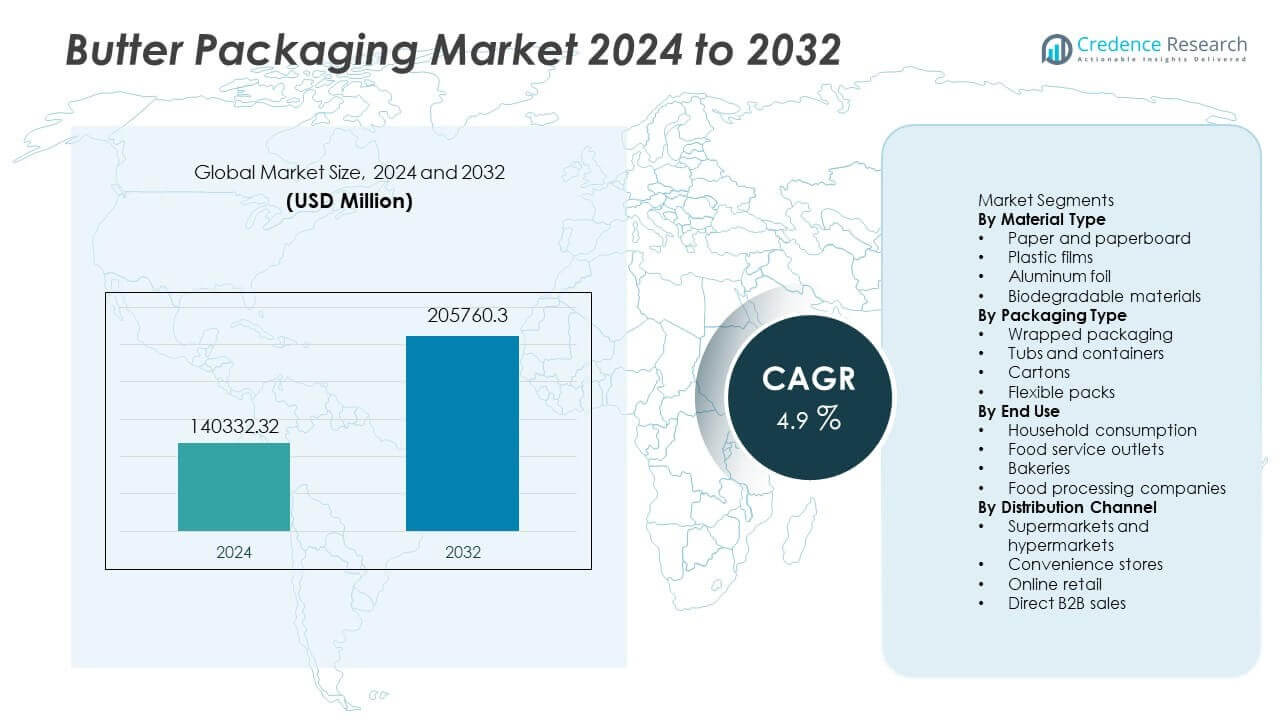
The Butter Packaging market size was valued at USD 140,332.32 million in 2024 and is projected to reach USD 205,760.3 million by 2032, registering a CAGR of 4.9% during the forecast period.
| REPORT ATTRIBUTE | DETAILS |
|---|---|
| Historical Period | 2020-2023 |
| Base Year | 2024 |
| Forecast Period | 2025-2032 |
| Butter Packaging Market Size 2024 | USD 140,332.32 million |
| Butter Packaging Market, CAGR | 4.9% |
| Butter Packaging Market Size 2032 | USD 205,760.3 million |
Butter Packaging Market Insights
- Rising butter consumption in households and foodservice drives demand for wraps and tubs, with paper and paperboard leading the material segment at a 38.6% share.
- Sustainability trends support increased adoption of recyclable paper-based packaging, while wrapped packaging dominates packaging type with a 42.1% share.
- Competitive intensity remains moderate, led by global packaging players focusing on barrier performance, cost efficiency, and private-label supply contracts.
- North America leads with a 32.4% market share, followed by Europe at 29.1% and Asia Pacific at 24.6%, driven by retail expansion and bakery demand.
Butter Packaging Market Segmentation Analysis:
By Material Type
The material type segment shows strong dominance of paper and paperboard, holding a market share of 38.6%. Paper-based butter packaging benefits from strong barrier coatings, easy printability, and cost efficiency. Dairy brands prefer paper wraps for portion control and brand visibility. Regulatory pressure to reduce plastic use further supports adoption. Paper and paperboard also align with recycling infrastructure in developed markets. Plastic films follow due to moisture resistance, but sustainability concerns limit growth. Aluminum foil retains demand for premium butter, while biodegradable materials grow steadily due to clean-label and eco-friendly packaging strategies.
- For instance, Mondi Group developed a paper-based butter wrap using functional coatings tested to withstand 6 hours of refrigerated moisture exposure while maintaining grease resistance across 30 folding cycles.
By Packaging Type
By packaging type, wrapped packaging leads the segment with a market share of 42.1%. Wrapped formats remain standard for butter sticks and blocks due to material efficiency and high-speed production compatibility. Dairy processors favor wraps for shelf stability and reduced packaging weight. Strong demand from retail private labels also supports dominance. Tubs and containers gain traction for spreadable butter, driven by convenience and resealability. Cartons support bulk and premium formats. Flexible packs see gradual adoption in cost-sensitive markets, supported by logistics efficiency and reduced material consumption.
- For instance, Amcor plc engineered high-speed butter wrapping films designed to operate efficiently on horizontal form-fill-seal lines while maintaining seal integrity throughout the cold-chain storage and distribution process.
By End Use
By end use, household consumption dominates with a market share of 47.8%. Rising home cooking and baking habits directly support retail butter packaging demand. Household buyers prefer standardized pack sizes with clear labeling and longer shelf life. Strong retail penetration and brand loyalty reinforce this segment. Food service outlets follow, driven by bulk packaging needs and consistent supply. Bakeries rely on volume packs for operational efficiency. Food processing companies use industrial butter packaging focused on protection and handling efficiency, supporting stable demand across B2B channels.
Key Growth Drivers
Rising Butter Consumption Across Retail and Foodservice
Rising butter consumption across households and foodservice outlets drives packaging demand. Home cooking and baking remain strong in urban areas. Foodservice operators increase bulk butter usage for consistent taste. This growth requires packaging that ensures freshness and shelf stability. Retail brands invest in attractive packaging to improve shelf visibility. Private-label butter expansion further increases volume demand. These factors collectively support steady growth in butter packaging across wraps, tubs, and cartons.
- For instance, WestRock Company developed coated paper butter wraps validated to maintain grease resistance after 21 days at 4°C, supporting extended freshness for retail and foodservice packs.
Expansion of Organized Retail and Cold Chain Infrastructure
The expansion of organized retail and cold chain systems strengthens butter packaging adoption. Supermarkets require standardized packaging with extended shelf life. Improved cold storage reduces spoilage during transport and storage. Emerging markets benefit from better logistics coverage. Retailers prefer packaging that withstands temperature variation and handling stress. This drives demand for barrier-coated paper, foil laminates, and durable plastic formats. Infrastructure development directly supports higher packaging volumes and safer distribution.
- For instance, the SIG Group evaluates aseptic carton packaging through rigorous testing to verify structural integrity and seal strength during the distribution of products such as milk or juice.
Growing Focus on Branding and Product Differentiation
Butter producers increasingly use packaging to strengthen brand identity. Clear labeling, premium finishes, and attractive designs influence purchase decisions. Packaging highlights product origin, quality, and nutrition claims. Brands introduce varied pack sizes to target different consumer needs. Premium butter relies on high-quality wraps and cartons to support pricing. Competitive pressure increases reliance on packaging innovation. This focus drives demand for advanced printing, coatings, and customized packaging solutions.
Key Trends and Opportunities
Shift Toward Sustainable and Eco-Friendly Packaging
Sustainability creates strong growth opportunities in butter packaging. Brands reduce plastic use due to regulatory pressure and environmental goals. Paper-based and biodegradable materials gain preference for recyclability. Consumers increasingly favor eco-friendly packaging options. Manufacturers invest in barrier coatings that balance protection and sustainability. This shift supports material innovation and premium green offerings. Companies adopting sustainable packaging improve brand trust and compliance alignment.
- For instance, Huhtamaki Oyj developed paper-based butter wraps using bio-based barrier coatings that achieved grease resistance for 28 days under refrigerated storage at 5°C while remaining compatible with standard paper recycling streams.
Growth of Convenient and Resealable Packaging Formats
Demand for convenient and resealable butter packaging continues to rise. Urban consumers prefer easy handling and storage. Resealable tubs and flexible packs reduce food waste. Portion-controlled packs suit changing consumption habits. Foodservice buyers value packaging that improves operational efficiency. This trend creates opportunities for improved closures and flexible designs. Convenience-focused innovation supports value-added growth.
- For instance, Berry Global Group, Inc. engineered resealable butter tubs featuring snap-fit lids designed to maintain seal integrity throughout repeated use and extended refrigerated storage without leakage.
Key Challenges
Volatility in Raw Material Prices
Raw material price volatility challenges butter packaging manufacturers. Paper pulp, aluminum, and polymer prices fluctuate due to energy and supply issues. Cost changes affect margins and pricing stability. Smaller players face difficulty absorbing sudden increases. Long-term contracts reduce risk but limit flexibility. Companies must manage costs without reducing quality. This pressure encourages material optimization and efficient sourcing strategies.
Maintaining Barrier Performance with Sustainable Materials
Maintaining strong barrier protection with sustainable materials remains difficult. Butter needs protection from oxygen, moisture, and light. Eco-friendly materials often deliver lower barrier strength. Additional coatings raise cost and process complexity. Manufacturers must meet shelf-life standards while improving recyclability. Regulatory testing adds further pressure. Balancing performance, sustainability, and cost remains a key challenge for butter packaging innovation.
Regional Analysis
North America
North America holds a market share of 32.4% in the butter packaging market, supported by strong dairy consumption and advanced retail infrastructure. High household butter usage drives demand for wrapped packaging and tubs with strong barrier performance. Supermarkets and private-label brands emphasize consistent packaging quality and shelf appeal. Sustainability initiatives encourage adoption of paper-based and recyclable materials. The region benefits from well-developed cold chain systems that support longer shelf life. Foodservice demand also remains stable due to bakery and restaurant usage. These factors collectively support steady packaging innovation and volume growth.
Europe
Europe accounts for a market share of 29.1%, driven by strong butter consumption across households and bakeries. Traditional dairy-rich diets support stable demand for packaged butter. Strict environmental regulations accelerate the shift toward paper, paperboard, and biodegradable packaging materials. Premium butter brands in Western Europe invest in high-quality wraps and cartons for differentiation. Organized retail networks demand standardized and visually appealing packaging. The region also benefits from advanced recycling infrastructure. Food processing companies maintain consistent demand for bulk packaging. Regulatory focus and premiumization trends shape packaging innovation across Europe.
Asia Pacific
Asia Pacific holds a market share of 24.6%, supported by rising urbanization and changing dietary habits. Butter consumption increases steadily in bakery, confectionery, and foodservice sectors. Expanding organized retail improves access to packaged dairy products. Cost-efficient plastic films and flexible packs remain widely used, while paper-based packaging adoption grows gradually. Domestic dairy brands focus on functional packaging with basic branding. Cold chain expansion improves distribution efficiency across major economies. Growing middle-class populations support higher packaged food demand, making Asia Pacific a key growth region for butter packaging suppliers.
Latin America
Latin America represents a market share of 8.7%, driven by steady household consumption and bakery sector demand. Butter packaging demand remains focused on affordability and durability. Plastic films and wrapped packaging dominate due to cost sensitivity. Organized retail expansion in urban areas improves packaged butter penetration. Local dairy producers emphasize functional packaging over premium design. Cold storage improvements support better shelf life, especially in larger markets. Sustainability adoption remains gradual but gains attention through regional regulations. Stable foodservice demand also supports consistent packaging volume across the region.
Middle East & Africa
The Middle East & Africa region holds a market share of 5.2%, supported by growing urban populations and expanding retail formats. Butter consumption rises steadily in hotels, restaurants, and bakeries. Imported butter drives demand for packaging with strong barrier protection. Plastic-based packaging dominates due to cost efficiency and climate conditions. Cold chain investments improve distribution reliability in key markets. Sustainability adoption remains limited but shows early momentum in developed economies. The region offers long-term growth potential as packaged dairy consumption continues to expand.
Butter Packaging Market Segmentations:
By Material Type
- Paper and paperboard
- Plastic films
- Aluminum foil
- Biodegradable materials
By Packaging Type
- Wrapped packaging
- Tubs and containers
- Cartons
- Flexible packs
By End Use
- Household consumption
- Food service outlets
- Bakeries
- Food processing companies
By Distribution Channel
- Supermarkets and hypermarkets
- Convenience stores
- Online retail
- Direct B2B sales
By Geography
- North America
- U.S.
- Canada
- Mexico
- Europe
- Germany
- France
- U.K.
- Italy
- Spain
- Rest of Europe
- Asia Pacific
- China
- Japan
- India
- South Korea
- South-east Asia
- Rest of Asia Pacific
- Latin America
- Brazil
- Argentina
- Rest of Latin America
- Middle East & Africa
- GCC Countries
- South Africa
- Rest of the Middle East and Africa
Competitive Landscape
Competitive landscape analysis highlights strong participation from Amcor plc, Tetra Pak International S.A., Mondi Group, Huhtamaki Oyj, Berry Global Group, Inc., Smurfit Kappa Group, WestRock Company, Sealed Air Corporation, Constantia Flexibles, and SIG Group. The butter packaging market remains moderately consolidated, with global players holding strong regional positions. Competition centers on material innovation, barrier protection, and sustainability compliance. Companies invest in recyclable paper-based solutions and advanced coatings to meet regulatory demands. Long-term contracts with dairy processors strengthen revenue stability. Capacity expansion supports rising private-label and retail demand. Advanced printing improves branding and shelf visibility. Regional players compete through cost efficiency and local sourcing. Competitive intensity increases as sustainability standards tighten and buyers demand performance consistency.
Key Player Analysis
- Amcor plc
- Tetra Pak International S.A.
- Mondi Group
- Huhtamaki Oyj
- Berry Global Group, Inc.
- Smurfit Kappa Group
- WestRock Company
- Sealed Air Corporation
- Constantia Flexibles
- SIG Group
Recent Developments
- In December 2025, Tetra Pak International S.A. unveiled a paper-based barrier for cartons.
- In August 2025, Mondi Group ramped barrier paper with OTR <0.5 cm³/m²·day.
- In February 2025, Berry Global Group, Inc. announced packaging with 100% recycled content.
Report Coverage
The research report offers an in-depth analysis based on Material Type, Packaging Type, End Use, Distribution Channel and Geography. It details leading market players, providing an overview of their business, product offerings, investments, revenue streams, and key applications. Additionally, the report includes insights into the competitive environment, SWOT analysis, current market trends, as well as the primary drivers and constraints. Furthermore, it discusses various factors that have driven market expansion in recent years. The report also explores market dynamics, regulatory scenarios, and technological advancements that are shaping the industry. It assesses the impact of external factors and global economic changes on market growth. Lastly, it provides strategic recommendations for new entrants and established companies to navigate the complexities of the market.
Future Outlook
- Sustainable materials will gain wider adoption due to regulatory and consumer pressure.
- Paper-based and biodegradable packaging will replace traditional plastic formats.
- Packaging innovation will focus on improved barrier performance and recyclability.
- Demand for wrapped packaging will remain strong across retail channels.
- Resealable tubs will grow due to convenience and reduced food waste.
- Private-label butter expansion will increase standardized packaging demand.
- Advanced printing will support stronger branding and shelf differentiation.
- Cold chain expansion will improve shelf life and distribution efficiency.
- Asia Pacific will record faster growth due to urbanization and bakery demand.
- Strategic partnerships between dairies and packaging firms will increase.

Request a Free Sample
Fill in your details and we'll send you a free sample report.
- Sample data tables & charts
- Research methodology
Need a Custom Version of This Report?
Tailor the scope, geography, or segments to your exact requirements.
- Custom geography or segment scope
- Direct access to our analyst team
Frequently Asked Questions
What is the current market size for Butter Packaging market, and what is its projected size in 2032?
At what Compound Annual Growth Rate is the Butter Packaging market projected to grow between 2024 and 2032?
Which Butter Packaging market segment held the largest share in 2024?
What are the primary factors fueling the growth of the Butter Packaging market?
Who are the leading companies in the Butter Packaging market?
Which region commanded the largest share of the Butter Packaging market in 2024?
Table of Content
Chapter 1 Market Segmentation
- 1.1 Segmentation Framework
- 1.1.1 Product and Service Classification
- 1.1.2 Application and End-Use Classification
- 1.1.3 Technology and Solution Classification
- 1.1.4 Customer and Distribution Channel Classification
- 1.1.5 Geographic Segmentation
- 1.1.6 Market Segment Definitions and Boundaries
Chapter 2 Introduction
- 2.1 Report Objectives and Scope
- 2.2 Product Definition and Industry Terminology
- 2.3 Market Inclusions and Exclusions
- 2.4 Research Process
- 2.4.1 Primary Research and Expert Interviews
- 2.4.2 Secondary Research and Source Review
- 2.4.3 Top-Down and Bottom-Up Estimation
- 2.4.4 Data Triangulation and Verification
- 2.5 Market Size Measurement Basis
- 2.5.1 2024: USD 140,332.32 million → 2032: USD 205,760.3 million
- 2.6 Historical and Forecast Reference Periods
- 2.6.1 Base Year: 2024
- 2.6.2 Forecast Period: 2024-2032
- 2.7 Research Assumptions and Limitations
Chapter 3 Executive Summary
- 3.1 Market Snapshot and Key Findings
- 3.2 Base-Year Market Size, 2024
- 3.3 Forecast Market Size, 2032
- 3.4 Revenue and Volume Growth Outlook
- 3.5 Key Demand and Supply Indicators
- 3.6 Leading Market Segments
- 3.7 Fastest-Growing Market Opportunities
- 3.8 Regional Performance Highlights
- 3.9 Technology and Industry Transformation
- 3.10 Competitive Landscape Summary
- 3.11 Analyst View and Strategic Implications
Chapter 4 Global Butter Packaging Market Trends and Developments
- 4.1 Historical Industry Development
- 4.2 Recent Market Trends and Developments
- 4.3 Demand and Customer Behavior Trends
- 4.4 Technology and Product Innovation
- 4.5 Artificial Intelligence, Automation and Digitalization
- 4.6 Local Manufacturing and Supply Chain Realignment
- 4.7 Industry Partnerships, Mergers and Acquisitions
- 4.8 Sustainability and Circular Economy Developments
- 4.9 Government and Private Sector Investment Trends
- 4.10 Emerging Business Models and Commercialization
- 4.11 Industry Developments and Announcements
Chapter 5 Global Butter Packaging Market Production, Supply and Demand Analysis
- 5.1 Demand Trend and Consumption Analysis
- 5.2 Demand Forecast, 2024-2032
- 5.3 Production and Output Trend
- 5.4 Production and Output Forecast, 2024-2032
- 5.5 Installed Capacity and Capacity Utilization
- 5.6 Company-Wise Production Plants and Statistics
- 5.6.1 Installed Production Capacity
- 5.6.2 Actual Production
- 5.6.3 Planned Capacity and Expansion Targets
- 5.7 Supply Chain Structure and Procurement Trends
- 5.8 Supply-Demand Gap and Bottlenecks
- 5.9 Import Dependence and Sourcing Structure
- 5.10 Contract Manufacturing and Outsourcing
- 5.11 Regional Supply and Demand Concentration
Chapter 6 Global Butter Packaging Market Pricing Analysis
- 6.1 Pricing Structure and Measurement
- 6.2 Historical Pricing Trends
- 6.3 Pricing Outlook, 2024-2032
- 6.4 Average Selling Price and Unit Economics
- 6.5 Pricing by Product and Market Segment
- 6.6 Geographic Pricing Differences
- 6.7 Key Input, Energy, Labor and Logistics Costs
- 6.8 Contract Pricing and Purchasing Models
- 6.9 Pricing Sensitivity and Competitive Positioning
- 6.10 Price, Margin and Profitability Implications
Chapter 7 Global Butter Packaging Market Dynamics
- 7.1 Market Growth Drivers
- 7.1.1 Demand-Side Drivers
- 7.1.2 Technology and Innovation Drivers
- 7.1.3 Infrastructure and Investment Drivers
- 7.1.4 Regulatory and Policy Drivers
- 7.2 Market Restraints
- 7.2.1 Cost and Affordability Constraints
- 7.2.2 Technology and Adoption Barriers
- 7.2.3 Supply Chain and Operational Constraints
- 7.3 Market Challenges
- 7.3.1 Competitive Pressure and Margin Erosion
- 7.3.2 Skills, Infrastructure and Implementation Gaps
- 7.4 Emerging Market Opportunities
- 7.5 Market Dynamics Impact and Time-Horizon Assessment
Chapter 8 Global Butter Packaging Value Chain Analysis
- 8.1 Industry Value Chain Overview
- 8.2 Upstream Suppliers and Critical Inputs
- 8.3 Technology and Component Providers
- 8.4 Manufacturing or Service Delivery
- 8.5 Distribution, Channel Partners and Integrators
- 8.6 Downstream Applications and End Users
- 8.7 Value Addition and Profit Pools
- 8.8 Vertical Integration and Outsourcing
- 8.9 Supplier Concentration and Risk
- 8.10 Supply Chain Localization and Resilience
Chapter 9 Global Butter Packaging Market Regulations and Policies
- 9.1 Relevant Laws, Standards and Compliance Frameworks
- 9.2 Product, Service, Safety and Quality Requirements
- 9.3 Government Policies, Incentives and Subsidies
- 9.4 Imports, Exports and Trade Barriers
- 9.5 Public Procurement and Local Content Requirements
- 9.6 Environmental and Sustainability Compliance
- 9.7 Upcoming Policy Changes and Market Implications
Chapter 10 Global Butter Packaging Market Hotspots and Opportunities
- 10.1 Market Opportunity Mapping and Growth Hotspots
- 10.2 High-Growth Applications and Customer Groups
- 10.3 Underserved Markets and White-Space Opportunities
- 10.4 Emerging Technology and Product Opportunities
- 10.5 New Capacity and Investment Hotspots
- 10.6 Market Entry and Expansion Opportunities
- 10.7 Distribution and Partnership Opportunities
- 10.8 Near-Term and Long-Term Commercial Potential
- 10.9 Opportunity Attractiveness and Execution Risks
Chapter 11 Global Butter Packaging Market Outlook, 2024-2032
- 11.1 Market Size and Analysis
- 11.1.1 Revenue (Market Measurement: 2024: USD 140,332.32 million → 2032: USD 205,760.3 million)
- 11.1.2 Market Volume and Quantity Sold
- 11.1.3 Historical Market Size
- 11.1.4 Base-Year Market Size, 2024
- 11.2 Market Forecast, 2024-2032
- 11.2.1 Revenue Forecast to 2032
- 11.2.2 Volume Forecast to 2032
- 11.2.3 CAGR and Year-on-Year Growth
- 11.2.4 Incremental Revenue Opportunity
- 11.3 Forecast Assumptions and Scenario Analysis
- 11.3.1 Base-Case Forecast
- 11.3.2 Optimistic and Conservative Scenarios
- 11.3.3 Technology, Pricing and Policy Sensitivities
- 11.4 Market Attractiveness and Growth Outlook
Chapter 12 Global Butter Packaging Market Segmentation and Outlook
- 12.1 Segmentation Summary and Market Shares, 2024
- 12.2 Largest and Fastest-Growing Segments
- 12.3 Segment Growth Comparison
- 12.4 Segment Attractiveness and Priority Matrix
Chapter 13 Global Butter Packaging Geographic Market Outlook, 2024-2032
- 13.1 Regional Market Size and Share, 2024
- 13.2 Regional Market Forecast, 2024-2032
- 13.3 Regional Pricing, Production and Demand Differences
- 13.4 North America
- 13.4.1 United States
- 13.4.2 Canada
- 13.4.3 Mexico
- 13.5 Europe
- 13.5.1 Germany
- 13.5.2 France
- 13.5.3 Italy
- 13.5.4 United Kingdom
- 13.5.5 Spain
- 13.5.6 Poland
- 13.5.7 Russia
- 13.5.8 Netherlands
- 13.5.9 Belgium
- 13.5.10 Sweden
- 13.5.11 Denmark
- 13.5.12 Norway
- 13.5.13 Rest of Europe
- 13.6 Asia Pacific
- 13.6.1 China
- 13.6.2 India
- 13.6.3 Japan
- 13.6.4 South Korea
- 13.6.5 Thailand
- 13.6.6 Indonesia
- 13.6.7 Vietnam
- 13.6.8 Malaysia
- 13.6.9 Australia
- 13.6.10 Rest of Asia Pacific
- 13.7 Latin America
- 13.7.1 Brazil
- 13.7.2 Argentina
- 13.7.3 Colombia
- 13.7.4 Chile
- 13.7.5 Rest of Latin America
- 13.8 Middle East
- 13.8.1 Saudi Arabia
- 13.8.2 United Arab Emirates
- 13.8.3 Turkey
- 13.8.4 Israel
- 13.8.5 Iran
- 13.8.6 Rest of the Middle East
- 13.9 Africa
- 13.9.1 South Africa
- 13.9.2 Egypt
- 13.9.3 Nigeria
- 13.9.4 Morocco
- 13.9.5 Rest of Africa
- 13.10 Regional Investment, Policy and Supply Chain Differences
- 13.11 Regional Competitive Landscape
- 13.12 Geographic Growth Hotspots
Chapter 14 Global Butter Packaging Technology, Innovation and Sustainability Outlook
- 14.1 Technology Landscape and Maturity
- 14.2 Product, Process and Service Innovation
- 14.3 AI, Automation and Digital Tools in the Industry
- 14.4 Technology Adoption and Performance Benchmarking
- 14.5 Innovation Pipeline and R&D Investment
- 14.6 Patent and Intellectual Property Trends
- 14.7 Energy Efficiency and Resource Management
- 14.8 Sustainability, Recycling and Circularity
- 14.9 Technology Roadmap, 2024-2032
- 14.10 Risks of Obsolescence and Technology Substitution
Chapter 15 Global Butter Packaging Market Key Strategic Imperatives
- 15.1 Growth and Market Entry Priorities
- 15.2 High-Return Products and Segments
- 15.3 Pricing, Profitability and Cost Optimization
- 15.4 Technology Investment and Product Differentiation
- 15.5 Supply Chain Localization and Resilience
- 15.6 Distribution and Customer Acquisition
- 15.7 Partnership, Acquisition and Capacity Strategy
- 15.8 Regional Expansion Priorities
- 15.9 Short-, Medium- and Long-Term Actions
Chapter 16 Competition Outlook
- 16.1 Industry Competition Characteristics
- 16.2 Market Structure and Concentration
- 16.3 Market Share and Competitive Positioning, 2024
- 16.4 Company-Wise Revenue and Product Benchmarking
- 16.5 Production and Service Capacity Benchmarking
- 16.6 Technology, Pricing and Differentiation
- 16.7 Regional Footprint and Distribution Strength
- 16.8 Mergers, Acquisitions and Strategic Alliances
- 16.9 New Entrants and Competitive Threats
- 16.10 Porter's Five Forces and Industry Attractiveness
- 16.11 Competitive Outlook, 2024-2032
Chapter 17 Company Profiles
- 17.1 Company Coverage and Selection Criteria
- 17.2 Leading Market Participants – Standard Profile Structure
- 17.2.1 Business Description
- 17.2.2 Company Ownership and Geographic Presence
- 17.2.3 Product and Service Portfolio
- 17.2.4 Manufacturing and Operating Footprint
- 17.2.5 Production Capacity and Expansion Plans
- 17.2.6 Financial Performance and Investment
- 17.2.7 Market Share and Competitive Position
- 17.2.8 Technology and Innovation Capabilities
- 17.2.9 Strategic Alliances or Partnerships
- 17.2.10 Recent Developments
- 17.2.11 Growth Strategy and Outlook
- 17.3 Other Relevant Market Participants
Note: Every listed company is profiled on the structure shown under the first company. The company list is preliminary and may change based on research findings, market developments, data availability and client requirements.
Chapter 18 Disclaimer
- 18.1 Research and Forecast Disclaimer
- 18.2 Data Source and Estimation Limitations
Note: The depth of individual sections depends on data availability for this market. Volume, capacity, trade and other unit-based metrics are included where applicable.