
Market overview
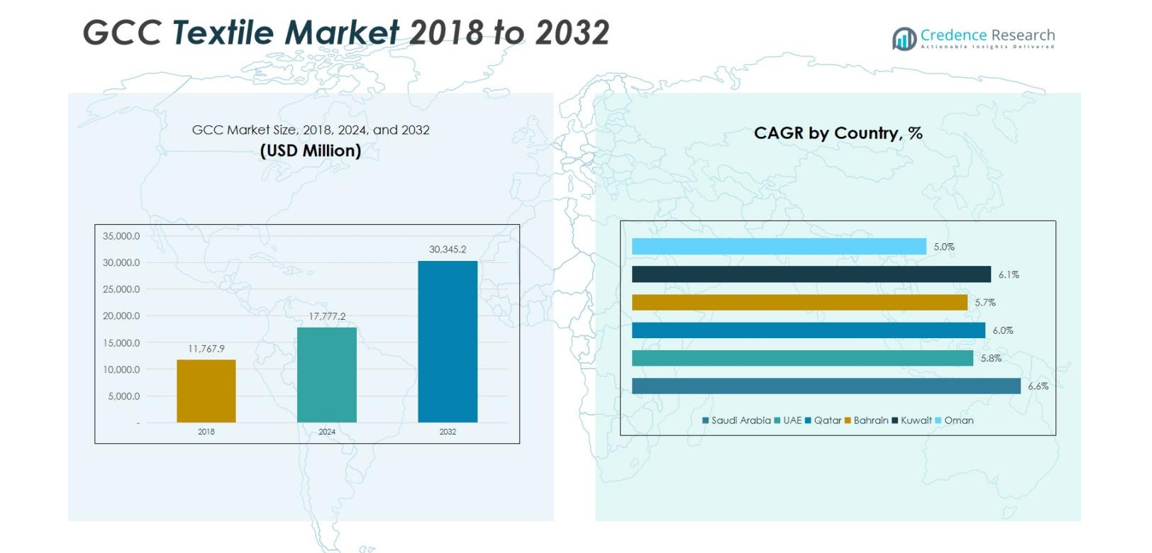
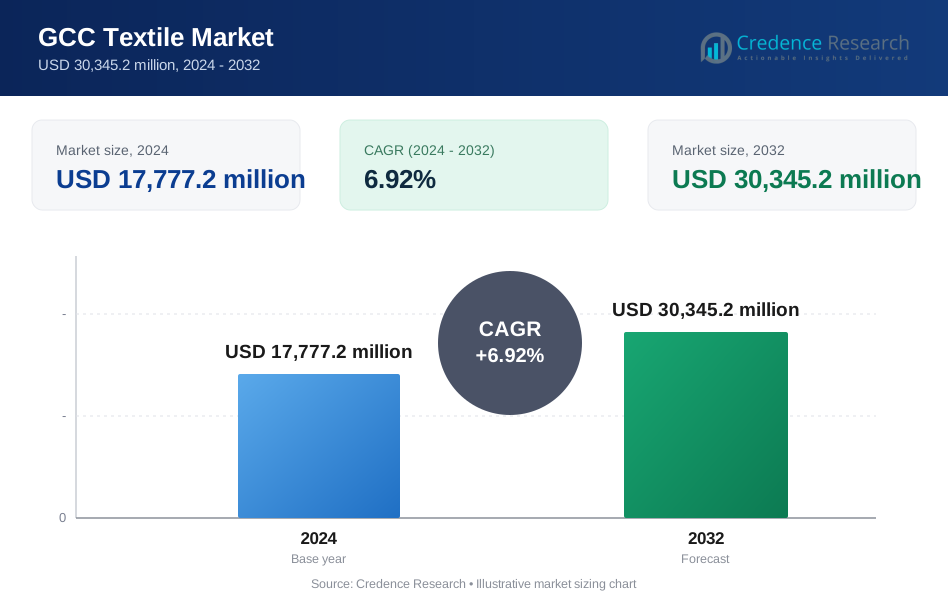
The GCC Textile Market was valued at USD 11,767.9 million in 2018 and is projected to reach USD 17,777.2 million by 2024, growing at a CAGR of 6.92%. It is expected to continue its growth trajectory, reaching USD 30,345.2 million by 2032 during the forecast period.
| REPORT ATTRIBUTE | DETAILS |
|---|---|
| Historical Period | 2020-2023 |
| Base Year | 2024 |
| Forecast Period | 2025-2032 |
| GCC Textile Market Size 2024 | USD 17,777.2 million |
| GCC Textile Market, CAGR | 6.92% |
| GCC Textile Market Size 2032 | USD 30,345.2 million |
The GCC Textile Market is marked by robust leadership from companies such as Ajlan & Bros, FPC Industrial Co., Al‑Khaleej Textile Co. and Pearl Global Industries, each actively expanding production capacities and innovating their product offerings. The region’s most dominant market is Saudi Arabia with a share of 33.5 %, followed by the United Arab Emirates at 29.2 %. These leading companies leverage regional leadership and the favourable conditions in these two countries to capture high volumes, scale operations, and steer the textile market’s growth across the GCC.
Market Insights
- The GCC Textile Market is valued at USD 17,777.2 million in 2024 and is expected to reach USD 30,345.2 million by 2032, growing at a CAGR of 6.92% during the forecast period.
- The demand for sustainable and eco-friendly textiles is a major driver, with increasing consumer preference for organic and recycled materials.
- Technological advancements in textile production, such as automated weaving and digital printing, are reshaping the market by improving efficiency and quality.
- The UAE and Saudi Arabia lead the market with shares of 29.2% and 33.5%, respectively, driven by strong retail sectors, growing fashion trends, and increasing investments in local manufacturing.
- Raw material cost fluctuations and intense competition from low-cost textile-producing countries pose significant challenges to the region's textile manufacturers.
Market Segmentation Analysis:
By Product Type:
In the GCC Textile Market, the Synthetic Fibers segment holds the largest share, commanding 45.3% of the market. Synthetic fibers, such as polyester and nylon, are extensively used due to their durability, cost-effectiveness, and versatile applications in various textile products. The Natural Fibers segment follows with a 34.1% market share, driven by the rising consumer demand for eco-friendly and sustainable materials. Blended Fibers hold 17.6%, as they combine the benefits of both natural and synthetic fibers, catering to a broad range of applications. Others contribute the remaining 3% share, which includes innovative fiber types.
- For instance, Saudi Basic Industries Corporation (SABIC), a leading petrochemical company in Saudi Arabia, is a key producer of synthetic fibers, leveraging its strong petrochemical integration to supply polyester fibers widely used in the GCC textile industry.
By Technology:
The Spinning technology segment leads the GCC Textile Market with a dominant market share of 38.7%. This technology is crucial for converting raw fibers into yarn, which forms the foundation for textile production, especially in the production of synthetic and natural fibers. Weaving follows with a 29.4% share, playing a critical role in fabric production for various applications. The Dyeing & Finishing segment accounts for 23.5%, as it adds value to fabrics, enhancing color, texture, and performance. Others hold the remaining 8.4% share, representing less common techniques.
- For instance, Huntsman Corporation supplies eco-friendly reactive dyes and digital finishing chemicals to textile processors in the UAE to support sustainable coloration processes.
By Application:
The Fashion & Clothing segment holds the largest share of the GCC Textile Market at 51.2%, driven by the growing demand for diverse and trendy apparel in the region. This segment benefits from both domestic consumption and the regional fashion industry’s expansion. The Household application segment follows with 30.6%, fueled by the continuous demand for textile products in bedding, curtains, and home décor. The Technical segment, with a 14.5% market share, is expanding due to increasing demand for textiles used in automotive, medical, and industrial applications. Others contribute the remaining 3.7%, encompassing niche applications.
Key Growth Drivers
Increasing Demand for Sustainable Textiles
One of the major growth drivers in the GCC Textile Market is the rising consumer preference for sustainable and eco-friendly textiles. As environmental awareness grows, there is a significant shift towards materials that are biodegradable, recyclable, or made from natural fibers. This trend is further supported by government initiatives promoting green practices and sustainable manufacturing processes. The demand for organic cotton, recycled polyester, and other environmentally friendly materials continues to rise, driving growth within the natural fibers segment and leading to the adoption of green technologies in production.
- For instance, the Austrian company Lenzing produces Tencel fibers derived from sustainably sourced wood pulp, known for their eco-friendly and biodegradable properties.
Technological Advancements in Textile Production
The GCC textile industry is witnessing rapid advancements in textile production technologies, which significantly enhance production efficiency and fabric quality. Innovations such as automated weaving, advanced dyeing techniques, and smart textiles are revolutionizing the sector. These technologies enable manufacturers to produce high-quality fabrics at lower costs while meeting increasing consumer expectations for durability, functionality, and customization. The rise of digital printing and IoT applications for textile monitoring also contributes to growth, as they improve design processes and enable faster turnaround times for products.
- For instance, the adoption of automated weaving technology with computerized machine control has increased machine speeds up to 1000 revolutions per minute and enabled faster style changes, resulting in higher productivity and consistent fabric quality.
Growing Demand for Fashion & Clothing
The fashion and clothing sector continues to be a primary growth driver in the GCC Textile Market, accounting for a substantial share of overall textile consumption. This is due to a thriving fashion industry supported by a large population, rapid urbanization, and a burgeoning middle class in the region. Fashion-conscious consumers seek a wide range of apparel, including luxury and ready-to-wear options, fueling demand for diverse fabrics. The increase in regional and international fashion events further boosts market growth, making the GCC a hub for textile production and retail.
Key Trends & Opportunities
Shift Toward Smart and Technical Textiles
There is an emerging trend in the GCC Textile Market towards the development and adoption of smart textiles and technical textiles. These fabrics, embedded with advanced technologies such as sensors, conductive materials, and integrated electronics, are finding applications in sectors like healthcare, automotive, and defense. The growing demand for wearables, including health-monitoring garments, smart uniforms, and protective clothing, presents significant opportunities for textile manufacturers to innovate and diversify. As these textiles gain traction, they are expected to drive growth in the technical segment of the market.
- For instance, AiQ Smart Clothing Inc. develops smart garments integrated with conductive textile cables for health monitoring and sports performance, catering to growing markets in the GCC and beyond.
Expansion of E-commerce in Textile Sales
E-commerce has emerged as a key opportunity for the GCC Textile Market, particularly as more consumers shift to online shopping for apparel and home textiles. The convenience, variety, and personalized shopping experiences offered by e-commerce platforms make them highly attractive to the region’s digitally savvy consumers. Textile companies are increasingly leveraging online channels to reach a wider audience, expand their market presence, and offer customized products. The growth of online retailing, coupled with advancements in digital marketing, is expected to further accelerate the sales of textile products across the GCC.
- For instance, Beyoung, an Indian fashion brand, partnered with Noon.com in November 2024 to enter the GCC online market, focusing on affordable premium fashion tailored to the UAE’s consumer base.
Key Challenges
Rising Raw Material Costs
A significant challenge faced by the GCC Textile Market is the fluctuation in the cost of raw materials, particularly synthetic fibers and cotton. As global supply chains face disruptions and the cost of key materials rises, manufacturers in the region are experiencing pressure on their profit margins. This issue is exacerbated by the volatility in international commodity prices, which affects not only the cost of production but also the competitiveness of GCC textile products in the global market. Companies need to adopt cost-efficient production techniques to manage this challenge.
Intense Competition from Low-Cost Markets
The GCC Textile Market faces stiff competition from low-cost textile manufacturing countries such as China, India, and Bangladesh. These regions have the advantage of lower labor costs, which enables them to produce textiles at competitive prices. As a result, GCC textile companies must focus on differentiating their products through quality, innovation, and sustainable practices to maintain a competitive edge. Additionally, trade barriers, tariffs, and fluctuations in exchange rates further complicate the market environment for regional manufacturers.
Regional Analysis
Saudi Arabia
Saudi Arabia dominates the GCC Textile Market with a market share of 33.5%. The country benefits from its large population, strong economic growth, and rising disposable incomes, leading to an increased demand for textiles across various sectors. The fashion and clothing segment, in particular, drives substantial demand, supported by the country's vibrant retail landscape and large fashion events. Additionally, Saudi Arabia's initiatives to diversify its economy, including the development of its manufacturing sector, are boosting textile production capabilities, making it a key player in the regional market.
United Arab Emirates (UAE)
The UAE holds a 29.2% share of the GCC Textile Market, emerging as a major textile hub due to its strategic location as a trade and logistics center. The UAE is recognized for its luxury fashion sector, fueling demand for high-end textile products. Additionally, the country’s growing e-commerce sector plays a significant role in market expansion, with more consumers opting for online textile purchases. The UAE's commitment to innovation and adoption of new textile technologies is further boosting the production of technical textiles and smart fabrics, driving the country's textile sector growth.
Kuwait
Kuwait accounts for 12.4% of the GCC Textile Market. The country’s well-established retail infrastructure and strong purchasing power contribute significantly to its market share. The demand for textiles in Kuwait is predominantly driven by fashion and clothing applications, with an increasing preference for high-quality, luxury products. Additionally, Kuwait’s government has been investing in infrastructure development, which supports the textile industry. The growing interest in sustainability and eco-friendly products in the country is expected to further boost the demand for organic and natural fibers in the coming years.
Qatar
Qatar holds an 8.6% share of the GCC Textile Market. The country benefits from rapid economic development, particularly due to its booming construction and infrastructure sectors, which drive demand for textiles used in technical and industrial applications. Fashion and household textiles are also significant contributors to the market, with rising consumer demand for high-quality, luxury products. The growing popularity of e-commerce in Qatar is expected to enhance market dynamics, providing opportunities for textile companies to expand their digital presence and reach a broader consumer base.
Oman
Oman captures a 7.1% share of the GCC Textile Market. The country's textile demand is driven by both household and fashion applications. With its strong tourism and retail sectors, Oman has seen a steady increase in textile consumption, especially in clothing and home décor. The Omani government's initiatives to diversify its economy and promote manufacturing are creating favorable conditions for the textile industry. Additionally, Oman’s focus on sustainability and the growing interest in eco-friendly products align with the increasing demand for natural fibers and sustainable textiles, contributing to market growth.
Bahrain
Bahrain accounts for 5.5% of the GCC Textile Market. The country's market growth is fueled by its established retail sector and growing interest in fashion and clothing. Bahrain's small yet affluent population, along with its strategic location, allows it to serve as a significant consumer market for high-quality textiles. Additionally, the country’s commitment to economic diversification and increasing investments in manufacturing sectors is positively influencing the textile market. The rising demand for eco-friendly textiles and sustainable practices is also expected to drive growth in Bahrain's textile industry in the coming years.
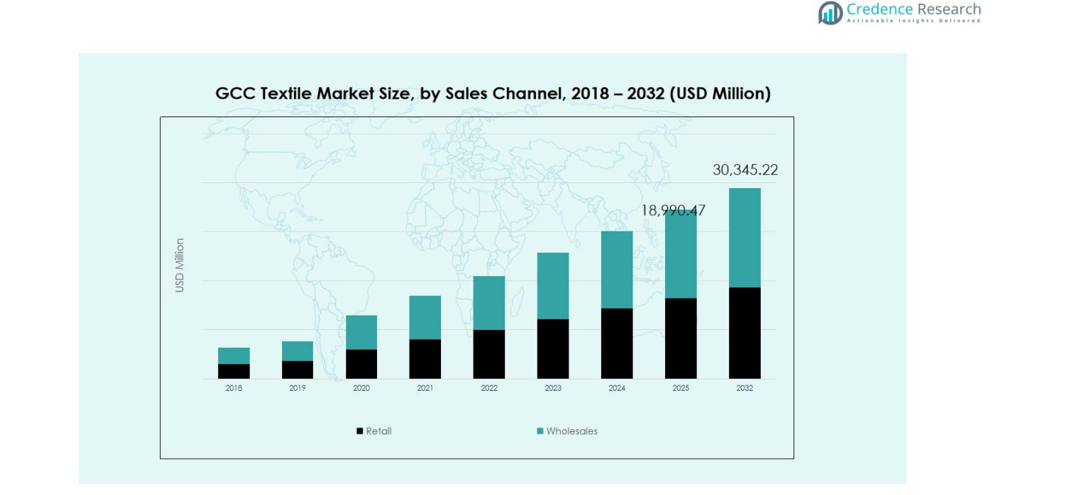
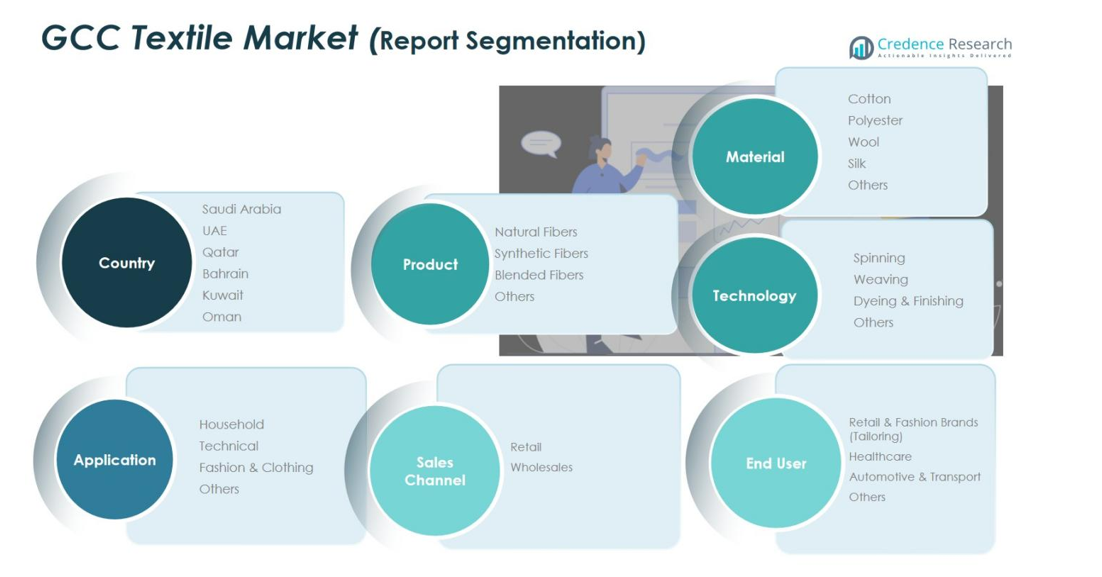
Market Segmentations:
By Product Type
- Natural Fibers
- Synthetic Fibers
- Blended Fibers
- Others
By Technology
- Spinning
- Weaving
- Dyeing & Finishing
- Others
By Application
- Household
- Technical
- Fashion & Clothing
- Others
By Sales Channel Type
- Retail
- Wholesale
By End User
- Retail & Fashion Brands (Tailoring)
- Healthcare
- Automotive & Transport
- Others
By Material
- Cotton
- Polyester
- Wool
- Silk
- Others
By Geography
- Saudi Arabia
- Oman
- Kuwait
- UAE
- Bahrain
- Qatar
Competitive Landscape
The GCC Textile Market is highly competitive, with major players such as Ajlan & Bros, FPC Industrial Co., Al-Khaleej Textile Co., and Pearl Global Industries leading the way. These companies dominate the market by leveraging advanced manufacturing technologies, broad product portfolios, and strong brand recognition. The market is characterized by a mix of established local players and international textile companies, both of which are expanding their presence in the region. Companies are focusing on product innovation, particularly in the areas of sustainable and eco-friendly textiles, as consumers demand more sustainable options. Additionally, the growing e-commerce segment has prompted several companies to invest in digital transformation to reach wider consumer bases. Key players are also exploring partnerships and joint ventures to expand their production capacities and access new markets. With the region’s increasing demand for high-quality, fashionable, and technical textiles, competition is expected to intensify as companies strive to meet evolving consumer needs.
Key Player Analysis
- Ajlan & Bros
- FPC Industrial Co.
- Al-Khaleej Textile Co.
- Pearl Global Industries
- AMCO Apparel Manufacturing Company
- Sirus
- Oman Textile Mills LLC
- Fabriclore
- The ODD Factory
- Rk Garment
- Other Key Players
Recent Developments
- In March 2025, Apparel Group opened the region’s first mono‑branded store of BCBG at The Avenues Mall in Bahrain, marking a strategic expansion in the GCC textile and apparel retail sector.
- In November 2025, KAST GmbH & Co. (Germany) and Khalifa A. Abdulrahman Algosaibi Investment Company (Saudi Arabia) announced a joint venture to establish KAST W.L.L. in Bahrain, aimed at producing advanced reinforcing technical textiles for construction and industrial applications.
- In November 2025, the Fashion Commission announced the launch of “Saudi Fabric of the Future: Sustainability, Innovation and Investment” in collaboration with Collateral Good, IE University and Proaltus Capital Partners, set to take place at Misk City in Riyadh on 25 November 2025.
Report Coverage
The research report offers an in-depth analysis based on Product Type, Technology, Application, Sales Channel Type, End User, Material and Geography. It details leading market players, providing an overview of their business, product offerings, investments, revenue streams, and key applications. Additionally, the report includes insights into the competitive environment, SWOT analysis, current market trends, as well as the primary drivers and constraints. Furthermore, it discusses various factors that have driven market expansion in recent years. The report also explores market dynamics, regulatory scenarios, and technological advancements that are shaping the industry. It assesses the impact of external factors and global economic changes on market growth. Lastly, it provides strategic recommendations for new entrants and established companies to navigate the complexities of the market.
Future Outlook
- The GCC Textile Market is expected to experience steady growth driven by the increasing demand for sustainable and eco-friendly textiles.
- Technological advancements in textile production, including automation and digital printing, will continue to enhance manufacturing efficiency and product quality.
- The fashion and clothing segment will remain the dominant driver, with a growing preference for luxury and high-quality textile products.
- E-commerce will play a crucial role in market expansion, offering consumers more convenient access to textile products and personalized shopping experiences.
- The demand for smart textiles, including wearable technology and technical textiles, will grow as industries such as healthcare and automotive adopt advanced fabric solutions.
- The expansion of retail infrastructure and the rise of shopping malls in the GCC will support the growth of the textile market.
- Increasing interest in sustainable manufacturing practices will push companies to adopt green technologies and reduce environmental impact.
- The UAE and Saudi Arabia will continue to lead the market due to their large consumer bases and significant investments in the textile industry.
- Consumer trends focusing on comfort, durability, and versatility will drive demand for functional and high-performance textiles.
- Regional government initiatives to diversify the economy will result in increased investments in local textile production capabilities, supporting industry growth.
Request a Free Sample
Fill in your details and we'll send you a free sample report.
- Sample data tables & charts
- Research methodology
Need a Custom Version of This Report?
Tailor the scope, geography, or segments to your exact requirements.
- Custom geography or segment scope
- Direct access to our analyst team
Frequently Asked Questions
What is the current market size for GCC Textile Market, and what is its projected size in 2032?
At what Compound Annual Growth Rate is the GCC Textile Market projected to grow between 2025 and 2032?
Which GCC Textile Market segment held the largest share in 2024?
What are the primary factors fueling the growth of the GCC Textile Market?
Who are the leading companies in the GCC Textile Market?
Table of Content
Chapter 1. Report Introduction
- 1.1 Report Description & Purpose
- 1.1.1 Report Title & Market Definition
- 1.1.2 Unique Selling Propositions (USP) & Key Differentiators
- 1.1.3 Value Proposition for Stakeholders
- 1.2 Research Objectives
- 1.2.1 Market Sizing Objectives (Volume & Revenue)
- 1.2.2 Segmentation Objectives
- 1.2.3 Competitive Intelligence Objectives
- 1.2.4 Forecast & Scenario Objectives
- 1.3 Report Scope
- 1.3.1 GCC Textile Scope – Types & Subtypes Covered
- 1.3.2 Geographic Scope – Regions & Countries Covered
- 1.3.3 Historical Period, Base Year & Forecast Period (2024; forecast to 2032)
- 1.3.4 Inclusions & Exclusions
- 1.4 HS Code & Classification Framework
- 1.5 Currency, Units & Pricing Basis
- 1.6 Target Stakeholders
- 1.7 Limitations & Assumptions
Chapter 2. Executive Summary
- 2.1 Global GCC Textile Market Snapshot
- 2.1.1 Market Size – Historical (2024) & Forecast (2024-2032) (2024: USD 17,777.2 million → 2032: USD 30,345.2 million)
- 2.1.2 Volume & Revenue – Global Totals
- 2.1.3 Key Market Highlights – Top Five Facts
- 2.2 GCC Textile Market Segmentation Snapshot
- 2.2.1 Market Split by Region – 2024 vs. 2032
- 2.3 Competitive Snapshot
- 2.3.1 Top 10 Players by Revenue Share – 2024
- 2.3.2 Top 10 Players by Volume Share – 2024
- 2.3.3 Recent Strategic Developments (18-Month Summary)
- 2.4 Key Investment Highlights & Strategic Conclusions
Chapter 3. GCC Textile Market Dynamics & Industry Analysis
- 3.1 Market Overview & Context
- 3.1.1 GCC Textile Market Position in the Broader Automotive Value Chain
- 3.1.2 OEM vs. Replacement Market Dynamics
- 3.1.3 Market Maturity & Development Stage by Region
- 3.2 GCC Textile Market Drivers
- 3.3 GCC Textile Market Restraints & Challenges
- 3.4 GCC Textile Market Opportunities
- 3.5 Porter's Five Forces Analysis
- 3.5.1 Threat of New Entrants
- 3.5.2 Bargaining Power of Suppliers
- 3.5.3 Bargaining Power of Buyers
- 3.5.4 Threat of Substitutes
- 3.5.5 Competitive Rivalry – Intensity Assessment
- 3.6 GCC Textile Value Chain Analysis
- 3.6.1 Upstream – Raw Material/Input Suppliers
- 3.6.1.1 Raw Material/Input 1
- 3.6.1.2 Raw Material/Input 2
- 3.6.1.3 Raw Material/Input 3
- 3.6.2 Midstream – Production/Manufacturing/Service Delivery
- 3.6.2.1 Production/Process Overview
- 3.6.2.2 Key Facility Locations & Capacity by Manufacturer
- 3.6.3 Downstream – Distribution & End Consumer
- 3.6.3.1 Primary Channel – B2B/OEM
- 3.6.3.2 Secondary Channels – Dealer, Retail, Online, Direct
- 3.6.4 Value Chain Profitability Analysis
- 3.6.1 Upstream – Raw Material/Input Suppliers
- 3.7 PESTEL Analysis
- 3.7.1 Political Factors
- 3.7.2 Economic Factors
- 3.7.3 Social Factors
- 3.7.4 Technological Factors
- 3.7.5 Environmental Factors
- 3.7.6 Legal Factors
- 3.8 GCC Textile Supply Chain Analysis
- 3.8.1 Raw Material/Input Supply Risk Assessment
- 3.8.2 Manufacturing Concentration Risk (Geographic Exposure)
- 3.8.3 Trade Disruption Impact Analysis
- 3.9 Regulatory & Policy Landscape
Note: The regulatory and policy landscape section covers regulations based on their applicability to the market, GCC Textile category, geography, and scope of the study. Only regulatory frameworks with a material impact on operations, compliance, trade, sustainability, or market access are analyzed in detail.
Chapter 4. Key Investment Pockets & Opportunity Analysis
- 4.1 GCC Textile Market Attractiveness Analysis
- 4.1.1 By Region – Investment Attractiveness Matrix (Volume × CAGR)
- 4.2 Absolute Revenue Growth Opportunity
- 4.2.1 By Region – Absolute USD Growth Through 2032
- 4.3 Incremental Volume Opportunity
- 4.3.1 By Region – Incremental Volume Through 2032
- 4.3.2 Segment – Incremental Volume
- 4.4 Emerging Submarket Opportunity Deep Dive (Subject to Applicability)
- 4.5 Emerging Market Opportunity Scorecards
- 4.5.1 United States
- 4.5.2 Europe
- 4.5.3 Asia
- 4.5.4 Middle East & Africa
Note: Emerging Market Opportunity Scorecards will be included based on relevance and strategic importance. Regions listed are indicative and may vary depending on data availability and market dynamics.
Chapter 5. GCC Textile Import-Export Analysis & Trade Flows
- 5.1 Global Trade Overview
- 5.1.1 Global Export Value by Country (2024)
- 5.1.2 Global Export Volume by Country (2024)
- 5.1.3 Global Import Value by Country (2024)
- 5.1.4 Global Import Volume by Country (2024)
- 5.1.5 Net Trade Balance by Country (2024)
- 5.2 Export Analysis – Segment
- 5.2.1 Type 1 (HS Code)
- 5.2.2 Type 2 (HS Code)
- 5.2.3 Type 3 (HS Code)
- 5.2.4 Type 4 (HS Code)
- 5.2.5 Type 5 (HS Code)
- 5.3 Import Analysis – Segment
- 5.3.1 Type 1 (HS Code)
- 5.3.2 Type 2 (HS Code)
- 5.3.3 Type 3 (HS Code)
- 5.3.4 Type 4 (HS Code)
- 5.3.5 Type 5 (HS Code)
- 5.4 Average Unit Trade Prices
- 5.4.1 Average Export Price – Segment & Country
- 5.4.2 Average Import Price – Segment & Source Country
- 5.4.3 Price Trends (2024)
- 5.5 Key Trade Route Analysis
- 5.5.1 Trade Route 1
- 5.5.2 Trade Route 2
- 5.5.3 Trade Route 3
- 5.5.4 Trade Route 4
- 5.5.5 Trade Route 5
- 5.6 Trade Policy Impact Assessment
- 5.6.1 US Anti-Dumping & Section 301 Tariffs
- 5.6.2 EU Customs Union Impact
- 5.6.3 Major Free Trade Agreements
- 5.6.4 USMCA Rules of Origin
Note: Trade policy analysis will be included only where relevant to the GCC Textile market.
Chapter 6. Competitive Landscape & Company Benchmarking
- 6.1 GCC Textile Market Concentration & Structure
- 6.1.1 Herfindahl-Hirschman Index (HHI) – vs. 2024
- 6.1.2 Tier 1, Tier 2 & Tier 3 Market Structure
- 6.1.3 Global, Regional & Local Player Dynamics
- 6.2 GCC Textile Market Share Analysis – 2024
- 6.2.1 Global Revenue Share by Company
- 6.2.2 Global Volume Share by Company
- 6.2.3 Regional Revenue Share
- 6.2.4 Market Share Evolution ( vs. 2024)
- 6.2.5 OEM Segment Share by Company
- 6.2.6 Replacement Segment Share by Company
- 6.3 Production/Delivery Capacity & Facility Analysis
- 6.3.1 Global Installed Capacity
- 6.3.2 Capacity Utilization Rates
- 6.3.3 Production/Output Volume
- 6.3.4 Facility Locations & Capacity Map
- 6.3.5 Planned Capacity Additions
- 6.4 GCC Textile Competitive Benchmarking Matrix
- 6.4.1 Revenue, Volume, CAGR & Profitability Comparison
- 6.4.2 Channel Revenue Mix
- 6.4.3 Geographic Revenue Exposure
- 6.4.4 R&D Intensity
- 6.4.5 Sustainability Maturity
- 6.5 Strategic Developments in GCC Textile (Last 24 Months)
- 6.5.1 Mergers, Acquisitions & Divestments
- 6.5.2 New GCC Textile Launches
- 6.5.3 Facility Expansions
- 6.5.4 Strategic Alliances, Joint Ventures & Partnerships
- 6.5.5 Distribution Expansion & Market Entry
- 6.5.6 Sustainability & ESG Initiatives
- 6.6 Competitive Strategy Mapping
- 6.6.1 Leader, Challenger, Follower & Niche Classification
- 6.6.2 Pricing Strategy Comparison
- 6.6.3 Channel Strategy Matrix
Note: Strategic developments are included based on their materiality and the availability of reliable information.
Chapter 7. Global GCC Textile Market – By Distribution Channel
- 7.1 Segment Overview
- 7.1.1 Volume & Revenue Split by Channel (2024 & 2032)
- 7.1.2 Channel Mix Evolution (2024-2032)
Chapter 8. Regional Market Analysis – Global Overview
- 8.1 Global Regional Overview
- 8.1.1 Regional Volume Share
- 8.1.2 Regional Revenue Share
- 8.1.3 Regional Volume by Region
- 8.1.4 Regional Revenue by Region
- 8.1.5 Regional Forecast Through 2032
- 8.2 Cross-Regional Segment Analysis
- 8.2.1 By Distribution Channel
- 8.2.2 By Brand/Price Tier
Chapter 9. North America GCC Textile Market
- 9.1 United States
- 9.2 Canada
- 9.3 Mexico
Chapter 10. Europe GCC Textile Market
- 10.1 Germany
- 10.2 France
- 10.3 Italy
- 10.4 United Kingdom
- 10.5 Spain
- 10.6 Poland
- 10.7 Russia
- 10.8 Netherlands
- 10.9 Belgium
- 10.10 Sweden
- 10.11 Denmark
- 10.12 Norway
- 10.13 Rest of Europe
Chapter 11. Asia Pacific GCC Textile Market
- 11.1 China
- 11.2 India
- 11.3 Japan
- 11.4 South Korea
- 11.5 Thailand
- 11.6 Indonesia
- 11.7 Vietnam
- 11.8 Malaysia
- 11.9 Australia
- 11.10 Rest of Asia Pacific
Chapter 12. Latin America GCC Textile Market
- 12.1 Brazil
- 12.2 Argentina
- 12.3 Colombia
- 12.4 Chile
- 12.5 Rest of Latin America
Chapter 13. Middle East GCC Textile Market
- 13.1 Saudi Arabia
- 13.2 United Arab Emirates
- 13.3 Turkey
- 13.4 Israel
- 13.5 Iran
- 13.6 Rest of the Middle East
Chapter 14. Africa GCC Textile Market
- 14.1 South Africa
- 14.2 Egypt
- 14.3 Nigeria
- 14.4 Morocco
- 14.5 Rest of Africa
Chapter 15. GCC Textile Company Profiles
- 15.1 [Company 01]
- 15.1.1 Company Overview
- 15.1.2 Key Management Personnel
- 15.1.3 Products & Services Portfolio
- 15.1.4 Financial Performance
- 15.1.5 Key Market Focus & Geographic Presence
- 15.1.6 Recent Developments & Strategic Initiatives
Note: The company profile list is preliminary and may change based on research findings, market developments, data availability, and client requirements.
Chapter 16. Appendices
- Appendix A – List of Abbreviations & Acronyms
- Appendix B – Industry Classification Code Reference – Full Series
- Appendix C – Production & Capacity Data Tables
- Appendix D – End-Use & Demand Base Tables
- Appendix E – Consumption & Replacement Rate Assumptions
- Appendix F – ASP Reference Tables
- Appendix G – Manufacturing & Facility Database
- Appendix H – Import-Export Data Tables
- Appendix I – Regulatory Summary Tables
- Appendix J – Primary Research Participant List (Anonymized)
- Appendix K – Primary Research Questionnaire Framework
- Appendix L – Data Sources & Bibliography
- Appendix M – Market Size Divergence & Source Comparison
Chapter 17. Research Methodology
- 17.1 Research Framework & Philosophy
- 17.2 Secondary Research – Sources, Hierarchy & Data Extraction
- 17.3 Data Modeling – Bottom-Up & Top-Down Market Sizing
- 17.4 Primary Research – Stakeholder Framework, LOI & Sample Sizes
- 17.5 Forecast Methodology – Regression, Scenario & Sensitivity Analysis
- 17.6 Quality Control – Four-Layer Validation Framework
- 17.7 Limitations & Standard Assumptions
- 17.8 Disclaimer
