| REPORT ATTRIBUTE | DETAILS |
|---|---|
| Historical Period | 2019-2022 |
| Base Year | 2023 |
| Forecast Period | 2024-2032 |
| Heart Health Supplements Market Size 2023 | USD 11541.2 Million |
| Heart Health Supplements Market, CAGR | 10.30% |
| Heart Health Supplements Market Size 2032 | USD 27888.8 Million |
Market Insights
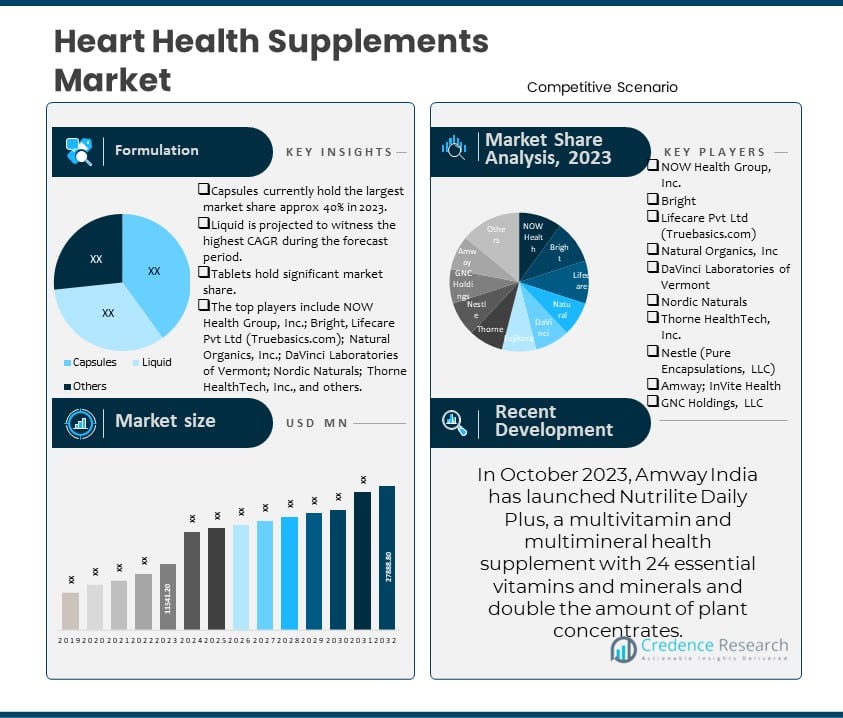
- The Heart Health Supplements Market reached a valuation of USD 11541.2 Million in 2023 and is anticipated to rise to USD 27888.8 Million by 2032, indicating a strong CAGR of 10.30% from 2024 to 2032.
- Omega-3 Fatty Acids Supplements emerged as the dominant segment by type, constituting approximately 30-35% of the total market share in 2023. This segment's growth is primarily attributed to the widely recognized beneficial effects of omega-3 fatty acids on heart health.
- Plant Sterols and Stanols Supplements are projected to witness significant growth during the forecast period, driven by the increasing demand for natural alternatives to conventional drugs and their ability to lower cholesterol levels.
- Capsules hold the largest market share by formulation in 2023, accounting for approximately 40% of the total market. This segment's popularity is due to the convenience and ease of dosage provided by capsules.
- Adults hold the largest market share by end-user, constituting approximately 40-48% of the market in 2023. This is attributed to the higher susceptibility of adults to cardiovascular issues and their inclination towards preventative measures such as heart health supplements.
- Pharmacies and Drugstores are the leading distribution channel, holding around 40-45% of the market share in 2023. This dominance is due to the trust and accessibility associated with pharmacies, especially among older adults.
- North America holds the largest share of the Heart Health Supplements Market, accounting for around 40-42% of the market in 2023. Factors such as the rising incidence of cardiovascular diseases and increased awareness of heart health contribute to the region's growth.
- Technological advancements in manufacturing heart health supplements, along with increased digital marketing and social media advertising by online retailers, are driving market growth and awareness.
Executive Summary
Market Definition
The global heart health drugs market is growing rapidly. This growth is driven by various factors such as increased heart health awareness, pressure and high cholesterol levels caused by blood pressure and high cholesterol; a growing aging population, elevating the risk of heart issues; heightened health consciousness among consumers, rising demand for supplements; and advances in nutritional science, which further drive the market. Heart health supplements come in a variety of forms such as dietary supplements like capsules, tablets and powders; combined with functional foods such as omega-3 fatty acids and antioxidants; and into beverages such as juices for smoothies, providing easy-to-drink options. The main key end users include adults aged 45 years and older, who are particularly susceptible to cardiovascular events; athletes and fitness enthusiasts looking to improve cardiovascular fitness and performance; and individuals with chronic conditions such as hypertension or high cholesterol, use complementary medicine as part of treatment regimens to improve overall heart health.
Market Overview
- The Heart Health Supplements Market reached a valuation of USD 11541.2 Million in 2023 and is expected to surge to USD 27888.8 Million by 2032, showcasing a robust CAGR of 10.30% from 2024 to 2032.
- Omega-3 Fatty Acids Supplements emerged as the dominant segment by type, constituting approximately 30-35% of the total market share in 2023. This segment's growth is primarily attributed to the widely recognized beneficial effects of omega-3 fatty acids on heart health.
- Plant Sterols and Stanols Supplements are projected to witness significant growth during the forecast period, driven by the increasing demand for natural alternatives to conventional drugs and their ability to lower cholesterol levels.
- Capsules hold the largest market share by formulation in 2023, accounting for approximately 40% of the total market. This segment's popularity is due to the convenience and ease of dosage provided by capsules.
- Adults hold the largest market share by end-user, constituting approximately 40-48% of the market in 2023. This is attributed to the higher susceptibility of adults to cardiovascular issues and their inclination towards preventative measures such as heart health supplements.
- Pharmacies and Drugstores are the leading distribution channel, holding around 40-45% of the market share in 2023. This dominance is due to the trust and accessibility associated with pharmacies, especially among older adults.
- North America holds the largest share of the Heart Health Supplements Market, accounting for around 40-42% of the market in 2023. Factors such as the rising incidence of cardiovascular diseases and increased awareness of heart health contribute to the region's growth.
- Key opportunities in the market include significant growth potential in Asia Pacific, Growing investments and product development in the heart health supplement sector are further fueling market growth, and continuous advancements in technology, fostering market expansion.
Segmentation by Type of Supplement
- Omega-3 Fatty Acids Supplements currently hold the largest market share approx 30-35% in 2023. Omega-3 fatty acids are widely recognized for their beneficial effects on heart health, a including reducing inflammation, improving lipid profile and reducing the risk of heart failure.
- Plant Sterols and Stanols Supplements, is projected to witness the highest CAGR during the forecast period. Plant sterols and stanols have gained popularity in recent years for their ability to lower cholesterol levels and reduce the risk of heart disease in addition to being natural compounds found in plants, making them attractive for consumers looking for natural alternatives to conventional drugs.
Segmentation by Formulation
- Capsules currently hold the largest market share approx 40% in 2023. This is because capsules are a convenient and popular dosage form for many supplements, making them easier to take and more accurately dosed.
- Liquid is projected to witness the highest CAGR during the forecast period. This is because water is becoming increasingly popular in dietary supplement market because its easy to consume, fast absorption and versatility. Liquid supplements are easily mixed with drinks or taken sublingually, making them more convenient for users who have difficulty swallowing pills or tablets.
Segmentation by End-User
- Adults currently hold the largest market share approx 40-48% in 2023 due to adults are more prone to cardiovascular issues such as high blood pressure, high cholesterol, and heart disease, they are more likely to take antiarrhythmic drugs to prevent them contributed the market growth.
- Athletes and Fitness Enthusiasts is projected to witness the highest CAGR during the forecast period. Athletes and fitness enthusiasts are increasingly looking for supplements that can help improve their cardiovascular health and performance. Furthermore, the growing popularity of veganism and plant-based diet among athletes and fitness enthusiasts is also driving demand for plant-based heart health supplements.
Segmentation by Distribution Channel
- Pharmacies and Drugstores currently hold the largest market share approx 40-45% in 2023. This is because pharmacies and drugstores are the most common and trusted sources for purchasing supplements, especially for older adults who may not be comfortable shopping online or who prefer to consult with a healthcare professional before making a purchase.
- Online Retailers (e-commerce) is projected to witness the highest CAGR during the forecast period. Online Retailers (e-commerce) offer a wide variety of heart medicines from different brands, often at discounted prices, making it easier to take home.
Segmentation by Region
- North America held largest share around 40-42% of the market in 2023. This is due to due to several factors like that rising incidence of cardiovascular diseases, increased awareness of cardiovascular benefits supplement Presence and well-established healthcare infrastructure contribute to its large market share.
- Europe and North America collectively account for just under 55% share in 2023, with Asia Pacific holding over 20% share in the same year.
- The rest of the world, including Latin America, the Middle East, and Africa, supplies the remaining demand for Heart Health Supplements.
Technological advancements in manufacturing the heart health supplements, online retailers are investing heavily in digital marketing and social media advertising, which is helping to raise awareness about heart health supplements, are also contributing to market growth.
The North America region held largest share of Heart Health Supplements market. This dominance can be attributed to several factors such as increasing consumer awareness on the importance of cardiac health care, increasing incidence of cardiovascular diseases, died from heart disease and availability of well-established healthcare infrastructure. For instance, according to the Centers for Disease Control and Prevention, heart disease is a major health problem in the United States. Every 33 seconds, someone in the US dies from heart disease. In 2021, over 695,000 people died from heart disease, which is one out of every five deaths. Moreover, the North America region witnesses significant growth in the Heart Health Supplements market. For instance, according to the Centers for Disease Control and Prevention, the total cost of heart disease in the U.S. is around $240 billion per year, which includes medical expenses, prescription drugs, and lost productivity due to death. Consumers in North America are recognizing the benefits of supplementation in maintaining overall health, including heart health. This has led to a surge in sales of cardiac supplements, especially among older adults who are at increased risk for cardiovascular disease.
Moreover, according to National Institutes of Health (NIH), multivitamin/mineral (MVM) and multivitamin (MV) supplements accounted for 14% of nutrition purchases and 38% of vitamin and mineral supplements sales in the United States in 2019. Total nutrition is estimated to be $55.7 billion by 2020 , where $21.2 billion was spent on supplements containing vitamins, minerals, or both, of which $8.0 billion was for MVM and MV Because of the high prevalence of heart disease in the US. and people are increasingly recognizing the importance of heart health so, obviously so a significant portion of these supplements marketed as heart health supplements further drive the Heart Health Supplements Market.
The Asia Pacific region held significant share of Heart Health Supplements market. The Asia-Pacific region is a key market for cardiovascular health products, as the prevalence of cardiovascular diseases is increasing and awareness of the importance of cardiovascular disease among consumers. In India, for example, the government has launched programs to promote traditional Ayurvedic medicine, including herbal supplements for heart health. This has increased the demand for cardiac drugs, especially in the elderly population. For instance, in August 2020, The Ministry of AYUSH has taken several steps to promote the Indian system of medicines globally. They have signed 13 MoUs with foreign universities/institutes to set up AYUSH academic chairs, allowing AYUSH experts to teach, train, and conduct research in reputed universities. Additionally, the ministry has signed country-to-country MoUs with 23 countries for cooperation in traditional medicine and homoeopathy, including research, education, and training. Moreover, dietary supplements, including heart medicines, are becoming increasingly popular in China due to the country’s rapidly aging population and growing middle class families. For instance, in December 2022, China's SAMR has approved 1,445 health food and dietary supplement registrations, with 421 being new products, accounting for 29.13% of the total. 80 new products were approved in 2021, and 341 were approved in 2022. The remaining 1,024 registration approvals were renewals, alterations, and transfer of technology registrations. The news is beneficial for China’s heart health supplements market as it indicates an increased need for health foods and nutritional supplements in the country. The approval of new products and the renewal of existing products means that the market is dynamic and competitive, with options for consumers this increases consumer confidence and spending in the industry, and ultimately it benefits the heart health products market.
Key Highlights of the Report
The Heart Health Supplements Market is segmented based on various factors including type, formulation, end-user, distribution channel, and region. The growing awareness of heart health and the increasing demand for natural preventative solutions are driving the adoption of heart health supplements across diverse demographics.
Omega-3 Fatty Acids Supplements emerge as the dominant segment, renowned for their beneficial effects on heart health. Plant Sterols and Stanols Supplements are anticipated to witness significant growth, fueled by the demand for natural alternatives to conventional drugs.
Capsules hold the largest market share by formulation, offering convenience and accurate dosing. Adults constitute the largest end-user segment, reflecting their susceptibility to cardiovascular issues and inclination towards preventative measures.
Pharmacies and Drugstores lead in distribution channels, leveraging trust and accessibility. North America dominates the Heart Health Supplements Market, driven by the rising incidence of cardiovascular diseases and increased awareness.
Asia Pacific presents significant growth opportunities, propelled by increasing health consciousness and disposable income. Continuous technological advancements foster market expansion, enhancing product efficacy and consumer acceptance in the Heart Health Supplements Market.
Key players such as Mann Nordic Naturals; Thorne HealthTech, Inc.; Nestle (Pure Encapsulations, LLC); Amway; InVite Health; GNC Holdings, LLC compete in the market, focusing on product innovation, distribution channel expansion, and strategic partnerships to maintain competitiveness. Collaborations and technological advancements contribute to Asia Pacific's dominance in the Heart Health Supplements Market, with major players like Toyota and Honda expanding their presence and capabilities in the region to meet growing demand.
What Are The Main Drivers Of The Global Heart Health Supplements Market?
The global heart health supplement market is primarily driven by the rising incidence of cardiovascular diseases, growing importance of heart health, and increasing demand for natural health prevention solutions, and Plant Sterols solutiuons. Furthermore, the presence of key players and their continuous innovation and growth efforts are also anticipated to contribute to the growth of the market.
What Are The Major Challenges Faced By The Global Heart Health Supplements Market?
The major challenges in the global automotive exhaust filter market include intense competition, regulatory barriers, concerns over the safety and efficacy of certain drugs and lack of standardization in the industry, and a lack of strong evidence to support the benefits of certain medications. Furthermore, the high costs associated with clinical trials and regulatory approvals for new products pose significant barriers for manufacturers in the long-term.
What Are The Growth Opportunities In The Global Heart Health Supplements Market?
The global Heart Health Supplements market presents numerous growth opportunities due to increased demand for organic natural products, increased awareness on the importance of healthcare a prevention is needed, and the expansion of the middle class with increased disposable income, resulting in new and innovative products. Also, growing online sales and increasing health conscious consumers are expected to fuel the market growth. Finally, there will be an increase in mergers and acquisitions in the market, leading to expansion of existing players and entry into new players.
Market Drivers
The global Heart Health Supplements market is driven by several factors. The following are the key drivers of the global Heart Health Supplements market:
Increasing demand Plant Sterols and Stanols Supplements
Increasing demand Plant Sterols and Stanols Supplements drives the global Heart Health Supplements market. The global heart health supplements market is experiencing significant growth, driven by the increasing demand for plant sterol and stanols supplements. These supplements are widely recognized for their ability to lower cholesterol and improve heart health. Increasing consumer awareness of the importance of heart health and increasing incidence of cardiovascular diseases contributes to market growth. With the increasing popularity of natural medicines, plant sterol stanol supplements are becoming more popular with consumers looking for an option want a safe and effective way to support their heart health. Owing to this benefit market players continues launch the product to cater the demand. For instance, in September 2023, Nutrartis has launched Cardiosmile, a natural supplement containing plant sterols, in the US market. Cardiosmile is designed to help manage cholesterol levels and support heart health, and is available in a convenient liquid sachet format that can be easily added to beverages, food, and daily routines. The supplement uses water-dispersible phytosterols, which have been scientifically proven to be effective in promoting heart health.
Market Restraints
The global Heart Health Supplements market faces some challenges that may hinder its growth. These include the following:
Regulatory Barriers
The global Heart Health Supplements market is primarily constrained by regulatory barriers. Strict regulation by government agencies such as the US. Food and Drug Administration (FDA) limits the sale and distribution of heart failure drugs. This regulation makes it difficult for companies to bring new products to market, and limits the claims that can be made about health benefits even limits of these supplements choosing a medication is difficult. All these factors together restrained the growth of the Cardiovascular Supplements market.
Opportunities
The global Heart Health Supplements market offers significant growth opportunities. These include the following:
Adoption Of Various Strategies Among Market Players
The major companies serving the global Heart Health Supplements Market are Mann+Hummel GmbH, UFI Filters, K&N Engineering, Inc., Denso Corporation, Donaldson Company Inc, among others. The market players are considerably contributing to the market growth by the adoption of various strategies including mergers & acquisitions, collaborations, funding, and new product launches, to stay competitive in the market also makes opportunity for the market growth. For instance, in August 2023, Nordic Naturals is partnered with Sam's Club to offer their premium omega-3 supplements, Ultimate Omega and Algae Omega, in Sam's Club stores nationwide. This collaboration aims to make high-quality omega-3 supplements more accessible and affordable to a wider range of individuals, supporting their journey toward optimal health.
Competitive Landscape
Key Players
The global Heart Health Supplements market is highly competitive, with several key players. Some of the major players in the market and their market share are as follows:
- NOW Health Group, Inc.
- Bright
- Lifecare Pvt Ltd (Truebasics.com)
- Natural Organics, Inc
- DaVinci Laboratories of Vermont
- Nordic Naturals
- Thorne HealthTech, Inc.
- Nestle (Pure Encapsulations, LLC)
- Amway
- InVite Health
- GNC Holdings, LLC
- Others
These organizations prioritize product innovation, distribution channel expansion, and mergers and acquisitions to stay competitive.
The global Heart Health Supplements market's key players continually seek to stay ahead by offering new products and developments.
In October 2023, Amway India has launched Nutrilite Daily Plus, a multivitamin and multimineral health supplement with 24 essential vitamins and minerals and double the amount of plant concentrates. The supplement features a unique Dual Layer Dual Release Formulation and includes Gotukola, an ingredient known for its stress-reducing properties, to support holistic wellness and mental well-being.
In April 2023, Nordic Naturals is collaborating with Walmart to increase accessibility of its high-quality, heart healthy omega-3 supplements. This partnership allows Walmart customers to purchase Nordic Naturals' top-selling products, including Ultimate Omega and Algae Omega, at select stores and online. This expansion aims to support more people in their quest for better heart health.
Summary of Key Findings
- The Heart Health Supplements Market is experiencing significant growth, propelled by the increasing demand for natural preventative solutions and heightened awareness of heart health.
- Market segmentation based on type, formulation, end-user, distribution channel, and region reflects the diverse applications and market dynamics within the heart health supplements industry.
- Omega-3 Fatty Acids Supplements emerge as the dominant segment, renowned for their beneficial effects on heart health, followed by Plant Sterols and Stanols Supplements, catering to the demand for natural alternatives to conventional drugs.
- Key end-user segments include adults seeking preventative measures, athletes and fitness enthusiasts aiming to improve cardiovascular health and performance, and individuals with chronic conditions such as hypertension or high cholesterol.
- North America leads the Heart Health Supplements Market, driven by the rising incidence of cardiovascular diseases and established healthcare infrastructure, followed by Europe and Asia Pacific.
Future Outlook
- The Heart Health Supplements Market presents promising growth opportunities, especially in Asia Pacific, attributed to factors like increasing health consciousness and disposable income.
- Anticipated challenges in the forecast period include competition from alternative health supplements and ensuring regulatory compliance and product quality standards.
- To maintain competitiveness, industry players should focus on product innovation, technological advancements, and strategic collaborations to meet evolving consumer demands and capitalize on emerging market opportunities in the dynamic Heart Health Supplements Market.
How CXOs Can Benefit from the Credence Research Heart Health Supplements Networks Market Report
The Credence Research Heart Health Supplements Networks Market Report provides CXOs with a comprehensive overview of the market, including:
- Market size and growth forecast:The report provides detailed estimates of the global Heart Health Supplements networks market size, segmented type, formulation, end-user, distribution channel, and region. It also includes forecasts for the market through 2032, based on key trends and drivers.
- Market segmentation:The report segments the Heart Health Supplements networks market by type, formulation, end-user, distribution channel, and region. The increasing demand for advanced solutions is driven. This segmentation provides CXOs with a granular understanding of the market and the opportunities in each segment.
- Competitive landscape:The report profiles the key players in the Heart Health Supplements networks market and provides insights into their strategies, product offerings, and financial performance. This information can help CXOs to identify and assess their competition.
- Key trends and drivers:The report identifies and analyzes the key trends and drivers that are shaping the Heart Health Supplements networks market. This information can help CXOs to make informed decisions about their investments and strategies.
CXOs can use the insights from the Credence Research Heart Health Supplements Networks Market Report to:
- Identify growth opportunities:The report can help CXOs to identify new growth opportunities in the Heart Health Supplements networks market. For example, the report identifies the growing demand for Heart Health Supplements networks from cloud computing providers and telecom companies as a key opportunity.
- Make informed investment decisions:The report can help CXOs to make informed investment decisions about Heart Health Supplements networks. For example, the report provides insights into the key factors to consider when evaluating Heart Health Supplements providers and selecting Heart Health Supplements solutions.
- Develop competitive strategies:The report can help CXOs to develop competitive strategies for their Heart Health Supplements networks businesses. For example, the report identifies the key strategies that Heart Health Supplements providers are using to differentiate themselves from their competitors.
- Track market developments:The report can help CXOs to track market developments and stay ahead of the curve. For example, the report provides insights into the latest trends and innovations in the Heart Health Supplements networks market.
Overall, the Credence Research Heart Health Supplements Networks Market Report is a valuable resource for CXOs who are looking to gain a deeper understanding of the market and identify opportunities for growth.
Segmentation
- Type of Supplement:
- Omega-3 Fatty Acids Supplements
- Coenzyme Q10 (CoQ10) Supplements
- Antioxidant Supplements (e.g., vitamins C and E)
- Magnesium Supplements
- Calcium Supplements
- L-arginine Supplements
- Plant Sterols and Stanols Supplements
- Fiber Supplements
- Vitamin D Supplements
- Herbal Supplements (e.g., garlic, hawthorn, turmeric)
- Others
- Formulation:
- Capsules
- Tablets
- Softgels
- Powder
- Liquid
- Others
- End-User:
- Adults
- Elderly
- Athletes and Fitness Enthusiasts
- Pediatric
- Pregnant and Lactating Women
- Distribution Channel:
- Pharmacies and Drugstores
- Health and Wellness Stores
- Online Retailers (e-commerce)
- Supermarkets and Hypermarkets
- Specialty Stores
- Others
- By Region
- North America
- The U.S.
- Canada
- Mexico
- Europe
- Germany
- France
- The U.K.
- Italy
- Spain
- Rest of Europe
- Asia Pacific
- China
- Japan
- India
- South Korea
- South-east Asia
- Rest of Asia Pacific
- Latin America
- Brazil
- Argentina
- Rest of Latin America
- Middle East & Africa
- GCC Countries
- South Africa
- Rest of Middle East and Africa
- North America

Request a Free Sample
Fill in your details and we'll send you a free sample report.
- Sample data tables & charts
- Research methodology
Market Dynamics
Rising Incidence of Cardiovascular Diseases
The increasing prevalence of heart disease and related conditions globally is prompting more consumers to seek preventative solutions, directly boosting demand for heart health supplements.
Growing Consumer Awareness and Preventative Health Focus
Heightened awareness about the importance of cardiovascular health, especially among adults and the aging population, is driving adoption of supplements as a proactive health measure.
Preference for Natural and Plant-Based Alternatives
Consumers are increasingly seeking natural alternatives to conventional drugs, such as plant sterols and stanols, which are perceived as safer and effective for cholesterol management and heart health.
Expansion of Distribution Channels and Digital Marketing
The growth of online retail and increased digital marketing efforts by supplement brands are making heart health supplements more accessible and visible, especially to younger and tech-savvy consumers.
Technological Advancements in Supplement Formulation
Innovations in supplement delivery forms, such as convenient capsules and fast-absorbing liquids, are improving consumer experience and compliance, further supporting market growth.
Need a Custom Version of This Report?
Tailor the scope, geography, or segments to your exact requirements.
- Custom geography or segment scope
- Direct access to our analyst team
Frequently Asked Questions
What is the current size of the global Heart Health Supplements market?
What is the expected growth rate of the Heart Health Supplements market between 2024 and 2032?
Which segment is leading the market share in terms of Heart Health Supplements Types?
Which Formulation segments governs the demand for Heart Health Supplements in the world?
Who are the major players in the global Heart Health Supplements market?
Table of Content
Chapter 1 Market Segmentation
- 1.1 Segmentation Framework
- 1.1.1 Product and Service Classification
- 1.1.2 Application and End-Use Classification
- 1.1.3 Technology and Solution Classification
- 1.1.4 Customer and Distribution Channel Classification
- 1.1.5 Geographic Segmentation
- 1.1.6 Market Segment Definitions and Boundaries
- 1.2 By End-User
- 1.2.1 Adults
- 1.2.2 Elderly
- 1.2.3 Athletes and Fitness Enthusiasts
- 1.2.4 Pediatric
- 1.2.5 Pregnant and Lactating Women
- 1.3 By Formulation
- 1.3.1 Capsules
- 1.3.2 Tablets
- 1.3.3 Softgels
- 1.3.4 Powder
- 1.3.5 Liquid
- 1.4 By Type of Supplement
- 1.4.1 Omega-3 Fatty Acids Supplements
- 1.4.2 Coenzyme Q10 (CoQ10) Supplements
- 1.4.3 Plant Sterols and Stanols Supplements
- 1.4.4 Antioxidant Supplements (e.g., vitamins C and E)
- 1.4.5 Herbal Supplements (e.g., garlic, hawthorn, turmeric)
- 1.4.6 Others
Chapter 2 Introduction
- 2.1 Report Objectives and Scope
- 2.2 Product Definition and Industry Terminology
- 2.3 Market Inclusions and Exclusions
- 2.4 Research Process
- 2.4.1 Primary Research and Expert Interviews
- 2.4.2 Secondary Research and Source Review
- 2.4.3 Top-Down and Bottom-Up Estimation
- 2.4.4 Data Triangulation and Verification
- 2.5 Market Size Measurement Basis
- 2.5.1 2023: USD 11541.2 Million → 2032: USD 27,888.8 Million
- 2.6 Historical and Forecast Reference Periods
- 2.6.1 Base Year: 2023
- 2.6.2 Forecast Period: 2023-2032
- 2.7 Research Assumptions and Limitations
Chapter 3 Executive Summary
- 3.1 Market Snapshot and Key Findings
- 3.2 Base-Year Market Size, 2023
- 3.3 Forecast Market Size, 2032
- 3.4 Revenue and Volume Growth Outlook
- 3.5 Key Demand and Supply Indicators
- 3.6 Leading Market Segments
- 3.7 Fastest-Growing Market Opportunities
- 3.8 Regional Performance Highlights
- 3.9 Technology and Industry Transformation
- 3.10 Competitive Landscape Summary
- 3.11 Analyst View and Strategic Implications
Chapter 4 Global Heart Health Supplements Market Trends and Developments
- 4.1 Historical Industry Development
- 4.2 Recent Market Trends and Developments
- 4.3 Demand and Customer Behavior Trends
- 4.4 Technology and Product Innovation
- 4.5 Artificial Intelligence, Automation and Digitalization
- 4.6 Local Manufacturing and Supply Chain Realignment
- 4.7 Industry Partnerships, Mergers and Acquisitions
- 4.8 Sustainability and Circular Economy Developments
- 4.9 Government and Private Sector Investment Trends
- 4.10 Emerging Business Models and Commercialization
- 4.11 Industry Developments and Announcements
Chapter 5 Global Heart Health Supplements Market Production, Supply and Demand Analysis
- 5.1 Demand Trend and Consumption Analysis
- 5.2 Demand Forecast, 2023-2032
- 5.3 Production and Output Trend
- 5.4 Production and Output Forecast, 2023-2032
- 5.5 Installed Capacity and Capacity Utilization
- 5.6 Company-Wise Production Plants and Statistics
- 5.6.1 Installed Production Capacity
- 5.6.2 Actual Production
- 5.6.3 Planned Capacity and Expansion Targets
- 5.7 Supply Chain Structure and Procurement Trends
- 5.8 Supply-Demand Gap and Bottlenecks
- 5.9 Import Dependence and Sourcing Structure
- 5.10 Contract Manufacturing and Outsourcing
- 5.11 Regional Supply and Demand Concentration
Chapter 6 Global Heart Health Supplements Market Pricing Analysis
- 6.1 Pricing Structure and Measurement
- 6.2 Historical Pricing Trends
- 6.3 Pricing Outlook, 2023-2032
- 6.4 Average Selling Price and Unit Economics
- 6.5 Pricing by Product and Market Segment
- 6.6 Geographic Pricing Differences
- 6.7 Key Input, Energy, Labor and Logistics Costs
- 6.8 Contract Pricing and Purchasing Models
- 6.9 Pricing Sensitivity and Competitive Positioning
- 6.10 Price, Margin and Profitability Implications
Chapter 7 Global Heart Health Supplements Market Dynamics
- 7.1 Market Growth Drivers
- 7.1.1 Demand-Side Drivers
- 7.1.2 Technology and Innovation Drivers
- 7.1.3 Infrastructure and Investment Drivers
- 7.1.4 Regulatory and Policy Drivers
- 7.2 Market Restraints
- 7.2.1 Cost and Affordability Constraints
- 7.2.2 Technology and Adoption Barriers
- 7.2.3 Supply Chain and Operational Constraints
- 7.3 Market Challenges
- 7.3.1 Competitive Pressure and Margin Erosion
- 7.3.2 Skills, Infrastructure and Implementation Gaps
- 7.4 Emerging Market Opportunities
- 7.5 Market Dynamics Impact and Time-Horizon Assessment
Chapter 8 Global Heart Health Supplements Value Chain Analysis
- 8.1 Industry Value Chain Overview
- 8.2 Upstream Suppliers and Critical Inputs
- 8.3 Technology and Component Providers
- 8.4 Manufacturing or Service Delivery
- 8.5 Distribution, Channel Partners and Integrators
- 8.6 Downstream Applications and End Users
- 8.7 Value Addition and Profit Pools
- 8.8 Vertical Integration and Outsourcing
- 8.9 Supplier Concentration and Risk
- 8.10 Supply Chain Localization and Resilience
Chapter 9 Global Heart Health Supplements Market Regulations and Policies
- 9.1 Relevant Laws, Standards and Compliance Frameworks
- 9.2 Product, Service, Safety and Quality Requirements
- 9.3 Government Policies, Incentives and Subsidies
- 9.4 Imports, Exports and Trade Barriers
- 9.5 Public Procurement and Local Content Requirements
- 9.6 Environmental and Sustainability Compliance
- 9.7 Upcoming Policy Changes and Market Implications
Chapter 10 Global Heart Health Supplements Market Hotspots and Opportunities
- 10.1 Market Opportunity Mapping and Growth Hotspots
- 10.2 High-Growth Applications and Customer Groups
- 10.3 Underserved Markets and White-Space Opportunities
- 10.4 Emerging Technology and Product Opportunities
- 10.5 New Capacity and Investment Hotspots
- 10.6 Market Entry and Expansion Opportunities
- 10.7 Distribution and Partnership Opportunities
- 10.8 Near-Term and Long-Term Commercial Potential
- 10.9 Opportunity Attractiveness and Execution Risks
Chapter 11 Global Heart Health Supplements Market Outlook, 2023-2032
- 11.1 Market Size and Analysis
- 11.1.1 Revenue (Market Measurement: 2023: USD 11541.2 Million → 2032: USD 27,888.8 Million)
- 11.1.2 Market Volume and Quantity Sold
- 11.1.3 Historical Market Size
- 11.1.4 Base-Year Market Size, 2023
- 11.2 Market Forecast, 2023-2032
- 11.2.1 Revenue Forecast to 2032
- 11.2.2 Volume Forecast to 2032
- 11.2.3 CAGR and Year-on-Year Growth
- 11.2.4 Incremental Revenue Opportunity
- 11.3 Forecast Assumptions and Scenario Analysis
- 11.3.1 Base-Case Forecast
- 11.3.2 Optimistic and Conservative Scenarios
- 11.3.3 Technology, Pricing and Policy Sensitivities
- 11.4 Market Attractiveness and Growth Outlook
Chapter 12 Global Heart Health Supplements Market Segmentation and Outlook
- 12.1 Segmentation Summary and Market Shares, 2023
- 12.2 Largest and Fastest-Growing Segments
- 12.3 By End-User - Market Size and Forecast, 2023-2032
- 12.3.1 Segment Definition and Scope
- 12.3.2 Historical Market Size
- 12.3.3 Revenue Forecast, 2023-2032
- 12.3.4 Volume Forecast, 2023-2032
- 12.3.5 Base-Year Market Share, 2023
- 12.3.6 Segment CAGR and Growth Drivers
- 12.3.7 Subsegment Market Size and Forecast
- 12.3.7.1 Adults
- 12.3.7.2 Elderly
- 12.3.7.3 Athletes and Fitness Enthusiasts
- 12.3.7.4 Pediatric
- 12.3.7.5 Pregnant and Lactating Women
- 12.3.8 Subsegment Pricing and Adoption Trends
- 12.3.9 Leading Suppliers and Competition
- 12.3.10 Regional Demand and Opportunities
- 12.4 By Formulation - Market Size and Forecast, 2023-2032
- 12.4.1 Segment Definition and Scope
- 12.4.2 Historical Market Size
- 12.4.3 Revenue Forecast, 2023-2032
- 12.4.4 Volume Forecast, 2023-2032
- 12.4.5 Base-Year Market Share, 2023
- 12.4.6 Segment CAGR and Growth Drivers
- 12.4.7 Subsegment Market Size and Forecast
- 12.4.7.1 Capsules
- 12.4.7.2 Tablets
- 12.4.7.3 Softgels
- 12.4.7.4 Powder
- 12.4.7.5 Liquid
- 12.4.8 Subsegment Pricing and Adoption Trends
- 12.4.9 Leading Suppliers and Competition
- 12.4.10 Regional Demand and Opportunities
- 12.5 By Type of Supplement - Market Size and Forecast, 2023-2032
- 12.5.1 Segment Definition and Scope
- 12.5.2 Historical Market Size
- 12.5.3 Revenue Forecast, 2023-2032
- 12.5.4 Volume Forecast, 2023-2032
- 12.5.5 Base-Year Market Share, 2023
- 12.5.6 Segment CAGR and Growth Drivers
- 12.5.7 Subsegment Market Size and Forecast
- 12.5.7.1 Omega-3 Fatty Acids Supplements
- 12.5.7.2 Coenzyme Q10 (CoQ10) Supplements
- 12.5.7.3 Plant Sterols and Stanols Supplements
- 12.5.7.4 Antioxidant Supplements (e.g., vitamins C and E)
- 12.5.7.5 Herbal Supplements (e.g., garlic, hawthorn, turmeric)
- 12.5.7.6 Others
- 12.5.8 Subsegment Pricing and Adoption Trends
- 12.5.9 Leading Suppliers and Competition
- 12.5.10 Regional Demand and Opportunities
- 12.6 Segment Growth Comparison
- 12.7 Segment Attractiveness and Priority Matrix
Chapter 13 Global Heart Health Supplements End-Use and Application Market Outlook
- 13.1 End-Use Industry and Customer Demand Structure
- 13.2 Leading Applications and Customer Groups
- 13.3 End-Use Market Size, Share and Forecast
- 13.4 Major End-Use Industry Deep Dives
- 13.4.1 Customer Requirements and Use Cases
- 13.4.2 Demand and Replacement Cycles
- 13.4.3 Technical and Regulatory Considerations
- 13.4.4 Purchasing and Procurement Models
- 13.4.5 Leading Vendors and Distribution Channels
- 13.4.6 Forecast and Commercial Opportunities
- 13.5 Emerging Applications and Cross-Segment Demand
- 13.6 End-Use Industry Investment Priorities
Chapter 14 Global Heart Health Supplements Geographic Market Outlook, 2023-2032
- 14.1 Regional Market Size and Share, 2023
- 14.2 Regional Market Forecast, 2023-2032
- 14.3 Regional Pricing, Production and Demand Differences
- 14.4 North America
- 14.4.1 United States
- 14.4.2 Canada
- 14.4.3 Mexico
- 14.5 Europe
- 14.5.1 Germany
- 14.5.2 France
- 14.5.3 Italy
- 14.5.4 United Kingdom
- 14.5.5 Spain
- 14.5.6 Poland
- 14.5.7 Russia
- 14.5.8 Netherlands
- 14.5.9 Belgium
- 14.5.10 Sweden
- 14.5.11 Denmark
- 14.5.12 Norway
- 14.5.13 Rest of Europe
- 14.6 Asia Pacific
- 14.6.1 China
- 14.6.2 India
- 14.6.3 Japan
- 14.6.4 South Korea
- 14.6.5 Thailand
- 14.6.6 Indonesia
- 14.6.7 Vietnam
- 14.6.8 Malaysia
- 14.6.9 Australia
- 14.6.10 Rest of Asia Pacific
- 14.7 Latin America
- 14.7.1 Brazil
- 14.7.2 Argentina
- 14.7.3 Colombia
- 14.7.4 Chile
- 14.7.5 Rest of Latin America
- 14.8 Middle East
- 14.8.1 Saudi Arabia
- 14.8.2 United Arab Emirates
- 14.8.3 Turkey
- 14.8.4 Israel
- 14.8.5 Iran
- 14.8.6 Rest of the Middle East
- 14.9 Africa
- 14.9.1 South Africa
- 14.9.2 Egypt
- 14.9.3 Nigeria
- 14.9.4 Morocco
- 14.9.5 Rest of Africa
- 14.10 Regional Investment, Policy and Supply Chain Differences
- 14.11 Regional Competitive Landscape
- 14.12 Geographic Growth Hotspots
Chapter 15 Global Heart Health Supplements Technology, Innovation and Sustainability Outlook
- 15.1 Technology Landscape and Maturity
- 15.2 Product, Process and Service Innovation
- 15.3 AI, Automation and Digital Tools in the Industry
- 15.4 Technology Adoption and Performance Benchmarking
- 15.5 Innovation Pipeline and R&D Investment
- 15.6 Patent and Intellectual Property Trends
- 15.7 Energy Efficiency and Resource Management
- 15.8 Sustainability, Recycling and Circularity
- 15.9 Technology Roadmap, 2023-2032
- 15.10 Risks of Obsolescence and Technology Substitution
Chapter 16 Global Heart Health Supplements Market Key Strategic Imperatives
- 16.1 Growth and Market Entry Priorities
- 16.2 High-Return Products and Segments
- 16.3 Pricing, Profitability and Cost Optimization
- 16.4 Technology Investment and Product Differentiation
- 16.5 Supply Chain Localization and Resilience
- 16.6 Distribution and Customer Acquisition
- 16.7 Partnership, Acquisition and Capacity Strategy
- 16.8 Regional Expansion Priorities
- 16.9 Short-, Medium- and Long-Term Actions
Chapter 17 Competition Outlook
- 17.1 Industry Competition Characteristics
- 17.2 Market Structure and Concentration
- 17.3 Market Share and Competitive Positioning, 2023
- 17.4 Company-Wise Revenue and Product Benchmarking
- 17.5 Production and Service Capacity Benchmarking
- 17.6 Technology, Pricing and Differentiation
- 17.7 Regional Footprint and Distribution Strength
- 17.8 Mergers, Acquisitions and Strategic Alliances
- 17.9 New Entrants and Competitive Threats
- 17.10 Porter's Five Forces and Industry Attractiveness
- 17.11 Competitive Outlook, 2023-2032
Chapter 18 Company Profiles
- 18.1 Company Coverage and Selection Criteria
- 18.2 Nordic Naturals
- 18.2.1 Business Description
- 18.2.2 Company Ownership and Geographic Presence
- 18.2.3 Product and Service Portfolio
- 18.2.4 Manufacturing and Operating Footprint
- 18.2.5 Production Capacity and Expansion Plans
- 18.2.6 Financial Performance and Investment
- 18.2.7 Market Share and Competitive Position
- 18.2.8 Technology and Innovation Capabilities
- 18.2.9 Strategic Alliances or Partnerships
- 18.2.10 Recent Developments
- 18.2.11 Growth Strategy and Outlook
- 18.3 Thorne HealthTech, Inc.
- 18.4 Nestle (Pure Encapsulations, LLC)
- 18.5 Amway
- 18.6 InVite Health
- 18.7 GNC Holdings, LLC
- 18.8 NOW Health Group, Inc.
- 18.9 Natural Organics, Inc.
- 18.10 DaVinci Laboratories of Vermont
- 18.11 Lifecare Pvt Ltd (Truebasics.com)
- 18.12 Other Relevant Market Participants
Note: Every listed company is profiled on the structure shown under the first company. The company list is preliminary and may change based on research findings, market developments, data availability and client requirements.
Chapter 19 Disclaimer
- 19.1 Research and Forecast Disclaimer
- 19.2 Data Source and Estimation Limitations
Note: The depth of individual sections depends on data availability for this market. Volume, capacity, trade and other unit-based metrics are included where applicable.