
Market Overview:
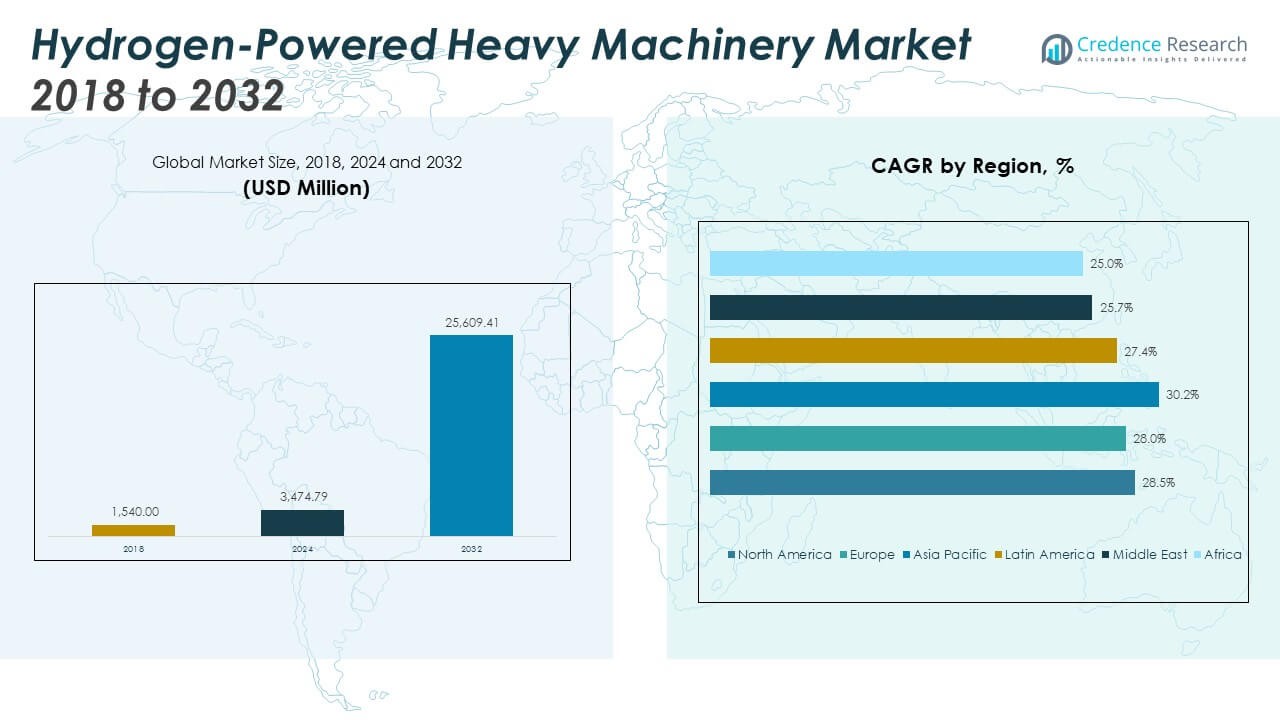
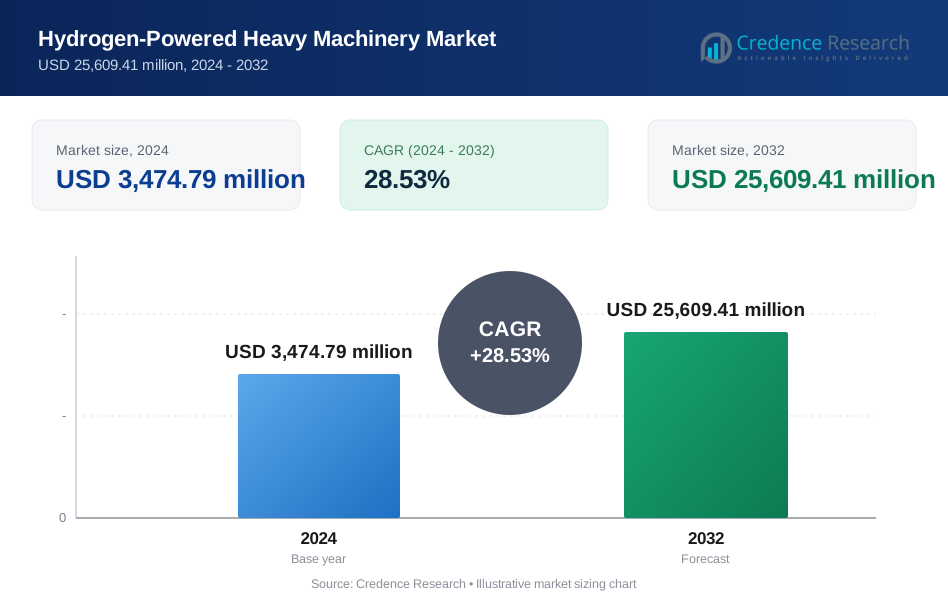
The Hydrogen-Powered Heavy Machinery Market size was valued at USD 1,540.00 million in 2018 to USD 3,474.79 million in 2024 and is anticipated to reach USD 25,609.41 million by 2032, at a CAGR of 28.53% during the forecast period.
| REPORT ATTRIBUTE | DETAILS |
|---|---|
| Historical Period | 2020-2023 |
| Base Year | 2024 |
| Forecast Period | 2025-2032 |
| Hydrogen-Powered Heavy Machinery Market Size 2024 | USD 3,474.79 Million |
| Hydrogen-Powered Heavy Machinery Market, CAGR | 28.53% |
| Hydrogen-Powered Heavy Machinery Market Size 2032 | USD 25,609.41 Million |
Growing industrial decarbonization and stricter emission policies accelerate adoption of hydrogen-driven heavy machinery. Construction, mining, and logistics operators prioritize zero-emission systems to replace diesel-powered fleets. Equipment manufacturers introduce hydrogen fuel-cell engines for large excavators, loaders, and haul trucks. Rising hydrogen production and refueling infrastructure investments support deployment across industrial zones. Collaboration between OEMs and hydrogen producers boosts market scalability and cost efficiency. These developments strengthen demand across industries seeking sustainable performance solutions.
Europe leads the global market due to strong regulatory incentives and robust hydrogen infrastructure. North America follows with rapid investment in heavy-duty hydrogen trials across construction and mining sectors. Asia Pacific emerges as the fastest-growing region, driven by large-scale hydrogen programs in China, Japan, and South Korea. Latin America and the Middle East show rising potential from industrial diversification and clean energy targets. Africa advances gradually with mining-led hydrogen initiatives. Each region progresses at a distinct pace based on technology maturity and policy support.
Market Insights:
- The Hydrogen-Powered Heavy Machinery Market was valued at USD 1,540.00 million in 2018, reached USD 3,474.79 million in 2024, and is projected to attain USD 25,609.41 million by 2032, growing at a CAGR of 28.53%.
- Europe leads with about 29% market share, driven by strict emission laws, strong hydrogen infrastructure, and large-scale equipment electrification programs.
- Asia Pacific follows with roughly 31% share and the fastest growth, supported by industrial expansion, government hydrogen policies, and active OEM participation across China, Japan, and South Korea.
- North America holds close to 19% share, benefiting from advanced hydrogen mobility trials and fleet conversion programs in construction and mining sectors.
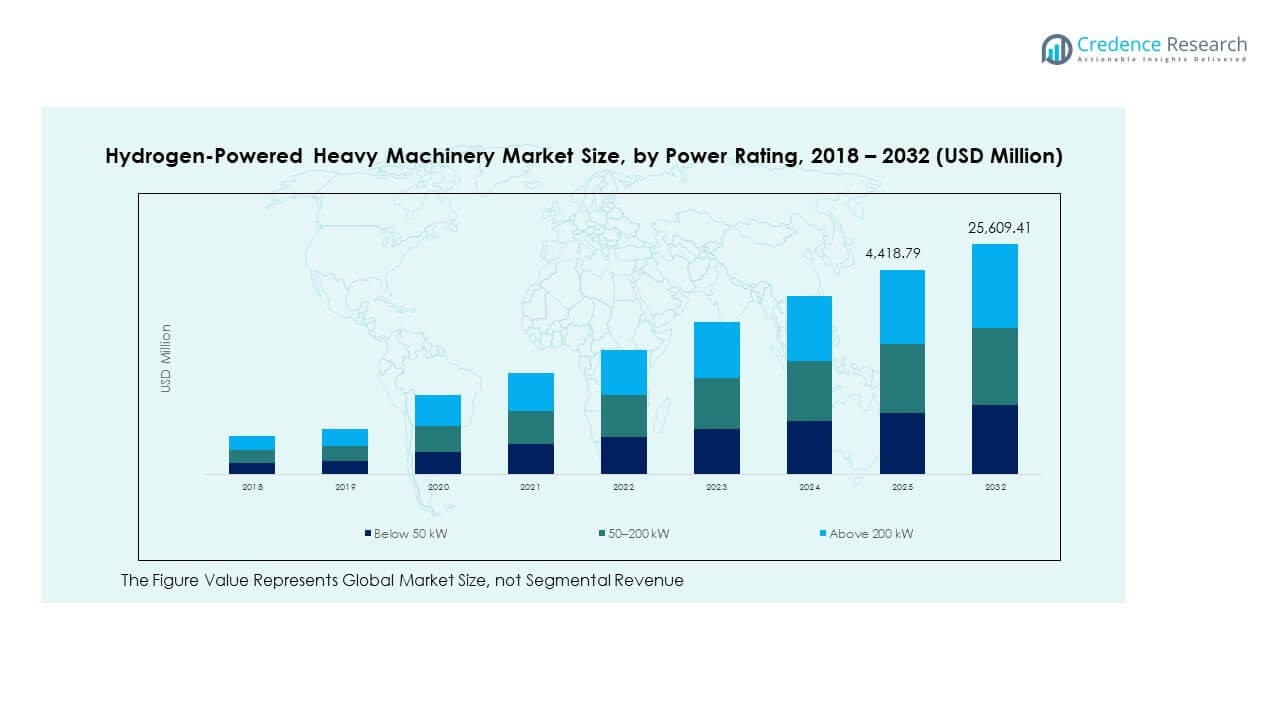
- Segment-wise, the 50–200 kW range dominates with over 45% share due to broad application across excavators and loaders, while systems above 200 kW account for about 35%, serving high-torque mining and infrastructure equipment.
Market Drivers
Rising Global Decarbonization Targets Accelerate Hydrogen Machinery Deployment
Growing environmental commitments across industries push rapid adoption of clean energy solutions. Construction, mining, and logistics sectors transition toward hydrogen power to cut diesel dependence. The Hydrogen-Powered Heavy Machinery Market gains momentum from national hydrogen strategies and industrial emission regulations. Governments in Europe, Japan, and the U.S. encourage green transition through direct funding and tax incentives. Companies invest in hydrogen-ready excavators, cranes, and loaders to meet sustainability goals. Equipment manufacturers integrate fuel cell modules that match diesel torque performance. Rising focus on operational efficiency enhances interest in hydrogen-powered fleets. It benefits from stronger collaboration between technology providers and heavy-equipment OEMs.
- For instance, Hyundai Construction Equipment’s HW155H hydrogen fuel cell excavator is an authentic 15-ton prototype showcased at Bauma 2025. It matches the performance of comparable diesel models and operates on a 70–100 kW fuel cell system, confirming Hyundai’s progress toward zero-emission construction machinery.
Expanding Hydrogen Infrastructure Network Boosts Equipment Feasibility
Development of hydrogen refueling and production networks strengthens heavy-machinery adoption. Countries expand refueling corridors along industrial zones and logistics routes. Growth in green hydrogen production using renewable energy supports steady fuel supply. The Hydrogen-Powered Heavy Machinery Market grows as producers ensure scalable hydrogen access for end users. Equipment uptime improves with high-capacity refueling systems and mobile hydrogen stations. Contractors and fleet operators invest in hydrogen storage solutions for remote construction sites. Hydrogen consortiums form to standardize fueling systems across regions. It benefits from long-term infrastructure investments that reduce range anxiety in heavy-duty operations.
Technological Integration Enhances Operational Efficiency and Reliability
Fuel cell system innovations deliver higher energy density and faster refueling rates. Companies advance hybrid hydrogen-electric powertrains for better load management. Integration of IoT and predictive maintenance tools improves asset reliability and life cycle performance. The Hydrogen-Powered Heavy Machinery Market expands with new telematics-enabled machinery platforms. Automation features enhance energy optimization and route planning for large equipment. Firms develop digital twins to test fuel cell configurations under variable working loads. Energy management software reduces downtime and increases uptime during demanding cycles. It gains support from R&D partnerships focused on real-world performance validation.
- For instance, Ballard Power Systems’ FCgen®-LCS fuel cell stack delivers up to 90 kW of net power with high volumetric power density and freeze-start capability down to –30 °C. The FCmove®-XD module is a 120 kW system that can be scaled to 240 kW or 360 kW by combining multiple units, supporting heavy-duty vehicles and industrial machinery with strong durability and performance.
Government Support and Policy Alignment Strengthen Market Expansion
Public investment drives large-scale pilot projects across mining, port, and construction sectors. Governments align hydrogen policies with net-zero targets, ensuring long-term stability for investors. The Hydrogen-Powered Heavy Machinery Market benefits from zero-emission mandates in industrial operations. Incentives for fuel cell innovation accelerate OEM adoption rates. Policy reforms promote green procurement and low-emission machinery standards. Export credit agencies support global deployment of hydrogen-powered construction fleets. Industry alliances collaborate on certification programs to ensure equipment safety and interoperability. It receives consistent policy backing that fosters broader market acceptance.
Market Trends
Surge in Heavy Equipment Electrification Transition Toward Hydrogen-Based Systems
Industrial operators migrate from diesel engines to zero-emission hydrogen platforms. Demand for electric alternatives stimulates integration of fuel cell modules in heavy-duty applications. The Hydrogen-Powered Heavy Machinery Market evolves through advanced electrification strategies focused on power density. Hybrid systems combining batteries and fuel cells improve overall energy efficiency. Equipment brands redesign chassis to accommodate hydrogen tanks and balance weight distribution. Port and mining operators prefer hydrogen systems for extended operation cycles. Fast refueling capabilities offer an edge over battery-only models. It reflects a growing shift in heavy industries toward hybrid-electric configurations.
- For instance, Kobelco Construction Machinery developed a mid-size hydrogen fuel cell electric excavator prototype in March 2023, equipped with Toyota’s fuel cell unit and hydrogen tank. Operational tests confirmed that it performs essential excavation and loading tasks under real-world conditions, demonstrating performance comparable to diesel-powered excavators.
Collaborative R&D Ecosystems Drive Fuel Cell System Innovation
Industry partnerships accelerate innovation in hydrogen engine technology and fuel cell stacks. Research centers and OEMs co-develop power systems for excavators, forklifts, and mining trucks. The Hydrogen-Powered Heavy Machinery Market advances with improved durability and high-output performance. Companies pursue shared testing environments to validate performance in rugged conditions. Joint ventures target lower fuel cell cost through scalable component manufacturing. Research on lightweight storage materials boosts machinery efficiency. Patent filings rise in fuel cell architecture and integration systems. It gains innovation momentum through joint technical and financial frameworks.
Shift Toward Modular and Scalable Hydrogen Equipment Platforms
Manufacturers design modular platforms for flexible deployment across machinery types. Scalable hydrogen systems reduce customization costs and simplify retrofitting of existing fleets. The Hydrogen-Powered Heavy Machinery Market strengthens with modular components supporting different load classes. Flexible configurations allow shared technology use across excavators, bulldozers, and haul trucks. OEMs standardize hydrogen storage units and control systems to streamline production. Modular designs help smaller firms adopt hydrogen power without redesigning entire models. Industry players implement scalable powertrain kits adaptable to various industries. It improves cost efficiency and accelerates commercialization cycles.
- For instance, Liebherr’s L566 H hydrogen-powered wheel loader is a fully functional prototype equipped with a modified combustion engine operating on hydrogen and standardized storage modules. The machine was publicly demonstrated in 2024 as the first large wheel loader of its kind, showcasing practical application of hydrogen technology in heavy machinery.
Integration of Smart Analytics and Remote Fleet Management Solutions
Smart sensors track hydrogen consumption, equipment efficiency, and real-time emissions data. IoT integration supports predictive diagnostics and proactive maintenance schedules. The Hydrogen-Powered Heavy Machinery Market benefits from digital monitoring of field operations. Cloud-based analytics optimize fuel usage and operating cycles. Fleet operators use performance data to plan refueling routes and minimize idle hours. AI-driven analytics predict component wear and guide replacement timelines. Automation ensures higher reliability across heavy machinery fleets. It enhances operational intelligence and supports sustainability reporting frameworks.
Market Challenges Analysis
High Production Costs and Limited Hydrogen Supply Infrastructure
Fuel cell manufacturing remains expensive due to scarce platinum and complex designs. Hydrogen storage and transport infrastructure are underdeveloped across several industrial hubs. The Hydrogen-Powered Heavy Machinery Market faces constraints from uneven hydrogen availability and cost fluctuations. Heavy-equipment operators encounter challenges establishing on-site refueling systems in remote regions. Capital expenses for hydrogen production plants remain significant, limiting small-scale adoption. Supply chain dependencies slow large-scale rollout of heavy-duty fuel systems. Market participants struggle with balancing cost recovery and green transition objectives. It continues to face pricing pressure from conventional diesel alternatives.
Technical Complexity and Equipment Adaptation Limitations
Hydrogen powertrains demand specialized engineering for safety, vibration resistance, and temperature stability. Integrating large hydrogen tanks affects equipment weight and structural design. The Hydrogen-Powered Heavy Machinery Market encounters limitations in adapting legacy machinery. Certification and safety protocols remain fragmented across regional standards. Limited workforce training and maintenance expertise reduce adoption speed. Hydrogen fuel handling requires high-pressure safety systems that raise operational costs. Standardization gaps hinder interoperability among suppliers and refueling partners. It requires ongoing technical alignment between OEMs and fuel cell developers.
Market Opportunities
Rising Industrial Investments in Green Hydrogen Infrastructure and Equipment Modernization
Large-scale industrial zones invest in hydrogen production to power next-generation machinery. Public-private partnerships fund clean energy projects that include heavy-equipment modernization. The Hydrogen-Powered Heavy Machinery Market benefits from industrial decarbonization programs worldwide. Governments support fleet conversions through grants and preferential loans. Mining and logistics companies explore hydrogen adoption to meet internal sustainability goals. The construction sector shows growing readiness to replace diesel-powered fleets. OEMs expand pilot programs to validate cost performance under real-world conditions. It aligns with strong demand for renewable hydrogen ecosystems.
Expansion in Emerging Markets and Cross-Sector Hydrogen Collaboration
Developing economies in Asia-Pacific, Latin America, and the Middle East see strong growth potential. Regional hydrogen projects stimulate machinery imports and local assembly initiatives. The Hydrogen-Powered Heavy Machinery Market gains from technology transfer and regional partnerships. Collaborations among energy firms, logistics providers, and construction players strengthen integration paths. International funding supports demonstration projects across ports and mining hubs. Governments streamline policies to attract hydrogen technology investors. It creates growth opportunities in markets adopting early hydrogen frameworks.
Market Segmentation Analysis:
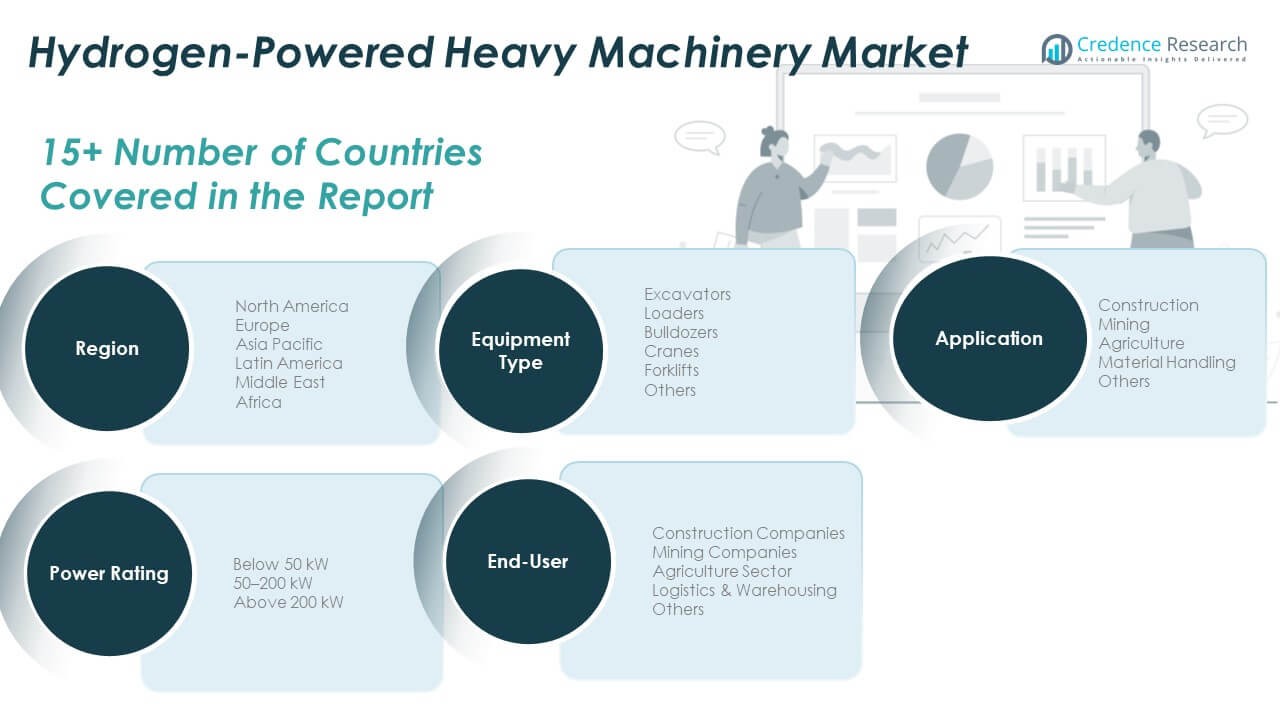
The Hydrogen-Powered Heavy Machinery Market shows balanced growth across equipment, application, end-user, and power rating segments.
By equipment type, excavators lead due to their early adoption in construction and mining operations, supported by strong OEM partnerships and high torque efficiency. Loaders and bulldozers follow, benefiting from improved fuel cell integration and operational reliability in heavy-duty environments. Cranes and forklifts gain steady momentum in logistics and warehousing, supported by faster refueling and cleaner power solutions.
- For example, JCB’s 220X hydrogen fuel cell excavator prototype, undergoing over 12 months of testing, has shown practical zero-emission operation and competitive performance against diesel equivalents, marking it as the first such product globally unveiled by a construction equipment manufacturer.
By application, construction dominates due to global infrastructure expansion and demand for low-emission machinery. Mining follows closely with the deployment of hydrogen-powered haul trucks and drilling units. Agriculture and material handling adopt these systems for long-hour performance and fuel independence.
By end-user analysis highlights construction and mining companies as primary adopters, while logistics and warehousing sectors expand adoption for equipment used in closed industrial zones.
- For example, Hyundai’s XCIENT Fuel Cell heavy-duty truck has accumulated nearly 10 million operational miles globally, demonstrating endurance and viability vital to these sectors.
By power rating, machines between 50–200 kW represent the most active category, aligning with mid-size excavators and loaders. Equipment above 200 kW serves heavy mining and infrastructure projects that require higher torque. Below 50 kW systems cater to compact machinery such as forklifts and small agricultural vehicles. It demonstrates growing demand across all classes, driven by emissions control regulations and the operational advantages of hydrogen-based systems.
Segmentation:
By Equipment Type
- Excavators
- Loaders
- Bulldozers
- Cranes
- Forklifts
- Others
By Application
- Construction
- Mining
- Agriculture
- Material Handling
- Others
By End-User
- Construction Companies
- Mining Companies
- Agriculture Sector
- Logistics & Warehousing
- Others
By Power Rating
- Below 50 kW
- 50 – 200 kW
- Above 200 kW
By Region
- North America
- U.S.
- Canada
- Mexico
- Europe
- Germany
- France
- U.K.
- Italy
- Spain
- Rest of Europe
- Asia Pacific
- China
- Japan
- India
- South Korea
- South-east Asia
- Rest of Asia Pacific
- Latin America
- Brazil
- Argentina
- Rest of Latin America
- Middle East & Africa
- GCC Countries
- South Africa
- Rest of the Middle East and Africa
Regional Analysis:
North America
The North America Hydrogen-Powered Heavy Machinery Market size was valued at USD 394.24 million in 2018 to USD 874.24 million in 2024 and is anticipated to reach USD 6,430.57 million by 2032, at a CAGR of 28.5% during the forecast period. North America holds around 19% share of the global market. The region benefits from strong decarbonization mandates and advanced hydrogen infrastructure development in the United States and Canada. Construction and mining sectors actively test hydrogen-powered excavators and loaders for large-scale operations. Federal programs and public-private funding enhance regional fuel cell adoption. Equipment manufacturers collaborate with technology providers to develop efficient hydrogen drive systems. The U.S. leads through projects that integrate renewable hydrogen into industrial fleets. It gains further momentum from early fleet conversion pilots and strong policy alignment.
Europe
The Europe Hydrogen-Powered Heavy Machinery Market size was valued at USD 624.62 million in 2018 to USD 1,373.84 million in 2024 and is anticipated to reach USD 9,766.22 million by 2032, at a CAGR of 28.0% during the forecast period. Europe accounts for nearly 29% of the global share. The region leads in hydrogen technology innovation, supported by strong funding through the European Green Deal. Germany, France, and the U.K. adopt fuel cell machinery for sustainable infrastructure programs. The region’s strict emission standards accelerate replacement of diesel-based equipment. Hydrogen consortiums build production and refueling corridors to support industrial zones. OEMs test hydrogen forklifts and cranes across construction and logistics sectors. Regional governments incentivize heavy-equipment conversions through green finance programs. It continues to benefit from coordinated regional policy and industrial collaboration.
Asia Pacific
The Asia Pacific Hydrogen-Powered Heavy Machinery Market size was valued at USD 361.59 million in 2018 to USD 853.57 million in 2024 and is anticipated to reach USD 6,968.34 million by 2032, at a CAGR of 30.2% during the forecast period. Asia Pacific commands nearly 31% of the global market share. Rapid industrialization and large construction activity in China, Japan, South Korea, and India fuel demand for zero-emission machinery. Governments invest heavily in hydrogen production hubs and infrastructure corridors. Regional OEMs launch pilot programs for hydrogen-powered bulldozers and cranes. Mining operators in Australia and Indonesia explore hydrogen fleets for long-distance hauling. The region benefits from local fuel cell manufacturing capabilities and technology transfer agreements. Public investments in renewable hydrogen production expand market readiness. It remains the fastest-growing regional hub for hydrogen-based machinery deployment.
Latin America
The Latin America Hydrogen-Powered Heavy Machinery Market size was valued at USD 97.02 million in 2018 to USD 216.79 million in 2024 and is anticipated to reach USD 1,482.02 million by 2032, at a CAGR of 27.4% during the forecast period. Latin America holds about 7% share of the global market. Brazil and Chile lead hydrogen pilot projects within the mining and energy sectors. Regional infrastructure development supports gradual adoption of hydrogen-powered construction equipment. Mining companies test fuel cell-based haul trucks in resource-rich zones. Governments introduce clean energy roadmaps to attract hydrogen investments. Equipment suppliers form partnerships with international OEMs to localize technology production. Renewable energy abundance strengthens green hydrogen generation potential. It benefits from early-stage hydrogen initiatives backed by global energy corporations.
Middle East
The Middle East Hydrogen-Powered Heavy Machinery Market size was valued at USD 36.34 million in 2018 to USD 73.64 million in 2024 and is anticipated to reach USD 453.43 million by 2032, at a CAGR of 25.7% during the forecast period. The region represents around 4% of the global market share. Hydrogen development initiatives align with national diversification strategies in Saudi Arabia and the UAE. Construction and logistics projects within smart cities explore hydrogen-powered forklifts and cranes. Government-led megaprojects create steady demand for clean industrial equipment. Port authorities integrate hydrogen solutions for material handling operations. The region attracts foreign partnerships to accelerate hydrogen value chain integration. Local manufacturing zones support pilot assembly for heavy machinery units. It gains attention as a potential export base for green hydrogen technologies.
Africa
The Africa Hydrogen-Powered Heavy Machinery Market size was valued at USD 26.18 million in 2018 to USD 82.71 million in 2024 and is anticipated to reach USD 508.84 million by 2032, at a CAGR of 25.0% during the forecast period. Africa contributes nearly 3% to the global market share. South Africa and Egypt lead regional adoption supported by renewable energy expansion. Mining and construction industries drive interest in hydrogen-powered machinery to cut fuel costs. Governments partner with global agencies to build green hydrogen plants near resource centers. OEMs conduct pilot projects in mining belts to validate machinery endurance. Local assemblers explore adaptation of mid-power equipment to regional needs. Hydrogen clusters emerge near industrial ports with export potential. It progresses gradually with external investment and technology transfer initiatives.
Key Player Analysis:
- Ballard Power Systems
- Cummins Inc.
- Plug Power Inc.
- Nikola Corporation
- Toyota Motor Corporation
- Hyundai Motor Company
- JCB (J.C. Bamford Excavators Limited)
- Caterpillar Inc.
- Komatsu Ltd.
- Doosan Mobility Innovation
- Liebherr Group
- Hyzon Motors
- SANY Group
- Bosch Rexroth AG
- Siemens AG
- Hyster-Yale Group
- Alstom SA
- Anglo American plc
- Mitsubishi Heavy Industries Ltd.
Competitive Analysis:
The Hydrogen‑Powered Heavy Machinery Market exhibits intense competition among heavy-equipment manufacturers, fuel-cell innovators and integrated system providers. Leading OEMs such as Caterpillar Inc., Komatsu Ltd. and SANY Group invest significantly in hydrogen-drive development and fleet pilot projects. Fuel-cell specialists like Ballard Power Systems strengthen their position through partnerships and licensing deals with equipment makers. Some firms expand via regional manufacturing expansions and strategic alliances to secure global footprint. It prioritises cost reduction, durability and service-network strength as key competitive levers. Entry barriers remain high due to capital intensity, infrastructure needs and regulatory compliance. Companies that scale hydrogen systems effectively gain early-mover advantage in fleet-conversion deals.
Recent Developments:
- In October 2025, Hyundai Motor Company and PlusAI, Inc. were recognized by TIME for their autonomous hydrogen fuel-cell heavy-duty truck, marking a milestone for hydrogen-powered heavy vehicle systems that may influence heavy-machinery applications.
- In May 2025, Adani Enterprises flagged off India’s first hydrogen fuel-cell truck for coal-haul operations, signalling early adoption of hydrogen heavy-machinery in mining logistics.
- In January 2025, JCB (J.C. Bamford Excavators Limited) formed a joint venture named HyKit with HYCAP and HydraB Group to develop mobile hydrogen refuelling, storage and distribution infrastructure tailored for hydrogen-powered heavy machinery.
Report Coverage:
The research report offers an in-depth analysis based on equipment, application, end-user, and power rating segments. It details leading market players, providing an overview of their business, product offerings, investments, revenue streams, and key applications. Additionally, the report includes insights into the competitive environment, SWOT analysis, current market trends, as well as the primary drivers and constraints. Furthermore, it discusses various factors that have driven market expansion in recent years. The report also explores market dynamics, regulatory scenarios, and technological advancements that are shaping the industry. It assesses the impact of external factors and global economic changes on market growth. Lastly, it provides strategic recommendations for new entrants and established companies to navigate the complexities of the market.
Future Outlook:
- The Hydrogen-Powered Heavy Machinery Market will advance with stronger policy mandates supporting zero-emission operations across construction and mining sectors.
- Fuel cell efficiency and modular integration will improve, driving broader adoption in heavy-duty machinery.
- OEM partnerships with hydrogen producers will expand to secure consistent energy supply and scalable refueling networks.
- Cost optimization through mass production and supply chain localization will enhance commercial viability.
- Technological innovations in hybrid powertrains will boost torque performance and operational reliability.
- Digital monitoring tools and IoT integration will enhance maintenance planning and fleet optimization.
- Regional collaborations between governments and private sectors will accelerate infrastructure development.
- Hydrogen storage advancements will enable longer operational cycles for large machinery.
- Competitive differentiation will depend on OEM innovation speed and aftersales support strength.
- It will emerge as a central enabler of sustainable industrial transformation through low-emission equipment deployment.
Request a Free Sample
Fill in your details and we'll send you a free sample report.
- Sample data tables & charts
- Research methodology
Need a Custom Version of This Report?
Tailor the scope, geography, or segments to your exact requirements.
- Custom geography or segment scope
- Direct access to our analyst team
Frequently Asked Questions
What is the current market size for the Hydrogen-Powered Heavy Machinery Market, and what is its projected size in 2032?
At what Compound Annual Growth Rate is the Hydrogen-Powered Heavy Machinery Market projected to grow between 2024 and 2032?
Which Hydrogen-Powered Heavy Machinery Market segment held the largest share in 2024?
What are the primary factors fueling the growth of the Hydrogen-Powered Heavy Machinery Market?
Who are the leading companies in the Hydrogen-Powered Heavy Machinery Market?
Which region commanded the largest share of the Hydrogen-Powered Heavy Machinery Market in 2024?
Table of Content
Chapter 1. Report Introduction
- 1.1 Report Description & Purpose
- 1.1.1 Report Title & Market Definition
- 1.1.2 Unique Selling Propositions (USP) & Key Differentiators
- 1.1.3 Value Proposition for Stakeholders
- 1.2 Research Objectives
- 1.2.1 Market Sizing Objectives (Volume & Revenue)
- 1.2.2 Segmentation Objectives
- 1.2.3 Competitive Intelligence Objectives
- 1.2.4 Forecast & Scenario Objectives
- 1.3 Report Scope
- 1.3.1 Hydrogen-Powered Heavy Machinery Scope – Types & Subtypes Covered
- 1.3.2 Geographic Scope – Regions & Countries Covered
- 1.3.3 Historical Period, Base Year & Forecast Period (2024; forecast to 2032)
- 1.3.4 Inclusions & Exclusions
- 1.4 HS Code & Classification Framework
- 1.5 Currency, Units & Pricing Basis
- 1.6 Target Stakeholders
- 1.7 Limitations & Assumptions
Chapter 2. Executive Summary
- 2.1 Global Hydrogen-Powered Heavy Machinery Market Snapshot
- 2.1.1 Market Size – Historical (2024) & Forecast (2024-2032) (2024: USD 3,474.79 million → 2032: USD 25,609.41 million)
- 2.1.2 Volume & Revenue – Global Totals
- 2.1.3 Key Market Highlights – Top Five Facts
- 2.2 Hydrogen-Powered Heavy Machinery Market Segmentation Snapshot
- 2.2.1 Market Split by Region – 2024 vs. 2032
- 2.3 Competitive Snapshot
- 2.3.1 Top 10 Players by Revenue Share – 2024
- 2.3.2 Top 10 Players by Volume Share – 2024
- 2.3.3 Recent Strategic Developments (18-Month Summary)
- 2.4 Key Investment Highlights & Strategic Conclusions
Chapter 3. Hydrogen-Powered Heavy Machinery Market Dynamics & Industry Analysis
- 3.1 Market Overview & Context
- 3.1.1 Hydrogen-Powered Heavy Machinery Market Position in the Broader Automotive Value Chain
- 3.1.2 OEM vs. Replacement Market Dynamics
- 3.1.3 Market Maturity & Development Stage by Region
- 3.2 Hydrogen-Powered Heavy Machinery Market Drivers
- 3.3 Hydrogen-Powered Heavy Machinery Market Restraints & Challenges
- 3.4 Hydrogen-Powered Heavy Machinery Market Opportunities
- 3.5 Porter's Five Forces Analysis
- 3.5.1 Threat of New Entrants
- 3.5.2 Bargaining Power of Suppliers
- 3.5.3 Bargaining Power of Buyers
- 3.5.4 Threat of Substitutes
- 3.5.5 Competitive Rivalry – Intensity Assessment
- 3.6 Hydrogen-Powered Heavy Machinery Value Chain Analysis
- 3.6.1 Upstream – Raw Material/Input Suppliers
- 3.6.1.1 Raw Material/Input 1
- 3.6.1.2 Raw Material/Input 2
- 3.6.1.3 Raw Material/Input 3
- 3.6.2 Midstream – Production/Manufacturing/Service Delivery
- 3.6.2.1 Production/Process Overview
- 3.6.2.2 Key Facility Locations & Capacity by Manufacturer
- 3.6.3 Downstream – Distribution & End Consumer
- 3.6.3.1 Primary Channel – B2B/OEM
- 3.6.3.2 Secondary Channels – Dealer, Retail, Online, Direct
- 3.6.4 Value Chain Profitability Analysis
- 3.6.1 Upstream – Raw Material/Input Suppliers
- 3.7 PESTEL Analysis
- 3.7.1 Political Factors
- 3.7.2 Economic Factors
- 3.7.3 Social Factors
- 3.7.4 Technological Factors
- 3.7.5 Environmental Factors
- 3.7.6 Legal Factors
- 3.8 Hydrogen-Powered Heavy Machinery Supply Chain Analysis
- 3.8.1 Raw Material/Input Supply Risk Assessment
- 3.8.2 Manufacturing Concentration Risk (Geographic Exposure)
- 3.8.3 Trade Disruption Impact Analysis
- 3.9 Regulatory & Policy Landscape
Note: The regulatory and policy landscape section covers regulations based on their applicability to the market, Hydrogen-Powered Heavy Machinery category, geography, and scope of the study. Only regulatory frameworks with a material impact on operations, compliance, trade, sustainability, or market access are analyzed in detail.
Chapter 4. Key Investment Pockets & Opportunity Analysis
- 4.1 Hydrogen-Powered Heavy Machinery Market Attractiveness Analysis
- 4.1.1 By Region – Investment Attractiveness Matrix (Volume × CAGR)
- 4.2 Absolute Revenue Growth Opportunity
- 4.2.1 By Region – Absolute USD Growth Through 2032
- 4.3 Incremental Volume Opportunity
- 4.3.1 By Region – Incremental Volume Through 2032
- 4.3.2 Segment – Incremental Volume
- 4.4 Emerging Submarket Opportunity Deep Dive (Subject to Applicability)
- 4.5 Emerging Market Opportunity Scorecards
- 4.5.1 United States
- 4.5.2 Europe
- 4.5.3 Asia
- 4.5.4 Middle East & Africa
Note: Emerging Market Opportunity Scorecards will be included based on relevance and strategic importance. Regions listed are indicative and may vary depending on data availability and market dynamics.
Chapter 5. Hydrogen-Powered Heavy Machinery Import-Export Analysis & Trade Flows
- 5.1 Global Trade Overview
- 5.1.1 Global Export Value by Country (2024)
- 5.1.2 Global Export Volume by Country (2024)
- 5.1.3 Global Import Value by Country (2024)
- 5.1.4 Global Import Volume by Country (2024)
- 5.1.5 Net Trade Balance by Country (2024)
- 5.2 Export Analysis – Segment
- 5.2.1 Type 1 (HS Code)
- 5.2.2 Type 2 (HS Code)
- 5.2.3 Type 3 (HS Code)
- 5.2.4 Type 4 (HS Code)
- 5.2.5 Type 5 (HS Code)
- 5.3 Import Analysis – Segment
- 5.3.1 Type 1 (HS Code)
- 5.3.2 Type 2 (HS Code)
- 5.3.3 Type 3 (HS Code)
- 5.3.4 Type 4 (HS Code)
- 5.3.5 Type 5 (HS Code)
- 5.4 Average Unit Trade Prices
- 5.4.1 Average Export Price – Segment & Country
- 5.4.2 Average Import Price – Segment & Source Country
- 5.4.3 Price Trends (2024)
- 5.5 Key Trade Route Analysis
- 5.5.1 Trade Route 1
- 5.5.2 Trade Route 2
- 5.5.3 Trade Route 3
- 5.5.4 Trade Route 4
- 5.5.5 Trade Route 5
- 5.6 Trade Policy Impact Assessment
- 5.6.1 US Anti-Dumping & Section 301 Tariffs
- 5.6.2 EU Customs Union Impact
- 5.6.3 Major Free Trade Agreements
- 5.6.4 USMCA Rules of Origin
Note: Trade policy analysis will be included only where relevant to the Hydrogen-Powered Heavy Machinery market.
Chapter 6. Competitive Landscape & Company Benchmarking
- 6.1 Hydrogen-Powered Heavy Machinery Market Concentration & Structure
- 6.1.1 Herfindahl-Hirschman Index (HHI) – vs. 2024
- 6.1.2 Tier 1, Tier 2 & Tier 3 Market Structure
- 6.1.3 Global, Regional & Local Player Dynamics
- 6.2 Hydrogen-Powered Heavy Machinery Market Share Analysis – 2024
- 6.2.1 Global Revenue Share by Company
- 6.2.2 Global Volume Share by Company
- 6.2.3 Regional Revenue Share
- 6.2.4 Market Share Evolution ( vs. 2024)
- 6.2.5 OEM Segment Share by Company
- 6.2.6 Replacement Segment Share by Company
- 6.3 Production/Delivery Capacity & Facility Analysis
- 6.3.1 Global Installed Capacity
- 6.3.2 Capacity Utilization Rates
- 6.3.3 Production/Output Volume
- 6.3.4 Facility Locations & Capacity Map
- 6.3.5 Planned Capacity Additions
- 6.4 Hydrogen-Powered Heavy Machinery Competitive Benchmarking Matrix
- 6.4.1 Revenue, Volume, CAGR & Profitability Comparison
- 6.4.2 Channel Revenue Mix
- 6.4.3 Geographic Revenue Exposure
- 6.4.4 R&D Intensity
- 6.4.5 Sustainability Maturity
- 6.5 Strategic Developments in Hydrogen-Powered Heavy Machinery (Last 24 Months)
- 6.5.1 Mergers, Acquisitions & Divestments
- 6.5.2 New Hydrogen-Powered Heavy Machinery Launches
- 6.5.3 Facility Expansions
- 6.5.4 Strategic Alliances, Joint Ventures & Partnerships
- 6.5.5 Distribution Expansion & Market Entry
- 6.5.6 Sustainability & ESG Initiatives
- 6.6 Competitive Strategy Mapping
- 6.6.1 Leader, Challenger, Follower & Niche Classification
- 6.6.2 Pricing Strategy Comparison
- 6.6.3 Channel Strategy Matrix
Note: Strategic developments are included based on their materiality and the availability of reliable information.
Chapter 7. Global Hydrogen-Powered Heavy Machinery Market – By Distribution Channel
- 7.1 Segment Overview
- 7.1.1 Volume & Revenue Split by Channel (2024 & 2032)
- 7.1.2 Channel Mix Evolution (2024-2032)
Chapter 8. Regional Market Analysis – Global Overview
- 8.1 Global Regional Overview
- 8.1.1 Regional Volume Share
- 8.1.2 Regional Revenue Share
- 8.1.3 Regional Volume by Region
- 8.1.4 Regional Revenue by Region
- 8.1.5 Regional Forecast Through 2032
- 8.2 Cross-Regional Segment Analysis
- 8.2.1 By Distribution Channel
- 8.2.2 By Brand/Price Tier
Chapter 9. North America Hydrogen-Powered Heavy Machinery Market
- 9.1 United States
- 9.2 Canada
- 9.3 Mexico
Chapter 10. Europe Hydrogen-Powered Heavy Machinery Market
- 10.1 Germany
- 10.2 France
- 10.3 Italy
- 10.4 United Kingdom
- 10.5 Spain
- 10.6 Poland
- 10.7 Russia
- 10.8 Netherlands
- 10.9 Belgium
- 10.10 Sweden
- 10.11 Denmark
- 10.12 Norway
- 10.13 Rest of Europe
Chapter 11. Asia Pacific Hydrogen-Powered Heavy Machinery Market
- 11.1 China
- 11.2 India
- 11.3 Japan
- 11.4 South Korea
- 11.5 Thailand
- 11.6 Indonesia
- 11.7 Vietnam
- 11.8 Malaysia
- 11.9 Australia
- 11.10 Rest of Asia Pacific
Chapter 12. Latin America Hydrogen-Powered Heavy Machinery Market
- 12.1 Brazil
- 12.2 Argentina
- 12.3 Colombia
- 12.4 Chile
- 12.5 Rest of Latin America
Chapter 13. Middle East Hydrogen-Powered Heavy Machinery Market
- 13.1 Saudi Arabia
- 13.2 United Arab Emirates
- 13.3 Turkey
- 13.4 Israel
- 13.5 Iran
- 13.6 Rest of the Middle East
Chapter 14. Africa Hydrogen-Powered Heavy Machinery Market
- 14.1 South Africa
- 14.2 Egypt
- 14.3 Nigeria
- 14.4 Morocco
- 14.5 Rest of Africa
Chapter 15. Hydrogen-Powered Heavy Machinery Company Profiles
- 15.1 [Company 01]
- 15.1.1 Company Overview
- 15.1.2 Key Management Personnel
- 15.1.3 Products & Services Portfolio
- 15.1.4 Financial Performance
- 15.1.5 Key Market Focus & Geographic Presence
- 15.1.6 Recent Developments & Strategic Initiatives
Note: The company profile list is preliminary and may change based on research findings, market developments, data availability, and client requirements.
Chapter 16. Appendices
- Appendix A – List of Abbreviations & Acronyms
- Appendix B – Industry Classification Code Reference – Full Series
- Appendix C – Production & Capacity Data Tables
- Appendix D – End-Use & Demand Base Tables
- Appendix E – Consumption & Replacement Rate Assumptions
- Appendix F – ASP Reference Tables
- Appendix G – Manufacturing & Facility Database
- Appendix H – Import-Export Data Tables
- Appendix I – Regulatory Summary Tables
- Appendix J – Primary Research Participant List (Anonymized)
- Appendix K – Primary Research Questionnaire Framework
- Appendix L – Data Sources & Bibliography
- Appendix M – Market Size Divergence & Source Comparison
Chapter 17. Research Methodology
- 17.1 Research Framework & Philosophy
- 17.2 Secondary Research – Sources, Hierarchy & Data Extraction
- 17.3 Data Modeling – Bottom-Up & Top-Down Market Sizing
- 17.4 Primary Research – Stakeholder Framework, LOI & Sample Sizes
- 17.5 Forecast Methodology – Regression, Scenario & Sensitivity Analysis
- 17.6 Quality Control – Four-Layer Validation Framework
- 17.7 Limitations & Standard Assumptions
- 17.8 Disclaimer
