
| REPORT ATTRIBUTE | DETAILS |
|---|---|
| Historical Period | 2019-2022 |
| Base Year | 2023 |
| Forecast Period | 2024-2032 |
| India Conveyor Belt Market Size 2023 | USD 2,009.07 Million |
| India Conveyor Belt Market, CAGR | 5.91% |
| India Conveyor Belt Market Size 2032 | USD 3,382.95 Million |
Market Overview
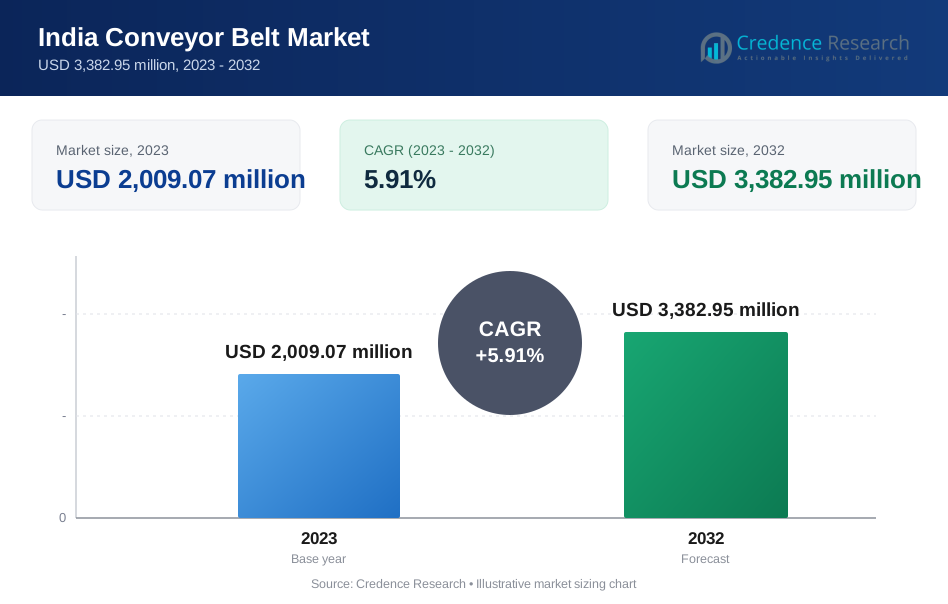
The India conveyor belt market is projected to grow from USD 2,009.07 million in 2023 to an estimated USD 3,382.95 million by 2032, with a compound annual growth rate (CAGR) of 5.91% from 2024 to 2032. This significant growth is attributed to the increasing demand for efficient material handling systems in various industries, such as mining, manufacturing, and logistics.
Key market drivers include the rapid industrialization and urbanization across India, leading to heightened infrastructure development projects. Additionally, the rising adoption of conveyor systems in the food and beverage industry, to maintain hygiene and speed up production processes, significantly contributes to market growth. Trends such as advancements in conveyor belt technologies, including the integration of IoT and automation for real-time monitoring and maintenance, are also propelling the market forward.
Geographically, the Indian market is diverse, with significant contributions from regions like Maharashtra, Tamil Nadu, and Gujarat, which are industrial hubs. Northern regions, including Delhi and Uttar Pradesh, are also experiencing increased demand due to expanding industrial activities. Prominent players in the market include Continental AG, Fenner Dunlop, and Sempertrans India Private Limited, which are continuously innovating to meet the evolving needs of various industries. These companies are focusing on strategic partnerships and technological advancements to strengthen their market presence and cater to the growing demand.
Market Drivers
Rapid Industrialization and Urbanization
India has been witnessing rapid industrialization and urbanization over the past few decades, significantly impacting the conveyor belt market. The government's push for "Make in India" and other industrial policies has led to an increase in manufacturing activities. Industries such as automotive, electronics, pharmaceuticals, and textiles are expanding, thereby increasing the demand for efficient material handling solutions. Conveyor belts play a crucial role in these industries by streamlining processes, enhancing productivity, and reducing manual labor. For instance, the production of crude steel in India stood at 118.37 MT from April-January FY24. Urbanization has also led to the development of infrastructure projects, including airports, metro stations, and large commercial complexes. These projects require the efficient movement of goods and materials, further driving the demand for conveyor belts. The growth in the e-commerce sector, which necessitates efficient warehousing and logistics solutions, also contributes significantly to the market. As cities expand and new urban centers emerge, the requirement for robust and reliable conveyor belt systems is expected to rise correspondingly.
Advancements in Conveyor Belt Technologies
Technological advancements in conveyor belt systems are a major driver of market growth. The integration of smart technologies such as the Internet of Things (IoT), artificial intelligence (AI), and machine learning (ML) into conveyor systems has revolutionized the industry. These technologies enable real-time monitoring, predictive maintenance, and enhanced control over the material handling processes. For instance, IoT sensors can monitor the wear and tear of conveyor belts and predict potential failures, thereby reducing downtime and maintenance costs. Automation is another significant trend impacting the market. Automated conveyor systems offer improved efficiency, accuracy, and speed in material handling operations. They are particularly beneficial in industries like food and beverage, pharmaceuticals, and logistics, where precision and hygiene are paramount. The adoption of automated conveyor systems is growing as companies seek to improve operational efficiency and reduce labor costs.
Growth in Mining and Mineral Processing Industries
The mining and mineral processing industries are substantial contributors to the demand for conveyor belts in India. India is rich in mineral resources, and the mining sector is a critical component of the country's economy. Conveyor belts are extensively used in mining operations for transporting ores, coal, and other materials over long distances within mines and to processing plants. For instance, the expansion of mining activities, driven by increasing demand for minerals and metals both domestically and internationally, is propelling the need for efficient conveyor systems. Moreover, the development of new mining projects and the modernization of existing ones are expected to further boost the demand for advanced conveyor belt technologies. The focus on sustainability and environmental conservation has also led to the adoption of eco-friendly conveyor belts that are energy-efficient and have a lower environmental impact.
Rising Demand in the Food and Beverage Industry
The food and beverage industry in India is growing rapidly, driven by changing consumer preferences, increasing disposable incomes, and a growing population. Conveyor belts are essential in food processing and packaging plants for the safe and hygienic handling of products. They help in maintaining the quality and integrity of food items by reducing human contact and ensuring efficient production processes. The demand for conveyor belts in this industry is also influenced by the need for compliance with stringent food safety regulations. Companies are investing in conveyor systems that are easy to clean, corrosion-resistant, and capable of operating in various environmental conditions. Additionally, the rise of the ready-to-eat and packaged food segments is contributing to the growth of the conveyor belt market, as these segments require efficient and reliable material handling solutions to meet high production volumes and ensure timely deliveries.
Market Trends
Adoption of Smart Technologies and Automation
One of the most significant trends in the India conveyor belt market is the increasing adoption of smart technologies and automation. Conveyor systems are evolving with the integration of the Internet of Things (IoT), artificial intelligence (AI), and machine learning (ML). These technologies enable real-time monitoring and predictive maintenance, allowing companies to minimize downtime and enhance operational efficiency. IoT sensors can track the wear and tear of conveyor belts, providing data that can predict potential failures and schedule maintenance activities before breakdowns occur. This proactive approach reduces maintenance costs and ensures continuous operation. Automation in conveyor belt systems is also gaining traction, especially in industries such as food and beverage, pharmaceuticals, and e-commerce. Automated conveyor belts improve speed, accuracy, and reliability in material handling processes. For instance, IoT sensors can monitor the wear and tear of conveyor belts and predict potential failures, thereby reducing downtime and maintenance costs. They reduce the dependency on manual labor, thus lowering labor costs and mitigating human error. The use of robotic arms and automated guided vehicles (AGVs) in conjunction with conveyor systems is becoming more prevalent, further optimizing the material handling process. These advancements are driving the market towards more efficient and technologically advanced solutions.
Increasing Focus on Sustainability and Eco-Friendly Solutions
Sustainability has become a critical concern across industries, and the conveyor belt market is no exception. There is a growing emphasis on developing eco-friendly and energy-efficient conveyor belt systems. Manufacturers are focusing on creating conveyor belts from recyclable and biodegradable materials to reduce their environmental impact. For instance, some manufacturers are developing PVC and TPU conveyor belts to support the recycling of larger quantities of waste. Additionally, energy-efficient motors and drives are being incorporated into conveyor systems to minimize energy consumption and reduce carbon footprints. The demand for sustainable solutions is particularly strong in industries with stringent environmental regulations, such as mining and food processing. Companies are investing in conveyor belts that not only comply with these regulations but also enhance their overall sustainability efforts. The use of renewable energy sources to power conveyor systems is another emerging trend, further contributing to the market’s green initiatives. This focus on sustainability is driving innovation and pushing manufacturers to develop advanced, eco-friendly conveyor belt solutions that meet the evolving demands of their customers.
Market Restraints and Challenges
High Initial Investment and Maintenance Costs
One of the primary restraints in the India conveyor belt market is the high initial investment required for the installation of advanced conveyor systems. While these systems offer significant long-term benefits in terms of efficiency and productivity, the upfront costs can be prohibitive for small and medium-sized enterprises (SMEs). The expense of purchasing high-quality materials, integrating advanced technologies like IoT and automation, and ensuring compliance with industry standards can deter potential buyers. Additionally, the costs associated with regular maintenance, repairs, and the need for skilled technicians to manage these systems add to the financial burden. Maintenance is particularly challenging in environments where conveyor belts are subjected to harsh conditions, such as mining and heavy manufacturing. Frequent wear and tear demand continuous monitoring and timely interventions, which can escalate operational costs. For companies operating on tight budgets, these financial constraints can limit their ability to invest in or upgrade to more efficient conveyor systems, thereby hindering market growth.
Complex Regulatory and Compliance Requirements
Navigating the complex landscape of regulatory and compliance requirements poses a significant challenge for the India conveyor belt market. Various industries that utilize conveyor belts, such as mining, food processing, and pharmaceuticals, are subject to stringent regulations regarding safety, environmental impact, and operational standards. Ensuring compliance with these regulations necessitates substantial investment in research and development, as well as frequent updates to equipment and processes. For instance, in the food and beverage industry, conveyor belts must adhere to strict hygiene standards to prevent contamination. This requires the use of specific materials and technologies, which can be costly and technically demanding. Similarly, the mining sector must comply with environmental regulations that mandate the use of eco-friendly and sustainable conveyor solutions. Meeting these regulatory requirements can be complex and time-consuming, often requiring companies to invest in specialized expertise and resources. Moreover, non-compliance can lead to severe penalties, operational disruptions, and damage to the company's reputation, making it a critical concern for market players. The constant evolution of regulatory frameworks further complicates compliance efforts, requiring companies to stay abreast of changes and adapt accordingly, which can strain their resources and impact market growth.
Market Segmentation Analysis
By Type
Crescent conveyor belts, widely used in industries requiring smooth material transportation with minimal spillage, are particularly popular in agriculture and food processing for delicate handling. Floor conveyor belts, extensively utilized in manufacturing and warehousing, ensure efficient transport of heavy and bulky items, making them indispensable in industrial settings. Overhead conveyor belts optimize floor space and are prevalent in automotive and garment industries, facilitating efficient movement of parts through production lines. Pallet conveyor belts, primarily used in logistics and warehousing, ensure seamless transport of pallets, aiding in efficient inventory management and reducing manual handling. Roller conveyor belts, versatile and capable of handling a wide range of materials, are common in distribution centers and manufacturing plants, enabling smooth movement of items through various processing stages.
By Belt Type
Heavy-weight conveyor belts, designed for high-capacity operations, are ideal for mining, construction, and heavy manufacturing industries due to their durability and strength, allowing them to transport large volumes of materials over long distances. Medium-weight conveyor belts offer a balance between durability and flexibility, making them suitable for various applications in manufacturing, packaging, and warehousing, where efficient transportation of moderate loads is necessary. Lightweight conveyor belts, known for their agility and flexibility, are popular in industries such as food processing, pharmaceuticals, and electronics, where precise and gentle handling of products is crucial.
Segments
Based on Type
- Crescent Conveyor Belts
- Floor Conveyor Belts
- Overhead Conveyor Belts
- Pallet Conveyor Belts
- Roller Conveyor Belts
Based on Belt Type
- Heavy-Weight Conveyor Belts
- Medium-Weight Conveyor Belts
- Lightweight Conveyor Belts
Based on Material
- Polymers
- Metals
Based on Installation
- Stationary Conveyor Belts
- Portable Conveyor Belts
Based on End User
- Automotive
- Retail
- Industrial
- Poultry & Dairy
- Others
Based on Region
- Northern India
- Western India
- Southern India
- Eastern India
- Central India
Regional Analysis
Northern India (20%):
Northern India, comprising states like Delhi, Uttar Pradesh, and Haryana, accounts for approximately 20% of the market share. This region is a burgeoning industrial hub, particularly in sectors such as automotive, manufacturing, and logistics. The rapid urbanization and infrastructure development, including new metro projects and expansion of industrial zones, drive the demand for conveyor belts. Additionally, the presence of numerous manufacturing units and warehouses in the National Capital Region (NCR) further fuels market growth.
Western India (30%):
Western India, particularly Maharashtra and Gujarat, holds the largest market share at around 30%. These states are pivotal industrial and economic centers, hosting a multitude of manufacturing industries, including automotive, chemicals, textiles, and pharmaceuticals. Mumbai and Pune in Maharashtra, along with Ahmedabad and Surat in Gujarat, are key cities contributing to this dominance. The region's advanced industrial infrastructure and strong presence of multinational corporations significantly boost the demand for advanced conveyor belt systems.
Southern India (25%):
Southern India, including states like Tamil Nadu, Karnataka, and Andhra Pradesh, represents approximately 25% of the market share. This region is known for its robust automotive, electronics, and food processing industries. Chennai in Tamil Nadu and Bengaluru in Karnataka are major industrial hubs driving the demand for conveyor belts. The region’s focus on high-tech manufacturing and the presence of numerous Special Economic Zones (SEZs) contribute to its substantial market share. The ongoing expansion of ports and logistics infrastructure also enhances the demand for conveyor systems.
Eastern India (15%):
Eastern India, with states such as West Bengal, Odisha, and Jharkhand, accounts for about 15% of the market share. This region is rich in mineral resources and has a strong presence of mining and heavy industries. Conveyor belts are extensively used in these industries for material transportation and processing. The industrial growth in cities like Kolkata and the development of industrial corridors in Odisha and Jharkhand further drive the market. The government’s focus on improving infrastructure and industrial output in these states is expected to propel future growth.
Key players
- Daifuku Co. Ltd
- Murata Machinery, Ltd.
- SSI Schaefer AG
- KUKA AG (Swisslog AG)
- BEUMER Group
- KNAPP AG
- Honeywell Intelligrated Inc.
- Kardex Group
- Flexlink Systems, Inc.
Competitive Analysis
The India conveyor belt market is highly competitive, characterized by the presence of several key players offering diverse solutions. Daifuku Co. Ltd and Murata Machinery, Ltd. lead the market with their advanced automation technologies and extensive industry experience. SSI Schaefer AG and KUKA AG (Swisslog AG) are notable for their innovative material handling solutions, which integrate robotics and IoT for enhanced operational efficiency. The BEUMER Group and KNAPP AG are recognized for their robust conveyor systems tailored for heavy-duty applications in sectors like mining and logistics. Honeywell Intelligrated Inc. stands out for its comprehensive range of automated solutions, particularly in the e-commerce and distribution sectors. Kardex Group and Flexlink Systems, Inc. excel in providing modular and flexible conveyor systems suitable for various industrial applications. These companies compete by leveraging their technological advancements, extensive service networks, and strategic partnerships to capture significant market share and address the evolving needs of Indian industries.
Recent Developments
In January 2023, Power, LLC acquired Dunham Rubber & Belting Corporation. This strategic acquisition enabled Power, LLC to expand its market presence and better serve the needs of diverse sectors, including food processing, material handling, building products, pharmaceuticals, and general industrial markets. By integrating Dunham Rubber & Belting Corporation’s expertise and product range, Power, LLC enhanced its capability to offer comprehensive solutions tailored to these industries, thereby strengthening its competitive position and broadening its customer base.
In July 2022, Continental AG acquired WCCO Belting, Inc., a U.S.-based belting manufacturer. This acquisition significantly bolstered Continental AG’s conveyor solutions for the agricultural sector. By leveraging WCCO Belting’s specialized products and expertise, Continental AG enhanced its ability to provide advanced and reliable conveyor systems tailored to agricultural applications. This strategic move allowed Continental AG to expand its market share and reinforce its commitment to delivering innovative solutions that meet the evolving demands of the agricultural industry.
In April 2021, Marubeni Corporation acquired Remacan Industries Inc., a conveyor belt distribution business based in Ontario, Canada, through its subsidiary Belterra Corporation. This acquisition enabled Marubeni Corporation to strengthen its distribution network and expand its presence in the North American market. By integrating Remacan Industries' operations, Marubeni Corporation enhanced its ability to provide high-quality conveyor belt solutions to a broader customer base, thereby solidifying its market position and supporting its growth strategy in the conveyor belt industry.
Market Concentration and Characteristics
The India conveyor belt market exhibits moderate to high market concentration, with a few key players dominating the industry. Companies such as Daifuku Co. Ltd, Murata Machinery, Ltd., and Continental AG have a significant market share, leveraging their advanced technological solutions and extensive distribution networks. The market is characterized by a strong focus on innovation, with leading players continually investing in research and development to introduce more efficient and automated conveyor systems. Additionally, the market features a diverse range of products catering to various industries, including manufacturing, food processing, and mining, with a growing emphasis on sustainability and eco-friendly solutions.
Report Coverage
The research report offers an in-depth analysis based on Type, Belt Type, Material, Installation, End User and Region. It details leading market players, providing an overview of their business, product offerings, investments, revenue streams, and key applications. Additionally, the report includes insights into the competitive environment, SWOT analysis, current market trends, as well as the primary drivers and constraints. Furthermore, it discusses various factors that have driven market expansion in recent years. The report also explores market dynamics, regulatory scenarios, and technological advancements that are shaping the industry. It assesses the impact of external factors and global economic changes on market growth. Lastly, it provides strategic recommendations for new entrants and established companies to navigate the complexities of the market.
Future Outlook
- The market will witness increased integration of IoT and AI technologies in conveyor belt systems, enhancing real-time monitoring and predictive maintenance capabilities.
- There will be a significant rise in the adoption of automated conveyor systems across various industries, driving efficiency and reducing labor costs.
- The demand for eco-friendly and energy-efficient conveyor belts will grow, driven by stringent environmental regulations and corporate sustainability initiatives.
- The growth of the mining industry will continue to boost demand for heavy-duty conveyor belts, essential for efficient material handling and transportation.
- The food and beverage industry will increasingly rely on conveyor belts for hygienic and efficient processing and packaging, supporting market expansion.
- Ongoing and upcoming infrastructure projects, such as metro systems and industrial corridors, will spur demand for conveyor belts in construction and logistics.
- The rapid growth of the e-commerce sector will drive the need for advanced conveyor systems in warehouses and distribution centers to manage high volumes of goods.
- Regions like Western and Southern India will continue to lead the market, supported by robust industrial activities and strong economic growth.
- Key players will invest more in research and development to innovate and offer advanced conveyor belt solutions, maintaining their competitive edge.
- The market will experience further consolidation through mergers and acquisitions, as companies seek to expand their product portfolios and geographical presence.
Request a Free Sample
Fill in your details and we'll send you a free sample report.
- Sample data tables & charts
- Research methodology
Need a Custom Version of This Report?
Tailor the scope, geography, or segments to your exact requirements.
- Custom geography or segment scope
- Direct access to our analyst team
Frequently Asked Questions
What is the projected growth of the India conveyor belt market?
What are the key drivers of market growth?
How are technological advancements impacting the market?
Which regions in India are major contributors to the conveyor belt market?
Who are the prominent players in the India conveyor belt market?
Table of Content
Chapter 1. Report Introduction
- 1.1 Report Description & Purpose
- 1.1.1 Report Title & Market Definition
- 1.1.2 Unique Selling Propositions (USP) & Key Differentiators
- 1.1.3 Value Proposition for Stakeholders
- 1.2 Research Objectives
- 1.2.1 Market Sizing Objectives (Volume & Revenue)
- 1.2.2 Segmentation Objectives
- 1.2.3 Competitive Intelligence Objectives
- 1.2.4 Forecast & Scenario Objectives
- 1.3 Report Scope
- 1.3.1 India Conveyor Belt Scope – Types & Subtypes Covered
- 1.3.2 Geographic Scope – Regions & Countries Covered
- 1.3.3 Historical Period, Base Year & Forecast Period (2023; forecast to 2032)
- 1.3.4 Inclusions & Exclusions
- 1.4 HS Code & Classification Framework
- 1.5 Currency, Units & Pricing Basis
- 1.6 Target Stakeholders
- 1.7 Limitations & Assumptions
Chapter 2. Executive Summary
- 2.1 Global India Conveyor Belt Market Snapshot
- 2.1.1 Market Size – Historical (2023) & Forecast (2023-2032) (2023: USD 2,009.07 million → 2032: USD 3,382.95 million)
- 2.1.2 Volume & Revenue – Global Totals
- 2.1.3 Key Market Highlights – Top Five Facts
- 2.2 India Conveyor Belt Market Segmentation Snapshot
- 2.2.1 Market Split by Region – 2023 vs. 2032
- 2.3 Competitive Snapshot
- 2.3.1 Top 10 Players by Revenue Share – 2023
- 2.3.2 Top 10 Players by Volume Share – 2023
- 2.3.3 Recent Strategic Developments (18-Month Summary)
- 2.4 Key Investment Highlights & Strategic Conclusions
Chapter 3. India Conveyor Belt Market Dynamics & Industry Analysis
- 3.1 Market Overview & Context
- 3.1.1 India Conveyor Belt Market Position in the Broader Automotive Value Chain
- 3.1.2 OEM vs. Replacement Market Dynamics
- 3.1.3 Market Maturity & Development Stage by Region
- 3.2 India Conveyor Belt Market Drivers
- 3.3 India Conveyor Belt Market Restraints & Challenges
- 3.4 India Conveyor Belt Market Opportunities
- 3.5 Porter's Five Forces Analysis
- 3.5.1 Threat of New Entrants
- 3.5.2 Bargaining Power of Suppliers
- 3.5.3 Bargaining Power of Buyers
- 3.5.4 Threat of Substitutes
- 3.5.5 Competitive Rivalry – Intensity Assessment
- 3.6 India Conveyor Belt Value Chain Analysis
- 3.6.1 Upstream – Raw Material/Input Suppliers
- 3.6.1.1 Raw Material/Input 1
- 3.6.1.2 Raw Material/Input 2
- 3.6.1.3 Raw Material/Input 3
- 3.6.2 Midstream – Production/Manufacturing/Service Delivery
- 3.6.2.1 Production/Process Overview
- 3.6.2.2 Key Facility Locations & Capacity by Manufacturer
- 3.6.3 Downstream – Distribution & End Consumer
- 3.6.3.1 Primary Channel – B2B/OEM
- 3.6.3.2 Secondary Channels – Dealer, Retail, Online, Direct
- 3.6.4 Value Chain Profitability Analysis
- 3.6.1 Upstream – Raw Material/Input Suppliers
- 3.7 PESTEL Analysis
- 3.7.1 Political Factors
- 3.7.2 Economic Factors
- 3.7.3 Social Factors
- 3.7.4 Technological Factors
- 3.7.5 Environmental Factors
- 3.7.6 Legal Factors
- 3.8 India Conveyor Belt Supply Chain Analysis
- 3.8.1 Raw Material/Input Supply Risk Assessment
- 3.8.2 Manufacturing Concentration Risk (Geographic Exposure)
- 3.8.3 Trade Disruption Impact Analysis
- 3.9 Regulatory & Policy Landscape
Note: The regulatory and policy landscape section covers regulations based on their applicability to the market, India Conveyor Belt category, geography, and scope of the study. Only regulatory frameworks with a material impact on operations, compliance, trade, sustainability, or market access are analyzed in detail.
Chapter 4. Key Investment Pockets & Opportunity Analysis
- 4.1 India Conveyor Belt Market Attractiveness Analysis
- 4.1.1 By Region – Investment Attractiveness Matrix (Volume × CAGR)
- 4.2 Absolute Revenue Growth Opportunity
- 4.2.1 By Region – Absolute USD Growth Through 2032
- 4.3 Incremental Volume Opportunity
- 4.3.1 By Region – Incremental Volume Through 2032
- 4.3.2 Segment – Incremental Volume
- 4.4 Emerging Submarket Opportunity Deep Dive (Subject to Applicability)
- 4.5 Emerging Market Opportunity Scorecards
- 4.5.1 United States
- 4.5.2 Europe
- 4.5.3 Asia
- 4.5.4 Middle East & Africa
Note: Emerging Market Opportunity Scorecards will be included based on relevance and strategic importance. Regions listed are indicative and may vary depending on data availability and market dynamics.
Chapter 5. India Conveyor Belt Import-Export Analysis & Trade Flows
- 5.1 Global Trade Overview
- 5.1.1 Global Export Value by Country (2023)
- 5.1.2 Global Export Volume by Country (2023)
- 5.1.3 Global Import Value by Country (2023)
- 5.1.4 Global Import Volume by Country (2023)
- 5.1.5 Net Trade Balance by Country (2023)
- 5.2 Export Analysis – Segment
- 5.2.1 Type 1 (HS Code)
- 5.2.2 Type 2 (HS Code)
- 5.2.3 Type 3 (HS Code)
- 5.2.4 Type 4 (HS Code)
- 5.2.5 Type 5 (HS Code)
- 5.3 Import Analysis – Segment
- 5.3.1 Type 1 (HS Code)
- 5.3.2 Type 2 (HS Code)
- 5.3.3 Type 3 (HS Code)
- 5.3.4 Type 4 (HS Code)
- 5.3.5 Type 5 (HS Code)
- 5.4 Average Unit Trade Prices
- 5.4.1 Average Export Price – Segment & Country
- 5.4.2 Average Import Price – Segment & Source Country
- 5.4.3 Price Trends (2023)
- 5.5 Key Trade Route Analysis
- 5.5.1 Trade Route 1
- 5.5.2 Trade Route 2
- 5.5.3 Trade Route 3
- 5.5.4 Trade Route 4
- 5.5.5 Trade Route 5
- 5.6 Trade Policy Impact Assessment
- 5.6.1 US Anti-Dumping & Section 301 Tariffs
- 5.6.2 EU Customs Union Impact
- 5.6.3 Major Free Trade Agreements
- 5.6.4 USMCA Rules of Origin
Note: Trade policy analysis will be included only where relevant to the India Conveyor Belt market.
Chapter 6. Competitive Landscape & Company Benchmarking
- 6.1 India Conveyor Belt Market Concentration & Structure
- 6.1.1 Herfindahl-Hirschman Index (HHI) – vs. 2023
- 6.1.2 Tier 1, Tier 2 & Tier 3 Market Structure
- 6.1.3 Global, Regional & Local Player Dynamics
- 6.2 India Conveyor Belt Market Share Analysis – 2023
- 6.2.1 Global Revenue Share by Company
- 6.2.2 Global Volume Share by Company
- 6.2.3 Regional Revenue Share
- 6.2.4 Market Share Evolution ( vs. 2023)
- 6.2.5 OEM Segment Share by Company
- 6.2.6 Replacement Segment Share by Company
- 6.3 Production/Delivery Capacity & Facility Analysis
- 6.3.1 Global Installed Capacity
- 6.3.2 Capacity Utilization Rates
- 6.3.3 Production/Output Volume
- 6.3.4 Facility Locations & Capacity Map
- 6.3.5 Planned Capacity Additions
- 6.4 India Conveyor Belt Competitive Benchmarking Matrix
- 6.4.1 Revenue, Volume, CAGR & Profitability Comparison
- 6.4.2 Channel Revenue Mix
- 6.4.3 Geographic Revenue Exposure
- 6.4.4 R&D Intensity
- 6.4.5 Sustainability Maturity
- 6.5 Strategic Developments in India Conveyor Belt (Last 24 Months)
- 6.5.1 Mergers, Acquisitions & Divestments
- 6.5.2 New India Conveyor Belt Launches
- 6.5.3 Facility Expansions
- 6.5.4 Strategic Alliances, Joint Ventures & Partnerships
- 6.5.5 Distribution Expansion & Market Entry
- 6.5.6 Sustainability & ESG Initiatives
- 6.6 Competitive Strategy Mapping
- 6.6.1 Leader, Challenger, Follower & Niche Classification
- 6.6.2 Pricing Strategy Comparison
- 6.6.3 Channel Strategy Matrix
Note: Strategic developments are included based on their materiality and the availability of reliable information.
Chapter 7. Global India Conveyor Belt Market – By Distribution Channel
- 7.1 Segment Overview
- 7.1.1 Volume & Revenue Split by Channel (2023 & 2032)
- 7.1.2 Channel Mix Evolution (2023-2032)
Chapter 8. Regional Market Analysis – Global Overview
- 8.1 Global Regional Overview
- 8.1.1 Regional Volume Share
- 8.1.2 Regional Revenue Share
- 8.1.3 Regional Volume by Region
- 8.1.4 Regional Revenue by Region
- 8.1.5 Regional Forecast Through 2032
- 8.2 Cross-Regional Segment Analysis
- 8.2.1 By Distribution Channel
- 8.2.2 By Brand/Price Tier
Chapter 9. North America India Conveyor Belt Market
- 9.1 United States
- 9.2 Canada
- 9.3 Mexico
Chapter 10. Europe India Conveyor Belt Market
- 10.1 Germany
- 10.2 France
- 10.3 Italy
- 10.4 United Kingdom
- 10.5 Spain
- 10.6 Poland
- 10.7 Russia
- 10.8 Netherlands
- 10.9 Belgium
- 10.10 Sweden
- 10.11 Denmark
- 10.12 Norway
- 10.13 Rest of Europe
Chapter 11. Asia Pacific India Conveyor Belt Market
- 11.1 China
- 11.2 India
- 11.3 Japan
- 11.4 South Korea
- 11.5 Thailand
- 11.6 Indonesia
- 11.7 Vietnam
- 11.8 Malaysia
- 11.9 Australia
- 11.10 Rest of Asia Pacific
Chapter 12. Latin America India Conveyor Belt Market
- 12.1 Brazil
- 12.2 Argentina
- 12.3 Colombia
- 12.4 Chile
- 12.5 Rest of Latin America
Chapter 13. Middle East India Conveyor Belt Market
- 13.1 Saudi Arabia
- 13.2 United Arab Emirates
- 13.3 Turkey
- 13.4 Israel
- 13.5 Iran
- 13.6 Rest of the Middle East
Chapter 14. Africa India Conveyor Belt Market
- 14.1 South Africa
- 14.2 Egypt
- 14.3 Nigeria
- 14.4 Morocco
- 14.5 Rest of Africa
Chapter 15. India Conveyor Belt Company Profiles
- 15.1 [Company 01]
- 15.1.1 Company Overview
- 15.1.2 Key Management Personnel
- 15.1.3 Products & Services Portfolio
- 15.1.4 Financial Performance
- 15.1.5 Key Market Focus & Geographic Presence
- 15.1.6 Recent Developments & Strategic Initiatives
Note: The company profile list is preliminary and may change based on research findings, market developments, data availability, and client requirements.
Chapter 16. Appendices
- Appendix A – List of Abbreviations & Acronyms
- Appendix B – Industry Classification Code Reference – Full Series
- Appendix C – Production & Capacity Data Tables
- Appendix D – End-Use & Demand Base Tables
- Appendix E – Consumption & Replacement Rate Assumptions
- Appendix F – ASP Reference Tables
- Appendix G – Manufacturing & Facility Database
- Appendix H – Import-Export Data Tables
- Appendix I – Regulatory Summary Tables
- Appendix J – Primary Research Participant List (Anonymized)
- Appendix K – Primary Research Questionnaire Framework
- Appendix L – Data Sources & Bibliography
- Appendix M – Market Size Divergence & Source Comparison
Chapter 17. Research Methodology
- 17.1 Research Framework & Philosophy
- 17.2 Secondary Research – Sources, Hierarchy & Data Extraction
- 17.3 Data Modeling – Bottom-Up & Top-Down Market Sizing
- 17.4 Primary Research – Stakeholder Framework, LOI & Sample Sizes
- 17.5 Forecast Methodology – Regression, Scenario & Sensitivity Analysis
- 17.6 Quality Control – Four-Layer Validation Framework
- 17.7 Limitations & Standard Assumptions
- 17.8 Disclaimer
