
Market Overview:
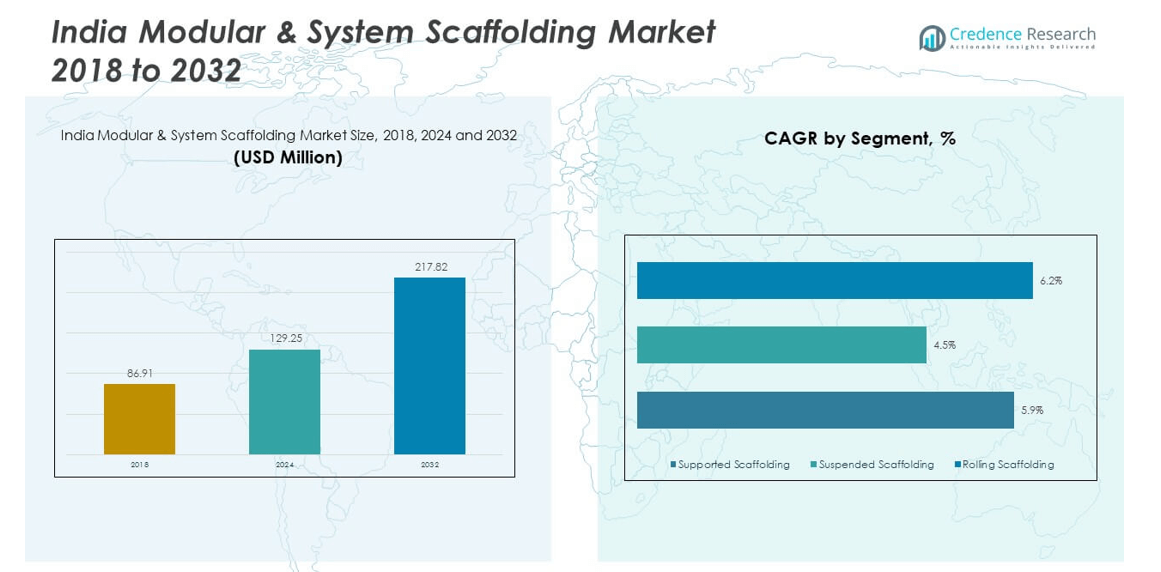
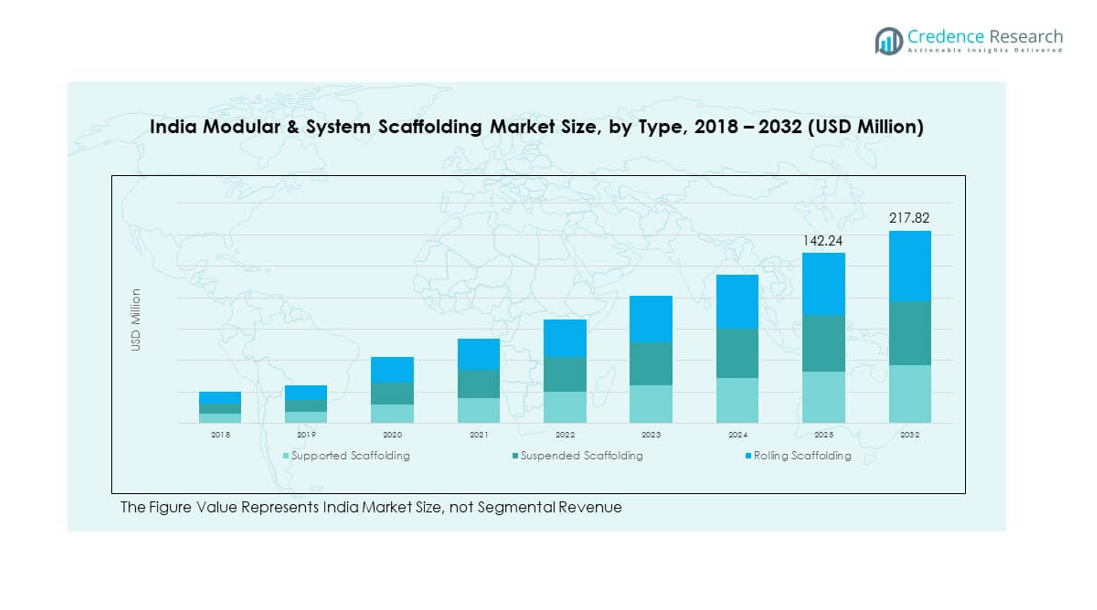
The India Modular & System Scaffolding Market size was valued at USD 86.91 million in 2018 to USD 129.25 million in 2024 and is anticipated to reach USD 217.82 million by 2032, at a CAGR of 6.67% during the forecast period.
| REPORT ATTRIBUTE | DETAILS |
|---|---|
| Historical Period | 2020-2023 |
| Base Year | 2024 |
| Forecast Period | 2025-2032 |
| India Modular & System Scaffolding Market Size 2024 | USD 129.25 million |
| India Modular & System Scaffolding Market, CAGR | 6.67% |
| India Modular & System Scaffolding Market Size 2032 | USD 217.82 million |
The India Modular & System Scaffolding Market is experiencing robust growth due to the surge in infrastructure development, urban expansion, and industrial construction projects. Increased government investments in smart cities and metro rail networks have propelled the demand for safer and more efficient scaffolding systems. Contractors and builders are increasingly shifting toward modular scaffolding solutions for their ease of assembly, durability, and compliance with safety standards. Additionally, the growing adoption of advanced construction techniques and increased emphasis on worker safety are reinforcing market demand across urban construction hubs.
Regionally, western and southern India dominate the modular and system scaffolding market due to high construction activity in states like Maharashtra, Gujarat, Karnataka, and Tamil Nadu. These regions host numerous commercial and industrial projects, fueling sustained demand. Meanwhile, northern and eastern regions are emerging markets, driven by infrastructure upgrades, residential developments, and growing foreign investments in Tier II and Tier III cities. Expansion of transportation corridors and industrial parks in these areas is also contributing to increased adoption of modular scaffolding solutions.
Market Insights:
- India Modular & System Scaffolding Market is projected to grow from USD 129.25 million in 2024 to USD 217.82 million by 2032, registering a CAGR of 6.67%. This expansion reflects increasing infrastructure investments and the shift toward safer, standardized scaffolding practices across urban and industrial sectors.
- The Global Modular & System Scaffolding Market size was valued at USD 3,638.85 million in 2018 to USD 5,272.51 million in 2024 and is anticipated to reach USD 8,544.92 million by 2032, at a CAGR of 5.79% during the forecast period.
- Government-funded infrastructure projects, including smart cities and metro rail networks, are driving strong demand for modular scaffolding systems due to their efficiency, safety, and faster setup capabilities.
- Real estate growth in metro cities like Mumbai, Bengaluru, and Hyderabad is pushing builders to adopt flexible and high-strength scaffolding systems that comply with modern safety and regulatory standards.
- Manufacturing clusters, logistics hubs, and industrial parks in non-urban zones are boosting demand for high-load modular scaffolds used in facility maintenance and expansion under the Make in India and PLI initiatives.
- Worker safety norms and compliance awareness are catalyzing the shift from traditional bamboo and tube scaffolds to engineered modular systems, especially in large-scale and high-rise construction sites.
- Adoption in smaller projects is hindered by high capital investment and logistical barriers, particularly in rural and Tier III towns where transport and storage add significant costs.
- Regionally, Western India leads with 34.2% market share, followed by Southern India at 27.6% and Northern India at 22.8%, while Eastern and Northeastern zones hold 15.4% and are seen as emerging growth areas.
Market Drivers:
Government-Led Infrastructure Growth Catalyzes Demand Across Urban and Semi-Urban Projects
The Government of India continues to prioritize large-scale infrastructure initiatives, including smart cities, metro corridors, and highway expansions. These projects require highly durable and modular scaffolding systems to ensure safe and efficient construction. The India Modular & System Scaffolding Market benefits directly from increased tender activity and public-private partnerships in urban renewal projects. Demand intensifies where timelines are tight and worker safety is paramount. Modular systems, with their faster assembly and disassembly, meet these expectations efficiently. Contractors are replacing traditional bamboo and tube scaffolding with modern modular systems across most government-funded developments. This structural shift is fueling consistent market expansion.
Private Sector Real Estate Expansion Spurs the Need for Safe and Flexible Scaffolding Systems
Rapid urbanization and rising incomes have created robust demand for residential and commercial buildings. Builders are scaling high-rise projects in cities like Mumbai, Bengaluru, and Hyderabad, requiring adaptable scaffolding structures. The India Modular & System Scaffolding Market supports these needs by offering configurable platforms that enhance worker access and safety on vertical builds. Developers are embracing modular systems to meet stringent regulatory norms and improve operational efficiency. The private sector is also investing in green building certifications, which favor modern scaffolding solutions with minimal site disturbance. This transition from traditional methods to engineered systems continues to drive demand.
Industrial Corridor and Logistics Infrastructure Drive Adoption in Non-Urban Zones
The development of industrial parks, logistics hubs, and manufacturing clusters across non-metropolitan regions is expanding the market footprint. The India Modular & System Scaffolding Market finds significant opportunity in sectors like steel, cement, and automotive where industrial infrastructure requires regular maintenance and construction. These zones demand high-load scaffolding solutions for plant structures and warehouse units. Modular scaffolding improves turnaround time during shutdown maintenance or facility expansions. As the government promotes Make in India and Production Linked Incentives (PLI), the need for industrial infrastructure accelerates. This dynamic pushes scaffolding suppliers to scale operations across emerging corridors.
- For instance, Cuplock scaffold systems are recognized for their high-capacity performance and fast assembly well-suited for maintenance and industrial turnaround projects like those at JSW Steel's Vijayanagar facility.
Strict Safety Norms and Rising Awareness Drive the Shift from Traditional to Modular Scaffolding
India’s construction industry has seen a growing focus on worker safety and regulatory compliance. Government agencies and private institutions have begun enforcing stricter norms for site safety, leading to broader acceptance of modular scaffolding. The India Modular & System Scaffolding Market responds to these regulations with engineered systems offering enhanced stability and load-bearing capacity. Builders and contractors increasingly prioritize solutions that reduce fall risks and support quality certifications like ISO and OHSAS. Training programs by construction boards have created awareness of system scaffolding benefits. This transformation is replacing unsafe, labor-intensive practices with structured, secure alternatives.
- For example, ULMA Construction offers structured training programs and on-site supervision to support safe deployment of its MK System and associated solutions in markets including India.
Market Trends:
Integration of Scaffolding with Digital Project Management Tools Enhances Efficiency
Construction firms are integrating modular scaffolding setups with digital tools to improve on-site planning and logistics. The India Modular & System Scaffolding Market is witnessing the trend of using Building Information Modeling (BIM) to design scaffolding structures that align with overall project schematics. These integrations reduce errors, optimize resource allocation, and minimize rework. QR code tracking for scaffold components, cloud-based monitoring, and mobile checklists are becoming standard. Companies use this data-driven approach to plan scaffolding cycles and avoid bottlenecks. Such digitization supports smoother coordination between contractors and project managers on complex construction sites.
- For instance, Technocraft Industries India Ltd. leverages Building Information Modeling (BIM) in scaffolding and formwork design to improve accuracy, reduce design rework, and generate material schedules automatically.
Rental Model Emerges as a Cost-Efficient Alternative Across Project Scales
Construction companies increasingly opt for scaffolding rental services rather than investing in permanent ownership. The India Modular & System Scaffolding Market is seeing growth in rental and leasing models, particularly among small to mid-sized contractors. These businesses aim to reduce upfront capital expenditure while accessing high-quality, certified equipment. Scaffolding rental firms are offering delivery, erection, and dismantling services bundled into packages. The rise in short-term industrial shutdowns and maintenance projects supports rental scalability. Market players are expanding their inventory and logistics support to address this shift toward flexible, on-demand scaffolding access.
Customized Scaffold Designs Gain Ground in Specialized Construction Applications
Architectural diversity and structural complexity across Indian cities have driven the trend of custom-designed scaffolding systems. The India Modular & System Scaffolding Market is adapting by developing modular frameworks tailored for bridges, tunnels, stadiums, and heritage restoration projects. Companies now offer 3D model-based planning, adaptable connections, and variable load systems to match specific site conditions. Custom scaffolding improves safety and fits non-standard geometries better than generic solutions. This trend is particularly visible in large infrastructure ventures and complex urban redevelopment schemes, where precision is essential to avoid structural conflicts or safety lapses.
- For instance, WINSTEEL Engineering Works India offers movable scaffolding systems (MSS) including both underslung and overhead variants tailored for cast-in-place bridge decks spanning approximately 20–70 m.
Eco-Friendly Scaffolding Materials Attract Builders Committed to Sustainability Goals
Sustainability is becoming central to procurement decisions in the Indian construction sector. The India Modular & System Scaffolding Market is responding with recyclable materials and corrosion-resistant coatings. Aluminum and galvanized steel scaffolds are replacing wooden poles and rust-prone tubular systems. These eco-friendly solutions reduce material waste and extend lifecycle performance. Developers pursuing IGBC or LEED certification prefer these systems for their durability and environmental benefits. The move toward green construction has also driven innovations in modular design that enable easy reuse and reconfiguration. This trend aligns with India’s larger green building movement.
Market Challenges Analysis:
Fragmented Contractor Ecosystem Limits Standardization and Quality Compliance
India’s construction sector is heavily fragmented, with a large number of unorganized and small-scale contractors operating across regions. The India Modular & System Scaffolding Market faces hurdles in penetrating this segment due to cost concerns, limited awareness, and low willingness to upgrade. Many contractors still rely on traditional bamboo or tube-and-coupler scaffolds to save on upfront investment. This behavior limits the pace at which modern systems gain traction, especially in low-budget projects. Further, inconsistent adherence to safety norms makes it difficult for manufacturers to enforce standard practices or offer training across dispersed geographies. Educating and converting these users remains a challenge.
High Initial Investment and Logistical Complexity Discourage Adoption in Smaller Projects
The capital expenditure involved in procuring modular scaffolding systems can be substantial, particularly for small-scale developers. Although rentals offer a partial solution, logistics and transport costs often deter adoption in rural or remote projects. The India Modular & System Scaffolding Market contends with high handling and storage costs associated with bulky equipment. Transportation infrastructure limitations in tier-III towns and construction belts add to this complexity. Project timelines sometimes compress scaffold erection and dismantling windows, demanding more manpower and planning. These limitations affect deployment scalability and restrict penetration into lower-margin or short-duration projects.
Market Opportunities:
Tier-II and Tier-III City Expansion Unlocks Demand for Mid-Sized Construction Projects
India’s construction activity is rapidly shifting beyond metros into smaller cities driven by real estate affordability, industrial decentralization, and government-led smart city initiatives. The India Modular & System Scaffolding Market finds significant opportunity in these regions, where demand for commercial complexes, institutional buildings, and small infrastructure is rising. Developers in these cities are now adopting modular solutions to enhance project efficiency and comply with evolving safety norms. This geographic expansion allows suppliers to establish local rental hubs and improve market access.
Public-Private Partnerships and Foreign Investments Create Long-Term Growth Potential
The increasing participation of private players in infrastructure development under public-private models is generating new business for scaffolding vendors. Foreign direct investments in roads, ports, renewable energy, and industrial zones continue to rise. The India Modular & System Scaffolding Market benefits from global companies demanding high safety standards and structured construction systems. This influx of institutional projects offers long-term contracts and repeat business for suppliers providing certified, engineered scaffolding. It also encourages technology transfer and capacity building within the local ecosystem.
Market Segmentation Analysis:
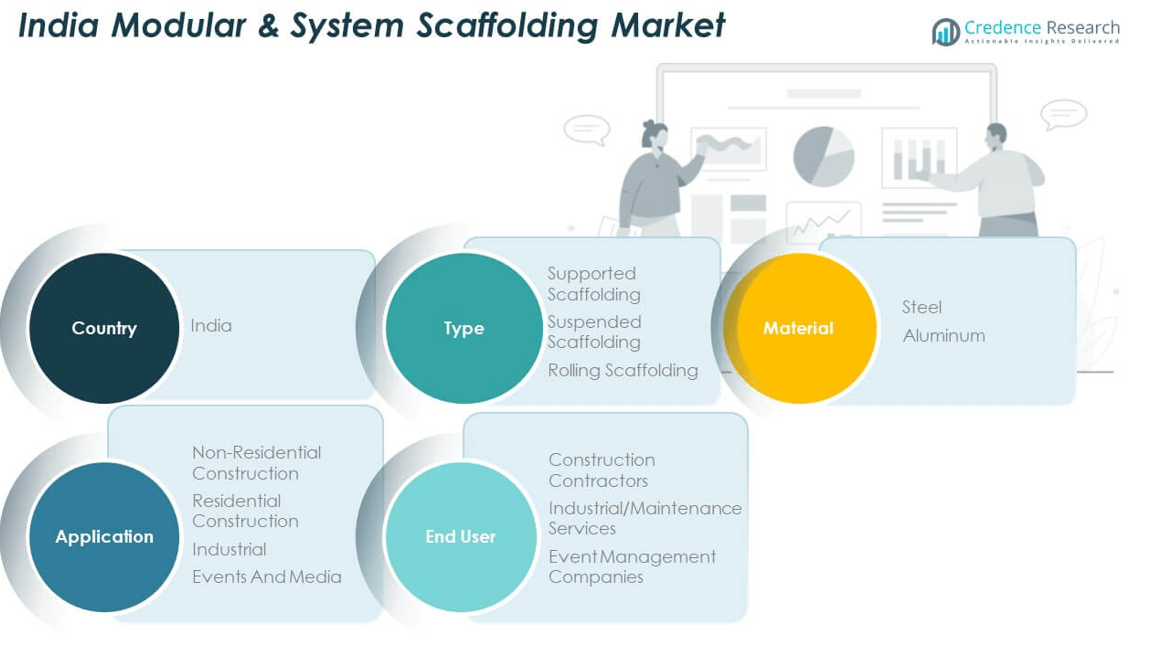
The India Modular & System Scaffolding Market is segmented by type, material, application, and end user.
By type, supported scaffolding dominates the market due to its stability and wide use in high-rise and infrastructure projects. Suspended scaffolding finds niche application in exterior maintenance and repair works, particularly for tall structures. Rolling scaffolding is gaining adoption in indoor construction and industrial applications where mobility is essential.
- For example, Technocraft India manufactures modular scaffolding systems such as Techlok (Ringlok) and Cuplock, compliant with major global standards, and exports them for infrastructure, industrial, and bridge projects.
By material, steel scaffolding leads the market owing to its superior strength and durability, while aluminum scaffolding is preferred for lightweight, portable applications in maintenance and event setups.
- For example, Alufase manufactures modular aluminum scaffold towers like the Span 400 and Span 500, engineered for rapid, tool-free setup and mobility-well suited to event staging and exhibition environments.
By application, non-residential construction holds the largest share due to extensive commercial, institutional, and industrial projects across urban centers. Residential construction follows, supported by growing urban housing demands. Industrial applications are steadily rising, driven by plant maintenance and infrastructure expansions. Events and media represent a smaller yet stable segment where temporary and quick-setup scaffolding is required.
By end user, construction contractors form the largest customer group in the India Modular & System Scaffolding Market, with widespread deployment across public and private projects. Industrial and maintenance services contribute significantly to recurring demand, particularly in factories, warehouses, and utilities. Event management companies make up an emerging user base, utilizing modular scaffolds for stages, lighting rigs, and temporary structures. It continues to evolve with changing user needs and growing preferences for safer, modular, and reusable scaffolding systems across sectors.
Segmentation:
By Type:
- Supported Scaffolding
- Suspended Scaffolding
- Rolling Scaffolding
By Material:
- Steel
- Aluminum
By Application:
- Non-Residential Construction
- Residential Construction
- Industrial
- Events and Media
By End User:
- Construction Contractors
- Industrial/Maintenance Services
- Event Management Companies
Regional Analysis:
Western India commands the largest share of the India Modular & System Scaffolding Market, accounting for 34.2% of the overall market in 2024. This dominance stems from high infrastructure investment and commercial construction activity in Maharashtra and Gujarat. Metro rail expansions, high-rise developments, and smart city projects in cities like Mumbai, Pune, and Ahmedabad have accelerated the adoption of modular scaffolding. The region’s mature construction industry prefers modular systems for their compliance with safety regulations and efficiency on complex builds. Industrial projects, including ports and SEZs, further boost demand. Strong logistics infrastructure supports scaffolding suppliers with seamless distribution networks.
Southern India holds the second-largest share of the market at 27.6%, driven by rapid urbanization and real estate growth in Karnataka, Tamil Nadu, and Telangana. Bengaluru and Chennai are major hubs for IT parks, commercial complexes, and mixed-use developments. These projects require modern scaffolding solutions to meet vertical construction demands and tight timelines. The region is witnessing strong adoption of rental scaffolding models among mid-sized contractors. Government-backed housing and infrastructure projects also contribute to steady demand. The presence of local manufacturers and service providers strengthens regional supply chains.
Northern India captures 22.8% of the India Modular & System Scaffolding Market, with the National Capital Region (NCR), Punjab, and Uttar Pradesh leading growth. Delhi NCR is a major driver with multiple infrastructure and redevelopment projects fueling market expansion. The adoption of system scaffolding in flyover construction, metro stations, and commercial towers continues to grow. Government focus on industrial corridors and transportation connectivity supports the demand for high-load modular scaffolds. Eastern and Northeastern India together hold a smaller market share of 15.4%, but present emerging opportunities. Infrastructure development in states like West Bengal and Assam is improving scaffold penetration in underdeveloped zones.
Key Player Analysis:
- BSL Scaffolding Ltd
- Renny Kwikstage Scaffolding
- PERI India
- Layher Scaffolding Systems Pvt Ltd
- ULMA Formworks India Pvt Ltd
- Finomax Scaffolding Pvt Ltd
- PASCHAL Formwork (India) Pvt Ltd
- Gleanore India Pvt Ltd
- Wheels Scaffolding Ltd (WSL)
- Winntus Formwork System Pvt Ltd
Competitive Analysis:
The India Modular & System Scaffolding Market features a moderately consolidated competitive landscape, led by both multinational players and established domestic firms. Key companies include PERI India, Layher Scaffolding, Harsco Infrastructure, and Indian Scaffolding Solutions. These firms compete on the basis of product durability, system flexibility, rental services, and safety certifications. Local manufacturers focus on cost-effectiveness and project-specific customization to gain market share. Strategic partnerships with construction firms and rental service expansion remain core growth strategies. It continues to attract new entrants offering modular kits and scaffolding accessories tailored for small to mid-scale projects. Players are enhancing logistics and technical support to improve customer retention in regional markets.
Recent Developments:
- In June 2025, Finomax Scaffolding Pvt Ltd announced the transformational impact of its aluminium formwork solutions on India’s construction industry. According to their CEO, the new modular systems deliver superior efficiency, quality, and sustainability across project types, representing a significant innovation for the sector in 2025.
Market Concentration & Characteristics:
The India Modular & System Scaffolding Market demonstrates medium market concentration with a mix of organized and unorganized players. Large firms dominate metro city projects while regional contractors and rental operators serve tier-II and tier-III cities. It exhibits characteristics such as high demand variability, price sensitivity, and a growing preference for system-based scaffolds over conventional methods. The market favors players who offer rapid assembly, compliance with safety norms, and scalable rental services. Seasonality influences demand, with peaks aligned to infrastructure and real estate project cycles. Innovation in lightweight materials and digital tracking features is becoming a competitive differentiator. Entry barriers remain moderate due to low initial investment for rental-based operations. Strong after-sales service and technical training also influence long-term client retention.
Report Coverage:
The research report offers an in-depth analysis based on Type, Material, Application and End User. It details leading market players, providing an overview of their business, product offerings, investments, revenue streams, and key applications. Additionally, the report includes insights into the competitive environment, SWOT analysis, current market trends, as well as the primary drivers and constraints. Furthermore, it discusses various factors that have driven market expansion in recent years. The report also explores market dynamics, regulatory scenarios, and technological advancements that are shaping the industry. It assesses the impact of external factors and global economic changes on market growth. Lastly, it provides strategic recommendations for new entrants and established companies to navigate the complexities of the market.
Future Outlook:
- Increased urban infrastructure development will drive sustained demand for modular scaffolding across metro and tier-I cities.
- Expansion of smart city and affordable housing projects will create new opportunities for system scaffolding adoption.
- Growing rental and leasing models will attract small and mid-sized contractors to shift from traditional scaffolds.
- Integration of digital planning tools like BIM will enhance precision and reduce setup time on large-scale projects.
- Rising emphasis on construction safety will accelerate regulatory push toward certified scaffolding systems.
- Industrial corridor development and logistics parks will boost usage in non-residential and maintenance applications.
- Customized scaffold solutions will gain traction in complex architectural and heritage restoration projects.
- Adoption of eco-friendly and corrosion-resistant materials will align with sustainability goals in construction.
- Strategic partnerships between scaffolding providers and EPC contractors will strengthen market reach.
- Improved logistics and warehousing networks will support faster equipment deployment in remote regions.

Request a Free Sample
Fill in your details and we'll send you a free sample report.
- Sample data tables & charts
- Research methodology
Market Dynamics
Government-Led Infrastructure Growth
Large-scale government investments in smart cities, metro rail, and highway projects are driving demand for modular and system scaffolding, as these projects require efficient, safe, and standardized scaffolding solutions to meet tight timelines and regulatory standards.
Urbanization and Real Estate Expansion
Rapid urbanization and the boom in high-rise and commercial construction in metro cities like Mumbai, Bengaluru, and Hyderabad are pushing builders to adopt modular scaffolding systems that offer flexibility, safety, and compliance with modern building codes.
Industrial Corridor and Logistics Infrastructure Development
The expansion of industrial parks, logistics hubs, and manufacturing clusters under initiatives like Make in India and PLI is increasing the need for high-load, durable scaffolding systems for plant maintenance and facility expansion in non-urban zones.
Shift Toward Safety and Regulatory Compliance
Stricter enforcement of worker safety norms and growing awareness of compliance requirements are accelerating the transition from traditional bamboo and tube scaffolds to engineered modular systems, especially in large-scale and high-rise projects.
Growth of Rental and Leasing Models
The emergence of scaffolding rental and leasing services is making modular systems more accessible to small and mid-sized contractors, reducing upfront capital expenditure and supporting market penetration in both urban and emerging tier-II and tier-III cities.
Need a Custom Version of This Report?
Tailor the scope, geography, or segments to your exact requirements.
- Custom geography or segment scope
- Direct access to our analyst team
Frequently Asked Questions
What is the current market size for India Modular & System Scaffolding Market, and what is its projected size in 2032?
Which India Modular & System Scaffolding Market segment held the largest share in 2024?
Who are the leading companies in the India Modular & System Scaffolding Market?
Which region commanded the largest share of the India Modular & System Scaffolding Market in 2024?
Table of Content
Chapter 1 Market Segmentation
- 1.1 Segmentation Framework
- 1.1.1 Product and Service Classification
- 1.1.2 Application and End-Use Classification
- 1.1.3 Technology and Solution Classification
- 1.1.4 Customer and Distribution Channel Classification
- 1.1.5 Geographic Segmentation
- 1.1.6 Market Segment Definitions and Boundaries
- 1.2 By Type
- 1.2.1 Supported Scaffolding
- 1.2.2 Suspended Scaffolding
- 1.2.3 Rolling Scaffolding
- 1.3 By End User
- 1.3.1 Construction Contractors
- 1.3.2 Industrial/Maintenance Services
- 1.3.3 Event Management Companies
- 1.4 By Material
- 1.4.1 Steel
- 1.4.2 Aluminum
- 1.5 By Application
- 1.5.1 Non-Residential Construction
- 1.5.2 Residential Construction
- 1.5.3 Industrial
- 1.5.4 Events and Media
Chapter 2 Introduction
- 2.1 Report Objectives and Scope
- 2.2 Product Definition and Industry Terminology
- 2.3 Market Inclusions and Exclusions
- 2.4 Research Process
- 2.4.1 Primary Research and Expert Interviews
- 2.4.2 Secondary Research and Source Review
- 2.4.3 Top-Down and Bottom-Up Estimation
- 2.4.4 Data Triangulation and Verification
- 2.5 Market Size Measurement Basis
- 2.5.1 2024: USD 129.26 million → 2032: USD 217.82 million
- 2.6 Historical and Forecast Reference Periods
- 2.6.1 Base Year: 2024
- 2.6.2 Forecast Period: 2024-2032
- 2.7 Research Assumptions and Limitations
Chapter 3 Executive Summary
- 3.1 Market Snapshot and Key Findings
- 3.2 Base-Year Market Size, 2024
- 3.3 Forecast Market Size, 2032
- 3.4 Revenue and Volume Growth Outlook
- 3.5 Key Demand and Supply Indicators
- 3.6 Leading Market Segments
- 3.7 Fastest-Growing Market Opportunities
- 3.8 Regional Performance Highlights
- 3.9 Technology and Industry Transformation
- 3.10 Competitive Landscape Summary
- 3.11 Analyst View and Strategic Implications
Chapter 4 India Modular & System Scaffolding Market Trends and Developments
- 4.1 Historical Industry Development
- 4.2 Recent Market Trends and Developments
- 4.3 Demand and Customer Behavior Trends
- 4.4 Technology and Product Innovation
- 4.5 Artificial Intelligence, Automation and Digitalization
- 4.6 Local Manufacturing and Supply Chain Realignment
- 4.7 Industry Partnerships, Mergers and Acquisitions
- 4.8 Sustainability and Circular Economy Developments
- 4.9 Government and Private Sector Investment Trends
- 4.10 Emerging Business Models and Commercialization
- 4.11 Industry Developments and Announcements
Chapter 5 India Modular & System Scaffolding Market Production, Supply and Demand Analysis
- 5.1 Demand Trend and Consumption Analysis
- 5.2 Demand Forecast, 2024-2032
- 5.3 Production and Output Trend
- 5.4 Production and Output Forecast, 2024-2032
- 5.5 Installed Capacity and Capacity Utilization
- 5.6 Company-Wise Production Plants and Statistics
- 5.6.1 Installed Production Capacity
- 5.6.2 Actual Production
- 5.6.3 Planned Capacity and Expansion Targets
- 5.7 Supply Chain Structure and Procurement Trends
- 5.8 Supply-Demand Gap and Bottlenecks
- 5.9 Import Dependence and Sourcing Structure
- 5.10 Contract Manufacturing and Outsourcing
- 5.11 Regional Supply and Demand Concentration
Chapter 6 India Modular & System Scaffolding Market Pricing Analysis
- 6.1 Pricing Structure and Measurement
- 6.2 Historical Pricing Trends
- 6.3 Pricing Outlook, 2024-2032
- 6.4 Average Selling Price and Unit Economics
- 6.5 Pricing by Product and Market Segment
- 6.6 Geographic Pricing Differences
- 6.7 Key Input, Energy, Labor and Logistics Costs
- 6.8 Contract Pricing and Purchasing Models
- 6.9 Pricing Sensitivity and Competitive Positioning
- 6.10 Price, Margin and Profitability Implications
Chapter 7 India Modular & System Scaffolding Market Dynamics
- 7.1 Market Growth Drivers
- 7.1.1 Demand-Side Drivers
- 7.1.2 Technology and Innovation Drivers
- 7.1.3 Infrastructure and Investment Drivers
- 7.1.4 Regulatory and Policy Drivers
- 7.2 Market Restraints
- 7.2.1 Cost and Affordability Constraints
- 7.2.2 Technology and Adoption Barriers
- 7.2.3 Supply Chain and Operational Constraints
- 7.3 Market Challenges
- 7.3.1 Competitive Pressure and Margin Erosion
- 7.3.2 Skills, Infrastructure and Implementation Gaps
- 7.4 Emerging Market Opportunities
- 7.5 Market Dynamics Impact and Time-Horizon Assessment
Chapter 8 India Modular & System Scaffolding Value Chain Analysis
- 8.1 Industry Value Chain Overview
- 8.2 Upstream Suppliers and Critical Inputs
- 8.3 Technology and Component Providers
- 8.4 Manufacturing or Service Delivery
- 8.5 Distribution, Channel Partners and Integrators
- 8.6 Downstream Applications and End Users
- 8.7 Value Addition and Profit Pools
- 8.8 Vertical Integration and Outsourcing
- 8.9 Supplier Concentration and Risk
- 8.10 Supply Chain Localization and Resilience
Chapter 9 India Modular & System Scaffolding Market Regulations and Policies
- 9.1 Relevant Laws, Standards and Compliance Frameworks
- 9.2 Product, Service, Safety and Quality Requirements
- 9.3 Government Policies, Incentives and Subsidies
- 9.4 Imports, Exports and Trade Barriers
- 9.5 Public Procurement and Local Content Requirements
- 9.6 Environmental and Sustainability Compliance
- 9.7 Upcoming Policy Changes and Market Implications
Chapter 10 India Modular & System Scaffolding Market Hotspots and Opportunities
- 10.1 Market Opportunity Mapping and Growth Hotspots
- 10.2 High-Growth Applications and Customer Groups
- 10.3 Underserved Markets and White-Space Opportunities
- 10.4 Emerging Technology and Product Opportunities
- 10.5 New Capacity and Investment Hotspots
- 10.6 Market Entry and Expansion Opportunities
- 10.7 Distribution and Partnership Opportunities
- 10.8 Near-Term and Long-Term Commercial Potential
- 10.9 Opportunity Attractiveness and Execution Risks
Chapter 11 India Modular & System Scaffolding Market Outlook, 2024-2032
- 11.1 Market Size and Analysis
- 11.1.1 Revenue (Market Measurement: 2024: USD 129.26 million → 2032: USD 217.82 million)
- 11.1.2 Market Volume and Quantity Sold
- 11.1.3 Historical Market Size
- 11.1.4 Base-Year Market Size, 2024
- 11.2 Market Forecast, 2024-2032
- 11.2.1 Revenue Forecast to 2032
- 11.2.2 Volume Forecast to 2032
- 11.2.3 CAGR and Year-on-Year Growth
- 11.2.4 Incremental Revenue Opportunity
- 11.3 Forecast Assumptions and Scenario Analysis
- 11.3.1 Base-Case Forecast
- 11.3.2 Optimistic and Conservative Scenarios
- 11.3.3 Technology, Pricing and Policy Sensitivities
- 11.4 Market Attractiveness and Growth Outlook
Chapter 12 India Modular & System Scaffolding Market Segmentation and Outlook
- 12.1 Segmentation Summary and Market Shares, 2024
- 12.2 Largest and Fastest-Growing Segments
- 12.3 By Type - Market Size and Forecast, 2024-2032
- 12.3.1 Segment Definition and Scope
- 12.3.2 Historical Market Size
- 12.3.3 Revenue Forecast, 2024-2032
- 12.3.4 Volume Forecast, 2024-2032
- 12.3.5 Base-Year Market Share, 2024
- 12.3.6 Segment CAGR and Growth Drivers
- 12.3.7 Subsegment Market Size and Forecast
- 12.3.7.1 Supported Scaffolding
- 12.3.7.2 Suspended Scaffolding
- 12.3.7.3 Rolling Scaffolding
- 12.3.8 Subsegment Pricing and Adoption Trends
- 12.3.9 Leading Suppliers and Competition
- 12.3.10 Regional Demand and Opportunities
- 12.4 By End User - Market Size and Forecast, 2024-2032
- 12.4.1 Segment Definition and Scope
- 12.4.2 Historical Market Size
- 12.4.3 Revenue Forecast, 2024-2032
- 12.4.4 Volume Forecast, 2024-2032
- 12.4.5 Base-Year Market Share, 2024
- 12.4.6 Segment CAGR and Growth Drivers
- 12.4.7 Subsegment Market Size and Forecast
- 12.4.7.1 Construction Contractors
- 12.4.7.2 Industrial/Maintenance Services
- 12.4.7.3 Event Management Companies
- 12.4.8 Subsegment Pricing and Adoption Trends
- 12.4.9 Leading Suppliers and Competition
- 12.4.10 Regional Demand and Opportunities
- 12.5 By Material - Market Size and Forecast, 2024-2032
- 12.5.1 Segment Definition and Scope
- 12.5.2 Historical Market Size
- 12.5.3 Revenue Forecast, 2024-2032
- 12.5.4 Volume Forecast, 2024-2032
- 12.5.5 Base-Year Market Share, 2024
- 12.5.6 Segment CAGR and Growth Drivers
- 12.5.7 Subsegment Market Size and Forecast
- 12.5.7.1 Steel
- 12.5.7.2 Aluminum
- 12.5.8 Subsegment Pricing and Adoption Trends
- 12.5.9 Leading Suppliers and Competition
- 12.5.10 Regional Demand and Opportunities
- 12.6 By Application - Market Size and Forecast, 2024-2032
- 12.6.1 Segment Definition and Scope
- 12.6.2 Historical Market Size
- 12.6.3 Revenue Forecast, 2024-2032
- 12.6.4 Volume Forecast, 2024-2032
- 12.6.5 Base-Year Market Share, 2024
- 12.6.6 Segment CAGR and Growth Drivers
- 12.6.7 Subsegment Market Size and Forecast
- 12.6.7.1 Non-Residential Construction
- 12.6.7.2 Residential Construction
- 12.6.7.3 Industrial
- 12.6.7.4 Events and Media
- 12.6.8 Subsegment Pricing and Adoption Trends
- 12.6.9 Leading Suppliers and Competition
- 12.6.10 Regional Demand and Opportunities
- 12.7 Segment Growth Comparison
- 12.8 Segment Attractiveness and Priority Matrix
Chapter 13 India Modular & System Scaffolding End-Use and Application Market Outlook
- 13.1 End-Use Industry and Customer Demand Structure
- 13.2 Leading Applications and Customer Groups
- 13.3 End-Use Market Size, Share and Forecast
- 13.4 Major End-Use Industry Deep Dives
- 13.4.1 Customer Requirements and Use Cases
- 13.4.2 Demand and Replacement Cycles
- 13.4.3 Technical and Regulatory Considerations
- 13.4.4 Purchasing and Procurement Models
- 13.4.5 Leading Vendors and Distribution Channels
- 13.4.6 Forecast and Commercial Opportunities
- 13.5 Emerging Applications and Cross-Segment Demand
- 13.6 End-Use Industry Investment Priorities
Chapter 14 India Modular & System Scaffolding Geographic Market Outlook, 2024-2032
- 14.1 Domestic Market Distribution and Demand Clusters
- 14.2 State- or Province-Wise Market Size and Forecast, 2024-2032
- 14.3 City and Metropolitan Market Outlook
- 14.4 Industrial, Manufacturing and Commercial Clusters
- 14.5 Geographic Concentration of Key End Users
- 14.6 Local Pricing and Purchasing Differences
- 14.7 Domestic Production Facilities and Capacity Map
- 14.8 Local Infrastructure and Project Pipeline
- 14.9 State-Level Policy and Incentive Differences
- 14.10 Subnational Investment Hotspots and Opportunities
- 14.11 Distribution and Logistics Networks
- 14.12 Domestic Competitive Footprint
Chapter 15 India Modular & System Scaffolding Technology, Innovation and Sustainability Outlook
- 15.1 Technology Landscape and Maturity
- 15.2 Product, Process and Service Innovation
- 15.3 AI, Automation and Digital Tools in the Industry
- 15.4 Technology Adoption and Performance Benchmarking
- 15.5 Innovation Pipeline and R&D Investment
- 15.6 Patent and Intellectual Property Trends
- 15.7 Energy Efficiency and Resource Management
- 15.8 Sustainability, Recycling and Circularity
- 15.9 Technology Roadmap, 2024-2032
- 15.10 Risks of Obsolescence and Technology Substitution
Chapter 16 India Modular & System Scaffolding Market Key Strategic Imperatives
- 16.1 Growth and Market Entry Priorities
- 16.2 High-Return Products and Segments
- 16.3 Pricing, Profitability and Cost Optimization
- 16.4 Technology Investment and Product Differentiation
- 16.5 Supply Chain Localization and Resilience
- 16.6 Distribution and Customer Acquisition
- 16.7 Partnership, Acquisition and Capacity Strategy
- 16.8 Regional Expansion Priorities
- 16.9 Short-, Medium- and Long-Term Actions
Chapter 17 Competition Outlook
- 17.1 Industry Competition Characteristics
- 17.2 Market Structure and Concentration
- 17.3 Market Share and Competitive Positioning, 2024
- 17.4 Company-Wise Revenue and Product Benchmarking
- 17.5 Production and Service Capacity Benchmarking
- 17.6 Technology, Pricing and Differentiation
- 17.7 Regional Footprint and Distribution Strength
- 17.8 Mergers, Acquisitions and Strategic Alliances
- 17.9 New Entrants and Competitive Threats
- 17.10 Porter's Five Forces and Industry Attractiveness
- 17.11 Competitive Outlook, 2024-2032
Chapter 18 Company Profiles
- 18.1 Company Coverage and Selection Criteria
- 18.2 BSL Scaffolding Ltd
- 18.2.1 Business Description
- 18.2.2 Company Ownership and Geographic Presence
- 18.2.3 Product and Service Portfolio
- 18.2.4 Manufacturing and Operating Footprint
- 18.2.5 Production Capacity and Expansion Plans
- 18.2.6 Financial Performance and Investment
- 18.2.7 Market Share and Competitive Position
- 18.2.8 Technology and Innovation Capabilities
- 18.2.9 Strategic Alliances or Partnerships
- 18.2.10 Recent Developments
- 18.2.11 Growth Strategy and Outlook
- 18.3 Renny Kwikstage Scaffolding
- 18.4 PERI India
- 18.5 Layher Scaffolding Systems Pvt Ltd
- 18.6 ULMA Formworks India Pvt Ltd
- 18.7 Finomax Scaffolding Pvt Ltd
- 18.8 PASCHAL Formwork (India) Pvt Ltd
- 18.9 Gleanore India Pvt Ltd
- 18.10 Wheels Scaffolding Ltd (WSL)
- 18.11 Winntus Formwork System Pvt Ltd
- 18.12 Other Relevant Market Participants
Note: Every listed company is profiled on the structure shown under the first company. The company list is preliminary and may change based on research findings, market developments, data availability and client requirements.
Chapter 19 Disclaimer
- 19.1 Research and Forecast Disclaimer
- 19.2 Data Source and Estimation Limitations
Note: The depth of individual sections depends on data availability for this market. Volume, capacity, trade and other unit-based metrics are included where applicable.

