
Market Overview:
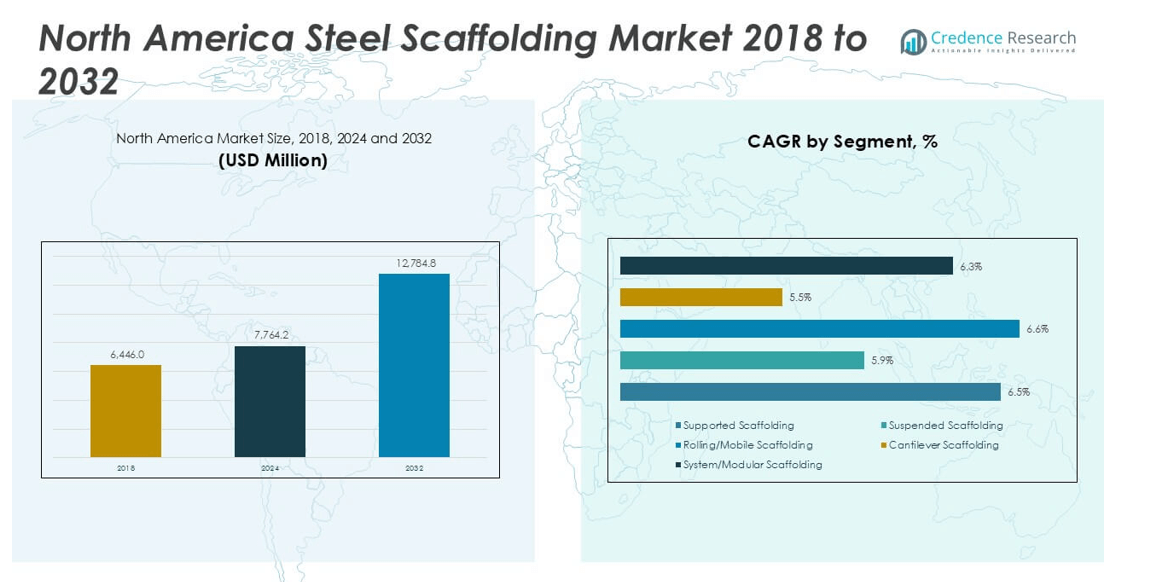
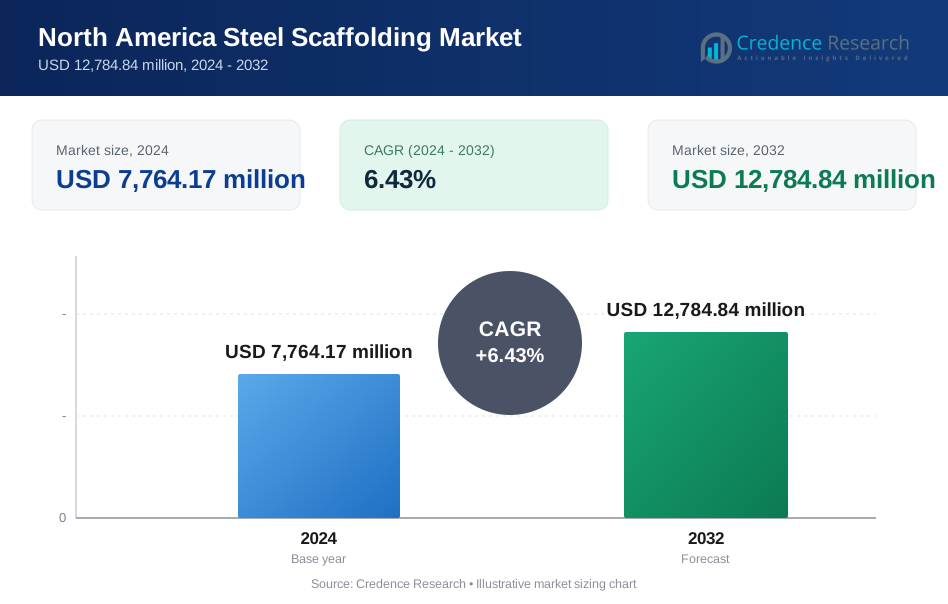
The North America steel scaffolding market size was valued at USD 6,445.98 million in 2018 and grew to USD 7,764.17 million in 2024. It is anticipated to reach USD 12,784.84 million by 2032, expanding at a CAGR of 6.43% during the forecast period (2024–2032).
| REPORT ATTRIBUTE | DETAILS |
|---|---|
| Historical Period | 2020-2023 |
| Base Year | 2024 |
| Forecast Period | 2025-2032 |
| North America Steel Scaffolding Market Size 2024 | USD 7,764.17 million |
| North America Steel Scaffolding Market, CAGR | 6.43% |
| North America Steel Scaffolding Market Size 2032 | USD 12,784.84 million |
The North America steel scaffolding market is led by prominent players such as Layher Holding GmbH & Co. KG, PERI SE, BrandSafway, ULMA Construction, Altrad Group, Waco Kwikform, ADTO Group, RMD Kwikform, Sunbelt Rentals, and Instant Upright Ltd. These companies focus on expanding modular and supported scaffolding solutions with enhanced safety features and efficient assembly systems. The United States remains the leading region, accounting for over 70% of the market share in 2024, driven by large-scale infrastructure projects, high-rise construction, and strict OSHA compliance requirements. Canada follows with nearly 20% share, supported by rail, hydroelectric, and commercial construction projects, while Mexico contributes around 10% through industrial expansion and urban development.
Market Insights
- The North America steel scaffolding market was valued at USD 7,764.17 million in 2024 and is projected to reach USD 12,784.84 million by 2032, growing at a CAGR of 6.43% during 2024–2032.
- Growth is driven by rising construction of high-rise buildings, infrastructure modernization programs, and maintenance activities across industrial and energy sectors.
- Modular and lightweight galvanized scaffolding systems are gaining traction due to faster installation, safety compliance, and cost efficiency, supporting demand in large-scale projects.
- Key players such as Layher Holding, PERI SE, BrandSafway, ULMA Construction, and Sunbelt Rentals are focusing on expanding rental networks, product innovations, and digital monitoring solutions to stay competitive.
- The United States dominates the market with over 70% share, followed by Canada with nearly 20% and Mexico with around 10%, while supported scaffolding holds the largest segment share due to its stability and load-bearing capacity.
Market Segmentation Analysis:
By Type
Supported scaffolding held the dominant share of over 45% in 2024 due to its versatility, stability, and ability to handle heavy loads for large-scale construction projects. It is widely preferred for high-rise buildings and infrastructure development as it provides safe working platforms and easy assembly. Suspended scaffolding follows, driven by demand in facade maintenance and painting applications. Rolling or mobile scaffolding is gaining traction in warehouses and interior projects where frequent repositioning is needed. Cantilever and system/modular scaffolding are used in space-restricted sites and industrial maintenance where quick installation reduces downtime.
- For instance, in 2024, PERI SE, a major international supplier of construction systems, supplied a range of formwork and scaffolding solutions for numerous construction projects across Europe.
By Location
External access scaffolding accounted for the largest share, exceeding 50% of the market, supported by extensive use in construction of commercial and residential buildings. Rising investments in facade renovation and retrofitting projects also boost this segment. Internal access scaffolding is important for industrial facilities and maintenance of high interior spaces. Formwork and falsework systems support concrete pouring in bridges and flyovers. Facade/maintenance scaffolding is driven by demand for safe access in cleaning and repair, while heavy-duty load-bearing systems are critical for infrastructure and power projects needing enhanced structural strength.
- For instance, Layher, a leading scaffolding supplier in Europe, provides façade scaffolding for a wide variety of renovation projects across countries such as Germany, France, and Poland. All Layher products are designed to meet European safety standards.
By End-use Industry
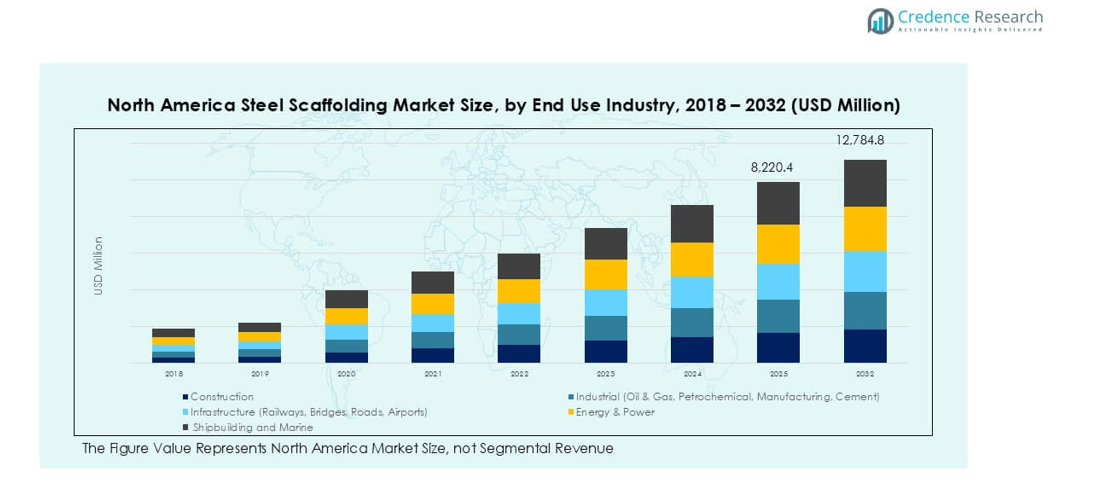
Construction remained the leading end-use segment, capturing more than 40% share in 2024, driven by growth in residential complexes, commercial spaces, and urban redevelopment projects across North America. The infrastructure segment is expanding rapidly due to government spending on bridges, rail, and airport modernization. Industrial users, including oil & gas and manufacturing, adopt scaffolding for maintenance shutdowns and equipment installation. Energy and power projects use scaffolding for turbine maintenance and plant overhauls, especially in renewables. Shipbuilding and marine demand is steady, led by repair and maintenance of naval and commercial vessels.
Market Overview
Infrastructure Modernization and Urban Development
The expansion of urban centers and government-backed infrastructure projects drive strong demand for steel scaffolding. Large-scale investments in bridges, highways, airports, and commercial buildings require durable scaffolding systems for safe and efficient construction. Supported scaffolding solutions dominate these projects due to their ability to bear heavy loads and adapt to varying site conditions. Continuous redevelopment of aging infrastructure across the U.S. and Canada ensures steady utilization of scaffolding, creating a sustained growth pipeline for manufacturers and rental companies in the region.
- For instance, BrandSafway, a provider of access and specialized services, is known for its involvement in large infrastructure projects, including U.S. highway bridge rehabilitations and airport expansions. The company utilizes advanced systems, such as pre-engineered and modular scaffolding, that are designed to improve productivity and reduce assembly times.
Shift Toward Safety and Compliance Standards
Stringent occupational safety standards by OSHA and regional authorities encourage the use of engineered scaffolding solutions. Companies are increasingly replacing temporary makeshift solutions with certified steel scaffolding systems to reduce workplace accidents. Demand for safer and more reliable platforms is driving innovations in modular systems with enhanced load capacity and guardrail features. This regulatory focus on worker safety strengthens the market’s long-term outlook and encourages contractors to invest in premium scaffolding equipment to maintain compliance and minimize liability risks.
- For instance, PERI offers advanced guardrail systems like the one integrated into its PERI UP Easy and PERI UP MI scaffolding systems, which have been available for several years and contribute to on-site safety through design features like advanced guardrail assembly.
Industrial and Energy Sector Maintenance
North America’s vast network of oil refineries, petrochemical plants, and energy facilities supports significant scaffolding consumption for maintenance shutdowns and upgrades. Routine plant turnarounds require robust access systems for workers, which boosts adoption of modular scaffolding for quicker assembly and dismantling. The growing renewable energy sector, including wind and solar plants, adds opportunities for scaffolding in turbine installation and maintenance. Frequent regulatory safety inspections in industrial facilities also contribute to recurring demand for scaffolding equipment throughout the forecast period.
Key Trends & Opportunities
Adoption of Modular and Lightweight Systems
Modular scaffolding is gaining traction as contractors seek faster installation, reduced labor costs, and high reusability. Lightweight galvanized steel systems enable quicker handling without compromising strength. This trend supports productivity in high-rise projects and time-bound infrastructure contracts. Rental providers are expanding inventories of modular units, creating opportunities for equipment suppliers offering customization and easy-to-transport solutions.
- For instance, Layher is a leading scaffolding manufacturer that supplies its lightweight Allround modular scaffolding system for use in construction projects across Europe, including high-rise buildings and metro infrastructure. The Allround system uses a bolt-free connection design that is designed for faster assembly than traditional tube-and-coupler scaffolding.
Integration of Digital Monitoring Solutions
The integration of digital technologies in scaffolding is becoming a significant growth catalyst for the industry. Smart scaffolding systems equipped with IoT-based sensors allow real-time load monitoring, vibration tracking, and structural stress detection, ensuring the highest standards of worker safety. These sensors can instantly alert supervisors to any instability, helping prevent accidents and equipment failures before they occur. In addition, digital monitoring enables automated compliance reporting and data-driven maintenance planning, which improves efficiency and reduces costly downtime during routine inspections. As construction companies increasingly focus on productivity and workplace safety, large contractors are showing strong interest in these connected solutions. Firms that combine advanced digital monitoring capabilities with their scaffolding offerings are likely to gain a competitive edge, attract high-value projects, and strengthen long-term client relationships.
- For instance, BrandSafway uses digital tools, such as its cloud-based SmartTag platform, to provide real-time monitoring and reporting for its scaffolding on job sites across North America and other regions. This technology is designed to help improve productivity and enhance safety.
Growing Demand from Refurbishment Projects
The steady growth of renovation and refurbishment activities in aging commercial buildings and industrial facilities is fueling consistent demand for scaffolding services. Retrofit projects often involve complex structural upgrades, energy-efficiency improvements, and façade restorations, all of which require specialized access solutions such as suspended, cantilever, or custom-designed scaffolding systems. Urban centers across North America and Europe are prioritizing green building upgrades and sustainable infrastructure initiatives, which amplify the need for safe and adaptable scaffolding. Additionally, the push for energy-efficient heating, ventilation, and air-conditioning (HVAC) systems and modernized exterior designs contributes to a robust market for scaffolding in repair and maintenance projects.
Key Challenges
High Initial Investment and Rental Costs
Despite the market’s positive outlook, cost considerations remain a major challenge. Steel scaffolding systems, known for their durability and load-bearing capacity, require substantial upfront investments that can deter small and mid-sized contractors. Rising rental rates, driven by strong demand and limited availability, also place pressure on profit margins, particularly for short-term or small-scale projects. Furthermore, transportation and storage expenses add to the financial burden, especially for companies operating across multiple job sites or regions. These high costs often compel price-sensitive contractors to explore lower-cost alternatives such as aluminum or bamboo scaffolding, which may compromise performance and safety.
Shortage of Skilled Labor for Assembly
Another significant constraint is the shortage of skilled labor required to erect and dismantle scaffolding safely and efficiently. Proper assembly is vital to avoid structural instability and ensure worker protection, yet the construction industry in North America faces an ongoing deficit of trained personnel. This shortage leads to project delays, higher labor costs, and an elevated risk of workplace accidents. To mitigate these challenges, contractors are increasingly investing in workforce training programs, partnering with technical institutes, or adopting modular scaffolding systems that require less expertise. While these strategies can reduce risks, they often result in additional expenditures that impact overall project budgets, creating a delicate balance between safety, cost control, and timely project completion.
Regional Analysis
United States
The United States held the largest share of the North America steel scaffolding market, accounting for over 70% in 2024. The market benefits from robust demand driven by large-scale infrastructure programs, including road, bridge, and airport modernization projects funded under federal initiatives. High-rise residential and commercial construction in urban centers like New York, Chicago, and Houston further supports adoption of supported and modular scaffolding. Strong enforcement of OSHA safety standards encourages contractors to invest in certified systems. Growing renewable energy projects, including wind turbine installations, also drive recurring demand for scaffolding in maintenance and installation activities.
Canada
Canada captured nearly 20% of the regional market in 2024, with strong growth fueled by public infrastructure investments and urban development in provinces like Ontario, British Columbia, and Alberta. Large-scale projects in rail expansion, hydroelectric facilities, and commercial construction contribute significantly to scaffolding usage. Demand for suspended and modular scaffolding is rising due to refurbishment of aging industrial facilities and public buildings. The country’s commitment to sustainable building practices and worker safety drives adoption of galvanized steel and reusable systems. The oil sands industry in Alberta also generates cyclical demand for scaffolding during maintenance shutdowns and plant upgrades.
Mexico
Mexico accounted for around 10% of the North America steel scaffolding market in 2024 and is witnessing steady growth supported by rising industrialization and infrastructure expansion. Government-backed investments in airport construction, logistics hubs, and energy projects are creating new opportunities for scaffolding suppliers. Demand is strong from manufacturing facilities in automotive and electronics clusters requiring periodic maintenance scaffolding. Urban housing development and commercial construction in cities like Monterrey and Guadalajara boost supported scaffolding adoption. Growing compliance with workplace safety norms is encouraging contractors to shift from makeshift wooden platforms to engineered steel scaffolding systems with improved load capacity.
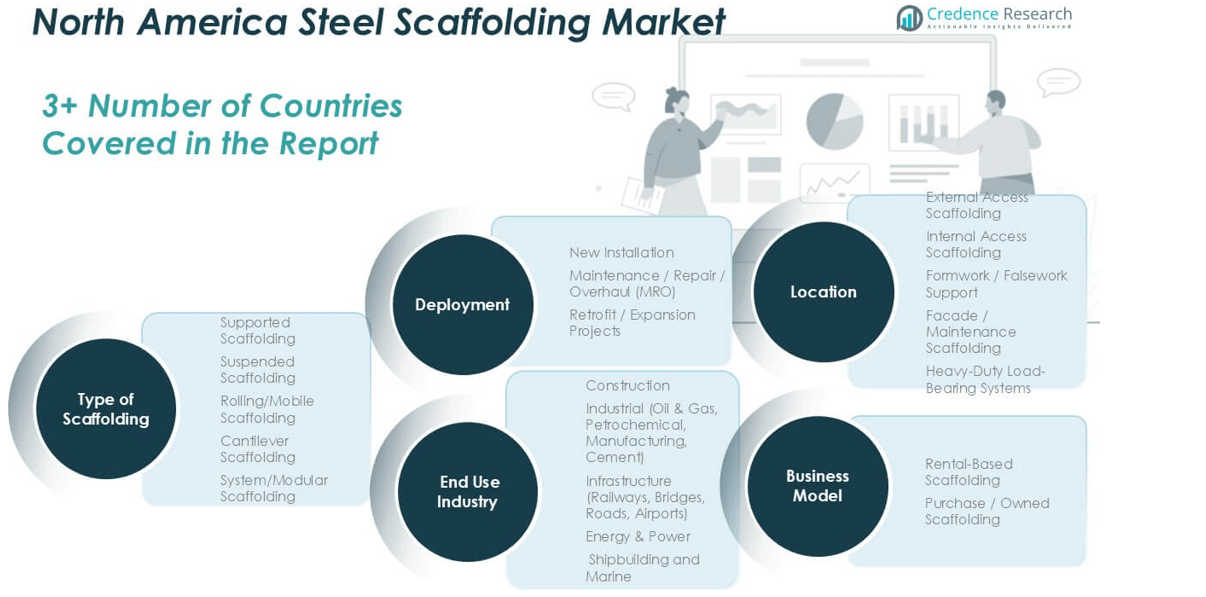
Market Segmentations:
By Type
- Supported Scaffolding
- Suspended Scaffolding
- Rolling/Mobile Scaffolding
- Cantilever Scaffolding
- System/Modular Scaffolding
By Location
- External Access Scaffolding
- Internal Access Scaffolding
- Formwork / Falsework Support
- Facade / Maintenance Scaffolding
- Heavy-Duty Load-Bearing Systems
By End-use Industry
- Construction
- Industrial (Oil & Gas, Petrochemical, Manufacturing, Cement)
- Infrastructure (Railways, Bridges, Roads, Airports)
- Energy & Power (Thermal, Hydro, Renewable Plant Maintenance)
- Shipbuilding and Marine
By Deployment
- New Installation
- Maintenance / Repair / Overhaul (MRO)
- Retrofit / Expansion Projects
By Business Model
- Rental-Based Scaffolding
- Purchase / Owned Scaffolding
By Geography
- United States
- Canada
- Mexico
Competitive Landscape
The competitive landscape of the North America steel scaffolding market is moderately consolidated, with several global and regional players focusing on product innovation and service expansion. Key companies include Layher Holding GmbH & Co. KG, PERI SE, BrandSafway, ULMA Construction, Altrad Group, Waco Kwikform, ADTO Group, RMD Kwikform, Sunbelt Rentals, and Instant Upright Ltd. These players compete on product quality, safety compliance, and rental service networks. BrandSafway and Sunbelt Rentals dominate the rental and access solutions space across the U.S. and Canada. Layher and PERI are recognized for their modular scaffolding systems offering quick assembly and high load capacity. Companies invest in digital monitoring solutions, galvanized systems, and lightweight designs to improve worker safety and reduce installation time. Strategic partnerships, acquisitions, and expansion of rental fleets are key strategies adopted to strengthen regional presence and serve the growing construction, industrial, and infrastructure maintenance demand.
Key Player Analysis
- Layher Holding GmbH & Co. KG
- PERI SE
- BrandSafway (Safway Group)
- ULMA Construction
- Altrad Group
- Waco Kwikform
- ADTO Group (Atlantic Pacific Equipment, AT-PAC)
- RMD Kwikform
- Sunbelt Rentals (industrial access, rental segment in US/Canada)
- Instant Upright Ltd.
Recent Developments
- In April 2025, Layher unveiled its new corporate identity and cutting-edge scaffolding innovations at Bauma 2025 in Munich. Highlights included advanced digital planning tools (Layher SIM2Field®), lightweight bridging systems, and new modular components for versatile applications. The company emphasized digitalization, safety, and sustainability as part of their redesign, and introduced products like the Xtra-Slim steel plank for tight spaces and the O-version FlexBeam compatible with weather protection roofs.
- In April 2025, PERI showcased digital, sustainable scaffolding solutions and smart construction tools at Bauma 2025. The innovations included modular, safety-focused systems and new digital management tools, emphasizing eco-friendly materials and productivity gains for residential and infrastructure projects.
- In February 2025, the Altrad Group finalized the acquisition of Stork's UK business and Heras' UK mobile fencing operations, significantly expanding its services in temporary fencing, hoarding, and scaffolding in the United Kingdom and Europe.
Report Coverage
The research report offers an in-depth analysis based on Type, Location, End-use Industry, Deployment, Business Model and Geography. It details leading market players, providing an overview of their business, product offerings, investments, revenue streams, and key applications. Additionally, the report includes insights into the competitive environment, SWOT analysis, current market trends, as well as the primary drivers and constraints. Furthermore, it discusses various factors that have driven market expansion in recent years. The report also explores market dynamics, regulatory scenarios, and technological advancements that are shaping the industry. It assesses the impact of external factors and global economic changes on market growth. Lastly, it provides strategic recommendations for new entrants and established companies to navigate the complexities of the market.
Future Outlook
- The market will see strong growth driven by infrastructure modernization and urban redevelopment projects.
- Adoption of modular and system scaffolding will increase due to faster installation needs.
- Demand from industrial maintenance and turnaround projects will remain a key revenue source.
- Digital monitoring and IoT-enabled scaffolding solutions will improve safety and efficiency.
- Rental services will expand as contractors prefer cost-effective access to equipment.
- Strict OSHA safety regulations will encourage use of certified steel scaffolding systems.
- Renewable energy projects will create opportunities for turbine and plant maintenance scaffolding.
- Lightweight galvanized systems will gain preference to reduce labor effort and handling time.
- Investment in training programs will grow to address skilled labor shortages in erection.
- The United States will continue to lead the market, with Canada and Mexico showing steady growth.
Request a Free Sample
Fill in your details and we'll send you a free sample report.
- Sample data tables & charts
- Research methodology
Need a Custom Version of This Report?
Tailor the scope, geography, or segments to your exact requirements.
- Custom geography or segment scope
- Direct access to our analyst team
Frequently Asked Questions
What is the current market size for North America Steel Scaffolding market, and what is its projected size in 2032?
At what Compound Annual Growth Rate is the North America Steel Scaffolding market projected to grow between 2025 and 2032?
Which North America Steel Scaffolding market segment held the largest share in 2024?
What are the primary factors fueling the growth of the North America Steel Scaffolding market?
Who are the leading companies in the North America Steel Scaffolding market?
Table of Content
Chapter 1. Report Introduction
- 1.1 Report Description & Purpose
- 1.1.1 Report Title & Market Definition
- 1.1.2 Unique Selling Propositions (USP) & Key Differentiators
- 1.1.3 Value Proposition for Stakeholders
- 1.2 Research Objectives
- 1.2.1 Market Sizing Objectives (Volume & Revenue)
- 1.2.2 Segmentation Objectives
- 1.2.3 Competitive Intelligence Objectives
- 1.2.4 Forecast & Scenario Objectives
- 1.3 Report Scope
- 1.3.1 North America Steel Scaffolding Scope – Types & Subtypes Covered
- 1.3.2 Geographic Scope – Regions & Countries Covered
- 1.3.3 Historical Period, Base Year & Forecast Period (2024; forecast to 2032)
- 1.3.4 Inclusions & Exclusions
- 1.4 HS Code & Classification Framework
- 1.5 Currency, Units & Pricing Basis
- 1.6 Target Stakeholders
- 1.7 Limitations & Assumptions
Chapter 2. Executive Summary
- 2.1 Global North America Steel Scaffolding Market Snapshot
- 2.1.1 Market Size – Historical (2024) & Forecast (2024-2032) (2024: USD 7,764.17 million → 2032: USD 12,784.84 million)
- 2.1.2 Volume & Revenue – Global Totals
- 2.1.3 Key Market Highlights – Top Five Facts
- 2.2 North America Steel Scaffolding Market Segmentation Snapshot
- 2.2.1 Market Split by Region – 2024 vs. 2032
- 2.3 Competitive Snapshot
- 2.3.1 Top 10 Players by Revenue Share – 2024
- 2.3.2 Top 10 Players by Volume Share – 2024
- 2.3.3 Recent Strategic Developments (18-Month Summary)
- 2.4 Key Investment Highlights & Strategic Conclusions
Chapter 3. North America Steel Scaffolding Market Dynamics & Industry Analysis
- 3.1 Market Overview & Context
- 3.1.1 North America Steel Scaffolding Market Position in the Broader Automotive Value Chain
- 3.1.2 OEM vs. Replacement Market Dynamics
- 3.1.3 Market Maturity & Development Stage by Region
- 3.2 North America Steel Scaffolding Market Drivers
- 3.3 North America Steel Scaffolding Market Restraints & Challenges
- 3.4 North America Steel Scaffolding Market Opportunities
- 3.5 Porter's Five Forces Analysis
- 3.5.1 Threat of New Entrants
- 3.5.2 Bargaining Power of Suppliers
- 3.5.3 Bargaining Power of Buyers
- 3.5.4 Threat of Substitutes
- 3.5.5 Competitive Rivalry – Intensity Assessment
- 3.6 North America Steel Scaffolding Value Chain Analysis
- 3.6.1 Upstream – Raw Material/Input Suppliers
- 3.6.1.1 Raw Material/Input 1
- 3.6.1.2 Raw Material/Input 2
- 3.6.1.3 Raw Material/Input 3
- 3.6.2 Midstream – Production/Manufacturing/Service Delivery
- 3.6.2.1 Production/Process Overview
- 3.6.2.2 Key Facility Locations & Capacity by Manufacturer
- 3.6.3 Downstream – Distribution & End Consumer
- 3.6.3.1 Primary Channel – B2B/OEM
- 3.6.3.2 Secondary Channels – Dealer, Retail, Online, Direct
- 3.6.4 Value Chain Profitability Analysis
- 3.6.1 Upstream – Raw Material/Input Suppliers
- 3.7 PESTEL Analysis
- 3.7.1 Political Factors
- 3.7.2 Economic Factors
- 3.7.3 Social Factors
- 3.7.4 Technological Factors
- 3.7.5 Environmental Factors
- 3.7.6 Legal Factors
- 3.8 North America Steel Scaffolding Supply Chain Analysis
- 3.8.1 Raw Material/Input Supply Risk Assessment
- 3.8.2 Manufacturing Concentration Risk (Geographic Exposure)
- 3.8.3 Trade Disruption Impact Analysis
- 3.9 Regulatory & Policy Landscape
Note: The regulatory and policy landscape section covers regulations based on their applicability to the market, North America Steel Scaffolding category, geography, and scope of the study. Only regulatory frameworks with a material impact on operations, compliance, trade, sustainability, or market access are analyzed in detail.
Chapter 4. Key Investment Pockets & Opportunity Analysis
- 4.1 North America Steel Scaffolding Market Attractiveness Analysis
- 4.1.1 By Region – Investment Attractiveness Matrix (Volume × CAGR)
- 4.2 Absolute Revenue Growth Opportunity
- 4.2.1 By Region – Absolute USD Growth Through 2032
- 4.3 Incremental Volume Opportunity
- 4.3.1 By Region – Incremental Volume Through 2032
- 4.3.2 Segment – Incremental Volume
- 4.4 Emerging Submarket Opportunity Deep Dive (Subject to Applicability)
- 4.5 Emerging Market Opportunity Scorecards
- 4.5.1 United States
- 4.5.2 Europe
- 4.5.3 Asia
- 4.5.4 Middle East & Africa
Note: Emerging Market Opportunity Scorecards will be included based on relevance and strategic importance. Regions listed are indicative and may vary depending on data availability and market dynamics.
Chapter 5. North America Steel Scaffolding Import-Export Analysis & Trade Flows
- 5.1 Global Trade Overview
- 5.1.1 Global Export Value by Country (2024)
- 5.1.2 Global Export Volume by Country (2024)
- 5.1.3 Global Import Value by Country (2024)
- 5.1.4 Global Import Volume by Country (2024)
- 5.1.5 Net Trade Balance by Country (2024)
- 5.2 Export Analysis – Segment
- 5.2.1 Type 1 (HS Code)
- 5.2.2 Type 2 (HS Code)
- 5.2.3 Type 3 (HS Code)
- 5.2.4 Type 4 (HS Code)
- 5.2.5 Type 5 (HS Code)
- 5.3 Import Analysis – Segment
- 5.3.1 Type 1 (HS Code)
- 5.3.2 Type 2 (HS Code)
- 5.3.3 Type 3 (HS Code)
- 5.3.4 Type 4 (HS Code)
- 5.3.5 Type 5 (HS Code)
- 5.4 Average Unit Trade Prices
- 5.4.1 Average Export Price – Segment & Country
- 5.4.2 Average Import Price – Segment & Source Country
- 5.4.3 Price Trends (2024)
- 5.5 Key Trade Route Analysis
- 5.5.1 Trade Route 1
- 5.5.2 Trade Route 2
- 5.5.3 Trade Route 3
- 5.5.4 Trade Route 4
- 5.5.5 Trade Route 5
- 5.6 Trade Policy Impact Assessment
- 5.6.1 US Anti-Dumping & Section 301 Tariffs
- 5.6.2 EU Customs Union Impact
- 5.6.3 Major Free Trade Agreements
- 5.6.4 USMCA Rules of Origin
Note: Trade policy analysis will be included only where relevant to the North America Steel Scaffolding market.
Chapter 6. Competitive Landscape & Company Benchmarking
- 6.1 North America Steel Scaffolding Market Concentration & Structure
- 6.1.1 Herfindahl-Hirschman Index (HHI) – vs. 2024
- 6.1.2 Tier 1, Tier 2 & Tier 3 Market Structure
- 6.1.3 Global, Regional & Local Player Dynamics
- 6.2 North America Steel Scaffolding Market Share Analysis – 2024
- 6.2.1 Global Revenue Share by Company
- 6.2.2 Global Volume Share by Company
- 6.2.3 Regional Revenue Share
- 6.2.4 Market Share Evolution ( vs. 2024)
- 6.2.5 OEM Segment Share by Company
- 6.2.6 Replacement Segment Share by Company
- 6.3 Production/Delivery Capacity & Facility Analysis
- 6.3.1 Global Installed Capacity
- 6.3.2 Capacity Utilization Rates
- 6.3.3 Production/Output Volume
- 6.3.4 Facility Locations & Capacity Map
- 6.3.5 Planned Capacity Additions
- 6.4 North America Steel Scaffolding Competitive Benchmarking Matrix
- 6.4.1 Revenue, Volume, CAGR & Profitability Comparison
- 6.4.2 Channel Revenue Mix
- 6.4.3 Geographic Revenue Exposure
- 6.4.4 R&D Intensity
- 6.4.5 Sustainability Maturity
- 6.5 Strategic Developments in North America Steel Scaffolding (Last 24 Months)
- 6.5.1 Mergers, Acquisitions & Divestments
- 6.5.2 New North America Steel Scaffolding Launches
- 6.5.3 Facility Expansions
- 6.5.4 Strategic Alliances, Joint Ventures & Partnerships
- 6.5.5 Distribution Expansion & Market Entry
- 6.5.6 Sustainability & ESG Initiatives
- 6.6 Competitive Strategy Mapping
- 6.6.1 Leader, Challenger, Follower & Niche Classification
- 6.6.2 Pricing Strategy Comparison
- 6.6.3 Channel Strategy Matrix
Note: Strategic developments are included based on their materiality and the availability of reliable information.
Chapter 7. Global North America Steel Scaffolding Market – By Distribution Channel
- 7.1 Segment Overview
- 7.1.1 Volume & Revenue Split by Channel (2024 & 2032)
- 7.1.2 Channel Mix Evolution (2024-2032)
Chapter 8. Regional Market Analysis – Global Overview
- 8.1 Global Regional Overview
- 8.1.1 Regional Volume Share
- 8.1.2 Regional Revenue Share
- 8.1.3 Regional Volume by Region
- 8.1.4 Regional Revenue by Region
- 8.1.5 Regional Forecast Through 2032
- 8.2 Cross-Regional Segment Analysis
- 8.2.1 By Distribution Channel
- 8.2.2 By Brand/Price Tier
Chapter 9. North America North America Steel Scaffolding Market
- 9.1 United States
- 9.2 Canada
- 9.3 Mexico
Chapter 10. Europe North America Steel Scaffolding Market
- 10.1 Germany
- 10.2 France
- 10.3 Italy
- 10.4 United Kingdom
- 10.5 Spain
- 10.6 Poland
- 10.7 Russia
- 10.8 Netherlands
- 10.9 Belgium
- 10.10 Sweden
- 10.11 Denmark
- 10.12 Norway
- 10.13 Rest of Europe
Chapter 11. Asia Pacific North America Steel Scaffolding Market
- 11.1 China
- 11.2 India
- 11.3 Japan
- 11.4 South Korea
- 11.5 Thailand
- 11.6 Indonesia
- 11.7 Vietnam
- 11.8 Malaysia
- 11.9 Australia
- 11.10 Rest of Asia Pacific
Chapter 12. Latin America North America Steel Scaffolding Market
- 12.1 Brazil
- 12.2 Argentina
- 12.3 Colombia
- 12.4 Chile
- 12.5 Rest of Latin America
Chapter 13. Middle East North America Steel Scaffolding Market
- 13.1 Saudi Arabia
- 13.2 United Arab Emirates
- 13.3 Turkey
- 13.4 Israel
- 13.5 Iran
- 13.6 Rest of the Middle East
Chapter 14. Africa North America Steel Scaffolding Market
- 14.1 South Africa
- 14.2 Egypt
- 14.3 Nigeria
- 14.4 Morocco
- 14.5 Rest of Africa
Chapter 15. North America Steel Scaffolding Company Profiles
- 15.1 [Company 01]
- 15.1.1 Company Overview
- 15.1.2 Key Management Personnel
- 15.1.3 Products & Services Portfolio
- 15.1.4 Financial Performance
- 15.1.5 Key Market Focus & Geographic Presence
- 15.1.6 Recent Developments & Strategic Initiatives
Note: The company profile list is preliminary and may change based on research findings, market developments, data availability, and client requirements.
Chapter 16. Appendices
- Appendix A – List of Abbreviations & Acronyms
- Appendix B – Industry Classification Code Reference – Full Series
- Appendix C – Production & Capacity Data Tables
- Appendix D – End-Use & Demand Base Tables
- Appendix E – Consumption & Replacement Rate Assumptions
- Appendix F – ASP Reference Tables
- Appendix G – Manufacturing & Facility Database
- Appendix H – Import-Export Data Tables
- Appendix I – Regulatory Summary Tables
- Appendix J – Primary Research Participant List (Anonymized)
- Appendix K – Primary Research Questionnaire Framework
- Appendix L – Data Sources & Bibliography
- Appendix M – Market Size Divergence & Source Comparison
Chapter 17. Research Methodology
- 17.1 Research Framework & Philosophy
- 17.2 Secondary Research – Sources, Hierarchy & Data Extraction
- 17.3 Data Modeling – Bottom-Up & Top-Down Market Sizing
- 17.4 Primary Research – Stakeholder Framework, LOI & Sample Sizes
- 17.5 Forecast Methodology – Regression, Scenario & Sensitivity Analysis
- 17.6 Quality Control – Four-Layer Validation Framework
- 17.7 Limitations & Standard Assumptions
- 17.8 Disclaimer
