
| REPORT ATTRIBUTE | DETAILS |
|---|---|
| Historical Period | 2019-2022 |
| Base Year | 2023 |
| Forecast Period | 2024-2032 |
| Paddle and Locker Switches Market Size 2024 | USD 2,612.5 million |
| Paddle and Locker Switches Market, CAGR | 4.2% |
| Paddle and Locker Switches Market Size 2032 | USD 3,630.76 million |
Market Overview:
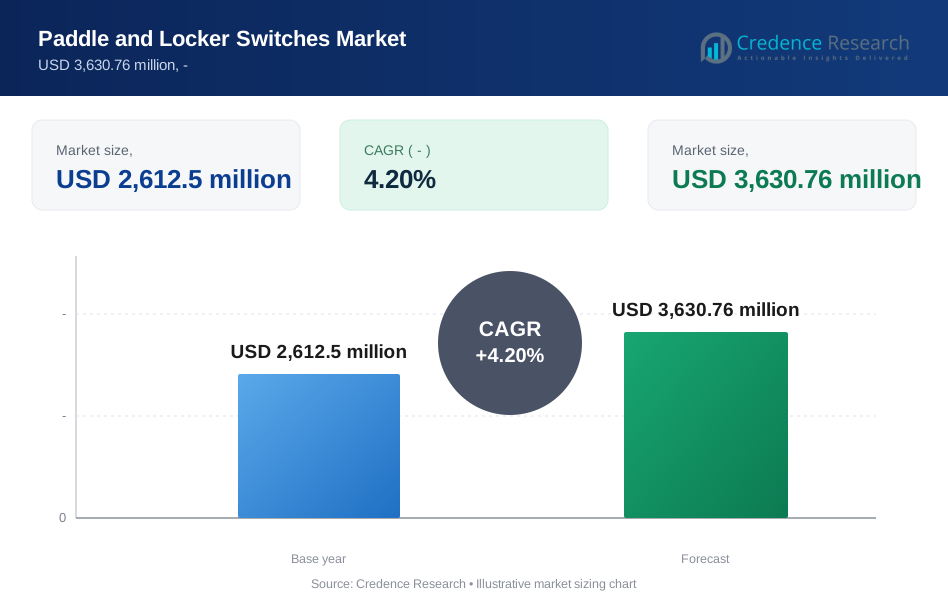
The Paddle and Locker Switches Market is projected to grow from a market size of USD 2,612.5 million in 2024 to approximately USD 3,630.76 million by 2032, reflecting a compound annual growth rate (CAGR) of 4.2%. Paddle and locker switches serve a critical role in providing user-friendly and reliable control mechanisms in a variety of applications, including industrial, commercial, residential, and automotive settings. These switches, known for their durability, ergonomic design, and high performance, have gained traction due to their versatile applicability across sectors seeking effective control solutions.
Key market drivers include the rising demand for advanced control systems across the automotive and industrial sectors, where paddle and locker switches contribute to improved operational efficiency and user interface. The rapid growth of smart home technologies and automation in commercial buildings also bolsters demand for these switches, enabling seamless control and enhanced energy management. Moreover, ongoing investments in infrastructure development and industrial modernization are spurring adoption in various applications, including heavy machinery and automated production lines. The trend toward user-friendly and safety-enhanced electrical controls further reinforces the market's growth prospects, driving innovation and customization in switch designs.
Regionally, North America and Europe hold substantial shares in the Paddle and Locker Switches Market, attributed to their focus on industrial automation, smart buildings, and robust infrastructure modernization initiatives. The strong presence of major industry players and high adoption rates of advanced technologies support market growth in these regions. Meanwhile, the Asia-Pacific region is expected to witness the fastest growth due to rapid industrialization, urbanization, and infrastructure development, particularly in emerging economies like China and India. The increasing use of automation technologies and smart systems further accelerates demand in the region, creating significant opportunities for market expansion. Latin America, the Middle East, and Africa are experiencing steady growth, primarily driven by investments in construction and energy sectors.
Market Drivers:
Increasing Demand for Smart Home and Building Automation:
The rise of smart home technologies and building automation systems is a major driver for the Paddle and Locker Switches Market. As consumers seek greater convenience, security, and energy efficiency, demand for advanced control mechanisms like paddle and locker switches has surged. According to the U.S. Department of Energy, smart home devices can reduce energy usage by 10-15%, prompting widespread adoption. Companies such as Schneider Electric and Legrand are capitalizing on this trend by offering switches with advanced connectivity features, enhancing home automation solutions.
Expansion of Industrial Automation:
Industrial automation has gained momentum worldwide as manufacturers focus on efficiency and precision in their processes. For instance, in 2023, the global market for industrial automation was valued at over USD 150 billion, as per a study by the International Federation of Robotics. Paddle and locker switches play a critical role in controlling industrial equipment, enhancing operational safety and productivity. Major industrial sectors, such as automotive manufacturing and process industries, increasingly rely on these switches to optimize their workflows and meet stringent safety standards.
Increasing Automotive Integration:
The integration of paddle and locker switches in automotive applications has experienced a significant boost due to the rising demand for enhanced user experience and control in vehicles. Advanced automotive electronics, including steering-mounted controls and console switches, have become standard features in many modern vehicles. According to data from the European Automobile Manufacturers Association, over 60% of new cars in Europe feature such systems, driving demand for high-performance switches. Companies like Bosch and Continental are continually innovating in this space to improve functionality and ergonomics.
Infrastructure Modernization Initiatives:
Government initiatives worldwide to upgrade infrastructure further fuel the demand for advanced switching solutions. For instance, the European Commission allocated over EUR 1 trillion towards the European Green Deal, emphasizing smart and energy-efficient infrastructure. This large-scale modernization effort drives demand for paddle and locker switches in residential, commercial, and public infrastructure projects, contributing to enhanced control and energy management capabilities.
Market Trends:
Increasing Adoption of Touchless and Smart Switches:
The shift toward touchless and smart switching solutions is a prevailing trend in the Paddle and Locker Switches Market. With heightened emphasis on hygiene and convenience, touchless technology has gained significant traction across various sectors. For instance, A 2023 survey by the National Electrical Manufacturers Association (NEMA) revealed that touchless switch installations rose by 25% in commercial spaces, driven by demand for contact-free solutions. Companies like Honeywell and Lutron have responded by introducing touchless switches that enhance user experience and safety in residential, healthcare, and commercial settings.
Focus on Energy Efficiency and Sustainability:
Sustainability initiatives and stringent energy efficiency regulations continue to shape market trends, driving the adoption of energy-efficient paddle and locker switches. According to the International Energy Agency (IEA), global efforts to improve energy efficiency could reduce energy demand by 10% by 2030. For instance, Leading manufacturers, including Schneider Electric and Siemens, are developing eco-friendly switch solutions designed to minimize energy consumption in buildings and industrial applications. These products not only comply with environmental standards but also offer cost-saving benefits to consumers and businesses.
Integration of IoT-Enabled Controls:
The incorporation of IoT (Internet of Things) technology into paddle and locker switches is transforming traditional switching mechanisms into smart, interconnected systems. IoT-enabled switches allow for seamless communication and remote control, enhancing the functionality of building management systems. A recent study highlighted that IoT device installations in homes and buildings are expected to surpass 75 billion by 2025. Industry players such as Legrand and ABB have introduced IoT-compatible switches to support advanced automation and data-driven control strategies.
Growing Use of Advanced Materials and Designs:
Innovation in materials and designs has become a key trend, enhancing the durability and functionality of paddle and locker switches. Advanced materials such as thermoplastics and composites are increasingly used to create ergonomic and robust switches for demanding environments. For instance, in 2022, multiple manufacturers collaborated to introduce weather-resistant switches specifically designed for outdoor and industrial use, meeting consumer demand for long-lasting and reliable solutions.
Market Challenges Analysis:
Regulatory Compliance and Standards:
The Paddle and Locker Switches Market faces challenges associated with stringent regulatory standards imposed by government authorities, such as the U.S. Occupational Safety and Health Administration (OSHA) and the European Committee for Electrotechnical Standardization (CENELEC). These regulations emphasize product safety, energy efficiency, and material standards, requiring manufacturers to invest in rigorous testing and compliance measures. While these standards promote safety and quality, they also add significant costs to the production process, affecting profit margins and potentially limiting smaller players' market entry.
High Competition and Price Pressure:
The market is highly competitive, with numerous global and regional players vying for market share. Intense price competition often results in squeezed profit margins, particularly for smaller manufacturers lacking the economies of scale enjoyed by major companies. To stay competitive, market participants must continuously innovate and offer differentiated products, leading to increased research and development expenses. This competitive environment can make it challenging for new entrants to establish themselves or for existing players to maintain strong profitability.
Supply Chain Disruptions and Raw Material Costs:
The market also contends with supply chain disruptions and fluctuations in raw material costs, which have become more pronounced due to global economic uncertainties and geopolitical factors. These disruptions can lead to delays in manufacturing and higher production costs, directly impacting market growth. For instance, shortages of key materials such as metals and plastics have affected production timelines, reducing manufacturers' ability to meet demand effectively.
Technological Obsolescence Risk:
The rapid pace of technological advancements in automation and smart home technologies presents another challenge. As new, more advanced switching technologies emerge, traditional paddle and locker switches may become less appealing, risking obsolescence. Manufacturers must invest heavily in research and development to stay relevant, which can strain resources, particularly for small and medium-sized enterprises.
Market Segmentation Analysis:
By Type
The Paddle and Locker Switches Market is segmented by type into paddle switches and locker switches. Paddle switches, known for their ergonomic design and ease of use, are widely used in residential, commercial, and industrial applications, particularly for lighting and electrical control. Locker switches, on the other hand, are favored in settings that require secure, reliable control, such as machinery and equipment in industrial facilities. The demand for both types continues to rise due to their versatility and ability to support advanced automation.
By Technology
The market is further segmented by technology into traditional mechanical switches and smart, IoT-enabled switches. Mechanical switches offer robust and reliable performance and remain popular due to their simplicity and cost-effectiveness. Meanwhile, smart switches, integrated with IoT capabilities, provide enhanced control, energy efficiency, and automation features, aligning with the growing trend of smart homes and buildings. The increasing adoption of IoT-enabled solutions is driving innovation and reshaping the market landscape.
By End User
End-user segments in the Paddle and Locker Switches Market include residential, commercial, and industrial sectors. The residential segment benefits from increasing demand for user-friendly and smart control systems in modern homes. Commercial applications, such as office buildings and retail spaces, prioritize efficiency and automation, driving demand for advanced switching solutions. In contrast, the industrial segment relies on durable, high-performance switches for machinery and infrastructure, further driving market demand. The diverse applications across these sectors underscore the market's potential for continued growth and innovation.
Segmentations:
By Type
- Single-Pole Switch
- Double-Pole Switch
By Application
- Consumer Electronics and Appliance
- Telecommunications
- Industrial and Medical
- Other
By Geography
- North America
- U.S.
- Canada
- Mexico
- Europe
- Germany
- France
- U.K.
- Italy
- Spain
- Rest of Europe
- Asia Pacific
- China
- Japan
- India
- South Korea
- South-east Asia
- Rest of Asia Pacific
- Latin America
- Brazil
- Argentina
- Rest of Latin America
- Middle East & Africa
- GCC Countries
- South Africa
- Rest of the Middle East and Africa
Regional Analysis:
North America
North America holds a substantial share of the Paddle and Locker Switches Market, accounting for approximately 30% of the global market. The region's dominance is driven by high demand for smart home technologies, industrial automation, and energy-efficient solutions. The United States and Canada lead in adopting advanced switching technologies, with a focus on safety, durability, and seamless connectivity. Favorable government regulations and incentives to promote energy efficiency, coupled with the widespread adoption of IoT-enabled devices, further support market growth. Additionally, strong industrial and commercial sectors ensure sustained demand for paddle and locker switches across diverse applications.
Europe
Europe represents around 25% of the market share, supported by the region’s emphasis on energy efficiency, smart building initiatives, and stringent regulatory standards. Countries like Germany, the UK, and France are at the forefront of adopting sustainable and intelligent electrical control solutions. The European Union's directives on reducing carbon emissions and promoting smart infrastructure have accelerated the integration of advanced switching solutions. Market players are focused on developing eco-friendly, high-performance switches to meet these stringent regulations, driving innovation and product adoption.
Asia-Pacific
The Asia-Pacific region leads the Paddle and Locker Switches Market, with a market share of approximately 35%. This dominance is driven by rapid industrialization, urbanization, and infrastructure development, particularly in emerging economies such as China, India, and Southeast Asian countries. Increasing demand for residential, commercial, and industrial automation is fueling the adoption of paddle and locker switches. Government initiatives promoting smart city projects, energy-efficient buildings, and infrastructure upgrades further accelerate market growth. The presence of numerous regional manufacturers and the availability of cost-effective solutions contribute to the strong market position of the region.
Middle East & Africa
The Middle East & Africa region holds a moderate market share of around 5%. Growth in this region is driven by increasing investments in infrastructure projects, energy efficiency initiatives, and smart building developments. Countries such as the UAE and Saudi Arabia are investing heavily in commercial and residential developments, creating a demand for advanced switching solutions. However, market expansion is somewhat constrained by economic variability and slower adoption rates in certain areas.
Latin America
Latin America captures about 5% of the global market share, with growth primarily driven by urbanization and the expansion of infrastructure in countries such as Brazil, Mexico, and Argentina. While the market faces challenges such as economic fluctuations and varying regulatory frameworks, ongoing modernization projects and increasing demand for energy-efficient solutions create positive growth opportunities. The region's focus on improving electrical infrastructure reliability and safety further drives demand for paddle and locker switches.
Key Player Analysis:
- E-Switch
- NTE Electronics
- C&K Components
- Littelfuse
- APEM (IDEC)
- Eaton
- Carling Technologies
- NKK Switches
- TAIWAY Electronics
- HELLA
Competitive Analysis:
The Paddle and Locker Switches Market is marked by intense competition, with key players focusing on innovation, product differentiation, and expansion to maintain their market positions. Leading companies such as Eaton, Carling Technologies, C&K Components, and Littelfuse invest significantly in research and development to enhance product performance, durability, and smart capabilities. The market also includes regional players who compete by offering cost-effective solutions tailored to local demands. Increasing consumer demand for smart, IoT-enabled devices and energy-efficient solutions further intensifies competition as companies strive to introduce advanced technologies that meet evolving market needs. Strategic partnerships, acquisitions, and product portfolio expansions are common strategies employed to gain competitive advantages. The industry’s dynamic nature requires continuous adaptation to technological advancements and regulatory changes, compelling market participants to innovate and deliver value-added solutions that cater to a broad range of industrial, residential, and commercial applications.
Recent Developments:
- In March 2023 Eaton introduced a new line of smart rocker switches designed for seamless integration with home automation systems. These switches offer wireless connectivity and energy monitoring features, catering to the growing demand for smart home solutions.
- In July 2022 Littelfuse completed the acquisition of C&K Switches, expanding its product portfolio to include a comprehensive range of paddle and rocker switches. This strategic move aims to enhance Littelfuse's market presence and provide customers with a broader selection of switching solutions.
- In January 2024 Carling Technologies launched a series of environmentally sealed rocker switches suitable for harsh environments. These switches are designed to withstand extreme conditions, making them ideal for industrial and marine applications.
- In September 2023 NKK Switches announced the development of IoT-enabled paddle switches that allow for remote monitoring and control. This innovation aligns with the increasing trend toward connected devices and smart infrastructure.
Market Concentration & Characteristics:
The Paddle and Locker Switches Market exhibits a moderate level of market concentration, with a mix of established global players and numerous regional manufacturers. Leading companies, such as Eaton, Carling Technologies, C&K Components, and Littelfuse, hold significant market share due to their strong brand reputation, extensive distribution networks, and continuous investment in innovative products. Smaller regional players compete by offering cost-effective, specialized solutions tailored to local demands, thereby maintaining a dynamic competitive landscape. Market characteristics include a strong emphasis on product durability, energy efficiency, and technological advancement, particularly as smart and IoT-enabled switches gain traction. Additionally, the market is shaped by evolving consumer preferences for advanced connectivity, heightened regulatory standards promoting safety and energy efficiency, and a growing focus on sustainability. This combination of factors drives continuous innovation, strategic partnerships, and product differentiation efforts among market participants.
Report Coverage:
The research report offers an in-depth analysis based on Type, Application, and Geography. It details leading market players, providing an overview of their business, product offerings, investments, revenue streams, and key applications. Additionally, the report includes insights into the competitive environment, SWOT analysis, current market trends, as well as the primary drivers and constraints. Furthermore, it discusses various factors that have driven market expansion in recent years. The report also explores market dynamics, regulatory scenarios, and technological advancements that are shaping the industry. It assesses the impact of external factors and global economic changes on market growth. Lastly, it provides strategic recommendations for new entrants and established companies to navigate the complexities of the market.
Future Outlook:
- The market will see increased demand for smart, IoT-enabled paddle and locker switches driven by the rising adoption of smart home and building automation systems.
- Technological advancements will lead to the development of more energy-efficient and eco-friendly switches, catering to evolving regulatory standards and consumer preferences.
- Integration of advanced materials will enhance switch durability and performance in demanding industrial and outdoor environments.
- Emerging markets in Asia-Pacific and Latin America will drive growth, fueled by rapid urbanization, industrialization, and infrastructure expansion.
- Ongoing investments in industrial automation and factory modernization will continue to boost demand for reliable and high-performance switches.
- The trend toward touchless control and safety-enhanced products will accelerate innovation and adoption across healthcare, commercial, and public sectors.
- Competitive dynamics will emphasize product differentiation, customization, and adherence to energy efficiency standards to capture market share.
- Expansion of smart city initiatives globally will present opportunities for advanced switching solutions in infrastructure and public services.
- Collaboration and partnerships between key industry players and technology firms will spur innovation and expand market reach.
- Supply chain optimization and cost control measures will become focal points for manufacturers in response to economic uncertainties and raw material price fluctuations.
Request a Free Sample
Fill in your details and we'll send you a free sample report.
- Sample data tables & charts
- Research methodology
Need a Custom Version of This Report?
Tailor the scope, geography, or segments to your exact requirements.
- Custom geography or segment scope
- Direct access to our analyst team
Frequently Asked Questions
What is the current size of the Paddle and Locker Switches Market?
What factors are driving the growth of the Paddle and Locker Switches Market?
What are some challenges faced by the Paddle and Locker Switches Market?
Who are the major players in the Paddle and Locker Switches Market?
Which segment is leading the market share?
Table of Content
Chapter 1. Report Introduction
- 1.1 Report Description & Purpose
- 1.1.1 Report Title & Market Definition
- 1.1.2 Unique Selling Propositions (USP) & Key Differentiators
- 1.1.3 Value Proposition for Stakeholders
- 1.2 Research Objectives
- 1.2.1 Market Sizing Objectives (Volume & Revenue)
- 1.2.2 Segmentation Objectives
- 1.2.3 Competitive Intelligence Objectives
- 1.2.4 Forecast & Scenario Objectives
- 1.3 Report Scope
- 1.3.1 Paddle and Locker Switches Scope – Types & Subtypes Covered
- 1.3.2 Geographic Scope – Regions & Countries Covered
- 1.3.3 Historical Period, Base Year & Forecast Period (the historical period; forecast to the forecast period)
- 1.3.4 Inclusions & Exclusions
- 1.4 HS Code & Classification Framework
- 1.5 Currency, Units & Pricing Basis
- 1.6 Target Stakeholders
- 1.7 Limitations & Assumptions
Chapter 2. Executive Summary
- 2.1 Global Paddle and Locker Switches Market Snapshot
- 2.1.1 Market Size – Historical (the historical period) & Forecast (the forecast period) (base year: USD 2,612.5 million → forecast year: USD 3,630.76 million)
- 2.1.2 Volume & Revenue – Global Totals
- 2.1.3 Key Market Highlights – Top Five Facts
- 2.2 Paddle and Locker Switches Market Segmentation Snapshot
- 2.2.1 Market Split by Region – vs.
- 2.3 Competitive Snapshot
- 2.3.1 Top 10 Players by Revenue Share –
- 2.3.2 Top 10 Players by Volume Share –
- 2.3.3 Recent Strategic Developments (18-Month Summary)
- 2.4 Key Investment Highlights & Strategic Conclusions
Chapter 3. Paddle and Locker Switches Market Dynamics & Industry Analysis
- 3.1 Market Overview & Context
- 3.1.1 Paddle and Locker Switches Market Position in the Broader Automotive Value Chain
- 3.1.2 OEM vs. Replacement Market Dynamics
- 3.1.3 Market Maturity & Development Stage by Region
- 3.2 Paddle and Locker Switches Market Drivers
- 3.3 Paddle and Locker Switches Market Restraints & Challenges
- 3.4 Paddle and Locker Switches Market Opportunities
- 3.5 Porter's Five Forces Analysis
- 3.5.1 Threat of New Entrants
- 3.5.2 Bargaining Power of Suppliers
- 3.5.3 Bargaining Power of Buyers
- 3.5.4 Threat of Substitutes
- 3.5.5 Competitive Rivalry – Intensity Assessment
- 3.6 Paddle and Locker Switches Value Chain Analysis
- 3.6.1 Upstream – Raw Material/Input Suppliers
- 3.6.1.1 Raw Material/Input 1
- 3.6.1.2 Raw Material/Input 2
- 3.6.1.3 Raw Material/Input 3
- 3.6.2 Midstream – Production/Manufacturing/Service Delivery
- 3.6.2.1 Production/Process Overview
- 3.6.2.2 Key Facility Locations & Capacity by Manufacturer
- 3.6.3 Downstream – Distribution & End Consumer
- 3.6.3.1 Primary Channel – B2B/OEM
- 3.6.3.2 Secondary Channels – Dealer, Retail, Online, Direct
- 3.6.4 Value Chain Profitability Analysis
- 3.6.1 Upstream – Raw Material/Input Suppliers
- 3.7 PESTEL Analysis
- 3.7.1 Political Factors
- 3.7.2 Economic Factors
- 3.7.3 Social Factors
- 3.7.4 Technological Factors
- 3.7.5 Environmental Factors
- 3.7.6 Legal Factors
- 3.8 Paddle and Locker Switches Supply Chain Analysis
- 3.8.1 Raw Material/Input Supply Risk Assessment
- 3.8.2 Manufacturing Concentration Risk (Geographic Exposure)
- 3.8.3 Trade Disruption Impact Analysis
- 3.9 Regulatory & Policy Landscape
Note: The regulatory and policy landscape section covers regulations based on their applicability to the market, Paddle and Locker Switches category, geography, and scope of the study. Only regulatory frameworks with a material impact on operations, compliance, trade, sustainability, or market access are analyzed in detail.
Chapter 4. Key Investment Pockets & Opportunity Analysis
- 4.1 Paddle and Locker Switches Market Attractiveness Analysis
- 4.1.1 By Region – Investment Attractiveness Matrix (Volume × CAGR)
- 4.2 Absolute Revenue Growth Opportunity
- 4.2.1 By Region – Absolute USD Growth Through the forecast period
- 4.3 Incremental Volume Opportunity
- 4.3.1 By Region – Incremental Volume Through the forecast period
- 4.3.2 Segment – Incremental Volume
- 4.4 Emerging Submarket Opportunity Deep Dive (Subject to Applicability)
- 4.5 Emerging Market Opportunity Scorecards
- 4.5.1 United States
- 4.5.2 Europe
- 4.5.3 Asia
- 4.5.4 Middle East & Africa
Note: Emerging Market Opportunity Scorecards will be included based on relevance and strategic importance. Regions listed are indicative and may vary depending on data availability and market dynamics.
Chapter 5. Paddle and Locker Switches Import-Export Analysis & Trade Flows
- 5.1 Global Trade Overview
- 5.1.1 Global Export Value by Country (the historical period)
- 5.1.2 Global Export Volume by Country (the historical period)
- 5.1.3 Global Import Value by Country (the historical period)
- 5.1.4 Global Import Volume by Country (the historical period)
- 5.1.5 Net Trade Balance by Country (the historical period)
- 5.2 Export Analysis – Segment
- 5.2.1 Type 1 (HS Code)
- 5.2.2 Type 2 (HS Code)
- 5.2.3 Type 3 (HS Code)
- 5.2.4 Type 4 (HS Code)
- 5.2.5 Type 5 (HS Code)
- 5.3 Import Analysis – Segment
- 5.3.1 Type 1 (HS Code)
- 5.3.2 Type 2 (HS Code)
- 5.3.3 Type 3 (HS Code)
- 5.3.4 Type 4 (HS Code)
- 5.3.5 Type 5 (HS Code)
- 5.4 Average Unit Trade Prices
- 5.4.1 Average Export Price – Segment & Country
- 5.4.2 Average Import Price – Segment & Source Country
- 5.4.3 Price Trends (the historical period)
- 5.5 Key Trade Route Analysis
- 5.5.1 Trade Route 1
- 5.5.2 Trade Route 2
- 5.5.3 Trade Route 3
- 5.5.4 Trade Route 4
- 5.5.5 Trade Route 5
- 5.6 Trade Policy Impact Assessment
- 5.6.1 US Anti-Dumping & Section 301 Tariffs
- 5.6.2 EU Customs Union Impact
- 5.6.3 Major Free Trade Agreements
- 5.6.4 USMCA Rules of Origin
Note: Trade policy analysis will be included only where relevant to the Paddle and Locker Switches market.
Chapter 6. Competitive Landscape & Company Benchmarking
- 6.1 Paddle and Locker Switches Market Concentration & Structure
- 6.1.1 Herfindahl-Hirschman Index (HHI) – vs.
- 6.1.2 Tier 1, Tier 2 & Tier 3 Market Structure
- 6.1.3 Global, Regional & Local Player Dynamics
- 6.2 Paddle and Locker Switches Market Share Analysis –
- 6.2.1 Global Revenue Share by Company
- 6.2.2 Global Volume Share by Company
- 6.2.3 Regional Revenue Share
- 6.2.4 Market Share Evolution ( vs. )
- 6.2.5 OEM Segment Share by Company
- 6.2.6 Replacement Segment Share by Company
- 6.3 Production/Delivery Capacity & Facility Analysis
- 6.3.1 Global Installed Capacity
- 6.3.2 Capacity Utilization Rates
- 6.3.3 Production/Output Volume
- 6.3.4 Facility Locations & Capacity Map
- 6.3.5 Planned Capacity Additions
- 6.4 Paddle and Locker Switches Competitive Benchmarking Matrix
- 6.4.1 Revenue, Volume, CAGR & Profitability Comparison
- 6.4.2 Channel Revenue Mix
- 6.4.3 Geographic Revenue Exposure
- 6.4.4 R&D Intensity
- 6.4.5 Sustainability Maturity
- 6.5 Strategic Developments in Paddle and Locker Switches (Last 24 Months)
- 6.5.1 Mergers, Acquisitions & Divestments
- 6.5.2 New Paddle and Locker Switches Launches
- 6.5.3 Facility Expansions
- 6.5.4 Strategic Alliances, Joint Ventures & Partnerships
- 6.5.5 Distribution Expansion & Market Entry
- 6.5.6 Sustainability & ESG Initiatives
- 6.6 Competitive Strategy Mapping
- 6.6.1 Leader, Challenger, Follower & Niche Classification
- 6.6.2 Pricing Strategy Comparison
- 6.6.3 Channel Strategy Matrix
Note: Strategic developments are included based on their materiality and the availability of reliable information.
Chapter 7. Global Paddle and Locker Switches Market – By Distribution Channel
- 7.1 Segment Overview
- 7.1.1 Volume & Revenue Split by Channel ( & )
- 7.1.2 Channel Mix Evolution (the forecast period)
Chapter 8. Regional Market Analysis – Global Overview
- 8.1 Global Regional Overview
- 8.1.1 Regional Volume Share
- 8.1.2 Regional Revenue Share
- 8.1.3 Regional Volume by Region
- 8.1.4 Regional Revenue by Region
- 8.1.5 Regional Forecast Through the forecast period
- 8.2 Cross-Regional Segment Analysis
- 8.2.1 By Distribution Channel
- 8.2.2 By Brand/Price Tier
Chapter 9. North America Paddle and Locker Switches Market
- 9.1 United States
- 9.2 Canada
- 9.3 Mexico
Chapter 10. Europe Paddle and Locker Switches Market
- 10.1 Germany
- 10.2 France
- 10.3 Italy
- 10.4 United Kingdom
- 10.5 Spain
- 10.6 Poland
- 10.7 Russia
- 10.8 Netherlands
- 10.9 Belgium
- 10.10 Sweden
- 10.11 Denmark
- 10.12 Norway
- 10.13 Rest of Europe
Chapter 11. Asia Pacific Paddle and Locker Switches Market
- 11.1 China
- 11.2 India
- 11.3 Japan
- 11.4 South Korea
- 11.5 Thailand
- 11.6 Indonesia
- 11.7 Vietnam
- 11.8 Malaysia
- 11.9 Australia
- 11.10 Rest of Asia Pacific
Chapter 12. Latin America Paddle and Locker Switches Market
- 12.1 Brazil
- 12.2 Argentina
- 12.3 Colombia
- 12.4 Chile
- 12.5 Rest of Latin America
Chapter 13. Middle East Paddle and Locker Switches Market
- 13.1 Saudi Arabia
- 13.2 United Arab Emirates
- 13.3 Turkey
- 13.4 Israel
- 13.5 Iran
- 13.6 Rest of the Middle East
Chapter 14. Africa Paddle and Locker Switches Market
- 14.1 South Africa
- 14.2 Egypt
- 14.3 Nigeria
- 14.4 Morocco
- 14.5 Rest of Africa
Chapter 15. Paddle and Locker Switches Company Profiles
- 15.1 [Company 01]
- 15.1.1 Company Overview
- 15.1.2 Key Management Personnel
- 15.1.3 Products & Services Portfolio
- 15.1.4 Financial Performance
- 15.1.5 Key Market Focus & Geographic Presence
- 15.1.6 Recent Developments & Strategic Initiatives
Note: The company profile list is preliminary and may change based on research findings, market developments, data availability, and client requirements.
Chapter 16. Appendices
- Appendix A – List of Abbreviations & Acronyms
- Appendix B – Industry Classification Code Reference – Full Series
- Appendix C – Production & Capacity Data Tables
- Appendix D – End-Use & Demand Base Tables
- Appendix E – Consumption & Replacement Rate Assumptions
- Appendix F – ASP Reference Tables
- Appendix G – Manufacturing & Facility Database
- Appendix H – Import-Export Data Tables
- Appendix I – Regulatory Summary Tables
- Appendix J – Primary Research Participant List (Anonymized)
- Appendix K – Primary Research Questionnaire Framework
- Appendix L – Data Sources & Bibliography
- Appendix M – Market Size Divergence & Source Comparison
Chapter 17. Research Methodology
- 17.1 Research Framework & Philosophy
- 17.2 Secondary Research – Sources, Hierarchy & Data Extraction
- 17.3 Data Modeling – Bottom-Up & Top-Down Market Sizing
- 17.4 Primary Research – Stakeholder Framework, LOI & Sample Sizes
- 17.5 Forecast Methodology – Regression, Scenario & Sensitivity Analysis
- 17.6 Quality Control – Four-Layer Validation Framework
- 17.7 Limitations & Standard Assumptions
- 17.8 Disclaimer
