
Market Overview
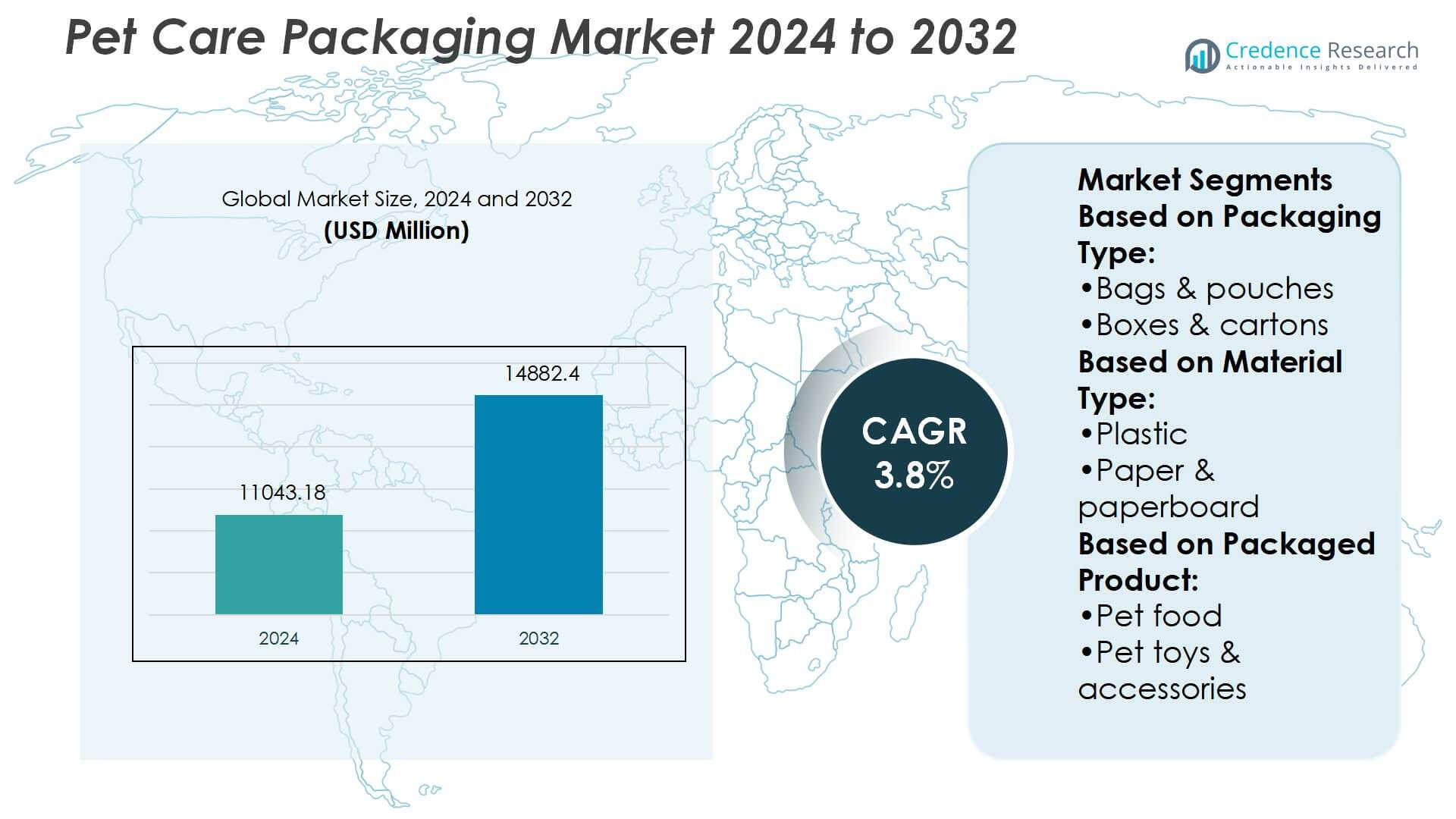
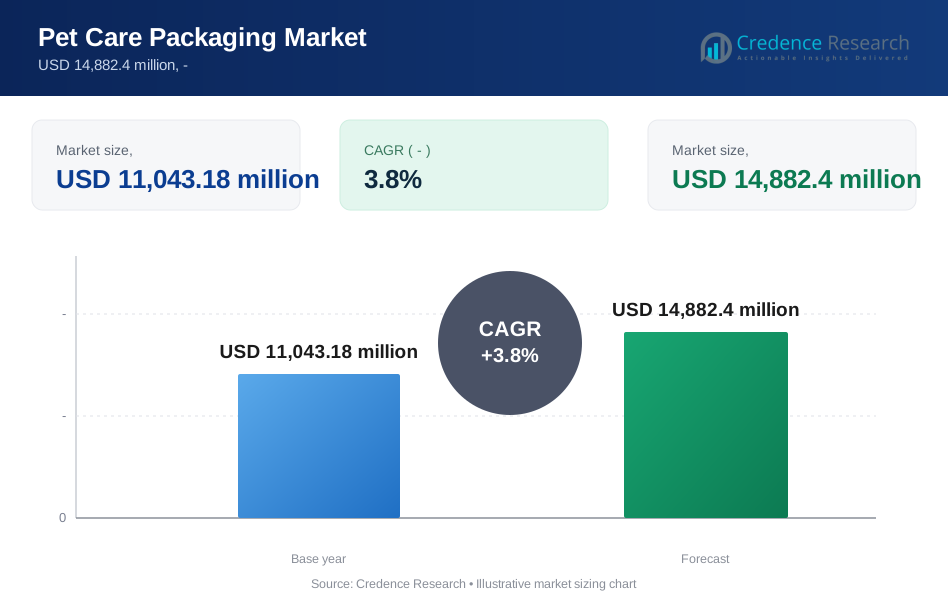
Pet Care Packaging Market size was valued USD 11043.18 million in 2024 and is anticipated to reach USD 14882.4 million by 2032, at a CAGR of 3.8% during the forecast period.
| REPORT ATTRIBUTE | DETAILS |
|---|---|
| Historical Period | 2020-2023 |
| Base Year | 2024 |
| Forecast Period | 2025-2032 |
| Pet Care Packaging Market Size 2024 | USD 11043.18 Million |
| Pet Care Packaging Market, CAGR | 3.8% |
| Pet Care Packaging Market Size 2032 | USD 14882.4 Million |
The pet care packaging market is highly competitive, with top players including Amcor, Berry Global, Mondi, Huhtamaki, DS Smith, Constantia Flexibles, Coveris, Graphic Packaging, NNZ Group, and ATID Packaging. These companies focus on innovation, sustainability, and customized packaging solutions to strengthen their market presence. Flexible packaging formats such as pouches and resealable bags remain central to their product portfolios, while sustainable paperboard and recyclable plastics are gaining momentum due to regulatory and consumer demand. Regionally, North America leads the market with a 37% share, driven by high pet ownership rates, premium product demand, and the strong presence of global packaging manufacturers.
Market Insights
- The Pet Care Packaging Market was valued at USD 11043.18 million in 2024 and is expected to reach USD 14882.4 million by 2032, growing at a CAGR of 3.8%.
- Rising pet humanization and growing demand for premium pet food drive the need for innovative packaging formats, with bags and pouches holding the largest segment share due to convenience and resealable features.
- Sustainable and recyclable packaging solutions are a key trend, with paperboard and eco-friendly plastics gaining momentum as regulations on single-use plastics tighten across major markets.
- The market is highly competitive, with companies like Amcor, Berry Global, Mondi, and Huhtamaki focusing on product differentiation, material innovation, and customized packaging to maintain leadership in both global and regional markets.
- North America leads with a 37% share, supported by high pet ownership and premium product demand, while Europe and Asia-Pacific show strong growth driven by sustainability initiatives and rising disposable incomes.
Market Segmentation Analysis:
By Packaging Type
Bags and pouches dominate the pet care packaging market with a market share of 38%. Their lightweight nature, resealable features, and cost-effectiveness make them highly suitable for dry pet food and treats. Growing consumer preference for convenience and portion control drives adoption. Flexible formats also support branding with high-quality graphics and barrier protection. In contrast, bottles and jars are expanding in grooming products, while cans and containers serve wet food. However, bags and pouches remain the most preferred due to sustainability initiatives and recyclable material options.
- For instance, Huhtamaki launched fiber-based egg cartons made from 100% recycled materials in North America.The company also developed a home-compostable paper-based coffee capsule under its blueloop™ technology.
By Material Type
Plastic holds the largest share of 55% in material use for pet care packaging. Its versatility, durability, and ability to provide airtight sealing ensure product safety and extended shelf life. Plastic’s adaptability across bottles, pouches, and containers strengthens its dominance. However, rising demand for eco-friendly packaging is accelerating the adoption of paper and paperboard, particularly for secondary packaging and small pet accessory packs. Metal maintains a niche role in premium canned pet food. The increasing regulatory push toward recyclable plastics further enhances innovation in this dominant segment.
- For instance, DS Smith replaced over 1.2 billion pieces of plastic from supermarket shelf items with fibre-based alternatives (fruit & vegetable punnets, shrink wrap etc.).
By Packaged Product
Pet food packaging accounts for the largest segment, commanding 62% of the overall market share. Strong global demand for dry, wet, and specialty food products drives its dominance. Packaging innovations such as resealable pouches, single-serve sachets, and portion-control packs align with consumer convenience trends. Premiumization in pet food also increases demand for high-barrier films and cartons. Grooming and hygiene products are growing sub-segments, supported by rising pet humanization and health awareness. Nonetheless, pet food packaging remains the largest contributor, supported by continuous innovation and brand differentiation strategies.
Key Growth Drivers
Rising Pet Humanization
The growing trend of pet humanization is a major driver for the pet care packaging market. Pet owners increasingly view pets as family members, fueling demand for premium food, grooming, and healthcare products. This shift pushes packaging innovation toward premium designs, convenience features, and enhanced product safety. Brands are investing in resealable, portion-controlled, and travel-friendly formats to meet consumer expectations. As spending on pet well-being rises globally, packaging companies benefit from greater volumes and premium pricing opportunities across both food and non-food pet categories.
- For instance, Berry Global rolled out pantry jars for Mars’s M&M’S®, SKITTLES®, and STARBURST® brands made with 100% recycled plastic (excluding lids). This change eliminates over 1,300 metric tons of virgin plastic annually.
Expansion of Pet Food Industry
The rapid growth of the pet food industry strongly supports packaging market expansion. Dry food, wet food, and specialty diets require advanced packaging solutions to ensure freshness, shelf stability, and convenience. High demand for resealable bags, pouches, and single-serve formats reflects consumer focus on portion control and waste reduction. Global brands are investing in high-barrier materials to preserve nutrition and flavor. With pet food accounting for the largest share of pet care packaging, this segment’s continuous innovation acts as a central driver for market growth.
- For instance, Mondi launched FunctionalBarrier Paper Ultimate, a paper-based barrier paper that delivers an oxygen transmission rate (OTR) below 0.5 cm³/m²·d and a water vapour transmission rate (WVTR) below 0.5 g/m²·d.
Sustainability and Eco-Friendly Packaging
Sustainability initiatives are driving strong adoption of eco-friendly packaging solutions. Consumers increasingly demand recyclable, biodegradable, and compostable materials, prompting companies to reduce plastic use and introduce alternatives like paperboard and bioplastics. Packaging players are developing lightweight designs that minimize material usage without compromising safety. Regulatory pressure on single-use plastics also accelerates sustainable innovation across the supply chain. This driver is shaping both product development and brand differentiation, with companies adopting greener solutions to align with consumer values and comply with global environmental standards.
Key Trends & Opportunities
Premium and Customized Packaging
Premium packaging is emerging as a key trend as consumers seek high-quality, aesthetically appealing pet products. Customization opportunities, including personalized labels, portion packs, and specialty designs, enhance brand loyalty and consumer engagement. Packaging formats that emphasize transparency, resealability, and convenience are growing in demand. Brands that integrate premium features can command higher margins while appealing to the increasing number of urban pet owners. This trend also opens opportunities for packaging players to collaborate with pet food and grooming product brands to deliver value-added solutions.
- For instance, Amcor now offers recycle-ready solutions for 94% of its flexible packaging portfolio (by area).Rigid packaging from Amcor is 95% recyclable in practice and at scale across its operations.
E-Commerce-Driven Packaging Demand
The rapid growth of e-commerce in pet care is creating strong opportunities for specialized packaging. Online channels require packaging that is durable, lightweight, and protective during shipping. Easy-to-store and compact designs also appeal to online shoppers. Companies are optimizing packaging for direct-to-consumer deliveries by focusing on convenience and reducing shipping costs. This trend is fostering demand for corrugated cartons, flexible pouches, and protective secondary packaging. With digital sales channels continuing to expand globally, e-commerce-specific packaging represents a growing revenue stream for packaging manufacturers.
- For instance, EcoPeelCover, Constantia reduced aluminium thickness by 25% and lowered the coating layer weight by 50% relative to its previous standard lids, while still achieving sealing temperature tolerance up to 230 °C.
Innovation in Functional Packaging
Functional packaging innovations are reshaping the pet care market, with features like resealable zippers, easy-pour spouts, and odor-control systems gaining traction. Advanced barrier films are being adopted to maintain product freshness and extend shelf life. Functional packaging also supports portion control, waste reduction, and better storage, which align with consumer convenience needs. Packaging manufacturers investing in these innovations gain a competitive edge by enhancing the overall customer experience. This trend highlights opportunities to blend technology with packaging for stronger market positioning.
Key Challenges
Rising Raw Material Costs
The pet care packaging market faces challenges due to volatile raw material prices. Plastics, paperboard, and metal costs fluctuate with global supply chains, affecting production expenses for packaging manufacturers. These cost pressures limit profit margins and may result in higher end-product prices, impacting consumer affordability. Companies are working to mitigate risks by adopting lightweight designs, increasing material efficiency, and investing in alternative sources. Despite these strategies, unpredictable cost surges remain a persistent challenge for packaging firms operating in competitive pet care markets.
Regulatory Compliance and Sustainability Pressure
Increasing regulatory focus on environmental sustainability presents another significant challenge. Governments worldwide are enforcing stricter regulations on single-use plastics and mandating recyclable or biodegradable packaging solutions. While these policies encourage innovation, they also raise compliance costs for manufacturers. Companies must invest in new technologies, materials, and certifications to align with these standards. Smaller firms may struggle with the financial burden of compliance, creating entry barriers. Meeting evolving regulatory requirements while maintaining cost efficiency continues to be a balancing act for market players.
Regional Analysis
North America
North America holds the largest share of the pet care packaging market at 37% in 2024. Strong pet ownership rates, particularly in the U.S., drive consistent demand for premium food and grooming packaging. High consumer spending on pets and a preference for convenience-oriented formats such as resealable pouches and single-serve packs support growth. Sustainability initiatives are also reshaping packaging trends, with companies investing in recyclable and biodegradable materials. The presence of leading packaging manufacturers and pet food brands strengthens the region’s dominance, making North America a key hub for innovation and product development in the global market.
Europe
Europe accounts for 29% of the global pet care packaging market in 2024. The region’s demand is shaped by strict sustainability regulations and consumer preference for eco-friendly materials. Paperboard and recyclable plastics see strong adoption, particularly in Western European countries. Premium packaging is gaining traction due to rising pet humanization and the popularity of organic and specialty food. E-commerce growth across the region also fuels demand for protective and lightweight packaging solutions. With supportive regulatory frameworks and high consumer awareness, Europe remains a leader in driving innovation toward sustainable packaging solutions for the pet care sector.
Asia-Pacific
Asia-Pacific represents 23% of the pet care packaging market and is the fastest-growing region. Rising urbanization and increasing pet ownership in countries like China, India, and Japan are fueling demand for packaged food and grooming products. Consumers prefer cost-effective yet durable packaging formats such as flexible films, pouches, and cartons. E-commerce expansion is also creating new opportunities for protective and portable packaging designs. Growing awareness of pet health and premium food options is driving interest in advanced packaging. As disposable incomes rise, Asia-Pacific is expected to significantly expand its market share during the forecast period.
Latin America
Latin America holds 7% of the global pet care packaging market in 2024. The region’s growth is supported by increasing pet adoption and a rising middle-class population in countries such as Brazil, Mexico, and Argentina. Flexible packaging formats like pouches dominate due to their affordability and convenience. Economic constraints limit premium packaging adoption, but demand is increasing for cost-effective packaging that ensures product safety and freshness. Regional players are gradually shifting toward sustainable materials, though adoption remains slower compared to developed markets. With growing e-commerce channels, the region is emerging as a key growth opportunity for packaging providers.
Middle East & Africa
The Middle East & Africa region accounts for 4% of the pet care packaging market. Market growth is gradual, supported by increasing urbanization, rising pet ownership, and expanding retail channels. Countries like South Africa, UAE, and Saudi Arabia are witnessing higher demand for packaged pet food and accessories. Flexible and low-cost packaging formats dominate, while premium packaging remains limited to niche segments. Sustainability adoption is still at an early stage but is gaining traction with international brands entering the market. Although currently a smaller market, the region presents long-term growth potential driven by changing consumer lifestyles.
Market Segmentations:
By Packaging Type:
- Bags & pouches
- Boxes & cartons
By Material Type:
- Plastic
- Paper & paperboard
By Packaged Product:
- Pet food
- Pet toys & accessories
By Geography
- North America
- U.S.
- Canada
- Mexico
- Europe
- UK
- France
- Germany
- Italy
- Spain
- Russia
- Rest of Europe
- Asia Pacific
- China
- Japan
- South Korea
- India
- Australia
- Southeast Asia
- Rest of Asia Pacific
- Latin America
- Brazil
- Argentina
- Rest of Latin America
- Middle East
- GCC Countries
- Israel
- Turkey
- Rest of Middle East
- Africa
- South Africa
- Egypt
- Rest of Africa
Competitive Landscape
The competitive landscape of the pet care packaging market is shaped by key players such as Huhtamaki, DS Smith, ATID Packaging, Berry Global, Mondi, NNZ Group, Graphic Packaging, Amcor, Constantia Flexibles, and Coveris. The competitive landscape of the pet care packaging market is defined by continuous innovation, sustainability initiatives, and strategic partnerships. Companies are focusing on developing eco-friendly materials such as recyclable plastics, biodegradable films, and paperboard alternatives to meet regulatory requirements and consumer demand for green solutions. Advancements in flexible packaging, resealable closures, and lightweight designs are enhancing convenience and functionality, particularly in pet food and grooming products. E-commerce growth is further shaping packaging needs, with durable, protective, and cost-efficient formats gaining traction. Intense competition drives firms to invest in research, expand regional presence, and differentiate through premium and customized packaging solutions.
Key Player Analysis
- Huhtamaki
- DS Smith
- ATID Packaging
- Berry Global
- Mondi
- NNZ Group
- Graphic Packaging
- Amcor
- Constantia Flexibles
- Coveris
Recent Developments
- In July 2024, Mondi launched additions to the company’s sustainable pre-made plastic bags portfolio. The new line, FlexiBag Reinforced, is recyclable packaging, mono-polyethylene-based with enhanced properties such as sealability, stiffness and puncture-resistance.
- In May 2024, ALPLA, a plastic packaging manufacturer, announced the introduction of a new wine container that is recyclable and composed of PET (polyethylene terephthalate). With possible cost reductions of up to 30%, this packaging method reduces carbon footprints by up to 50%.
- In April 2024, ProMach launched its Pet Care Solutions group, aimed at providing specialized processing and packaging solutions tailored for the pet care industry. This new division is designed to address the challenges faced by pet food manufacturers, including the production and packaging of wet foods, kibble, and treats.
- In January 2024, Coca-Cola India and Reliance Retail, the retail division of India-based conglomerate Reliance Industries Limited (RIL), have introduced a new program for collecting and recycling polyethylene terephthalate (PET). In January 2024, Coca-Cola India and Reliance Retail, the retail division of India-based conglomerate Reliance Industries Limited (RIL), have introduced a new program for collecting and recycling polyethylene terephthalate (PET).
Report Coverage
The research report offers an in-depth analysis based on Packaging Type, Material Type, Packaged Product and Geography. It details leading market players, providing an overview of their business, product offerings, investments, revenue streams, and key applications. Additionally, the report includes insights into the competitive environment, SWOT analysis, current market trends, as well as the primary drivers and constraints. Furthermore, it discusses various factors that have driven market expansion in recent years. The report also explores market dynamics, regulatory scenarios, and technological advancements that are shaping the industry. It assesses the impact of external factors and global economic changes on market growth. Lastly, it provides strategic recommendations for new entrants and established companies to navigate the complexities of the market.
Future Outlook
- The market will see rising demand for sustainable and recyclable packaging materials.
- Flexible packaging formats will continue to dominate due to convenience and cost efficiency.
- Premium packaging designs will gain traction with growing pet humanization trends.
- E-commerce expansion will increase the need for durable and protective packaging solutions.
- Smart and functional packaging with resealable and portion-control features will see higher adoption.
- Paperboard and biodegradable alternatives will grow as regulatory pressures on plastics intensify.
- Customization and branding opportunities will expand to strengthen consumer engagement.
- Emerging markets will contribute significantly as pet ownership and disposable incomes rise.
- Partnerships between packaging firms and pet food brands will enhance innovation pipelines.
- Technology-driven packaging solutions will evolve to ensure freshness, safety, and extended shelf life.
Request a Free Sample
Fill in your details and we'll send you a free sample report.
- Sample data tables & charts
- Research methodology
Need a Custom Version of This Report?
Tailor the scope, geography, or segments to your exact requirements.
- Custom geography or segment scope
- Direct access to our analyst team
Frequently Asked Questions
What is the current market size for Pet Care Packaging Market, and what is its projected size in 2032?
At what Compound Annual Growth Rate is the Pet Care Packaging Market projected to grow between 2025 and 2032?
Which Pet Care Packaging Market segment held the largest share in 2024?
What are the primary factors fueling the growth of the Pet Care Packaging Market?
Who are the leading companies in the Pet Care Packaging Market?
Which region commanded the largest share of the Pet Care Packaging Market in 2024?
Table of Content
Chapter 1. Report Introduction
- 1.1 Report Description & Purpose
- 1.1.1 Report Title & Market Definition
- 1.1.2 Unique Selling Propositions (USP) & Key Differentiators
- 1.1.3 Value Proposition for Stakeholders
- 1.2 Research Objectives
- 1.2.1 Market Sizing Objectives (Volume & Revenue)
- 1.2.2 Segmentation Objectives
- 1.2.3 Competitive Intelligence Objectives
- 1.2.4 Forecast & Scenario Objectives
- 1.3 Report Scope
- 1.3.1 Pet Care Packaging Scope – Types & Subtypes Covered
- 1.3.2 Geographic Scope – Regions & Countries Covered
- 1.3.3 Historical Period, Base Year & Forecast Period (the historical period; forecast to the forecast period)
- 1.3.4 Inclusions & Exclusions
- 1.4 HS Code & Classification Framework
- 1.5 Currency, Units & Pricing Basis
- 1.6 Target Stakeholders
- 1.7 Limitations & Assumptions
Chapter 2. Executive Summary
- 2.1 Global Pet Care Packaging Market Snapshot
- 2.1.1 Market Size – Historical (the historical period) & Forecast (the forecast period) (base year: USD 11,043.18 million → forecast year: USD 14,882.4 million)
- 2.1.2 Volume & Revenue – Global Totals
- 2.1.3 Key Market Highlights – Top Five Facts
- 2.2 Pet Care Packaging Market Segmentation Snapshot
- 2.2.1 Market Split by Region – vs.
- 2.3 Competitive Snapshot
- 2.3.1 Top 10 Players by Revenue Share –
- 2.3.2 Top 10 Players by Volume Share –
- 2.3.3 Recent Strategic Developments (18-Month Summary)
- 2.4 Key Investment Highlights & Strategic Conclusions
Chapter 3. Pet Care Packaging Market Dynamics & Industry Analysis
- 3.1 Market Overview & Context
- 3.1.1 Pet Care Packaging Market Position in the Broader Automotive Value Chain
- 3.1.2 OEM vs. Replacement Market Dynamics
- 3.1.3 Market Maturity & Development Stage by Region
- 3.2 Pet Care Packaging Market Drivers
- 3.3 Pet Care Packaging Market Restraints & Challenges
- 3.4 Pet Care Packaging Market Opportunities
- 3.5 Porter's Five Forces Analysis
- 3.5.1 Threat of New Entrants
- 3.5.2 Bargaining Power of Suppliers
- 3.5.3 Bargaining Power of Buyers
- 3.5.4 Threat of Substitutes
- 3.5.5 Competitive Rivalry – Intensity Assessment
- 3.6 Pet Care Packaging Value Chain Analysis
- 3.6.1 Upstream – Raw Material/Input Suppliers
- 3.6.1.1 Raw Material/Input 1
- 3.6.1.2 Raw Material/Input 2
- 3.6.1.3 Raw Material/Input 3
- 3.6.2 Midstream – Production/Manufacturing/Service Delivery
- 3.6.2.1 Production/Process Overview
- 3.6.2.2 Key Facility Locations & Capacity by Manufacturer
- 3.6.3 Downstream – Distribution & End Consumer
- 3.6.3.1 Primary Channel – B2B/OEM
- 3.6.3.2 Secondary Channels – Dealer, Retail, Online, Direct
- 3.6.4 Value Chain Profitability Analysis
- 3.6.1 Upstream – Raw Material/Input Suppliers
- 3.7 PESTEL Analysis
- 3.7.1 Political Factors
- 3.7.2 Economic Factors
- 3.7.3 Social Factors
- 3.7.4 Technological Factors
- 3.7.5 Environmental Factors
- 3.7.6 Legal Factors
- 3.8 Pet Care Packaging Supply Chain Analysis
- 3.8.1 Raw Material/Input Supply Risk Assessment
- 3.8.2 Manufacturing Concentration Risk (Geographic Exposure)
- 3.8.3 Trade Disruption Impact Analysis
- 3.9 Regulatory & Policy Landscape
Note: The regulatory and policy landscape section covers regulations based on their applicability to the market, Pet Care Packaging category, geography, and scope of the study. Only regulatory frameworks with a material impact on operations, compliance, trade, sustainability, or market access are analyzed in detail.
Chapter 4. Key Investment Pockets & Opportunity Analysis
- 4.1 Pet Care Packaging Market Attractiveness Analysis
- 4.1.1 By Region – Investment Attractiveness Matrix (Volume × CAGR)
- 4.2 Absolute Revenue Growth Opportunity
- 4.2.1 By Region – Absolute USD Growth Through the forecast period
- 4.3 Incremental Volume Opportunity
- 4.3.1 By Region – Incremental Volume Through the forecast period
- 4.3.2 Segment – Incremental Volume
- 4.4 Emerging Submarket Opportunity Deep Dive (Subject to Applicability)
- 4.5 Emerging Market Opportunity Scorecards
- 4.5.1 United States
- 4.5.2 Europe
- 4.5.3 Asia
- 4.5.4 Middle East & Africa
Note: Emerging Market Opportunity Scorecards will be included based on relevance and strategic importance. Regions listed are indicative and may vary depending on data availability and market dynamics.
Chapter 5. Pet Care Packaging Import-Export Analysis & Trade Flows
- 5.1 Global Trade Overview
- 5.1.1 Global Export Value by Country (the historical period)
- 5.1.2 Global Export Volume by Country (the historical period)
- 5.1.3 Global Import Value by Country (the historical period)
- 5.1.4 Global Import Volume by Country (the historical period)
- 5.1.5 Net Trade Balance by Country (the historical period)
- 5.2 Export Analysis – Segment
- 5.2.1 Type 1 (HS Code)
- 5.2.2 Type 2 (HS Code)
- 5.2.3 Type 3 (HS Code)
- 5.2.4 Type 4 (HS Code)
- 5.2.5 Type 5 (HS Code)
- 5.3 Import Analysis – Segment
- 5.3.1 Type 1 (HS Code)
- 5.3.2 Type 2 (HS Code)
- 5.3.3 Type 3 (HS Code)
- 5.3.4 Type 4 (HS Code)
- 5.3.5 Type 5 (HS Code)
- 5.4 Average Unit Trade Prices
- 5.4.1 Average Export Price – Segment & Country
- 5.4.2 Average Import Price – Segment & Source Country
- 5.4.3 Price Trends (the historical period)
- 5.5 Key Trade Route Analysis
- 5.5.1 Trade Route 1
- 5.5.2 Trade Route 2
- 5.5.3 Trade Route 3
- 5.5.4 Trade Route 4
- 5.5.5 Trade Route 5
- 5.6 Trade Policy Impact Assessment
- 5.6.1 US Anti-Dumping & Section 301 Tariffs
- 5.6.2 EU Customs Union Impact
- 5.6.3 Major Free Trade Agreements
- 5.6.4 USMCA Rules of Origin
Note: Trade policy analysis will be included only where relevant to the Pet Care Packaging market.
Chapter 6. Competitive Landscape & Company Benchmarking
- 6.1 Pet Care Packaging Market Concentration & Structure
- 6.1.1 Herfindahl-Hirschman Index (HHI) – vs.
- 6.1.2 Tier 1, Tier 2 & Tier 3 Market Structure
- 6.1.3 Global, Regional & Local Player Dynamics
- 6.2 Pet Care Packaging Market Share Analysis –
- 6.2.1 Global Revenue Share by Company
- 6.2.2 Global Volume Share by Company
- 6.2.3 Regional Revenue Share
- 6.2.4 Market Share Evolution ( vs. )
- 6.2.5 OEM Segment Share by Company
- 6.2.6 Replacement Segment Share by Company
- 6.3 Production/Delivery Capacity & Facility Analysis
- 6.3.1 Global Installed Capacity
- 6.3.2 Capacity Utilization Rates
- 6.3.3 Production/Output Volume
- 6.3.4 Facility Locations & Capacity Map
- 6.3.5 Planned Capacity Additions
- 6.4 Pet Care Packaging Competitive Benchmarking Matrix
- 6.4.1 Revenue, Volume, CAGR & Profitability Comparison
- 6.4.2 Channel Revenue Mix
- 6.4.3 Geographic Revenue Exposure
- 6.4.4 R&D Intensity
- 6.4.5 Sustainability Maturity
- 6.5 Strategic Developments in Pet Care Packaging (Last 24 Months)
- 6.5.1 Mergers, Acquisitions & Divestments
- 6.5.2 New Pet Care Packaging Launches
- 6.5.3 Facility Expansions
- 6.5.4 Strategic Alliances, Joint Ventures & Partnerships
- 6.5.5 Distribution Expansion & Market Entry
- 6.5.6 Sustainability & ESG Initiatives
- 6.6 Competitive Strategy Mapping
- 6.6.1 Leader, Challenger, Follower & Niche Classification
- 6.6.2 Pricing Strategy Comparison
- 6.6.3 Channel Strategy Matrix
Note: Strategic developments are included based on their materiality and the availability of reliable information.
Chapter 7. Global Pet Care Packaging Market – By Distribution Channel
- 7.1 Segment Overview
- 7.1.1 Volume & Revenue Split by Channel ( & )
- 7.1.2 Channel Mix Evolution (the forecast period)
Chapter 8. Regional Market Analysis – Global Overview
- 8.1 Global Regional Overview
- 8.1.1 Regional Volume Share
- 8.1.2 Regional Revenue Share
- 8.1.3 Regional Volume by Region
- 8.1.4 Regional Revenue by Region
- 8.1.5 Regional Forecast Through the forecast period
- 8.2 Cross-Regional Segment Analysis
- 8.2.1 By Distribution Channel
- 8.2.2 By Brand/Price Tier
Chapter 9. North America Pet Care Packaging Market
- 9.1 United States
- 9.2 Canada
- 9.3 Mexico
Chapter 10. Europe Pet Care Packaging Market
- 10.1 Germany
- 10.2 France
- 10.3 Italy
- 10.4 United Kingdom
- 10.5 Spain
- 10.6 Poland
- 10.7 Russia
- 10.8 Netherlands
- 10.9 Belgium
- 10.10 Sweden
- 10.11 Denmark
- 10.12 Norway
- 10.13 Rest of Europe
Chapter 11. Asia Pacific Pet Care Packaging Market
- 11.1 China
- 11.2 India
- 11.3 Japan
- 11.4 South Korea
- 11.5 Thailand
- 11.6 Indonesia
- 11.7 Vietnam
- 11.8 Malaysia
- 11.9 Australia
- 11.10 Rest of Asia Pacific
Chapter 12. Latin America Pet Care Packaging Market
- 12.1 Brazil
- 12.2 Argentina
- 12.3 Colombia
- 12.4 Chile
- 12.5 Rest of Latin America
Chapter 13. Middle East Pet Care Packaging Market
- 13.1 Saudi Arabia
- 13.2 United Arab Emirates
- 13.3 Turkey
- 13.4 Israel
- 13.5 Iran
- 13.6 Rest of the Middle East
Chapter 14. Africa Pet Care Packaging Market
- 14.1 South Africa
- 14.2 Egypt
- 14.3 Nigeria
- 14.4 Morocco
- 14.5 Rest of Africa
Chapter 15. Pet Care Packaging Company Profiles
- 15.1 [Company 01]
- 15.1.1 Company Overview
- 15.1.2 Key Management Personnel
- 15.1.3 Products & Services Portfolio
- 15.1.4 Financial Performance
- 15.1.5 Key Market Focus & Geographic Presence
- 15.1.6 Recent Developments & Strategic Initiatives
Note: The company profile list is preliminary and may change based on research findings, market developments, data availability, and client requirements.
Chapter 16. Appendices
- Appendix A – List of Abbreviations & Acronyms
- Appendix B – Industry Classification Code Reference – Full Series
- Appendix C – Production & Capacity Data Tables
- Appendix D – End-Use & Demand Base Tables
- Appendix E – Consumption & Replacement Rate Assumptions
- Appendix F – ASP Reference Tables
- Appendix G – Manufacturing & Facility Database
- Appendix H – Import-Export Data Tables
- Appendix I – Regulatory Summary Tables
- Appendix J – Primary Research Participant List (Anonymized)
- Appendix K – Primary Research Questionnaire Framework
- Appendix L – Data Sources & Bibliography
- Appendix M – Market Size Divergence & Source Comparison
Chapter 17. Research Methodology
- 17.1 Research Framework & Philosophy
- 17.2 Secondary Research – Sources, Hierarchy & Data Extraction
- 17.3 Data Modeling – Bottom-Up & Top-Down Market Sizing
- 17.4 Primary Research – Stakeholder Framework, LOI & Sample Sizes
- 17.5 Forecast Methodology – Regression, Scenario & Sensitivity Analysis
- 17.6 Quality Control – Four-Layer Validation Framework
- 17.7 Limitations & Standard Assumptions
- 17.8 Disclaimer
