
| REPORT ATTRIBUTE | DETAILS |
|---|---|
| Historical Period | 2020-2023 |
| Base Year | 2024 |
| Forecast Period | 2025-2032 |
| Portable Monitor Market Size 2024 | USD 266 Million |
| Portable Monitor Market, CAGR | 23.94% |
| Portable Monitor Market Size 2032 | USD 1,481 Million |
Market Overview
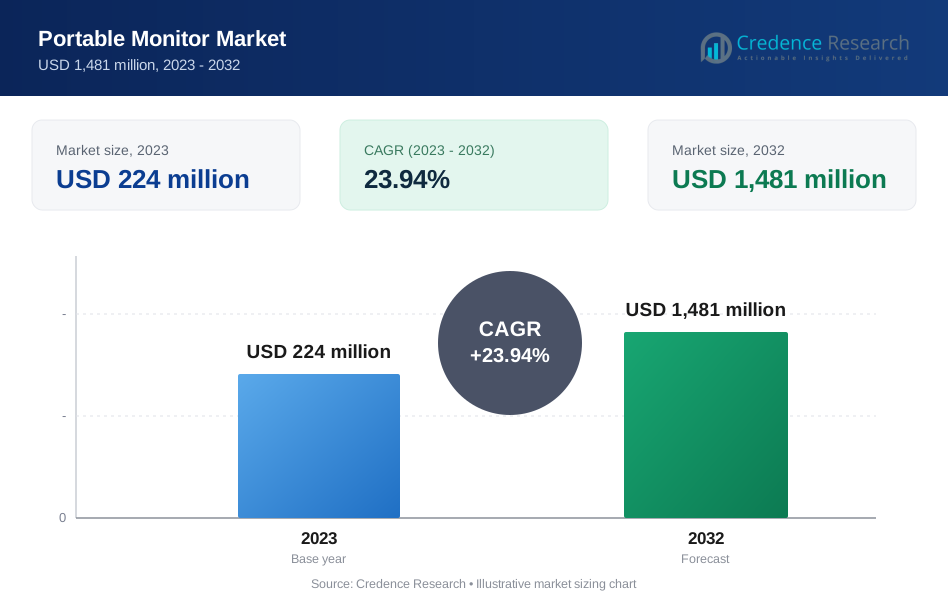
The Global Portable Monitor Market is projected to grow from USD 266 million in 2024 to an estimated USD 1,481 million based on 2032, with a compound annual growth rate (CAGR) of 23.94% from 2025 to 2032.
The market is driven by the growing remote and hybrid workforce, which has amplified the need for secondary screens that enhance productivity. Rising penetration of USB-C and HDMI connectivity, combined with improvements in resolution and touchscreen capabilities, continues to attract tech-savvy users. Trends such as multi-monitor setups, mobile gaming, and on-the-go content creation further support adoption. Demand from the education sector and content professionals also contributes to sustained growth, as portable monitors offer flexibility and compatibility with laptops, tablets, and smartphones.
Geographically, Asia Pacific holds a significant share due to widespread electronics manufacturing and rising tech adoption in countries such as China, Japan, and South Korea. North America and Europe follow closely, driven by strong demand from corporate and gaming users. Key players shaping the competitive landscape include ASUS, AOC, Lenovo, ViewSonic, LG Electronics, HP, Dell, and Gechic, who continue to invest in design innovation, panel quality, and expanded distribution to capture market share globally.
Market Insights
- The Global Portable Monitor Market is projected to grow from USD 266 million in 2024 to USD 1,481 million by 2032, registering a CAGR of 23.94% from 2025 to 2032.
- Rising demand for remote work setups and mobile productivity tools is a key driver boosting portable monitor adoption across professional and personal use cases.
- Increased use of USB-C and HDMI connectivity, coupled with higher display resolution and portability, enhances consumer appeal and supports long-term growth.
- High product costs and limited awareness in emerging regions act as restraints, slowing mass adoption in price-sensitive markets.
- Asia Pacific leads with over 35% market share, supported by strong manufacturing, tech innovation, and growing consumer demand in China, Japan, and South Korea.
- North America and Europe show high adoption rates due to established tech infrastructure and rising use among remote workers and gamers.
- The market remains moderately concentrated, with key players like ASUS, Lenovo, Dell, and ViewSonic competing on design, quality, and distribution strategies.
Market Drivers
Rising Demand from Remote Work and Mobile Professionals Enhancing Market Adoption
The shift toward remote and hybrid work models has significantly increased demand for portable monitors. Professionals now seek compact, dual-screen setups to boost productivity from remote locations, home offices, or while traveling. The Global Portable Monitor Market benefits from this trend, as users prioritize flexibility and device compatibility. USB-C powered monitors with plug-and-play capabilities enable fast setup, making them ideal for dynamic work environments. Businesses are also equipping employees with lightweight, portable display options to ensure seamless workflows outside traditional office spaces. It supports improved collaboration and multitasking, which reinforces its utility across industries.
- For instance, a 2024 Dell Technologies survey of enterprise IT managers reported that over a six-month period, 320,000 portable monitors were distributed to remote employees in North America alone to support hybrid work initiatives.
Growth in Gaming and Entertainment Applications Expanding Use Cases
Portable monitors are gaining popularity among gamers and content consumers who value flexibility and visual performance. The rise of mobile gaming, console compatibility, and streaming devices has broadened the market’s reach beyond corporate use. The Global Portable Monitor Market captures this demand by offering high refresh rate displays, HDR support, and wide color gamuts. Consumers are choosing these monitors for their ability to enhance entertainment experiences without bulky setups. The integration of features like built-in speakers and touchscreen functions adds further appeal. It aligns with the evolving preferences of tech-savvy and media-focused users.
- For instance, according to a 2024 NPD Group consumer electronics report, U.S. retailers recorded sales of 180,000 portable gaming monitors during the holiday quarter, reflecting the growing demand for flexible, high-performance displays among gamers and content consumers.
Advancements in Display Technology Driving Product Differentiation
Rapid innovation in display technology contributes to a wave of feature-rich portable monitors. Brands are incorporating OLED, IPS, and 4K panels to deliver superior image quality and viewing angles. The Global Portable Monitor Market is benefitting from these enhancements, which elevate user experience and command premium pricing. Thinner bezels, improved brightness, and touchscreen sensitivity have become standard expectations. Energy-efficient displays extend battery life, supporting portability. It allows manufacturers to cater to both entry-level and premium market segments effectively.
Expansion in Educational and Creative Professional Applications Strengthening Growth
The increasing use of digital tools in education and creative fields supports the broader adoption of portable monitors. Students and educators are leveraging these displays for virtual learning, coding, and design projects. The Global Portable Monitor Market is meeting this demand by offering compatibility with tablets, laptops, and smartphones across operating systems. Graphic designers, photographers, and video editors use it for on-site work and previewing high-resolution content. Educational institutions and training centers are integrating portable monitors into their digital infrastructure. It reflects a growing reliance on flexible and collaborative visual tools.
Market Trends
Integration of USB-C and Thunderbolt Ports Accelerating Device Compatibility
The shift toward USB-C and Thunderbolt interfaces is transforming the usability of portable monitors. These ports allow for faster data transfer, power delivery, and single-cable connectivity, simplifying the user experience. The Global Portable Monitor Market is aligning with this trend by equipping products with universal ports that support laptops, smartphones, and gaming consoles. It reduces cable clutter and setup time, increasing appeal among mobile professionals and gamers. USB-C support also enhances portability, removing the need for bulky adapters or external power sources. Manufacturers are prioritizing these standards to future-proof their devices and attract a broader user base.
- For instance, according to a 2024 product survey by Display Supply Chain Consultants, 37 leading portable monitor models from 12 different brands launched in the first half of the year featured USB-C connectivity, with 9 models also supporting Thunderbolt.
Demand for Touchscreen and Stylus-Supported Models Enhancing Interactivity
Touch-enabled portable monitors with stylus support are gaining traction across creative, educational, and business applications. These displays offer a more interactive and intuitive experience for note-taking, drawing, and presentation tasks. The Global Portable Monitor Market is evolving to accommodate users who prefer tactile input, especially in design and training environments. It bridges the gap between tablets and traditional monitors by offering precision and control. Educational users and graphic professionals value these monitors for on-the-go content creation. Product launches now frequently include pen-compatible and touch-responsive models to address this rising expectation.
- For instance, Wacom’s 2024 annual report noted that the company shipped 210,000 portable touch monitors with stylus support to educational and design institutions globally during the fiscal year, reflecting strong institutional demand for interactive display solutions.
Emphasis on Lightweight Designs and Ultra-Thin Form Factors Boosting Portability
Slim, lightweight designs remain central to product differentiation and user preference. Consumers prioritize ease of transport and space-saving capabilities, especially for frequent travel or limited desk setups. The Global Portable Monitor Market continues to introduce thinner bezels, lighter materials, and compact stands to meet this need. It ensures user convenience without sacrificing screen quality or durability. The growing use of aluminum alloys and foldable cases supports this trend. Brands are refining aesthetics and functionality simultaneously to meet professional and consumer expectations.
Product Diversification Targeting Multiple End-User Segments
Portable monitor manufacturers are expanding product lines to cater to various user needs and price points. Gaming-focused models feature high refresh rates and low latency, while business-centric displays emphasize color accuracy and multitasking. The Global Portable Monitor Market is diversifying to meet the specific requirements of students, freelancers, executives, and digital artists. It promotes customized user experiences through feature segmentation. Brands are also offering bundled accessories, such as magnetic stands and protective sleeves, to enhance usability. The trend supports market growth by addressing both general-purpose and specialized use cases.
Market Challenges
High Price Sensitivity and Limited Awareness Hindering Mass Adoption
Many consumers remain price-sensitive when evaluating portable monitors, especially in emerging markets. The Global Portable Monitor Market faces challenges from cost-conscious buyers who view these devices as non-essential add-ons. It struggles to penetrate segments where laptops or tablets already serve dual purposes. Limited awareness of use cases and product benefits further restricts demand. Brands must invest in consumer education and offer competitively priced models to expand adoption. Without clear differentiation, users may hesitate to invest in a secondary display.
- For instance, a 2024 company survey by Acer identified 4,500,000 price-sensitive consumers and recorded 1,200,000 units sold in emerging markets, while the company launched 15 consumer education campaigns to boost awareness and adoption.
Compatibility Issues and Performance Trade-offs Impacting User Experience
Despite improved connectivity options, device compatibility remains a concern for certain users. Operating system limitations, power supply inconsistencies, and non-standardized ports can affect usability. The Global Portable Monitor Market must address these challenges to ensure seamless cross-device performance. It often faces trade-offs between portability and advanced features such as resolution, brightness, or color accuracy. Budget models may underdeliver on performance, causing dissatisfaction. Ensuring consistency across platforms and devices remains critical to building consumer trust.
Market Opportunities
Expanding Use in Education and E-Learning Platforms Offering New Revenue Streams
The increasing digitalization of education creates strong demand for versatile display tools among students and educators. Portable monitors support virtual classrooms, remote collaboration, and interactive learning experiences. The Global Portable Monitor Market can leverage this trend by offering affordable, durable, and compatible models tailored for educational settings. It provides an efficient solution for multitasking and content sharing, especially in environments with limited infrastructure. Government-led digital education initiatives further open institutional procurement opportunities. Brands that focus on this segment can establish long-term growth channels.
Rising Demand from Freelancers and Creative Professionals Creating Niche Growth Potential
Freelancers, digital nomads, and creative professionals require portable, high-resolution monitors for tasks like video editing, design work, and client presentations. This growing segment values mobility, color accuracy, and extended screen space. The Global Portable Monitor Market can address these needs with premium features such as 4K resolution, touchscreen input, and stylus support. It enables users to maintain professional-grade workflows while working from any location. Demand for compact workstations continues to rise, especially in industries that prioritize visual quality. Companies targeting this audience can achieve higher margins and brand loyalty.
Market Segmentation Analysis
By Connectivity Type
USB connectivity dominates the segment due to its versatility, faster data transfer, and power delivery capabilities through a single cable. Users prefer USB-C portable monitors for plug-and-play convenience across laptops, smartphones, and gaming consoles. HDMI connectivity holds a significant share among traditional users and gamers who require stable, high-resolution output without relying on drivers. VGA connectivity, although declining, still serves legacy systems in certain industrial and educational environments. The Global Portable Monitor Market is responding by offering multi-port options to ensure broader compatibility. It helps users transition between modern and older hardware with minimal disruption.
- For instance, a 2024 IDC survey reported that more than 7 million USB-C portable monitors were shipped globally, compared to 3.5 million HDMI and 800,000 VGA units.
By Display Technology
LED portable monitors lead the market with a balance of energy efficiency, brightness, and cost-effectiveness. These displays are widely available and suit general-purpose users seeking reliability and portability. OLED portable monitors, while positioned at the premium end, offer superior contrast, deeper blacks, and vibrant visuals, attracting gamers and creative professionals. LCD monitors remain relevant for budget-conscious buyers due to their lower cost and sufficient performance for everyday tasks. The Global Portable Monitor Market continues to innovate within each technology type to meet performance expectations across use cases. It supports diverse applications by aligning display features with user priorities.
- For instance, according to a 2024 report by Display Supply Chain Consultants, 9 million LED portable monitors were sold worldwide, while OLED models accounted for 1.2 million units and LCD models for 2.8 million units.
Segments
Based on Connectivity Type
- USB connectivity
- HDMI connectivity
- VGA connectivity
Based on Display Technology
- LED Portable Monitors
- OLED Portable Monitors
- LCD Portable Monitors
Based on Region
- North America
- U.S.
- Canada
- Mexico
- Europe
- UK
- France
- Germany
- Italy
- Spain
- Russia
- Belgium
- Netherlands
- Austria
- Sweden
- Poland
- Denmark
- Switzerland
- Rest of Europe
- Asia Pacific
- China
- Japan
- South Korea
- India
- Australia
- Thailand
- Indonesia
- Vietnam
- Malaysia
- Philippines
- Taiwan
- Rest of Asia Pacific
- Latin America
- Brazil
- Argentina
- Peru
- Chile
- Colombia
- Rest of Latin America
- Middle East
- UAE
- KSA
- Israel
- Turkey
- Iran
- Rest of Middle East
- Africa
- Egypt
- Nigeria
- Algeria
- Morocco
- Rest of Africa
Regional Analysis
North America Portable Monitor Market
North America holds a significant share of the global market, accounting for approximately 29%. Strong demand from the remote workforce, freelancers, and gamers continues to drive regional growth. The Portable Monitor Market in this region benefits from high consumer awareness, advanced infrastructure, and broad adoption of mobile work solutions. It sees strong sales from brands offering premium models with enhanced connectivity and performance. The United States dominates the region due to early technology adoption and a mature consumer electronics market. Companies invest in marketing, retail partnerships, and tech integration to maintain regional momentum.
Europe Portable Monitor Market
Europe accounts for around 22% of the global market, supported by growing demand from business professionals and students. The Portable Monitor Market gains traction from the increasing use of flexible workstations and BYOD policies. It serves diverse users in Germany, the UK, and France where mobility and screen quality are key purchasing criteria. Regulatory standards and environmental preferences push demand for energy-efficient and lightweight displays. Corporate adoption continues to expand, supported by digital transformation initiatives. Brands focus on offering localized support and distribution to meet regional expectations.
Asia Pacific Portable Monitor Market
Asia Pacific leads the market with the highest share of approximately 35%. High-volume production, tech-savvy consumers, and expanding e-learning adoption drive this leadership. The Portable Monitor Market benefits from growing middle-class demand and strong presence of OEMs in China, Japan, and South Korea. It supports widespread use in mobile gaming, education, and productivity applications. Price competitiveness and product variety enhance regional market penetration. Local manufacturers contribute to innovation and scale advantages.
Latin America Portable Monitor Market
Latin America represents a smaller but expanding share at about 6%. Growth is supported by the rising availability of affordable monitors and increasing internet access. The Portable Monitor Market in countries such as Brazil and Mexico sees demand from students, remote workers, and gamers. It gains traction as users seek flexible digital tools amid infrastructure limitations. Regional distributors and online platforms play a critical role in improving accessibility. Currency fluctuations and import duties remain key challenges.
Middle East Portable Monitor Market
The Middle East accounts for around 4% of the global market, driven by adoption in education, business, and hospitality sectors. The Portable Monitor Market serves users in the UAE, Saudi Arabia, and Qatar who value digital flexibility and mobile convenience. It supports high-end purchases from corporate clients and professionals. Growth is linked to investments in smart cities and digital infrastructure. Limited local manufacturing increases reliance on imports. Brands focus on building partnerships with regional distributors.
Africa Portable Monitor Market
Africa contributes approximately 2% to the global market and shows gradual growth. The Portable Monitor Market in this region is shaped by the need for cost-effective solutions in education and small businesses. It faces barriers from limited connectivity and high import costs. Demand is rising in urban centers with improving digital infrastructure. Government-led education programs and tech access initiatives create entry points. Product availability through online channels is helping expand visibility and adoption.
Key players
- ASUS
- Lenovo
- Dell Technologies
- ViewSonic Corporation
- AOC
- LG Electronics
- HP Development Company, L.P.
- Gechic Corporation
- Cocopar
- SideTrak
Competitive Analysis
The Global Portable Monitor Market is highly competitive, with key players focusing on product innovation, feature enhancement, and strategic distribution. Companies such as ASUS, Lenovo, and Dell lead with wide product portfolios and strong brand presence. It relies heavily on differentiating factors like display quality, connectivity options, and form factor. Firms invest in touchscreen capabilities, 4K resolution, and energy-efficient technology to capture consumer interest. Competitive pricing, bundled accessories, and platform compatibility also influence market positioning. Emerging brands target niche segments like mobile gaming and education, while established players expand global reach through e-commerce and retail partnerships.
Recent Developments
- In February 13, 2025, ASUS announced the availability of the ZenScreen Duo OLED MQ149CD, featuring dual 14″ 1920×1200 OLED panels with USB‑C connectivity and a 360° hinge
- In March 29, 2025, Dell introduced the Pro 14 Plus (P1425) portable monitor, offering a 14″ WUXGA IPS display, portrait mode, and USB‑C power delivery support
Market Concentration and Characteristics
The Global Portable Monitor Market shows moderate concentration, with a mix of established electronics brands and emerging players competing for share. It features rapid innovation cycles, strong consumer focus, and high product differentiation. Companies emphasize display quality, connectivity standards, and portability to attract target users across professional, gaming, and educational segments. The market favors agile players that can respond to evolving user preferences and technology standards. While leading brands hold a competitive edge through scale and global distribution, smaller firms compete by offering niche features and price flexibility. Product lifecycles remain short, driven by fast-paced advancements in screen technology and user interface integration.
Report Coverage
The research report offers an in-depth analysis based on Connectivity Type, Display Technology and Region. It details leading market players, providing an overview of their business, product offerings, investments, revenue streams, and key applications. Additionally, the report includes insights into the competitive environment, SWOT analysis, current market trends, as well as the primary drivers and constraints. Furthermore, it discusses various factors that have driven market expansion in recent years. The report also explores market dynamics, regulatory scenarios, and technological advancements that are shaping the industry. It assesses the impact of external factors and global economic changes on market growth. Lastly, it provides strategic recommendations for new entrants and established companies to navigate the complexities of the market.
Future Outlook
- The Global Portable Monitor Market will continue to expand rapidly, supported by the widespread shift toward mobile and hybrid work environments. High demand for productivity tools will drive consistent sales across business and consumer segments.
- Manufacturers will prioritize seamless integration with laptops, smartphones, and tablets. USB-C and wireless display support will become standard across future product lines.
- Emerging economies in Asia, Latin America, and Africa will see rising adoption as affordability improves. Localized marketing and regional distribution partnerships will support this expansion.
- Consumers and creative professionals will increasingly prefer high-resolution and color-accurate displays. Brands will invest in OLED and 4K portable monitors to meet these expectations.
- Touch functionality and stylus support will see growing demand in education, healthcare, and design sectors. Portable monitors will evolve to include advanced interactivity features.
- Manufacturers will adopt eco-friendly materials and energy-efficient designs. These features will appeal to environmentally conscious consumers and align with global sustainability goals.
- Future offerings will include bundled accessories like protective cases, foldable stands, and detachable keyboards. These value-added features will enhance user experience and increase average selling prices.
- Portable monitors will see increased use in retail, logistics, healthcare, and field services. Companies will develop industry-specific models tailored for durability and performance in mobile environments.
- Future models will integrate AI-driven brightness control, display optimization, and cross-platform support. Software updates will enhance usability and differentiate premium offerings.
- Global brands will form alliances with OEMs, PC manufacturers, and telecom providers. These collaborations will help streamline distribution, lower costs, and expand reach into new consumer segments.
Request a Free Sample
Fill in your details and we'll send you a free sample report.
- Sample data tables & charts
- Research methodology
Need a Custom Version of This Report?
Tailor the scope, geography, or segments to your exact requirements.
- Custom geography or segment scope
- Direct access to our analyst team
Frequently Asked Questions
What was the market size of the Global Portable Monitor Market in 2023, and what is its projected size by 2032?
What is driving the growth of the portable monitor market globally?
Which regions hold the largest share in the Global Portable Monitor Market?
Who are the major players in the portable monitor market?
What applications are portable monitors commonly used for?
Table of Content
Chapter 1. Report Introduction
- 1.1 Report Description & Purpose
- 1.1.1 Report Title & Market Definition
- 1.1.2 Unique Selling Propositions (USP) & Key Differentiators
- 1.1.3 Value Proposition for Stakeholders
- 1.2 Research Objectives
- 1.2.1 Market Sizing Objectives (Volume & Revenue) (Volume Where Applicable)
- 1.2.2 Segmentation Objectives
- 1.2.3 Competitive Intelligence Objectives
- 1.2.4 Forecast & Scenario Objectives
- 1.3 Report Scope
- 1.3.1 Portable Monitor Scope – Segments & Subsegments Covered
- 1.3.2 Geographic Scope – Regions & Countries Covered
- 1.3.3 Historical Period, Base Year & Forecast Period (2023; forecast to 2032)
- 1.3.4 Inclusions & Exclusions
- 1.4 Industry Classification & Applicable Codes
- 1.5 Currency, Measurement Units & Valuation Basis
- 1.6 Target Stakeholders
- 1.7 Limitations & Assumptions
Chapter 2. Executive Summary
- 2.1 Global Portable Monitor Market Snapshot
- 2.1.1 Market Size – Historical (2023) & Forecast (2023-2032) (2023: USD 224 million → 2032: USD 1,481 million)
- 2.1.2 Volume & Revenue – Global Totals (Volume Where Applicable)
- 2.1.3 Key Market Highlights – Top Five Facts
- 2.2 Portable Monitor Market Segmentation Snapshot
- 2.2.1 Market Split by Region – 2023 vs. 2032
- 2.3 Competitive Snapshot
- 2.3.1 Top 10 Players by Revenue Share – 2023
- 2.3.2 Top 10 Players by Volume Share – 2023 (Volume Where Applicable)
- 2.3.3 Recent Strategic Developments (18-Month Summary)
- 2.4 Key Investment Highlights & Strategic Conclusions
Chapter 3. Portable Monitor Market Dynamics & Industry Analysis
- 3.1 Market Overview & Context
- 3.1.1 Portable Monitor Market Position in the Broader Industry Value Chain
- 3.1.2 Demand Structure & Purchasing Dynamics
- 3.1.3 Market Maturity & Development Stage by Region
- 3.2 Portable Monitor Market Drivers
- 3.3 Portable Monitor Market Restraints & Challenges
- 3.4 Portable Monitor Market Opportunities
- 3.5 Porter's Five Forces Analysis
- 3.5.1 Threat of New Entrants
- 3.5.2 Bargaining Power of Suppliers
- 3.5.3 Bargaining Power of Buyers
- 3.5.4 Threat of Substitutes
- 3.5.5 Competitive Rivalry – Intensity Assessment
- 3.6 Portable Monitor Value Chain Analysis
- 3.6.1 Upstream – Key Inputs, Resources & Suppliers
- 3.6.1.1 Key Input/Resource 1
- 3.6.1.2 Key Input/Resource 2
- 3.6.1.3 Key Input/Resource 3
- 3.6.2 Midstream – Core Operations & Value Creation
- 3.6.2.1 Operating Model & Process Overview
- 3.6.2.2 Key Operating Locations & Capabilities by Company
- 3.6.3 Downstream – Market Channels & End Users
- 3.6.3.1 Direct Sales & Customer Engagement Channels
- 3.6.3.2 Indirect Sales, Intermediaries & Partner Channels
- 3.6.4 Value Chain Profitability Analysis
- 3.6.1 Upstream – Key Inputs, Resources & Suppliers
- 3.7 PESTEL Analysis
- 3.7.1 Political Factors
- 3.7.2 Economic Factors
- 3.7.3 Social Factors
- 3.7.4 Technological Factors
- 3.7.5 Environmental Factors
- 3.7.6 Legal Factors
- 3.8 Portable Monitor Supply Chain Analysis
- 3.8.1 Critical Input & Resource Availability Risk Assessment
- 3.8.2 Supplier & Operational Concentration Risk (Geographic Exposure)
- 3.8.3 Supply & Service Disruption Impact Analysis
- 3.9 Regulatory & Policy Landscape
Note: The regulatory and policy landscape section covers regulations based on their applicability to the market, Portable Monitor category, geography, and scope of the study. Only regulatory frameworks with a material impact on operations, compliance, trade, sustainability, or market access are analyzed in detail.
Chapter 4. Key Investment Pockets & Opportunity Analysis
- 4.1 Portable Monitor Market Attractiveness Analysis
- 4.1.1 By Region – Investment Attractiveness Matrix (Market Size × CAGR)
- 4.2 Absolute Revenue Growth Opportunity
- 4.2.1 By Region – Absolute Revenue Growth Through 2032
- 4.3 Incremental Demand Opportunity
- 4.3.1 By Region – Incremental Demand Through 2032
- 4.3.2 Segment – Incremental Demand
- 4.4 Emerging Submarket Opportunity Deep Dive (Subject to Applicability)
- 4.5 Priority Market Opportunity Scorecards
- 4.5.1 United States
- 4.5.2 Europe
- 4.5.3 Asia
- 4.5.4 Middle East & Africa
Note: Priority market opportunity scorecards reflect the geographic scope and strategic relevance of the study. Listed markets are indicative and may be adapted to the industry.
Chapter 5. Portable Monitor Cross-Border Trade & Market Access Analysis
- 5.1 International Trade & Cross-Border Activity Overview
- 5.1.1 Global Export Value by Country (2023)
- 5.1.2 Global Export Volume by Country (2023) (Volume Where Applicable)
- 5.1.3 Global Import Value by Country (2023)
- 5.1.4 Global Import Volume by Country (2023) (Volume Where Applicable)
- 5.1.5 Net Trade Balance by Country (2023)
- 5.2 Export Analysis – Segment
- 5.2.1 Category 1 (Applicable Classification Code)
- 5.2.2 Category 2 (Applicable Classification Code)
- 5.2.3 Category 3 (Applicable Classification Code)
- 5.2.4 Category 4 (Applicable Classification Code)
- 5.2.5 Category 5 (Applicable Classification Code)
- 5.3 Import Analysis – Segment
- 5.3.1 Category 1 (Applicable Classification Code)
- 5.3.2 Category 2 (Applicable Classification Code)
- 5.3.3 Category 3 (Applicable Classification Code)
- 5.3.4 Category 4 (Applicable Classification Code)
- 5.3.5 Category 5 (Applicable Classification Code)
- 5.4 Cross-Border Pricing & Transaction Benchmarks
- 5.4.1 Export Pricing – Segment & Country
- 5.4.2 Import Pricing – Segment & Source Country
- 5.4.3 Price Trends (2023)
- 5.5 Key Cross-Border Trade & Delivery Routes
- 5.5.1 Cross-Border Trade/Delivery Route 1
- 5.5.2 Cross-Border Trade/Delivery Route 2
- 5.5.3 Cross-Border Trade/Delivery Route 3
- 5.5.4 Cross-Border Trade/Delivery Route 4
- 5.5.5 Cross-Border Trade/Delivery Route 5
- 5.6 Trade Policy & Market Access Impact Assessment
- 5.6.1 Tariff & Non-Tariff Barriers
- 5.6.2 Regional Trade & Economic Integration Frameworks
- 5.6.3 Bilateral & Multilateral Trade Agreements
- 5.6.4 Cross-Border Operating, Licensing & Localization Requirements
Note: This chapter applies where cross-border trade or delivery is relevant to Portable Monitor. Goods, services, and digital offerings are assessed using applicable classifications and transaction measures. Import-export volumes, trade balances, and route analyses are included only where meaningful to the market.
Chapter 6. Competitive Landscape & Company Benchmarking
- 6.1 Portable Monitor Market Concentration & Structure
- 6.1.1 Herfindahl-Hirschman Index (HHI) – the historical period vs. 2023
- 6.1.2 Leading, Mid-Sized & Emerging Player Structure
- 6.1.3 Global, Regional & Local Player Dynamics
- 6.2 Portable Monitor Market Share Analysis – 2023
- 6.2.1 Global Revenue Share by Company
- 6.2.2 Global Volume Share by Company (Volume Where Applicable)
- 6.2.3 Regional Revenue Share
- 6.2.4 Market Share Evolution (the historical period vs. 2023)
- 6.2.5 Company Market Share by Key Segment
- 6.2.6 Company Market Share by Customer Group
- 6.3 Operating Scale, Capacity & Infrastructure Analysis
- 6.3.1 Global Operating Scale & Supply Capacity
- 6.3.2 Resource Utilization & Operating Efficiency
- 6.3.3 Output, Service Delivery & Activity Metrics
- 6.3.4 Operating Footprint & Infrastructure Map
- 6.3.5 Planned Operational & Capacity Expansion
- 6.4 Portable Monitor Competitive Benchmarking Matrix
- 6.4.1 Revenue, Growth, Profitability & Operating Metric Comparison
- 6.4.2 Channel Revenue Mix
- 6.4.3 Geographic Revenue Exposure
- 6.4.4 R&D Intensity
- 6.4.5 Sustainability Maturity
- 6.5 Strategic Developments in Portable Monitor (Last 24 Months)
- 6.5.1 Mergers, Acquisitions & Divestments
- 6.5.2 New Products, Services & Solutions in Portable Monitor
- 6.5.3 Operational & Infrastructure Expansions
- 6.5.4 Strategic Alliances, Joint Ventures & Partnerships
- 6.5.5 Distribution Expansion & Market Entry
- 6.5.6 Sustainability & ESG Initiatives
- 6.6 Competitive Strategy Mapping
- 6.6.1 Leader, Challenger, Follower & Niche Classification
- 6.6.2 Pricing Strategy Comparison
- 6.6.3 Channel Strategy Matrix
Note: Strategic developments are included based on their materiality and the availability of reliable information.
Chapter 7. Global Portable Monitor Market – By Sales & Delivery Channel
- 7.1 Segment Overview
- 7.1.1 Volume & Revenue Split by Channel (2023 & 2032) (Volume Where Applicable)
- 7.1.2 Channel Mix Evolution (2023-2032)
Chapter 8. Regional Market Analysis – Global Overview
- 8.1 Global Regional Overview
- 8.1.1 Regional Volume Share (Volume Where Applicable)
- 8.1.2 Regional Revenue Share
- 8.1.3 Regional Volume by Region (Volume Where Applicable)
- 8.1.4 Regional Revenue by Region
- 8.1.5 Regional Forecast Through 2032
- 8.2 Cross-Regional Segment Analysis
- 8.2.1 By Sales & Delivery Channel
- 8.2.2 By Competitive Positioning & Price Tier
Chapter 9. North America Portable Monitor Market
- 9.1 United States
- 9.2 Canada
- 9.3 Mexico
Chapter 10. Europe Portable Monitor Market
- 10.1 Germany
- 10.2 France
- 10.3 Italy
- 10.4 United Kingdom
- 10.5 Spain
- 10.6 Poland
- 10.7 Russia
- 10.8 Netherlands
- 10.9 Belgium
- 10.10 Sweden
- 10.11 Denmark
- 10.12 Norway
- 10.13 Rest of Europe
Chapter 11. Asia Pacific Portable Monitor Market
- 11.1 China
- 11.2 India
- 11.3 Japan
- 11.4 South Korea
- 11.5 Thailand
- 11.6 Indonesia
- 11.7 Vietnam
- 11.8 Malaysia
- 11.9 Australia
- 11.10 Rest of Asia Pacific
Chapter 12. Latin America Portable Monitor Market
- 12.1 Brazil
- 12.2 Argentina
- 12.3 Colombia
- 12.4 Chile
- 12.5 Rest of Latin America
Chapter 13. Middle East Portable Monitor Market
- 13.1 Saudi Arabia
- 13.2 United Arab Emirates
- 13.3 Turkey
- 13.4 Israel
- 13.5 Iran
- 13.6 Rest of the Middle East
Chapter 14. Africa Portable Monitor Market
- 14.1 South Africa
- 14.2 Egypt
- 14.3 Nigeria
- 14.4 Morocco
- 14.5 Rest of Africa
Chapter 15. Portable Monitor Company Profiles
- 15.1 [Company 01]
- 15.1.1 Company Overview
- 15.1.2 Key Management Personnel
- 15.1.3 Products & Services Portfolio
- 15.1.4 Financial Performance
- 15.1.5 Key Market Focus & Geographic Presence
- 15.1.6 Recent Developments & Strategic Initiatives
Note: The company profile list is preliminary and may change based on research findings, market developments, data availability, and client requirements.
Chapter 16. Appendices
- Appendix A – List of Abbreviations & Acronyms
- Appendix B – Industry Classification Code Reference – Full Series
- Appendix C – Supply, Output & Operating Capacity Data Tables
- Appendix D – End-Use & Demand Base Tables
- Appendix E – Demand, Adoption & Usage Assumptions
- Appendix F – Pricing & Revenue Metric Reference Tables
- Appendix G – Company Operations & Infrastructure Database
- Appendix H – Cross-Border Trade & Activity Data Tables (Where Applicable)
- Appendix I – Regulatory Summary Tables
- Appendix J – Primary Research Participant List (Anonymized)
- Appendix K – Primary Research Questionnaire Framework
- Appendix L – Data Sources & Bibliography
- Appendix M – Market Size Divergence & Source Comparison
Chapter 17. Research Methodology
- 17.1 Research Framework & Philosophy
- 17.2 Secondary Research – Sources, Hierarchy & Data Extraction
- 17.3 Data Modeling – Bottom-Up & Top-Down Market Sizing
- 17.4 Primary Research – Stakeholder Framework, LOI & Sample Sizes
- 17.5 Forecast Methodology – Regression, Scenario & Sensitivity Analysis
- 17.6 Quality Control – Four-Layer Validation Framework
- 17.7 Limitations & Standard Assumptions
- 17.8 Disclaimer
