Market Overview:
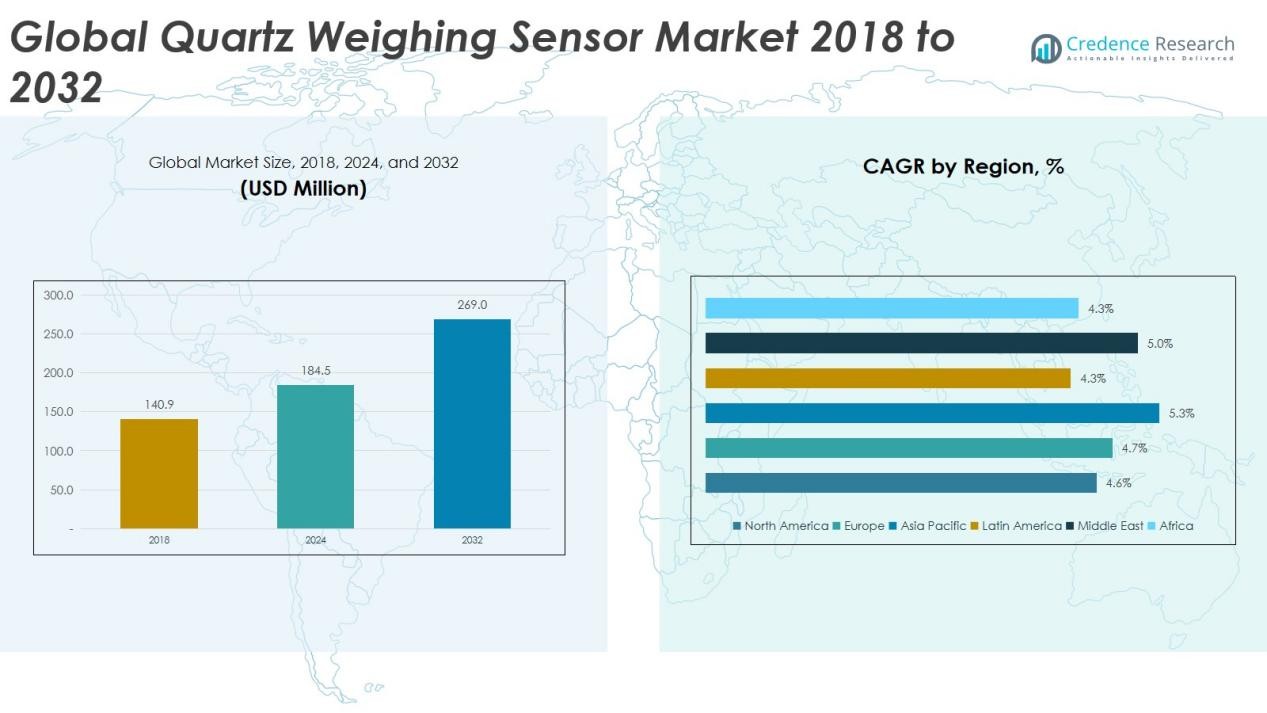
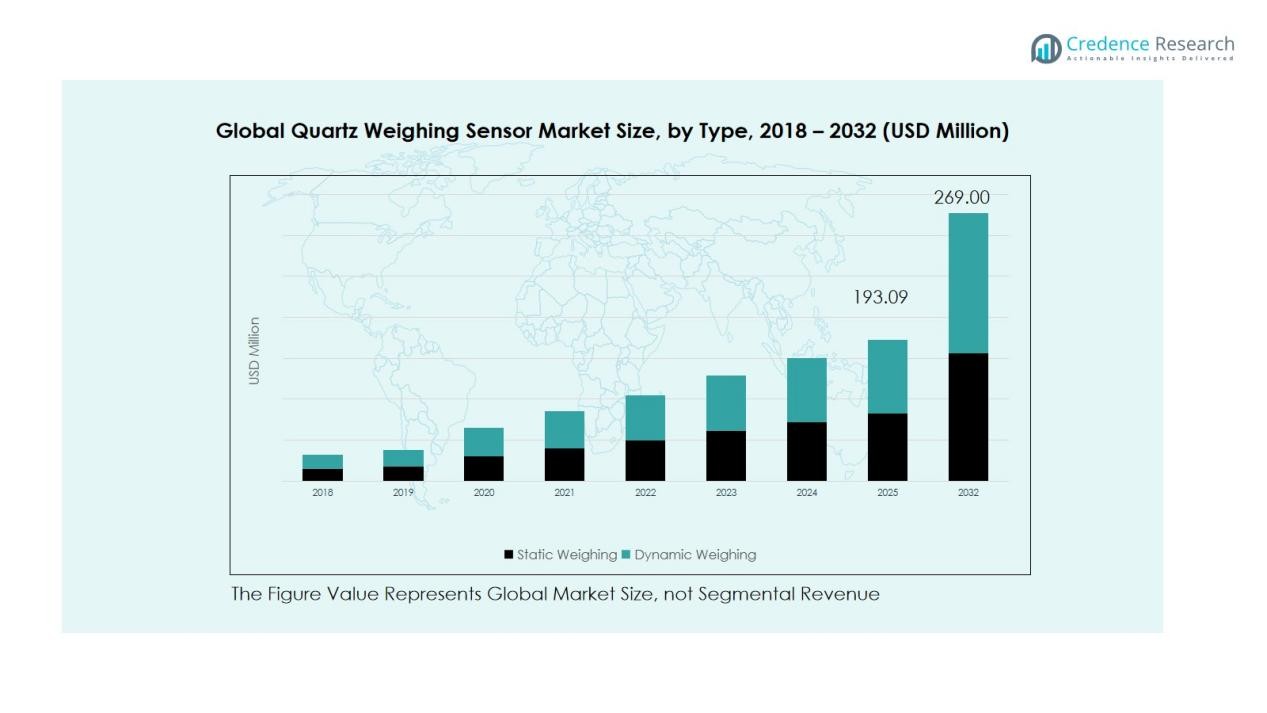
The Global Quartz Weighing Sensor Market size was valued at USD 140.9 million in 2018 to USD 184.5 million in 2024 and is anticipated to reach USD 269.0 million by 2032, at a CAGR of 4.85% during the forecast period.
| REPORT ATTRIBUTE | DETAILS |
|---|---|
| Historical Period | 2020-2023 |
| Base Year | 2024 |
| Forecast Period | 2025-2032 |
| Quartz Weighing Sensor Market Size 2024 | USD 184.5 Million |
| Quartz Weighing Sensor Market, CAGR | 4.85% |
| Quartz Weighing Sensor Market Size 2032 | USD 269.0 Million |
Rising automation, miniaturization of weighing devices, and advancements in sensor calibration techniques are fueling adoption. Growing investments in process control, quality assurance, and smart manufacturing are also accelerating the use of quartz weighing sensors. Their ability to operate efficiently in extreme temperature and vibration conditions further strengthens market growth, especially in critical sectors like aerospace and automotive testing.
Regionally, North America dominates the Global Quartz Weighing Sensor Market due to advanced manufacturing infrastructure and strong adoption of precision measurement systems. Europe follows with robust demand from industrial automation and pharmaceutical sectors. The Asia Pacific region is anticipated to record the fastest growth, supported by rapid industrialization, expansion of electronics production, and rising adoption of high-accuracy weighing instruments across China, Japan, and South Korea.
Market Insights:
- The Global Quartz Weighing Sensor Market was valued at USD 140.9 million in 2018 and reached USD 184.5 million in 2024, projected to hit USD 269.0 million by 2032, growing at a CAGR of 4.85%.
- Rising automation, miniaturization of weighing systems, and advancements in sensor calibration are driving steady adoption across industries.
- The market is expanding with strong demand from aerospace, automotive testing, and semiconductor applications that require high precision and stability.
- North America led the market in 2024 with a 31% share, supported by advanced manufacturing and research infrastructure.
- Europe held a 27% share, driven by industrial automation, food processing, and a focus on sustainable sensor production.
- Asia Pacific accounted for 34% share and is the fastest-growing region due to rapid industrialization, R&D investments, and electronic manufacturing expansion.
- High production costs and limited awareness in emerging economies remain key challenges, but rising demand for smart and high-accuracy weighing instruments will sustain long-term growth.
Market Drivers:
Rising Demand for High-Precision Measurement Across Industries:
The Global Quartz Weighing Sensor Market is driven by increasing demand for accurate and consistent weight measurement in critical sectors such as pharmaceuticals, food processing, and semiconductors. Industries require high sensitivity and repeatability to ensure product quality and compliance with stringent regulations. Quartz sensors provide excellent linearity and long-term stability, making them ideal for precision applications. This growing emphasis on measurement accuracy and quality control continues to boost adoption across both laboratory and industrial environments.
- For instance, METTLER TOLEDO's XPR microbalance leverages electromagnetic force compensation (EMFC) technology to achieve a minimum readability of 0.001 mg, supporting analytic labs in pharmaceutical R&D with highly reliable measurements.
Expanding Use in Automation and Smart Manufacturing Systems
Automation trends in manufacturing are promoting the use of quartz-based weighing sensors for efficient process control. These sensors offer fast response times and high durability, supporting automated weighing systems used in packaging, batching, and robotic operations. It enables manufacturers to reduce human error and enhance operational efficiency. The integration of sensors with digital interfaces and IoT platforms further strengthens their role in smart factories.
- For Instance, the SIWAREX WP351 weighing module uses standard strain gauge-based load cells, not quartz technology, offering high precision with an internal resolution of ±20,000,000 increments and a 1,000 Hz sampling rate.
Technological Advancements in Sensor Design and Calibration
Continuous improvements in sensor miniaturization, frequency stability, and calibration technology are expanding performance capabilities. New quartz sensor designs support compact devices without compromising precision or temperature stability. It also enhances accuracy under varying environmental conditions, which is critical in sectors like aerospace and research laboratories. These innovations contribute to the rising preference for quartz sensors over conventional strain gauge technologies.
Growing Adoption in Harsh and Dynamic Environments
Quartz weighing sensors are increasingly used in environments where temperature fluctuation, vibration, or pressure variation affect accuracy. Their inherent resistance to thermal drift and mechanical stress supports reliable operation under extreme conditions. It finds strong applications in automotive testing, defense systems, and heavy industrial processes. This ability to maintain performance integrity across challenging settings continues to drive their market expansion globally.
Market Trends:
Integration of Digital Interfaces and Smart Connectivity in Weighing Systems
The Global Quartz Weighing Sensor Market is witnessing a steady shift toward digital integration and smart connectivity. Manufacturers are developing sensors with built-in data transmission and wireless monitoring capabilities to enhance precision control in industrial processes. It enables real-time data acquisition, automated calibration, and remote diagnostics, improving system reliability. Smart interfaces such as USB, RS-485, and Ethernet are becoming common to support digital communication and compatibility with automation platforms. This trend aligns with Industry 4.0 goals, promoting data-driven decision-making and predictive maintenance. Integration with IoT-enabled networks also helps reduce downtime and improves quality control in manufacturing and laboratory operations.
- For Instance, METTLER TOLEDO launched its ACT350 weighing sensor module years before August 2025
Growing Preference for Compact, Energy-Efficient, and Sustainable Sensor Designs
Recent product innovations emphasize compactness, low power consumption, and sustainable material use in sensor construction. Manufacturers are investing in energy-efficient quartz sensing modules that meet both performance and environmental standards. It supports the demand for portable weighing devices used in field applications and smart laboratories. Advancements in micro-fabrication techniques allow smaller yet more sensitive sensors suited for precision instruments. The market trend also reflects a growing focus on recyclability and eco-friendly production methods to align with global sustainability targets. Increasing adoption of these advanced, lightweight, and power-optimized designs continues to reshape product development strategies within the quartz weighing sensor industry.
- For Instance, Siemens introduced the SITRANS SCM IQ smart condition monitoring system, which includes the wireless SITRANS MS200 multisensor.
Market Challenges Analysis:
High Production Costs and Complex Manufacturing Processes
The Global Quartz Weighing Sensor Market faces challenges related to high production costs and complex fabrication requirements. Precision manufacturing of quartz crystals demands advanced equipment, skilled labor, and strict environmental control, increasing overall production expenses. It limits affordability for small-scale manufacturers and end users in cost-sensitive industries. The need for precise calibration and testing adds further complexity to production cycles. Supply chain disruptions and fluctuations in raw material availability can also affect delivery timelines and product pricing. These factors collectively restrict market penetration in emerging economies.
Limited Awareness and Technical Expertise Among End Users
Many potential users lack technical knowledge about the benefits and operational requirements of quartz-based sensors. It creates hesitation in adoption, especially in industries still relying on conventional strain gauge technologies. Integration with digital platforms and automation systems often requires specialized skills for installation and maintenance. Smaller enterprises may struggle to justify investment without clear performance benchmarks or local technical support. Inconsistent standardization across regions also impacts interoperability between sensor systems. Addressing these awareness and training gaps remains a critical challenge for sustained market expansion.
Market Opportunities:
Expanding Adoption in Emerging Industrial and Research Applications
The Global Quartz Weighing Sensor Market presents strong opportunities through growing use in biotechnology, nanotechnology, and advanced material research. High-precision measurement needs in laboratories and micro-manufacturing facilities are expanding sensor demand. It supports analytical instruments, thin-film measurement, and real-time process monitoring. The increasing focus on miniaturized devices and high-frequency oscillation sensors creates space for product innovation. Partnerships between sensor manufacturers and research institutes can accelerate new application development. Rising investments in R&D across Asia Pacific and Europe further enhance growth potential for quartz sensor suppliers.
Integration with IoT and Smart Manufacturing Technologies
The shift toward connected and automated production systems offers significant expansion prospects. Integration of quartz weighing sensors with IoT platforms allows continuous monitoring and predictive maintenance across production lines. It enables industries to collect precise data for performance optimization and process control. Development of cloud-based analytics tools can improve calibration accuracy and operational transparency. The growing trend toward smart factories and digital twins encourages the deployment of intelligent weighing systems. This integration opens new business models and value-added service opportunities for manufacturers worldwide.
Market Segmentation Analysis:
By Type
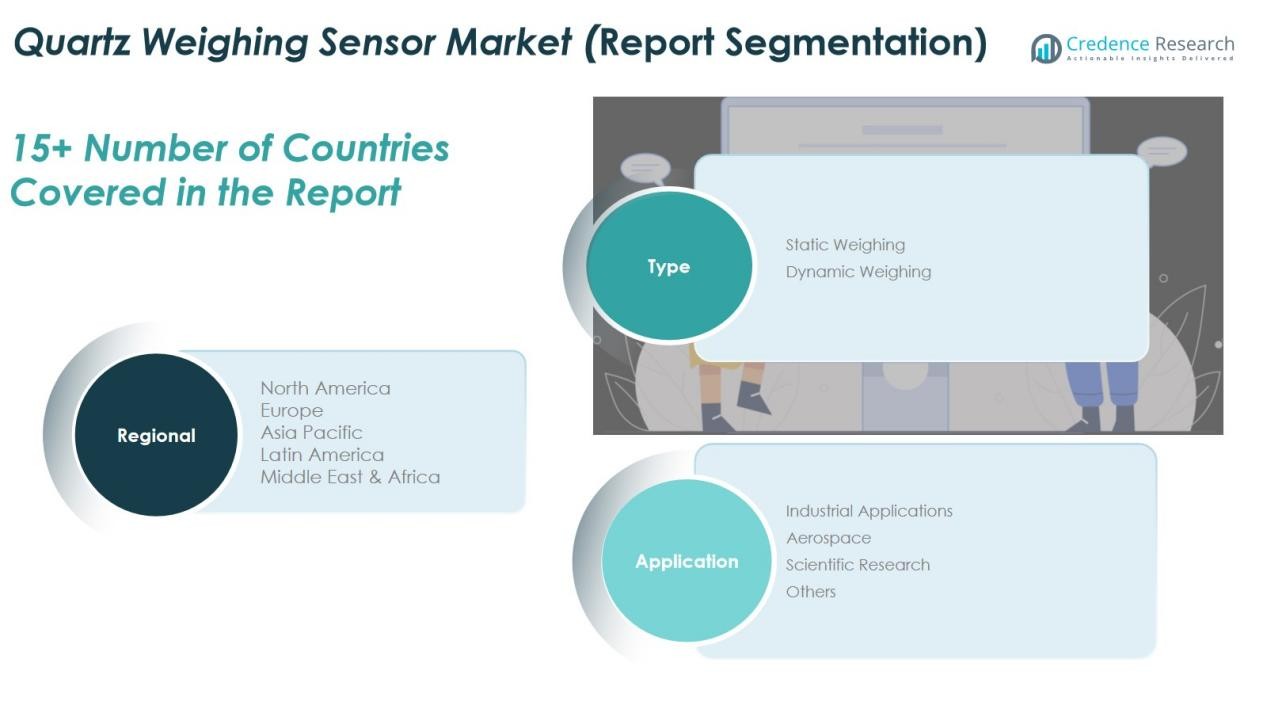
The Global Quartz Weighing Sensor Market is segmented into static weighing and dynamic weighing types. Static weighing sensors dominate the market due to their precision and reliability in laboratory and industrial applications. They are widely used in calibration equipment, material testing, and research facilities that require consistent accuracy. Dynamic weighing sensors are gaining traction in automation, packaging, and high-speed production systems where real-time measurements are essential. It supports advanced process control and enhances operational efficiency in automated environments. The growing demand for faster, more efficient weighing systems continues to drive the adoption of dynamic sensor technology.
- For instance, certain models within METTLER TOLEDO's XPR Excellence line of analytical balances can achieve an exceptional repeatability of 0.015 mg with stabilization times as fast as 1.5 seconds.
By Application
The market is classified into industrial applications, aerospace, scientific research, and others. Industrial applications lead the segment, supported by widespread use in manufacturing, process control, and material handling systems. It ensures accuracy in weight monitoring, which is critical for product quality and compliance. The aerospace segment shows significant growth potential due to rising adoption of quartz sensors in precision testing and engine calibration. Scientific research also represents a strong segment, with increasing use of quartz sensors in laboratories and research institutes for high-sensitivity measurements. The expanding use across emerging sectors strengthens the market outlook across multiple end-user industries.
- For instance, Quartzdyne (ChampionX) developed quartz pressure sensors achieving 0.05% full scale accuracy for oil field applications, while Paroscientific's Digiquartz sensors deliver parts-per-billion resolution and precision comparable to primary standards through resonant quartz crystal technology developed over five decades.
Segmentations:
By Type:
- Static Weighing
- Dynamic Weighing
By Application:
- Industrial Applications
- Aerospace
- Scientific Research
- Others
By Region:
- North America
- U.S.
- Canada
- Mexico
- Europe
- Germany
- France
- U.K.
- Italy
- Spain
- Rest of Europe
- Asia Pacific
- China
- Japan
- India
- South Korea
- South-east Asia
- Rest of Asia Pacific
- Latin America
- Brazil
- Argentina
- Rest of Latin America
- Middle East & Africa
- GCC Countries
- South Africa
- Rest of the Middle East and Africa
Regional Analysis:
North America
The North America Quartz Weighing Sensor Market size was valued at USD 36.78 million in 2018 to USD 47.38 million in 2024 and is anticipated to reach USD 67.52 million by 2032, at a CAGR of 4.6% during the forecast period. The Global Quartz Weighing Sensor Market in North America held 31% share in 2024, supported by advanced manufacturing facilities and early adoption of precision technologies. It benefits from strong demand across pharmaceutical, aerospace, and semiconductor industries. The United States remains the primary contributor due to its robust automation ecosystem and research investments. Leading manufacturers focus on product innovation and digital sensor integration to meet industry standards. Expansion of smart factories and regulatory emphasis on quality control continue to strengthen regional market growth.
Europe
The Europe Quartz Weighing Sensor Market size was valued at USD 31.14 million in 2018 to USD 40.54 million in 2024 and is anticipated to reach USD 58.59 million by 2032, at a CAGR of 4.7% during the forecast period. Europe captured 27% of the Global Quartz Weighing Sensor Market in 2024, driven by strong adoption in industrial automation and food processing sectors. Germany, the UK, and France lead regional demand with growing implementation of high-precision weighing systems. It benefits from a well-established regulatory framework emphasizing quality assurance and safety. Manufacturers are focusing on sustainable sensor production aligned with EU environmental goals. Increasing use in laboratory automation and research institutes further contributes to market development across Europe.
Asia Pacific
The Asia Pacific Quartz Weighing Sensor Market size was valued at USD 48.84 million in 2018 to USD 65.64 million in 2024 and is anticipated to reach USD 98.94 million by 2032, at a CAGR of 5.3% during the forecast period. Asia Pacific dominated the Global Quartz Weighing Sensor Market with a 34% share in 2024. Rapid industrialization, growing electronics manufacturing, and expanding R&D capabilities in China, Japan, and South Korea are key growth drivers. It benefits from increasing automation investments and government support for precision technologies. Local players are expanding their capabilities through strategic collaborations and export-oriented production. Rising adoption in pharmaceutical and semiconductor manufacturing further accelerates regional growth potential.
Latin America
The Latin America Quartz Weighing Sensor Market size was valued at USD 12.34 million in 2018 to USD 15.64 million in 2024 and is anticipated to reach USD 21.79 million by 2032, at a CAGR of 4.3% during the forecast period. Latin America accounted for 9% of the Global Quartz Weighing Sensor Market in 2024, led by Brazil and Mexico. It shows growing adoption in food processing and industrial packaging sectors. Local industries are embracing automated weighing solutions to improve productivity and product consistency. Limited domestic production capacity encourages imports from North America and Europe. Expanding investments in manufacturing modernization and technology transfer support regional advancement.
Middle East
The Middle East Quartz Weighing Sensor Market size was valued at USD 6.73 million in 2018 to USD 8.91 million in 2024 and is anticipated to reach USD 13.18 million by 2032, at a CAGR of 5.0% during the forecast period. The region held 6% of the Global Quartz Weighing Sensor Market in 2024, supported by growth in petrochemical, energy, and industrial automation sectors. It benefits from modernization projects across Saudi Arabia, the UAE, and Qatar. The integration of advanced weighing systems in refineries and chemical plants enhances operational safety and efficiency. Increasing collaboration between international suppliers and local distributors drives market accessibility. Rising focus on process optimization continues to support long-term market expansion.
Africa
The Africa Quartz Weighing Sensor Market size was valued at USD 5.03 million in 2018 to USD 6.41 million in 2024 and is anticipated to reach USD 8.98 million by 2032, at a CAGR of 4.3% during the forecast period. Africa contributed 5% share of the Global Quartz Weighing Sensor Market in 2024, led by South Africa and Egypt. Growing development in food processing, pharmaceuticals, and mining sectors is driving demand for accurate weighing instruments. It faces infrastructure and affordability challenges, limiting large-scale adoption in certain areas. International partnerships and training initiatives are helping to improve awareness and technical expertise. Gradual industrial diversification and government support for digitalization are expected to improve the regional outlook.
Key Player Analysis:
- TE Connectivity
- Kistler Group
- PCB Piezotronics
- ChampionX
- Enviko
- Zhengzhou Hengliang Tech Co., Ltd
Competitive Analysis:
The Global Quartz Weighing Sensor Market is highly competitive, with key players focusing on innovation, precision, and product reliability. Major companies such as TE Connectivity, Kistler Group, PCB Piezotronics, ChampionX, Enviko, and Zhengzhou Hengliang Tech Co., Ltd dominate the market through strong technical capabilities and broad product portfolios. It emphasizes sensor accuracy, durability, and integration with digital systems to meet evolving industrial needs. Companies are investing in R&D to enhance performance in high-temperature and vibration-prone environments. Strategic collaborations and product diversification help strengthen their global footprint. It also shows increasing competition among regional manufacturers offering cost-effective solutions and localized service support. Continuous advancement in sensor miniaturization and smart connectivity defines the current competitive landscape.
Recent Developments:
- In February 2025, TE Connectivity announced the acquisition of Richards Manufacturing Co., aiming to expand its position in the North American energy market through a $2.3 billion deal that is anticipated to close by June 2025.
- In May 2025, Kistler Group and Keller Pressure strengthened their partnership to enhance joint offerings and expand market reach in China, leveraging complementary strengths in sensor technologies.
- In October 2025, PCB Piezotronics upgraded its miniature ICP triaxial accelerometer portfolio by releasing the TLD356A01 and TLD356A03 models with embedded TEDS functionality for advanced vibration measurement.
Report Coverage:
The research report offers an in-depth analysis based on Type, Application and Region. It details leading market players, providing an overview of their business, product offerings, investments, revenue streams, and key applications. Additionally, the report includes insights into the competitive environment, SWOT analysis, current market trends, as well as the primary drivers and constraints. Furthermore, it discusses various factors that have driven market expansion in recent years. The report also explores market dynamics, regulatory scenarios, and technological advancements that are shaping the industry. It assesses the impact of external factors and global economic changes on market growth. Lastly, it provides strategic recommendations for new entrants and established companies to navigate the complexities of the market.
Future Outlook:
- The Global Quartz Weighing Sensor Market is expected to experience strong growth driven by automation and precision measurement needs.
- Rising demand from semiconductor, aerospace, and pharmaceutical industries will continue to expand application areas.
- Integration of sensors with IoT platforms and cloud-based monitoring systems will enhance operational efficiency.
- Advancements in miniaturization and calibration technology will improve sensor accuracy and adaptability.
- Manufacturers will focus on developing energy-efficient and compact sensor models for modern industries.
- Growing investments in smart manufacturing will increase adoption across production and testing facilities.
- The shift toward sustainable and recyclable materials will influence future sensor design strategies.
- Emerging economies in Asia Pacific and the Middle East will offer lucrative opportunities for market expansion.
- Collaborations between research institutions and industry players will accelerate product innovation.
- Rising emphasis on quality control, automation, and precision weighing will sustain market momentum globally.

Request a Free Sample
Fill in your details and we'll send you a free sample report.
- Sample data tables & charts
- Research methodology
Need a Custom Version of This Report?
Tailor the scope, geography, or segments to your exact requirements.
- Custom geography or segment scope
- Direct access to our analyst team
Frequently Asked Questions
What is the current market size for the Global Quartz Weighing Sensor Market, and what is its projected size in 2032?
At what Compound Annual Growth Rate is the Global Quartz Weighing Sensor Market projected to grow between 2024 and 2032?
Which Global Quartz Weighing Sensor Market segment held the largest share in 2024?
What are the primary factors fueling the growth of the Global Quartz Weighing Sensor Market?
Who are the leading companies in the Global Quartz Weighing Sensor Market?
Which region commanded the largest share of the Global Quartz Weighing Sensor Market in 2024?
Table of Content
Chapter 1 Market Segmentation
- 1.1 Segmentation Framework
- 1.1.1 Product and Service Classification
- 1.1.2 Application and End-Use Classification
- 1.1.3 Technology and Solution Classification
- 1.1.4 Customer and Distribution Channel Classification
- 1.1.5 Geographic Segmentation
- 1.1.6 Market Segment Definitions and Boundaries
Chapter 2 Introduction
- 2.1 Report Objectives and Scope
- 2.2 Product Definition and Industry Terminology
- 2.3 Market Inclusions and Exclusions
- 2.4 Research Process
- 2.4.1 Primary Research and Expert Interviews
- 2.4.2 Secondary Research and Source Review
- 2.4.3 Top-Down and Bottom-Up Estimation
- 2.4.4 Data Triangulation and Verification
- 2.5 Market Size Measurement Basis
- 2.5.1 2024: USD 184.5 million → 2032: USD 269.0 million
- 2.6 Historical and Forecast Reference Periods
- 2.6.1 Base Year: 2024
- 2.6.2 Forecast Period: 2024-2032
- 2.7 Research Assumptions and Limitations
Chapter 3 Executive Summary
- 3.1 Market Snapshot and Key Findings
- 3.2 Base-Year Market Size, 2024
- 3.3 Forecast Market Size, 2032
- 3.4 Revenue and Volume Growth Outlook
- 3.5 Key Demand and Supply Indicators
- 3.6 Leading Market Segments
- 3.7 Fastest-Growing Market Opportunities
- 3.8 Regional Performance Highlights
- 3.9 Technology and Industry Transformation
- 3.10 Competitive Landscape Summary
- 3.11 Analyst View and Strategic Implications
Chapter 4 Global Quartz Weighing Sensor Market Trends and Developments
- 4.1 Historical Industry Development
- 4.2 Recent Market Trends and Developments
- 4.3 Demand and Customer Behavior Trends
- 4.4 Technology and Product Innovation
- 4.5 Artificial Intelligence, Automation and Digitalization
- 4.6 Local Manufacturing and Supply Chain Realignment
- 4.7 Industry Partnerships, Mergers and Acquisitions
- 4.8 Sustainability and Circular Economy Developments
- 4.9 Government and Private Sector Investment Trends
- 4.10 Emerging Business Models and Commercialization
- 4.11 Industry Developments and Announcements
Chapter 5 Global Quartz Weighing Sensor Market Production, Supply and Demand Analysis
- 5.1 Demand Trend and Consumption Analysis
- 5.2 Demand Forecast, 2024-2032
- 5.3 Production and Output Trend
- 5.4 Production and Output Forecast, 2024-2032
- 5.5 Installed Capacity and Capacity Utilization
- 5.6 Company-Wise Production Plants and Statistics
- 5.6.1 Installed Production Capacity
- 5.6.2 Actual Production
- 5.6.3 Planned Capacity and Expansion Targets
- 5.7 Supply Chain Structure and Procurement Trends
- 5.8 Supply-Demand Gap and Bottlenecks
- 5.9 Import Dependence and Sourcing Structure
- 5.10 Contract Manufacturing and Outsourcing
- 5.11 Regional Supply and Demand Concentration
Chapter 6 Global Quartz Weighing Sensor Market Pricing Analysis
- 6.1 Pricing Structure and Measurement
- 6.2 Historical Pricing Trends
- 6.3 Pricing Outlook, 2024-2032
- 6.4 Average Selling Price and Unit Economics
- 6.5 Pricing by Product and Market Segment
- 6.6 Geographic Pricing Differences
- 6.7 Key Input, Energy, Labor and Logistics Costs
- 6.8 Contract Pricing and Purchasing Models
- 6.9 Pricing Sensitivity and Competitive Positioning
- 6.10 Price, Margin and Profitability Implications
Chapter 7 Global Quartz Weighing Sensor Market Dynamics
- 7.1 Market Growth Drivers
- 7.1.1 Demand-Side Drivers
- 7.1.2 Technology and Innovation Drivers
- 7.1.3 Infrastructure and Investment Drivers
- 7.1.4 Regulatory and Policy Drivers
- 7.2 Market Restraints
- 7.2.1 Cost and Affordability Constraints
- 7.2.2 Technology and Adoption Barriers
- 7.2.3 Supply Chain and Operational Constraints
- 7.3 Market Challenges
- 7.3.1 Competitive Pressure and Margin Erosion
- 7.3.2 Skills, Infrastructure and Implementation Gaps
- 7.4 Emerging Market Opportunities
- 7.5 Market Dynamics Impact and Time-Horizon Assessment
Chapter 8 Global Quartz Weighing Sensor Value Chain Analysis
- 8.1 Industry Value Chain Overview
- 8.2 Upstream Suppliers and Critical Inputs
- 8.3 Technology and Component Providers
- 8.4 Manufacturing or Service Delivery
- 8.5 Distribution, Channel Partners and Integrators
- 8.6 Downstream Applications and End Users
- 8.7 Value Addition and Profit Pools
- 8.8 Vertical Integration and Outsourcing
- 8.9 Supplier Concentration and Risk
- 8.10 Supply Chain Localization and Resilience
Chapter 9 Global Quartz Weighing Sensor Market Regulations and Policies
- 9.1 Relevant Laws, Standards and Compliance Frameworks
- 9.2 Product, Service, Safety and Quality Requirements
- 9.3 Government Policies, Incentives and Subsidies
- 9.4 Imports, Exports and Trade Barriers
- 9.5 Public Procurement and Local Content Requirements
- 9.6 Environmental and Sustainability Compliance
- 9.7 Upcoming Policy Changes and Market Implications
Chapter 10 Global Quartz Weighing Sensor Market Hotspots and Opportunities
- 10.1 Market Opportunity Mapping and Growth Hotspots
- 10.2 High-Growth Applications and Customer Groups
- 10.3 Underserved Markets and White-Space Opportunities
- 10.4 Emerging Technology and Product Opportunities
- 10.5 New Capacity and Investment Hotspots
- 10.6 Market Entry and Expansion Opportunities
- 10.7 Distribution and Partnership Opportunities
- 10.8 Near-Term and Long-Term Commercial Potential
- 10.9 Opportunity Attractiveness and Execution Risks
Chapter 11 Global Quartz Weighing Sensor Market Outlook, 2024-2032
- 11.1 Market Size and Analysis
- 11.1.1 Revenue (Market Measurement: 2024: USD 184.5 million → 2032: USD 269.0 million)
- 11.1.2 Market Volume and Quantity Sold
- 11.1.3 Historical Market Size
- 11.1.4 Base-Year Market Size, 2024
- 11.2 Market Forecast, 2024-2032
- 11.2.1 Revenue Forecast to 2032
- 11.2.2 Volume Forecast to 2032
- 11.2.3 CAGR and Year-on-Year Growth
- 11.2.4 Incremental Revenue Opportunity
- 11.3 Forecast Assumptions and Scenario Analysis
- 11.3.1 Base-Case Forecast
- 11.3.2 Optimistic and Conservative Scenarios
- 11.3.3 Technology, Pricing and Policy Sensitivities
- 11.4 Market Attractiveness and Growth Outlook
Chapter 12 Global Quartz Weighing Sensor Market Segmentation and Outlook
- 12.1 Segmentation Summary and Market Shares, 2024
- 12.2 Largest and Fastest-Growing Segments
- 12.3 Segment Growth Comparison
- 12.4 Segment Attractiveness and Priority Matrix
Chapter 13 Global Quartz Weighing Sensor Geographic Market Outlook, 2024-2032
- 13.1 Regional Market Size and Share, 2024
- 13.2 Regional Market Forecast, 2024-2032
- 13.3 Regional Pricing, Production and Demand Differences
- 13.4 North America
- 13.4.1 United States
- 13.4.2 Canada
- 13.4.3 Mexico
- 13.5 Europe
- 13.5.1 Germany
- 13.5.2 France
- 13.5.3 Italy
- 13.5.4 United Kingdom
- 13.5.5 Spain
- 13.5.6 Poland
- 13.5.7 Russia
- 13.5.8 Netherlands
- 13.5.9 Belgium
- 13.5.10 Sweden
- 13.5.11 Denmark
- 13.5.12 Norway
- 13.5.13 Rest of Europe
- 13.6 Asia Pacific
- 13.6.1 China
- 13.6.2 India
- 13.6.3 Japan
- 13.6.4 South Korea
- 13.6.5 Thailand
- 13.6.6 Indonesia
- 13.6.7 Vietnam
- 13.6.8 Malaysia
- 13.6.9 Australia
- 13.6.10 Rest of Asia Pacific
- 13.7 Latin America
- 13.7.1 Brazil
- 13.7.2 Argentina
- 13.7.3 Colombia
- 13.7.4 Chile
- 13.7.5 Rest of Latin America
- 13.8 Middle East
- 13.8.1 Saudi Arabia
- 13.8.2 United Arab Emirates
- 13.8.3 Turkey
- 13.8.4 Israel
- 13.8.5 Iran
- 13.8.6 Rest of the Middle East
- 13.9 Africa
- 13.9.1 South Africa
- 13.9.2 Egypt
- 13.9.3 Nigeria
- 13.9.4 Morocco
- 13.9.5 Rest of Africa
- 13.10 Regional Investment, Policy and Supply Chain Differences
- 13.11 Regional Competitive Landscape
- 13.12 Geographic Growth Hotspots
Chapter 14 Global Quartz Weighing Sensor Technology, Innovation and Sustainability Outlook
- 14.1 Technology Landscape and Maturity
- 14.2 Product, Process and Service Innovation
- 14.3 AI, Automation and Digital Tools in the Industry
- 14.4 Technology Adoption and Performance Benchmarking
- 14.5 Innovation Pipeline and R&D Investment
- 14.6 Patent and Intellectual Property Trends
- 14.7 Energy Efficiency and Resource Management
- 14.8 Sustainability, Recycling and Circularity
- 14.9 Technology Roadmap, 2024-2032
- 14.10 Risks of Obsolescence and Technology Substitution
Chapter 15 Global Quartz Weighing Sensor Market Key Strategic Imperatives
- 15.1 Growth and Market Entry Priorities
- 15.2 High-Return Products and Segments
- 15.3 Pricing, Profitability and Cost Optimization
- 15.4 Technology Investment and Product Differentiation
- 15.5 Supply Chain Localization and Resilience
- 15.6 Distribution and Customer Acquisition
- 15.7 Partnership, Acquisition and Capacity Strategy
- 15.8 Regional Expansion Priorities
- 15.9 Short-, Medium- and Long-Term Actions
Chapter 16 Competition Outlook
- 16.1 Industry Competition Characteristics
- 16.2 Market Structure and Concentration
- 16.3 Market Share and Competitive Positioning, 2024
- 16.4 Company-Wise Revenue and Product Benchmarking
- 16.5 Production and Service Capacity Benchmarking
- 16.6 Technology, Pricing and Differentiation
- 16.7 Regional Footprint and Distribution Strength
- 16.8 Mergers, Acquisitions and Strategic Alliances
- 16.9 New Entrants and Competitive Threats
- 16.10 Porter's Five Forces and Industry Attractiveness
- 16.11 Competitive Outlook, 2024-2032
Chapter 17 Company Profiles
- 17.1 Company Coverage and Selection Criteria
- 17.2 Leading Market Participants – Standard Profile Structure
- 17.2.1 Business Description
- 17.2.2 Company Ownership and Geographic Presence
- 17.2.3 Product and Service Portfolio
- 17.2.4 Manufacturing and Operating Footprint
- 17.2.5 Production Capacity and Expansion Plans
- 17.2.6 Financial Performance and Investment
- 17.2.7 Market Share and Competitive Position
- 17.2.8 Technology and Innovation Capabilities
- 17.2.9 Strategic Alliances or Partnerships
- 17.2.10 Recent Developments
- 17.2.11 Growth Strategy and Outlook
- 17.3 Other Relevant Market Participants
Note: Every listed company is profiled on the structure shown under the first company. The company list is preliminary and may change based on research findings, market developments, data availability and client requirements.
Chapter 18 Disclaimer
- 18.1 Research and Forecast Disclaimer
- 18.2 Data Source and Estimation Limitations
Note: The depth of individual sections depends on data availability for this market. Volume, capacity, trade and other unit-based metrics are included where applicable.