
Market Overview
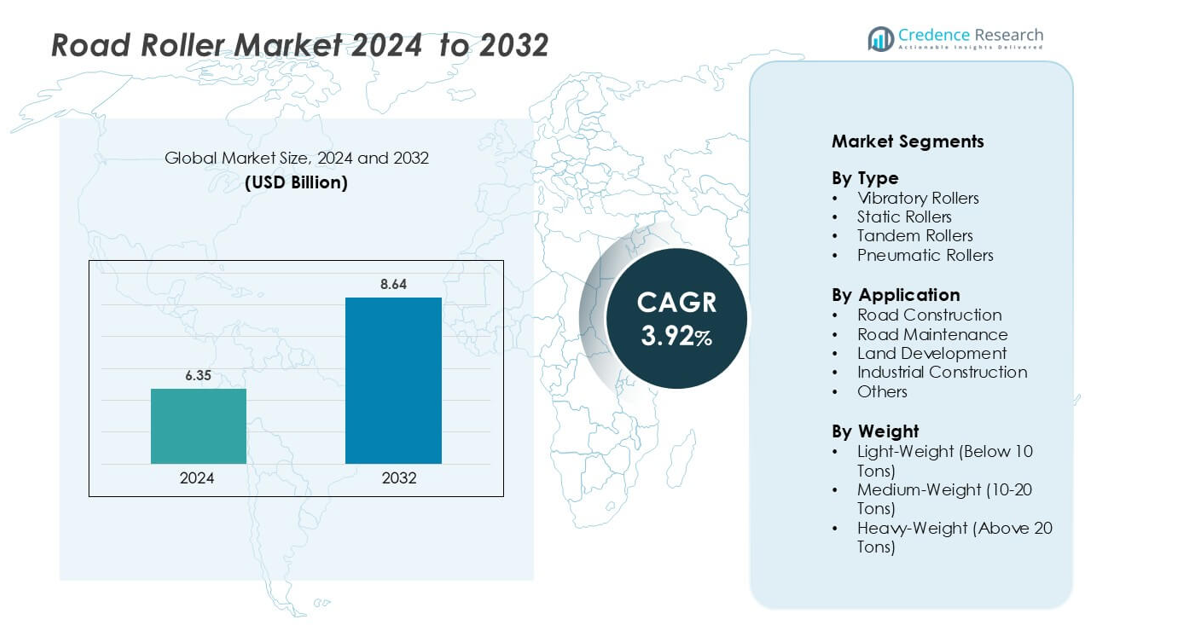
Road Roller Market size was valued USD 6.35 billion in 2024 and is anticipated to reach USD 8.64 billion by 2032, at a CAGR of 3.92 % during the forecast period.
| REPORT ATTRIBUTE | DETAILS |
|---|---|
| Historical Period | 2020-2023 |
| Base Year | 2024 |
| Forecast Period | 2025-2032 |
| Road Roller Market Size 2024 | USD 6.35 billion |
| Road Roller Market, CAGR | 3.92% |
| Road Roller Market Size 2032 | USD 8.64 billion |
The road roller market is characterized by strong competition among global and regional manufacturers emphasizing innovation, efficiency, and sustainability. Key players include SANY Group, Caterpillar, XCMG Construction Machinery Co. Ltd., Liugong Machinery Co. Ltd., Wirtgen Group, BOMAG GmbH, JC Bamford Excavators Ltd., Changlin Company Limited, Speedcrafts Limited, and Xiamen XGMA Machinery Co., Ltd. These companies focus on expanding product portfolios through electric and hybrid rollers, telematics-enabled systems, and advanced compaction technologies. Asia Pacific dominates the global market with a 39% share, supported by rapid industrialization, large-scale infrastructure projects, and government-led road development programs. Strategic collaborations and regional expansions continue to define the competitive landscape.
Market Insights
- The global Road Roller Market was valued at USD 6.35 billion in 2024 and is projected to grow at a CAGR of 3.92 % through 2032, driven by rising demand for efficient compaction equipment across infrastructure and construction sectors.
- Expanding road infrastructure projects and government investments in highway development are the primary growth drivers enhancing equipment adoption worldwide.
- Technological trends such as IoT integration, GPS-based monitoring, and hybrid power systems are improving machine performance, efficiency, and sustainability.
- The market is competitive, with key players including Caterpillar, SANY Group, XCMG, Liugong, and BOMAG focusing on smart rollers, emission control, and energy-efficient technologies.
- Asia Pacific leads the market with a 39% share, followed by North America at 34% and Europe at 27%, while the vibratory roller segment dominates with a 46% share due to its superior compaction performance and wide industrial application.
Market Segmentation Analysis:
By Type
Vibratory rollers dominate the road roller market with a 46% share due to their superior compaction efficiency and adaptability. These rollers use high-frequency vibrations to compact asphalt and granular materials effectively. Their growing use in highway, airport, and large-scale road projects drives segment growth. The inclusion of telematics and GPS-based monitoring systems enhances operational accuracy and productivity. Demand is also rising for energy-efficient and low-emission models that meet environmental standards, encouraging manufacturers to innovate in hybrid and electric roller technologies.
- For instance, Caterpillar introduced its CB2.7 GC Vibratory Compactor featuring a dual amplitude system with 62 Hz high-frequency vibration and 0.52 mm amplitude for fine asphalt compaction.
By Application
Road construction holds the largest share at 48%, supported by continuous infrastructure expansion and highway modernization programs. Governments across emerging economies are investing heavily in road connectivity and expressway networks, boosting demand for high-capacity rollers. These machines are vital in achieving smooth, durable road surfaces that meet global compaction standards. Rapid urbanization and rising public-private partnerships also accelerate market growth. Increased adoption of automated rollers with real-time compaction control further strengthens the dominance of the road construction segment.
- For instance, HAMM’s HC 250i compactor integrates Smart Compact technology and HCQ Navigator, providing GPS-based real-time compaction mapping with up to 10 cm precision, enhancing surface uniformity and quality control.
By Weight
Heavy-weight rollers (above 20 tons) lead the market with a 41% share due to their ability to deliver deep compaction for large infrastructure projects. These machines are primarily used in highways, airports, and industrial foundations where high load-bearing capacity is required. Their hydraulic and dual-drum systems provide uniform surface density and reduced passes. Manufacturers are developing smart heavy rollers integrated with load sensors and data tracking systems to improve compaction quality and project efficiency. The segment continues to expand with the rise of large-scale construction initiatives globally.
Key Growth Drivers
Expanding Road Infrastructure Development
Global infrastructure expansion remains the leading growth driver for the road roller market. Governments are increasing investments in highway upgrades, urban roads, and rural connectivity projects. The rising demand for efficient compaction equipment to ensure smooth, long-lasting pavements fuels adoption. Major economies such as India, China, and the United States are implementing national highway expansion and smart city projects that rely heavily on road rollers. The use of advanced rollers in large-scale infrastructure developments reduces project timelines and improves surface uniformity. Additionally, public-private partnerships and foreign investments in construction sectors are sustaining equipment demand across developing regions.
- For instance, Caterpillar’s CB10 Asphalt Compactor features an advanced Compaction Control System using infrared temperature sensors and accelerometers capable of monitoring up to 20 data points per second to optimize rolling patterns and surface density.
Technological Advancements and Automation
Automation and digitalization are reshaping road construction, driving demand for intelligent and connected rollers. Modern machines feature GPS-based compaction control, telematics, and real-time monitoring systems to enhance accuracy and operational efficiency. These features allow operators to optimize compaction patterns, minimize fuel use, and ensure consistent soil density. The integration of electric and hybrid technologies aligns with sustainability targets and reduces carbon emissions during operation. Manufacturers such as Caterpillar and BOMAG are introducing smart rollers equipped with data analytics and automated control systems. This technological shift increases productivity and extends machine lifespan, making automation a major market growth driver.
- For instance, BOMAG's Asphalt Manager 2 system automatically adjusts amplitude and vibration direction based on material stiffness (measured as the EVIB value), achieving optimal and uniform compaction throughout the asphalt layer.
Rising Focus on Sustainable and Energy-Efficient Equipment
The growing emphasis on sustainability in construction is encouraging the adoption of energy-efficient road rollers. Governments and contractors are prioritizing eco-friendly machinery to meet emission standards and reduce environmental impact. Hybrid and electric-powered rollers are gaining traction due to lower fuel consumption and noise levels. Manufacturers are focusing on developing lightweight yet high-performance materials to improve energy efficiency without compromising durability. For instance, the demand for rollers compliant with EU Stage V and U.S. Tier 4 emission norms is rising. Sustainability-driven procurement policies across major economies are further stimulating demand for environmentally responsible compaction equipment.
Key Trends & Opportunities
Integration of Telematics and IoT Solutions
Telematics and Internet of Things (IoT) integration represent a major trend transforming the road roller market. These technologies enable remote diagnostics, performance tracking, and predictive maintenance, reducing downtime and operational costs. Construction firms are increasingly adopting connected rollers for better fleet management and productivity optimization. IoT-enabled data analytics assist in improving compaction accuracy and monitoring operator behavior in real time. Manufacturers are capitalizing on this trend by offering subscription-based digital monitoring platforms. The trend creates opportunities for service-based revenue models and supports the shift toward smart construction ecosystems globally.
- For instance, in August 2019, an article citing Volvo Construction Equipment (Volvo CE) reported that for customers using its ActiveCare Direct service, only 1% of monitored units ever became critical machine-down cases.
Growing Adoption of Electric and Hybrid Rollers
The transition toward cleaner energy is driving the adoption of electric and hybrid road rollers. Governments are offering tax incentives and grants for low-emission construction equipment, creating significant opportunities for manufacturers. Electric rollers provide advantages such as reduced noise, lower operational costs, and compliance with stringent environmental regulations. Several leading OEMs are investing in R&D to develop fully electric compact rollers for urban construction. The trend also supports sustainable infrastructure goals and aligns with green construction mandates in Europe and North America. This growing shift toward electrification marks a key opportunity for innovation in the market.
- For instance, Wacker Neuson’s RD28e tandem roller operates on a 48 V lithium-ion battery with a 23.4 kWh capacity, providing up to 3.5 hours of continuous operation on a single charge while producing zero tailpipe emissions.
Expansion in Emerging Economies
Rapid urbanization and industrialization across Asia Pacific, Africa, and Latin America are creating new growth avenues. Infrastructure development programs, particularly in India, Indonesia, and Brazil, are boosting demand for high-performance compaction machinery. The rise in government-backed road development schemes, along with private sector participation, supports market expansion. Manufacturers are establishing regional production facilities and service networks to cater to local demand efficiently. This expansion into emerging markets presents opportunities for cost-effective product offerings and long-term partnerships in the construction equipment sector.
Key Challenges
High Initial Investment and Maintenance Costs
The significant upfront cost of purchasing road rollers remains a key challenge, especially for small and medium-sized contractors. Advanced models equipped with automation and telematics systems further increase investment requirements. Maintenance costs related to hydraulic systems, sensors, and electronic components also add to operational expenses. High repair and replacement costs can reduce the return on investment for rental and leasing firms. Limited access to financing options in developing countries further restricts market adoption among smaller enterprises. These cost-related barriers continue to slow down widespread adoption of technologically advanced rollers.
Shortage of Skilled Operators and Training Requirements
The road roller market faces a persistent shortage of skilled machine operators capable of handling automated and connected equipment. Modern rollers with advanced control systems require specialized training for safe and efficient operation. Insufficient training programs in emerging regions lead to reduced machine efficiency and increased risk of equipment damage. Additionally, improper handling can compromise compaction quality and increase project delays. Manufacturers and construction firms must invest in operator training and digital simulation programs to address this gap. The lack of skilled personnel remains a challenge to maximizing equipment performance and achieving operational efficiency.
Regional Analysis
North America
North America holds a 34% share of the global road roller market, driven by continuous infrastructure modernization and highway rehabilitation projects. The United States leads the region with strong demand for vibratory and tandem rollers in large-scale road and airport construction. Federal investments under the Infrastructure Investment and Jobs Act (IIJA) have accelerated equipment procurement across states. Canada also contributes significantly through urban road upgrades and sustainable construction initiatives. The presence of major manufacturers such as Caterpillar and Case Construction supports technological adoption and drives steady growth across the regional construction equipment market.
Europe
Europe accounts for 27% of the market, supported by stringent environmental standards and high infrastructure quality requirements. Countries such as Germany, France, and the United Kingdom are focusing on energy-efficient and low-emission rollers to comply with EU Stage V norms. The region’s demand is further boosted by ongoing maintenance of aging road networks and expansion of smart city projects. Advanced technologies like telematics and GPS-integrated rollers are widely adopted to ensure operational precision. Manufacturers such as BOMAG and Volvo Construction Equipment play a key role in shaping Europe’s market growth and innovation.
Asia Pacific
Asia Pacific dominates the global market with a 39% share, fueled by rapid urbanization, industrialization, and major infrastructure programs. China and India lead in demand for heavy-duty road rollers due to large-scale expressway, railway, and airport development projects. Government-backed initiatives like India’s Bharatmala Pariyojana and China’s Belt and Road Initiative have created robust equipment needs. Southeast Asian countries are also investing in road connectivity and smart mobility infrastructure. Local manufacturers and affordable production costs strengthen the region’s market position, making Asia Pacific the fastest-growing region in the global road roller industry.
Latin America
Latin America holds a 7% market share, driven by growing investments in transportation and urban development projects. Brazil, Mexico, and Chile are key contributors, with demand rising in road rehabilitation and industrial construction. Regional governments are emphasizing road connectivity improvements to enhance trade efficiency. Adoption of medium-weight and compact rollers is increasing due to diverse terrain conditions. However, limited infrastructure funding and import dependency pose challenges for consistent growth. International manufacturers are expanding partnerships with local distributors to strengthen after-sales support and capture emerging opportunities in the region’s construction sector.
Middle East & Africa
The Middle East & Africa region represents a 6% share of the global market, supported by infrastructure diversification and urban expansion. GCC countries such as Saudi Arabia, the UAE, and Qatar are investing heavily in smart cities and transport corridors under national development programs. Africa’s road construction initiatives, particularly in South Africa and Kenya, are also boosting roller demand. The market favors heavy and vibratory rollers suited for large-scale infrastructure and desert terrain. Strategic collaborations between global manufacturers and local contractors are driving equipment adoption and expanding market penetration across emerging economies.
Market Segmentations:
By Type
- Vibratory Rollers
- Static Rollers
- Tandem Rollers
- Pneumatic Rollers
By Application
- Road Construction
- Road Maintenance
- Land Development
- Industrial Construction
- Others
By Weight
- Light-Weight (Below 10 Tons)
- Medium-Weight (10-20 Tons)
- Heavy-Weight (Above 20 Tons)
By Geography
- North America
- U.S.
- Canada
- Mexico
- Europe
- Germany
- France
- U.K.
- Italy
- Spain
- Rest of Europe
- Asia Pacific
- China
- Japan
- India
- South Korea
- South-east Asia
- Rest of Asia Pacific
- Latin America
- Brazil
- Argentina
- Rest of Latin America
- Middle East & Africa
- GCC Countries
- South Africa
- Rest of the Middle East and Africa
Competitive Landscape
The road roller market is highly competitive, led by global and regional manufacturers such as Caterpillar, SANY Group, XCMG Construction Machinery Co. Ltd., Liugong Machinery Co. Ltd., Wirtgen Group, BOMAG GmbH, JC Bamford Excavators Ltd., Changlin Company Limited, Speedcrafts Limited, and Xiamen XGMA Machinery Co. Ltd. These companies focus on technological innovation, product diversification, and geographic expansion to strengthen market reach. Advancements in telematics, compaction control, and hybrid power systems enhance machine efficiency and operator safety. Manufacturers are increasingly investing in eco-friendly and intelligent rollers designed to reduce fuel consumption and carbon emissions. Strategic collaborations and aftersales network expansions are helping players capture infrastructure development opportunities across Asia-Pacific and Africa. Continuous innovation in vibration technology, drum design, and automation supports performance improvement and operational precision, giving leading firms a strong edge in the evolving road construction equipment landscape.
Key Player Analysis
- Caterpillar
- SANY Group
- XCMG Construction Machinery Co. Ltd.
- Liugong Machinery Co. Ltd.
- Wirtgen Group
- BOMAG GmbH
- JC Bamford Excavators Ltd.
- Changlin Company Limited
- Speedcrafts Limited
- Xiamen XGMA Machinery Co., Ltd.
Recent Developments
- In March 2023, Dynapac plans to commence the manufacturing of a fresh lineup of tandem rollers across its 6, 7, and 10-ton categories by the end of 2023. CC2200 VI, a tandem asphalt roller series, is tailored for optimal operational simplicity as well as driver comfort and safety. With drum widths spanning from 1,500 to 1,680mm, these rollers are available in split drum and combi variations, showcasing Dynapac's commitment to enhanced versatility & efficiency.
- In November 2022, Ammann introduced the eARX 26-2 Light Tandem Roller designed for construction endeavors. This roller showcases a complete electric drive system capable of continuous operation for 18 hours or more before requiring a recharge.
Report Coverage
The research report offers an in-depth analysis based on Type, Application, Weight and Geography. It details leading market players, providing an overview of their business, product offerings, investments, revenue streams, and key applications. Additionally, the report includes insights into the competitive environment, SWOT analysis, current market trends, as well as the primary drivers and constraints. Furthermore, it discusses various factors that have driven market expansion in recent years. The report also explores market dynamics, regulatory scenarios, and technological advancements that are shaping the industry. It assesses the impact of external factors and global economic changes on market growth. Lastly, it provides strategic recommendations for new entrants and established companies to navigate the complexities of the market.
Future Outlook
- Demand for electric and hybrid road rollers will rise as governments promote green construction.
- Integration of IoT and telematics will enhance performance tracking and predictive maintenance.
- Automation and operator-assist technologies will improve compaction accuracy and safety.
- Asia Pacific will remain the dominant region due to ongoing infrastructure expansion.
- Rental and leasing services will gain traction among small and medium contractors.
- Manufacturers will focus on low-emission and noise-reduction designs to meet environmental norms.
- Digital monitoring and fleet management solutions will drive operational efficiency.
- Urbanization and smart city projects will create consistent demand for compact rollers.
- Partnerships between global and local manufacturers will strengthen regional market penetration.
- Continuous R&D investments will lead to durable, energy-efficient, and intelligent roller models.

Request a Free Sample
Fill in your details and we'll send you a free sample report.
- Sample data tables & charts
- Research methodology
Need a Custom Version of This Report?
Tailor the scope, geography, or segments to your exact requirements.
- Custom geography or segment scope
- Direct access to our analyst team
Frequently Asked Questions
What is the current market size for the Road Roller Market, and what is its projected size in 2032?
At what Compound Annual Growth Rate is the Road Roller Market projected to grow between 2025 and 2032?
Which Road Roller Market segment held the largest share in 2024?
What are the primary factors fueling the growth of the Road Roller Market?
Who are the leading companies in the Road Roller Market?
Table of Content
Chapter 1 Market Segmentation
- 1.1 Segmentation Framework
- 1.1.1 Product and Service Classification
- 1.1.2 Application and End-Use Classification
- 1.1.3 Technology and Solution Classification
- 1.1.4 Customer and Distribution Channel Classification
- 1.1.5 Geographic Segmentation
- 1.1.6 Market Segment Definitions and Boundaries
Chapter 2 Introduction
- 2.1 Report Objectives and Scope
- 2.2 Product Definition and Industry Terminology
- 2.3 Market Inclusions and Exclusions
- 2.4 Research Process
- 2.4.1 Primary Research and Expert Interviews
- 2.4.2 Secondary Research and Source Review
- 2.4.3 Top-Down and Bottom-Up Estimation
- 2.4.4 Data Triangulation and Verification
- 2.5 Market Size Measurement Basis
- 2.5.1 2024: USD 6.35 billion → 2032: USD 8.64 billion
- 2.6 Historical and Forecast Reference Periods
- 2.6.1 Base Year: 2024
- 2.6.2 Forecast Period: 2024-2032
- 2.7 Research Assumptions and Limitations
Chapter 3 Executive Summary
- 3.1 Market Snapshot and Key Findings
- 3.2 Base-Year Market Size, 2024
- 3.3 Forecast Market Size, 2032
- 3.4 Revenue and Volume Growth Outlook
- 3.5 Key Demand and Supply Indicators
- 3.6 Leading Market Segments
- 3.7 Fastest-Growing Market Opportunities
- 3.8 Regional Performance Highlights
- 3.9 Technology and Industry Transformation
- 3.10 Competitive Landscape Summary
- 3.11 Analyst View and Strategic Implications
Chapter 4 Global Road Roller Market Trends and Developments
- 4.1 Historical Industry Development
- 4.2 Recent Market Trends and Developments
- 4.3 Demand and Customer Behavior Trends
- 4.4 Technology and Product Innovation
- 4.5 Artificial Intelligence, Automation and Digitalization
- 4.6 Local Manufacturing and Supply Chain Realignment
- 4.7 Industry Partnerships, Mergers and Acquisitions
- 4.8 Sustainability and Circular Economy Developments
- 4.9 Government and Private Sector Investment Trends
- 4.10 Emerging Business Models and Commercialization
- 4.11 Industry Developments and Announcements
Chapter 5 Global Road Roller Market Production, Supply and Demand Analysis
- 5.1 Demand Trend and Consumption Analysis
- 5.2 Demand Forecast, 2024-2032
- 5.3 Production and Output Trend
- 5.4 Production and Output Forecast, 2024-2032
- 5.5 Installed Capacity and Capacity Utilization
- 5.6 Company-Wise Production Plants and Statistics
- 5.6.1 Installed Production Capacity
- 5.6.2 Actual Production
- 5.6.3 Planned Capacity and Expansion Targets
- 5.7 Supply Chain Structure and Procurement Trends
- 5.8 Supply-Demand Gap and Bottlenecks
- 5.9 Import Dependence and Sourcing Structure
- 5.10 Contract Manufacturing and Outsourcing
- 5.11 Regional Supply and Demand Concentration
Chapter 6 Global Road Roller Market Pricing Analysis
- 6.1 Pricing Structure and Measurement
- 6.2 Historical Pricing Trends
- 6.3 Pricing Outlook, 2024-2032
- 6.4 Average Selling Price and Unit Economics
- 6.5 Pricing by Product and Market Segment
- 6.6 Geographic Pricing Differences
- 6.7 Key Input, Energy, Labor and Logistics Costs
- 6.8 Contract Pricing and Purchasing Models
- 6.9 Pricing Sensitivity and Competitive Positioning
- 6.10 Price, Margin and Profitability Implications
Chapter 7 Global Road Roller Market Dynamics
- 7.1 Market Growth Drivers
- 7.1.1 Demand-Side Drivers
- 7.1.2 Technology and Innovation Drivers
- 7.1.3 Infrastructure and Investment Drivers
- 7.1.4 Regulatory and Policy Drivers
- 7.2 Market Restraints
- 7.2.1 Cost and Affordability Constraints
- 7.2.2 Technology and Adoption Barriers
- 7.2.3 Supply Chain and Operational Constraints
- 7.3 Market Challenges
- 7.3.1 Competitive Pressure and Margin Erosion
- 7.3.2 Skills, Infrastructure and Implementation Gaps
- 7.4 Emerging Market Opportunities
- 7.5 Market Dynamics Impact and Time-Horizon Assessment
Chapter 8 Global Road Roller Value Chain Analysis
- 8.1 Industry Value Chain Overview
- 8.2 Upstream Suppliers and Critical Inputs
- 8.3 Technology and Component Providers
- 8.4 Manufacturing or Service Delivery
- 8.5 Distribution, Channel Partners and Integrators
- 8.6 Downstream Applications and End Users
- 8.7 Value Addition and Profit Pools
- 8.8 Vertical Integration and Outsourcing
- 8.9 Supplier Concentration and Risk
- 8.10 Supply Chain Localization and Resilience
Chapter 9 Global Road Roller Market Regulations and Policies
- 9.1 Relevant Laws, Standards and Compliance Frameworks
- 9.2 Product, Service, Safety and Quality Requirements
- 9.3 Government Policies, Incentives and Subsidies
- 9.4 Imports, Exports and Trade Barriers
- 9.5 Public Procurement and Local Content Requirements
- 9.6 Environmental and Sustainability Compliance
- 9.7 Upcoming Policy Changes and Market Implications
Chapter 10 Global Road Roller Market Hotspots and Opportunities
- 10.1 Market Opportunity Mapping and Growth Hotspots
- 10.2 High-Growth Applications and Customer Groups
- 10.3 Underserved Markets and White-Space Opportunities
- 10.4 Emerging Technology and Product Opportunities
- 10.5 New Capacity and Investment Hotspots
- 10.6 Market Entry and Expansion Opportunities
- 10.7 Distribution and Partnership Opportunities
- 10.8 Near-Term and Long-Term Commercial Potential
- 10.9 Opportunity Attractiveness and Execution Risks
Chapter 11 Global Road Roller Market Outlook, 2024-2032
- 11.1 Market Size and Analysis
- 11.1.1 Revenue (Market Measurement: 2024: USD 6.35 billion → 2032: USD 8.64 billion)
- 11.1.2 Market Volume and Quantity Sold
- 11.1.3 Historical Market Size
- 11.1.4 Base-Year Market Size, 2024
- 11.2 Market Forecast, 2024-2032
- 11.2.1 Revenue Forecast to 2032
- 11.2.2 Volume Forecast to 2032
- 11.2.3 CAGR and Year-on-Year Growth
- 11.2.4 Incremental Revenue Opportunity
- 11.3 Forecast Assumptions and Scenario Analysis
- 11.3.1 Base-Case Forecast
- 11.3.2 Optimistic and Conservative Scenarios
- 11.3.3 Technology, Pricing and Policy Sensitivities
- 11.4 Market Attractiveness and Growth Outlook
Chapter 12 Global Road Roller Market Segmentation and Outlook
- 12.1 Segmentation Summary and Market Shares, 2024
- 12.2 Largest and Fastest-Growing Segments
- 12.3 Segment Growth Comparison
- 12.4 Segment Attractiveness and Priority Matrix
Chapter 13 Global Road Roller Geographic Market Outlook, 2024-2032
- 13.1 Regional Market Size and Share, 2024
- 13.2 Regional Market Forecast, 2024-2032
- 13.3 Regional Pricing, Production and Demand Differences
- 13.4 North America
- 13.4.1 United States
- 13.4.2 Canada
- 13.4.3 Mexico
- 13.5 Europe
- 13.5.1 Germany
- 13.5.2 France
- 13.5.3 Italy
- 13.5.4 United Kingdom
- 13.5.5 Spain
- 13.5.6 Poland
- 13.5.7 Russia
- 13.5.8 Netherlands
- 13.5.9 Belgium
- 13.5.10 Sweden
- 13.5.11 Denmark
- 13.5.12 Norway
- 13.5.13 Rest of Europe
- 13.6 Asia Pacific
- 13.6.1 China
- 13.6.2 India
- 13.6.3 Japan
- 13.6.4 South Korea
- 13.6.5 Thailand
- 13.6.6 Indonesia
- 13.6.7 Vietnam
- 13.6.8 Malaysia
- 13.6.9 Australia
- 13.6.10 Rest of Asia Pacific
- 13.7 Latin America
- 13.7.1 Brazil
- 13.7.2 Argentina
- 13.7.3 Colombia
- 13.7.4 Chile
- 13.7.5 Rest of Latin America
- 13.8 Middle East
- 13.8.1 Saudi Arabia
- 13.8.2 United Arab Emirates
- 13.8.3 Turkey
- 13.8.4 Israel
- 13.8.5 Iran
- 13.8.6 Rest of the Middle East
- 13.9 Africa
- 13.9.1 South Africa
- 13.9.2 Egypt
- 13.9.3 Nigeria
- 13.9.4 Morocco
- 13.9.5 Rest of Africa
- 13.10 Regional Investment, Policy and Supply Chain Differences
- 13.11 Regional Competitive Landscape
- 13.12 Geographic Growth Hotspots
Chapter 14 Global Road Roller Technology, Innovation and Sustainability Outlook
- 14.1 Technology Landscape and Maturity
- 14.2 Product, Process and Service Innovation
- 14.3 AI, Automation and Digital Tools in the Industry
- 14.4 Technology Adoption and Performance Benchmarking
- 14.5 Innovation Pipeline and R&D Investment
- 14.6 Patent and Intellectual Property Trends
- 14.7 Energy Efficiency and Resource Management
- 14.8 Sustainability, Recycling and Circularity
- 14.9 Technology Roadmap, 2024-2032
- 14.10 Risks of Obsolescence and Technology Substitution
Chapter 15 Global Road Roller Market Key Strategic Imperatives
- 15.1 Growth and Market Entry Priorities
- 15.2 High-Return Products and Segments
- 15.3 Pricing, Profitability and Cost Optimization
- 15.4 Technology Investment and Product Differentiation
- 15.5 Supply Chain Localization and Resilience
- 15.6 Distribution and Customer Acquisition
- 15.7 Partnership, Acquisition and Capacity Strategy
- 15.8 Regional Expansion Priorities
- 15.9 Short-, Medium- and Long-Term Actions
Chapter 16 Competition Outlook
- 16.1 Industry Competition Characteristics
- 16.2 Market Structure and Concentration
- 16.3 Market Share and Competitive Positioning, 2024
- 16.4 Company-Wise Revenue and Product Benchmarking
- 16.5 Production and Service Capacity Benchmarking
- 16.6 Technology, Pricing and Differentiation
- 16.7 Regional Footprint and Distribution Strength
- 16.8 Mergers, Acquisitions and Strategic Alliances
- 16.9 New Entrants and Competitive Threats
- 16.10 Porter's Five Forces and Industry Attractiveness
- 16.11 Competitive Outlook, 2024-2032
Chapter 17 Company Profiles
- 17.1 Company Coverage and Selection Criteria
- 17.2 Leading Market Participants – Standard Profile Structure
- 17.2.1 Business Description
- 17.2.2 Company Ownership and Geographic Presence
- 17.2.3 Product and Service Portfolio
- 17.2.4 Manufacturing and Operating Footprint
- 17.2.5 Production Capacity and Expansion Plans
- 17.2.6 Financial Performance and Investment
- 17.2.7 Market Share and Competitive Position
- 17.2.8 Technology and Innovation Capabilities
- 17.2.9 Strategic Alliances or Partnerships
- 17.2.10 Recent Developments
- 17.2.11 Growth Strategy and Outlook
- 17.3 Other Relevant Market Participants
Note: Every listed company is profiled on the structure shown under the first company. The company list is preliminary and may change based on research findings, market developments, data availability and client requirements.
Chapter 18 Disclaimer
- 18.1 Research and Forecast Disclaimer
- 18.2 Data Source and Estimation Limitations
Note: The depth of individual sections depends on data availability for this market. Volume, capacity, trade and other unit-based metrics are included where applicable.

