
Key Highlights of the Report
How are the major segments performing in the Semiconductor Diffusion Equipment market?
- In 2022, the Oxidation Furnace segment accounted for the largest market share as it is used for various purposes, such as chemical attachment and surface modifiability, using oxide as a filler material, etc.
- In 2022, the Integrated Circuit segment was anticipated to hold a prominent share of the global Semiconductor Diffusion Equipment market. Due to the increasing demand for integrated circuits used in various applications, such as communication systems, consumer electronics, computing devices, and medical equipment, the integrated circuit industry is expanding.
What is the Market Size of Semiconductor Diffusion Equipment regarding value?
The global Semiconductor Diffusion Equipment market is anticipated to grow at a substantial CAGR of 8.50% in the upcoming years. The global Semiconductor Diffusion Equipment industry was estimated to be worth USD XX.X million in 2022 and was expected to be worth USD XX million by 2030.
Which region dominated the Semiconductor Diffusion Equipment market?
Asia-Pacific will dominate the global Semiconductor Diffusion Equipment Market based on market share in 2022. The growth in the production of semiconductor devices in Asian economies such as China, South Korea, Japan, and Taiwan propels the regional Semiconductor Diffusion Equipment Market. APAC is the center of the Market, which is served by several fabrication facilities located in APAC. China, South Korea, Japan, and Taiwan own the most manufacturing facilities globally.
Which are the key countries in the Semiconductor Diffusion Equipment market?
China's importance as the manufacturer of mature semiconductor technologies has increased significantly. On the other hand, the Chinese government continues to prioritize Semiconductor Diffusion Equipment as an indicator of economic development and technological leadership. By 2030, it is expected to contribute roughly 40 percent of the new global capacity.
The main factors driving the development of Semiconductor Diffusion Equipment in Japan are the increasing adoption of smart electronic devices that enhance manufacturing opportunities and the extensive integration of electronics into various applications. In addition, incorporating IoT, artificial intelligence, and other connected devices into various end-user industries is anticipated to drive the Market for Semiconductor Diffusion Equipment in the country.
How is the economy impacting the global Semiconductor Diffusion Equipment growth?
Semiconductor Diffusion Equipment, which has historically been a significant source of high-tech jobs, is among the many industries that have had to adjust their production strategies and operations due to the shift in demand for major semiconductor end applications brought about by COVID-19. The semiconductor industry, which has historically been a significant source of high-tech jobs, is among the many industries that have had to adjust their manufacturing planning and operations in response to the shift in demand for major semiconductor end applications caused by COVID-19.
What is the competitive environment of the Semiconductor Diffusion Equipment market?
The competitive rivalry in the Semiconductor Diffusion Equipment market is moderately intense. The high R&D investments and spending on capital required to compete in the Semiconductor Diffusion Equipment industry drive firm specialization. Samsung Electronics is anticipated to intensify its efforts to expand its presence in the automotive semiconductor market by forming a partnership with Hyundai Motor in May 2020. Qualcomm of the Netherlands and Infineon of Germany dominate the global automotive semiconductor market. After a closed meeting between Samsung Electronics and Hyundai Motor Group, industry insiders predict that automotive semiconductors will be one of the products on which Samsung Electronics and Hyundai Motor will collaborate.
Executive Summary
What are the key trends in the Semiconductor Diffusion Equipment market?
- As automobiles, medical equipment, smart homes, smart devices, and wearables continue developing, semiconductor integration has become widespread. In addition, the expanding trend of combining semiconductors onto a single processor results from consumer demand for smaller-sized devices. Since semiconductors can now be assembled on a single chip, the machinery that manufactures semiconductors is gathering momentum.
- The growth of smartphones, which is anticipated to increase with population expansion, is the Market's primary driver. Growing customer demand for products such as tablets, laptop computers, smartphones, and wearable devices drives the consumer electronics industry. As semiconductor technology develops, new market segments, such as machine learning, are swiftly incorporated.
How Does the Growing Demand for Consumer Electronics Affect the Semiconductor Diffusion Equipment Market?
Consumer electronics is one of the most indispensable industries wholly dependent on semiconductors. The consumer electronics market contributes to expanding the global semiconductor manufacturing equipment industry. Globally, the number of manufacturing facilities has increased as the demand for consumer electronics has increased. Changing chip sizes and inventive configurations in various electronic devices have increased semiconductor demand, resulting in substantial profits for semiconductor equipment manufacturers. Applied Materials, Inc., for instance, announced new technologies and capabilities in September 2021 to assist clients in accelerating their hybrid chip design and integrating technology roadmaps.
Which are the key investments by the Semiconductor Diffusion Equipment market players?
The Semiconductor Diffusion equipment market is anticipated to expand in the coming years due to rising investments in the sector's technological development. The US CHIPS and Science Act, which the US Congress enacted in July 2022, has allocated over $52 billion in incentives to strengthen domestic semiconductor manufacturing incentives and research investments. The final package includes $39 billion for the construction of semiconductor facilities, $10 billion for regional technology hubs, $11 billion in semiconductor research and development investments, $200 million for a semiconductor workforce and education fund, $2 billion for the US Department of Defense, USD 500 million for international technology security along with supply chains, and a 25% investment tax credit for semiconductor manufacturing facilities. In accordance with the law, recipients of US funding are prohibited from expanding new semiconductor manufacturing plants in China and other countries.
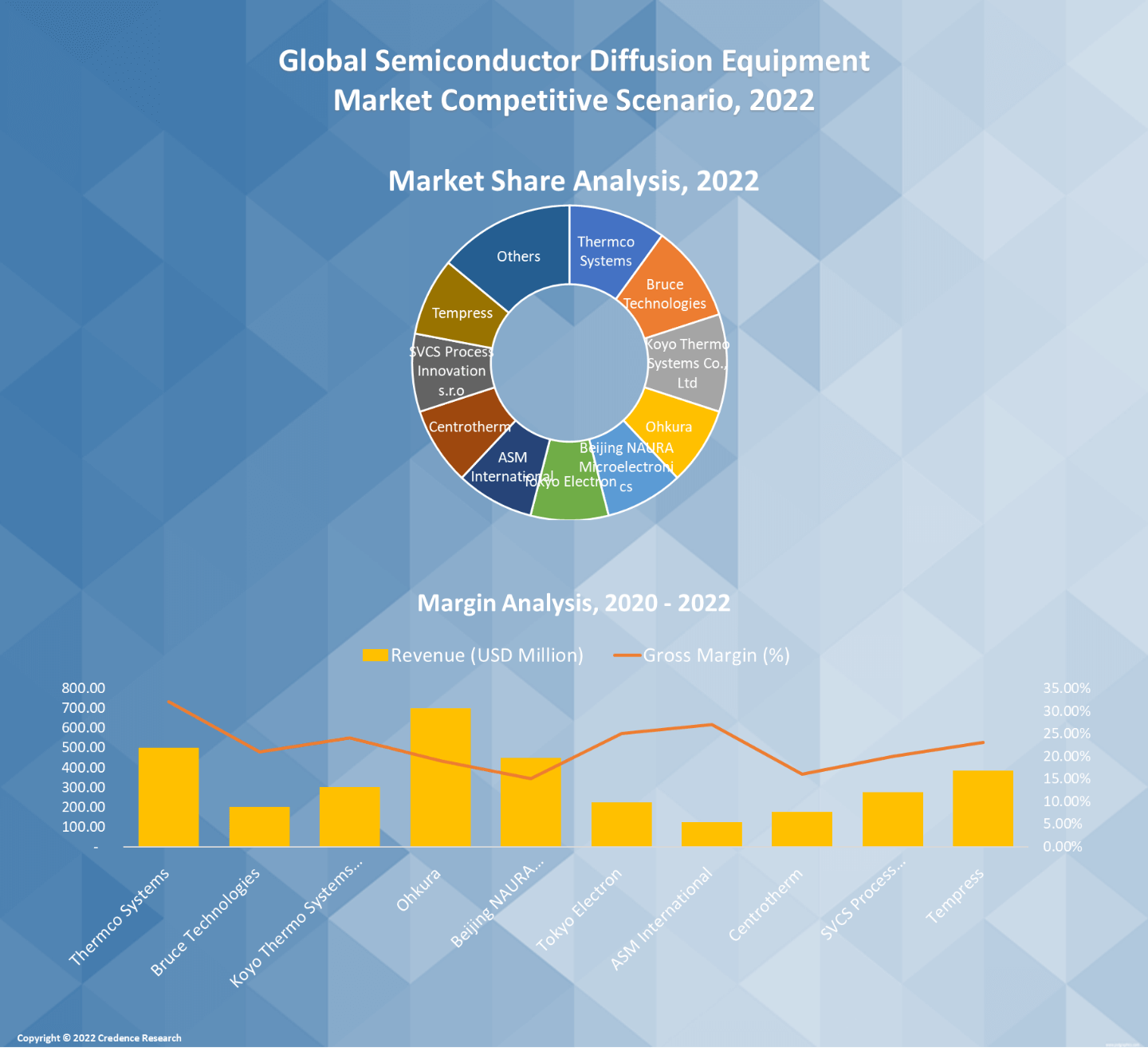
Some major players in the Semiconductor Diffusion Equipment market are Thermco Systems, Bruce Technologies, Koyo Thermo Systems Co., Ltd, Ohkura, Beijing NAURA Microelectronics, Tokyo Electron, ASM International, Centrotherm, SVCS Process Innovation s.r.o, Tempress, SEMCO TECHNOLOGIES, and Kokusai Electric Corporation.
What are the Major Driving Factors for the Semiconductor Diffusion Equipment Market?
The semiconductor industry is one of the world's fastest-growing industries, so it is no surprise that the semiconductor diffusion apparatus is a crucial component of this booming Market. As chip manufacturers seek to improve the speed and efficiency of their semiconductors, they are increasingly looking to advanced diffusion equipment to increase the efficiency of their production processes. Because they make it simpler to control film thickness and composition, these technologies are widely used in the semiconductor manufacturing industry. The increasing demand for these technologies is anticipated to drive the growth of the Semiconductor Diffusion equipment market during the forecast period.
What are the Major Risks for the Semiconductor Diffusion Equipment Market?
Particles of dust disrupt the entire semiconductor production and manufacturing procedure, necessitating the use of a clean environment and clean tools. In addition, manufacturing defects cause supply delays, resulting in losses such as order cancellations and client migration to alternative providers.
Which is the key application in the Semiconductor Diffusion Equipment market?
The Consumer Electronics segment is expected to hold a major share of the global Semiconductor Diffusion Equipment market during the forecast period. Consumer electronics is the fastest-growing sector and a major contributor to market growth. Smartphone subscriptions continue to increase. By the end of 2021, nearly 77% of all cell phone plans will be for smartphones. This is expected to increase to 7.8 billion by 2027, representing 87% of all mobile subscribers. The Market for semiconductor equipment is driven by the demand for faster and more efficient memory solutions. These semiconductors are becoming increasingly complex and can perform intensive memory operations. Due to the increased reliance on IP solution providers, the Semiconductor Diffusion equipment market is witnessing significant investment.
How is the Semiconductor Diffusion Equipment market performing in regions?
The European Market is anticipated to witness the fastest growth in the global Semiconductor Diffusion Equipment market during the forecast period. European nations are also concentrated on investments and business expansion. Germany has announced that, under the EU State Aid IPCEI (Important Projects of Common European Interest) initiative, it will invest €3 billion in domestic production across the entire semiconductor production value chain. In May 2022, the Business, Energy, and Industrial Strategy (BEIS) Committee of the United Kingdom commenced an investigation into the advantages and disadvantages of the semiconductor industry and its supply chain in the United Kingdom and is anticipated to publish a report detailing its findings.
What is the regulatory landscape for the Semiconductor Diffusion Equipment market?
The Semiconductor Fabrication Standards govern the semiconductor manufacturing process. Given the significance of clean spaces, these standards address gas distribution, water use, and quality in this context. In addition, IEC 62258 contains information regarding semiconductor die products. Other important topics, such as EM immunity, semiconductor examination, and aerospace-specific requirements, are also covered.
What are the major players planning for the future of the Semiconductor Diffusion Equipment market?
In addition, the gradual transitions in the semiconductor sector, such as the miniaturization of nodes and wafer sizes, have spurred the development of semiconductor equipment by increasing the demand for larger wafers for ultra-large-scale integration technologies. In addition, fab manufacturers are transferring process monitors from bare wafers to manufacturing wafers due to wafer miniaturization's higher cost and inspection challenges.
| REPORT ATTRIBUTE | DETAILS |
|---|---|
| Semiconductor Diffusion Equipment Market by Value | Yes |
| Semiconductor Diffusion Equipment Market, Tornado Analysis | Yes |
| Semiconductor Diffusion Equipment Market, STAR Analysis | Yes |
| Semiconductor Diffusion Equipment Market, SRC Analysis | Yes |
| Semiconductor Diffusion Equipment Market Pricing Analysis | Yes (On Demand) |
| Semiconductor Diffusion Equipment Market Segment Analysis | By Type (Oxidation Furnace, Annealing Furnace, and RTP Furnace) By Application (Integrated Circuit, Consumer Electronics, Telecommunication, and Others) |
| Semiconductor Diffusion Equipment Market, Regional Analysis | North America (US and Canada) Europe (Germany, UK, France, Italy, Spain, and Rest of Europe) Asia Pacific (China, India, Japan, South Korea, South East Asia, and Rest of Asia Pacific) Latin America (Brazil, Mexico, and Rest of Latin America) Middle East and Africa (GCC Countries, South Africa, and Rest of Middle East and Africa) |
| Semiconductor Diffusion Equipment Market Key Companies | Thermco Systems, Bruce Technologies, Koyo Thermo Systems Co., Ltd, Ohkura, Beijing NAURA Microelectronics, Tokyo Electron, ASM International, Centrotherm, SVCS Process Innovation s.r.o, Tempress, SEMCO TECHNOLOGIES, and Kokusai Electric Corporation |
| Semiconductor Diffusion Equipment Market Competitive Landscape | Market Share Analysis Competitive Benchmarking Key Players Market Positioning Geographical Presence Analysis Major Strategies Adopted |
Segmentation of Global Semiconductor Diffusion Equipment Market-
Global Semiconductor Diffusion Equipment Market – By Types
- Oxidation Furnace
- Annealing Furnace
- RTP Furnace
Global Semiconductor Diffusion Equipment Market – By Application
- Integrated Circuit
- Consumer Electronics
- Telecommunication
- Others
Global Semiconductor Diffusion Equipment Market – By Region
- North America
- U.S.
- Canada
- Europe
- Germany
- France
- U.K.
- Italy
- Spain
- Rest of Europe
- Asia Pacific
- China
- Japan
- India
- South Korea
- South-east Asia
- Rest of Asia Pacific
- Latin America
- Brazil
- Mexico
- Rest of Latin America
- Middle East & Africa
- GCC Countries
- South Africa
- Rest of Middle East and Africa
Request a Free Sample
Fill in your details and we'll send you a free sample report.
- Sample data tables & charts
- Research methodology
Need a Custom Version of This Report?
Tailor the scope, geography, or segments to your exact requirements.
- Custom geography or segment scope
- Direct access to our analyst team
Frequently Asked Questions
How does COVID-19 Impact the global Semiconductor Diffusion Equipment market?
Which is the leading region of the Market for Semiconductor Diffusion Equipment?
Which is the major segment in the Semiconductor Diffusion Equipment market by application?
What are the key drivers for the growth of the Semiconductor Diffusion Equipment market?
Which is the major segment in the Semiconductor Diffusion Equipment market by type?
Table of Content
Chapter 1. Report Introduction
- 1.1 Report Description & Purpose
- 1.1.1 Report Title & Market Definition
- 1.1.2 Unique Selling Propositions (USP) & Key Differentiators
- 1.1.3 Value Proposition for Stakeholders
- 1.2 Research Objectives
- 1.2.1 Market Sizing Objectives (Volume & Revenue)
- 1.2.2 Segmentation Objectives
- 1.2.3 Competitive Intelligence Objectives
- 1.2.4 Forecast & Scenario Objectives
- 1.3 Report Scope
- 1.3.1 Semiconductor Diffusion Equipment Scope – Types & Subtypes Covered
- 1.3.2 Geographic Scope – Regions & Countries Covered
- 1.3.3 Historical Period, Base Year & Forecast Period (the historical period; forecast to the forecast period)
- 1.3.4 Inclusions & Exclusions
- 1.4 HS Code & Classification Framework
- 1.5 Currency, Units & Pricing Basis
- 1.6 Target Stakeholders
- 1.7 Limitations & Assumptions
Chapter 2. Executive Summary
- 2.1 Global Semiconductor Diffusion Equipment Market Snapshot
- 2.1.1 Market Size – Historical (the historical period) & Forecast (the forecast period) (base year: NULL → forecast year: NULL)
- 2.1.2 Volume & Revenue – Global Totals
- 2.1.3 Key Market Highlights – Top Five Facts
- 2.2 Semiconductor Diffusion Equipment Market Segmentation Snapshot
- 2.2.1 Market Split by Region – vs.
- 2.3 Competitive Snapshot
- 2.3.1 Top 10 Players by Revenue Share –
- 2.3.2 Top 10 Players by Volume Share –
- 2.3.3 Recent Strategic Developments (18-Month Summary)
- 2.4 Key Investment Highlights & Strategic Conclusions
Chapter 3. Semiconductor Diffusion Equipment Market Dynamics & Industry Analysis
- 3.1 Market Overview & Context
- 3.1.1 Semiconductor Diffusion Equipment Market Position in the Broader Automotive Value Chain
- 3.1.2 OEM vs. Replacement Market Dynamics
- 3.1.3 Market Maturity & Development Stage by Region
- 3.2 Semiconductor Diffusion Equipment Market Drivers
- 3.3 Semiconductor Diffusion Equipment Market Restraints & Challenges
- 3.4 Semiconductor Diffusion Equipment Market Opportunities
- 3.5 Porter's Five Forces Analysis
- 3.5.1 Threat of New Entrants
- 3.5.2 Bargaining Power of Suppliers
- 3.5.3 Bargaining Power of Buyers
- 3.5.4 Threat of Substitutes
- 3.5.5 Competitive Rivalry – Intensity Assessment
- 3.6 Semiconductor Diffusion Equipment Value Chain Analysis
- 3.6.1 Upstream – Raw Material/Input Suppliers
- 3.6.1.1 Raw Material/Input 1
- 3.6.1.2 Raw Material/Input 2
- 3.6.1.3 Raw Material/Input 3
- 3.6.2 Midstream – Production/Manufacturing/Service Delivery
- 3.6.2.1 Production/Process Overview
- 3.6.2.2 Key Facility Locations & Capacity by Manufacturer
- 3.6.3 Downstream – Distribution & End Consumer
- 3.6.3.1 Primary Channel – B2B/OEM
- 3.6.3.2 Secondary Channels – Dealer, Retail, Online, Direct
- 3.6.4 Value Chain Profitability Analysis
- 3.6.1 Upstream – Raw Material/Input Suppliers
- 3.7 PESTEL Analysis
- 3.7.1 Political Factors
- 3.7.2 Economic Factors
- 3.7.3 Social Factors
- 3.7.4 Technological Factors
- 3.7.5 Environmental Factors
- 3.7.6 Legal Factors
- 3.8 Semiconductor Diffusion Equipment Supply Chain Analysis
- 3.8.1 Raw Material/Input Supply Risk Assessment
- 3.8.2 Manufacturing Concentration Risk (Geographic Exposure)
- 3.8.3 Trade Disruption Impact Analysis
- 3.9 Regulatory & Policy Landscape
Note: The regulatory and policy landscape section covers regulations based on their applicability to the market, Semiconductor Diffusion Equipment category, geography, and scope of the study. Only regulatory frameworks with a material impact on operations, compliance, trade, sustainability, or market access are analyzed in detail.
Chapter 4. Key Investment Pockets & Opportunity Analysis
- 4.1 Semiconductor Diffusion Equipment Market Attractiveness Analysis
- 4.1.1 By Region – Investment Attractiveness Matrix (Volume × CAGR)
- 4.2 Absolute Revenue Growth Opportunity
- 4.2.1 By Region – Absolute USD Growth Through the forecast period
- 4.3 Incremental Volume Opportunity
- 4.3.1 By Region – Incremental Volume Through the forecast period
- 4.3.2 Segment – Incremental Volume
- 4.4 Emerging Submarket Opportunity Deep Dive (Subject to Applicability)
- 4.5 Emerging Market Opportunity Scorecards
- 4.5.1 United States
- 4.5.2 Europe
- 4.5.3 Asia
- 4.5.4 Middle East & Africa
Note: Emerging Market Opportunity Scorecards will be included based on relevance and strategic importance. Regions listed are indicative and may vary depending on data availability and market dynamics.
Chapter 5. Semiconductor Diffusion Equipment Import-Export Analysis & Trade Flows
- 5.1 Global Trade Overview
- 5.1.1 Global Export Value by Country (the historical period)
- 5.1.2 Global Export Volume by Country (the historical period)
- 5.1.3 Global Import Value by Country (the historical period)
- 5.1.4 Global Import Volume by Country (the historical period)
- 5.1.5 Net Trade Balance by Country (the historical period)
- 5.2 Export Analysis – Segment
- 5.2.1 Type 1 (HS Code)
- 5.2.2 Type 2 (HS Code)
- 5.2.3 Type 3 (HS Code)
- 5.2.4 Type 4 (HS Code)
- 5.2.5 Type 5 (HS Code)
- 5.3 Import Analysis – Segment
- 5.3.1 Type 1 (HS Code)
- 5.3.2 Type 2 (HS Code)
- 5.3.3 Type 3 (HS Code)
- 5.3.4 Type 4 (HS Code)
- 5.3.5 Type 5 (HS Code)
- 5.4 Average Unit Trade Prices
- 5.4.1 Average Export Price – Segment & Country
- 5.4.2 Average Import Price – Segment & Source Country
- 5.4.3 Price Trends (the historical period)
- 5.5 Key Trade Route Analysis
- 5.5.1 Trade Route 1
- 5.5.2 Trade Route 2
- 5.5.3 Trade Route 3
- 5.5.4 Trade Route 4
- 5.5.5 Trade Route 5
- 5.6 Trade Policy Impact Assessment
- 5.6.1 US Anti-Dumping & Section 301 Tariffs
- 5.6.2 EU Customs Union Impact
- 5.6.3 Major Free Trade Agreements
- 5.6.4 USMCA Rules of Origin
Note: Trade policy analysis will be included only where relevant to the Semiconductor Diffusion Equipment market.
Chapter 6. Competitive Landscape & Company Benchmarking
- 6.1 Semiconductor Diffusion Equipment Market Concentration & Structure
- 6.1.1 Herfindahl-Hirschman Index (HHI) – vs.
- 6.1.2 Tier 1, Tier 2 & Tier 3 Market Structure
- 6.1.3 Global, Regional & Local Player Dynamics
- 6.2 Semiconductor Diffusion Equipment Market Share Analysis –
- 6.2.1 Global Revenue Share by Company
- 6.2.2 Global Volume Share by Company
- 6.2.3 Regional Revenue Share
- 6.2.4 Market Share Evolution ( vs. )
- 6.2.5 OEM Segment Share by Company
- 6.2.6 Replacement Segment Share by Company
- 6.3 Production/Delivery Capacity & Facility Analysis
- 6.3.1 Global Installed Capacity
- 6.3.2 Capacity Utilization Rates
- 6.3.3 Production/Output Volume
- 6.3.4 Facility Locations & Capacity Map
- 6.3.5 Planned Capacity Additions
- 6.4 Semiconductor Diffusion Equipment Competitive Benchmarking Matrix
- 6.4.1 Revenue, Volume, CAGR & Profitability Comparison
- 6.4.2 Channel Revenue Mix
- 6.4.3 Geographic Revenue Exposure
- 6.4.4 R&D Intensity
- 6.4.5 Sustainability Maturity
- 6.5 Strategic Developments in Semiconductor Diffusion Equipment (Last 24 Months)
- 6.5.1 Mergers, Acquisitions & Divestments
- 6.5.2 New Semiconductor Diffusion Equipment Launches
- 6.5.3 Facility Expansions
- 6.5.4 Strategic Alliances, Joint Ventures & Partnerships
- 6.5.5 Distribution Expansion & Market Entry
- 6.5.6 Sustainability & ESG Initiatives
- 6.6 Competitive Strategy Mapping
- 6.6.1 Leader, Challenger, Follower & Niche Classification
- 6.6.2 Pricing Strategy Comparison
- 6.6.3 Channel Strategy Matrix
Note: Strategic developments are included based on their materiality and the availability of reliable information.
Chapter 7. Global Semiconductor Diffusion Equipment Market – By Distribution Channel
- 7.1 Segment Overview
- 7.1.1 Volume & Revenue Split by Channel ( & )
- 7.1.2 Channel Mix Evolution (the forecast period)
Chapter 8. Regional Market Analysis – Global Overview
- 8.1 Global Regional Overview
- 8.1.1 Regional Volume Share
- 8.1.2 Regional Revenue Share
- 8.1.3 Regional Volume by Region
- 8.1.4 Regional Revenue by Region
- 8.1.5 Regional Forecast Through the forecast period
- 8.2 Cross-Regional Segment Analysis
- 8.2.1 By Distribution Channel
- 8.2.2 By Brand/Price Tier
Chapter 9. North America Semiconductor Diffusion Equipment Market
- 9.1 United States
- 9.2 Canada
- 9.3 Mexico
Chapter 10. Europe Semiconductor Diffusion Equipment Market
- 10.1 Germany
- 10.2 France
- 10.3 Italy
- 10.4 United Kingdom
- 10.5 Spain
- 10.6 Poland
- 10.7 Russia
- 10.8 Netherlands
- 10.9 Belgium
- 10.10 Sweden
- 10.11 Denmark
- 10.12 Norway
- 10.13 Rest of Europe
Chapter 11. Asia Pacific Semiconductor Diffusion Equipment Market
- 11.1 China
- 11.2 India
- 11.3 Japan
- 11.4 South Korea
- 11.5 Thailand
- 11.6 Indonesia
- 11.7 Vietnam
- 11.8 Malaysia
- 11.9 Australia
- 11.10 Rest of Asia Pacific
Chapter 12. Latin America Semiconductor Diffusion Equipment Market
- 12.1 Brazil
- 12.2 Argentina
- 12.3 Colombia
- 12.4 Chile
- 12.5 Rest of Latin America
Chapter 13. Middle East Semiconductor Diffusion Equipment Market
- 13.1 Saudi Arabia
- 13.2 United Arab Emirates
- 13.3 Turkey
- 13.4 Israel
- 13.5 Iran
- 13.6 Rest of the Middle East
Chapter 14. Africa Semiconductor Diffusion Equipment Market
- 14.1 South Africa
- 14.2 Egypt
- 14.3 Nigeria
- 14.4 Morocco
- 14.5 Rest of Africa
Chapter 15. Semiconductor Diffusion Equipment Company Profiles
- 15.1 [Company 01]
- 15.1.1 Company Overview
- 15.1.2 Key Management Personnel
- 15.1.3 Products & Services Portfolio
- 15.1.4 Financial Performance
- 15.1.5 Key Market Focus & Geographic Presence
- 15.1.6 Recent Developments & Strategic Initiatives
Note: The company profile list is preliminary and may change based on research findings, market developments, data availability, and client requirements.
Chapter 16. Appendices
- Appendix A – List of Abbreviations & Acronyms
- Appendix B – Industry Classification Code Reference – Full Series
- Appendix C – Production & Capacity Data Tables
- Appendix D – End-Use & Demand Base Tables
- Appendix E – Consumption & Replacement Rate Assumptions
- Appendix F – ASP Reference Tables
- Appendix G – Manufacturing & Facility Database
- Appendix H – Import-Export Data Tables
- Appendix I – Regulatory Summary Tables
- Appendix J – Primary Research Participant List (Anonymized)
- Appendix K – Primary Research Questionnaire Framework
- Appendix L – Data Sources & Bibliography
- Appendix M – Market Size Divergence & Source Comparison
Chapter 17. Research Methodology
- 17.1 Research Framework & Philosophy
- 17.2 Secondary Research – Sources, Hierarchy & Data Extraction
- 17.3 Data Modeling – Bottom-Up & Top-Down Market Sizing
- 17.4 Primary Research – Stakeholder Framework, LOI & Sample Sizes
- 17.5 Forecast Methodology – Regression, Scenario & Sensitivity Analysis
- 17.6 Quality Control – Four-Layer Validation Framework
- 17.7 Limitations & Standard Assumptions
- 17.8 Disclaimer
