
Market Overview
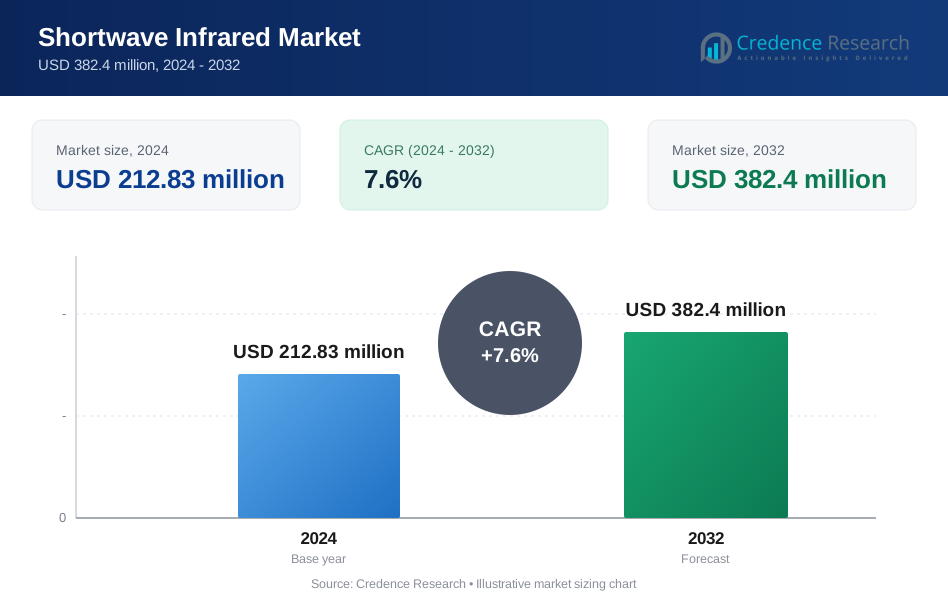
Shortwave Infrared Market size was valued at USD 212.83 million in 2024 and is anticipated to reach USD 382.4 million by 2032, at a CAGR of 7.6% during the forecast period.
| REPORT ATTRIBUTE | DETAILS |
|---|---|
| Historical Period | 2020-2023 |
| Base Year | 2024 |
| Forecast Period | 2025-2032 |
| Shortwave Infrared Market Size 2024 | USD 212.83 million |
| Shortwave Infrared Market, CAGR | 7.6% |
| Shortwave Infrared Market Size 2032 | USD 382.4 million |
The Shortwave Infrared Market includes major players such as Hamamatsu Photonics K.K., Raptor Photonics, Teledyne FLIR LLC, Lynred, Fluke Corporation, Corning Incorporated, Leonardo DRS, Allied Vision Technologies GmbH, Collins Aerospace, and New Imaging Technologies (NIT). These companies compete through advancements in uncooled sensors, compact camera design, and AI-supported imaging for industrial and defense use. Demand continues to rise in semiconductor inspection, surveillance, automation, and precision agriculture. North America led the market in 2024 with about 38% share, supported by strong defense spending and advanced manufacturing, while Europe and Asia Pacific followed with growing adoption across industrial and research applications.
Market Insights
- The Shortwave Infrared Market was valued at USD 212.83 million in 2024 and is projected to reach USD 382.4 million by 2032, growing at a CAGR of 7.6%.
- Growing use in defense, semiconductor inspection, and industrial automation drives demand, supported by wider adoption of uncooled sensors for cost-effective deployment.
- Key trends include compact SWIR system development, AI-enabled imaging, and rising integration in robotics, agriculture, and environmental monitoring, with thermal imaging leading at about 58% share.
- Leading companies enhance competitiveness through advanced sensor engineering, edge-processing capabilities, and stronger partnerships across manufacturing, aerospace, and security industries, with solutions holding about 72% share.
- North America led the market with 38% share, followed by Europe at 27% and Asia Pacific at 25%, while Latin America and Middle East & Africa held 6% and 4% respectively.
Market Segmentation Analysis:
By Offering
held the dominant position in 2024 with about 72% share. Strong demand came from integrated SWIR cameras, modules, and sensors used in defense, industrial sorting, and semiconductor inspection. Buyers preferred complete hardware–software bundles that support fast deployment and high accuracy in low-light and high-temperature environments. Growth also came from rising adoption of automated inspection in electronics and food processing. Services grew at a steady pace due to increasing system integration and maintenance needs across factories and security projects worldwide.
- For instance, Teledyne FLIR’s Forge 1GigE SWIR camera offers 1.3-megapixel 1280×1024 resolution. It reaches 92 frames per second across a 400 to 1700 nanometer spectral range.
By Technology
Uncooled technology led the market in 2024 with nearly 64% share. Wider use stemmed from its lower cost, compact structure, and simpler thermal management demands, making it suitable for surveillance, inspection, and agricultural analytics. Manufacturers expanded uncooled SWIR camera lines to meet rising demand for lightweight and power-efficient systems. Cooled systems advanced through niche use in scientific research, aerospace, and high-precision defense tasks but remained smaller due to higher costs and complex operation requirements.
- For instance, Sensors Unlimited’s Nano-SWIR C-Platform camera uses a 640×512-pixel InGaAs imager. It explicitly “does not require thermal stabilization” while targeting small size, weight, and power.
By Imaging Type
Thermal imaging dominated this segment in 2024 with about 58% share. Adoption increased due to strong use in industrial monitoring, predictive maintenance, and perimeter security where SWIR thermal systems offer higher contrast and better detection under smoke, fog, or low visibility. Demand also rose in semiconductor wafer inspection and quality control. Spectral imaging expanded with growing food sorting and material identification uses, while hyperspectral imaging gained traction in research and advanced analytics but remained a smaller niche due to higher system cost.
Key Growth Drivers
Rising demand in defense and security
Defense agencies increased adoption of SWIR systems due to superior visibility in low-light, night, and harsh weather conditions. Border surveillance, target identification, and threat detection relied heavily on compact SWIR cameras that offer clearer imaging than traditional IR systems. Higher investment in modernization programs across major economies supported steady growth. Strong interest in advanced imaging for drones and soldier-worn devices also pushed demand. This broad security focus positioned defense as a major growth driver in the Shortwave Infrared Market.
- For instance, Raptor Photonics’ Owl 640 S SWIR camera uses a 640×512-pixel InGaAs sensor. It provides imaging from 0.9 to 1.7 micrometers and runs at up to 300 frames per second for surveillance.
Expansion of industrial inspection applications
Industrial users embraced SWIR imaging for semiconductor inspection, quality control, and material sorting. Manufacturers valued the ability of SWIR cameras to detect defects, moisture content, and hidden features that remain invisible in visible or thermal ranges. Growing automation in electronics, food processing, and pharmaceuticals expanded the use of inline inspection systems. As factories pushed for higher yield and reduced downtime, demand for SWIR-based process monitoring grew sharply. This shift made industrial automation a key growth driver.
- For instance, Adimec’s Sapphire 25M S-25A70 CoaXPress machine-vision camera delivers 25-megapixel resolution (5120 × 5120 pixels). The CoaXPress model supports frame rates up to 70 frames per second for demanding semiconductor and display inspection tools.
Growth in agriculture and environmental monitoring
SWIR imaging saw rising use in crop health assessment, water content detection, and soil mapping. Farmers and environmental agencies used these systems to achieve accurate monitoring under changing light conditions and to support precision agriculture. Adoption increased with the rise of drone-based imaging and government interest in sustainable farming. This growing application base strengthened SWIR uptake in field analytics, marking agriculture and environmental monitoring as a key growth driver within the Shortwave Infrared Market.
Key Trends & Opportunities
Shift toward compact and uncooled SWIR systems
A major trend involved rapid development of compact, lightweight, and uncooled SWIR cameras that reduce power use and system complexity. These devices opened new opportunities in industrial automation, handheld inspection tools, and smart surveillance platforms. Wider availability of cost-optimized sensors allowed more small and mid-size companies to adopt SWIR technologies. This shift supported broader market penetration and created strong opportunities across commercial and semi-professional applications.
- For instance, Allied Vision’s Goldeye G-030 VSWIR TEC1 camera uses a 0.3-megapixel sensor. It reaches 234 frames per second over a 400 to 1700 nanometer range in a 78×55×55 millimeter housing.
Integration of SWIR with AI and hyperspectral analytics
AI-enabled SWIR imaging expanded new opportunities in fault detection, material identification, and automated decision systems. Combined with hyperspectral analytics, SWIR platforms improved accuracy across semiconductor inspection, recycling, mining, and pharmaceutical testing. Growth in edge-AI devices enhanced real-time processing, while rising interest in sustainability boosted demand for advanced material sorting. This technological convergence became a major trend shaping next-generation imaging solutions across industries.
- For instance, Headwall Photonics’ SWIR 640 hyperspectral package covers a 900 to 2500 nanometer range. It integrates a 640-pixel sensor with onboard GPS/IMU and a 25-millimeter lens for drone-based analytics.
Rising adoption in autonomous and robotics applications
SWIR cameras gained traction within robotics and autonomous systems due to better visibility in dust, fog, and low-contrast environments. Robotics manufacturers explored SWIR for navigation, obstacle detection, and warehouse automation. As industries moved toward high-precision autonomous operations, interest in advanced SWIR sensors grew, creating new opportunities for integration in smart mobility and automated logistics.
Key Challenges
High manufacturing cost and limited affordability
Manufacturing SWIR sensors remains expensive due to complex materials and precision processing requirements. High device prices limit adoption among small enterprises and restrict use in cost-sensitive industries. Although uncooled sensors help reduce prices, overall system costs remain higher than visible or thermal alternatives. This cost barrier continues to challenge widespread penetration and slows the transition toward mass-market applications in the Shortwave Infrared Market.
Shortage of technical expertise and integration complexity
Many industries face challenges integrating SWIR systems due to limited technical expertise and complex calibration requirements. Successful deployment often requires skilled personnel for sensor alignment, data interpretation, and environmental optimization. This slows adoption in regions with weaker technical infrastructure. Integration complexity also affects scalability, especially for companies seeking large, multi-line installations. As a result, technical constraints remain a core challenge affecting broader market expansion.
Regional Analysis
North America
North America held about 38% share in 2024, driven by strong defense spending, rapid adoption of advanced surveillance systems, and increasing semiconductor inspection demand. Growth came from expanding use in border security, aerospace programs, and industrial automation. The United States led investments in uncooled and compact SWIR technologies, supporting wider commercial use. Rising deployment in agriculture analytics and environmental monitoring also strengthened regional uptake. Strong presence of imaging manufacturers and high R&D activity kept North America as the leading region in the Shortwave Infrared Market.
Europe
Europe accounted for nearly 27% share in 2024, supported by growing demand across defense modernization, automotive testing, industrial inspection, and environmental monitoring. Countries such as Germany, France, and the United Kingdom increased adoption of SWIR systems for quality control in manufacturing and semiconductor processes. Rising emphasis on sustainability encouraged use in precision farming and material recycling. Expanding robotics and automation programs further boosted market penetration. Strong regulatory frameworks and technological collaboration kept Europe a key region with steady adoption across commercial and research sectors.
Asia Pacific
Asia Pacific held about 25% share in 2024, driven by large-scale manufacturing, semiconductor production, and fast industrial automation adoption. China, Japan, and South Korea expanded use of SWIR systems in wafer inspection, electronics assembly, and food quality monitoring. Growing drone use in agriculture and expanding robotics deployment supported additional growth. Government investment in surveillance and smart infrastructure further increased SWIR uptake. Rapid technological advancement and competitive sensor manufacturing positioned Asia Pacific as the fastest-growing regional market.
Latin America
Latin America accounted for roughly 6% share in 2024, with adoption led by industrial and agricultural sectors. Brazil, Mexico, and Chile expanded use of SWIR imaging in crop health assessment, mining operations, and food quality control. Interest in security applications grew at a moderate pace due to rising infrastructure needs. Limited local manufacturing slowed broader uptake, yet increasing imports and growing interest in automation created opportunities. Steady improvement in industrial capabilities continued to support regional market expansion.
Middle East and Africa
Middle East and Africa held nearly 4% share in 2024, with demand rising in defense, oil and gas inspection, and border monitoring. Countries such as the UAE, Israel, and Saudi Arabia adopted SWIR systems for security upgrades and industrial maintenance. Use in environmental monitoring and precision agriculture grew gradually across emerging African markets. Limited technical expertise and higher system costs slowed wider adoption, yet infrastructure modernization and expanding defense investments created long-term opportunities for SWIR technology penetration.
Market Segmentations:
By Offering
- Solution
- Services
By Technology
- Cooled
- Uncooled
By Imaging Type
- Spectral Imaging
- Thermal Imaging
- Hyperspectral Imaging
By Vertical
- Electronics and Communication
- Military and Defence
- Medical and Healthcare
- Food & Beverage
- Automotive
- Others
By Geography
- North America
- U.S.
- Canada
- Mexico
- Europe
- Germany
- France
- U.K.
- Italy
- Spain
- Rest of Europe
- Asia Pacific
- China
- Japan
- India
- South Korea
- South-east Asia
- Rest of Asia Pacific
- Latin America
- Brazil
- Argentina
- Rest of Latin America
- Middle East & Africa
- GCC Countries
- South Africa
- Rest of the Middle East and Africa
Competitive Landscape
The Shortwave Infrared Market is shaped by key players such as Hamamatsu Photonics K.K., Raptor Photonics, Teledyne FLIR LLC, Lynred, Fluke Corporation, Corning Incorporated, Leonardo DRS, Allied Vision Technologies GmbH, Collins Aerospace, and New Imaging Technologies (NIT). Leading manufacturers focus on expanding SWIR sensor performance, improving sensitivity, and reducing system size to support wider industrial and defense use. Companies emphasize innovations in uncooled technology to lower costs and enable broader adoption across commercial sectors. Strong investments in AI-enabled imaging, hyperspectral capabilities, and edge-processing solutions enhance competitive positioning. Partnerships with automation firms, semiconductor producers, and defense integrators strengthen product portfolios and global reach. Many participants also expand production capabilities and pursue advanced material engineering to improve imaging clarity under low-light and high-temperature conditions. Rising demand from semiconductor inspection, surveillance, agricultural analytics, and research applications continues to intensify competition, driving sustained innovation and technology upgrades across the market.
Key Player Analysis
- Hamamatsu Photonics K.K.
- Raptor Photonics
- Teledyne FLIR LLC
- Lynred
- Fluke Corporation
- Corning Incorporated
- Leonardo DRS
- Allied Vision Technologies GmbH
- Collins Aerospace
- New Imaging Technologies (NIT)
Recent Developments
- In 2024, Teledyne FLIR IIS launched the Forge 1GigE SWIR camera series using Sony SenSWIR IMX990 InGaAs sensors.
- In 2024, Corning optical technology was selected for the GHOSt satellite constellation to enable high-resolution hyperspectral imaging for methane and CO₂ leak detection.
- In 2022, Allied Vision announced four new Goldeye shortwave infrared cameras with extended-range InGaAs sensors.
Report Coverage
The research report offers an in-depth analysis based on Offering, Technology, Imaging Type, Vertical and Geography. It details leading market players, providing an overview of their business, product offerings, investments, revenue streams, and key applications. Additionally, the report includes insights into the competitive environment, SWOT analysis, current market trends, as well as the primary drivers and constraints. Furthermore, it discusses various factors that have driven market expansion in recent years. The report also explores market dynamics, regulatory scenarios, and technological advancements that are shaping the industry. It assesses the impact of external factors and global economic changes on market growth. Lastly, it provides strategic recommendations for new entrants and established companies to navigate the complexities of the market.
Future Outlook
- The Shortwave Infrared Market will expand as defense agencies increase adoption of next-generation imaging systems.
- Industrial automation will drive strong demand for SWIR inspection across semiconductor, electronics, and food sectors.
- Advances in uncooled sensor technology will reduce costs and support wider commercial use.
- AI-enabled analytics will enhance SWIR accuracy in material detection and quality control.
- Drone and robotics integration will grow as industries seek better visibility in low-contrast environments.
- Precision agriculture will adopt SWIR imaging for crop monitoring and moisture assessment.
- Smart city security upgrades will boost deployment of SWIR cameras for surveillance.
- Hyperspectral SWIR systems will gain traction in research, mining, and environmental monitoring.
- Manufacturers will invest in compact, lightweight designs to expand handheld and field applications.
- Partnerships between imaging companies and automation firms will accelerate global market penetration.
Request a Free Sample
Fill in your details and we'll send you a free sample report.
- Sample data tables & charts
- Research methodology
Need a Custom Version of This Report?
Tailor the scope, geography, or segments to your exact requirements.
- Custom geography or segment scope
- Direct access to our analyst team
Frequently Asked Questions
What is the current market size for Shortwave Infrared Market, and what is its projected size in 2032?
At what Compound Annual Growth Rate is the Shortwave Infrared Market projected to grow between 2024 and 2032?
Which Shortwave Infrared Market segment held the largest share in 2024?
What are the primary factors fueling the growth of the Shortwave Infrared Market?
Who are the leading companies in the Shortwave Infrared Market?
Table of Content
Chapter 1. Report Introduction
- 1.1 Report Description & Purpose
- 1.1.1 Report Title & Market Definition
- 1.1.2 Unique Selling Propositions (USP) & Key Differentiators
- 1.1.3 Value Proposition for Stakeholders
- 1.2 Research Objectives
- 1.2.1 Market Sizing Objectives (Volume & Revenue)
- 1.2.2 Segmentation Objectives
- 1.2.3 Competitive Intelligence Objectives
- 1.2.4 Forecast & Scenario Objectives
- 1.3 Report Scope
- 1.3.1 Shortwave Infrared Scope – Types & Subtypes Covered
- 1.3.2 Geographic Scope – Regions & Countries Covered
- 1.3.3 Historical Period, Base Year & Forecast Period (2024; forecast to 2032)
- 1.3.4 Inclusions & Exclusions
- 1.4 HS Code & Classification Framework
- 1.5 Currency, Units & Pricing Basis
- 1.6 Target Stakeholders
- 1.7 Limitations & Assumptions
Chapter 2. Executive Summary
- 2.1 Global Shortwave Infrared Market Snapshot
- 2.1.1 Market Size – Historical (2024) & Forecast (2024-2032) (2024: USD 212.83 million → 2032: USD 382.4 million)
- 2.1.2 Volume & Revenue – Global Totals
- 2.1.3 Key Market Highlights – Top Five Facts
- 2.2 Shortwave Infrared Market Segmentation Snapshot
- 2.2.1 Market Split by Region – 2024 vs. 2032
- 2.3 Competitive Snapshot
- 2.3.1 Top 10 Players by Revenue Share – 2024
- 2.3.2 Top 10 Players by Volume Share – 2024
- 2.3.3 Recent Strategic Developments (18-Month Summary)
- 2.4 Key Investment Highlights & Strategic Conclusions
Chapter 3. Shortwave Infrared Market Dynamics & Industry Analysis
- 3.1 Market Overview & Context
- 3.1.1 Shortwave Infrared Market Position in the Broader Automotive Value Chain
- 3.1.2 OEM vs. Replacement Market Dynamics
- 3.1.3 Market Maturity & Development Stage by Region
- 3.2 Shortwave Infrared Market Drivers
- 3.3 Shortwave Infrared Market Restraints & Challenges
- 3.4 Shortwave Infrared Market Opportunities
- 3.5 Porter's Five Forces Analysis
- 3.5.1 Threat of New Entrants
- 3.5.2 Bargaining Power of Suppliers
- 3.5.3 Bargaining Power of Buyers
- 3.5.4 Threat of Substitutes
- 3.5.5 Competitive Rivalry – Intensity Assessment
- 3.6 Shortwave Infrared Value Chain Analysis
- 3.6.1 Upstream – Raw Material/Input Suppliers
- 3.6.1.1 Raw Material/Input 1
- 3.6.1.2 Raw Material/Input 2
- 3.6.1.3 Raw Material/Input 3
- 3.6.2 Midstream – Production/Manufacturing/Service Delivery
- 3.6.2.1 Production/Process Overview
- 3.6.2.2 Key Facility Locations & Capacity by Manufacturer
- 3.6.3 Downstream – Distribution & End Consumer
- 3.6.3.1 Primary Channel – B2B/OEM
- 3.6.3.2 Secondary Channels – Dealer, Retail, Online, Direct
- 3.6.4 Value Chain Profitability Analysis
- 3.6.1 Upstream – Raw Material/Input Suppliers
- 3.7 PESTEL Analysis
- 3.7.1 Political Factors
- 3.7.2 Economic Factors
- 3.7.3 Social Factors
- 3.7.4 Technological Factors
- 3.7.5 Environmental Factors
- 3.7.6 Legal Factors
- 3.8 Shortwave Infrared Supply Chain Analysis
- 3.8.1 Raw Material/Input Supply Risk Assessment
- 3.8.2 Manufacturing Concentration Risk (Geographic Exposure)
- 3.8.3 Trade Disruption Impact Analysis
- 3.9 Regulatory & Policy Landscape
Note: The regulatory and policy landscape section covers regulations based on their applicability to the market, Shortwave Infrared category, geography, and scope of the study. Only regulatory frameworks with a material impact on operations, compliance, trade, sustainability, or market access are analyzed in detail.
Chapter 4. Key Investment Pockets & Opportunity Analysis
- 4.1 Shortwave Infrared Market Attractiveness Analysis
- 4.1.1 By Region – Investment Attractiveness Matrix (Volume × CAGR)
- 4.2 Absolute Revenue Growth Opportunity
- 4.2.1 By Region – Absolute USD Growth Through 2032
- 4.3 Incremental Volume Opportunity
- 4.3.1 By Region – Incremental Volume Through 2032
- 4.3.2 Segment – Incremental Volume
- 4.4 Emerging Submarket Opportunity Deep Dive (Subject to Applicability)
- 4.5 Emerging Market Opportunity Scorecards
- 4.5.1 United States
- 4.5.2 Europe
- 4.5.3 Asia
- 4.5.4 Middle East & Africa
Note: Emerging Market Opportunity Scorecards will be included based on relevance and strategic importance. Regions listed are indicative and may vary depending on data availability and market dynamics.
Chapter 5. Shortwave Infrared Import-Export Analysis & Trade Flows
- 5.1 Global Trade Overview
- 5.1.1 Global Export Value by Country (2024)
- 5.1.2 Global Export Volume by Country (2024)
- 5.1.3 Global Import Value by Country (2024)
- 5.1.4 Global Import Volume by Country (2024)
- 5.1.5 Net Trade Balance by Country (2024)
- 5.2 Export Analysis – Segment
- 5.2.1 Type 1 (HS Code)
- 5.2.2 Type 2 (HS Code)
- 5.2.3 Type 3 (HS Code)
- 5.2.4 Type 4 (HS Code)
- 5.2.5 Type 5 (HS Code)
- 5.3 Import Analysis – Segment
- 5.3.1 Type 1 (HS Code)
- 5.3.2 Type 2 (HS Code)
- 5.3.3 Type 3 (HS Code)
- 5.3.4 Type 4 (HS Code)
- 5.3.5 Type 5 (HS Code)
- 5.4 Average Unit Trade Prices
- 5.4.1 Average Export Price – Segment & Country
- 5.4.2 Average Import Price – Segment & Source Country
- 5.4.3 Price Trends (2024)
- 5.5 Key Trade Route Analysis
- 5.5.1 Trade Route 1
- 5.5.2 Trade Route 2
- 5.5.3 Trade Route 3
- 5.5.4 Trade Route 4
- 5.5.5 Trade Route 5
- 5.6 Trade Policy Impact Assessment
- 5.6.1 US Anti-Dumping & Section 301 Tariffs
- 5.6.2 EU Customs Union Impact
- 5.6.3 Major Free Trade Agreements
- 5.6.4 USMCA Rules of Origin
Note: Trade policy analysis will be included only where relevant to the Shortwave Infrared market.
Chapter 6. Competitive Landscape & Company Benchmarking
- 6.1 Shortwave Infrared Market Concentration & Structure
- 6.1.1 Herfindahl-Hirschman Index (HHI) – vs. 2024
- 6.1.2 Tier 1, Tier 2 & Tier 3 Market Structure
- 6.1.3 Global, Regional & Local Player Dynamics
- 6.2 Shortwave Infrared Market Share Analysis – 2024
- 6.2.1 Global Revenue Share by Company
- 6.2.2 Global Volume Share by Company
- 6.2.3 Regional Revenue Share
- 6.2.4 Market Share Evolution ( vs. 2024)
- 6.2.5 OEM Segment Share by Company
- 6.2.6 Replacement Segment Share by Company
- 6.3 Production/Delivery Capacity & Facility Analysis
- 6.3.1 Global Installed Capacity
- 6.3.2 Capacity Utilization Rates
- 6.3.3 Production/Output Volume
- 6.3.4 Facility Locations & Capacity Map
- 6.3.5 Planned Capacity Additions
- 6.4 Shortwave Infrared Competitive Benchmarking Matrix
- 6.4.1 Revenue, Volume, CAGR & Profitability Comparison
- 6.4.2 Channel Revenue Mix
- 6.4.3 Geographic Revenue Exposure
- 6.4.4 R&D Intensity
- 6.4.5 Sustainability Maturity
- 6.5 Strategic Developments in Shortwave Infrared (Last 24 Months)
- 6.5.1 Mergers, Acquisitions & Divestments
- 6.5.2 New Shortwave Infrared Launches
- 6.5.3 Facility Expansions
- 6.5.4 Strategic Alliances, Joint Ventures & Partnerships
- 6.5.5 Distribution Expansion & Market Entry
- 6.5.6 Sustainability & ESG Initiatives
- 6.6 Competitive Strategy Mapping
- 6.6.1 Leader, Challenger, Follower & Niche Classification
- 6.6.2 Pricing Strategy Comparison
- 6.6.3 Channel Strategy Matrix
Note: Strategic developments are included based on their materiality and the availability of reliable information.
Chapter 7. Global Shortwave Infrared Market – By Distribution Channel
- 7.1 Segment Overview
- 7.1.1 Volume & Revenue Split by Channel (2024 & 2032)
- 7.1.2 Channel Mix Evolution (2024-2032)
Chapter 8. Regional Market Analysis – Global Overview
- 8.1 Global Regional Overview
- 8.1.1 Regional Volume Share
- 8.1.2 Regional Revenue Share
- 8.1.3 Regional Volume by Region
- 8.1.4 Regional Revenue by Region
- 8.1.5 Regional Forecast Through 2032
- 8.2 Cross-Regional Segment Analysis
- 8.2.1 By Distribution Channel
- 8.2.2 By Brand/Price Tier
Chapter 9. North America Shortwave Infrared Market
- 9.1 United States
- 9.2 Canada
- 9.3 Mexico
Chapter 10. Europe Shortwave Infrared Market
- 10.1 Germany
- 10.2 France
- 10.3 Italy
- 10.4 United Kingdom
- 10.5 Spain
- 10.6 Poland
- 10.7 Russia
- 10.8 Netherlands
- 10.9 Belgium
- 10.10 Sweden
- 10.11 Denmark
- 10.12 Norway
- 10.13 Rest of Europe
Chapter 11. Asia Pacific Shortwave Infrared Market
- 11.1 China
- 11.2 India
- 11.3 Japan
- 11.4 South Korea
- 11.5 Thailand
- 11.6 Indonesia
- 11.7 Vietnam
- 11.8 Malaysia
- 11.9 Australia
- 11.10 Rest of Asia Pacific
Chapter 12. Latin America Shortwave Infrared Market
- 12.1 Brazil
- 12.2 Argentina
- 12.3 Colombia
- 12.4 Chile
- 12.5 Rest of Latin America
Chapter 13. Middle East Shortwave Infrared Market
- 13.1 Saudi Arabia
- 13.2 United Arab Emirates
- 13.3 Turkey
- 13.4 Israel
- 13.5 Iran
- 13.6 Rest of the Middle East
Chapter 14. Africa Shortwave Infrared Market
- 14.1 South Africa
- 14.2 Egypt
- 14.3 Nigeria
- 14.4 Morocco
- 14.5 Rest of Africa
Chapter 15. Shortwave Infrared Company Profiles
- 15.1 [Company 01]
- 15.1.1 Company Overview
- 15.1.2 Key Management Personnel
- 15.1.3 Products & Services Portfolio
- 15.1.4 Financial Performance
- 15.1.5 Key Market Focus & Geographic Presence
- 15.1.6 Recent Developments & Strategic Initiatives
Note: The company profile list is preliminary and may change based on research findings, market developments, data availability, and client requirements.
Chapter 16. Appendices
- Appendix A – List of Abbreviations & Acronyms
- Appendix B – Industry Classification Code Reference – Full Series
- Appendix C – Production & Capacity Data Tables
- Appendix D – End-Use & Demand Base Tables
- Appendix E – Consumption & Replacement Rate Assumptions
- Appendix F – ASP Reference Tables
- Appendix G – Manufacturing & Facility Database
- Appendix H – Import-Export Data Tables
- Appendix I – Regulatory Summary Tables
- Appendix J – Primary Research Participant List (Anonymized)
- Appendix K – Primary Research Questionnaire Framework
- Appendix L – Data Sources & Bibliography
- Appendix M – Market Size Divergence & Source Comparison
Chapter 17. Research Methodology
- 17.1 Research Framework & Philosophy
- 17.2 Secondary Research – Sources, Hierarchy & Data Extraction
- 17.3 Data Modeling – Bottom-Up & Top-Down Market Sizing
- 17.4 Primary Research – Stakeholder Framework, LOI & Sample Sizes
- 17.5 Forecast Methodology – Regression, Scenario & Sensitivity Analysis
- 17.6 Quality Control – Four-Layer Validation Framework
- 17.7 Limitations & Standard Assumptions
- 17.8 Disclaimer
