
Market Overview
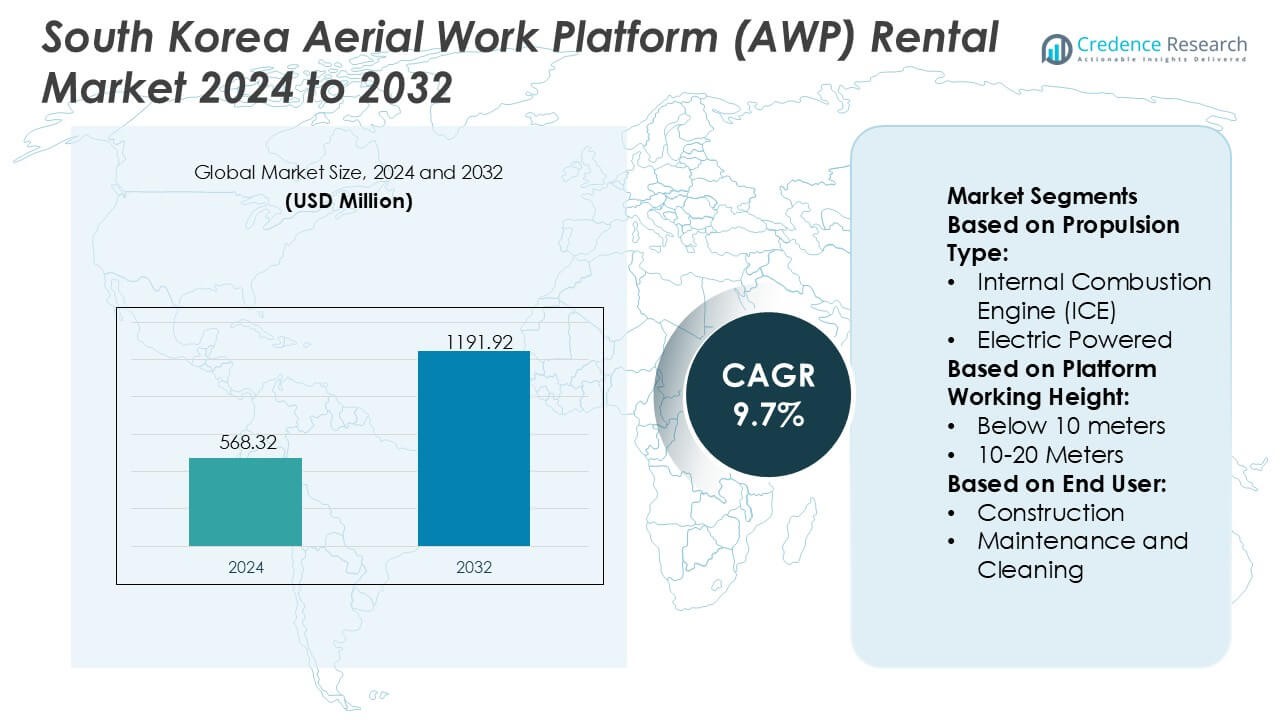
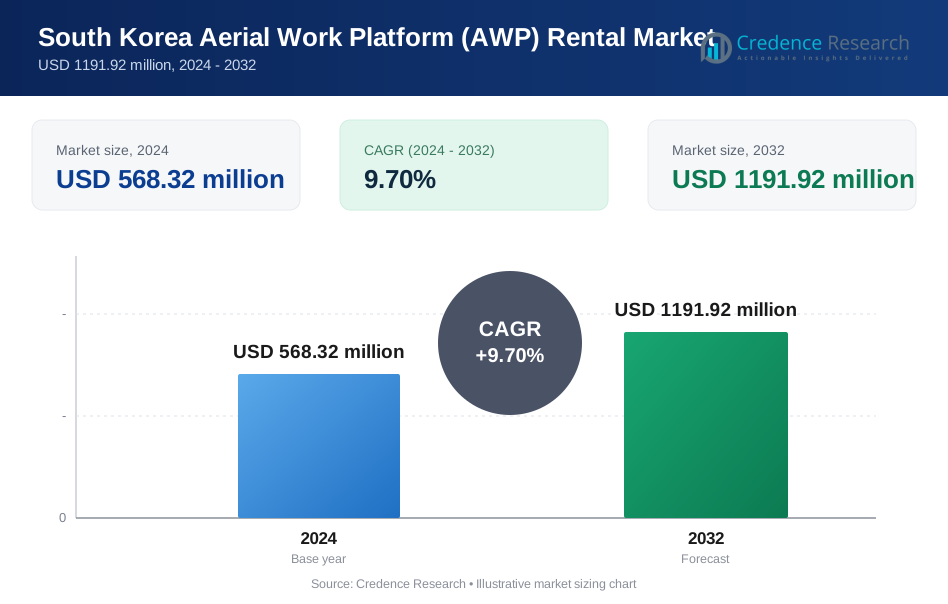
South Korea Aerial Work Platform (AWP) Rental Market size was valued USD 568.32 million in 2024 and is anticipated to reach USD 1191.92 million by 2032, at a CAGR of 9.7% during the forecast period.| REPORT ATTRIBUTE | DETAILS |
|---|---|
| Historical Period | 2020-2023 |
| Base Year | 2024 |
| Forecast Period | 2025-2032 |
| South Korea Aerial Work Platform (AWP) Rental Market Size 2024 | USD 568.32 Million |
| South Korea Aerial Work Platform (AWP) Rental Market, CAGR | 9.7% |
| South Korea Aerial Work Platform (AWP) Rental Market Size 2032 | USD 1191.92 Million |
Market Insights
- The market reached USD 568.32 million in 2024 and is projected to hit USD 1191.92 million by 2032 at a 9.7% CAGR, reflecting strong rental demand across construction, industrial maintenance, and commercial facility operations.
- Rising safety regulations, rapid electrification of fleets, and contractor preference for flexible rental models drive sustained adoption of AWP solutions across high-reach and indoor applications.
- Digital fleet management, telematics-enabled performance monitoring, and operator training services emerge as key trends strengthening competitiveness among leading rental providers.
- High capital costs for fleet modernization and price pressure from increasing competition remain key restraints, influencing rental companies to pursue efficiency-driven procurement and service strategies.
- Asia-Pacific holds the dominant 30% regional share, while scissor lifts maintain the largest segment share due to widespread use in logistics centers, manufacturing plants, and urban infrastructure development.
Market Segmentation Analysis:
By Propulsion Type Internal combustion engine (ICE) platforms dominate the South Korea AWP rental market with an approximate 63% share, driven by their high load capacity, superior outdoor performance, and suitability for heavy-duty applications across construction and industrial sites. Rental companies continue to prefer ICE units for large infrastructure projects requiring extended operation times and robust terrain adaptability. Electric-powered AWPs gain traction in urban settings due to zero-emission performance and lower operating noise, yet their adoption remains secondary as charging availability and battery endurance constraints limit deployment in demanding field conditions.- For instance, Cramo Plc strengthened its operational efficiency by integrating Trackunit telematics across more than 110,000 equipment assets, enabling real-time diagnostics that significantly reduced service response times and enhanced uptime for ICE-powered platforms.
- For instance, Maxim Crane Works, L.P. enhanced high-reach capabilities by deploying Liebherr LTM 1650-8.1 cranes with a maximum telescopic boom length of 80 meters and a luffing jib extension of 91 meters, enabling precise elevated operations across complex project environments.
Key Growth Drivers
Infrastructure Expansion and Construction Activity South Korea’s sustained investment in transport infrastructure, industrial complexes, and urban redevelopment drives strong demand for AWP rentals. Contractors increasingly rely on rental fleets to avoid high ownership costs and maintain operational flexibility across short project cycles. Government-backed smart city and logistics hub developments further accelerate fleet utilization, particularly for boom and scissor lifts required in elevated construction tasks. Rental providers benefit from continuous project turnover, enabling higher equipment availability, optimized asset rotation, and steady revenue generation across both public and private sector construction pipelines.- For instance, Kanamoto Co., Ltd. strengthened its technology-enabled rental operations by expanding its ICT-construction equipment fleet and managing over 620,000 rental assets, supported by a digital equipment-management system that automates maintenance scheduling and operational tracking.
- For instance, United Rentals, Inc. enhanced safety and fleet governance by deploying its Total Control® platform across more than 375,000 connected rental assets, enabling real-time equipment tracking, operational alerts, and predictive maintenance insights that have reduced job-site incident rates through data-driven oversight.
Key Trends & Opportunities
Rising Digitalization Through Telematics and Fleet Analytics AWP rental companies increasingly deploy telematics platforms to monitor utilization rates, predict maintenance needs, and optimize fleet distribution. Real-time data on machine health, fuel consumption, and operating hours enhances decision-making and reduces downtime for end users. Digital dashboards also enable dynamic pricing models and automated contract management. These innovations create opportunities for rental firms to deliver value-added services, strengthen customer retention, and differentiate through data-driven fleet management capabilities aligned with South Korea’s broader industrial digitalization trend.- For instance, Finning International Inc. leveraged Caterpillar’s digital ecosystem by connecting more than 100,000 machines to Cat® Product Link™, enabling analytics that process over 150 million telematics data points daily to enhance maintenance accuracy and equipment availability.
- For instance, Byrne Equipment Rental operates a fleet of more than 14,000 rental assets across 20 operational hubs, supported by integrated service teams that deliver on-site maintenance and technical assistance for complex multi-equipment project requirements.
Key Challenges
High Capital Expenditure and Fleet Replacement Burden AWP rental companies face significant financial pressure due to high equipment acquisition costs and rapid technology-driven replacement cycles. Maintaining a modern, safety-compliant, and diverse fleet requires continuous capital infusion, particularly as demand shifts toward electric and telematics-enabled models. Smaller rental players struggle to compete with large providers capable of large-scale fleet renewal. This cost burden constrains expansion, limits geographic reach, and may slow adoption of advanced platforms among budget-sensitive operators. Intensifying Competition and Price Pressure The South Korean AWP rental market experiences rising competition from expanding domestic rental firms and global players strengthening their local presence. Fleet commoditization leads to aggressive pricing strategies, reducing margins for rental providers. Customers increasingly negotiate lower rental rates and flexible contract terms, further pressuring profitability. Companies that fail to differentiate through service quality, fleet specialization, or digital capabilities face declining market share. This challenge reinforces the need for strategic investment and operational optimization across the rental ecosystem.Regional Analysis
North America North America accounts for 34% of the global AWP rental market and acts as a benchmark region influencing fleet modernization trends in South Korea. The United States drives innovation through high adoption of electric AWPs, advanced telematics, and stringent OSHA safety regulations, which shape Korean rental fleet standards. Major rental consolidations and structured service contracts in North America also guide South Korean firms seeking efficiency-driven leasing models. Strong R&D investment by OEMs in boom and scissor lift technologies promotes the transfer of best practices, enabling Korean providers to expand service quality and equipment reliability. Europe Europe holds a 28% share and significantly impacts South Korea’s AWP rental ecosystem through its leadership in sustainability-focused equipment and emissions-compliant lift platforms. EU regulations have accelerated electric and hybrid AWP adoption, prompting Korean rental companies to mirror similar fleet upgrades to meet indoor maintenance and green-building requirements. High rental penetration rates in Western Europe provide operational insights into scalable service models. Additionally, Europe’s focus on operator safety training and machine automation influences Korean rental firms to enhance certification programs, strengthen compliance frameworks, and adopt digital fleet-management systems for performance monitoring. Asia-Pacific Asia-Pacific represents 30% of the global AWP rental market and remains the most influential region for South Korea due to shared industrial structures, rapid construction growth, and expanding manufacturing investments. Strong demand from China, Japan, and Southeast Asia accelerates regional equipment circulation and drives competitive pricing strategies that impact Korean rental decisions. South Korea benefits from proximity to leading OEM manufacturing hubs, enabling faster access to specialized equipment and reduced logistical costs. The region’s shift toward electric platforms, high-reach boom lifts, and safety-compliant models further strengthens alignment with Korea’s infrastructure modernization and industrial maintenance needs. Latin America Latin America captures a 5% market share and provides niche but relevant comparative insights for South Korea, particularly in the adoption of AWPs for infrastructure upgrades and utility maintenance. The region’s gradual transition from scaffolding to mechanized access solutions mirrors earlier trends seen in Korea, reinforcing the long-term growth trajectory of rental-based equipment models. Rental companies in Brazil and Mexico increasingly prioritize fleet standardization and preventive maintenance practices, offering reference points for Korean operators refining cost-efficiency and uptime performance. Although smaller in scale, Latin America’s evolving contractor preferences support global learning in rental optimization strategies. Middle East & Africa The Middle East & Africa region holds a 3% share and influences South Korea’s AWP rental market through its reliance on high-capacity, rough-terrain AWPs used in oil, gas, and mega-infrastructure projects. Demand for durability, extended-reach platforms, and strict site safety compliance shapes OEM product enhancements that later diffuse into Asian markets, including Korea. Gulf nations’ preference for long-term rental contracts and fleet partnerships offers operational parallels for Korean firms targeting industrial and energy-sector clients. Despite relatively low market contribution, MEA provides insights into specialized high-performance fleet utilization under challenging environmental and operational conditions.Market Segmentations:
By Propulsion Type:- Internal Combustion Engine (ICE)
- Electric Powered
- Below 10 meters
- 10-20 Meters
- Construction
- Maintenance and Cleaning
- North America
- Europe
- Asia Pacific
- Latin America
- Middle East
- Africa
Competitive Landscape
The competitive landscape in the South Korea AWP Rental Market players such as Cramo Plc, Maxim Crane Works L.P., Ahern Rentals Inc., Kanamoto Co., Ltd., United Rentals, Inc., Finning International Inc., Byrne Equipment Rental, Liebherr-International AG, Caterpillar Inc., and AKTIO Corporation. the South Korea AWP Rental Market is shaped by a blend of global rental leaders, specialized regional providers, and OEM-backed service networks competing through fleet capability, safety compliance, and technology-driven efficiency. Companies increasingly invest in electric and hybrid AWPs, predictive maintenance tools, and operator training programs to meet rising safety regulations and sustainability expectations. Digital fleet management, telematics integration, and customized rental packages strengthen differentiation as customers seek cost-efficient, uptime-focused solutions for construction, maintenance, and industrial applications. Market competition continues to intensify as providers expand service footprints, upgrade high-reach platforms, and adopt data-driven rental models that enhance operational responsiveness.Key Player Analysis
- Cramo Plc
- Maxim Crane Works, L.P.
- Ahern Rentals Inc.
- Kanamoto Co., Ltd.
- United Rentals, Inc.
- Finning International Inc.
- Byrne Equipment Rental
- Liebherr-International AG
- Caterpillar Inc.
- AKTIO Corporation
- In October 2025, Blade Platforms is a large, truck-mounted aerial lift launched in for heavy-duty utility and infrastructure work, offering 187 feet of reach for tasks like transmission line maintenance, demonstrating innovation in the Mobile Elevated Work Platform (MEWP) market, which is seeing growth for specialized equipment.
- In February 2025, JLG Industries, one of Oshkosh Corporation's businesses, launched a newly designed aviation package for its electric-drive scissor lifts, JLG ES2646. The package is intended for aircraft manufacturing and maintenance requirements and includes cutting-edge sensor technology, enhanced safety capabilities, contact-free maintenance capacity.
- In September 2024, Skyjack launched the new micro XStep for its SJ3213 micro and SJ3219 micro scissor lifts, an accessory designed to provide extra reach (around 19 inches) in tight spaces like ceilings or HVAC work, boosting operator productivity without needing a new machine, and it's easily stowable or removable.
Report Coverage
The research report offers an in-depth analysis based on Propulsion Type, Platform Working Height, End-User and Geography. It details leading market players, providing an overview of their business, product offerings, investments, revenue streams, and key applications. Additionally, the report includes insights into the competitive environment, SWOT analysis, current market trends, as well as the primary drivers and constraints. Furthermore, it discusses various factors that have driven market expansion in recent years. The report also explores market dynamics, regulatory scenarios, and technological advancements that are shaping the industry. It assesses the impact of external factors and global economic changes on market growth. Lastly, it provides strategic recommendations for new entrants and established companies to navigate the complexities of the market.Future Outlook
- The market will expand as construction, logistics, and industrial facilities increase demand for safe and efficient elevated access solutions.
- Electric and hybrid AWPs will see accelerated adoption as companies prioritize low-emission and noise-free operations.
- Digital fleet management using telematics and analytics will become standard across rental providers to improve utilization and reduce downtime.
- Safety regulations will tighten, pushing contractors to rely more heavily on certified rental fleets rather than owned or traditional access equipment.
- High-reach and specialty platforms will gain traction as complex industrial projects require advanced maneuverability and stability.
- Rental firms will broaden service portfolios with on-site support, operator training, and maintenance-inclusive contracts.
- Fleet modernization cycles will intensify as companies replace older units with more efficient, compliance-ready platforms.
- Partnerships between OEMs and rental providers will strengthen to ensure faster equipment availability and technical support.
- Indoor maintenance applications will boost demand for compact and narrow-access electric lifts.
- Increased urban redevelopment and industrial automation will support long-term, steady growth in rental fleet utilization.
Request a Free Sample
Fill in your details and we'll send you a free sample report.
- Sample data tables & charts
- Research methodology
Need a Custom Version of This Report?
Tailor the scope, geography, or segments to your exact requirements.
- Custom geography or segment scope
- Direct access to our analyst team
Frequently Asked Questions
What is the current market size for the South Korea Aerial Work Platform (AWP) Rental Market, and what is its projected size in 2032?
At what Compound Annual Growth Rate is the South Korea Aerial Work Platform (AWP) Rental Market projected to grow between 2024 and 2032?
Which South Korea Aerial Work Platform (AWP) Rental Market segment held the largest share in 2024?
What are the primary factors fueling the growth of the South Korea Aerial Work Platform (AWP) Rental Market?
Who are the leading companies in the South Korea Aerial Work Platform (AWP) Rental Market?
Which region commanded the largest share of the South Korea Aerial Work Platform (AWP) Rental Market in 2024?
Table of Content
Chapter 1. Report Introduction
- 1.1 Report Description & Purpose
- 1.1.1 Report Title & Market Definition
- 1.1.2 Unique Selling Propositions (USP) & Key Differentiators
- 1.1.3 Value Proposition for Stakeholders
- 1.2 Research Objectives
- 1.2.1 Market Sizing Objectives (Volume & Revenue)
- 1.2.2 Segmentation Objectives
- 1.2.3 Competitive Intelligence Objectives
- 1.2.4 Forecast & Scenario Objectives
- 1.3 Report Scope
- 1.3.1 South Korea Aerial Work Platform (AWP) Rental Scope – Types & Subtypes Covered
- 1.3.2 Geographic Scope – Regions & Countries Covered
- 1.3.3 Historical Period, Base Year & Forecast Period (2024; forecast to 2032)
- 1.3.4 Inclusions & Exclusions
- 1.4 HS Code & Classification Framework
- 1.5 Currency, Units & Pricing Basis
- 1.6 Target Stakeholders
- 1.7 Limitations & Assumptions
Chapter 2. Executive Summary
- 2.1 Global South Korea Aerial Work Platform (AWP) Rental Market Snapshot
- 2.1.1 Market Size – Historical (2024) & Forecast (2024-2032) (2024: USD 568.32 million → 2032: USD 1191.92 million)
- 2.1.2 Volume & Revenue – Global Totals
- 2.1.3 Key Market Highlights – Top Five Facts
- 2.2 South Korea Aerial Work Platform (AWP) Rental Market Segmentation Snapshot
- 2.2.1 Market Split by Region – 2024 vs. 2032
- 2.3 Competitive Snapshot
- 2.3.1 Top 10 Players by Revenue Share – 2024
- 2.3.2 Top 10 Players by Volume Share – 2024
- 2.3.3 Recent Strategic Developments (18-Month Summary)
- 2.4 Key Investment Highlights & Strategic Conclusions
Chapter 3. South Korea Aerial Work Platform (AWP) Rental Market Dynamics & Industry Analysis
- 3.1 Market Overview & Context
- 3.1.1 South Korea Aerial Work Platform (AWP) Rental Market Position in the Broader Automotive Value Chain
- 3.1.2 OEM vs. Replacement Market Dynamics
- 3.1.3 Market Maturity & Development Stage by Region
- 3.2 South Korea Aerial Work Platform (AWP) Rental Market Drivers
- 3.3 South Korea Aerial Work Platform (AWP) Rental Market Restraints & Challenges
- 3.4 South Korea Aerial Work Platform (AWP) Rental Market Opportunities
- 3.5 Porter's Five Forces Analysis
- 3.5.1 Threat of New Entrants
- 3.5.2 Bargaining Power of Suppliers
- 3.5.3 Bargaining Power of Buyers
- 3.5.4 Threat of Substitutes
- 3.5.5 Competitive Rivalry – Intensity Assessment
- 3.6 South Korea Aerial Work Platform (AWP) Rental Value Chain Analysis
- 3.6.1 Upstream – Raw Material/Input Suppliers
- 3.6.1.1 Raw Material/Input 1
- 3.6.1.2 Raw Material/Input 2
- 3.6.1.3 Raw Material/Input 3
- 3.6.2 Midstream – Production/Manufacturing/Service Delivery
- 3.6.2.1 Production/Process Overview
- 3.6.2.2 Key Facility Locations & Capacity by Manufacturer
- 3.6.3 Downstream – Distribution & End Consumer
- 3.6.3.1 Primary Channel – B2B/OEM
- 3.6.3.2 Secondary Channels – Dealer, Retail, Online, Direct
- 3.6.4 Value Chain Profitability Analysis
- 3.6.1 Upstream – Raw Material/Input Suppliers
- 3.7 PESTEL Analysis
- 3.7.1 Political Factors
- 3.7.2 Economic Factors
- 3.7.3 Social Factors
- 3.7.4 Technological Factors
- 3.7.5 Environmental Factors
- 3.7.6 Legal Factors
- 3.8 South Korea Aerial Work Platform (AWP) Rental Supply Chain Analysis
- 3.8.1 Raw Material/Input Supply Risk Assessment
- 3.8.2 Manufacturing Concentration Risk (Geographic Exposure)
- 3.8.3 Trade Disruption Impact Analysis
- 3.9 Regulatory & Policy Landscape
Note: The regulatory and policy landscape section covers regulations based on their applicability to the market, South Korea Aerial Work Platform (AWP) Rental category, geography, and scope of the study. Only regulatory frameworks with a material impact on operations, compliance, trade, sustainability, or market access are analyzed in detail.
Chapter 4. Key Investment Pockets & Opportunity Analysis
- 4.1 South Korea Aerial Work Platform (AWP) Rental Market Attractiveness Analysis
- 4.1.1 By Region – Investment Attractiveness Matrix (Volume × CAGR)
- 4.2 Absolute Revenue Growth Opportunity
- 4.2.1 By Region – Absolute USD Growth Through 2032
- 4.3 Incremental Volume Opportunity
- 4.3.1 By Region – Incremental Volume Through 2032
- 4.3.2 Segment – Incremental Volume
- 4.4 Emerging Submarket Opportunity Deep Dive (Subject to Applicability)
- 4.5 Emerging Market Opportunity Scorecards
- 4.5.1 United States
- 4.5.2 Europe
- 4.5.3 Asia
- 4.5.4 Middle East & Africa
Note: Emerging Market Opportunity Scorecards will be included based on relevance and strategic importance. Regions listed are indicative and may vary depending on data availability and market dynamics.
Chapter 5. South Korea Aerial Work Platform (AWP) Rental Import-Export Analysis & Trade Flows
- 5.1 Global Trade Overview
- 5.1.1 Global Export Value by Country (2024)
- 5.1.2 Global Export Volume by Country (2024)
- 5.1.3 Global Import Value by Country (2024)
- 5.1.4 Global Import Volume by Country (2024)
- 5.1.5 Net Trade Balance by Country (2024)
- 5.2 Export Analysis – Segment
- 5.2.1 Type 1 (HS Code)
- 5.2.2 Type 2 (HS Code)
- 5.2.3 Type 3 (HS Code)
- 5.2.4 Type 4 (HS Code)
- 5.2.5 Type 5 (HS Code)
- 5.3 Import Analysis – Segment
- 5.3.1 Type 1 (HS Code)
- 5.3.2 Type 2 (HS Code)
- 5.3.3 Type 3 (HS Code)
- 5.3.4 Type 4 (HS Code)
- 5.3.5 Type 5 (HS Code)
- 5.4 Average Unit Trade Prices
- 5.4.1 Average Export Price – Segment & Country
- 5.4.2 Average Import Price – Segment & Source Country
- 5.4.3 Price Trends (2024)
- 5.5 Key Trade Route Analysis
- 5.5.1 Trade Route 1
- 5.5.2 Trade Route 2
- 5.5.3 Trade Route 3
- 5.5.4 Trade Route 4
- 5.5.5 Trade Route 5
- 5.6 Trade Policy Impact Assessment
- 5.6.1 US Anti-Dumping & Section 301 Tariffs
- 5.6.2 EU Customs Union Impact
- 5.6.3 Major Free Trade Agreements
- 5.6.4 USMCA Rules of Origin
Note: Trade policy analysis will be included only where relevant to the South Korea Aerial Work Platform (AWP) Rental market.
Chapter 6. Competitive Landscape & Company Benchmarking
- 6.1 South Korea Aerial Work Platform (AWP) Rental Market Concentration & Structure
- 6.1.1 Herfindahl-Hirschman Index (HHI) – vs. 2024
- 6.1.2 Tier 1, Tier 2 & Tier 3 Market Structure
- 6.1.3 Global, Regional & Local Player Dynamics
- 6.2 South Korea Aerial Work Platform (AWP) Rental Market Share Analysis – 2024
- 6.2.1 Global Revenue Share by Company
- 6.2.2 Global Volume Share by Company
- 6.2.3 Regional Revenue Share
- 6.2.4 Market Share Evolution ( vs. 2024)
- 6.2.5 OEM Segment Share by Company
- 6.2.6 Replacement Segment Share by Company
- 6.3 Production/Delivery Capacity & Facility Analysis
- 6.3.1 Global Installed Capacity
- 6.3.2 Capacity Utilization Rates
- 6.3.3 Production/Output Volume
- 6.3.4 Facility Locations & Capacity Map
- 6.3.5 Planned Capacity Additions
- 6.4 South Korea Aerial Work Platform (AWP) Rental Competitive Benchmarking Matrix
- 6.4.1 Revenue, Volume, CAGR & Profitability Comparison
- 6.4.2 Channel Revenue Mix
- 6.4.3 Geographic Revenue Exposure
- 6.4.4 R&D Intensity
- 6.4.5 Sustainability Maturity
- 6.5 Strategic Developments in South Korea Aerial Work Platform (AWP) Rental (Last 24 Months)
- 6.5.1 Mergers, Acquisitions & Divestments
- 6.5.2 New South Korea Aerial Work Platform (AWP) Rental Launches
- 6.5.3 Facility Expansions
- 6.5.4 Strategic Alliances, Joint Ventures & Partnerships
- 6.5.5 Distribution Expansion & Market Entry
- 6.5.6 Sustainability & ESG Initiatives
- 6.6 Competitive Strategy Mapping
- 6.6.1 Leader, Challenger, Follower & Niche Classification
- 6.6.2 Pricing Strategy Comparison
- 6.6.3 Channel Strategy Matrix
Note: Strategic developments are included based on their materiality and the availability of reliable information.
Chapter 7. Global South Korea Aerial Work Platform (AWP) Rental Market – By Distribution Channel
- 7.1 Segment Overview
- 7.1.1 Volume & Revenue Split by Channel (2024 & 2032)
- 7.1.2 Channel Mix Evolution (2024-2032)
Chapter 8. Regional Market Analysis – Global Overview
- 8.1 Global Regional Overview
- 8.1.1 Regional Volume Share
- 8.1.2 Regional Revenue Share
- 8.1.3 Regional Volume by Region
- 8.1.4 Regional Revenue by Region
- 8.1.5 Regional Forecast Through 2032
- 8.2 Cross-Regional Segment Analysis
- 8.2.1 By Distribution Channel
- 8.2.2 By Brand/Price Tier
Chapter 9. North America South Korea Aerial Work Platform (AWP) Rental Market
- 9.1 United States
- 9.2 Canada
- 9.3 Mexico
Chapter 10. Europe South Korea Aerial Work Platform (AWP) Rental Market
- 10.1 Germany
- 10.2 France
- 10.3 Italy
- 10.4 United Kingdom
- 10.5 Spain
- 10.6 Poland
- 10.7 Russia
- 10.8 Netherlands
- 10.9 Belgium
- 10.10 Sweden
- 10.11 Denmark
- 10.12 Norway
- 10.13 Rest of Europe
Chapter 11. Asia Pacific South Korea Aerial Work Platform (AWP) Rental Market
- 11.1 China
- 11.2 India
- 11.3 Japan
- 11.4 South Korea
- 11.5 Thailand
- 11.6 Indonesia
- 11.7 Vietnam
- 11.8 Malaysia
- 11.9 Australia
- 11.10 Rest of Asia Pacific
Chapter 12. Latin America South Korea Aerial Work Platform (AWP) Rental Market
- 12.1 Brazil
- 12.2 Argentina
- 12.3 Colombia
- 12.4 Chile
- 12.5 Rest of Latin America
Chapter 13. Middle East South Korea Aerial Work Platform (AWP) Rental Market
- 13.1 Saudi Arabia
- 13.2 United Arab Emirates
- 13.3 Turkey
- 13.4 Israel
- 13.5 Iran
- 13.6 Rest of the Middle East
Chapter 14. Africa South Korea Aerial Work Platform (AWP) Rental Market
- 14.1 South Africa
- 14.2 Egypt
- 14.3 Nigeria
- 14.4 Morocco
- 14.5 Rest of Africa
Chapter 15. South Korea Aerial Work Platform (AWP) Rental Company Profiles
- 15.1 [Company 01]
- 15.1.1 Company Overview
- 15.1.2 Key Management Personnel
- 15.1.3 Products & Services Portfolio
- 15.1.4 Financial Performance
- 15.1.5 Key Market Focus & Geographic Presence
- 15.1.6 Recent Developments & Strategic Initiatives
Note: The company profile list is preliminary and may change based on research findings, market developments, data availability, and client requirements.
Chapter 16. Appendices
- Appendix A – List of Abbreviations & Acronyms
- Appendix B – Industry Classification Code Reference – Full Series
- Appendix C – Production & Capacity Data Tables
- Appendix D – End-Use & Demand Base Tables
- Appendix E – Consumption & Replacement Rate Assumptions
- Appendix F – ASP Reference Tables
- Appendix G – Manufacturing & Facility Database
- Appendix H – Import-Export Data Tables
- Appendix I – Regulatory Summary Tables
- Appendix J – Primary Research Participant List (Anonymized)
- Appendix K – Primary Research Questionnaire Framework
- Appendix L – Data Sources & Bibliography
- Appendix M – Market Size Divergence & Source Comparison
Chapter 17. Research Methodology
- 17.1 Research Framework & Philosophy
- 17.2 Secondary Research – Sources, Hierarchy & Data Extraction
- 17.3 Data Modeling – Bottom-Up & Top-Down Market Sizing
- 17.4 Primary Research – Stakeholder Framework, LOI & Sample Sizes
- 17.5 Forecast Methodology – Regression, Scenario & Sensitivity Analysis
- 17.6 Quality Control – Four-Layer Validation Framework
- 17.7 Limitations & Standard Assumptions
- 17.8 Disclaimer
