
Market Overview
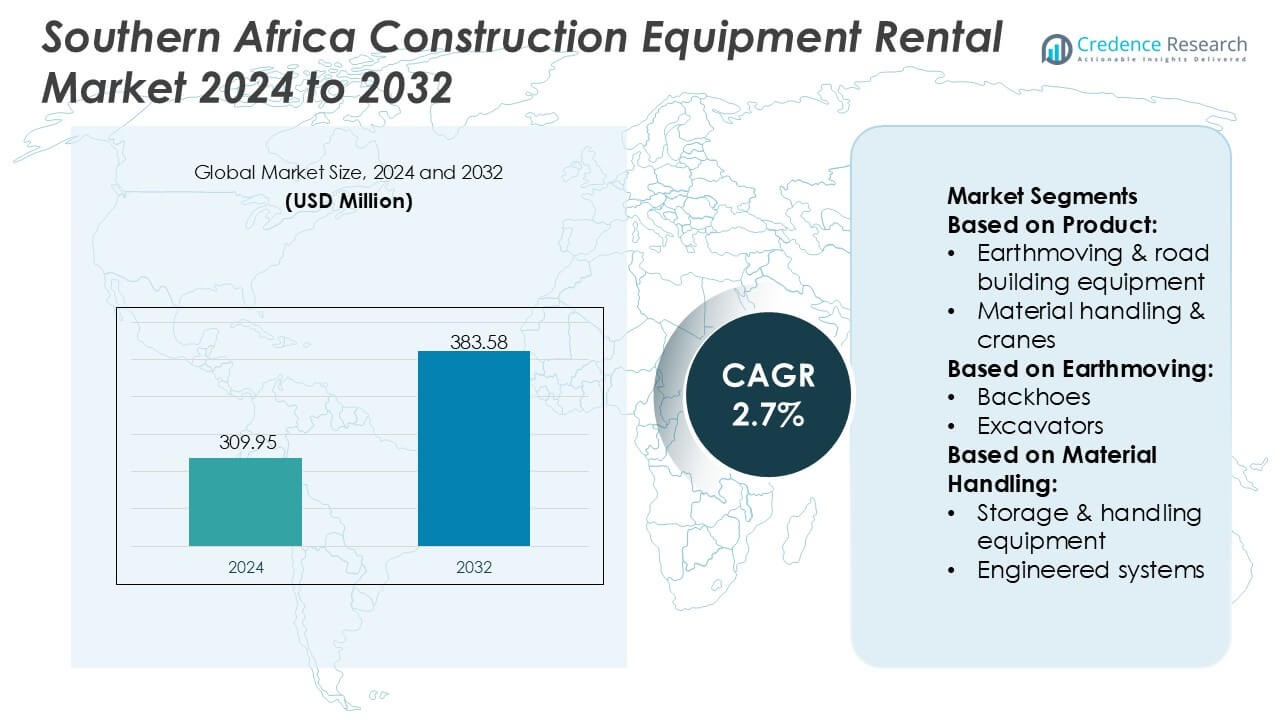
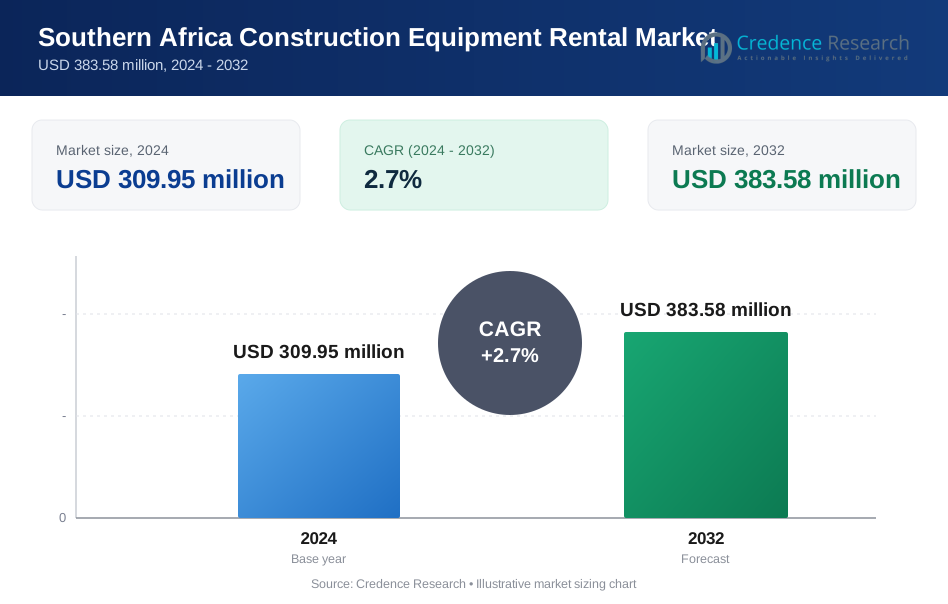
Southern Africa Construction Equipment Rental Market size was valued USD 309.95 million in 2024 and is anticipated to reach USD 383.58 million by 2032, at a CAGR of 2.7% during the forecast period.
| REPORT ATTRIBUTE | DETAILS |
|---|---|
| Historical Period | 2020-2023 |
| Base Year | 2024 |
| Forecast Period | 2025-2032 |
| Southern Africa Construction Equipment Rental Market Size 2024 | USD 309.95 Million |
| Southern Africa Construction Equipment Rental Market, CAGR | 2.7% |
| Southern Africa Construction Equipment Rental Market Size 2032 | USD 383.58 Million |
The Southern Africa Construction Equipment Rental Market is shaped by a mix of multinational rental providers, regional distributors, and specialized service companies that compete through diversified fleets, strong aftermarket support, and technology-enabled maintenance capabilities. Leading players focus on expanding earthmoving, material-handling, and crane portfolios while integrating telematics and predictive diagnostics to improve operational reliability for contractors across mining and infrastructure projects. The market is geographically dominated by South Africa, which holds an exact 48% share, supported by its extensive construction pipeline, mature rental ecosystem, and well-established service networks that ensure high equipment availability and consistent project performance across the region.
Market Insights
- The Southern Africa Construction Equipment Rental Market was valued at USD 309.95 million in 2024 and is projected to reach USD 383.58 million by 2032, registering a CAGR of 2.7% during the forecast period.
- Market growth is driven by rising demand for earthmoving and material-handling equipment rentals, as contractors prioritize asset-light models to manage project variability and reduce capital commitments.
- Trends emphasize wider adoption of telematics-enabled fleet monitoring and predictive maintenance, improving uptime for mining and large infrastructure works across the region.
- Competition intensifies as rental providers expand diversified fleets and service hubs, while restraints include high maintenance costs and limited availability of skilled technicians in remote project clusters.
- Regional performance is led by South Africa with 48% share, while the earthmoving equipment segment dominates at 52%, supported by strong utilization in road-building, mining support, and logistics corridor development.
Market Segmentation Analysis:
By Product
The Southern Africa Construction Equipment Rental Market is led by the earthmoving & road-building equipment segment, holding an estimated 52% share, driven by expanding infrastructure upgrades, mining activity, and road rehabilitation programs across South Africa, Botswana, and Namibia. Contractors increasingly prefer renting excavators, graders, and compactors to reduce capital expenditure and improve fleet flexibility in fluctuating project cycles. Material handling & cranes follow as the second-largest segment due to demand from logistics hubs and port modernization, while concrete equipment gains steady traction in commercial construction and urban redevelopment projects.
- For instance, Finning International Inc. enhanced rental fleet efficiency by deploying over 50,000 connected Caterpillar assets with telematics systems capable of transmitting multiple real-time machine health parameters, significantly improving uptime across earthmoving operations.
By Earthmoving
Within earthmoving machinery, excavators dominate with nearly 45% share, supported by high utilization in mining overburden removal, trenching, and large-scale civil engineering works. Rental penetration rises as contractors seek access to multiple tonnage classes without long-term financing commitments. Loaders represent the next significant category, benefiting from quarrying, aggregates handling, and urban construction tasks. Backhoes remain relevant for mid-scale municipal works, while compaction equipment and other utility machines demonstrate consistent demand in road construction, pipeline installation, and maintenance projects that require short-term, project-specific fleet deployment.
- For instance, Maxim Crane Works, L.P. strengthened heavy-equipment project capability by operating a fleet of crawler cranes with lifting capacities reaching 2,535 metric tons, supported by boom lengths extending up to 188 meters, enabling high-precision earthmoving and infrastructure support activities.
By Material Handling
In the material-handling segment, industrial trucks lead with approximately 48% share, driven by their essential role in warehousing, mining logistics, and construction material movement across distribution centers and industrial zones. Growing investments in regional logistics corridors and special economic zones accelerate the uptake of rental forklifts and lift trucks. Storage & handling equipment follows due to rising inventory capacities in retail and manufacturing. Engineered systems gain niche traction amid automation-focused upgrades, while bulk material handling equipment shows steady demand in mining belts requiring efficient movement of ores, aggregates, and construction inputs.
Key Growth Drivers
Growing Preference for Asset-Light Construction Models
Contractors across Southern Africa increasingly shift toward rental models to reduce upfront capital expenditure, limit long-term financing risks, and improve fleet flexibility. Rising project fragmentation in road rehabilitation, municipal infrastructure upgrades, and housing development increases reliance on short-term and medium-term rentals for excavators, loaders, and cranes. Firms leverage rentals to scale fleet size according to workload while avoiding maintenance and depreciation burdens. This asset-light approach strengthens demand for modern, fuel-efficient rental machinery that supports faster project execution and minimizes operational disruptions.
- For instance, United Rentals, Inc. company strengthened its digital leadership by running the largest telematics-enabled rental fleet globally, with over 375,000 connected equipment units enabling remote monitoring of runtime, location, fuel usage, and maintenance alerts through its proprietary platform.
Expansion of Infrastructure and Mining Activities
Large-scale mining expansions in South Africa, Botswana, and Zambia, combined with ongoing transportation and energy corridor investments, significantly accelerate equipment rental demand. Excavators, compaction machines, and material-handling units experience high utilization as governments prioritize road upgrades, renewable energy installations, and logistics network expansion. Rental companies benefit from project-based procurement cycles, where contractors require diverse machinery classes without committing to outright purchases. Growing emphasis on productivity, uptime reliability, and safety compliance further drives preference for professionally maintained rental fleets across mining and infrastructure domains.
- For instance, Byrne Equipment Rental enhanced its operational capability by deploying more than 14,000 rental assets across its network, including power systems engineered to deliver continuous outputs up to 1,250 kVA, supported by remote monitoring units capable of transmitting operational diagnostics, enabling high-reliability performance for mining and infrastructure workloads.
Shift Toward Technology-Enabled Rental Fleet Management
Digitalization strengthens rental market performance as equipment providers integrate telematics, GPS tracking, fuel monitoring, and predictive maintenance tools into their fleets. Contractors increasingly value real-time insights into machine utilization, idle time, and performance metrics to reduce project delays and operating costs. Remote diagnostics improve maintenance scheduling and minimize breakdown risks, enhancing rental fleet reliability for mission-critical mining and construction tasks. Technology-enabled transparency supports cost benchmarking and strengthens customer trust, reinforcing the competitive advantage of rental companies offering digitally managed and data-driven fleet solutions.
Key Trends & Opportunities
Rising Adoption of Eco-Efficient and Low-Emission Equipment
Sustainability priorities create opportunities for rental providers offering energy-efficient excavators, hybrid loaders, and low-emission compaction machinery. Regulatory pressure to curb fuel consumption and reduce carbon footprints influences contractors to rent newer-generation equipment rather than using older owned fleets. Rental firms investing in Tier-3/Tier-4 compliant machinery and alternative-fuel units gain competitive differentiation. The shift toward greener project contracting especially in urban construction opens avenues for premium rental packages linked to lower environmental impact and improved operational economics.
- For instance, Caterpillar demonstrated a hybrid retrofit of the 55,000-lb Cat 972 Wheel Loader completed in just 12 weeks illustrating how its Electrified Machine (EREM) solution delivers near-diesel performance in an electrified format, supporting job-site electrification without requiring DC charging infrastructure.
Growth of Integrated Rental Services and Project Support Solutions
Rental companies increasingly differentiate by offering bundled services such as on-site technicians, operator training, fleet planning assistance, and maintenance-inclusive rental contracts. Demand grows for turnkey rental solutions that ensure equipment readiness and minimize downtime during large civil engineering and mining projects. Companies offering flexible leasing models, multi-equipment packages, and performance monitoring dashboards capture expanding opportunities as contractors seek operational simplicity and predictable cost structures. This trend enhances long-term customer relationships and drives recurring revenue streams for established rental players.
- For instance, Henry Schein’s Blood Control IV Catheter 20 Gauge has a 1-inch beveled tip and comes 50 units per box, 4 boxes per case, ensuring standardization and ease of supply chain handling.
Expansion of Cross-Border Construction and Regional Collaboration
As Southern African countries pursue collaborative infrastructure programs and harmonized development frameworks, opportunities expand for rental firms capable of serving cross-border projects. Road corridor upgrades, border post modernization, and regional logistics infrastructure create sustained demand for mobile fleets that can be redeployed across markets. Rental providers with strong distribution networks and multi-country service capabilities gain strategic advantage. This trend encourages fleet standardization, operational partnerships, and expansion of service hubs aligned with regional economic integration initiatives.
Key Challenges
High Equipment Maintenance Costs and Limited Skilled Technicians
Rental companies face rising maintenance costs due to harsh operating conditions in mining and infrastructure sites that accelerate wear and tear on machines. Limited availability of skilled technicians in several Southern African markets increases service delays and impacts fleet utilization. Providers must invest heavily in preventive maintenance programs, technician training, and spare parts inventory to maintain uptime reliability. These operational burdens strain profitability, particularly for smaller rental operators with restricted fleet sizes and limited access to technical talent.
Market Fragmentation and Intense Price Competition
The market remains highly fragmented, with numerous small and mid-sized rental firms competing alongside established distributors. Price competition pressures margins as contractors often prioritize short-term cost savings over premium equipment offerings. Smaller players struggle to differentiate due to limited digital capabilities, smaller fleets, and inconsistent service quality. Larger providers must continuously upgrade machinery and expand service offerings to retain customers, further increasing cost structures. This competitive environment challenges long-term scalability and requires strategic consolidation to achieve operational efficiency and market stability.
Regional Analysis
North America
North America holds a 32% share in the broader construction equipment rental landscape and serves as a key benchmark for Southern Africa due to its advanced rental practices, strong digital fleet management, and highly professionalized rental networks. The region’s leadership in telematics-enabled equipment, maintenance-inclusive rental models, and stringent safety standards influences procurement behavior among Southern African contractors seeking operational efficiency. North American OEMs and rental providers also supply a substantial share of imported machinery into Southern Africa, shaping market expectations around fuel efficiency, uptime reliability, and emissions-compliant fleet offerings.
Europe
Europe maintains an estimated 28% market share globally and plays an important role in shaping equipment rental trends adopted across Southern Africa. The region’s emphasis on low-emission fleets, electrified compact machinery, and regulatory-driven sustainability standards accelerates demand for modern, fuel-efficient rental units in African markets. European suppliers dominate categories such as earthmoving, compaction, and material-handling equipment, influencing local rental fleet composition. Growing collaboration between European OEMs and Southern African distributors strengthens access to advanced machines, while expertise in circular rental models enhances operational efficiency and lifecycle management practices adopted by regional rental providers.
Asia-Pacific
Asia-Pacific accounts for around 24% of the global equipment rental market, supported by strong manufacturing capacity and competitive pricing that significantly influences Southern Africa’s rental ecosystem. The region’s dominance in producing excavators, loaders, cranes, and compact equipment creates cost-efficient sourcing channels for Southern African rental firms. China, Japan, and South Korea continue to supply high-demand models suited for mining, road-building, and infrastructure projects across Africa. Rental providers benefit from APAC’s wide machine availability, faster delivery cycles, and expanding aftersales support partnerships, enabling scalable fleet expansion across Southern African construction and agriculture sectors.
Latin America
Latin America holds roughly 9% market share and offers comparable emerging-market conditions that mirror Southern Africa’s rental growth trajectory. Both regions face similar challenges economic cyclicality, infrastructure gaps, and heavy dependence on mining and public-sector projects which makes Latin American rental strategies relevant benchmarks for Southern African operators. The rise of flexible leasing models, contractor preference for asset-light operations, and growth in mid-tier rental firms in Latin America parallel Southern Africa’s shift toward cost-optimized equipment access. Shared climate and terrain profiles also inform equipment selection patterns, including demand for durable earthmoving and material-handling machinery.
Middle East & Africa
The Middle East & Africa region collectively accounts for 27% share, with Southern Africa serving as one of its fastest-growing submarkets due to mining intensification and infrastructure modernization. High equipment utilization in energy, transport, and industrial construction projects strengthens demand for excavators, cranes, and compaction machinery. Gulf-region rental practices such as long-term leasing, maintenance contracts, and high-spec fleet adoption increasingly influence Southern African rental standards. Access to regional capital, stronger OEM presence, and cross-border rental partnerships supports market maturity. Southern Africa benefits from shared procurement channels, regional training hubs, and standardized fleet management practices.
Market Segmentations:
By Product:
- Earthmoving & road building equipment
- Material handling & cranes
By Earthmoving:
- Backhoes
- Excavators
By Material Handling:
- Storage & handling equipment
- Engineered systems
By Geography
- North America
- U.S.
- Canada
- Mexico
- Europe
- Germany
- France
- U.K.
- Italy
- Spain
- Rest of Europe
- Asia Pacific
- China
- Japan
- India
- South Korea
- South-east Asia
- Rest of Asia Pacific
- Latin America
- Brazil
- Argentina
- Rest of Latin America
- Middle East & Africa
- GCC Countries
- South Africa
- Rest of the Middle East and Africa
Competitive Landscape
The competitive landscape in the Southern Africa Construction Equipment Rental Market players such as Finning International Inc., Maxim Crane Works, L.P., Kanamoto Co., Ltd., Cramo Plc, United Rentals, Inc., Byrne Equipment Rental, AKTIO Corporation, Liebherr-International AG, Caterpillar Inc., and Ahern Rentals Inc. the Southern Africa Construction Equipment Rental Market reflects a mix of multinational rental providers, regional distributors, and specialized crane and earthmoving service companies that compete on fleet depth, equipment reliability, and value-added support services. Market participants prioritize expanding their portfolios with advanced excavators, loaders, material-handling units, and compaction equipment suited for demanding mining and infrastructure environments. Digital adoption accelerates differentiation as rental firms integrate telematics, real-time utilization monitoring, and predictive maintenance tools to enhance uptime and operational efficiency. Companies strengthen their regional presence through strategically located service hubs, maintenance-inclusive rental contracts, and flexible leasing models that address contractor requirements for cost optimization and project-specific adaptability. Growing competition encourages continuous fleet modernization, safety compliance upgrades, and the introduction of environmentally efficient machinery to align with emerging sustainability expectations across construction and mining sectors.
Key Player Analysis
- Finning International Inc.
- Maxim Crane Works, L.P.
- Kanamoto Co., Ltd.
- Cramo Plc
- United Rentals, Inc.
- Byrne Equipment Rental
- AKTIO Corporation
- Liebherr-International AG
- Caterpillar Inc.
- Ahern Rentals Inc.
Recent Developments
- In May 2025, Vandalia Rental launched its "Specialized Onsite Services (SOS)" for trench shoring expanding its offerings to include a full range of safety equipment like trench boxes, road plates, and hydraulic shores to help contractors prevent cave-ins and improve job site safety.
- In April 2025, CASE Construction Equipment launched new products and tech updates for the rental market, including specific new models of compact wheel loaders (one electric) and a small articulated loader with a telescopic boom.
- In December 2024, United Rentals launched its interactive "Excavation Safety Training for Competent Persons Program" (developed with Mosaic Learning) to teach OSHA's 1926 Subpart P standards, covering soil evaluation, protective systems (shoring, shielding), and more, using engaging methods like VR and the United Rentals Trench Safety app to boost jobsite safety for supervisors and workers.
- In October 2023, Komatsu began introducing new 20-ton class electric excavators (PC200LCE-11/PC210LCE-11) in Japan and Europe as rental units, with plans for gradual expansion to Asia, North America, and Australia as part of its 2050 carbon neutrality goal to electrify construction equipment.
Report Coverage
The research report offers an in-depth analysis based on Product, Earthmoving, Material Handling and Geography. It details leading market players, providing an overview of their business, product offerings, investments, revenue streams, and key applications. Additionally, the report includes insights into the competitive environment, SWOT analysis, current market trends, as well as the primary drivers and constraints. Furthermore, it discusses various factors that have driven market expansion in recent years. The report also explores market dynamics, regulatory scenarios, and technological advancements that are shaping the industry. It assesses the impact of external factors and global economic changes on market growth. Lastly, it provides strategic recommendations for new entrants and established companies to navigate the complexities of the market.
Future Outlook
- The market is expected to experience steady rental penetration as contractors increasingly adopt asset-light operational models.
- Digital fleet management solutions will gain wider adoption, improving equipment utilization and reducing downtime.
- Demand for fuel-efficient and lower-emission equipment will accelerate as sustainability priorities expand across the region.
- Infrastructure upgrades in transport, energy, and urban development will continue to drive high utilization of earthmoving and material-handling fleets.
- Mining sector expansion will create recurring demand for heavy-duty rental machinery across multiple tonnage categories.
- Rental firms will strengthen service networks with additional maintenance hubs and mobile technical support units.
- Flexible leasing models and maintenance-inclusive contracts will become more widely preferred by contractors.
- Regional cross-border rental partnerships will increase, enabling fleet mobility for large infrastructure projects.
- Adoption of operator training programs and safety-focused services will rise to meet regulatory and project compliance needs.
- Fleet modernization will accelerate as rental providers replace aging machines with technologically advanced, telematics-enabled units.
Request a Free Sample
Fill in your details and we'll send you a free sample report.
- Sample data tables & charts
- Research methodology
Need a Custom Version of This Report?
Tailor the scope, geography, or segments to your exact requirements.
- Custom geography or segment scope
- Direct access to our analyst team
Frequently Asked Questions
What is the current market size for the Southern Africa Construction Equipment Rental Market, and what is its projected size in 2032?
At what Compound Annual Growth Rate is the Southern Africa Construction Equipment Rental Market projected to grow between 2024 and 2032?
Which Southern Africa Construction Equipment Rental Market segment held the largest share in 2024?
What are the primary factors fueling the growth of the Southern Africa Construction Equipment Rental Market?
Who are the leading companies in the Southern Africa Construction Equipment Rental Market?
Which region commanded the largest share of the Southern Africa Construction Equipment Rental Market in 2024?
Table of Content
Chapter 1. Report Introduction
- 1.1 Report Description & Purpose
- 1.1.1 Report Title & Market Definition
- 1.1.2 Unique Selling Propositions (USP) & Key Differentiators
- 1.1.3 Value Proposition for Stakeholders
- 1.2 Research Objectives
- 1.2.1 Market Sizing Objectives (Volume & Revenue) (Volume Where Applicable)
- 1.2.2 Segmentation Objectives
- 1.2.3 Competitive Intelligence Objectives
- 1.2.4 Forecast & Scenario Objectives
- 1.3 Report Scope
- 1.3.1 Southern Africa Construction Equipment Rental Scope – Segments & Subsegments Covered
- 1.3.2 Geographic Scope – Regions & Countries Covered
- 1.3.3 Historical Period, Base Year & Forecast Period (2024; forecast to 2032)
- 1.3.4 Inclusions & Exclusions
- 1.4 Industry Classification & Applicable Codes
- 1.5 Currency, Measurement Units & Valuation Basis
- 1.6 Target Stakeholders
- 1.7 Limitations & Assumptions
Chapter 2. Executive Summary
- 2.1 Global Southern Africa Construction Equipment Rental Market Snapshot
- 2.1.1 Market Size – Historical (2024) & Forecast (2024-2032) (2024: USD 309.95 million → 2032: USD 383.58 million)
- 2.1.2 Volume & Revenue – Global Totals (Volume Where Applicable)
- 2.1.3 Key Market Highlights – Top Five Facts
- 2.2 Southern Africa Construction Equipment Rental Market Segmentation Snapshot
- 2.2.1 Market Split by Region – 2024 vs. 2032
- 2.3 Competitive Snapshot
- 2.3.1 Top 10 Players by Revenue Share – 2024
- 2.3.2 Top 10 Players by Volume Share – 2024 (Volume Where Applicable)
- 2.3.3 Recent Strategic Developments (18-Month Summary)
- 2.4 Key Investment Highlights & Strategic Conclusions
Chapter 3. Southern Africa Construction Equipment Rental Market Dynamics & Industry Analysis
- 3.1 Market Overview & Context
- 3.1.1 Southern Africa Construction Equipment Rental Market Position in the Broader Industry Value Chain
- 3.1.2 Demand Structure & Purchasing Dynamics
- 3.1.3 Market Maturity & Development Stage by Region
- 3.2 Southern Africa Construction Equipment Rental Market Drivers
- 3.3 Southern Africa Construction Equipment Rental Market Restraints & Challenges
- 3.4 Southern Africa Construction Equipment Rental Market Opportunities
- 3.5 Porter's Five Forces Analysis
- 3.5.1 Threat of New Entrants
- 3.5.2 Bargaining Power of Suppliers
- 3.5.3 Bargaining Power of Buyers
- 3.5.4 Threat of Substitutes
- 3.5.5 Competitive Rivalry – Intensity Assessment
- 3.6 Southern Africa Construction Equipment Rental Value Chain Analysis
- 3.6.1 Upstream – Key Inputs, Resources & Suppliers
- 3.6.1.1 Key Input/Resource 1
- 3.6.1.2 Key Input/Resource 2
- 3.6.1.3 Key Input/Resource 3
- 3.6.2 Midstream – Core Operations & Value Creation
- 3.6.2.1 Operating Model & Process Overview
- 3.6.2.2 Key Operating Locations & Capabilities by Company
- 3.6.3 Downstream – Market Channels & End Users
- 3.6.3.1 Direct Sales & Customer Engagement Channels
- 3.6.3.2 Indirect Sales, Intermediaries & Partner Channels
- 3.6.4 Value Chain Profitability Analysis
- 3.6.1 Upstream – Key Inputs, Resources & Suppliers
- 3.7 PESTEL Analysis
- 3.7.1 Political Factors
- 3.7.2 Economic Factors
- 3.7.3 Social Factors
- 3.7.4 Technological Factors
- 3.7.5 Environmental Factors
- 3.7.6 Legal Factors
- 3.8 Southern Africa Construction Equipment Rental Supply Chain Analysis
- 3.8.1 Critical Input & Resource Availability Risk Assessment
- 3.8.2 Supplier & Operational Concentration Risk (Geographic Exposure)
- 3.8.3 Supply & Service Disruption Impact Analysis
- 3.9 Regulatory & Policy Landscape
Note: The regulatory and policy landscape section covers regulations based on their applicability to the market, Southern Africa Construction Equipment Rental category, geography, and scope of the study. Only regulatory frameworks with a material impact on operations, compliance, trade, sustainability, or market access are analyzed in detail.
Chapter 4. Key Investment Pockets & Opportunity Analysis
- 4.1 Southern Africa Construction Equipment Rental Market Attractiveness Analysis
- 4.1.1 By Region – Investment Attractiveness Matrix (Market Size × CAGR)
- 4.2 Absolute Revenue Growth Opportunity
- 4.2.1 By Region – Absolute Revenue Growth Through 2032
- 4.3 Incremental Demand Opportunity
- 4.3.1 By Region – Incremental Demand Through 2032
- 4.3.2 Segment – Incremental Demand
- 4.4 Emerging Submarket Opportunity Deep Dive (Subject to Applicability)
- 4.5 Priority Market Opportunity Scorecards
- 4.5.1 United States
- 4.5.2 Europe
- 4.5.3 Asia
- 4.5.4 Middle East & Africa
Note: Priority market opportunity scorecards reflect the geographic scope and strategic relevance of the study. Listed markets are indicative and may be adapted to the industry.
Chapter 5. Southern Africa Construction Equipment Rental Cross-Border Trade & Market Access Analysis
- 5.1 International Trade & Cross-Border Activity Overview
- 5.1.1 Global Export Value by Country (2024)
- 5.1.2 Global Export Volume by Country (2024) (Volume Where Applicable)
- 5.1.3 Global Import Value by Country (2024)
- 5.1.4 Global Import Volume by Country (2024) (Volume Where Applicable)
- 5.1.5 Net Trade Balance by Country (2024)
- 5.2 Export Analysis – Segment
- 5.2.1 Category 1 (Applicable Classification Code)
- 5.2.2 Category 2 (Applicable Classification Code)
- 5.2.3 Category 3 (Applicable Classification Code)
- 5.2.4 Category 4 (Applicable Classification Code)
- 5.2.5 Category 5 (Applicable Classification Code)
- 5.3 Import Analysis – Segment
- 5.3.1 Category 1 (Applicable Classification Code)
- 5.3.2 Category 2 (Applicable Classification Code)
- 5.3.3 Category 3 (Applicable Classification Code)
- 5.3.4 Category 4 (Applicable Classification Code)
- 5.3.5 Category 5 (Applicable Classification Code)
- 5.4 Cross-Border Pricing & Transaction Benchmarks
- 5.4.1 Export Pricing – Segment & Country
- 5.4.2 Import Pricing – Segment & Source Country
- 5.4.3 Price Trends (2024)
- 5.5 Key Cross-Border Trade & Delivery Routes
- 5.5.1 Cross-Border Trade/Delivery Route 1
- 5.5.2 Cross-Border Trade/Delivery Route 2
- 5.5.3 Cross-Border Trade/Delivery Route 3
- 5.5.4 Cross-Border Trade/Delivery Route 4
- 5.5.5 Cross-Border Trade/Delivery Route 5
- 5.6 Trade Policy & Market Access Impact Assessment
- 5.6.1 Tariff & Non-Tariff Barriers
- 5.6.2 Regional Trade & Economic Integration Frameworks
- 5.6.3 Bilateral & Multilateral Trade Agreements
- 5.6.4 Cross-Border Operating, Licensing & Localization Requirements
Note: This chapter applies where cross-border trade or delivery is relevant to Southern Africa Construction Equipment Rental. Goods, services, and digital offerings are assessed using applicable classifications and transaction measures. Import-export volumes, trade balances, and route analyses are included only where meaningful to the market.
Chapter 6. Competitive Landscape & Company Benchmarking
- 6.1 Southern Africa Construction Equipment Rental Market Concentration & Structure
- 6.1.1 Herfindahl-Hirschman Index (HHI) – vs. 2024
- 6.1.2 Leading, Mid-Sized & Emerging Player Structure
- 6.1.3 Global, Regional & Local Player Dynamics
- 6.2 Southern Africa Construction Equipment Rental Market Share Analysis – 2024
- 6.2.1 Global Revenue Share by Company
- 6.2.2 Global Volume Share by Company (Volume Where Applicable)
- 6.2.3 Regional Revenue Share
- 6.2.4 Market Share Evolution ( vs. 2024)
- 6.2.5 Company Market Share by Key Segment
- 6.2.6 Company Market Share by Customer Group
- 6.3 Operating Scale, Capacity & Infrastructure Analysis
- 6.3.1 Global Operating Scale & Supply Capacity
- 6.3.2 Resource Utilization & Operating Efficiency
- 6.3.3 Output, Service Delivery & Activity Metrics
- 6.3.4 Operating Footprint & Infrastructure Map
- 6.3.5 Planned Operational & Capacity Expansion
- 6.4 Southern Africa Construction Equipment Rental Competitive Benchmarking Matrix
- 6.4.1 Revenue, Growth, Profitability & Operating Metric Comparison
- 6.4.2 Channel Revenue Mix
- 6.4.3 Geographic Revenue Exposure
- 6.4.4 R&D Intensity
- 6.4.5 Sustainability Maturity
- 6.5 Strategic Developments in Southern Africa Construction Equipment Rental (Last 24 Months)
- 6.5.1 Mergers, Acquisitions & Divestments
- 6.5.2 New Products, Services & Solutions in Southern Africa Construction Equipment Rental
- 6.5.3 Operational & Infrastructure Expansions
- 6.5.4 Strategic Alliances, Joint Ventures & Partnerships
- 6.5.5 Distribution Expansion & Market Entry
- 6.5.6 Sustainability & ESG Initiatives
- 6.6 Competitive Strategy Mapping
- 6.6.1 Leader, Challenger, Follower & Niche Classification
- 6.6.2 Pricing Strategy Comparison
- 6.6.3 Channel Strategy Matrix
Note: Strategic developments are included based on their materiality and the availability of reliable information.
Chapter 7. Global Southern Africa Construction Equipment Rental Market – By Sales & Delivery Channel
- 7.1 Segment Overview
- 7.1.1 Volume & Revenue Split by Channel (2024 & 2032) (Volume Where Applicable)
- 7.1.2 Channel Mix Evolution (2024-2032)
Chapter 8. Regional Market Analysis – Global Overview
- 8.1 Global Regional Overview
- 8.1.1 Regional Volume Share (Volume Where Applicable)
- 8.1.2 Regional Revenue Share
- 8.1.3 Regional Volume by Region (Volume Where Applicable)
- 8.1.4 Regional Revenue by Region
- 8.1.5 Regional Forecast Through 2032
- 8.2 Cross-Regional Segment Analysis
- 8.2.1 By Sales & Delivery Channel
- 8.2.2 By Competitive Positioning & Price Tier
Chapter 9. North America Southern Africa Construction Equipment Rental Market
- 9.1 United States
- 9.2 Canada
- 9.3 Mexico
Chapter 10. Europe Southern Africa Construction Equipment Rental Market
- 10.1 Germany
- 10.2 France
- 10.3 Italy
- 10.4 United Kingdom
- 10.5 Spain
- 10.6 Poland
- 10.7 Russia
- 10.8 Netherlands
- 10.9 Belgium
- 10.10 Sweden
- 10.11 Denmark
- 10.12 Norway
- 10.13 Rest of Europe
Chapter 11. Asia Pacific Southern Africa Construction Equipment Rental Market
- 11.1 China
- 11.2 India
- 11.3 Japan
- 11.4 South Korea
- 11.5 Thailand
- 11.6 Indonesia
- 11.7 Vietnam
- 11.8 Malaysia
- 11.9 Australia
- 11.10 Rest of Asia Pacific
Chapter 12. Latin America Southern Africa Construction Equipment Rental Market
- 12.1 Brazil
- 12.2 Argentina
- 12.3 Colombia
- 12.4 Chile
- 12.5 Rest of Latin America
Chapter 13. Middle East Southern Africa Construction Equipment Rental Market
- 13.1 Saudi Arabia
- 13.2 United Arab Emirates
- 13.3 Turkey
- 13.4 Israel
- 13.5 Iran
- 13.6 Rest of the Middle East
Chapter 14. Africa Southern Africa Construction Equipment Rental Market
- 14.1 South Africa
- 14.2 Egypt
- 14.3 Nigeria
- 14.4 Morocco
- 14.5 Rest of Africa
Chapter 15. Southern Africa Construction Equipment Rental Company Profiles
- 15.1 [Company 01]
- 15.1.1 Company Overview
- 15.1.2 Key Management Personnel
- 15.1.3 Products & Services Portfolio
- 15.1.4 Financial Performance
- 15.1.5 Key Market Focus & Geographic Presence
- 15.1.6 Recent Developments & Strategic Initiatives
Note: The company profile list is preliminary and may change based on research findings, market developments, data availability, and client requirements.
Chapter 16. Appendices
- Appendix A – List of Abbreviations & Acronyms
- Appendix B – Industry Classification Code Reference – Full Series
- Appendix C – Supply, Output & Operating Capacity Data Tables
- Appendix D – End-Use & Demand Base Tables
- Appendix E – Demand, Adoption & Usage Assumptions
- Appendix F – Pricing & Revenue Metric Reference Tables
- Appendix G – Company Operations & Infrastructure Database
- Appendix H – Cross-Border Trade & Activity Data Tables (Where Applicable)
- Appendix I – Regulatory Summary Tables
- Appendix J – Primary Research Participant List (Anonymized)
- Appendix K – Primary Research Questionnaire Framework
- Appendix L – Data Sources & Bibliography
- Appendix M – Market Size Divergence & Source Comparison
Chapter 17. Research Methodology
- 17.1 Research Framework & Philosophy
- 17.2 Secondary Research – Sources, Hierarchy & Data Extraction
- 17.3 Data Modeling – Bottom-Up & Top-Down Market Sizing
- 17.4 Primary Research – Stakeholder Framework, LOI & Sample Sizes
- 17.5 Forecast Methodology – Regression, Scenario & Sensitivity Analysis
- 17.6 Quality Control – Four-Layer Validation Framework
- 17.7 Limitations & Standard Assumptions
- 17.8 Disclaimer
