
Market Overview
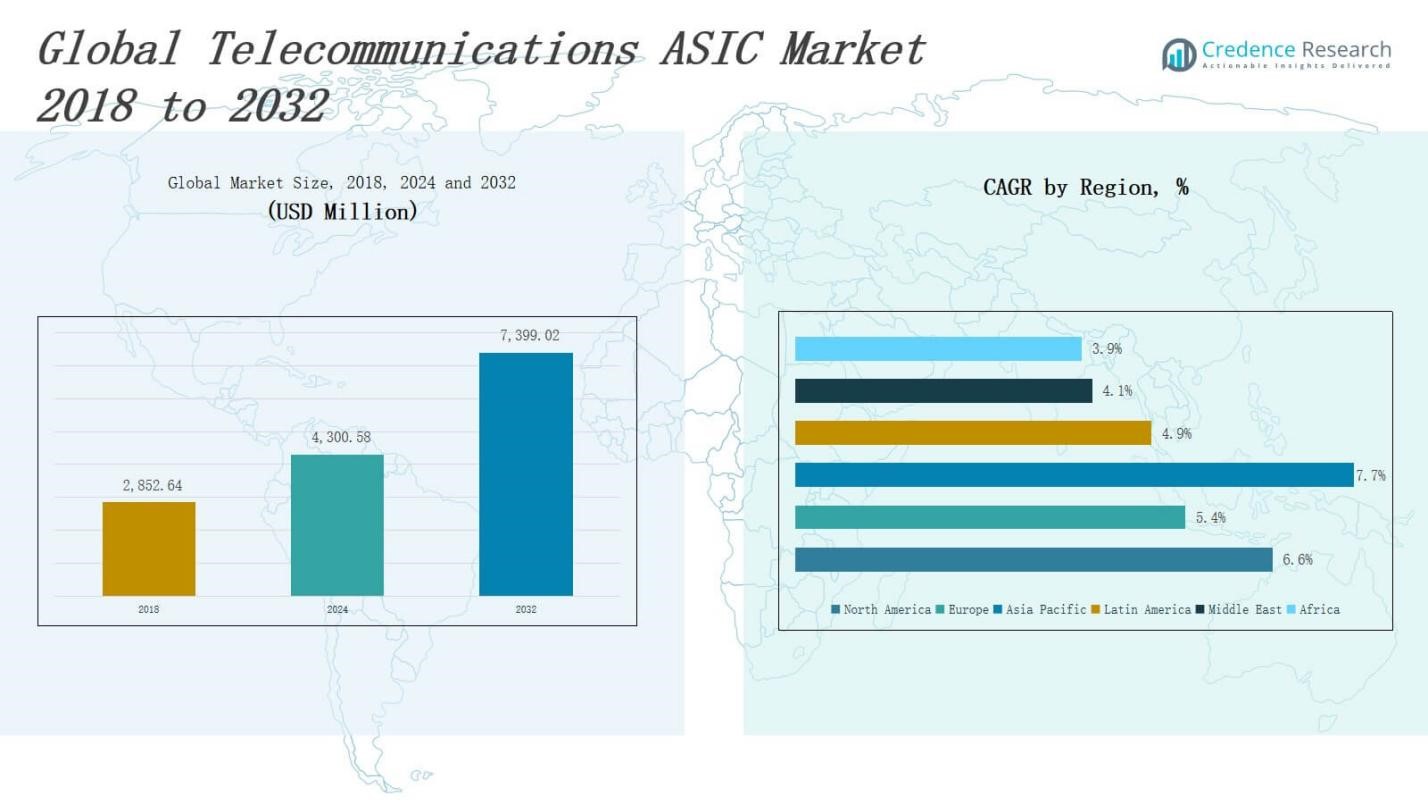
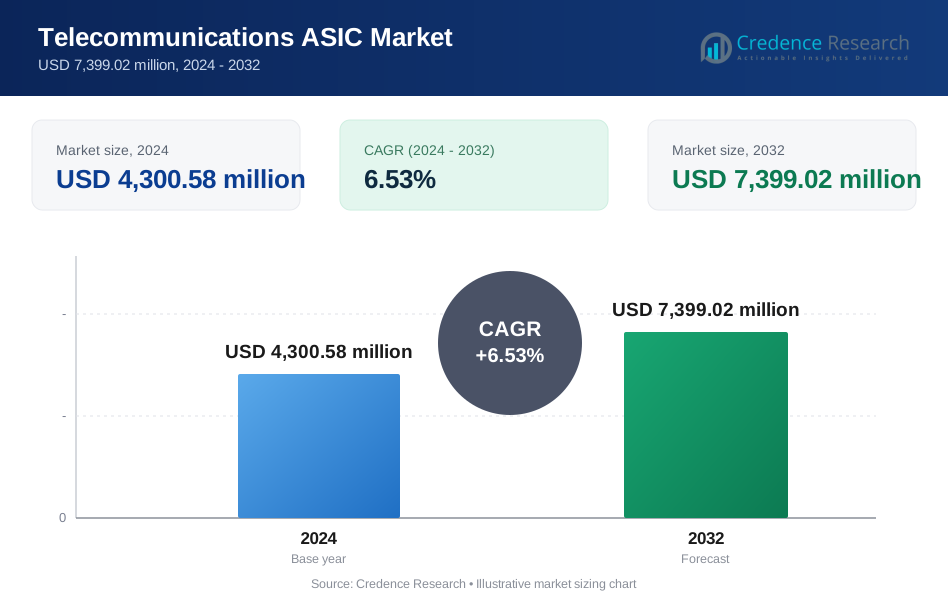
The Telecommunications ASIC Market size was valued at USD 2,852.64 million in 2018 to USD 4,300.58 million in 2024 and is anticipated to reach USD 7,399.02 million by 2032, at a CAGR of 6.53 % during the forecast period.
| REPORT ATTRIBUTE | DETAILS |
|---|---|
| Historical Period | 2020-2023 |
| Base Year | 2024 |
| Forecast Period | 2025-2032 |
| Telecommunications ASIC Market Size 2024 | USD 4,300.58 Million |
| Telecommunications ASIC Market, CAGR | 6.53 % |
| Telecommunications ASIC Market Size 2032 | USD 7,399.02 Million |
The Telecommunications ASIC market is driven by the rapid deployment of 5G infrastructure, escalating demand for high-speed data transmission, and increasing adoption of network virtualization technologies. Telecom operators rely on application-specific integrated circuits to optimize power efficiency, reduce latency, and support complex signal processing in base stations, routers, and optical networks. ASICs enable real-time data routing, bandwidth management, and protocol conversion, which are critical for scaling modern telecom networks. The rising integration of edge computing and IoT connectivity further accelerates demand for custom chips capable of handling massive device-to-device communications. Trends shaping the market include the transition to 3nm and 5nm fabrication processes, the growing use of system-on-chip (SoC) designs, and the emergence of AI-powered network optimization. Vendors are also focusing on energy-efficient ASIC solutions to align with sustainability goals and lower operational costs. As telecom infrastructure evolves to support cloud-native and software-defined networking (SDN), ASIC adoption is set to increase across both core and access networks.
The Telecommunications ASIC Market shows strong regional variation, with Asia Pacific leading at 38% market share due to aggressive 5G rollouts in China, Japan, South Korea, and India. North America follows with 32%, supported by early adoption and innovation hubs in the United States and Canada. Europe holds 18%, driven by digital infrastructure upgrades in Germany, the UK, and France. The remaining 12% comes from Latin America, the Middle East, and Africa, where growth is driven by broadband expansion and smart city projects. Key players shaping this global market include MediaTek, Analog Devices, Qualcomm, Marvell Technology, Texas Instruments, Broadcom, Renesas Electronics, NXP Semiconductors, and Intel. These companies compete on design efficiency, power optimization, and partnerships with telecom OEMs, offering custom ASICs for base stations, networking gear, and edge devices. Regional focus and technology capabilities define their competitive edge across different telecom ecosystems.
Market Insights
- The Telecommunications ASIC Market is projected to grow from USD 4,300.58 million in 2024 to USD 7,399.02 million by 2032.
- Demand is fueled by 5G rollouts, network upgrades, and high-speed data transmission across telecom infrastructure.
- ASICs play a critical role in supporting SDN, NFV, bandwidth management, and real-time signal processing.
- Edge computing and IoT growth are increasing the need for purpose-built ASICs in small cells and gateways.
- High development costs and compliance with telecom standards challenge smaller entrants and delay time-to-market.
- Asia Pacific leads with 38% market share, followed by North America (32%), Europe (18%), and the rest of the world (12%).
- Key players include Intel, Broadcom, MediaTek, Qualcomm, Analog Devices, Marvell, Texas Instruments, NXP, and Renesas Electronics.
Market Drivers
Expansion of 5G Networks and Infrastructure Modernization
The Telecommunications ASIC Market is growing due to the rapid global rollout of 5G networks and the modernization of legacy infrastructure. Telecom providers require high-performance ASICs to manage increased data loads, support higher frequency bands, and enable faster signal processing. It benefits from the demand for custom hardware that improves base station efficiency and supports millimeter-wave technologies. ASICs are integral to reducing latency, enhancing network speed, and ensuring low power consumption in 5G infrastructure.
- For instance, Qualcomm enabled large-scale Open RAN 5G deployments with operators like Vodafone and NTT Docomo, using advanced ASIC-based platforms to deliver energy-efficient and scalable network solutions.
Increased Demand for High-Speed Data Transmission
Surging internet traffic and data consumption across enterprise and consumer segments drive the Telecommunications ASIC Market. It supports network equipment that handles real-time data routing, video streaming, cloud access, and latency-sensitive applications. ASICs offer optimized architectures that enable faster throughput and higher bandwidth in routers, switches, and backhaul systems. Telecom operators rely on them for protocol translation, error correction, and load balancing. ASIC integration enhances network reliability and supports continuous traffic growth.
- For instance, Samsung Electronics is expanding ASIC production in South Korea to power 5G and AI-driven telecom applications, delivering chips that enable higher bandwidth and lower latency in next-generation wireless networks.
Adoption of Software-Defined Networking and Virtualization
The transition to software-defined networking (SDN) and network function virtualization (NFV) has created new ASIC requirements in the Telecommunications ASIC Market. It enables flexible, programmable, and cost-efficient telecom infrastructures. ASICs tailored for SDN and NFV help manage control planes, route packets efficiently, and ensure real-time network orchestration. Telecom vendors incorporate them into white-box switches and cloud-native infrastructure. These technologies reduce dependency on traditional hardware and improve scalability across networks.
Growth in Edge Computing and IoT Connectivity
The rising number of connected devices and the shift toward decentralized data processing contribute significantly to the Telecommunications ASIC Market. It requires purpose-built ASICs for edge devices that perform localized analytics and minimize data backhaul to central servers. These chips power IoT gateways, small cells, and micro data centers with real-time processing capabilities. ASICs also enhance cybersecurity, manage device authentication, and optimize energy use at the network edge.
Market Trends
Shift Toward Advanced Node Technologies and Miniaturization
Semiconductor manufacturers are investing in smaller process nodes such as 5nm and 3nm to improve ASIC performance and efficiency. The Telecommunications ASIC Market reflects this trend through increased integration of advanced-node chips in network hardware. It benefits from lower power consumption, higher transistor density, and faster switching speeds, which are critical for meeting telecom performance benchmarks. These advancements enable compact, thermally efficient chips suitable for high-density network environments and 5G small cell deployments.
- For instance, TSMC began mass production of 5nm chips in 2020 and has since introduced its 3nm process, which is recognized as the industry's most advanced, offering significant improvements in power, performance, and area for network and telecom applications
Rise of AI-Integrated Network Infrastructure
Artificial intelligence is becoming central to modern network management, driving demand for ASICs with embedded AI acceleration. The Telecommunications ASIC Market is witnessing a growing preference for chips that support real-time analytics, traffic optimization, and anomaly detection. It supports AI-driven functions such as predictive maintenance and automated network configuration. ASICs built with AI cores offer telecom operators faster inference capabilities at lower latency. These features enable smarter, more adaptive infrastructure aligned with evolving traffic patterns.
Growing Use of System-on-Chip (SoC) Designs in Telecom Equipment
The market is embracing SoC-based ASICs that consolidate multiple functions—including data routing, signal processing, and memory—on a single chip. The Telecommunications ASIC Market benefits from SoCs that reduce component count, streamline board design, and lower manufacturing costs. It allows OEMs to develop compact, power-efficient solutions for switches, base stations, and access points. These integrated chips simplify hardware architecture while meeting performance demands of 5G and edge networking. SoC adoption also shortens time-to-market.
- For instance, Apple’s A17 Bionic SoC powers iPhones by integrating the CPU, GPU, AI engine, and connectivity modules on a single chip, delivering high performance and energy efficiency for demanding mobile and communication applications.
Integration of ASICs in Edge and Cloud-Based Infrastructure
The convergence of edge computing and cloud-native networks is reshaping ASIC design priorities. The Telecommunications ASIC Market responds to this shift with chips optimized for low-latency, high-throughput edge processing. It enables real-time data handling near the source, reducing congestion and improving network responsiveness. These ASICs power distributed units, remote radio heads, and content delivery nodes. They are engineered for modular deployments and seamless scalability across hybrid network architectures.
Market Challenges Analysis
High Development Costs and Design Complexity
Designing custom ASICs for telecom applications involves significant capital investment and technical expertise. The Telecommunications ASIC Market faces cost pressures due to expensive electronic design automation (EDA) tools, extended verification cycles, and the need for specialized engineering talent. It requires strict compliance with telecom standards, which complicates design validation and increases time-to-market. The shift to smaller process nodes adds complexity in power management, thermal regulation, and signal integrity. These factors can deter smaller players from entering the market.
Supply Chain Disruptions and Foundry Constraints
The global semiconductor supply chain remains vulnerable to disruptions in raw material sourcing, foundry capacity, and geopolitical restrictions. The Telecommunications ASIC Market depends on timely access to advanced fabrication nodes, which are concentrated in a few countries. It experiences production delays when foundries prioritize higher-volume consumer chips or face export limitations. Fluctuating lead times affect product availability and hinder strategic rollouts. Managing long-term supply commitments becomes challenging in such a constrained environment.
Market Opportunities
Expansion of Private 5G and Enterprise Networks
The rise of private 5G deployments across manufacturing, logistics, and smart campuses creates strong demand for custom ASICs tailored to enterprise needs. The Telecommunications ASIC Market is well-positioned to support low-latency, high-throughput solutions for mission-critical applications. It enables secure, scalable network functions within private infrastructure by integrating custom signal processing and traffic management features. Enterprises seek ASICs that enhance performance while ensuring data control and compliance with internal protocols. This segment offers long-term growth potential.
Emergence of Open RAN and White-Box Infrastructure
Telecom operators are adopting Open RAN and disaggregated architectures to reduce vendor lock-in and improve network flexibility. The Telecommunications ASIC Market can capitalize on this trend by delivering purpose-built chips for white-box radios, distributed units, and network interface cards. It supports innovation in power-efficient hardware design and multi-vendor interoperability. ASIC vendors can form partnerships with Open RAN ecosystem players to co-develop optimized solutions. These developments offer opportunities to penetrate new markets and diversify revenue streams.
Market Segmentation Analysis:
By Product Type
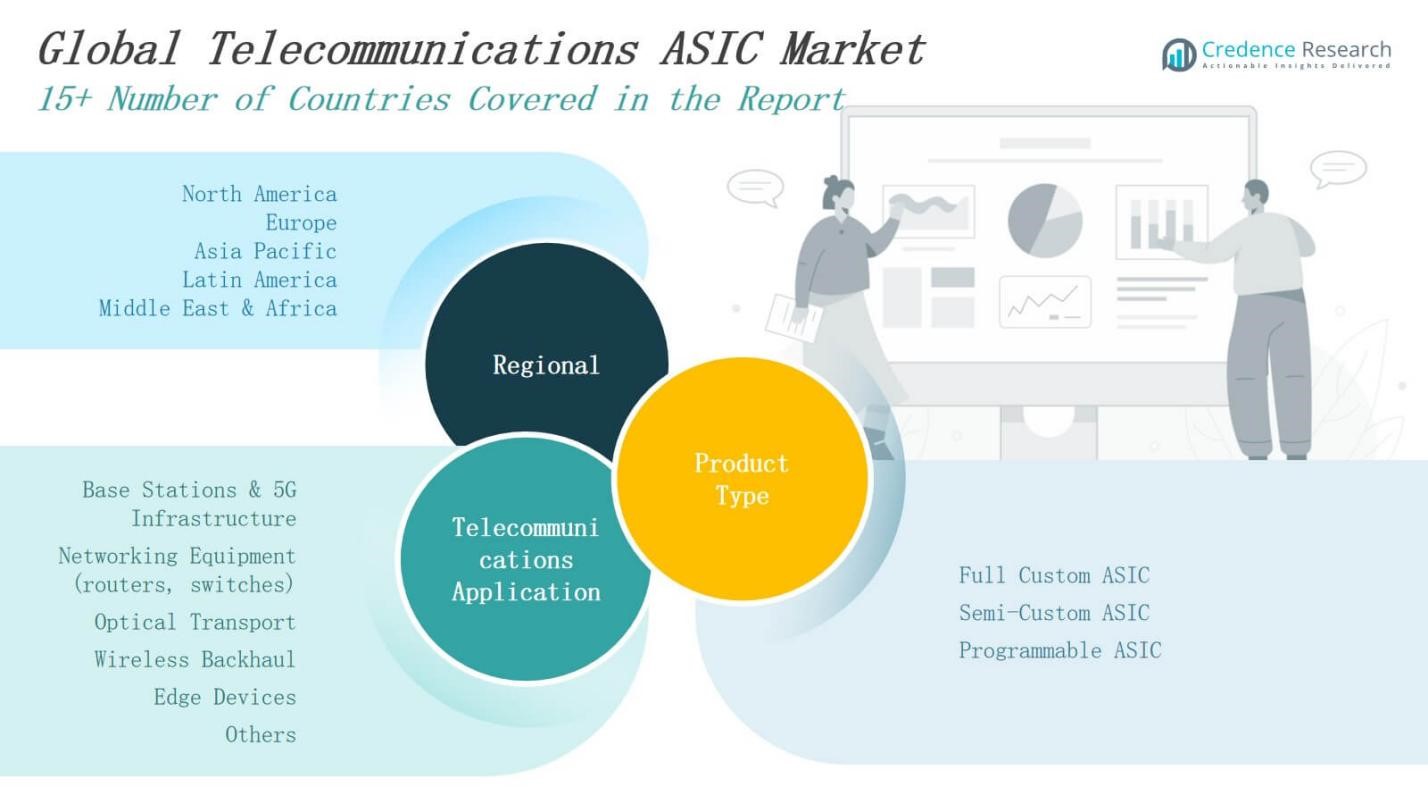
The Telecommunications ASIC Market includes three key product types: full custom ASIC, semi-custom ASIC, and programmable ASIC. Full custom ASICs offer maximum performance and power efficiency, making them ideal for large-scale base stations and core telecom infrastructure. Semi-custom ASICs provide a balance between cost and customization, supporting mid-range telecom hardware. Programmable ASICs appeal to vendors needing post-deployment flexibility. It reflects strong demand for tailored solutions, especially where performance optimization and low latency are critical.
- For instance, Cisco’s Silicon One ASIC enables routers to process up to 10.8 Terabits per second, supporting high-speed data transfer and low latency in modern network infrastructure.
By Telecommunications Application
The Telecommunications ASIC Market spans diverse applications, including base stations and 5G infrastructure, networking equipment, optical transport, wireless backhaul, edge devices, and others. ASICs in base stations and 5G systems enhance signal processing and reduce power consumption. Networking equipment like routers and switches use ASICs for high-speed packet routing. Optical transport and wireless backhaul systems rely on ASICs for bandwidth management and traffic control. Edge devices integrate ASICs for low-latency operations in distributed networks.
- For instance, Ericsson employs ASICs in its networking equipment, such as routers and switches, to enable high-speed packet routing and efficient traffic management for telecom operators expanding 5G infrastructure to support over 1 billion connected devices by 2025.
Segments:
Based on Product Type
- Full Custom ASIC
- Semi-Custom ASIC
- Programmable ASIC
Based on Telecommunications Application:
- Base Stations & 5G Infrastructure
- Networking Equipment (Routers, Switches)
- Optical Transport
- Wireless Backhaul
- Edge Devices
- Others
Based on Region:
North America
- U.S.
- Canada
- Mexico
Europe
- UK
- France
- Germany
- Italy
- Spain
- Russia
- Rest of Europe
Asia Pacific
- China
- Japan
- South Korea
- India
- Australia
- Southeast Asia
- Rest of Asia Pacific
Latin America
- Brazil
- Argentina
- Rest of Latin America
Middle East
- GCC Countries
- Israel
- Turkey
- Rest of Middle East
Africa
- South Africa
- Egypt
- Rest of Africa
Regional Analysis
North America
North America holds 32% share of the Telecommunications ASIC Market, led by the United States. The region benefits from early 5G deployment, strong presence of telecom OEMs, and advanced semiconductor R&D capabilities. It supports high ASIC demand across base stations, cloud infrastructure, and edge computing devices. Leading companies such as Intel, Broadcom, and Qualcomm invest in custom chip development to support evolving telecom needs. The market gains momentum from investments in private 5G and Open RAN infrastructure. It also reflects government-backed efforts to strengthen domestic semiconductor supply chains.
Asia Pacific
Asia Pacific accounts for 38% share of the Telecommunications ASIC Market, making it the largest regional contributor. China, Japan, South Korea, and India drive growth through aggressive telecom infrastructure expansion and 5G rollouts. It sees high adoption of ASICs in base stations, routers, and optical transport systems. Local players and global giants invest heavily in semiconductor manufacturing and R&D hubs. Regional governments support telecom innovation with strategic funding and spectrum allocation. Demand remains high for low-cost, high-efficiency ASICs tailored to dense urban and remote coverage needs.
Europe
Europe represents 18% share of the Telecommunications ASIC Market, supported by strong 5G rollout strategies across Germany, France, the UK, and Nordic countries. It relies on ASICs for modernizing legacy telecom networks and supporting SDN-based architectures. The market benefits from industrial automation and government-backed digital transformation programs. European vendors integrate ASICs into edge devices and optical transport networks. Demand increases for energy-efficient chipsets aligned with EU sustainability goals. It reflects moderate growth, driven by cross-border investments and increased network densification.
Rest of the World
The rest of the world collectively holds 12% share of the Telecommunications ASIC Market. Growth accelerates in the Middle East through smart city initiatives and in Africa through mobile broadband expansion. Latin America sees rising demand from digital inclusion efforts. It shows increasing deployment of programmable ASICs in cost-sensitive applications. Regional telecoms partner with global ASIC vendors to bridge performance and affordability gaps.
Key Player Analysis
- MediaTek
- Analog Devices
- Qualcomm
- Marvell Technology
- Texas Instruments
- Broadcom
- Renesas Electronics
- NXP Semiconductors
- Intel
Competitive Analysis
The Telecommunications ASIC Market features intense competition among global semiconductor leaders focused on custom chip design for telecom infrastructure. Companies like MediaTek, Analog Devices, and Qualcomm invest in high-performance ASICs for 5G base stations, routers, and edge devices. Marvell Technology and Texas Instruments deliver scalable solutions optimized for bandwidth efficiency and power savings. Broadcom leads in network switching ASICs, while Renesas Electronics and NXP Semiconductors target integrated system-on-chip designs. Intel leverages its foundry and architecture expertise to support telecom-grade ASIC solutions. The market favors players with strong R&D pipelines, advanced node capabilities, and strategic partnerships with telecom OEMs. It demands rapid innovation, low-latency architecture, and alignment with emerging trends such as Open RAN, AI-based networking, and edge computing. Companies differentiate by offering application-specific solutions that reduce energy use, improve real-time data processing, and support modular infrastructure deployments. Competitive positioning depends on technological leadership, pricing flexibility, and ability to meet global volume demand.
Recent Developments
- In January 2025, NVIDIA launched a dedicated ASIC department to develop custom chips for AI and large language models, addressing the growing demand in the telecommunications ASIC market.
- In June 2024, Renesas Electronics Corporation completed the acquisition of Transphorm, Inc., a leader in gallium nitride (GaN) power semiconductors, expanding Renesas’ portfolio with GaN-based power products and reference designs relevant to telecom and power applications.
- In February 2025, Honeywell partnered with ForwardEdge ASIC LLC to develop radiation-hardened ASICs for space and defense communication systems, enhancing its custom chip portfolio.
- In May 2025, SEALSQ Corp announced the acquisition of IC’ALPS SAS, a French ASIC design company, to strengthen its telecommunications ASIC development capabilities.
Market Concentration & Characteristics
The Telecommunications ASIC Market exhibits moderate to high market concentration, with a small group of global semiconductor companies holding a significant share. It is characterized by high entry barriers due to complex design requirements, capital-intensive fabrication, and reliance on advanced process nodes. Leading players such as MediaTek, Intel, Broadcom, and Qualcomm maintain a competitive advantage through proprietary architectures, strong IP portfolios, and long-standing relationships with telecom OEMs. The market prioritizes performance, energy efficiency, and customization to meet application-specific demands across 5G, optical transport, and edge computing. Rapid technology evolution drives continuous product development, while the transition toward Open RAN and software-defined networks creates demand for agile and programmable ASICs. It also reflects growing alignment with sustainability goals, pushing vendors to deliver lower-power, thermally optimized solutions. Strategic partnerships, foundry access, and R&D investment are critical factors influencing market dynamics and supplier selection in telecom infrastructure deployments.
Report Coverage
The research report offers an in-depth analysis based on Product Type, Telecommunication Application, End-User and Geography. It details leading market players, providing an overview of their business, product offerings, investments, revenue streams, and key applications. Additionally, the report includes insights into the competitive environment, SWOT analysis, current market trends, as well as the primary drivers and constraints. Furthermore, it discusses various factors that have driven market expansion in recent years. The report also explores market dynamics, regulatory scenarios, and technological advancements that are shaping the industry. It assesses the impact of external factors and global economic changes on market growth. Lastly, it provides strategic recommendations for new entrants and established companies to navigate the complexities of the market.
Future Outlook
- Demand for ASICs will rise as telecom operators expand 5G standalone and private network deployments.
- Companies will focus on developing energy-efficient chips to meet network sustainability targets.
- Open RAN adoption will drive collaboration between ASIC vendors and telecom hardware providers.
- AI-driven network functions will increase the need for ASICs with embedded AI processing cores.
- Growth in edge computing will push demand for compact, low-latency ASICs for distributed infrastructure.
- SoC integration will become standard for optimizing space, cost, and performance in telecom equipment.
- Security and data encryption features will become essential components of telecom ASIC designs.
- Supply chain resilience will influence vendor selection and long-term sourcing strategies.
- Telecom ASIC vendors will explore advanced packaging and 3nm process technologies for performance gains.
- Partnerships with hyperscalers and cloud-native infrastructure providers will shape ASIC product roadmaps.
Request a Free Sample
Fill in your details and we'll send you a free sample report.
- Sample data tables & charts
- Research methodology
Need a Custom Version of This Report?
Tailor the scope, geography, or segments to your exact requirements.
- Custom geography or segment scope
- Direct access to our analyst team
Frequently Asked Questions
What is the current size of the Telecommunications ASIC Market?
What factors are driving the growth of the Telecommunications ASIC Market?
What are the key segments within the Telecommunications ASIC Market?
What are some challenges faced by the Telecommunications ASIC Market?
Who are the major players in the Telecommunications ASIC Market?
Table of Content
Chapter 1. Report Introduction
- 1.1 Report Description & Purpose
- 1.1.1 Report Title & Market Definition
- 1.1.2 Unique Selling Propositions (USP) & Key Differentiators
- 1.1.3 Value Proposition for Stakeholders
- 1.2 Research Objectives
- 1.2.1 Market Sizing Objectives (Volume & Revenue)
- 1.2.2 Segmentation Objectives
- 1.2.3 Competitive Intelligence Objectives
- 1.2.4 Forecast & Scenario Objectives
- 1.3 Report Scope
- 1.3.1 Telecommunications ASIC Scope – Types & Subtypes Covered
- 1.3.2 Geographic Scope – Regions & Countries Covered
- 1.3.3 Historical Period, Base Year & Forecast Period (2024; forecast to 2032)
- 1.3.4 Inclusions & Exclusions
- 1.4 HS Code & Classification Framework
- 1.5 Currency, Units & Pricing Basis
- 1.6 Target Stakeholders
- 1.7 Limitations & Assumptions
Chapter 2. Executive Summary
- 2.1 Global Telecommunications ASIC Market Snapshot
- 2.1.1 Market Size – Historical (2024) & Forecast (2024-2032) (2024: USD 4,300.58 million → 2032: USD 7,399.02 million)
- 2.1.2 Volume & Revenue – Global Totals
- 2.1.3 Key Market Highlights – Top Five Facts
- 2.2 Telecommunications ASIC Market Segmentation Snapshot
- 2.2.1 Market Split by Region – 2024 vs. 2032
- 2.3 Competitive Snapshot
- 2.3.1 Top 10 Players by Revenue Share – 2024
- 2.3.2 Top 10 Players by Volume Share – 2024
- 2.3.3 Recent Strategic Developments (18-Month Summary)
- 2.4 Key Investment Highlights & Strategic Conclusions
Chapter 3. Telecommunications ASIC Market Dynamics & Industry Analysis
- 3.1 Market Overview & Context
- 3.1.1 Telecommunications ASIC Market Position in the Broader Automotive Value Chain
- 3.1.2 OEM vs. Replacement Market Dynamics
- 3.1.3 Market Maturity & Development Stage by Region
- 3.2 Telecommunications ASIC Market Drivers
- 3.3 Telecommunications ASIC Market Restraints & Challenges
- 3.4 Telecommunications ASIC Market Opportunities
- 3.5 Porter's Five Forces Analysis
- 3.5.1 Threat of New Entrants
- 3.5.2 Bargaining Power of Suppliers
- 3.5.3 Bargaining Power of Buyers
- 3.5.4 Threat of Substitutes
- 3.5.5 Competitive Rivalry – Intensity Assessment
- 3.6 Telecommunications ASIC Value Chain Analysis
- 3.6.1 Upstream – Raw Material/Input Suppliers
- 3.6.1.1 Raw Material/Input 1
- 3.6.1.2 Raw Material/Input 2
- 3.6.1.3 Raw Material/Input 3
- 3.6.2 Midstream – Production/Manufacturing/Service Delivery
- 3.6.2.1 Production/Process Overview
- 3.6.2.2 Key Facility Locations & Capacity by Manufacturer
- 3.6.3 Downstream – Distribution & End Consumer
- 3.6.3.1 Primary Channel – B2B/OEM
- 3.6.3.2 Secondary Channels – Dealer, Retail, Online, Direct
- 3.6.4 Value Chain Profitability Analysis
- 3.6.1 Upstream – Raw Material/Input Suppliers
- 3.7 PESTEL Analysis
- 3.7.1 Political Factors
- 3.7.2 Economic Factors
- 3.7.3 Social Factors
- 3.7.4 Technological Factors
- 3.7.5 Environmental Factors
- 3.7.6 Legal Factors
- 3.8 Telecommunications ASIC Supply Chain Analysis
- 3.8.1 Raw Material/Input Supply Risk Assessment
- 3.8.2 Manufacturing Concentration Risk (Geographic Exposure)
- 3.8.3 Trade Disruption Impact Analysis
- 3.9 Regulatory & Policy Landscape
Note: The regulatory and policy landscape section covers regulations based on their applicability to the market, Telecommunications ASIC category, geography, and scope of the study. Only regulatory frameworks with a material impact on operations, compliance, trade, sustainability, or market access are analyzed in detail.
Chapter 4. Key Investment Pockets & Opportunity Analysis
- 4.1 Telecommunications ASIC Market Attractiveness Analysis
- 4.1.1 By Region – Investment Attractiveness Matrix (Volume × CAGR)
- 4.2 Absolute Revenue Growth Opportunity
- 4.2.1 By Region – Absolute USD Growth Through 2032
- 4.3 Incremental Volume Opportunity
- 4.3.1 By Region – Incremental Volume Through 2032
- 4.3.2 Segment – Incremental Volume
- 4.4 Emerging Submarket Opportunity Deep Dive (Subject to Applicability)
- 4.5 Emerging Market Opportunity Scorecards
- 4.5.1 United States
- 4.5.2 Europe
- 4.5.3 Asia
- 4.5.4 Middle East & Africa
Note: Emerging Market Opportunity Scorecards will be included based on relevance and strategic importance. Regions listed are indicative and may vary depending on data availability and market dynamics.
Chapter 5. Telecommunications ASIC Import-Export Analysis & Trade Flows
- 5.1 Global Trade Overview
- 5.1.1 Global Export Value by Country (2024)
- 5.1.2 Global Export Volume by Country (2024)
- 5.1.3 Global Import Value by Country (2024)
- 5.1.4 Global Import Volume by Country (2024)
- 5.1.5 Net Trade Balance by Country (2024)
- 5.2 Export Analysis – Segment
- 5.2.1 Type 1 (HS Code)
- 5.2.2 Type 2 (HS Code)
- 5.2.3 Type 3 (HS Code)
- 5.2.4 Type 4 (HS Code)
- 5.2.5 Type 5 (HS Code)
- 5.3 Import Analysis – Segment
- 5.3.1 Type 1 (HS Code)
- 5.3.2 Type 2 (HS Code)
- 5.3.3 Type 3 (HS Code)
- 5.3.4 Type 4 (HS Code)
- 5.3.5 Type 5 (HS Code)
- 5.4 Average Unit Trade Prices
- 5.4.1 Average Export Price – Segment & Country
- 5.4.2 Average Import Price – Segment & Source Country
- 5.4.3 Price Trends (2024)
- 5.5 Key Trade Route Analysis
- 5.5.1 Trade Route 1
- 5.5.2 Trade Route 2
- 5.5.3 Trade Route 3
- 5.5.4 Trade Route 4
- 5.5.5 Trade Route 5
- 5.6 Trade Policy Impact Assessment
- 5.6.1 US Anti-Dumping & Section 301 Tariffs
- 5.6.2 EU Customs Union Impact
- 5.6.3 Major Free Trade Agreements
- 5.6.4 USMCA Rules of Origin
Note: Trade policy analysis will be included only where relevant to the Telecommunications ASIC market.
Chapter 6. Competitive Landscape & Company Benchmarking
- 6.1 Telecommunications ASIC Market Concentration & Structure
- 6.1.1 Herfindahl-Hirschman Index (HHI) – vs. 2024
- 6.1.2 Tier 1, Tier 2 & Tier 3 Market Structure
- 6.1.3 Global, Regional & Local Player Dynamics
- 6.2 Telecommunications ASIC Market Share Analysis – 2024
- 6.2.1 Global Revenue Share by Company
- 6.2.2 Global Volume Share by Company
- 6.2.3 Regional Revenue Share
- 6.2.4 Market Share Evolution ( vs. 2024)
- 6.2.5 OEM Segment Share by Company
- 6.2.6 Replacement Segment Share by Company
- 6.3 Production/Delivery Capacity & Facility Analysis
- 6.3.1 Global Installed Capacity
- 6.3.2 Capacity Utilization Rates
- 6.3.3 Production/Output Volume
- 6.3.4 Facility Locations & Capacity Map
- 6.3.5 Planned Capacity Additions
- 6.4 Telecommunications ASIC Competitive Benchmarking Matrix
- 6.4.1 Revenue, Volume, CAGR & Profitability Comparison
- 6.4.2 Channel Revenue Mix
- 6.4.3 Geographic Revenue Exposure
- 6.4.4 R&D Intensity
- 6.4.5 Sustainability Maturity
- 6.5 Strategic Developments in Telecommunications ASIC (Last 24 Months)
- 6.5.1 Mergers, Acquisitions & Divestments
- 6.5.2 New Telecommunications ASIC Launches
- 6.5.3 Facility Expansions
- 6.5.4 Strategic Alliances, Joint Ventures & Partnerships
- 6.5.5 Distribution Expansion & Market Entry
- 6.5.6 Sustainability & ESG Initiatives
- 6.6 Competitive Strategy Mapping
- 6.6.1 Leader, Challenger, Follower & Niche Classification
- 6.6.2 Pricing Strategy Comparison
- 6.6.3 Channel Strategy Matrix
Note: Strategic developments are included based on their materiality and the availability of reliable information.
Chapter 7. Global Telecommunications ASIC Market – By Distribution Channel
- 7.1 Segment Overview
- 7.1.1 Volume & Revenue Split by Channel (2024 & 2032)
- 7.1.2 Channel Mix Evolution (2024-2032)
Chapter 8. Regional Market Analysis – Global Overview
- 8.1 Global Regional Overview
- 8.1.1 Regional Volume Share
- 8.1.2 Regional Revenue Share
- 8.1.3 Regional Volume by Region
- 8.1.4 Regional Revenue by Region
- 8.1.5 Regional Forecast Through 2032
- 8.2 Cross-Regional Segment Analysis
- 8.2.1 By Distribution Channel
- 8.2.2 By Brand/Price Tier
Chapter 9. North America Telecommunications ASIC Market
- 9.1 United States
- 9.2 Canada
- 9.3 Mexico
Chapter 10. Europe Telecommunications ASIC Market
- 10.1 Germany
- 10.2 France
- 10.3 Italy
- 10.4 United Kingdom
- 10.5 Spain
- 10.6 Poland
- 10.7 Russia
- 10.8 Netherlands
- 10.9 Belgium
- 10.10 Sweden
- 10.11 Denmark
- 10.12 Norway
- 10.13 Rest of Europe
Chapter 11. Asia Pacific Telecommunications ASIC Market
- 11.1 China
- 11.2 India
- 11.3 Japan
- 11.4 South Korea
- 11.5 Thailand
- 11.6 Indonesia
- 11.7 Vietnam
- 11.8 Malaysia
- 11.9 Australia
- 11.10 Rest of Asia Pacific
Chapter 12. Latin America Telecommunications ASIC Market
- 12.1 Brazil
- 12.2 Argentina
- 12.3 Colombia
- 12.4 Chile
- 12.5 Rest of Latin America
Chapter 13. Middle East Telecommunications ASIC Market
- 13.1 Saudi Arabia
- 13.2 United Arab Emirates
- 13.3 Turkey
- 13.4 Israel
- 13.5 Iran
- 13.6 Rest of the Middle East
Chapter 14. Africa Telecommunications ASIC Market
- 14.1 South Africa
- 14.2 Egypt
- 14.3 Nigeria
- 14.4 Morocco
- 14.5 Rest of Africa
Chapter 15. Telecommunications ASIC Company Profiles
- 15.1 [Company 01]
- 15.1.1 Company Overview
- 15.1.2 Key Management Personnel
- 15.1.3 Products & Services Portfolio
- 15.1.4 Financial Performance
- 15.1.5 Key Market Focus & Geographic Presence
- 15.1.6 Recent Developments & Strategic Initiatives
Note: The company profile list is preliminary and may change based on research findings, market developments, data availability, and client requirements.
Chapter 16. Appendices
- Appendix A – List of Abbreviations & Acronyms
- Appendix B – Industry Classification Code Reference – Full Series
- Appendix C – Production & Capacity Data Tables
- Appendix D – End-Use & Demand Base Tables
- Appendix E – Consumption & Replacement Rate Assumptions
- Appendix F – ASP Reference Tables
- Appendix G – Manufacturing & Facility Database
- Appendix H – Import-Export Data Tables
- Appendix I – Regulatory Summary Tables
- Appendix J – Primary Research Participant List (Anonymized)
- Appendix K – Primary Research Questionnaire Framework
- Appendix L – Data Sources & Bibliography
- Appendix M – Market Size Divergence & Source Comparison
Chapter 17. Research Methodology
- 17.1 Research Framework & Philosophy
- 17.2 Secondary Research – Sources, Hierarchy & Data Extraction
- 17.3 Data Modeling – Bottom-Up & Top-Down Market Sizing
- 17.4 Primary Research – Stakeholder Framework, LOI & Sample Sizes
- 17.5 Forecast Methodology – Regression, Scenario & Sensitivity Analysis
- 17.6 Quality Control – Four-Layer Validation Framework
- 17.7 Limitations & Standard Assumptions
- 17.8 Disclaimer
