
Market Overview
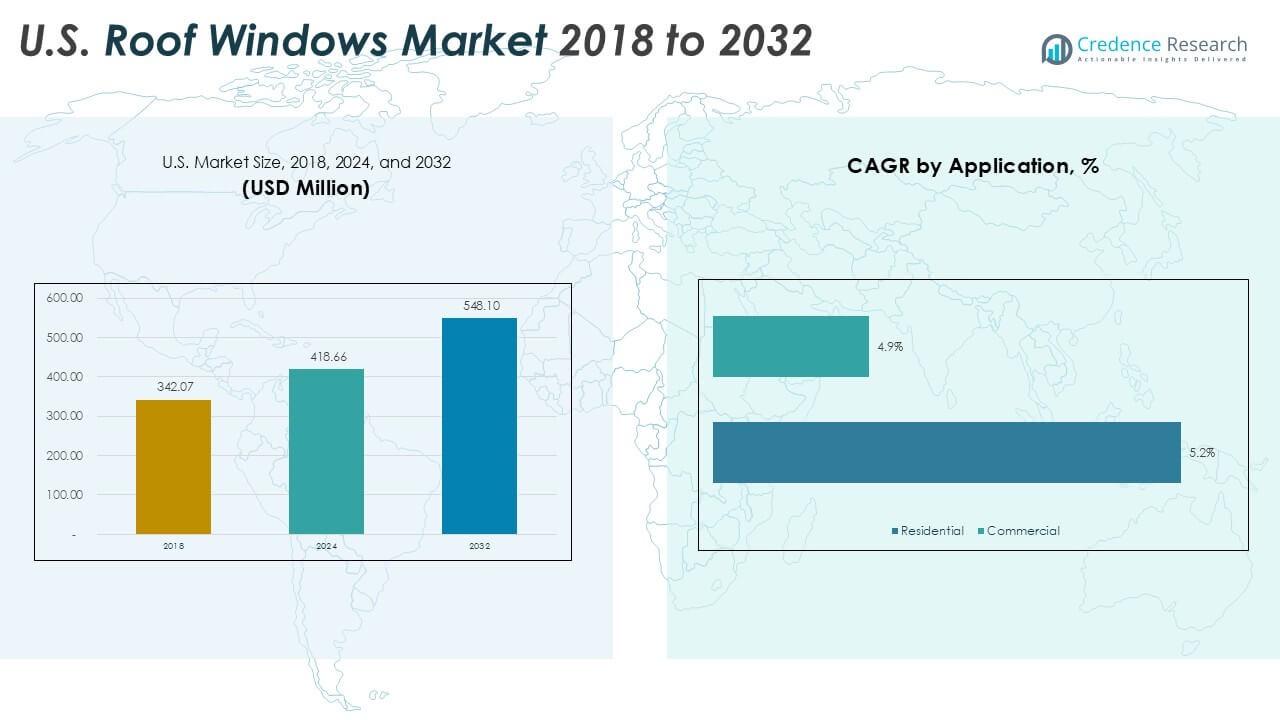
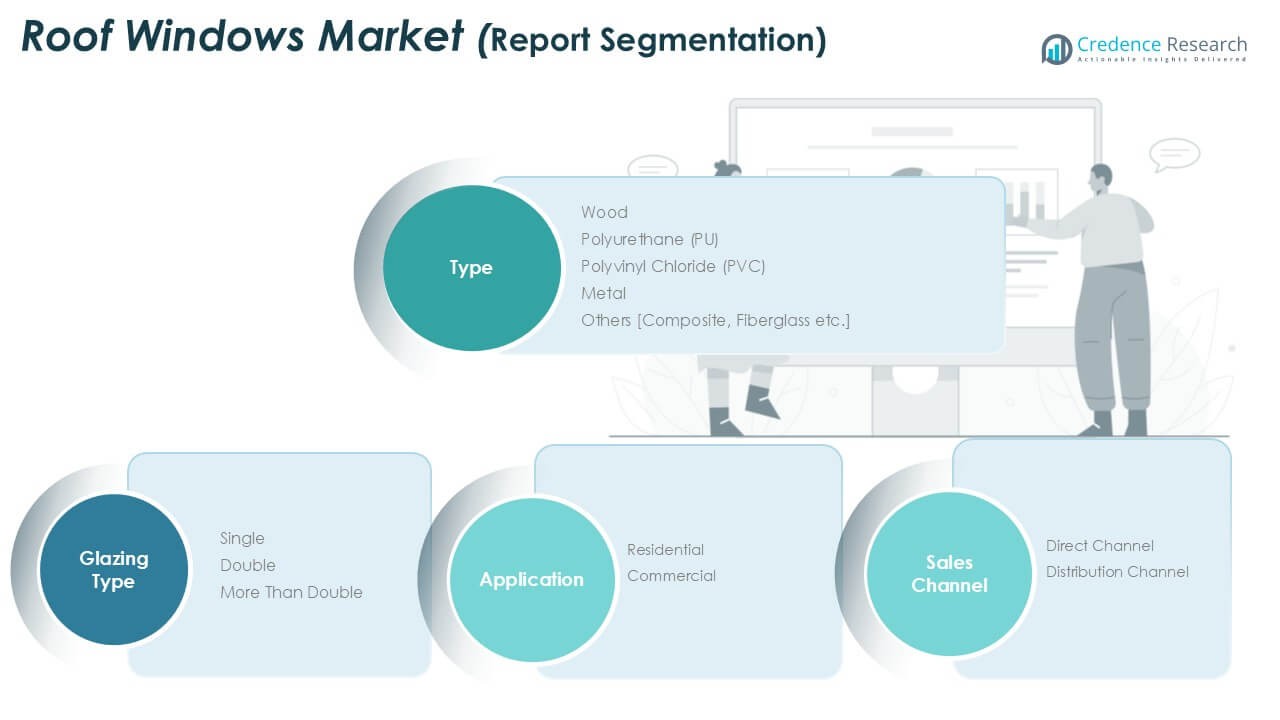
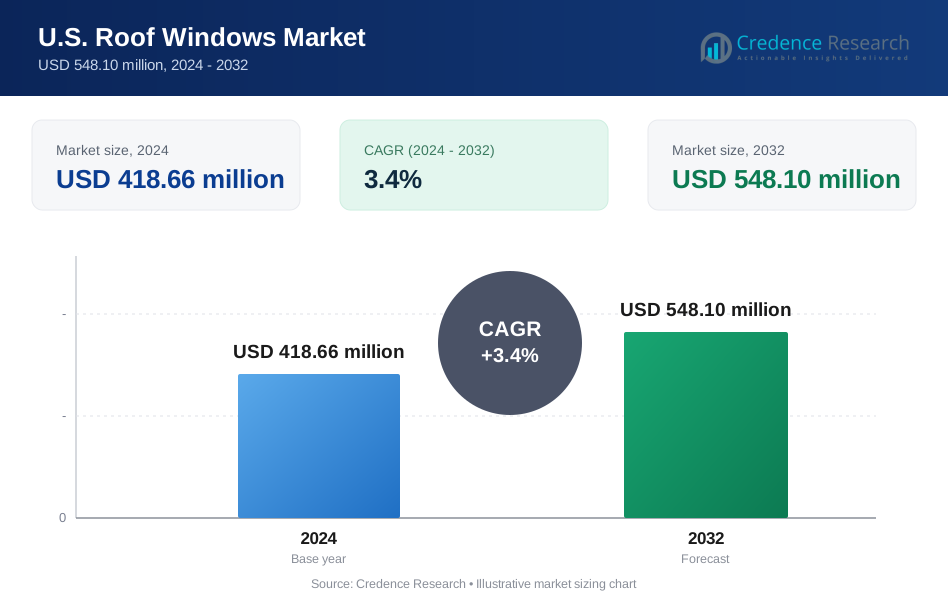
U.S. Roof Windows market size was valued at USD 342.07 million in 2018 to USD 418.66 million in 2024 and is anticipated to reach USD 548.10 million by 2032, at a CAGR of 3.4% during the forecast period.
| REPORT ATTRIBUTE | DETAILS |
|---|---|
| Historical Period | 2020-2023 |
| Base Year | 2024 |
| Forecast Period | 2025-2032 |
| U.S. Roof Windows Market Size 2024 | USD 418.66 Million |
| U.S. Roof Windows Market, CAGR | 3.4% |
| U.S. Roof Windows Market Size 2032 | USD 548.10 Million |
The U.S. roof windows market is led by major players such as Velux Group, Fakro, Roto Frank AG, Lamilux, and Marvin Windows and Doors, which together account for a significant share of total installations. Velux Group dominates with a broad product portfolio, extensive distribution, and focus on energy-efficient solutions. Fakro and Roto Frank AG strengthen competition with smart roof window systems and moisture-resistant frames. Regional suppliers like America Skylights Inc. and Skylights Plus cater to customized projects. The South leads with 32% market share, driven by strong residential construction and remodeling activity, followed by the Northeast at 25%, West at 23%, and Midwest at 20%.
Market Insights
- The U.S. Roof Windows market was valued at USD 418.66 million in 2024 and is projected to reach USD 10 million by 2032, growing at a CAGR of 3.4% during the forecast period.
- Rising home renovation and remodeling activities and demand for energy-efficient daylighting solutions drive market growth, supported by federal tax incentives and stricter building codes.
- Smart and automated roof windows, along with sustainable materials like recycled PVC and low-VOC coatings, are key trends shaping product innovation.
- The market is moderately consolidated with leading players such as Velux Group, Fakro, Roto Frank AG, and Lamilux focusing on product launches, smart integration, and partnerships to strengthen their U.S. presence.
- South leads with 32% share, followed by Northeast at 25%, West at 23%, and Midwest at 20%; by type, wood dominates with over 40% share, and double glazing remains the preferred option for energy-efficient installations.
Market Segmentation Analysis:
By Type
Wood dominates the U.S. roof windows market, holding over 40% market share due to its natural aesthetics, thermal insulation, and compatibility with traditional and premium housing designs. Demand is fueled by rising residential renovations and green building initiatives promoting sustainable materials. Polyurethane (PU) roof windows gain traction in moisture-prone areas like bathrooms and kitchens because of their durability and low maintenance. PVC options grow steadily for their cost efficiency and resistance to weathering, while metal frames see niche adoption in industrial applications. The “Others” category includes hybrid materials targeting custom architectural projects.
- For instance, Loewen is a high-end manufacturer of custom wood and aluminum-clad windows and doors for the North American market. The company offers FSC-certified wood products, which can contribute to points for projects seeking LEED certification.
By Application
Residential applications account for nearly 70% of the U.S. roof windows market, driven by rising home improvement projects, energy-efficient housing demand, and increased adoption of natural daylighting solutions. Roof windows improve indoor comfort and lower energy bills by reducing dependence on artificial lighting. Commercial installations, including offices, educational buildings, and hospitality projects, show steady growth as developers focus on wellness-oriented building designs. Tax credits and LEED certifications for daylight integration also encourage adoption in commercial spaces, though residential usage remains the primary revenue driver for manufacturers.
- For instance, FAKRO offers a range of high-efficiency triple-glazed windows designed to significantly improve a home's thermal insulation, reducing heat loss in cold weather and heat gain in warm weather. The specific energy savings depend on various factors, such as the window model, climate, and a home's overall energy performance.
By Glazing Type
Double-glazed roof windows dominate the market with over 50% share due to their balance between energy efficiency and affordability. They significantly reduce heat loss, improve acoustic insulation, and meet Energy Star requirements in most U.S. climate zones. Single-glazed options are declining as stricter building codes demand higher thermal performance. Triple and more glazing configurations are gaining popularity in colder regions and passive house projects, where superior insulation is critical. Rising focus on energy-efficient retrofits and federal incentives for high-performance fenestration further boost the demand for double and triple-glazed roof windows.
Key Growth Drivers
Rising Home Renovation and Remodeling Activities
Growing investments in home improvement projects drive demand for roof windows in the U.S. market. Homeowners install roof windows to enhance natural light, ventilation, and energy efficiency in living spaces. This trend is supported by rising disposable incomes and growing preference for modern, aesthetic interiors. The surge in green building certifications encourages the adoption of eco-friendly, energy-efficient fenestration solutions. Renovation incentives and federal tax credits further boost spending on daylighting upgrades, making roof windows a popular choice among residential property owners and remodelers.
- For instance, in 2023, Loewen supplied a large number of custom wood and wood-clad windows and doors for high-end remodeling and new construction projects, including oversized and specialty-shaped units.
Increasing Focus on Energy Efficiency
Energy efficiency remains a major driver for roof window adoption across residential and commercial sectors. Double and triple-glazed windows reduce heat loss, improve insulation, and help meet Energy Star standards. Federal and state-level incentives for high-performance fenestration products accelerate installation rates. Builders and architects prioritize energy-efficient windows to comply with updated building codes, particularly in colder U.S. regions. As consumers seek to lower energy bills and carbon footprints, roof windows with low-emissivity coatings and improved thermal breaks gain significant traction, contributing to market growth.
- For instance, a Roto Frank triple-glazed roof window can achieve an excellent thermal insulation value of Uw 97 W/m²K, which significantly cuts heat loss compared to older window types. In specific cold-climate scenarios, and depending on a home's original windows and insulation, this upgrade could contribute to annual energy savings potentially reaching up to 15% of a home's total heat loss.
Rising Popularity of Wellness-Oriented Building Designs
The U.S. market benefits from the growing trend toward wellness-focused architecture that prioritizes natural light and ventilation. Roof windows improve indoor air quality and support circadian rhythm regulation, making them popular in residential, educational, and healthcare buildings. The WELL Building Standard and similar initiatives encourage architects to incorporate daylight solutions. Employers and property developers focus on productivity and occupant well-being, further driving demand. This wellness-driven design philosophy creates a strong pull for roof windows, particularly in urban and suburban construction projects where natural light is limited.
Key Trends & Opportunities
Adoption of Smart and Automated Roof Windows
Smart roof windows with sensors and remote-control features represent a key growth trend. These systems open or close automatically based on weather conditions, indoor temperature, or air quality. Integration with home automation platforms such as Alexa or Google Home improves convenience and energy management. Manufacturers invest in IoT-enabled products to cater to tech-savvy consumers seeking modern solutions. This trend creates an opportunity for companies to differentiate their offerings through advanced features, supporting premium pricing and expanding adoption across residential and commercial projects.
- For instance, VELUX ACTIVE with NETATMO provides automatic ventilation and rain-sensor closing functions for VELUX skylights, blinds, and shutters.
Growth in Sustainable and Recyclable Materials
Sustainability presents a major opportunity for innovation in the roof windows market. Manufacturers increasingly use responsibly sourced wood, recycled PVC, and eco-friendly coatings to meet green building requirements. Consumers prefer low-VOC and recyclable materials that align with environmental goals. Companies focusing on circular economy practices, such as take-back programs and recyclable glazing units, gain a competitive edge. The trend toward carbon-neutral construction projects also supports demand for sustainable roof window solutions, helping suppliers secure contracts in large-scale residential and commercial developments.
- For instance, VELUX sources 100% of the wood for its products from FSC- and PEFC-certified forests. Additionally, the company has transitioned to using water-based coatings to reduce VOC emissions.
Key Challenges
High Installation and Maintenance Costs
The relatively high cost of installing roof windows remains a major barrier, especially for budget-conscious homeowners. Professional installation is often required due to structural modifications, which adds labor expenses. Ongoing maintenance, including frame care and glazing replacement in older models, further increases lifecycle costs. These factors can deter adoption, particularly in price-sensitive markets or small-scale renovation projects. Manufacturers must focus on cost-efficient designs and simplified installation processes to address this challenge and expand their customer base.
Risk of Water Leakage and Heat Loss
Improper installation or low-quality sealing can result in water leakage, which discourages adoption among homeowners concerned about roof damage. Heat loss through poorly insulated units can also raise energy bills, contradicting energy-efficiency goals. These issues lead to higher warranty claims and reputational risks for manufacturers. Addressing this challenge requires improved product design, better flashing systems, and comprehensive installer training programs to ensure long-term performance and customer satisfaction. Quality assurance initiatives can help build consumer confidence in roof window installations.
Regional Analysis
Northeast
The Northeast accounts for 25% of the U.S. roof windows market, driven by high renovation activity and older housing stock. Attic conversions and daylighting upgrades are common in cities like New York, Boston, and Philadelphia. Cold winters push demand for double- and triple-glazed units that meet energy codes. Wood-framed roof windows remain popular for heritage aesthetics, while Energy Star–certified options dominate replacement projects. LEED-certified commercial retrofits also contribute to growth. Retailers in the region report steady demand throughout the year, supported by tax incentives and state-level weatherization programs.
Midwest
The Midwest holds 20% of the market share, with demand supported by extreme winters and focus on energy efficiency. States such as Minnesota, Michigan, and Wisconsin favor high-insulation roof windows to reduce heating costs. Residential projects dominate, particularly for finished attic spaces and home expansions. Metal and PVC frames are preferred for durability in agricultural and light-industrial settings. Energy rebates and building codes encourage adoption of double-glazed and factory-flashed units. Chicago serves as a key distribution hub, ensuring timely deliveries for seasonal construction activity across the region.
South
The South represents the largest share at 32% of the U.S. roof windows market. New residential construction and remodeling in Texas, Florida, and Georgia fuel strong growth. High temperatures and humidity drive demand for UV-protected glazing and moisture-resistant PU or PVC frames. Impact-rated roof windows are increasingly installed in hurricane-prone coastal states. Builders integrate automated venting systems for indoor cooling and smart controls for energy management. Suburban expansion and favorable housing starts support continuous volume growth across both single-family and multifamily projects.
West
The West captures 23% of the market share, led by California’s Title 24 energy codes and high daylighting requirements. Sustainability initiatives encourage the use of low-E coated, triple-glazed roof windows in energy-efficient homes. Premium projects in coastal cities and mountain regions demand large-format units with aluminum cladding for durability and aesthetic appeal. Architects and designers drive adoption in custom homes and ADU developments. Integration of solar-powered and automated roof windows is a growing trend, appealing to eco-conscious homeowners across California, Washington, and Oregon.
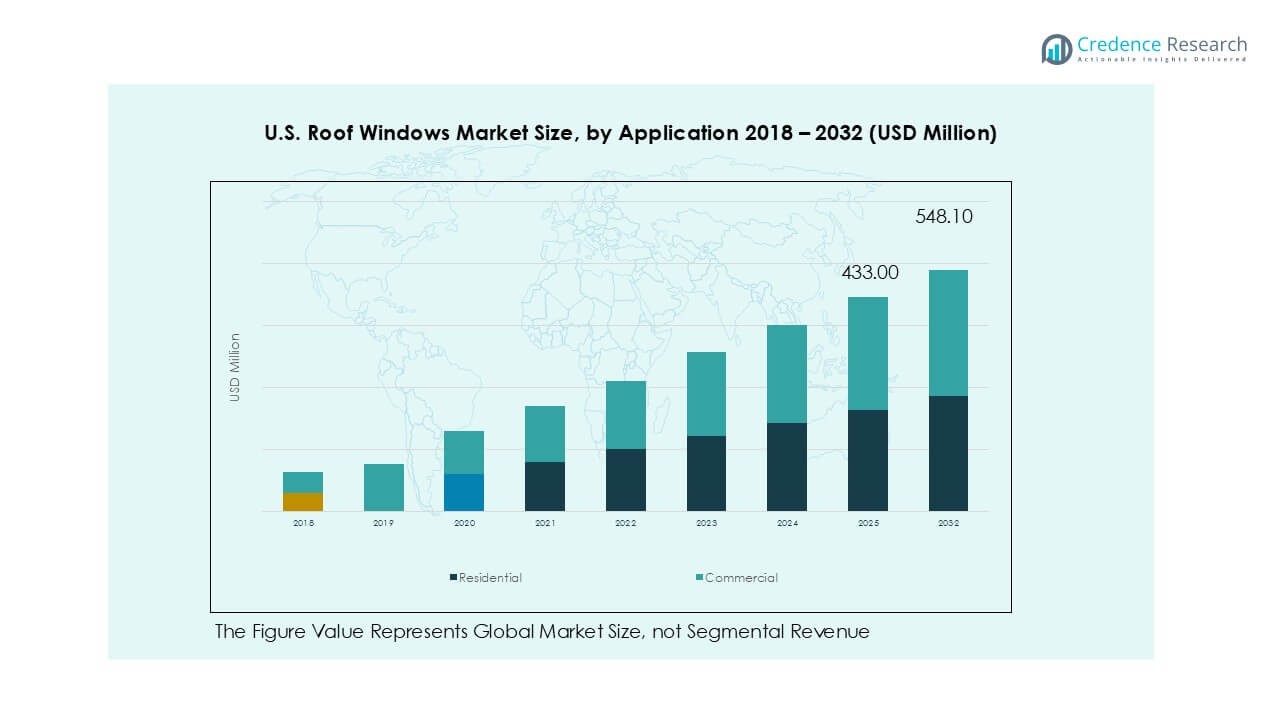
Market Segmentations:
By Type
- Wood
- Polyurethane (PU)
- Polyvinyl Chloride (PVC)
- Metal
- Others
By Application
- Residential
- Commercial
By Glazing Type
- Single
- Double
- Triple and More
By Sales Channel
- Direct Channel
- Distribution Channel
By Geography
- Northeast
- Midwest
- South
- West
Competitive Landscape
The U.S. roof windows market is moderately consolidated, with a mix of global leaders and regional manufacturers competing on product quality, energy efficiency, and design innovation. Velux Group and Fakro dominate with extensive distribution networks and strong brand recognition, offering advanced double- and triple-glazed solutions that meet Energy Star requirements. Roto Frank AG and Lamilux focus on premium segments, supplying automated and smart roof window systems for residential and commercial projects. America Skylights Inc. and Skylights Plus serve niche markets with customized solutions for small-scale construction. Players invest heavily in R&D to develop moisture-resistant frames, impact-rated glazing, and solar-powered opening systems. Strategic partnerships with builders, architects, and distributors strengthen market presence. Mergers, capacity expansions, and product launches remain key growth strategies as companies compete to meet demand for sustainable, code-compliant, and technologically advanced roof window solutions across diverse U.S. climate zones.
Key Player Analysis
- Fakro
- Velux Group
- Roto Frank AG
- America Skylights Inc.
- Lamilux
- Skyfens
- Skylights Plus
- Brett Martin
- Lonsdale Metal Co
- Marvin Windows and Doors
- Dakota Group
- Glazing Vision Ltd
Recent Developments
- In 2023, LAMILUX launched the Modular Glass Skylight MS78 (also referred to as a Modular Glass Roof), a customizable daylight system for buildings that combines flexibility, rapid installation, and a focus on aesthetics and sustainability.
- In April 2025, Velux launched the VELUX Skylight System, with a solar-powered, pre-installed room-darkening shade as a standard feature on all glass skylights from April 7, 2025. The new shade design lets in more daylight and provides improved thermal performance (45% U-value improvement, 19% better solar heat gain coefficient). The Skylight System supports smart home integration and features built-in rain sensors.
- In March 2025, Velux and Guardian Glass announced a joint development agreement for tempered vacuum insulated glass (VIG). This collaboration aims to advance VIG technology, focusing on developing manufacturing processes and capabilities to meet the growing demand for high-performance, energy-efficient windows.
Report Coverage
The research report offers an in-depth analysis based on Type, Application, Glazing Type, Sales Channel and Geography. It details leading market players, providing an overview of their business, product offerings, investments, revenue streams, and key applications. Additionally, the report includes insights into the competitive environment, SWOT analysis, current market trends, as well as the primary drivers and constraints. Furthermore, it discusses various factors that have driven market expansion in recent years. The report also explores market dynamics, regulatory scenarios, and technological advancements that are shaping the industry. It assesses the impact of external factors and global economic changes on market growth. Lastly, it provides strategic recommendations for new entrants and established companies to navigate the complexities of the market.
Future Outlook
- Demand for roof windows will rise with growing focus on energy-efficient and sustainable housing.
- Smart and automated roof window systems will gain wider adoption in residential projects.
- Triple-glazed units will see increased demand in colder regions to meet strict energy codes.
- Renovation and remodeling activities will continue to drive steady replacement sales.
- Manufacturers will invest in recyclable and low-VOC materials to meet green building standards.
- Integration of roof windows with solar-powered and IoT-enabled systems will become common.
- Commercial applications will expand as wellness-oriented building designs gain traction.
- Competitive pressure will push players to launch customized and modular roof window solutions.
- Distribution networks will strengthen through partnerships with contractors and e-commerce platforms.
- Southern states will remain the fastest-growing region due to strong housing construction and suburban expansion.
Request a Free Sample
Fill in your details and we'll send you a free sample report.
- Sample data tables & charts
- Research methodology
Need a Custom Version of This Report?
Tailor the scope, geography, or segments to your exact requirements.
- Custom geography or segment scope
- Direct access to our analyst team
Frequently Asked Questions
What is the current market size for U.S. Roof Windows market, and what is its projected size in 2032?
At what Compound Annual Growth Rate is the U.S. Roof Windows market projected to grow between 2025 and 2032?
Which U.S. Roof Windows market segment held the largest share in 2024?
What are the primary factors fueling the growth of the U.S. Roof Windows market?
Who are the leading companies in the U.S. Roof Windows market?
Which region commanded the largest share of the U.S. Roof Windows market in 2024?
Table of Content
Chapter 1. Report Introduction
- 1.1 Report Description & Purpose
- 1.1.1 Report Title & Market Definition
- 1.1.2 Unique Selling Propositions (USP) & Key Differentiators
- 1.1.3 Value Proposition for Stakeholders
- 1.2 Research Objectives
- 1.2.1 Market Sizing Objectives (Volume & Revenue)
- 1.2.2 Segmentation Objectives
- 1.2.3 Competitive Intelligence Objectives
- 1.2.4 Forecast & Scenario Objectives
- 1.3 Report Scope
- 1.3.1 U.S. Roof Windows Scope – Types & Subtypes Covered
- 1.3.2 Geographic Scope – Regions & Countries Covered
- 1.3.3 Historical Period, Base Year & Forecast Period (2024; forecast to 2032)
- 1.3.4 Inclusions & Exclusions
- 1.4 HS Code & Classification Framework
- 1.5 Currency, Units & Pricing Basis
- 1.6 Target Stakeholders
- 1.7 Limitations & Assumptions
Chapter 2. Executive Summary
- 2.1 Global U.S. Roof Windows Market Snapshot
- 2.1.1 Market Size – Historical (2024) & Forecast (2024-2032) (2024: USD 418.66 million → 2032: USD 548.10 million)
- 2.1.2 Volume & Revenue – Global Totals
- 2.1.3 Key Market Highlights – Top Five Facts
- 2.2 U.S. Roof Windows Market Segmentation Snapshot
- 2.2.1 Market Split by Region – 2024 vs. 2032
- 2.3 Competitive Snapshot
- 2.3.1 Top 10 Players by Revenue Share – 2024
- 2.3.2 Top 10 Players by Volume Share – 2024
- 2.3.3 Recent Strategic Developments (18-Month Summary)
- 2.4 Key Investment Highlights & Strategic Conclusions
Chapter 3. U.S. Roof Windows Market Dynamics & Industry Analysis
- 3.1 Market Overview & Context
- 3.1.1 U.S. Roof Windows Market Position in the Broader Automotive Value Chain
- 3.1.2 OEM vs. Replacement Market Dynamics
- 3.1.3 Market Maturity & Development Stage by Region
- 3.2 U.S. Roof Windows Market Drivers
- 3.3 U.S. Roof Windows Market Restraints & Challenges
- 3.4 U.S. Roof Windows Market Opportunities
- 3.5 Porter's Five Forces Analysis
- 3.5.1 Threat of New Entrants
- 3.5.2 Bargaining Power of Suppliers
- 3.5.3 Bargaining Power of Buyers
- 3.5.4 Threat of Substitutes
- 3.5.5 Competitive Rivalry – Intensity Assessment
- 3.6 U.S. Roof Windows Value Chain Analysis
- 3.6.1 Upstream – Raw Material/Input Suppliers
- 3.6.1.1 Raw Material/Input 1
- 3.6.1.2 Raw Material/Input 2
- 3.6.1.3 Raw Material/Input 3
- 3.6.2 Midstream – Production/Manufacturing/Service Delivery
- 3.6.2.1 Production/Process Overview
- 3.6.2.2 Key Facility Locations & Capacity by Manufacturer
- 3.6.3 Downstream – Distribution & End Consumer
- 3.6.3.1 Primary Channel – B2B/OEM
- 3.6.3.2 Secondary Channels – Dealer, Retail, Online, Direct
- 3.6.4 Value Chain Profitability Analysis
- 3.6.1 Upstream – Raw Material/Input Suppliers
- 3.7 PESTEL Analysis
- 3.7.1 Political Factors
- 3.7.2 Economic Factors
- 3.7.3 Social Factors
- 3.7.4 Technological Factors
- 3.7.5 Environmental Factors
- 3.7.6 Legal Factors
- 3.8 U.S. Roof Windows Supply Chain Analysis
- 3.8.1 Raw Material/Input Supply Risk Assessment
- 3.8.2 Manufacturing Concentration Risk (Geographic Exposure)
- 3.8.3 Trade Disruption Impact Analysis
- 3.9 Regulatory & Policy Landscape
Note: The regulatory and policy landscape section covers regulations based on their applicability to the market, U.S. Roof Windows category, geography, and scope of the study. Only regulatory frameworks with a material impact on operations, compliance, trade, sustainability, or market access are analyzed in detail.
Chapter 4. Key Investment Pockets & Opportunity Analysis
- 4.1 U.S. Roof Windows Market Attractiveness Analysis
- 4.1.1 By Region – Investment Attractiveness Matrix (Volume × CAGR)
- 4.2 Absolute Revenue Growth Opportunity
- 4.2.1 By Region – Absolute USD Growth Through 2032
- 4.3 Incremental Volume Opportunity
- 4.3.1 By Region – Incremental Volume Through 2032
- 4.3.2 Segment – Incremental Volume
- 4.4 Emerging Submarket Opportunity Deep Dive (Subject to Applicability)
- 4.5 Emerging Market Opportunity Scorecards
- 4.5.1 United States
- 4.5.2 Europe
- 4.5.3 Asia
- 4.5.4 Middle East & Africa
Note: Emerging Market Opportunity Scorecards will be included based on relevance and strategic importance. Regions listed are indicative and may vary depending on data availability and market dynamics.
Chapter 5. U.S. Roof Windows Import-Export Analysis & Trade Flows
- 5.1 Global Trade Overview
- 5.1.1 Global Export Value by Country (2024)
- 5.1.2 Global Export Volume by Country (2024)
- 5.1.3 Global Import Value by Country (2024)
- 5.1.4 Global Import Volume by Country (2024)
- 5.1.5 Net Trade Balance by Country (2024)
- 5.2 Export Analysis – Segment
- 5.2.1 Type 1 (HS Code)
- 5.2.2 Type 2 (HS Code)
- 5.2.3 Type 3 (HS Code)
- 5.2.4 Type 4 (HS Code)
- 5.2.5 Type 5 (HS Code)
- 5.3 Import Analysis – Segment
- 5.3.1 Type 1 (HS Code)
- 5.3.2 Type 2 (HS Code)
- 5.3.3 Type 3 (HS Code)
- 5.3.4 Type 4 (HS Code)
- 5.3.5 Type 5 (HS Code)
- 5.4 Average Unit Trade Prices
- 5.4.1 Average Export Price – Segment & Country
- 5.4.2 Average Import Price – Segment & Source Country
- 5.4.3 Price Trends (2024)
- 5.5 Key Trade Route Analysis
- 5.5.1 Trade Route 1
- 5.5.2 Trade Route 2
- 5.5.3 Trade Route 3
- 5.5.4 Trade Route 4
- 5.5.5 Trade Route 5
- 5.6 Trade Policy Impact Assessment
- 5.6.1 US Anti-Dumping & Section 301 Tariffs
- 5.6.2 EU Customs Union Impact
- 5.6.3 Major Free Trade Agreements
- 5.6.4 USMCA Rules of Origin
Note: Trade policy analysis will be included only where relevant to the U.S. Roof Windows market.
Chapter 6. Competitive Landscape & Company Benchmarking
- 6.1 U.S. Roof Windows Market Concentration & Structure
- 6.1.1 Herfindahl-Hirschman Index (HHI) – vs. 2024
- 6.1.2 Tier 1, Tier 2 & Tier 3 Market Structure
- 6.1.3 Global, Regional & Local Player Dynamics
- 6.2 U.S. Roof Windows Market Share Analysis – 2024
- 6.2.1 Global Revenue Share by Company
- 6.2.2 Global Volume Share by Company
- 6.2.3 Regional Revenue Share
- 6.2.4 Market Share Evolution ( vs. 2024)
- 6.2.5 OEM Segment Share by Company
- 6.2.6 Replacement Segment Share by Company
- 6.3 Production/Delivery Capacity & Facility Analysis
- 6.3.1 Global Installed Capacity
- 6.3.2 Capacity Utilization Rates
- 6.3.3 Production/Output Volume
- 6.3.4 Facility Locations & Capacity Map
- 6.3.5 Planned Capacity Additions
- 6.4 U.S. Roof Windows Competitive Benchmarking Matrix
- 6.4.1 Revenue, Volume, CAGR & Profitability Comparison
- 6.4.2 Channel Revenue Mix
- 6.4.3 Geographic Revenue Exposure
- 6.4.4 R&D Intensity
- 6.4.5 Sustainability Maturity
- 6.5 Strategic Developments in U.S. Roof Windows (Last 24 Months)
- 6.5.1 Mergers, Acquisitions & Divestments
- 6.5.2 New U.S. Roof Windows Launches
- 6.5.3 Facility Expansions
- 6.5.4 Strategic Alliances, Joint Ventures & Partnerships
- 6.5.5 Distribution Expansion & Market Entry
- 6.5.6 Sustainability & ESG Initiatives
- 6.6 Competitive Strategy Mapping
- 6.6.1 Leader, Challenger, Follower & Niche Classification
- 6.6.2 Pricing Strategy Comparison
- 6.6.3 Channel Strategy Matrix
Note: Strategic developments are included based on their materiality and the availability of reliable information.
Chapter 7. Global U.S. Roof Windows Market – By Distribution Channel
- 7.1 Segment Overview
- 7.1.1 Volume & Revenue Split by Channel (2024 & 2032)
- 7.1.2 Channel Mix Evolution (2024-2032)
Chapter 8. Regional Market Analysis – Global Overview
- 8.1 Global Regional Overview
- 8.1.1 Regional Volume Share
- 8.1.2 Regional Revenue Share
- 8.1.3 Regional Volume by Region
- 8.1.4 Regional Revenue by Region
- 8.1.5 Regional Forecast Through 2032
- 8.2 Cross-Regional Segment Analysis
- 8.2.1 By Distribution Channel
- 8.2.2 By Brand/Price Tier
Chapter 9. North America U.S. Roof Windows Market
- 9.1 United States
- 9.2 Canada
- 9.3 Mexico
Chapter 10. Europe U.S. Roof Windows Market
- 10.1 Germany
- 10.2 France
- 10.3 Italy
- 10.4 United Kingdom
- 10.5 Spain
- 10.6 Poland
- 10.7 Russia
- 10.8 Netherlands
- 10.9 Belgium
- 10.10 Sweden
- 10.11 Denmark
- 10.12 Norway
- 10.13 Rest of Europe
Chapter 11. Asia Pacific U.S. Roof Windows Market
- 11.1 China
- 11.2 India
- 11.3 Japan
- 11.4 South Korea
- 11.5 Thailand
- 11.6 Indonesia
- 11.7 Vietnam
- 11.8 Malaysia
- 11.9 Australia
- 11.10 Rest of Asia Pacific
Chapter 12. Latin America U.S. Roof Windows Market
- 12.1 Brazil
- 12.2 Argentina
- 12.3 Colombia
- 12.4 Chile
- 12.5 Rest of Latin America
Chapter 13. Middle East U.S. Roof Windows Market
- 13.1 Saudi Arabia
- 13.2 United Arab Emirates
- 13.3 Turkey
- 13.4 Israel
- 13.5 Iran
- 13.6 Rest of the Middle East
Chapter 14. Africa U.S. Roof Windows Market
- 14.1 South Africa
- 14.2 Egypt
- 14.3 Nigeria
- 14.4 Morocco
- 14.5 Rest of Africa
Chapter 15. U.S. Roof Windows Company Profiles
- 15.1 [Company 01]
- 15.1.1 Company Overview
- 15.1.2 Key Management Personnel
- 15.1.3 Products & Services Portfolio
- 15.1.4 Financial Performance
- 15.1.5 Key Market Focus & Geographic Presence
- 15.1.6 Recent Developments & Strategic Initiatives
Note: The company profile list is preliminary and may change based on research findings, market developments, data availability, and client requirements.
Chapter 16. Appendices
- Appendix A – List of Abbreviations & Acronyms
- Appendix B – Industry Classification Code Reference – Full Series
- Appendix C – Production & Capacity Data Tables
- Appendix D – End-Use & Demand Base Tables
- Appendix E – Consumption & Replacement Rate Assumptions
- Appendix F – ASP Reference Tables
- Appendix G – Manufacturing & Facility Database
- Appendix H – Import-Export Data Tables
- Appendix I – Regulatory Summary Tables
- Appendix J – Primary Research Participant List (Anonymized)
- Appendix K – Primary Research Questionnaire Framework
- Appendix L – Data Sources & Bibliography
- Appendix M – Market Size Divergence & Source Comparison
Chapter 17. Research Methodology
- 17.1 Research Framework & Philosophy
- 17.2 Secondary Research – Sources, Hierarchy & Data Extraction
- 17.3 Data Modeling – Bottom-Up & Top-Down Market Sizing
- 17.4 Primary Research – Stakeholder Framework, LOI & Sample Sizes
- 17.5 Forecast Methodology – Regression, Scenario & Sensitivity Analysis
- 17.6 Quality Control – Four-Layer Validation Framework
- 17.7 Limitations & Standard Assumptions
- 17.8 Disclaimer
