
Market Overview:
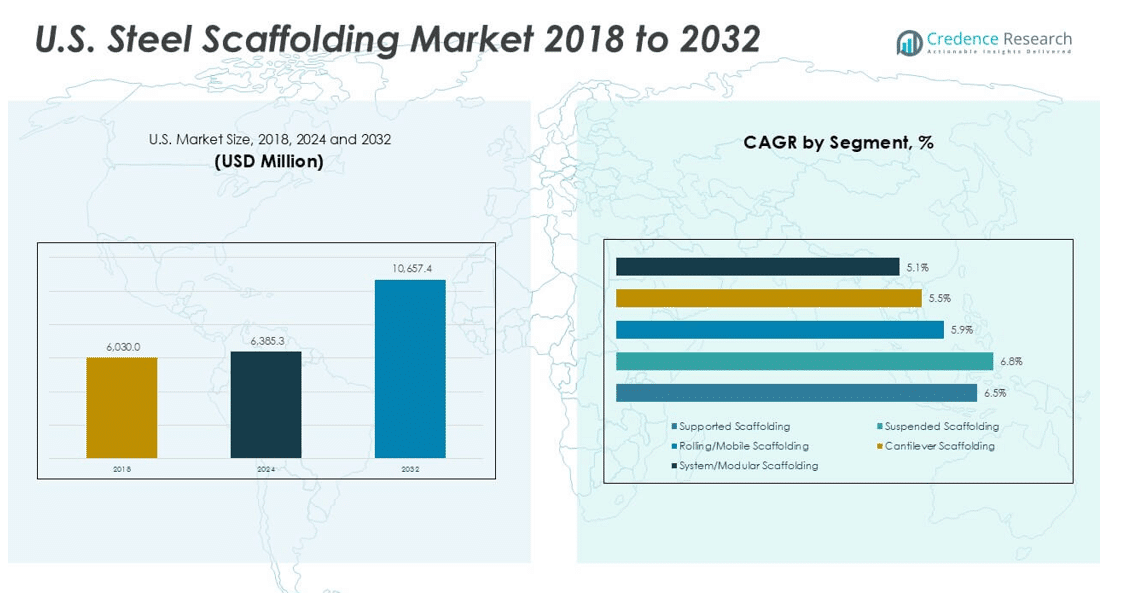
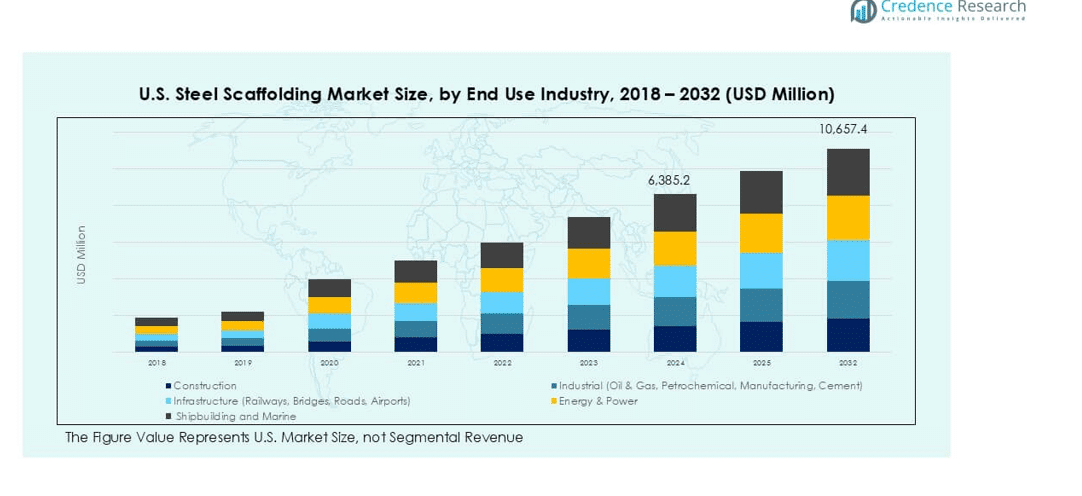
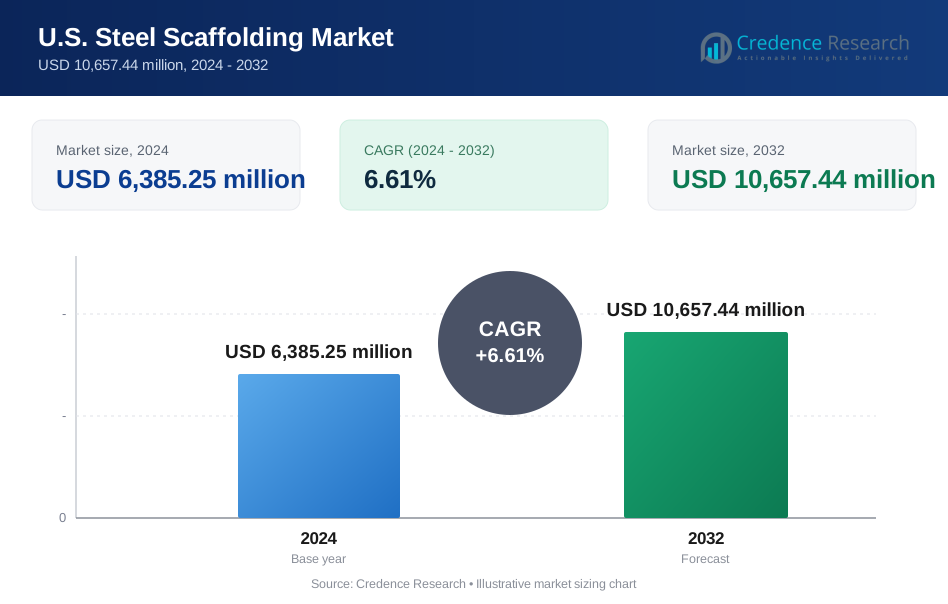
U.S. Steel Scaffolding market size was valued at USD 6,030.02 million in 2018 and grew to USD 6,385.25 million in 2024. It is anticipated to reach USD 10,657.44 million by 2032, expanding at a CAGR of 6.61% during the forecast period.
| REPORT ATTRIBUTE | DETAILS |
|---|---|
| Historical Period | 2020-2023 |
| Base Year | 2024 |
| Forecast Period | 2025-2032 |
| U.S. Steel Scaffolding Market Size 2024 | USD 6,385.25 million |
| U.S. Steel Scaffolding Market, CAGR | 6.61% |
| U.S. Steel Scaffolding Market Size 2032 | USD 10,657.44 million |
The U.S. steel scaffolding market is led by major players such as The Brock Group, BrandSafway, PERI USA, Layher Inc., and United Scaffolding, which collectively dominate supply and rental services across construction, industrial, and infrastructure projects. These companies focus on modular scaffolding systems, digital project planning, and safety-compliant solutions to meet OSHA standards. The South leads the market with 32% share, driven by large-scale infrastructure upgrades and petrochemical industry demand, followed by the Northeast at 24% with strong high-rise construction and maintenance activity. The West accounts for 23% share, supported by seismic retrofitting and renewable energy projects, while the Midwest holds 21% share, driven by industrial facility maintenance and bridge rehabilitation programs. This competitive landscape highlights a balanced mix of national players and regional suppliers catering to diverse end-use requirements and project complexities across the country.
Market Insights
- The U.S. steel scaffolding market was valued at USD 6,385.25 million in 2024 and is projected to reach USD 10,657.44 million by 2032, growing at a CAGR of 6.61% during 2025–2032.
- Growth is driven by federal infrastructure investments, industrial plant maintenance cycles, and rising adoption of modular scaffolding systems that reduce labor time and enhance site safety.
- Key trends include digital integration using BIM for project planning, increasing demand for recyclable steel scaffolding, and wider use of lightweight modular components in high-rise and infrastructure projects.
- Leading players such as The Brock Group, BrandSafway, PERI USA, and Layher Inc. focus on innovation, safety compliance, and rental network expansion to maintain competitive advantage.
- The South leads with 32% market share, followed by the Northeast (24%), West (23%), and Midwest (21%); supported scaffolding remains the dominant type segment across all regions due to its high stability and cost-effectiveness.
Market Segmentation Analysis:
By Type
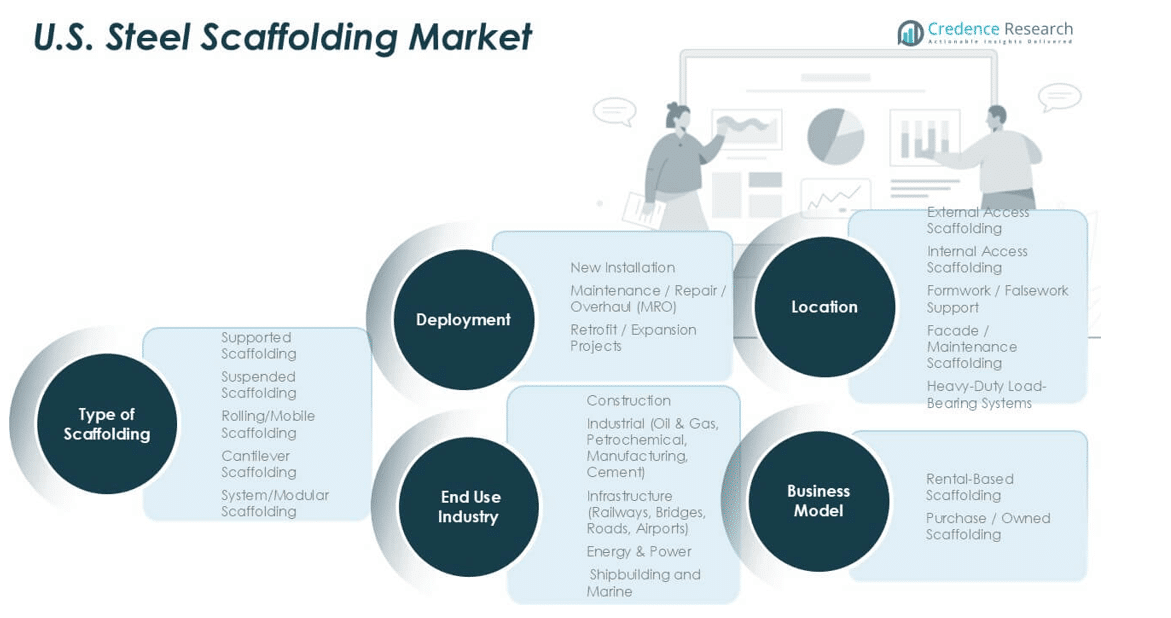
Supported scaffolding dominated the U.S. steel scaffolding market in 2024, holding the largest share due to its extensive use in commercial and residential construction. Its stability, high load-bearing capacity, and cost-effectiveness drive adoption in large projects. Rolling or mobile scaffolding is witnessing steady demand growth, supported by ease of movement and quick assembly in industrial maintenance tasks. System/modular scaffolding is gaining traction as contractors favor its efficiency, reduced labor requirements, and compliance with OSHA standards, making it a preferred solution for high-rise construction and infrastructure projects.
- For instance, BrandSafway, in collaboration with its subsidiary Safway Atlantic, made significant contributions to the Hudson Yards project in New York, including providing a specialized, 993-foot-tall construction elevator complex for the 50 Hudson Yards tower.
By Location
External access scaffolding accounted for the largest market share, driven by ongoing urban redevelopment and expansion of commercial buildings. Demand is high in facade works and exterior maintenance where safety and accessibility are key priorities. Heavy-duty load-bearing systems are growing steadily, fueled by bridge construction, refinery turnarounds, and large-scale infrastructure projects. Internal access scaffolding and formwork systems continue to serve building interiors, with demand supported by modern architecture trends and prefabricated construction practices.
- For instance, Layher, a German scaffolding company, has provided scaffolding for various projects over its 75-year history. Cologne Cathedral, which stands 157 meters tall, is almost constantly undergoing restoration due to weathering and pollution, and scaffolding is a regular feature on its exterior.
By End-use Industry
Construction remained the dominant end-use segment, holding the largest share due to consistent residential and non-residential building activities. Infrastructure development, including bridge replacements and airport expansions, contributed significantly to demand growth. Industrial sectors such as oil & gas and petrochemicals rely on scaffolding for plant maintenance and shutdowns, boosting recurring demand. Energy and power projects, including wind and solar installations, are emerging as new growth areas, while shipbuilding and marine applications drive niche demand in coastal regions.
Market Overviews
Expansion of Infrastructure Projects
The U.S. is investing heavily in infrastructure modernization, driving steel scaffolding demand. Federal funding under the Infrastructure Investment and Jobs Act supports bridge rehabilitation, railway upgrades, and airport expansions. These projects require safe, high-capacity scaffolding solutions for elevated works and structural repairs. Increased public and private construction spending fuels long-term demand. Contractors prefer durable steel scaffolding for its strength and reusability, ensuring compliance with safety regulations. This surge in infrastructure development is expected to significantly strengthen market growth through 2032.
- For instance, BrandSafway provided scaffolding for the Automated People Mover (APM) project at Los Angeles International Airport (LAX), enabling continuous construction work on elevated roadways.
Rising Adoption of Modular Scaffolding Systems
System and modular scaffolding are witnessing strong adoption due to their efficiency and faster assembly time. Contractors value modular solutions for high-rise projects, maintenance shutdowns, and industrial applications. These systems reduce labor requirements and improve on-site productivity, lowering overall project costs. OSHA-compliant designs further enhance safety, encouraging adoption in complex construction environments. Leading manufacturers are introducing advanced locking mechanisms and lighter components, making modular scaffolding the preferred choice for large-scale infrastructure and commercial projects.
- For instance, PERI's UP Flex modular scaffolding was utilized during a project at a petrochemical facility in Baytown, Texas. The scaffolding contributed to significant labor and time efficiencies compared to traditional methods, as noted by a project superintendent.
Growth in Industrial Maintenance Activities
Recurring maintenance activities in oil & gas refineries, petrochemical plants, and power stations are fueling scaffolding demand. Scheduled plant turnarounds and inspection cycles require extensive scaffolding installations to access critical equipment safely. The energy transition is also boosting maintenance for renewable power assets like wind farms and hydro plants. Industrial players seek high-strength scaffolding systems that can handle heavy-duty loads, ensuring worker safety. This recurring demand creates a stable revenue stream for scaffolding suppliers beyond the new construction market.
Key Trends & Opportunities
Digitalization and Safety Enhancements
Integration of digital tools like BIM and 3D modeling in scaffolding planning is gaining momentum. These technologies improve accuracy, optimize material usage, and reduce errors on-site. Digital monitoring systems allow real-time inspection and enhance compliance with OSHA safety standards. The trend is creating opportunities for companies offering smart scaffolding solutions and digital project management platforms. Investment in safety innovations like lightweight components, anti-slip platforms, and quick-lock systems is expected to differentiate leading players in the competitive U.S. market.
- For instance, Doka utilized its optimized formwork concept and advanced planning methods for the Vienna Central Station project to improve efficiency.
Demand for Green and Recyclable Materials
Sustainability is becoming a key purchasing factor, pushing demand for recyclable steel scaffolding. Contractors are opting for products with longer lifecycles and minimal environmental impact. Manufacturers are adopting eco-friendly galvanizing processes and closed-loop recycling to meet regulatory and ESG requirements. This shift creates opportunities for suppliers offering low-carbon steel scaffolding solutions. Green building certifications and government incentives are likely to accelerate adoption of sustainable scaffolding products, particularly in public infrastructure and commercial construction projects.
- For instance, BrandSafway offers inspection, maintenance, and refurbishment services for its scaffolding and access equipment. This is part of the company's broader commitment to environmental responsibility, safety, and continuous improvement. By maintaining its equipment to high standards, BrandSafway ensures durability and helps to extend the lifecycle of its products.
Key Challenges
Volatility in Raw Material Prices
Fluctuations in steel prices directly impact scaffolding manufacturing costs and profit margins. Supply chain disruptions and global trade uncertainties can raise procurement expenses, forcing manufacturers to pass costs to customers. Contractors often face budget constraints, leading to project delays or preference for rental scaffolding over purchases. Price instability challenges long-term contract negotiations and planning for scaffolding suppliers. Maintaining cost competitiveness while ensuring product quality is a major challenge for players in the U.S. market.
Labor Shortages and Safety Compliance
The construction industry faces skilled labor shortages, affecting scaffolding installation and dismantling timelines. Limited availability of trained workers increases the risk of accidents and non-compliance with OSHA standards. This challenge forces contractors to invest in training programs and rely on prefabricated modular systems to reduce assembly complexity. High penalties for safety violations further pressure contractors and suppliers to adopt stricter safety protocols. Balancing workforce limitations with compliance requirements remains a critical concern for the industry.
Regional Analysis
Northeast
The Northeast accounted for 24% of the U.S. steel scaffolding market in 2024, supported by high urban density and a large number of commercial renovation projects. States like New York, New Jersey, and Massachusetts are driving demand through high-rise construction, bridge maintenance, and facade restoration projects. Historic building preservation initiatives and strong government investment in transportation infrastructure further fuel scaffolding needs. The region’s strict OSHA enforcement encourages adoption of advanced modular scaffolding systems that meet stringent safety standards. Market growth is steady as public infrastructure spending and private redevelopment projects continue across major cities.
Midwest
The Midwest captured 21% of the U.S. steel scaffolding market share in 2024, driven by industrial and infrastructure development projects. Key demand comes from manufacturing facilities, automotive plants, and refinery maintenance activities in states such as Illinois, Ohio, and Michigan. Bridge rehabilitation and road improvement projects under federal funding programs are creating consistent scaffolding requirements. The presence of large contractors and competitive rental markets makes steel scaffolding a cost-effective choice. The region is expected to witness steady growth as urban revitalization projects and energy sector maintenance activities remain strong through the forecast period.
South
The South held the 32% market share in 2024, emerging as the largest regional market for steel scaffolding in the U.S. The growth is supported by rapid urbanization, large-scale residential construction, and extensive infrastructure upgrades across Texas, Florida, and Georgia. Strong activity in petrochemical and LNG facilities along the Gulf Coast fuels demand for heavy-duty scaffolding solutions. The region also benefits from lower construction costs and large workforce availability, encouraging more frequent use of modular scaffolding systems. High investments in highways, ports, and airport expansions further strengthen the region’s market dominance through 2032.
West
The West accounted for 23% of the U.S. steel scaffolding market share in 2024, driven by large-scale infrastructure projects and seismic retrofitting programs in California. Demand is boosted by renewable energy projects, including wind and solar farms, which require extensive scaffolding for installation and maintenance. Urban development in states like Washington, Oregon, and Nevada also supports growth. Environmental regulations and green building initiatives are pushing adoption of recyclable steel scaffolding. The region continues to show healthy growth potential as public funding focuses on climate-resilient infrastructure and expansion of public transportation systems.
Market Segmentations:
By Type
- Supported Scaffolding
- Suspended Scaffolding
- Rolling/Mobile Scaffolding
- Cantilever Scaffolding
- System/Modular Scaffolding
By Location
- External Access Scaffolding
- Internal Access Scaffolding
- Formwork / Falsework Support
- Facade / Maintenance Scaffolding
- Heavy-Duty Load-Bearing Systems
By End-use Industry
- Construction
- Industrial (Oil & Gas, Petrochemical, Manufacturing, Cement)
- Infrastructure (Railways, Bridges, Roads, Airports)
- Energy & Power (Thermal, Hydro, Renewable Plant Maintenance)
- Shipbuilding and Marine
By Deployment
- New Installation
- Maintenance / Repair / Overhaul (MRO)
- Retrofit / Expansion Projects
By Business Model
- Rental-Based Scaffolding
- Purchase / Owned Scaffolding
By Geography
- Northeast
- Midwest
- South
- West
Competitive Landscape
The U.S. steel scaffolding market is moderately consolidated, with key players including The Brock Group, BrandSafway, PERI USA, Layher Inc., and United Scaffolding leading supply and rental operations. These companies focus on offering OSHA-compliant solutions, advanced modular systems, and project-specific scaffolding designs to support complex construction, industrial maintenance, and infrastructure projects. BrandSafway and The Brock Group hold a strong presence in industrial turnarounds and refinery maintenance, while PERI USA and Layher dominate in modular and system scaffolding for high-rise and infrastructure projects. White Cap Construction Supply and Bil-Jax cater to mid-sized contractors through extensive rental networks and distribution. Players are investing in digital planning tools, lightweight materials, and training services to improve safety and productivity. Strategic partnerships, mergers, and regional expansions remain common as companies work to strengthen their market share and meet rising demand from construction, energy, and infrastructure sectors.
Key Player Analysis
- The Brock Group
- United Scaffolding
- BrandSafway
- PERI USA
- Atlantic Equipment & Surplus, Inc.
- White Cap Construction Supply
- Bil-Jax / Universal
- Waco Scaffolding & Equipment
- Layher Inc. (U.S. division)
Recent Developments
- In April 2025, Layher unveiled its new corporate identity and cutting-edge scaffolding innovations at Bauma 2025 in Munich. Highlights included advanced digital planning tools (Layher SIM2Field®), lightweight bridging systems, and new modular components for versatile applications. The company emphasized digitalization, safety, and sustainability as part of their redesign, and introduced products like the Xtra-Slim steel plank for tight spaces and the O-version FlexBeam compatible with weather protection roofs.
- In April 2025, PERI showcased digital, sustainable scaffolding solutions and smart construction tools at Bauma 2025. The innovations included modular, safety-focused systems and new digital management tools, emphasizing eco-friendly materials and productivity gains for residential and infrastructure projects.
- In February 2025, the Altrad Group finalized the acquisition of Stork's UK business and Heras' UK mobile fencing operations, significantly expanding its services in temporary fencing, hoarding, and scaffolding in the United Kingdom and Europe.
Report Coverage
The research report offers an in-depth analysis based on Type, Location, End-use Industry, Deployment, Business Model and Geography. It details leading market players, providing an overview of their business, product offerings, investments, revenue streams, and key applications. Additionally, the report includes insights into the competitive environment, SWOT analysis, current market trends, as well as the primary drivers and constraints. Furthermore, it discusses various factors that have driven market expansion in recent years. The report also explores market dynamics, regulatory scenarios, and technological advancements that are shaping the industry. It assesses the impact of external factors and global economic changes on market growth. Lastly, it provides strategic recommendations for new entrants and established companies to navigate the complexities of the market.
Future Outlook
- The market will witness strong growth driven by infrastructure modernization and urban redevelopment projects.
- Adoption of modular and system scaffolding will increase due to faster assembly and labor efficiency.
- Digital tools like BIM and 3D modeling will become standard for project planning and safety compliance.
- Demand for recyclable and eco-friendly steel scaffolding will rise as sustainability regulations tighten.
- Industrial maintenance cycles in oil & gas, power, and manufacturing sectors will support recurring demand.
- Rental services will expand as contractors prefer flexible and cost-efficient access to scaffolding systems.
- Technological innovations like lightweight materials and advanced locking mechanisms will improve worker safety.
- Skilled labor shortages will drive demand for prefabricated systems requiring less installation time.
- Regional growth will remain highest in the South, supported by petrochemical and infrastructure projects.
- Strategic partnerships and mergers among key players will strengthen distribution networks and service coverage.
Request a Free Sample
Fill in your details and we'll send you a free sample report.
- Sample data tables & charts
- Research methodology
Need a Custom Version of This Report?
Tailor the scope, geography, or segments to your exact requirements.
- Custom geography or segment scope
- Direct access to our analyst team
Frequently Asked Questions
What is the current market size for U.S. Steel Scaffolding market, and what is its projected size in 2032?
At what Compound Annual Growth Rate is the U.S. Steel Scaffolding market projected to grow between 2025 and 2032?
Which U.S. Steel Scaffolding market segment held the largest share in 2024?
What are the primary factors fueling the growth of the U.S. Steel Scaffolding market?
Who are the leading companies in the U.S. Steel Scaffolding market?
Table of Content
Chapter 1. Report Introduction
- 1.1 Report Description & Purpose
- 1.1.1 Report Title & Market Definition
- 1.1.2 Unique Selling Propositions (USP) & Key Differentiators
- 1.1.3 Value Proposition for Stakeholders
- 1.2 Research Objectives
- 1.2.1 Market Sizing Objectives (Volume & Revenue)
- 1.2.2 Segmentation Objectives
- 1.2.3 Competitive Intelligence Objectives
- 1.2.4 Forecast & Scenario Objectives
- 1.3 Report Scope
- 1.3.1 U.S. Steel Scaffolding Scope – Types & Subtypes Covered
- 1.3.2 Geographic Scope – Regions & Countries Covered
- 1.3.3 Historical Period, Base Year & Forecast Period (2024; forecast to 2032)
- 1.3.4 Inclusions & Exclusions
- 1.4 HS Code & Classification Framework
- 1.5 Currency, Units & Pricing Basis
- 1.6 Target Stakeholders
- 1.7 Limitations & Assumptions
Chapter 2. Executive Summary
- 2.1 Global U.S. Steel Scaffolding Market Snapshot
- 2.1.1 Market Size – Historical (2024) & Forecast (2024-2032) (2024: USD 6,385.25 million → 2032: USD 10,657.44 million)
- 2.1.2 Volume & Revenue – Global Totals
- 2.1.3 Key Market Highlights – Top Five Facts
- 2.2 U.S. Steel Scaffolding Market Segmentation Snapshot
- 2.2.1 Market Split by Region – 2024 vs. 2032
- 2.3 Competitive Snapshot
- 2.3.1 Top 10 Players by Revenue Share – 2024
- 2.3.2 Top 10 Players by Volume Share – 2024
- 2.3.3 Recent Strategic Developments (18-Month Summary)
- 2.4 Key Investment Highlights & Strategic Conclusions
Chapter 3. U.S. Steel Scaffolding Market Dynamics & Industry Analysis
- 3.1 Market Overview & Context
- 3.1.1 U.S. Steel Scaffolding Market Position in the Broader Automotive Value Chain
- 3.1.2 OEM vs. Replacement Market Dynamics
- 3.1.3 Market Maturity & Development Stage by Region
- 3.2 U.S. Steel Scaffolding Market Drivers
- 3.3 U.S. Steel Scaffolding Market Restraints & Challenges
- 3.4 U.S. Steel Scaffolding Market Opportunities
- 3.5 Porter's Five Forces Analysis
- 3.5.1 Threat of New Entrants
- 3.5.2 Bargaining Power of Suppliers
- 3.5.3 Bargaining Power of Buyers
- 3.5.4 Threat of Substitutes
- 3.5.5 Competitive Rivalry – Intensity Assessment
- 3.6 U.S. Steel Scaffolding Value Chain Analysis
- 3.6.1 Upstream – Raw Material/Input Suppliers
- 3.6.1.1 Raw Material/Input 1
- 3.6.1.2 Raw Material/Input 2
- 3.6.1.3 Raw Material/Input 3
- 3.6.2 Midstream – Production/Manufacturing/Service Delivery
- 3.6.2.1 Production/Process Overview
- 3.6.2.2 Key Facility Locations & Capacity by Manufacturer
- 3.6.3 Downstream – Distribution & End Consumer
- 3.6.3.1 Primary Channel – B2B/OEM
- 3.6.3.2 Secondary Channels – Dealer, Retail, Online, Direct
- 3.6.4 Value Chain Profitability Analysis
- 3.6.1 Upstream – Raw Material/Input Suppliers
- 3.7 PESTEL Analysis
- 3.7.1 Political Factors
- 3.7.2 Economic Factors
- 3.7.3 Social Factors
- 3.7.4 Technological Factors
- 3.7.5 Environmental Factors
- 3.7.6 Legal Factors
- 3.8 U.S. Steel Scaffolding Supply Chain Analysis
- 3.8.1 Raw Material/Input Supply Risk Assessment
- 3.8.2 Manufacturing Concentration Risk (Geographic Exposure)
- 3.8.3 Trade Disruption Impact Analysis
- 3.9 Regulatory & Policy Landscape
Note: The regulatory and policy landscape section covers regulations based on their applicability to the market, U.S. Steel Scaffolding category, geography, and scope of the study. Only regulatory frameworks with a material impact on operations, compliance, trade, sustainability, or market access are analyzed in detail.
Chapter 4. Key Investment Pockets & Opportunity Analysis
- 4.1 U.S. Steel Scaffolding Market Attractiveness Analysis
- 4.1.1 By Region – Investment Attractiveness Matrix (Volume × CAGR)
- 4.2 Absolute Revenue Growth Opportunity
- 4.2.1 By Region – Absolute USD Growth Through 2032
- 4.3 Incremental Volume Opportunity
- 4.3.1 By Region – Incremental Volume Through 2032
- 4.3.2 Segment – Incremental Volume
- 4.4 Emerging Submarket Opportunity Deep Dive (Subject to Applicability)
- 4.5 Emerging Market Opportunity Scorecards
- 4.5.1 United States
- 4.5.2 Europe
- 4.5.3 Asia
- 4.5.4 Middle East & Africa
Note: Emerging Market Opportunity Scorecards will be included based on relevance and strategic importance. Regions listed are indicative and may vary depending on data availability and market dynamics.
Chapter 5. U.S. Steel Scaffolding Import-Export Analysis & Trade Flows
- 5.1 Global Trade Overview
- 5.1.1 Global Export Value by Country (2024)
- 5.1.2 Global Export Volume by Country (2024)
- 5.1.3 Global Import Value by Country (2024)
- 5.1.4 Global Import Volume by Country (2024)
- 5.1.5 Net Trade Balance by Country (2024)
- 5.2 Export Analysis – Segment
- 5.2.1 Type 1 (HS Code)
- 5.2.2 Type 2 (HS Code)
- 5.2.3 Type 3 (HS Code)
- 5.2.4 Type 4 (HS Code)
- 5.2.5 Type 5 (HS Code)
- 5.3 Import Analysis – Segment
- 5.3.1 Type 1 (HS Code)
- 5.3.2 Type 2 (HS Code)
- 5.3.3 Type 3 (HS Code)
- 5.3.4 Type 4 (HS Code)
- 5.3.5 Type 5 (HS Code)
- 5.4 Average Unit Trade Prices
- 5.4.1 Average Export Price – Segment & Country
- 5.4.2 Average Import Price – Segment & Source Country
- 5.4.3 Price Trends (2024)
- 5.5 Key Trade Route Analysis
- 5.5.1 Trade Route 1
- 5.5.2 Trade Route 2
- 5.5.3 Trade Route 3
- 5.5.4 Trade Route 4
- 5.5.5 Trade Route 5
- 5.6 Trade Policy Impact Assessment
- 5.6.1 US Anti-Dumping & Section 301 Tariffs
- 5.6.2 EU Customs Union Impact
- 5.6.3 Major Free Trade Agreements
- 5.6.4 USMCA Rules of Origin
Note: Trade policy analysis will be included only where relevant to the U.S. Steel Scaffolding market.
Chapter 6. Competitive Landscape & Company Benchmarking
- 6.1 U.S. Steel Scaffolding Market Concentration & Structure
- 6.1.1 Herfindahl-Hirschman Index (HHI) – vs. 2024
- 6.1.2 Tier 1, Tier 2 & Tier 3 Market Structure
- 6.1.3 Global, Regional & Local Player Dynamics
- 6.2 U.S. Steel Scaffolding Market Share Analysis – 2024
- 6.2.1 Global Revenue Share by Company
- 6.2.2 Global Volume Share by Company
- 6.2.3 Regional Revenue Share
- 6.2.4 Market Share Evolution ( vs. 2024)
- 6.2.5 OEM Segment Share by Company
- 6.2.6 Replacement Segment Share by Company
- 6.3 Production/Delivery Capacity & Facility Analysis
- 6.3.1 Global Installed Capacity
- 6.3.2 Capacity Utilization Rates
- 6.3.3 Production/Output Volume
- 6.3.4 Facility Locations & Capacity Map
- 6.3.5 Planned Capacity Additions
- 6.4 U.S. Steel Scaffolding Competitive Benchmarking Matrix
- 6.4.1 Revenue, Volume, CAGR & Profitability Comparison
- 6.4.2 Channel Revenue Mix
- 6.4.3 Geographic Revenue Exposure
- 6.4.4 R&D Intensity
- 6.4.5 Sustainability Maturity
- 6.5 Strategic Developments in U.S. Steel Scaffolding (Last 24 Months)
- 6.5.1 Mergers, Acquisitions & Divestments
- 6.5.2 New U.S. Steel Scaffolding Launches
- 6.5.3 Facility Expansions
- 6.5.4 Strategic Alliances, Joint Ventures & Partnerships
- 6.5.5 Distribution Expansion & Market Entry
- 6.5.6 Sustainability & ESG Initiatives
- 6.6 Competitive Strategy Mapping
- 6.6.1 Leader, Challenger, Follower & Niche Classification
- 6.6.2 Pricing Strategy Comparison
- 6.6.3 Channel Strategy Matrix
Note: Strategic developments are included based on their materiality and the availability of reliable information.
Chapter 7. Global U.S. Steel Scaffolding Market – By Distribution Channel
- 7.1 Segment Overview
- 7.1.1 Volume & Revenue Split by Channel (2024 & 2032)
- 7.1.2 Channel Mix Evolution (2024-2032)
Chapter 8. Regional Market Analysis – Global Overview
- 8.1 Global Regional Overview
- 8.1.1 Regional Volume Share
- 8.1.2 Regional Revenue Share
- 8.1.3 Regional Volume by Region
- 8.1.4 Regional Revenue by Region
- 8.1.5 Regional Forecast Through 2032
- 8.2 Cross-Regional Segment Analysis
- 8.2.1 By Distribution Channel
- 8.2.2 By Brand/Price Tier
Chapter 9. North America U.S. Steel Scaffolding Market
- 9.1 United States
- 9.2 Canada
- 9.3 Mexico
Chapter 10. Europe U.S. Steel Scaffolding Market
- 10.1 Germany
- 10.2 France
- 10.3 Italy
- 10.4 United Kingdom
- 10.5 Spain
- 10.6 Poland
- 10.7 Russia
- 10.8 Netherlands
- 10.9 Belgium
- 10.10 Sweden
- 10.11 Denmark
- 10.12 Norway
- 10.13 Rest of Europe
Chapter 11. Asia Pacific U.S. Steel Scaffolding Market
- 11.1 China
- 11.2 India
- 11.3 Japan
- 11.4 South Korea
- 11.5 Thailand
- 11.6 Indonesia
- 11.7 Vietnam
- 11.8 Malaysia
- 11.9 Australia
- 11.10 Rest of Asia Pacific
Chapter 12. Latin America U.S. Steel Scaffolding Market
- 12.1 Brazil
- 12.2 Argentina
- 12.3 Colombia
- 12.4 Chile
- 12.5 Rest of Latin America
Chapter 13. Middle East U.S. Steel Scaffolding Market
- 13.1 Saudi Arabia
- 13.2 United Arab Emirates
- 13.3 Turkey
- 13.4 Israel
- 13.5 Iran
- 13.6 Rest of the Middle East
Chapter 14. Africa U.S. Steel Scaffolding Market
- 14.1 South Africa
- 14.2 Egypt
- 14.3 Nigeria
- 14.4 Morocco
- 14.5 Rest of Africa
Chapter 15. U.S. Steel Scaffolding Company Profiles
- 15.1 [Company 01]
- 15.1.1 Company Overview
- 15.1.2 Key Management Personnel
- 15.1.3 Products & Services Portfolio
- 15.1.4 Financial Performance
- 15.1.5 Key Market Focus & Geographic Presence
- 15.1.6 Recent Developments & Strategic Initiatives
Note: The company profile list is preliminary and may change based on research findings, market developments, data availability, and client requirements.
Chapter 16. Appendices
- Appendix A – List of Abbreviations & Acronyms
- Appendix B – Industry Classification Code Reference – Full Series
- Appendix C – Production & Capacity Data Tables
- Appendix D – End-Use & Demand Base Tables
- Appendix E – Consumption & Replacement Rate Assumptions
- Appendix F – ASP Reference Tables
- Appendix G – Manufacturing & Facility Database
- Appendix H – Import-Export Data Tables
- Appendix I – Regulatory Summary Tables
- Appendix J – Primary Research Participant List (Anonymized)
- Appendix K – Primary Research Questionnaire Framework
- Appendix L – Data Sources & Bibliography
- Appendix M – Market Size Divergence & Source Comparison
Chapter 17. Research Methodology
- 17.1 Research Framework & Philosophy
- 17.2 Secondary Research – Sources, Hierarchy & Data Extraction
- 17.3 Data Modeling – Bottom-Up & Top-Down Market Sizing
- 17.4 Primary Research – Stakeholder Framework, LOI & Sample Sizes
- 17.5 Forecast Methodology – Regression, Scenario & Sensitivity Analysis
- 17.6 Quality Control – Four-Layer Validation Framework
- 17.7 Limitations & Standard Assumptions
- 17.8 Disclaimer
