
Market Overview:
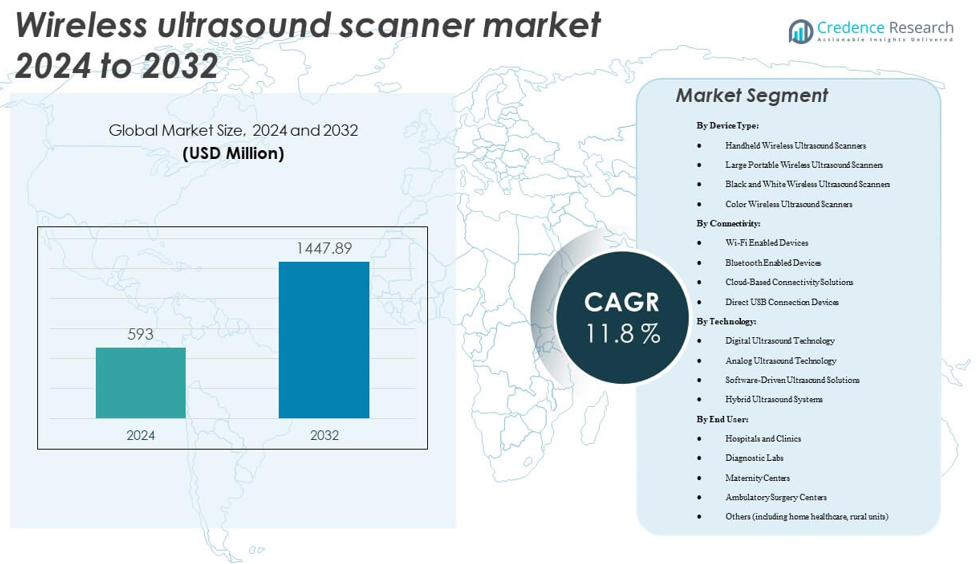
The Wireless ultrasound scanner market is projected to grow from USD 593 million in 2024 to an estimated USD 1,447.89 million by 2032, with a compound annual growth rate (CAGR) of 11.8% from 2024 to 2032.
| REPORT ATTRIBUTE | DETAILS |
|---|---|
| Historical Period | 2020-2023 |
| Base Year | 2024 |
| Forecast Period | 2025-2032 |
| Wireless ultrasound scanner market Size 2024 | USD 593 million |
| Wireless ultrasound scanner market, CAGR | 11.8% |
| Wireless ultrasound scanner market Size 2032 | USD 1,447.89 million |
The growth of the wireless ultrasound scanner market is driven by increasing demand for portable, real-time diagnostic tools that can be used in a variety of healthcare settings. Wireless ultrasound scanners enable healthcare providers to deliver more efficient and accessible care, especially in remote or rural areas. Technological advancements in imaging quality, mobility, and connectivity further enhance their adoption. These devices are becoming essential in point-of-care diagnostics, reducing equipment costs while improving patient care and outcomes.
Regionally, North America leads the Wireless ultrasound scanner market due to its advanced healthcare infrastructure and early adoption of digital medical technologies. Europe follows closely, with countries like the UK and Germany investing in telemedicine and home healthcare solutions. Emerging markets in Asia Pacific, such as China and India, are seeing rapid growth due to rising healthcare access, expanding hospital infrastructure, and increasing awareness of portable diagnostic solutions. Latin America and the Middle East also offer opportunities for growth as healthcare systems continue to modernize and seek cost-effective solutions.
Market Insights:
- The Wireless ultrasound scanner market is projected to grow from USD 593 million in 2024 to USD 1,447.89 million by 2032, with a CAGR of 11.8%.
- Rising demand for portable, real-time diagnostic tools is driving the market, especially in remote and rural healthcare settings.
- Technological advancements in imaging quality, mobility, and cloud-based connectivity solutions are enhancing product appeal and market adoption.
- Cost-effectiveness of wireless ultrasound scanners makes them increasingly popular in point-of-care diagnostics and home healthcare.
- The market faces challenges related to regulatory compliance and data security, especially with cloud-based storage solutions.
- North America holds the largest market share due to its advanced healthcare infrastructure and high adoption rates of digital technologies.
- The Asia Pacific region is witnessing rapid growth, driven by expanding healthcare access and infrastructure improvements in countries like China and India.
Market Drivers:
Rising Demand for Portable Medical Devices
The growing preference for portable, real-time diagnostic tools fuels the demand for wireless ultrasound scanners. These devices offer flexibility, enabling medical professionals to perform diagnostic imaging in remote or underserved locations. Their ability to provide quick results at the point of care is a significant factor driving adoption, particularly in rural areas and emergency settings. Wireless ultrasound scanners help healthcare providers streamline workflows and reduce the need for centralized imaging facilities, thus expanding their use across various clinical environments.
- For instance, the University of Rochester Medical Center (URMC) deployed 862 Butterfly Network’s point-of-care ultrasound devices across 64 departments by September 2024, leading to a 116% increase in ultrasound charge capture and enabling nearly 50,000 scanning sessions, generating over 175,000 images and over 15,000 finalized reports in less than three years.
Technological Advancements in Imaging Quality
Recent innovations in wireless ultrasound technology have significantly improved imaging quality, making these devices more reliable and effective for diagnosing a wide range of conditions. Enhanced resolution, advanced Doppler imaging capabilities, and better connectivity with cloud-based systems are some factors that have increased their market appeal. The improved accuracy and speed of wireless ultrasound scanners make them valuable diagnostic tools in critical care, emergency medicine, and general healthcare applications, further accelerating their adoption.
- For example, Clarius Mobile Health introduced the PAL HD3 in 2023 the world’s first handheld dual-array scanner for whole-body ultrasound offering a frequency range of 1 to 15 MHz and imaging depth up to 40 cm, with more than 25,000 AI-powered handheld ultrasound systems delivered to clinicians in 58 countries as of early 2024.
Cost-Effectiveness and Efficiency
The wireless ultrasound scanner market benefits from the increasing need for cost-effective healthcare solutions. These devices reduce the costs associated with traditional imaging systems, such as installation, maintenance, and infrastructure. Their portability and ease of use also enable healthcare providers to offer more affordable services. Hospitals, clinics, and mobile health providers are increasingly turning to wireless ultrasound scanners to optimize diagnostic efficiency while managing costs effectively.
Increased Adoption in Home Healthcare and Point-of-Care Settings
The growth of home healthcare services and point-of-care (POC) testing drives demand for wireless ultrasound scanners. Patients requiring regular monitoring benefit from the convenience and flexibility these devices offer, enabling healthcare professionals to conduct assessments at the patient's location. Wireless ultrasound systems can be easily integrated into home health monitoring programs, making it easier to track chronic conditions like cardiovascular diseases and pregnancy. This growing trend of decentralized care presents a significant market opportunity for these portable diagnostic tools.
Market Trends:
Integration with Mobile and Cloud Technologies
The integration of wireless ultrasound scanners with mobile devices and cloud-based platforms has become a notable trend. These devices allow healthcare providers to remotely access and analyze diagnostic images, improving collaboration among medical teams. The ability to store and share patient data securely via the cloud enhances workflow efficiency and supports telemedicine applications. This trend is shaping the future of healthcare by facilitating more comprehensive and accessible care, especially in remote or rural locations where access to specialized medical expertise is limited.
Miniaturization and Enhanced Portability
Miniaturization is a key trend in the wireless ultrasound scanner market, with manufacturers continuously working to reduce the size and weight of these devices. This trend makes the scanners more portable and easier to handle in various healthcare settings. As wireless ultrasound scanners become more compact, they are increasingly being used in both clinical and non-clinical environments, such as field hospitals, ambulances, and home healthcare. The shift toward more compact and lightweight designs contributes to the broader adoption of these devices.
- For example, the Clarius HD3 handheld ultrasound scanner (model L7 HD3) weighs 288 grams and measures 147 × 76 × 32 mm, based on the official technical product sheet released by Clarius. This device is compatible with both Apple and Android devices and offers a wireless, pocket-size form factor that supports high portability in field, EMS, and clinical settings.
Increased Use in Emergency Medical Services (EMS)
The adoption of wireless ultrasound scanners in emergency medical services is on the rise. These devices allow paramedics and emergency responders to perform real-time diagnostics in the field, providing crucial information before patients arrive at the hospital. Wireless ultrasound technology enhances the speed and accuracy of trauma assessments, allowing healthcare providers to make immediate decisions about patient care. As EMS teams continue to seek efficient and effective diagnostic tools, wireless ultrasound scanners are becoming a standard part of emergency response kits.
- For example, Philips Lumify is a handheld ultrasound solution that connects to smart devices, allowing healthcare providers to use it for ultrasound-guided procedures. It has been utilized in ambulances and pre-hospital environments, offering a portable, effective diagnostic tool in emergency medical settings.
Focus on User-Friendly Interfaces and AI Integration
There is an increasing focus on developing wireless ultrasound scanners with intuitive interfaces that are easy for healthcare providers to use. Simplified touch-screen controls, automated image analysis, and artificial intelligence (AI)-driven decision support systems are becoming common features. AI integration helps improve diagnostic accuracy by automatically detecting abnormalities and providing real-time suggestions to clinicians. These advancements make wireless ultrasound scanners more accessible, even to healthcare providers with minimal ultrasound experience, while also improving the overall quality of care.
Market Challenges Analysis:
Regulatory and Compliance Issues
The wireless ultrasound scanner market faces challenges related to regulatory approvals and compliance with medical device standards. Manufacturers must navigate complex regulatory frameworks to ensure their products meet safety and performance standards. This can involve rigorous testing and certification processes, which can delay product launches and increase development costs. Moreover, the market is subject to varying regulations across different regions, making it difficult for companies to maintain compliance and scale globally. The need for standardization and more efficient regulatory processes remains a key challenge.
Data Security and Privacy Concerns
As wireless ultrasound scanners become more integrated with cloud-based systems, data security and patient privacy concerns are emerging as significant challenges. Storing and transmitting sensitive medical data over the internet can expose healthcare providers to cybersecurity risks. Ensuring that these devices meet data protection regulations, such as HIPAA in the U.S. and GDPR in Europe, is crucial for maintaining trust and compliance. Addressing these concerns requires manufacturers to invest in robust encryption methods and secure cloud platforms to protect patient data from unauthorized access and breaches.
Market Opportunities:
Expanding in Emerging Markets
There is a significant growth opportunity for wireless ultrasound scanners in emerging markets, particularly in Asia-Pacific and Africa. As healthcare infrastructure continues to improve in these regions, the demand for cost-effective, portable diagnostic tools is rising. Wireless ultrasound scanners offer an affordable solution to healthcare providers in areas with limited access to traditional imaging equipment. The growing adoption of mobile health initiatives and the increasing availability of wireless connectivity further enhance the potential for market expansion in these regions.
Growth in Home Healthcare and Telemedicine
The rapid growth of home healthcare and telemedicine presents a promising opportunity for the wireless ultrasound scanner market. As more patients prefer receiving care at home, the demand for portable and easy-to-use diagnostic devices increases. Wireless ultrasound scanners enable healthcare providers to conduct remote consultations, allowing them to assess patient conditions and make timely decisions. This trend is expected to continue as healthcare systems shift towards more patient-centric, decentralized models of care, creating new opportunities for the market.
Market Segmentation Analysis:
By Device Type:
The Wireless ultrasound scanner market is segmented into four main device types: handheld, large portable, black and white, and color wireless ultrasound scanners. Handheld wireless ultrasound scanners are compact, lightweight, and ideal for point-of-care applications, offering flexibility in various healthcare settings. Large portable wireless ultrasound scanners combine advanced imaging capabilities with portability, suitable for hospitals and diagnostic centers. Black and white wireless ultrasound scanners provide basic imaging, making them an affordable option for routine diagnostics. Color wireless ultrasound scanners offer advanced imaging features, including color Doppler, and are widely used in fields like obstetrics and cardiology, where high-quality images are crucial for accurate diagnostics.
- For instance, the Butterfly iQ+ from Butterfly Network is a handheld, single-probe, whole-body ultrasound system utilizing patented Ultrasound-on-Chip technology and offering 20+ presets across clinical applications. It is FDA-cleared, CE-marked, and has facilitated space health research in partnership with NASA and the Translational Research Institute for Space Health.
By Connectivity:
The connectivity segment of the Wireless ultrasound scanner market includes Wi-Fi enabled devices, Bluetooth enabled devices, cloud-based connectivity solutions, and direct USB connection devices. Wi-Fi-enabled devices facilitate seamless real-time image sharing and remote consultations, improving workflow efficiency. Bluetooth-enabled devices offer secure and energy-efficient connections for quick image transfer to nearby devices. Cloud-based connectivity solutions allow for secure data storage, retrieval, and sharing across multiple devices, supporting telemedicine and remote diagnostics. Direct USB connection devices provide simple, secure connections for immediate data transfer without the need for internet access, catering to environments with limited connectivity.
By Technology:
The technology segment of the Wireless ultrasound scanner market includes digital ultrasound technology, analog ultrasound technology, software-driven ultrasound solutions, and hybrid ultrasound systems. Digital ultrasound technology provides high-quality imaging and enhanced resolution, making it the most common choice in modern wireless ultrasound systems. Analog ultrasound technology, though less common today, still plays a role in basic, cost-effective ultrasound solutions. Software-driven ultrasound solutions leverage AI and advanced algorithms to improve image quality and diagnostic accuracy, while hybrid ultrasound systems combine multiple technologies to offer versatile imaging capabilities, catering to complex diagnostic needs.
- For example, Samsung Medison continues to offer legacy analog ultrasound models still used in foundational diagnostic workflows in some rural care settings. Their historical 128-channel architecture is described in product manuals, though prevalence decreases as facilities update equipment.
By End User:
The end-user segment of the Wireless ultrasound scanner market includes hospitals and clinics, diagnostic labs, maternity centers, ambulatory surgery centers, and others, such as home healthcare and rural units. Hospitals and clinics are major consumers of wireless ultrasound scanners due to their need for portable, efficient diagnostic tools for a wide range of patient conditions. Diagnostic labs and maternity centers use these devices for routine and specialized testing, while ambulatory surgery centers benefit from the portability and ease of use in outpatient procedures. The growing demand for home healthcare and rural diagnostics is expanding the market as these devices offer cost-effective, reliable solutions for remote care and patient monitoring.
Segmentation:
By Device Type:
- Handheld Wireless Ultrasound Scanners
- Large Portable Wireless Ultrasound Scanners
- Black and White Wireless Ultrasound Scanners
- Color Wireless Ultrasound Scanners
By Connectivity:
- Wi-Fi Enabled Devices
- Bluetooth Enabled Devices
- Cloud-Based Connectivity Solutions
- Direct USB Connection Devices
By Technology:
- Digital Ultrasound Technology
- Analog Ultrasound Technology
- Software-Driven Ultrasound Solutions
- Hybrid Ultrasound Systems
By End User:
- Hospitals and Clinics
- Diagnostic Labs
- Maternity Centers
- Ambulatory Surgery Centers
- Others (including home healthcare, rural units)
By Region:
- North America
- U.S.
- Canada
- Mexico
- Europe
- Germany
- France
- U.K.
- Italy
- Spain
- Rest of Europe
- Asia Pacific
- China
- Japan
- India
- South Korea
- South-east Asia
- Rest of Asia Pacific
- Latin America
- Brazil
- Argentina
- Rest of Latin America
- Middle East & Africa
- GCC Countries
- South Africa
- Rest of the Middle East and Africa
Regional Analysis:
North America Dominance and Growth
North America holds a leading position in the Wireless ultrasound scanner market, capturing approximately 40% of global revenue. It benefits from advanced healthcare infrastructure, strong reimbursement frameworks, and high adoption of mobile imaging solutions. Leading players conduct substantial R&D in this region, which accelerates product innovation and deployment. Hospitals and outpatient settings drive demand for wireless systems in emergency and point‑of‑care settings. Market growth remains high due to increasing chronic disease prevalence and demand for quick diagnostics. Manufacturers expand partnerships with major health networks, strengthening market penetration and vendor positioning.
Europe Steady Adoption and Market Share
Europe contributes about 20% of the global wireless ultrasound scanner market share. The region sees steady adoption driven by aging populations, high public healthcare spending, and strong digital health initiatives. Key countries such as the UK, Germany and France invest in portable imaging upgrades across hospitals and clinics. The regulatory environment supports wireless diagnostics, although reimbursement varies across countries. Clinics and ambulatory care centers expand the use of wireless scanners to reduce costs and improve patient throughput. Growth remains moderate but sustainable due to stable healthcare budgets and focus on non‑invasive diagnostics.
Asia Pacific and Emerging Markets Acceleration
Asia Pacific commands around 30% of the market share in the wireless ultrasound scanner space, while Latin America and Middle East & Africa together account for near 10%. APAC leads the growth frontier thanks to rising healthcare access, increasing hospital infrastructure, and telemedicine expansion in countries such as China and India. In Latin America and MEA, growth remains smaller but promising because rural diagnostics and portable imaging gain attention. Manufacturers target these emerging regions with cost‑effective wireless systems to capture latent demand. Market entry strategies often feature local partnerships, training programs and tailored solutions for point‑of‑care settings.
Key Player Analysis:
- GE HealthCare
- Siemens Healthineers
- Philips Healthcare
- Butterfly Network Inc.
- Clarius Mobile Health Corp.
- Chison Medical Technologies
- EchoNous Inc.
- Healcerion Co., Ltd.
- Dramiński S.A.
- Dawei Group
Competitive Analysis:
The competitive landscape of the wireless ultrasound scanner market features several major players who vie for technological leadership and market share. Companies such as GE Healthcare, Philips Healthcare and Siemens Healthineers lead by delivering high‑end systems, strong global sales networks and extensive R&D capabilities. Emerging competitors like Clarius Mobile Health and Butterfly Network focus on portable, app‑enabled wireless scanners and offer innovative business models. The market remains fragmented with room for niche vendors targeting rural diagnostics, veterinary applications and home healthcare. Manufacturers compete on device portability, image quality, connectivity features and cost‑effectiveness. Strategic alliances and acquisitions help firms expand geographic reach and product portfolios. It remains critical for vendors to manage regulatory compliance, interoperability and service networks to maintain competitive advantage.
Recent Developments:
- In September 2025, GE HealthCare introduced its Voluson Performance series of ultrasound systems, which incorporates wireless Vscan Air probes and enhanced AI-driven imaging features. The new systems are designed for improved workflow and integration in point-of-care diagnostics, highlighting advancements in wireless ultrasound scanner technology for clinical settings.
- In January 2025, Clarius Mobile Health unveiled new enterprise software and AI-powered capabilities for its wireless ultrasound scanners, including features for workflow, billing management, and advanced anatomical overlays for learning and practice.
- In April 2024, GE HealthCare introduced the Vscan Air SL wireless ultrasound scanner enhanced with Caption AI, advancing their solutions for cardiac imaging and early disease detection. This integration followed GE's strategic acquisition of Caption Health in 2023, solidifying their leadership in AI-powered ultrasound technology.
Report Coverage:
The research report offers an in-depth analysis based on Device Type, Connectivity, Technology and End User. It details leading market players, providing an overview of their business, product offerings, investments, revenue streams, and key applications. Additionally, the report includes insights into the competitive environment, SWOT analysis, current market trends, as well as the primary drivers and constraints. Furthermore, it discusses various factors that have driven market expansion in recent years. The report also explores market dynamics, regulatory scenarios, and technological advancements that are shaping the industry. It assesses the impact of external factors and global economic changes on market growth. Lastly, it provides strategic recommendations for new entrants and established companies to navigate the complexities of the market.
Future Outlook:
- The wireless ultrasound scanner market will see rapid growth driven by increasing demand for portable, real-time diagnostic tools.
- Technological advancements in image quality and AI-driven features will enhance diagnostic capabilities and accuracy.
- Expansion of telemedicine and remote care services will significantly boost market adoption across healthcare settings.
- Increased adoption in emergency medical services (EMS) will open new opportunities for wireless ultrasound devices.
- Regulatory support for mobile healthcare solutions will pave the way for greater acceptance of wireless ultrasound scanners.
- As healthcare systems in emerging markets modernize, the wireless ultrasound scanner market will see accelerated growth.
- Continued advancements in connectivity features, such as cloud integration and mobile app compatibility, will drive further adoption.
- The increasing need for cost-effective diagnostic tools in rural and remote areas will further expand the market.
- Growing investments in healthcare infrastructure, particularly in Asia-Pacific and Latin America, will contribute to market expansion.
- Integration with wearable medical devices and personalized healthcare applications will enhance the use of wireless ultrasound scanners.

Request a Free Sample
Fill in your details and we'll send you a free sample report.
- Sample data tables & charts
- Research methodology
Market Dynamics
Demand for Portable, Real-Time Diagnostics
Wireless ultrasound scanners enable healthcare professionals to perform imaging at the point of care, especially in remote or rural settings where access to traditional imaging infrastructure is limited. This flexibility streamlines workflows and expands diagnostic capabilities beyond centralized facilities.
Technological Advancements in Imaging and Connectivity
Improvements in imaging resolution, Doppler capabilities, and integration with mobile/cloud platforms have made wireless ultrasound scanners more reliable and user-friendly. Enhanced connectivity supports telemedicine and remote consultations, increasing adoption across diverse healthcare environments.
Cost-Effectiveness and Efficiency
Wireless ultrasound scanners reduce installation, maintenance, and operational costs compared to traditional imaging systems. Their portability and ease of use allow providers to deliver affordable diagnostic services, making them attractive for hospitals, clinics, and home healthcare.
Growth of Home Healthcare and Telemedicine
The expansion of home healthcare and telemedicine services drives demand for portable diagnostic tools that can be used outside traditional clinical settings. Wireless ultrasound scanners support remote monitoring and decentralized care, meeting the needs of patients and providers in evolving healthcare models.
Increased Use in Emergency and Point-of-Care Settings
Emergency medical services and ambulatory care centers increasingly rely on wireless ultrasound scanners for rapid, on-site diagnostics. These devices improve the speed and accuracy of trauma assessments and critical care decisions, supporting better patient outcomes.
Need a Custom Version of This Report?
Tailor the scope, geography, or segments to your exact requirements.
- Custom geography or segment scope
- Direct access to our analyst team
Frequently Asked Questions
What is the size of Wireless Ultrasound Scanner Market?
What is the Wireless Ultrasound Scanner Market CAGR?
What is the Forecast period considered for Wireless Ultrasound Scanner Market?
What is the base year considered for Wireless Ultrasound Scanner Market?
Who are the major players in this market?
Table of Content
Chapter 1 Market Segmentation
- 1.1 Segmentation Framework
- 1.1.1 Product and Service Classification
- 1.1.2 Application and End-Use Classification
- 1.1.3 Technology and Solution Classification
- 1.1.4 Customer and Distribution Channel Classification
- 1.1.5 Geographic Segmentation
- 1.1.6 Market Segment Definitions and Boundaries
- 1.2 By End User
- 1.2.1 Hospitals and Clinics
- 1.2.2 Diagnostic Labs
- 1.2.3 Maternity Centers
- 1.2.4 Ambulatory Surgery Centers
- 1.2.5 Others (including home healthcare, rural units)
- 1.3 By Technology
- 1.3.1 Digital Ultrasound Technology
- 1.3.2 Analog Ultrasound Technology
- 1.3.3 Software-Driven Ultrasound Solutions
- 1.3.4 Hybrid Ultrasound Systems
- 1.4 By Device Type
- 1.4.1 Handheld Wireless Ultrasound Scanners
- 1.4.2 Large Portable Wireless Ultrasound Scanners
- 1.4.3 Black and White Wireless Ultrasound Scanners
- 1.4.4 Color Wireless Ultrasound Scanners
- 1.5 By Connectivity
- 1.5.1 Wi-Fi Enabled Devices
- 1.5.2 Bluetooth Enabled Devices
- 1.5.3 Cloud-Based Connectivity Solutions
- 1.5.4 Direct USB Connection Devices
Chapter 2 Introduction
- 2.1 Report Objectives and Scope
- 2.2 Product Definition and Industry Terminology
- 2.3 Market Inclusions and Exclusions
- 2.4 Research Process
- 2.4.1 Primary Research and Expert Interviews
- 2.4.2 Secondary Research and Source Review
- 2.4.3 Top-Down and Bottom-Up Estimation
- 2.4.4 Data Triangulation and Verification
- 2.5 Market Size Measurement Basis
- 2.5.1 2024: USD 593 million → 2032: USD 1,447.89 million
- 2.6 Historical and Forecast Reference Periods
- 2.6.1 Base Year: 2024
- 2.6.2 Forecast Period: 2024-2032
- 2.7 Research Assumptions and Limitations
Chapter 3 Executive Summary
- 3.1 Market Snapshot and Key Findings
- 3.2 Base-Year Market Size, 2024
- 3.3 Forecast Market Size, 2032
- 3.4 Revenue and Volume Growth Outlook
- 3.5 Key Demand and Supply Indicators
- 3.6 Leading Market Segments
- 3.7 Fastest-Growing Market Opportunities
- 3.8 Regional Performance Highlights
- 3.9 Technology and Industry Transformation
- 3.10 Competitive Landscape Summary
- 3.11 Analyst View and Strategic Implications
Chapter 4 Global Wireless Ultrasound Scanner Market Trends and Developments
- 4.1 Historical Industry Development
- 4.2 Recent Market Trends and Developments
- 4.3 Demand and Customer Behavior Trends
- 4.4 Technology and Product Innovation
- 4.5 Artificial Intelligence, Automation and Digitalization
- 4.6 Local Manufacturing and Supply Chain Realignment
- 4.7 Industry Partnerships, Mergers and Acquisitions
- 4.8 Sustainability and Circular Economy Developments
- 4.9 Government and Private Sector Investment Trends
- 4.10 Emerging Business Models and Commercialization
- 4.11 Industry Developments and Announcements
Chapter 5 Global Wireless Ultrasound Scanner Market Production, Supply and Demand Analysis
- 5.1 Demand Trend and Consumption Analysis
- 5.2 Demand Forecast, 2024-2032
- 5.3 Production and Output Trend
- 5.4 Production and Output Forecast, 2024-2032
- 5.5 Installed Capacity and Capacity Utilization
- 5.6 Company-Wise Production Plants and Statistics
- 5.6.1 Installed Production Capacity
- 5.6.2 Actual Production
- 5.6.3 Planned Capacity and Expansion Targets
- 5.7 Supply Chain Structure and Procurement Trends
- 5.8 Supply-Demand Gap and Bottlenecks
- 5.9 Import Dependence and Sourcing Structure
- 5.10 Contract Manufacturing and Outsourcing
- 5.11 Regional Supply and Demand Concentration
Chapter 6 Global Wireless Ultrasound Scanner Market Pricing Analysis
- 6.1 Pricing Structure and Measurement
- 6.2 Historical Pricing Trends
- 6.3 Pricing Outlook, 2024-2032
- 6.4 Average Selling Price and Unit Economics
- 6.5 Pricing by Product and Market Segment
- 6.6 Geographic Pricing Differences
- 6.7 Key Input, Energy, Labor and Logistics Costs
- 6.8 Contract Pricing and Purchasing Models
- 6.9 Pricing Sensitivity and Competitive Positioning
- 6.10 Price, Margin and Profitability Implications
Chapter 7 Global Wireless Ultrasound Scanner Market Dynamics
- 7.1 Market Growth Drivers
- 7.1.1 Demand-Side Drivers
- 7.1.2 Technology and Innovation Drivers
- 7.1.3 Infrastructure and Investment Drivers
- 7.1.4 Regulatory and Policy Drivers
- 7.2 Market Restraints
- 7.2.1 Cost and Affordability Constraints
- 7.2.2 Technology and Adoption Barriers
- 7.2.3 Supply Chain and Operational Constraints
- 7.3 Market Challenges
- 7.3.1 Competitive Pressure and Margin Erosion
- 7.3.2 Skills, Infrastructure and Implementation Gaps
- 7.4 Emerging Market Opportunities
- 7.5 Market Dynamics Impact and Time-Horizon Assessment
Chapter 8 Global Wireless Ultrasound Scanner Value Chain Analysis
- 8.1 Industry Value Chain Overview
- 8.2 Upstream Suppliers and Critical Inputs
- 8.3 Technology and Component Providers
- 8.4 Manufacturing or Service Delivery
- 8.5 Distribution, Channel Partners and Integrators
- 8.6 Downstream Applications and End Users
- 8.7 Value Addition and Profit Pools
- 8.8 Vertical Integration and Outsourcing
- 8.9 Supplier Concentration and Risk
- 8.10 Supply Chain Localization and Resilience
Chapter 9 Global Wireless Ultrasound Scanner Market Regulations and Policies
- 9.1 Relevant Laws, Standards and Compliance Frameworks
- 9.2 Product, Service, Safety and Quality Requirements
- 9.3 Government Policies, Incentives and Subsidies
- 9.4 Imports, Exports and Trade Barriers
- 9.5 Public Procurement and Local Content Requirements
- 9.6 Environmental and Sustainability Compliance
- 9.7 Upcoming Policy Changes and Market Implications
Chapter 10 Global Wireless Ultrasound Scanner Market Hotspots and Opportunities
- 10.1 Market Opportunity Mapping and Growth Hotspots
- 10.2 High-Growth Applications and Customer Groups
- 10.3 Underserved Markets and White-Space Opportunities
- 10.4 Emerging Technology and Product Opportunities
- 10.5 New Capacity and Investment Hotspots
- 10.6 Market Entry and Expansion Opportunities
- 10.7 Distribution and Partnership Opportunities
- 10.8 Near-Term and Long-Term Commercial Potential
- 10.9 Opportunity Attractiveness and Execution Risks
Chapter 11 Global Wireless Ultrasound Scanner Market Outlook, 2024-2032
- 11.1 Market Size and Analysis
- 11.1.1 Revenue (Market Measurement: 2024: USD 593 million → 2032: USD 1,447.89 million)
- 11.1.2 Market Volume and Quantity Sold
- 11.1.3 Historical Market Size
- 11.1.4 Base-Year Market Size, 2024
- 11.2 Market Forecast, 2024-2032
- 11.2.1 Revenue Forecast to 2032
- 11.2.2 Volume Forecast to 2032
- 11.2.3 CAGR and Year-on-Year Growth
- 11.2.4 Incremental Revenue Opportunity
- 11.3 Forecast Assumptions and Scenario Analysis
- 11.3.1 Base-Case Forecast
- 11.3.2 Optimistic and Conservative Scenarios
- 11.3.3 Technology, Pricing and Policy Sensitivities
- 11.4 Market Attractiveness and Growth Outlook
Chapter 12 Global Wireless Ultrasound Scanner Market Segmentation and Outlook
- 12.1 Segmentation Summary and Market Shares, 2024
- 12.2 Largest and Fastest-Growing Segments
- 12.3 By End User - Market Size and Forecast, 2024-2032
- 12.3.1 Segment Definition and Scope
- 12.3.2 Historical Market Size
- 12.3.3 Revenue Forecast, 2024-2032
- 12.3.4 Volume Forecast, 2024-2032
- 12.3.5 Base-Year Market Share, 2024
- 12.3.6 Segment CAGR and Growth Drivers
- 12.3.7 Subsegment Market Size and Forecast
- 12.3.7.1 Hospitals and Clinics
- 12.3.7.2 Diagnostic Labs
- 12.3.7.3 Maternity Centers
- 12.3.7.4 Ambulatory Surgery Centers
- 12.3.7.5 Others (including home healthcare, rural units)
- 12.3.8 Subsegment Pricing and Adoption Trends
- 12.3.9 Leading Suppliers and Competition
- 12.3.10 Regional Demand and Opportunities
- 12.4 By Technology - Market Size and Forecast, 2024-2032
- 12.4.1 Segment Definition and Scope
- 12.4.2 Historical Market Size
- 12.4.3 Revenue Forecast, 2024-2032
- 12.4.4 Volume Forecast, 2024-2032
- 12.4.5 Base-Year Market Share, 2024
- 12.4.6 Segment CAGR and Growth Drivers
- 12.4.7 Subsegment Market Size and Forecast
- 12.4.7.1 Digital Ultrasound Technology
- 12.4.7.2 Analog Ultrasound Technology
- 12.4.7.3 Software-Driven Ultrasound Solutions
- 12.4.7.4 Hybrid Ultrasound Systems
- 12.4.8 Subsegment Pricing and Adoption Trends
- 12.4.9 Leading Suppliers and Competition
- 12.4.10 Regional Demand and Opportunities
- 12.5 By Device Type - Market Size and Forecast, 2024-2032
- 12.5.1 Segment Definition and Scope
- 12.5.2 Historical Market Size
- 12.5.3 Revenue Forecast, 2024-2032
- 12.5.4 Volume Forecast, 2024-2032
- 12.5.5 Base-Year Market Share, 2024
- 12.5.6 Segment CAGR and Growth Drivers
- 12.5.7 Subsegment Market Size and Forecast
- 12.5.7.1 Handheld Wireless Ultrasound Scanners
- 12.5.7.2 Large Portable Wireless Ultrasound Scanners
- 12.5.7.3 Black and White Wireless Ultrasound Scanners
- 12.5.7.4 Color Wireless Ultrasound Scanners
- 12.5.8 Subsegment Pricing and Adoption Trends
- 12.5.9 Leading Suppliers and Competition
- 12.5.10 Regional Demand and Opportunities
- 12.6 By Connectivity - Market Size and Forecast, 2024-2032
- 12.6.1 Segment Definition and Scope
- 12.6.2 Historical Market Size
- 12.6.3 Revenue Forecast, 2024-2032
- 12.6.4 Volume Forecast, 2024-2032
- 12.6.5 Base-Year Market Share, 2024
- 12.6.6 Segment CAGR and Growth Drivers
- 12.6.7 Subsegment Market Size and Forecast
- 12.6.7.1 Wi-Fi Enabled Devices
- 12.6.7.2 Bluetooth Enabled Devices
- 12.6.7.3 Cloud-Based Connectivity Solutions
- 12.6.7.4 Direct USB Connection Devices
- 12.6.8 Subsegment Pricing and Adoption Trends
- 12.6.9 Leading Suppliers and Competition
- 12.6.10 Regional Demand and Opportunities
- 12.7 Segment Growth Comparison
- 12.8 Segment Attractiveness and Priority Matrix
Chapter 13 Global Wireless Ultrasound Scanner End-Use and Application Market Outlook
- 13.1 End-Use Industry and Customer Demand Structure
- 13.2 Leading Applications and Customer Groups
- 13.3 End-Use Market Size, Share and Forecast
- 13.4 Major End-Use Industry Deep Dives
- 13.4.1 Customer Requirements and Use Cases
- 13.4.2 Demand and Replacement Cycles
- 13.4.3 Technical and Regulatory Considerations
- 13.4.4 Purchasing and Procurement Models
- 13.4.5 Leading Vendors and Distribution Channels
- 13.4.6 Forecast and Commercial Opportunities
- 13.5 Emerging Applications and Cross-Segment Demand
- 13.6 End-Use Industry Investment Priorities
Chapter 14 Global Wireless Ultrasound Scanner Geographic Market Outlook, 2024-2032
- 14.1 Regional Market Size and Share, 2024
- 14.2 Regional Market Forecast, 2024-2032
- 14.3 Regional Pricing, Production and Demand Differences
- 14.4 North America
- 14.4.1 United States
- 14.4.2 Canada
- 14.4.3 Mexico
- 14.5 Europe
- 14.5.1 Germany
- 14.5.2 France
- 14.5.3 Italy
- 14.5.4 United Kingdom
- 14.5.5 Spain
- 14.5.6 Poland
- 14.5.7 Russia
- 14.5.8 Netherlands
- 14.5.9 Belgium
- 14.5.10 Sweden
- 14.5.11 Denmark
- 14.5.12 Norway
- 14.5.13 Rest of Europe
- 14.6 Asia Pacific
- 14.6.1 China
- 14.6.2 India
- 14.6.3 Japan
- 14.6.4 South Korea
- 14.6.5 Thailand
- 14.6.6 Indonesia
- 14.6.7 Vietnam
- 14.6.8 Malaysia
- 14.6.9 Australia
- 14.6.10 Rest of Asia Pacific
- 14.7 Latin America
- 14.7.1 Brazil
- 14.7.2 Argentina
- 14.7.3 Colombia
- 14.7.4 Chile
- 14.7.5 Rest of Latin America
- 14.8 Middle East
- 14.8.1 Saudi Arabia
- 14.8.2 United Arab Emirates
- 14.8.3 Turkey
- 14.8.4 Israel
- 14.8.5 Iran
- 14.8.6 Rest of the Middle East
- 14.9 Africa
- 14.9.1 South Africa
- 14.9.2 Egypt
- 14.9.3 Nigeria
- 14.9.4 Morocco
- 14.9.5 Rest of Africa
- 14.10 Regional Investment, Policy and Supply Chain Differences
- 14.11 Regional Competitive Landscape
- 14.12 Geographic Growth Hotspots
Chapter 15 Global Wireless Ultrasound Scanner Technology, Innovation and Sustainability Outlook
- 15.1 Technology Landscape and Maturity
- 15.2 Product, Process and Service Innovation
- 15.3 AI, Automation and Digital Tools in the Industry
- 15.4 Technology Adoption and Performance Benchmarking
- 15.5 Innovation Pipeline and R&D Investment
- 15.6 Patent and Intellectual Property Trends
- 15.7 Energy Efficiency and Resource Management
- 15.8 Sustainability, Recycling and Circularity
- 15.9 Technology Roadmap, 2024-2032
- 15.10 Risks of Obsolescence and Technology Substitution
Chapter 16 Global Wireless Ultrasound Scanner Market Key Strategic Imperatives
- 16.1 Growth and Market Entry Priorities
- 16.2 High-Return Products and Segments
- 16.3 Pricing, Profitability and Cost Optimization
- 16.4 Technology Investment and Product Differentiation
- 16.5 Supply Chain Localization and Resilience
- 16.6 Distribution and Customer Acquisition
- 16.7 Partnership, Acquisition and Capacity Strategy
- 16.8 Regional Expansion Priorities
- 16.9 Short-, Medium- and Long-Term Actions
Chapter 17 Competition Outlook
- 17.1 Industry Competition Characteristics
- 17.2 Market Structure and Concentration
- 17.3 Market Share and Competitive Positioning, 2024
- 17.4 Company-Wise Revenue and Product Benchmarking
- 17.5 Production and Service Capacity Benchmarking
- 17.6 Technology, Pricing and Differentiation
- 17.7 Regional Footprint and Distribution Strength
- 17.8 Mergers, Acquisitions and Strategic Alliances
- 17.9 New Entrants and Competitive Threats
- 17.10 Porter's Five Forces and Industry Attractiveness
- 17.11 Competitive Outlook, 2024-2032
Chapter 18 Company Profiles
- 18.1 Company Coverage and Selection Criteria
- 18.2 GE HealthCare
- 18.2.1 Business Description
- 18.2.2 Company Ownership and Geographic Presence
- 18.2.3 Product and Service Portfolio
- 18.2.4 Manufacturing and Operating Footprint
- 18.2.5 Production Capacity and Expansion Plans
- 18.2.6 Financial Performance and Investment
- 18.2.7 Market Share and Competitive Position
- 18.2.8 Technology and Innovation Capabilities
- 18.2.9 Strategic Alliances or Partnerships
- 18.2.10 Recent Developments
- 18.2.11 Growth Strategy and Outlook
- 18.3 Siemens Healthineers
- 18.4 Philips Healthcare
- 18.5 Butterfly Network Inc.
- 18.6 Clarius Mobile Health Corp.
- 18.7 Chison Medical Technologies
- 18.8 EchoNous Inc.
- 18.9 Healcerion Co., Ltd.
- 18.10 Dramiński S.A.
- 18.11 Dawei Group
- 18.12 Other Relevant Market Participants
Note: Every listed company is profiled on the structure shown under the first company. The company list is preliminary and may change based on research findings, market developments, data availability and client requirements.
Chapter 19 Disclaimer
- 19.1 Research and Forecast Disclaimer
- 19.2 Data Source and Estimation Limitations
Note: The depth of individual sections depends on data availability for this market. Volume, capacity, trade and other unit-based metrics are included where applicable.

