
Diagnostic Specialty Antibodies Market Overview:
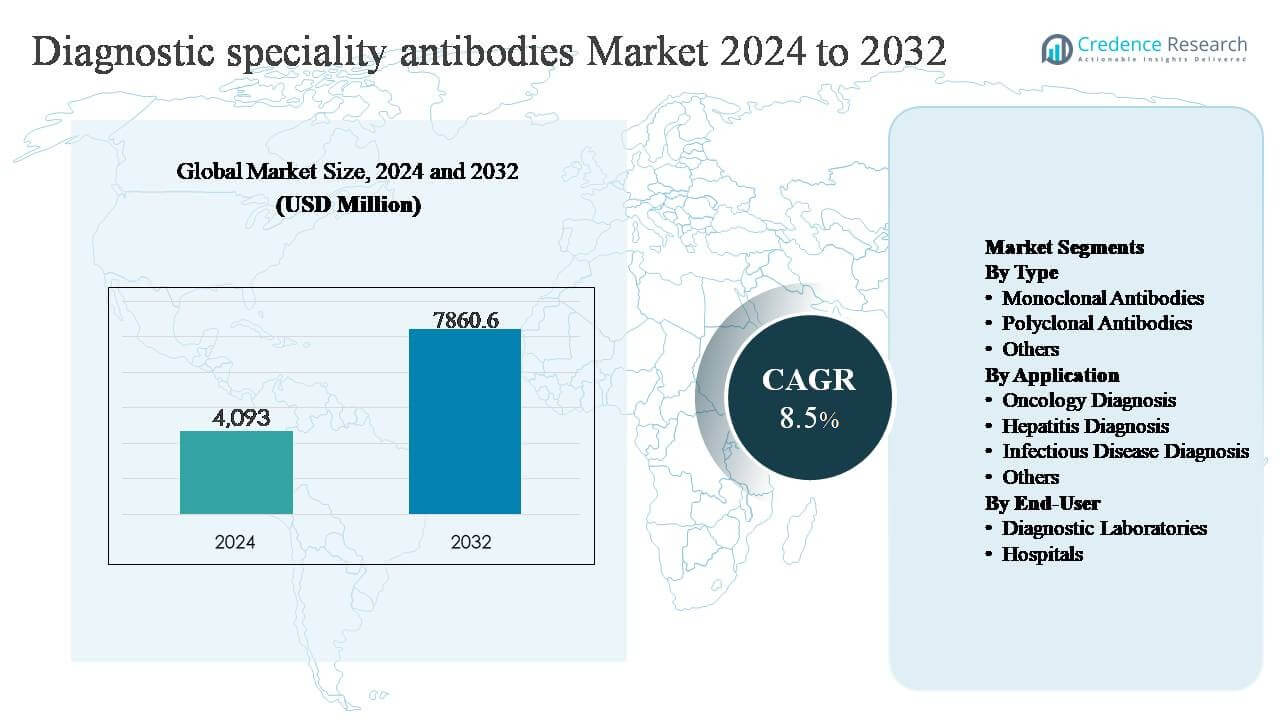
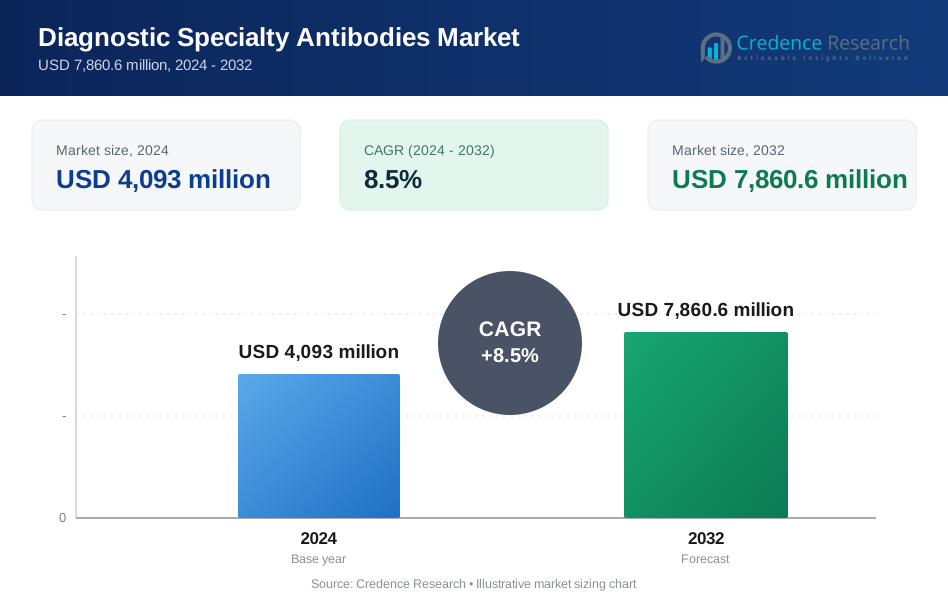
The diagnostic specialty antibodies market was valued at USD 4,093 million in 2024 and is projected to reach USD 7,860.6 million by 2032, expanding at a compound annual growth rate (CAGR) of 8.5% during the forecast period.
| REPORT ATTRIBUTE | DETAILS |
|---|---|
| Historical Period | 2020-2023 |
| Base Year | 2024 |
| Forecast Period | 2025-2032 |
| Diagnostic Specialty Antibodies Market Size 2024 | USD 4,093 million |
| Diagnostic Specialty Antibodies Market, CAGR | 8.5% |
| Diagnostic Specialty Antibodies Market Size 2032 | USD 7,860.6 million |
Diagnostic Specialty Antibodies Market Insights
- Market growth is driven by expanding adoption of precision diagnostics, particularly in oncology and infectious diseases, where monoclonal antibodies dominate with over 60% segment share due to their high specificity, reproducibility, and suitability for automated immunoassay platforms.
- Key market trends include growing use of companion diagnostics, increased deployment of multiplex immunoassays, and rising demand from centralized diagnostic laboratories, which account for approximately 65% of end-user share owing to high-throughput testing requirements.
- Competitive dynamics are shaped by portfolio breadth, assay validation capabilities, and supply reliability, with leading players focusing on recombinant antibody development, quality control standardization, and partnerships with IVD manufacturers.
- Regionally, North America leads with about 40% market share, followed by Europe at ~25%, Asia Pacific at ~28%, while Latin America and Middle East & Africa together account for ~7%, reflecting uneven diagnostic infrastructure maturity.
Diagnostic Specialty Antibodies Market Segmentation Analysis:
By Type:
Within the diagnostic specialty antibodies market, monoclonal antibodies represent the dominant sub-segment, accounting for the largest market share due to their high specificity, reproducibility, and consistent performance across diagnostic platforms. These antibodies are extensively used in immunohistochemistry, ELISA, and flow cytometry for precise antigen detection. Strong demand is driven by their critical role in oncology and infectious disease diagnostics, where accuracy is essential. Polyclonal antibodies maintain steady adoption for applications requiring high sensitivity, while other formats, including recombinant antibodies and fragments, support niche and advanced diagnostic assays.
- For instance,Roche Diagnostics’ PATHWAY anti-HER2/neu (4B5) rabbit monoclonal antibody is clinically validated for automated immunohistochemistry workflows on VENTANA BenchMark systems.
By Application:
Oncology diagnosis is the leading application sub-segment and holds the dominant market share, supported by rising global cancer incidence and increasing reliance on biomarker-based testing for tumor identification and stratification. Diagnostic specialty antibodies are integral to detecting cancer-associated antigens and guiding clinical decisions. Infectious disease diagnosis follows as a high-growth area, driven by expanding testing for viral and bacterial pathogens. Hepatitis diagnosis remains a stable segment due to routine screening programs, while other applications include autoimmune and neurological disease diagnostics with consistent demand.
- For instance, Abbott’s Architect and Alinity immunoassay platforms use antibody-based chemiluminescent assays to detect infectious disease markers, with Alinity i systems delivering throughput of up to 200 tests per hour per analyzer, supporting large-scale screening and confirmatory testing in centralized laboratories.
By End-User:
Diagnostic laboratories dominate the end-user segment, accounting for the largest market share owing to high testing volumes, centralized laboratory infrastructure, and widespread adoption of antibody-based assays for routine and specialized diagnostics. These laboratories prioritize scalable, high-throughput testing solutions, reinforcing sustained antibody demand. Hospitals represent a significant and growing sub-segment, supported by expanding in-house diagnostic capabilities and the integration of antibody-based testing within clinical workflows. Growth in hospital laboratories is further driven by rapid diagnostics, oncology services, and infectious disease management needs.
Key Growth Drivers
Rising Demand for Precision and Biomarker-Based Diagnostics
The increasing shift toward precision medicine is a major growth driver for diagnostic specialty antibodies. Healthcare providers are relying more heavily on biomarker-based diagnostics to improve disease detection accuracy, guide treatment decisions, and monitor disease progression. Diagnostic specialty antibodies enable highly specific identification of disease-associated antigens across oncology, infectious diseases, and autoimmune disorders. Their integration into immunohistochemistry, ELISA, and flow cytometry platforms supports reliable differentiation of disease subtypes. Expanding cancer screening programs, growing use of companion diagnostics, and the need for early and accurate diagnosis continue to strengthen antibody adoption. As clinical decision-making becomes increasingly data-driven, demand for high-affinity, well-validated diagnostic antibodies is expected to remain strong.
- For instance, BD Biosciences’ antibody panels used with the BD FACSymphony flow cytometry systems support 30-plus parameter cellular analysis in a single assay, allowing precise immune profiling for hematologic malignancies and immune-mediated diseases.
Expansion of Infectious Disease Testing and Surveillance
The sustained focus on infectious disease detection and surveillance is driving demand for diagnostic specialty antibodies. Rising testing volumes for viral, bacterial, and emerging pathogens have reinforced the importance of antibody-based assays in clinical diagnostics. Diagnostic antibodies play a central role in serological testing, antigen detection, and confirmatory diagnostics, supporting both routine screening and outbreak response. Increased government investment in public health laboratories, broader access to diagnostic services in emerging economies, and the growing need for rapid, scalable testing solutions continue to accelerate market growth. Antibody-based diagnostics remain essential for maintaining preparedness against future infectious threats.
- For instance, Siemens Healthineers’ Atellica IM Analyzer employs high-affinity diagnostic antibodies and supports continuous loading with a throughput of up to 440 tests per hour, allowing national reference laboratories to manage sustained infectious disease testing workloads.
Technological Advancements in Antibody Engineering and Assay Performance
Advancements in antibody engineering are significantly improving the performance and reliability of diagnostic specialty antibodies. Innovations in monoclonal and recombinant antibody production have enhanced specificity, affinity, and batch-to-batch consistency, addressing historical limitations in diagnostic reproducibility. Improved validation processes and optimized assay integration are increasing clinician confidence in antibody-based diagnostics. These advancements support broader clinical adoption across high-complexity testing environments, including oncology and molecular diagnostics. Continued innovation in antibody formats and assay compatibility is expanding application potential and driving sustained market demand.
Key Trends & Opportunities
Growing Adoption of Companion Diagnostics in Oncology
The increasing use of companion diagnostics represents a major opportunity for diagnostic specialty antibodies. Oncology treatment strategies increasingly depend on biomarker identification to guide targeted therapies, driving demand for high-specificity antibodies. Diagnostic antibodies enable precise detection of tumor-associated markers, supporting therapy selection and treatment monitoring. Pharmaceutical-diagnostic collaborations are strengthening this trend, as antibody-based diagnostics become integral to drug development and clinical workflows. This alignment creates long-term growth opportunities across both clinical and research settings.
- For instance, Agilent Dako’s pharmDx companion diagnostic portfolio includes assays for HER2 and EGFR that utilize specifically validated monoclonal antibody reagents. For example, the HercepTest™ mAb pharmDx (for Dako Omnis) uses a rabbit monoclonal antibody (clone DG44), while the EGFR pharmDx Kit utilizes a monoclonal mouse antibody (clone 2-18C9).
Expansion of Centralized and High-Throughput Diagnostic Laboratories
The rapid expansion of centralized diagnostic laboratories presents strong growth opportunities for diagnostic specialty antibodies. High-throughput testing environments rely heavily on standardized, scalable antibody-based assays to manage increasing sample volumes efficiently. Automation, digital pathology, and laboratory consolidation trends are further boosting antibody utilization. As laboratories seek reliable reagents that ensure consistency and operational efficiency, demand for validated diagnostic specialty antibodies continues to rise, particularly in emerging healthcare markets.
- For instance, Philips’ IntelliSite Pathology Solution digitizes histopathology slides at 0.25 microns per pixel, allowing antibody-stained slides to be reviewed remotely and supporting centralized diagnostic reporting.
Increasing Use of Multiplex and Advanced Immunoassays
The adoption of multiplex immunoassays is creating new opportunities for diagnostic specialty antibodies. These platforms allow simultaneous detection of multiple biomarkers, improving diagnostic efficiency and clinical insight. Specialty antibodies with high specificity and minimal cross-reactivity are essential for multiplex assay performance. Growing use in oncology, infectious disease panels, and autoimmune diagnostics is expanding the application scope, encouraging manufacturers to develop advanced antibody portfolios tailored to multiplex technologies.
Key Challenges
High Validation and Regulatory Compliance Requirements
One of the primary challenges in the diagnostic specialty antibodies market is the rigorous validation and regulatory compliance required for clinical use. Antibodies must meet stringent performance, specificity, and reproducibility standards before adoption in diagnostic assays. Extensive validation increases development timelines and costs, particularly for smaller manufacturers. Regulatory scrutiny varies across regions, adding complexity to global commercialization. These factors can slow product launches and limit market entry for new players, impacting overall innovation speed.
Batch-to-Batch Variability and Supply Chain Complexity
Despite technological improvements, batch-to-batch variability remains a challenge, particularly for polyclonal and legacy antibody products. Inconsistent performance can affect diagnostic accuracy and undermine clinician confidence. Additionally, supply chain complexities related to raw materials, manufacturing scalability, and quality control can disrupt antibody availability. Diagnostic laboratories require consistent reagent supply to maintain workflow continuity, making reliability a critical market expectation. Addressing these challenges requires sustained investment in manufacturing controls and quality assurance systems.
Regional Analysis
North America:
North America holds the largest share of the global diagnostic specialty antibodies market, approximately around 35-40% in 2024, driven by advanced healthcare infrastructure, strong clinical diagnostics adoption, and significant R&D investments. The region’s well-established laboratory networks and high demand for precise immunoassays support widespread use of specialty antibodies across oncology, infectious disease, and chronic condition diagnostics. The U.S. leads the market with widespread adoption of cutting-edge diagnostic platforms and strong reimbursement systems. Continued innovation, regulatory support for novel diagnostic tools, and high patient testing volumes are expected to sustain North America’s dominant position through the forecast period.
Europe:
Europe accounts for an estimated 20-25% market share in the diagnostic specialty antibodies landscape, underpinned by extensive healthcare services, robust immunodiagnostics demand, and strong research activity in key markets such as Germany, the U.K., and France. European laboratories increasingly integrate high-quality antibody reagents into routine testing for oncology, infectious diseases, and autoimmune conditions. Government initiatives targeting early disease detection and centralized national screening programs further support segment growth. Additionally, collaborations between diagnostics firms and research institutions drive adoption of advanced antibody-based assays across clinical settings, reinforcing Europe’s position as a key regional contributor.
Asia Pacific:
The Asia Pacific region is rapidly expanding and is projected to register the highest CAGR, representing approximately 25-30% of the global market share. Growth is supported by rising healthcare expenditures, expanding diagnostic infrastructure in China, India, Japan, and Southeast Asia, and increasing prevalence of chronic and infectious diseases. Emerging economies are strengthening laboratory capabilities and prioritizing early diagnosis adoption, which is boosting demand for specialty antibodies. Government initiatives to improve healthcare access, rising awareness of advanced diagnostics, and expanding middle-class populations are key drivers fueling sustained market momentum in the region.
Latin America:
Latin America holds around 10% market share in the diagnostic specialty antibodies market, with Brazil and Mexico leading regional demand. Growth is driven by rising prevalence of infectious diseases, increased public and private investments in healthcare infrastructure, and broader access to modern diagnostics. Government programs to strengthen laboratory networks and disease surveillance systems are enabling greater use of antibody-based tests. While constrained by budget limitations relative to developed markets, the region’s expanding diagnostic capabilities and improving reimbursement environments are creating new opportunities for market participants, especially in immunoassay and serological testing.
Middle East & Africa:
The Middle East & Africa region accounts for approximately 5% of the global market share, characterized by slower but steady growth. Increased investments in healthcare infrastructure, particularly in Gulf Cooperation Council countries and South Africa, support rising adoption of specialty antibodies within diagnostic laboratories and hospital networks. Awareness of advanced diagnostic testing is improving, with governments prioritizing early disease detection and public health programs. Constraints such as uneven access to diagnostics in rural areas and limited healthcare expenditure in some countries temper growth; however, ongoing initiatives to upgrade clinical services present future potential for expanded specialty antibody utilization.
Diagnostic Specialty Antibodies Market Segmentations:
By Type
- Monoclonal Antibodies
- Polyclonal Antibodies
- Others
By Application
- Oncology Diagnosis
- Hepatitis Diagnosis
- Infectious Disease Diagnosis
- Others
By End-User
- Diagnostic Laboratories
- Hospitals
By Geography
- North America
- U.S.
- Canada
- Mexico
- Europe
- Germany
- France
- U.K.
- Italy
- Spain
- Rest of Europe
- Asia Pacific
- China
- Japan
- India
- South Korea
- South-east Asia
- Rest of Asia Pacific
- Latin America
- Brazil
- Argentina
- Rest of Latin America
- Middle East & Africa
- GCC Countries
- South Africa
- Rest of the Middle East and Africa
Competitive Landscape
The competitive landscape for diagnostic specialty antibodies remains moderately fragmented, with competition shaped by portfolio breadth, validation depth, supply reliability, and compatibility with high-throughput diagnostic workflows. Large life-science suppliers leverage scale to offer extensive catalogs and application coverage across immunoassays and tissue-based testing, while specialist providers differentiate through high-affinity clones, recombinant formats, and tighter lot-to-lot consistency. Players increasingly invest in antibody engineering, standardized QC, and assay-ready documentation to meet clinical-lab expectations and reduce performance variability. Strategic M&A continues to reshape positioning most notably Danaher’s completion of the Abcam acquisition, which strengthens its life-science reagents footprint. Market leaders also emphasize broad antibody availability and workflow support (e.g., large Invitrogen antibody portfolios) to improve adoption and retention in routine diagnostic settings.
Key Player Analysis
- Abbott Laboratories
- Agilent Technologies, Inc.
- Bio-Rad Laboratories, Inc.
- Abcam plc
- Hoffmann-La Roche AG
Recent Developments
- In September 2025, Agilent Technologies, Inc.FDA approval of Agilent’s MMR IHC Panel pharmDx (Dako Omnis) as a companion diagnostic for colorectal cancer. This panel detects loss of function in four mismatch repair proteins (MLH1, PMS2, MSH2, MSH6) in formalin-fixed paraffin-embedded tissue and supports identification of patients eligible for specific immunotherapy treatment regimens, marking a significant regulatory milestone in IHC-based antibody diagnostics.
- In April 2025, Agilent showcased its diagnostic solutions and partnerships at the AACR Annual Meeting 2025, highlighting Agilent’s role in supporting cancer research and diagnostics workflows that rely on antibody-based technologies.
- In April 2025, Abcam was recognized as the ‘Antibody Supplier Succeeding in Genetics Research’ at the 2025 CiteAb Awards, reflecting its broad and highly validated portfolio of antibody reagents. While this recognition spans research and diagnostic uses, it demonstrates Abcam’s strength in supplying antibodies that underpin diagnostic assays and discovery platforms.
Report Coverage
The research report offers an in-depth analysis based on Type, Application, End-User and Geography. It details leading market players, providing an overview of their business, product offerings, investments, revenue streams, and key applications. Additionally, the report includes insights into the competitive environment, SWOT analysis, current market trends, as well as the primary drivers and constraints. Furthermore, it discusses various factors that have driven market expansion in recent years. The report also explores market dynamics, regulatory scenarios, and technological advancements that are shaping the industry. It assesses the impact of external factors and global economic changes on market growth. Lastly, it provides strategic recommendations for new entrants and established companies to navigate the complexities of the market.
Future Outlook
- Diagnostic specialty antibodies will see sustained demand as clinical diagnostics increasingly prioritize accuracy, reproducibility, and biomarker specificity.
- Adoption of monoclonal and recombinant antibodies will expand due to their superior consistency and compatibility with automated diagnostic platforms.
- Oncology diagnostics will remain the primary application area, supported by growing reliance on biomarker-driven cancer detection and monitoring.
- Infectious disease testing will continue to support market growth through routine screening and preparedness for emerging pathogens.
- Diagnostic laboratories will strengthen their dominance as centralized, high-throughput testing models expand globally.
- Integration of specialty antibodies into multiplex and companion diagnostic assays will increase across clinical workflows.
- Advances in antibody engineering will improve assay sensitivity, reduce cross-reactivity, and enhance lot-to-lot reliability.
- Emerging economies will contribute incremental growth as healthcare access and diagnostic infrastructure improve.
- Regulatory emphasis on assay validation and quality standards will drive demand for well-characterized, compliant antibody products.
- Strategic collaborations between diagnostics companies and biotechnology firms will shape innovation and portfolio expansion.
Request a Free Sample
Fill in your details and we'll send you a free sample report.
- Sample data tables & charts
- Research methodology
Need a Custom Version of This Report?
Tailor the scope, geography, or segments to your exact requirements.
- Custom geography or segment scope
- Direct access to our analyst team
Frequently Asked Questions
What is the current market size for Diagnostic specialty antibodies, and what is its projected size in 2032?
At what Compound Annual Growth Rate is the Diagnostic specialty antibodies market projected to grow between 2024 and 2032?
Which Diagnostic specialty antibodies segment held the largest share in 2024?
What are the primary factors fueling the growth of the Diagnostic specialty antibodies market?
Who are the leading companies in the Diagnostic specialty antibodies market?
Which region commanded the largest share of the Diagnostic specialty antibodies market in 2024?
Table of Content
Chapter 1. Report Introduction
- 1.1 Report Description & Purpose
- 1.1.1 Report Title & Market Definition
- 1.1.2 Unique Selling Propositions (USP) & Key Differentiators
- 1.1.3 Value Proposition for Stakeholders
- 1.2 Research Objectives
- 1.2.1 Market Sizing Objectives (Volume & Revenue)
- 1.2.2 Segmentation Objectives
- 1.2.3 Competitive Intelligence Objectives
- 1.2.4 Forecast & Scenario Objectives
- 1.3 Report Scope
- 1.3.1 Diagnostic Specialty Antibodies Scope – Types & Subtypes Covered
- 1.3.2 Geographic Scope – Regions & Countries Covered
- 1.3.3 Historical Period, Base Year & Forecast Period (2024; forecast to 2032)
- 1.3.4 Inclusions & Exclusions
- 1.4 HS Code & Classification Framework
- 1.5 Currency, Units & Pricing Basis
- 1.6 Target Stakeholders
- 1.7 Limitations & Assumptions
Chapter 2. Executive Summary
- 2.1 Global Diagnostic Specialty Antibodies Market Snapshot
- 2.1.1 Market Size – Historical (2024) & Forecast (2024-2032) (2024: USD 4,093 million → 2032: USD 7,860.6 million)
- 2.1.2 Volume & Revenue – Global Totals
- 2.1.3 Key Market Highlights – Top Five Facts
- 2.2 Diagnostic Specialty Antibodies Market Segmentation Snapshot
- 2.2.1 Market Split by Region – 2024 vs. 2032
- 2.3 Competitive Snapshot
- 2.3.1 Top 10 Players by Revenue Share – 2024
- 2.3.2 Top 10 Players by Volume Share – 2024
- 2.3.3 Recent Strategic Developments (18-Month Summary)
- 2.4 Key Investment Highlights & Strategic Conclusions
Chapter 3. Diagnostic Specialty Antibodies Market Dynamics & Industry Analysis
- 3.1 Market Overview & Context
- 3.1.1 Diagnostic Specialty Antibodies Market Position in the Broader Automotive Value Chain
- 3.1.2 OEM vs. Replacement Market Dynamics
- 3.1.3 Market Maturity & Development Stage by Region
- 3.2 Diagnostic Specialty Antibodies Market Drivers
- 3.3 Diagnostic Specialty Antibodies Market Restraints & Challenges
- 3.4 Diagnostic Specialty Antibodies Market Opportunities
- 3.5 Porter's Five Forces Analysis
- 3.5.1 Threat of New Entrants
- 3.5.2 Bargaining Power of Suppliers
- 3.5.3 Bargaining Power of Buyers
- 3.5.4 Threat of Substitutes
- 3.5.5 Competitive Rivalry – Intensity Assessment
- 3.6 Diagnostic Specialty Antibodies Value Chain Analysis
- 3.6.1 Upstream – Raw Material/Input Suppliers
- 3.6.1.1 Raw Material/Input 1
- 3.6.1.2 Raw Material/Input 2
- 3.6.1.3 Raw Material/Input 3
- 3.6.2 Midstream – Production/Manufacturing/Service Delivery
- 3.6.2.1 Production/Process Overview
- 3.6.2.2 Key Facility Locations & Capacity by Manufacturer
- 3.6.3 Downstream – Distribution & End Consumer
- 3.6.3.1 Primary Channel – B2B/OEM
- 3.6.3.2 Secondary Channels – Dealer, Retail, Online, Direct
- 3.6.4 Value Chain Profitability Analysis
- 3.6.1 Upstream – Raw Material/Input Suppliers
- 3.7 PESTEL Analysis
- 3.7.1 Political Factors
- 3.7.2 Economic Factors
- 3.7.3 Social Factors
- 3.7.4 Technological Factors
- 3.7.5 Environmental Factors
- 3.7.6 Legal Factors
- 3.8 Diagnostic Specialty Antibodies Supply Chain Analysis
- 3.8.1 Raw Material/Input Supply Risk Assessment
- 3.8.2 Manufacturing Concentration Risk (Geographic Exposure)
- 3.8.3 Trade Disruption Impact Analysis
- 3.9 Regulatory & Policy Landscape
Note: The regulatory and policy landscape section covers regulations based on their applicability to the market, Diagnostic Specialty Antibodies category, geography, and scope of the study. Only regulatory frameworks with a material impact on operations, compliance, trade, sustainability, or market access are analyzed in detail.
Chapter 4. Key Investment Pockets & Opportunity Analysis
- 4.1 Diagnostic Specialty Antibodies Market Attractiveness Analysis
- 4.1.1 By Region – Investment Attractiveness Matrix (Volume × CAGR)
- 4.2 Absolute Revenue Growth Opportunity
- 4.2.1 By Region – Absolute USD Growth Through 2032
- 4.3 Incremental Volume Opportunity
- 4.3.1 By Region – Incremental Volume Through 2032
- 4.3.2 Segment – Incremental Volume
- 4.4 Emerging Submarket Opportunity Deep Dive (Subject to Applicability)
- 4.5 Emerging Market Opportunity Scorecards
- 4.5.1 United States
- 4.5.2 Europe
- 4.5.3 Asia
- 4.5.4 Middle East & Africa
Note: Emerging Market Opportunity Scorecards will be included based on relevance and strategic importance. Regions listed are indicative and may vary depending on data availability and market dynamics.
Chapter 5. Diagnostic Specialty Antibodies Import-Export Analysis & Trade Flows
- 5.1 Global Trade Overview
- 5.1.1 Global Export Value by Country (2024)
- 5.1.2 Global Export Volume by Country (2024)
- 5.1.3 Global Import Value by Country (2024)
- 5.1.4 Global Import Volume by Country (2024)
- 5.1.5 Net Trade Balance by Country (2024)
- 5.2 Export Analysis – Segment
- 5.2.1 Type 1 (HS Code)
- 5.2.2 Type 2 (HS Code)
- 5.2.3 Type 3 (HS Code)
- 5.2.4 Type 4 (HS Code)
- 5.2.5 Type 5 (HS Code)
- 5.3 Import Analysis – Segment
- 5.3.1 Type 1 (HS Code)
- 5.3.2 Type 2 (HS Code)
- 5.3.3 Type 3 (HS Code)
- 5.3.4 Type 4 (HS Code)
- 5.3.5 Type 5 (HS Code)
- 5.4 Average Unit Trade Prices
- 5.4.1 Average Export Price – Segment & Country
- 5.4.2 Average Import Price – Segment & Source Country
- 5.4.3 Price Trends (2024)
- 5.5 Key Trade Route Analysis
- 5.5.1 Trade Route 1
- 5.5.2 Trade Route 2
- 5.5.3 Trade Route 3
- 5.5.4 Trade Route 4
- 5.5.5 Trade Route 5
- 5.6 Trade Policy Impact Assessment
- 5.6.1 US Anti-Dumping & Section 301 Tariffs
- 5.6.2 EU Customs Union Impact
- 5.6.3 Major Free Trade Agreements
- 5.6.4 USMCA Rules of Origin
Note: Trade policy analysis will be included only where relevant to the Diagnostic Specialty Antibodies market.
Chapter 6. Competitive Landscape & Company Benchmarking
- 6.1 Diagnostic Specialty Antibodies Market Concentration & Structure
- 6.1.1 Herfindahl-Hirschman Index (HHI) – vs. 2024
- 6.1.2 Tier 1, Tier 2 & Tier 3 Market Structure
- 6.1.3 Global, Regional & Local Player Dynamics
- 6.2 Diagnostic Specialty Antibodies Market Share Analysis – 2024
- 6.2.1 Global Revenue Share by Company
- 6.2.2 Global Volume Share by Company
- 6.2.3 Regional Revenue Share
- 6.2.4 Market Share Evolution ( vs. 2024)
- 6.2.5 OEM Segment Share by Company
- 6.2.6 Replacement Segment Share by Company
- 6.3 Production/Delivery Capacity & Facility Analysis
- 6.3.1 Global Installed Capacity
- 6.3.2 Capacity Utilization Rates
- 6.3.3 Production/Output Volume
- 6.3.4 Facility Locations & Capacity Map
- 6.3.5 Planned Capacity Additions
- 6.4 Diagnostic Specialty Antibodies Competitive Benchmarking Matrix
- 6.4.1 Revenue, Volume, CAGR & Profitability Comparison
- 6.4.2 Channel Revenue Mix
- 6.4.3 Geographic Revenue Exposure
- 6.4.4 R&D Intensity
- 6.4.5 Sustainability Maturity
- 6.5 Strategic Developments in Diagnostic Specialty Antibodies (Last 24 Months)
- 6.5.1 Mergers, Acquisitions & Divestments
- 6.5.2 New Diagnostic Specialty Antibodies Launches
- 6.5.3 Facility Expansions
- 6.5.4 Strategic Alliances, Joint Ventures & Partnerships
- 6.5.5 Distribution Expansion & Market Entry
- 6.5.6 Sustainability & ESG Initiatives
- 6.6 Competitive Strategy Mapping
- 6.6.1 Leader, Challenger, Follower & Niche Classification
- 6.6.2 Pricing Strategy Comparison
- 6.6.3 Channel Strategy Matrix
Note: Strategic developments are included based on their materiality and the availability of reliable information.
Chapter 7. Global Diagnostic Specialty Antibodies Market – By Distribution Channel
- 7.1 Segment Overview
- 7.1.1 Volume & Revenue Split by Channel (2024 & 2032)
- 7.1.2 Channel Mix Evolution (2024-2032)
Chapter 8. Regional Market Analysis – Global Overview
- 8.1 Global Regional Overview
- 8.1.1 Regional Volume Share
- 8.1.2 Regional Revenue Share
- 8.1.3 Regional Volume by Region
- 8.1.4 Regional Revenue by Region
- 8.1.5 Regional Forecast Through 2032
- 8.2 Cross-Regional Segment Analysis
- 8.2.1 By Distribution Channel
- 8.2.2 By Brand/Price Tier
Chapter 9. North America Diagnostic Specialty Antibodies Market
- 9.1 United States
- 9.2 Canada
- 9.3 Mexico
Chapter 10. Europe Diagnostic Specialty Antibodies Market
- 10.1 Germany
- 10.2 France
- 10.3 Italy
- 10.4 United Kingdom
- 10.5 Spain
- 10.6 Poland
- 10.7 Russia
- 10.8 Netherlands
- 10.9 Belgium
- 10.10 Sweden
- 10.11 Denmark
- 10.12 Norway
- 10.13 Rest of Europe
Chapter 11. Asia Pacific Diagnostic Specialty Antibodies Market
- 11.1 China
- 11.2 India
- 11.3 Japan
- 11.4 South Korea
- 11.5 Thailand
- 11.6 Indonesia
- 11.7 Vietnam
- 11.8 Malaysia
- 11.9 Australia
- 11.10 Rest of Asia Pacific
Chapter 12. Latin America Diagnostic Specialty Antibodies Market
- 12.1 Brazil
- 12.2 Argentina
- 12.3 Colombia
- 12.4 Chile
- 12.5 Rest of Latin America
Chapter 13. Middle East Diagnostic Specialty Antibodies Market
- 13.1 Saudi Arabia
- 13.2 United Arab Emirates
- 13.3 Turkey
- 13.4 Israel
- 13.5 Iran
- 13.6 Rest of the Middle East
Chapter 14. Africa Diagnostic Specialty Antibodies Market
- 14.1 South Africa
- 14.2 Egypt
- 14.3 Nigeria
- 14.4 Morocco
- 14.5 Rest of Africa
Chapter 15. Diagnostic Specialty Antibodies Company Profiles
- 15.1 [Company 01]
- 15.1.1 Company Overview
- 15.1.2 Key Management Personnel
- 15.1.3 Products & Services Portfolio
- 15.1.4 Financial Performance
- 15.1.5 Key Market Focus & Geographic Presence
- 15.1.6 Recent Developments & Strategic Initiatives
Note: The company profile list is preliminary and may change based on research findings, market developments, data availability, and client requirements.
Chapter 16. Appendices
- Appendix A – List of Abbreviations & Acronyms
- Appendix B – Industry Classification Code Reference – Full Series
- Appendix C – Production & Capacity Data Tables
- Appendix D – End-Use & Demand Base Tables
- Appendix E – Consumption & Replacement Rate Assumptions
- Appendix F – ASP Reference Tables
- Appendix G – Manufacturing & Facility Database
- Appendix H – Import-Export Data Tables
- Appendix I – Regulatory Summary Tables
- Appendix J – Primary Research Participant List (Anonymized)
- Appendix K – Primary Research Questionnaire Framework
- Appendix L – Data Sources & Bibliography
- Appendix M – Market Size Divergence & Source Comparison
Chapter 17. Research Methodology
- 17.1 Research Framework & Philosophy
- 17.2 Secondary Research – Sources, Hierarchy & Data Extraction
- 17.3 Data Modeling – Bottom-Up & Top-Down Market Sizing
- 17.4 Primary Research – Stakeholder Framework, LOI & Sample Sizes
- 17.5 Forecast Methodology – Regression, Scenario & Sensitivity Analysis
- 17.6 Quality Control – Four-Layer Validation Framework
- 17.7 Limitations & Standard Assumptions
- 17.8 Disclaimer
