mRNA Vaccine and Therapeutics Market Overview:
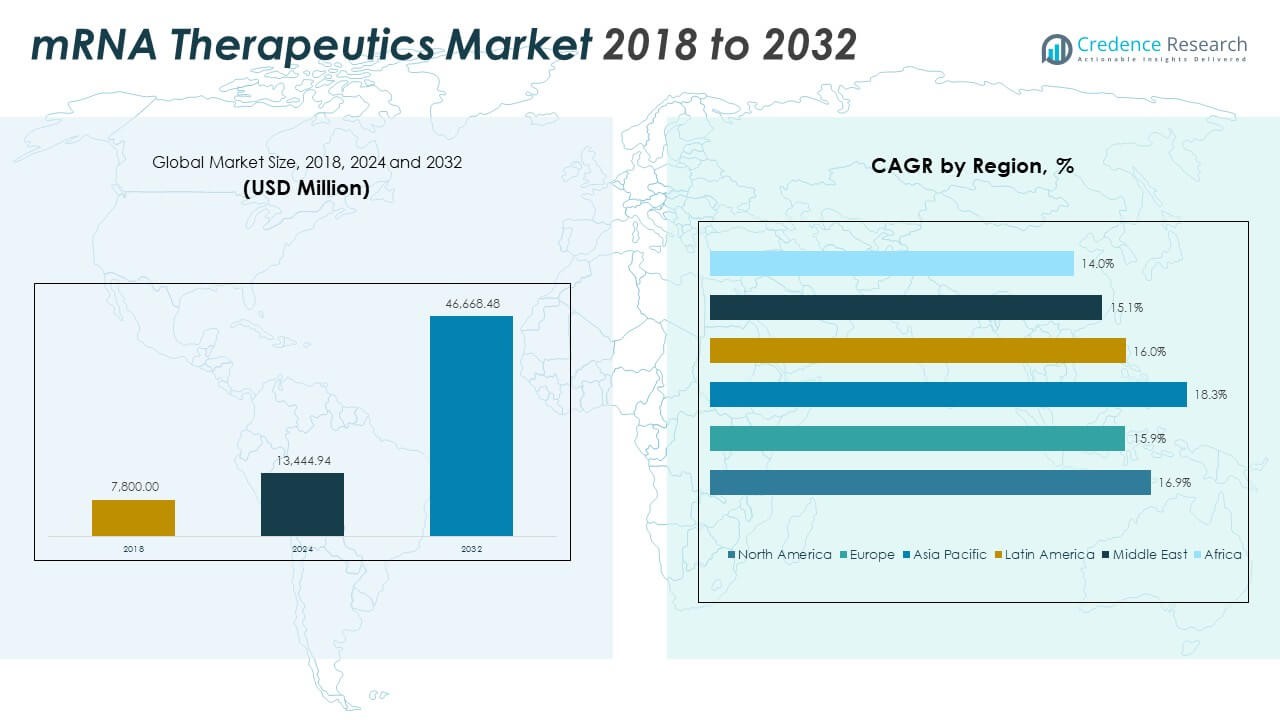
The Global mRNA Vaccine and Therapeutics Market size was valued at USD 7,800.00 million in 2018 to USD 13,444.94 million in 2024 and is anticipated to reach USD 46,668.48 million by 2032, at a CAGR of 16.93% during the forecast period.
| REPORT ATTRIBUTE | DETAILS |
|---|---|
| Historical Period | 2020-2023 |
| Base Year | 2024 |
| Forecast Period | 2025-2032 |
| mRNA Vaccine and Therapeutics Market Size 2024 | USD 13,444.94 Million |
| mRNA Vaccine and Therapeutics Market, CAGR | 16.93% |
| mRNA Vaccine and Therapeutics Market Size 2032 | USD 46,668.48 Million |
The market growth is driven by the rising prevalence of infectious and chronic diseases, advancements in genetic research, and growing investments in biotechnology. Increasing demand for precision medicine and personalized treatments has accelerated mRNA-based therapeutic development. Rapid approvals of COVID-19 vaccines have also boosted confidence in mRNA platforms, encouraging pharmaceutical firms to expand research into cancer immunotherapy, rare genetic disorders, and autoimmune diseases.
North America leads the Global mRNA Vaccine and Therapeutics Market due to strong R&D infrastructure, robust funding, and the presence of major biotech players. Europe follows with supportive regulatory frameworks and a focus on next-generation vaccine development. The Asia-Pacific region is emerging rapidly, supported by government initiatives, expanding healthcare access, and increasing biotech investments, especially in countries like China, Japan, and India.
mRNA Vaccine and Therapeutics Market Insights:
- The Global mRNA Vaccine and Therapeutics Market size was valued at USD 7,800 million in 2018, reached USD 13,444.94 million in 2024, and is projected to attain USD 46,668.48 million by 2032, growing at a CAGR of 16.93%.
- North America held the largest share at 39.8%, supported by strong biotechnology infrastructure and the presence of key players. Europe followed with 21.3%, driven by supportive regulatory systems, while Asia Pacific captured 26.5% due to expanding vaccine research and healthcare modernization.
- Asia Pacific emerged as the fastest-growing region, fueled by government funding, local mRNA research, and increased healthcare investments in countries such as China, Japan, and India.
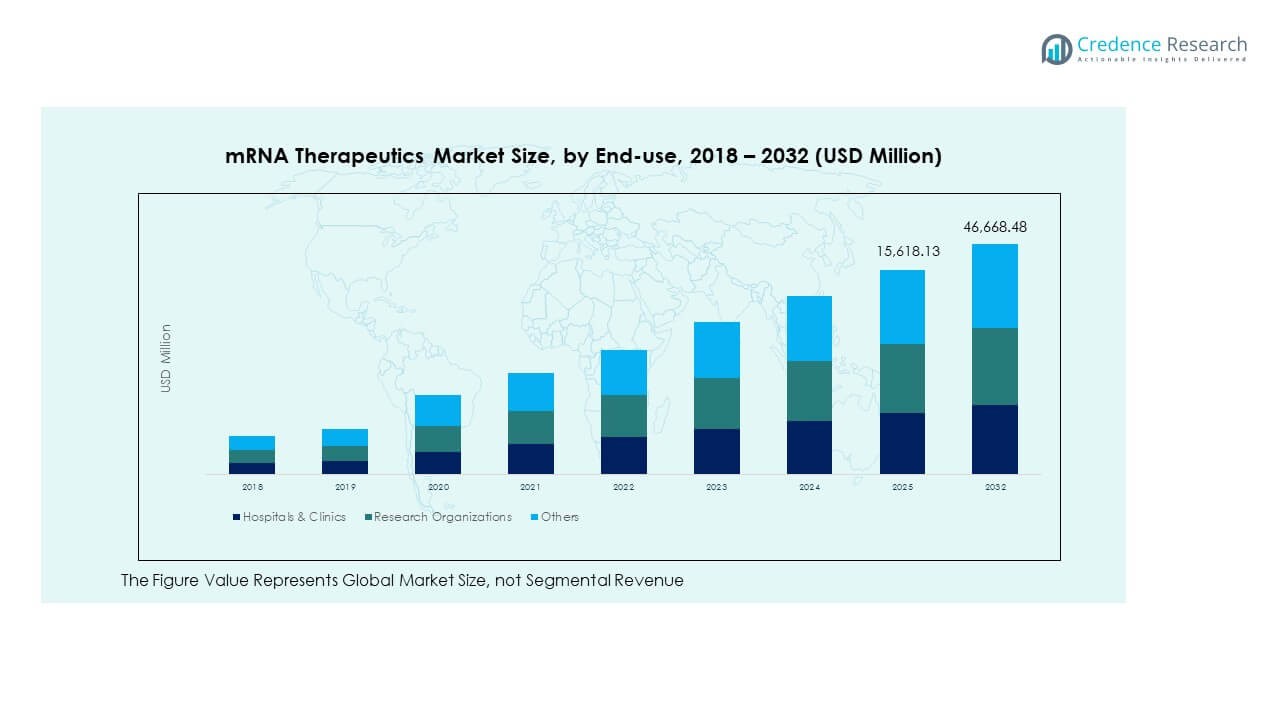
- In 2024, hospitals and clinics accounted for around 47% of the end-use segment, supported by large-scale vaccination programs and clinical integration of mRNA therapies.
- Research organizations held nearly 35% share, reflecting strong academic collaboration and growing investment in mRNA-based oncology and infectious disease studies.
mRNA Vaccine and Therapeutics Market Drivers:
Growing Application of mRNA in Infectious and Chronic Disease Treatment
The Global mRNA Vaccine and Therapeutics Market is witnessing rapid expansion due to its broad applications in infectious and chronic disease management. Pharmaceutical companies are actively developing mRNA-based solutions for conditions like influenza, HIV, and cancer. mRNA platforms allow faster production timelines, reducing dependency on traditional vaccine models. Strong pipeline products and successful clinical trials are improving investor confidence. The growing awareness of personalized medicine is creating new treatment pathways. Technological progress in lipid nanoparticles is improving delivery efficiency. It is transforming therapeutic outcomes and expanding treatment accessibility globally. Rising healthcare investments continue to strengthen research and innovation in this field.
- For instance, Moderna’s mRNA-1083 influenza vaccine achieved a higher antibody response in over 8,000 Phase 3 trial participants compared to standard flu vaccines, as published in June 2024 results.
Technological Innovations Enhancing Drug Delivery Efficiency and Stability
Continuous technological innovation is a major driver in the Global mRNA Vaccine and Therapeutics Market. Advances in lipid nanoparticle carriers and encapsulation methods have improved mRNA stability and bioavailability. Research in cold-chain management and thermostable formulations is making vaccines more practical for large-scale distribution. Strong collaboration between biotech firms and research institutions is accelerating development. The integration of AI and computational biology is improving sequence design and reducing time to market. It is enabling precise targeting of cells for enhanced therapeutic outcomes. Governments and private investors are supporting innovation through funding and policy backing. These developments are ensuring the reliability and scalability of mRNA-based therapies.
- For instance, research published in a March 2023 peer-reviewed journal demonstrated that optimally lyophilized (freeze-dried) mRNA lipid nanoparticles (LNPs) could maintain their transfection efficiency when stored at room temperature (22°C) for at least 12 weeks (three months), offering a potential solution to the cold-chain limitation of existing liquid mRNA vaccines. This study, while promising, was a general academic research effort and did not specifically confirm a BioNTech product has this shelf life.
Growing Investment and Funding from Public and Private Sectors
The market is benefiting from strong financial support across global economies. Major funding initiatives from governments and private investors are fueling mRNA research and commercialization. It is helping companies expand manufacturing capabilities and clinical infrastructure. Pharmaceutical giants are entering strategic alliances to strengthen product portfolios. Academic institutions are also contributing to research diversity through collaborative studies. The increased capital flow ensures faster transition from laboratory discoveries to market-ready therapies. This support is driving long-term sustainability and encouraging smaller biotech startups to innovate. The trend highlights growing confidence in the mRNA platform’s therapeutic potential.
Expanding Scope in Oncology and Rare Disease Therapeutics
Oncology and rare disease treatments are emerging as pivotal areas for mRNA innovation. Researchers are exploring mRNA-based cancer vaccines to trigger immune responses against tumor cells. Personalized vaccines targeting specific tumor mutations are gaining attention. It is creating opportunities for precision medicine and immune-modulating therapies. Rare genetic disorders are also being targeted using mRNA technologies. The ability to code specific proteins helps treat enzyme deficiencies and metabolic conditions. Strong patent activity and collaborations are supporting drug development pipelines. These advancements are expanding the therapeutic scope and improving long-term market resilience.
mRNA Vaccine and Therapeutics Market Trends:
Adoption of Personalized and Precision Medicine Approaches in Healthcare Systems
The Global mRNA Vaccine and Therapeutics Market is evolving toward personalized medicine, focusing on patient-specific treatment solutions. Healthcare systems are integrating genomic data and AI-driven tools for therapy customization. It is helping clinicians design targeted therapies with fewer side effects. Pharmaceutical companies are expanding genetic profiling programs to optimize vaccine efficiency. This trend aligns with the shift toward precision-based medical practices. Hospitals and research labs are adopting genomic databases for real-time diagnosis. The growing patient demand for effective and faster treatments is strengthening this transition. It is positioning mRNA therapeutics as a leading tool for personalized healthcare solutions.
- For instance, Gritstone Bio's April 2024 presentation at the AACR Annual Meeting showcased that improvements to its proprietary AI-driven EDGE™ platform resulted in a field-leading HLA Class I prediction accuracy of over 80%. This was an internal R&D achievement and not the result of a 2024 partnership with CureVac, which has its own separate collaborations for neoantigen identification.
Rising Collaborations Between Biotech Firms and Pharmaceutical Companies
Strategic collaborations are shaping innovation in the Global mRNA Vaccine and Therapeutics Market. Partnerships between biotech and pharmaceutical firms are accelerating drug development and clinical validation. Co-development models are reducing time and cost barriers in vaccine production. Governments are supporting public-private collaborations to scale R&D infrastructure. It is helping companies overcome technical challenges and improve global access. Mergers and acquisitions are expanding market reach and portfolio diversity. The collaboration trend is fostering shared knowledge and technical expertise. It is enhancing innovation pipelines and promoting cross-border research integration.
- For instance, Sanofi and BioNTech’s existing collaboration for cancer immunotherapies, which began in November 2015 and was expanded in January 2019, successfully moved their first candidate from concept to clinical stage in "well under three years". Separately, in May 2024, Sanofi announced a new licensing agreement with Novavax for a protein-based flu-COVID combination vaccine, a strategy that moves away from mRNA technology for their influenza portfolio.
Increasing Focus on Non-Vaccine Therapeutic Applications
The market is shifting focus beyond vaccines toward therapeutic use cases such as oncology and regenerative medicine. The Global mRNA Vaccine and Therapeutics Market is exploring mRNA’s role in protein replacement and immune modulation. It is offering new possibilities for genetic and autoimmune disorders. Research into mRNA therapies for cardiovascular and metabolic diseases is expanding. The trend highlights the potential to replace traditional biologics with faster, scalable alternatives. Biotech companies are investing in long-term platforms for multi-disease targeting. Continuous advancements in mRNA design and delivery are improving therapeutic precision. This transition is redefining the future of biopharmaceutical innovation.
Growing Demand for Scalable Manufacturing and Supply Chain Modernization
The expansion of mRNA production capacity is a key trend driving global competitiveness. The Global mRNA Vaccine and Therapeutics Market is experiencing strong investment in modular and automated manufacturing facilities. It is addressing scalability issues faced during pandemic responses. Companies are integrating robotics and AI to optimize yield and quality control. Governments are supporting domestic production to reduce import reliance. Global supply chain networks are adapting to cold-chain requirements with advanced logistics. The modernization of manufacturing systems ensures rapid response capability for emerging health threats. It is building resilience and long-term efficiency in biopharmaceutical production.
mRNA Vaccine and Therapeutics Market Challenges Analysis:
Regulatory Complexity and Standardization Issues Across Global Regions
The Global mRNA Vaccine and Therapeutics Market faces complex regulatory frameworks that slow product approvals. Differences in national guidelines for genetic materials, clinical testing, and quality control create inconsistency. Regulatory harmonization remains limited, leading to delays in commercialization. It is challenging for small and mid-sized companies to meet stringent safety and efficacy standards. High compliance costs add further burden to development timelines. The rapid pace of mRNA innovation often outpaces existing regulatory frameworks. Limited awareness among regulators regarding emerging mRNA technologies increases review times. Coordinated international efforts are needed to simplify approval pathways and promote transparency.
Manufacturing Costs, Cold Chain Constraints, and Workforce Shortages
Manufacturing complexity continues to challenge the scalability of mRNA products. The Global mRNA Vaccine and Therapeutics Market is dealing with high costs for specialized equipment, raw materials, and temperature-controlled logistics. Cold-chain infrastructure gaps restrict global distribution, especially in low-income nations. Skilled workforce shortages in molecular biology and RNA engineering further limit capacity expansion. It is difficult for emerging companies to maintain cost efficiency while ensuring quality. Energy-intensive production processes contribute to operational challenges. The need for automation and process optimization is becoming critical. Addressing these limitations will determine the market’s long-term growth and accessibility.
mRNA Vaccine and Therapeutics Market Opportunities:
Expansion into Cancer Immunotherapy and Genetic Disorder Treatments
The Global mRNA Vaccine and Therapeutics Market offers major opportunities in oncology and genetic medicine. The flexibility of mRNA enables rapid design of tumor-specific vaccines, improving patient response rates. It is also opening potential in treating genetic deficiencies through protein synthesis. Advances in lipid nanoparticles and vector design are improving delivery success in complex tissues. Collaborations between biotech firms and cancer research institutes are growing. These factors are enhancing the clinical pipeline for next-generation therapeutics. The expanding role of mRNA platforms is likely to reshape precision treatment landscapes worldwide.
Rising Government Support and Global Health Preparedness Initiatives
Governments and health organizations are prioritizing mRNA technologies for future pandemic readiness. The Global mRNA Vaccine and Therapeutics Market is gaining policy-driven momentum through funding and capacity-building programs. It is attracting public-private partnerships aimed at expanding regional production hubs. National strategies promoting local manufacturing and research autonomy are accelerating adoption. The focus on self-reliance and resilient healthcare systems is creating strong growth prospects. Public investment in cold-chain infrastructure and technology transfer initiatives is improving global accessibility. These developments are fostering innovation, preparedness, and equitable health outcomes.

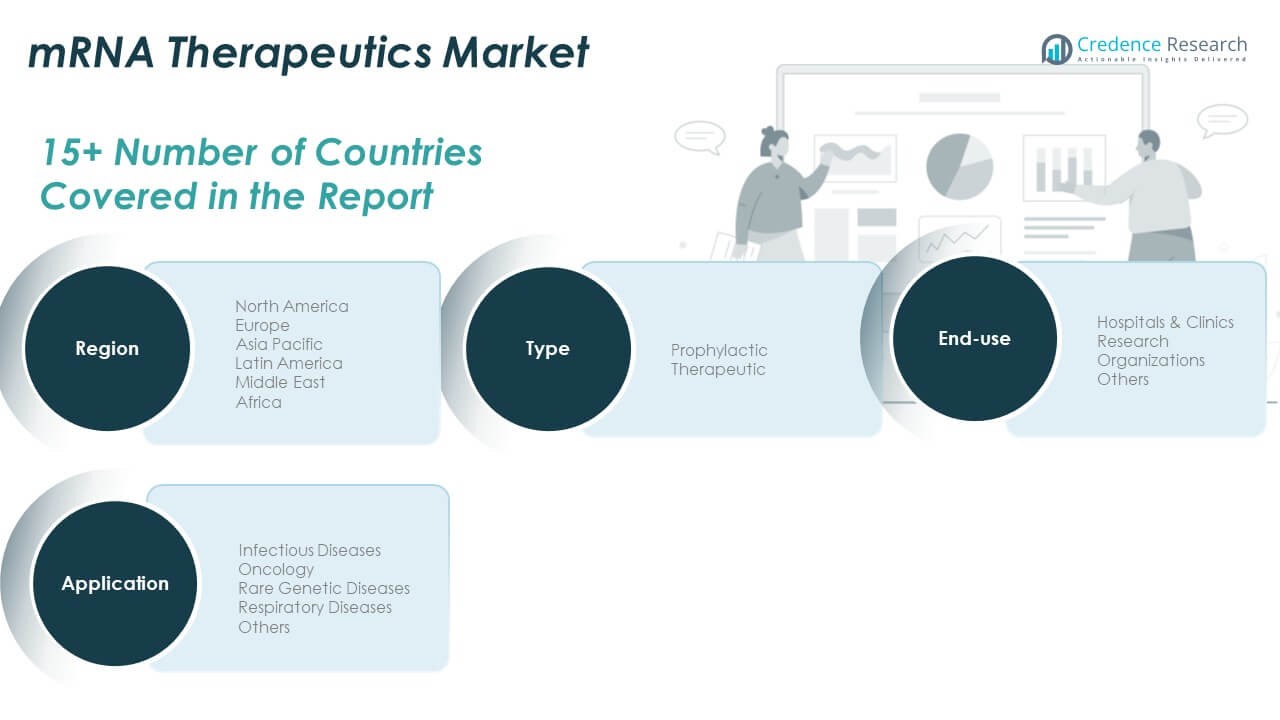
mRNA Vaccine and Therapeutics Market Segmentation Analysis:
By Type
The Global mRNA Vaccine and Therapeutics Market is divided into prophylactic and therapeutic segments. Prophylactic mRNA vaccines hold a dominant share due to their successful use in preventing infectious diseases such as COVID-19 and influenza. Continuous innovation in vaccine delivery platforms supports their sustained demand. The therapeutic segment is gaining traction with growing research in cancer immunotherapy, rare genetic disorders, and metabolic diseases. It benefits from the ability of mRNA technology to encode specific proteins for targeted therapy. The shift toward chronic disease management is accelerating investment in therapeutic applications.
- For instance, Sanofi and Translate Bio's mRNA therapy for cystic fibrosis (MRT5005) demonstrated robust dose-dependent delivery and expression of human CFTR mRNA and protein in animal studies (specifically rats and nonhuman primates), with mRNA levels in the lungs increasing up to 1500-fold compared to endogenous levels.
By End-Use
Hospitals and clinics lead the end-use segment owing to their role in vaccination programs and advanced treatment delivery. Strong healthcare infrastructure and expanding immunization coverage drive their dominance. Research organizations follow closely, supported by active R&D funding and academic collaborations. It is fostering breakthroughs in personalized and precision medicine. The “Others” category, including contract manufacturing and biotech startups, is emerging through specialized drug development initiatives.
By Application
Infectious diseases represent the largest application segment, supported by rising global health challenges and preventive immunization campaigns. Oncology is emerging rapidly as mRNA-based cancer vaccines enter clinical pipelines. Rare genetic diseases and respiratory disorders also show promising potential due to ongoing advancements in targeted gene therapy. The “Others” segment covers autoimmune and cardiovascular conditions, reflecting the broadening therapeutic potential of mRNA technology. It highlights the adaptability of this platform across multiple medical domains.

Segmentation:
By Type
- Prophylactic
- Therapeutic
By End-Use
- Hospitals & Clinics
- Research Organizations
- Others
By Application
- Infectious Diseases
- Oncology
- Rare Genetic Diseases
- Respiratory Diseases
- Others
By Region
- North America
- S.
- Canada
- Mexico
- Europe
- UK
- France
- Germany
- Italy
- Spain
- Russia
- Rest of Europe
- Asia Pacific
- China
- Japan
- South Korea
- India
- Australia
- Southeast Asia
- Rest of Asia Pacific
- Latin America
- Brazil
- Argentina
- Rest of Latin America
- Middle East
- GCC Countries
- Israel
- Turkey
- Rest of Middle East
- Africa
- South Africa
- Egypt
- Rest of Africa
Regional Analysis:
North America
The North America Global mRNA Vaccine and Therapeutics Market size was valued at USD 3,137.94 million in 2018 to USD 5,349.66 million in 2024 and is anticipated to reach USD 18,546.14 million by 2032, at a CAGR of 16.9% during the forecast period. North America dominates the global market, accounting for the largest share due to advanced healthcare infrastructure, robust biotechnology R&D, and high adoption of novel therapeutics. It benefits from strong government funding, well-established clinical trial networks, and the presence of key players such as Moderna and Pfizer. Continuous product innovation and collaboration between pharmaceutical and academic institutions are accelerating research in cancer and infectious disease applications. Favorable regulatory frameworks and rapid approval mechanisms strengthen market penetration. The region’s emphasis on vaccine manufacturing and innovation leadership supports sustained growth in the coming years.
Europe
The Europe Global mRNA Vaccine and Therapeutics Market size was valued at USD 1,739.40 million in 2018 to USD 2,860.72 million in 2024 and is anticipated to reach USD 9,275.49 million by 2032, at a CAGR of 15.9% during the forecast period. Europe holds a substantial market share due to active participation of companies such as BioNTech and CureVac. It benefits from strong research institutions and supportive regulatory bodies like the EMA promoting biotechnology advancements. Public-private collaborations are driving vaccine development and cancer immunotherapy research. Countries such as Germany, the UK, and France are key contributors to regional growth. It is also witnessing rising investment in precision medicine and biomanufacturing. The focus on developing regional supply chains and sustainable healthcare strategies reinforces its leadership in biotechnology innovation.
Asia Pacific
The Asia Pacific Global mRNA Vaccine and Therapeutics Market size was valued at USD 1,981.20 million in 2018 to USD 3,560.84 million in 2024 and is anticipated to reach USD 13,594.57 million by 2032, at a CAGR of 18.3% during the forecast period. Asia Pacific represents the fastest-growing regional market, driven by expanding healthcare infrastructure, government funding, and local manufacturing capacity. Countries such as China, Japan, and India are investing heavily in biotechnology and vaccine development. Growing awareness of preventive healthcare and rising chronic disease prevalence support mRNA adoption. The region’s cost-effective clinical trials and supportive regulatory frameworks encourage multinational companies to establish partnerships. It is emerging as a vital hub for clinical research, vaccine innovation, and large-scale production. Rapid technological advancement and favorable demographic factors will continue to boost regional expansion.
Latin America
The Latin America Global mRNA Vaccine and Therapeutics Market size was valued at USD 553.80 million in 2018 to USD 946.39 million in 2024 and is anticipated to reach USD 3,074.05 million by 2032, at a CAGR of 16.0% during the forecast period. Latin America is gradually expanding its market presence through public health initiatives and vaccination programs. Brazil and Mexico are key markets, supported by investments in biotechnology and clinical research. The growing burden of infectious diseases and government-led healthcare reforms are creating favorable conditions for adoption. It is also benefiting from regional collaborations with global pharmaceutical players for vaccine distribution. Improvements in healthcare access and diagnostic capabilities are strengthening demand for innovative therapies. Latin America’s young population and increasing R&D spending position it as an emerging growth region.
Middle East
The Middle East Global mRNA Vaccine and Therapeutics Market size was valued at USD 241.80 million in 2018 to USD 384.44 million in 2024 and is anticipated to reach USD 1,171.64 million by 2032, at a CAGR of 15.1% during the forecast period. The region’s market is expanding due to increasing healthcare modernization and growing investments in life sciences. GCC countries are leading growth with strategic national vaccination programs and biomedical research investments. It is witnessing partnerships with global biotech firms to develop regional manufacturing capacity. Government initiatives supporting local production and R&D diversification are fueling development. The rising prevalence of chronic diseases and rising awareness of preventive healthcare are driving market uptake. Continuous improvements in logistics and cold-chain infrastructure are enhancing accessibility to mRNA-based products.
Africa
The Africa Global mRNA Vaccine and Therapeutics Market size was valued at USD 145.86 million in 2018 to USD 342.90 million in 2024 and is anticipated to reach USD 1,006.60 million by 2032, at a CAGR of 14.0% during the forecast period. Africa’s market share remains smaller but is gaining attention through vaccine equity programs and international partnerships. It is witnessing progress in healthcare infrastructure and biotechnology education. Countries such as South Africa and Egypt are leading regional efforts in vaccine research and production. Collaborations with WHO and global health organizations are improving access to advanced therapeutics. Growing demand for immunization and disease control initiatives supports gradual market penetration. The region’s increasing investment in local manufacturing capabilities and cold-chain systems enhances readiness for future mRNA deployment.
Key Player Analysis:
- Moderna Inc.
- BioNTech SE
- CureVac N.V.
- Arcturus Therapeutics
- Sanofi
- GSK Plc.
- Argos Therapeutics Inc.
- Ethris
- Pfizer Inc.
- AstraZeneca
Competitive Analysis:
The Global mRNA Vaccine and Therapeutics Market is highly competitive, driven by innovation, research intensity, and strategic alliances. Leading companies such as Moderna, BioNTech, Pfizer, and CureVac dominate through strong product portfolios and R&D investment. It is characterized by rapid clinical advancements and patent-driven competition across vaccine and therapeutic pipelines. Partnerships with academic institutions and government funding programs strengthen their research base. Smaller biotech firms are entering the market with niche products targeting cancer and rare genetic disorders. Companies focus on expanding global manufacturing capacity and distribution networks. Continuous improvements in lipid nanoparticles and formulation technologies enhance product differentiation and long-term competitiveness.
Recent Developments:
- In October 2025, Moderna Inc. officially announced discontinuation of development for its investigational CMV vaccine, mRNA-1647, after the pivotal Phase 3 trial did not meet the efficacy endpoint, marking a setback for one of their key late-stage pipeline assets.
- In October 2025, BioNTech SE continued integrating advanced artificial intelligence into its mRNA discovery pipeline, co-hosting its second AI Day event in London together with InstaDeep Ltd., to showcase AI applications across vaccine and therapeutics development.
- In June–October 2025, CureVac N.V. entered into a binding agreement to be acquired by BioNTech SE for $1.25 billion, strengthening BioNTech’s mRNA cancer immunotherapy portfolio.
Report Coverage:
The research report offers an in-depth analysis based on type, end-use, and application segments. It details leading market players, providing an overview of their business, product offerings, investments, revenue streams, and key applications. Additionally, the report includes insights into the competitive environment, SWOT analysis, current market trends, as well as the primary drivers and constraints. Furthermore, it discusses various factors that have driven market expansion in recent years. The report also explores market dynamics, regulatory scenarios, and technological advancements that are shaping the industry. It assesses the impact of external factors and global economic changes on market growth. Lastly, it provides strategic recommendations for new entrants and established companies to navigate the complexities of the market.
Future Outlook:
- Continued investment in mRNA technology will expand vaccine and therapeutic pipelines.
- Cancer immunotherapy is expected to emerge as a key growth driver.
- Regional manufacturing hubs will strengthen supply chain resilience.
- AI and bioinformatics will improve mRNA design and sequence optimization.
- Partnerships between pharma and biotech firms will increase innovation speed.
- Advancements in lipid nanoparticles will improve delivery efficiency.
- Demand for mRNA-based treatments in rare diseases will grow steadily.
- Regulatory harmonization will enhance approval timelines globally.
- Expansion into non-vaccine applications will diversify revenue sources.
- Public and private funding will sustain long-term R&D activities.

Request a Free Sample
Fill in your details and we'll send you a free sample report.
- Sample data tables & charts
- Research methodology
Need a Custom Version of This Report?
Tailor the scope, geography, or segments to your exact requirements.
- Custom geography or segment scope
- Direct access to our analyst team
Frequently Asked Questions
What is the current market size for Global mRNA Vaccine and Therapeutics Market, and what is its projected size in 2032?
At what Compound Annual Growth Rate is the Global mRNA Vaccine and Therapeutics Market projected to grow between 2025 and 2032?
Which Global mRNA Vaccine and Therapeutics Market segment held the largest share in 2024?
What are the primary factors fueling the growth of the Global mRNA Vaccine and Therapeutics Market?
Who are the leading companies in the Global mRNA Vaccine and Therapeutics Market?
Which region commanded the largest share of the Global mRNA Vaccine and Therapeutics Market in 2024?
Table of Content
Chapter 1. Report Introduction
- 1.1 Report Description & Purpose
- 1.1.1 Report Title & Market Definition
- 1.1.2 Unique Selling Propositions (USP) & Key Differentiators
- 1.1.3 Value Proposition for Stakeholders
- 1.2 Research Objectives
- 1.2.1 Market Sizing Objectives (Volume & Revenue)
- 1.2.2 Segmentation Objectives
- 1.2.3 Competitive Intelligence Objectives
- 1.2.4 Forecast & Scenario Objectives
- 1.3 Report Scope
- 1.3.1 mRNA Vaccine and Therapeutics Scope – Types & Subtypes Covered
- 1.3.2 Geographic Scope – Regions & Countries Covered
- 1.3.3 Historical Period, Base Year & Forecast Period (2018; forecast to the forecast period)
- 1.3.4 Inclusions & Exclusions
- 1.4 HS Code & Classification Framework
- 1.5 Currency, Units & Pricing Basis
- 1.6 Target Stakeholders
- 1.7 Limitations & Assumptions
Chapter 2. Executive Summary
- 2.1 Global mRNA Vaccine and Therapeutics Market Snapshot
- 2.1.1 Market Size – Historical (2018) & Forecast (the forecast period) (2018: USD 7,800 million → forecast year: USD 46,668.48 million)
- 2.1.2 Volume & Revenue – Global Totals
- 2.1.3 Key Market Highlights – Top Five Facts
- 2.2 mRNA Vaccine and Therapeutics Market Segmentation Snapshot
- 2.2.1 Market Split by Region – 2018 vs.
- 2.3 Competitive Snapshot
- 2.3.1 Top 10 Players by Revenue Share – 2018
- 2.3.2 Top 10 Players by Volume Share – 2018
- 2.3.3 Recent Strategic Developments (18-Month Summary)
- 2.4 Key Investment Highlights & Strategic Conclusions
Chapter 3. mRNA Vaccine and Therapeutics Market Dynamics & Industry Analysis
- 3.1 Market Overview & Context
- 3.1.1 mRNA Vaccine and Therapeutics Market Position in the Broader Automotive Value Chain
- 3.1.2 OEM vs. Replacement Market Dynamics
- 3.1.3 Market Maturity & Development Stage by Region
- 3.2 mRNA Vaccine and Therapeutics Market Drivers
- 3.3 mRNA Vaccine and Therapeutics Market Restraints & Challenges
- 3.4 mRNA Vaccine and Therapeutics Market Opportunities
- 3.5 Porter's Five Forces Analysis
- 3.5.1 Threat of New Entrants
- 3.5.2 Bargaining Power of Suppliers
- 3.5.3 Bargaining Power of Buyers
- 3.5.4 Threat of Substitutes
- 3.5.5 Competitive Rivalry – Intensity Assessment
- 3.6 mRNA Vaccine and Therapeutics Value Chain Analysis
- 3.6.1 Upstream – Raw Material/Input Suppliers
- 3.6.1.1 Raw Material/Input 1
- 3.6.1.2 Raw Material/Input 2
- 3.6.1.3 Raw Material/Input 3
- 3.6.2 Midstream – Production/Manufacturing/Service Delivery
- 3.6.2.1 Production/Process Overview
- 3.6.2.2 Key Facility Locations & Capacity by Manufacturer
- 3.6.3 Downstream – Distribution & End Consumer
- 3.6.3.1 Primary Channel – B2B/OEM
- 3.6.3.2 Secondary Channels – Dealer, Retail, Online, Direct
- 3.6.4 Value Chain Profitability Analysis
- 3.6.1 Upstream – Raw Material/Input Suppliers
- 3.7 PESTEL Analysis
- 3.7.1 Political Factors
- 3.7.2 Economic Factors
- 3.7.3 Social Factors
- 3.7.4 Technological Factors
- 3.7.5 Environmental Factors
- 3.7.6 Legal Factors
- 3.8 mRNA Vaccine and Therapeutics Supply Chain Analysis
- 3.8.1 Raw Material/Input Supply Risk Assessment
- 3.8.2 Manufacturing Concentration Risk (Geographic Exposure)
- 3.8.3 Trade Disruption Impact Analysis
- 3.9 Regulatory & Policy Landscape
Note: The regulatory and policy landscape section covers regulations based on their applicability to the market, mRNA Vaccine and Therapeutics category, geography, and scope of the study. Only regulatory frameworks with a material impact on operations, compliance, trade, sustainability, or market access are analyzed in detail.
Chapter 4. Key Investment Pockets & Opportunity Analysis
- 4.1 mRNA Vaccine and Therapeutics Market Attractiveness Analysis
- 4.1.1 By Region – Investment Attractiveness Matrix (Volume × CAGR)
- 4.2 Absolute Revenue Growth Opportunity
- 4.2.1 By Region – Absolute USD Growth Through the forecast period
- 4.3 Incremental Volume Opportunity
- 4.3.1 By Region – Incremental Volume Through the forecast period
- 4.3.2 Segment – Incremental Volume
- 4.4 Emerging Submarket Opportunity Deep Dive (Subject to Applicability)
- 4.5 Emerging Market Opportunity Scorecards
- 4.5.1 United States
- 4.5.2 Europe
- 4.5.3 Asia
- 4.5.4 Middle East & Africa
Note: Emerging Market Opportunity Scorecards will be included based on relevance and strategic importance. Regions listed are indicative and may vary depending on data availability and market dynamics.
Chapter 5. mRNA Vaccine and Therapeutics Import-Export Analysis & Trade Flows
- 5.1 Global Trade Overview
- 5.1.1 Global Export Value by Country (2018)
- 5.1.2 Global Export Volume by Country (2018)
- 5.1.3 Global Import Value by Country (2018)
- 5.1.4 Global Import Volume by Country (2018)
- 5.1.5 Net Trade Balance by Country (2018)
- 5.2 Export Analysis – Segment
- 5.2.1 Type 1 (HS Code)
- 5.2.2 Type 2 (HS Code)
- 5.2.3 Type 3 (HS Code)
- 5.2.4 Type 4 (HS Code)
- 5.2.5 Type 5 (HS Code)
- 5.3 Import Analysis – Segment
- 5.3.1 Type 1 (HS Code)
- 5.3.2 Type 2 (HS Code)
- 5.3.3 Type 3 (HS Code)
- 5.3.4 Type 4 (HS Code)
- 5.3.5 Type 5 (HS Code)
- 5.4 Average Unit Trade Prices
- 5.4.1 Average Export Price – Segment & Country
- 5.4.2 Average Import Price – Segment & Source Country
- 5.4.3 Price Trends (2018)
- 5.5 Key Trade Route Analysis
- 5.5.1 Trade Route 1
- 5.5.2 Trade Route 2
- 5.5.3 Trade Route 3
- 5.5.4 Trade Route 4
- 5.5.5 Trade Route 5
- 5.6 Trade Policy Impact Assessment
- 5.6.1 US Anti-Dumping & Section 301 Tariffs
- 5.6.2 EU Customs Union Impact
- 5.6.3 Major Free Trade Agreements
- 5.6.4 USMCA Rules of Origin
Note: Trade policy analysis will be included only where relevant to the mRNA Vaccine and Therapeutics market.
Chapter 6. Competitive Landscape & Company Benchmarking
- 6.1 mRNA Vaccine and Therapeutics Market Concentration & Structure
- 6.1.1 Herfindahl-Hirschman Index (HHI) – vs. 2018
- 6.1.2 Tier 1, Tier 2 & Tier 3 Market Structure
- 6.1.3 Global, Regional & Local Player Dynamics
- 6.2 mRNA Vaccine and Therapeutics Market Share Analysis – 2018
- 6.2.1 Global Revenue Share by Company
- 6.2.2 Global Volume Share by Company
- 6.2.3 Regional Revenue Share
- 6.2.4 Market Share Evolution ( vs. 2018)
- 6.2.5 OEM Segment Share by Company
- 6.2.6 Replacement Segment Share by Company
- 6.3 Production/Delivery Capacity & Facility Analysis
- 6.3.1 Global Installed Capacity
- 6.3.2 Capacity Utilization Rates
- 6.3.3 Production/Output Volume
- 6.3.4 Facility Locations & Capacity Map
- 6.3.5 Planned Capacity Additions
- 6.4 mRNA Vaccine and Therapeutics Competitive Benchmarking Matrix
- 6.4.1 Revenue, Volume, CAGR & Profitability Comparison
- 6.4.2 Channel Revenue Mix
- 6.4.3 Geographic Revenue Exposure
- 6.4.4 R&D Intensity
- 6.4.5 Sustainability Maturity
- 6.5 Strategic Developments in mRNA Vaccine and Therapeutics (Last 24 Months)
- 6.5.1 Mergers, Acquisitions & Divestments
- 6.5.2 New mRNA Vaccine and Therapeutics Launches
- 6.5.3 Facility Expansions
- 6.5.4 Strategic Alliances, Joint Ventures & Partnerships
- 6.5.5 Distribution Expansion & Market Entry
- 6.5.6 Sustainability & ESG Initiatives
- 6.6 Competitive Strategy Mapping
- 6.6.1 Leader, Challenger, Follower & Niche Classification
- 6.6.2 Pricing Strategy Comparison
- 6.6.3 Channel Strategy Matrix
Note: Strategic developments are included based on their materiality and the availability of reliable information.
Chapter 7. Global mRNA Vaccine and Therapeutics Market – By Distribution Channel
- 7.1 Segment Overview
- 7.1.1 Volume & Revenue Split by Channel (2018 & )
- 7.1.2 Channel Mix Evolution (the forecast period)
Chapter 8. Regional Market Analysis – Global Overview
- 8.1 Global Regional Overview
- 8.1.1 Regional Volume Share
- 8.1.2 Regional Revenue Share
- 8.1.3 Regional Volume by Region
- 8.1.4 Regional Revenue by Region
- 8.1.5 Regional Forecast Through the forecast period
- 8.2 Cross-Regional Segment Analysis
- 8.2.1 By Distribution Channel
- 8.2.2 By Brand/Price Tier
Chapter 9. North America mRNA Vaccine and Therapeutics Market
- 9.1 United States
- 9.2 Canada
- 9.3 Mexico
Chapter 10. Europe mRNA Vaccine and Therapeutics Market
- 10.1 Germany
- 10.2 France
- 10.3 Italy
- 10.4 United Kingdom
- 10.5 Spain
- 10.6 Poland
- 10.7 Russia
- 10.8 Netherlands
- 10.9 Belgium
- 10.10 Sweden
- 10.11 Denmark
- 10.12 Norway
- 10.13 Rest of Europe
Chapter 11. Asia Pacific mRNA Vaccine and Therapeutics Market
- 11.1 China
- 11.2 India
- 11.3 Japan
- 11.4 South Korea
- 11.5 Thailand
- 11.6 Indonesia
- 11.7 Vietnam
- 11.8 Malaysia
- 11.9 Australia
- 11.10 Rest of Asia Pacific
Chapter 12. Latin America mRNA Vaccine and Therapeutics Market
- 12.1 Brazil
- 12.2 Argentina
- 12.3 Colombia
- 12.4 Chile
- 12.5 Rest of Latin America
Chapter 13. Middle East mRNA Vaccine and Therapeutics Market
- 13.1 Saudi Arabia
- 13.2 United Arab Emirates
- 13.3 Turkey
- 13.4 Israel
- 13.5 Iran
- 13.6 Rest of the Middle East
Chapter 14. Africa mRNA Vaccine and Therapeutics Market
- 14.1 South Africa
- 14.2 Egypt
- 14.3 Nigeria
- 14.4 Morocco
- 14.5 Rest of Africa
Chapter 15. mRNA Vaccine and Therapeutics Company Profiles
- 15.1 [Company 01]
- 15.1.1 Company Overview
- 15.1.2 Key Management Personnel
- 15.1.3 Products & Services Portfolio
- 15.1.4 Financial Performance
- 15.1.5 Key Market Focus & Geographic Presence
- 15.1.6 Recent Developments & Strategic Initiatives
Note: The company profile list is preliminary and may change based on research findings, market developments, data availability, and client requirements.
Chapter 16. Appendices
- Appendix A – List of Abbreviations & Acronyms
- Appendix B – Industry Classification Code Reference – Full Series
- Appendix C – Production & Capacity Data Tables
- Appendix D – End-Use & Demand Base Tables
- Appendix E – Consumption & Replacement Rate Assumptions
- Appendix F – ASP Reference Tables
- Appendix G – Manufacturing & Facility Database
- Appendix H – Import-Export Data Tables
- Appendix I – Regulatory Summary Tables
- Appendix J – Primary Research Participant List (Anonymized)
- Appendix K – Primary Research Questionnaire Framework
- Appendix L – Data Sources & Bibliography
- Appendix M – Market Size Divergence & Source Comparison
Chapter 17. Research Methodology
- 17.1 Research Framework & Philosophy
- 17.2 Secondary Research – Sources, Hierarchy & Data Extraction
- 17.3 Data Modeling – Bottom-Up & Top-Down Market Sizing
- 17.4 Primary Research – Stakeholder Framework, LOI & Sample Sizes
- 17.5 Forecast Methodology – Regression, Scenario & Sensitivity Analysis
- 17.6 Quality Control – Four-Layer Validation Framework
- 17.7 Limitations & Standard Assumptions
- 17.8 Disclaimer