
3D Drawing Doodle Printing Pen Market Overview:
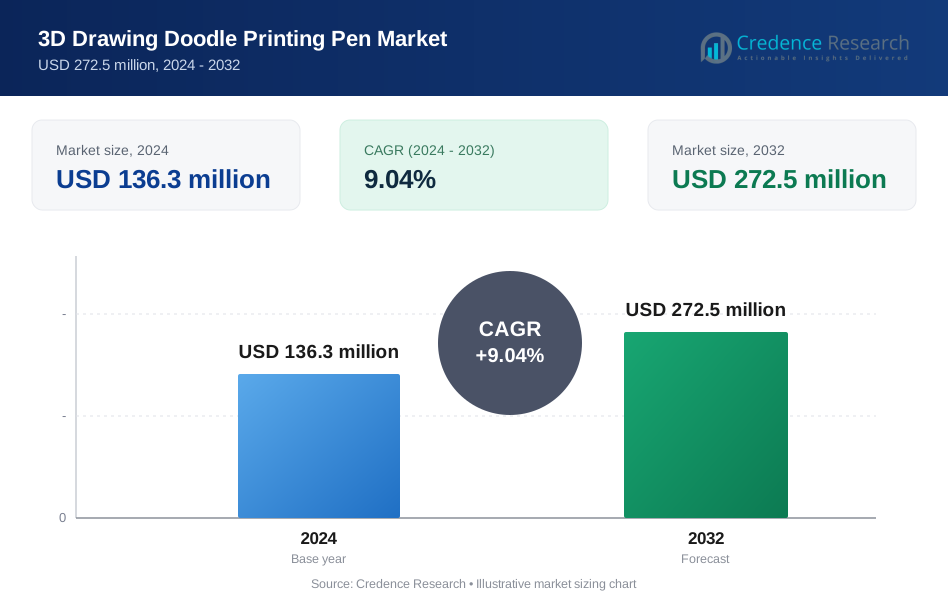
3D Drawing Doodle Printing Pen Market size was valued USD 136.3 million in 2024 and is anticipated to reach USD 272.5 million by 2032, at a CAGR of 9.04% during the forecast period.
| REPORT ATTRIBUTE | DETAILS |
|---|---|
| Historical Period | 2020-2023 |
| Base Year | 2024 |
| Forecast Period | 2025-2032 |
| 3D Drawing Doodle Printing Pen Market Size 2024 | USD 136.3 million |
| 3D Drawing Doodle Printing Pen Market , CAGR | 9.04% |
| 3D Drawing Doodle Printing Pen Market Size 2032 | USD 272.5 million |
3D Drawing Doodle Printing Pen Market Insights
- Key market drivers include growing emphasis on STEM education, hands-on learning tools, and increasing acceptance of entry-level additive manufacturing products for creative expression and early prototyping.
- Market trends highlight advances in filament materials, improved temperature control, safer low-heat designs, and better compatibility with PLA-based and specialty filaments, enhancing usability and performance consistency.
- Competitive dynamics are shaped by established digital fabrication players leveraging R&D capabilities, strong brand trust, and ecosystem support to raise quality benchmarks and encourage wider consumer adoption.
- Regionally, North America leads with an exact 38% market share, supported by mature retail channels and STEM programs, while the education segment holds the dominant share due to strong institutional and household demand.
Key Growth Drivers
Expanding Adoption in Education and STEM Learning
Educational institutions increasingly integrate 3D drawing doodle printing pens into classrooms to promote creativity, spatial thinking, and hands-on STEM learning. These tools enable students to visualize concepts in geometry, engineering design, and art through tactile creation rather than abstract theory alone. Their ease of use, affordability compared with full-scale 3D printers, and compatibility with project-based curricula accelerate adoption across primary and secondary education. Growing emphasis on experiential learning, maker spaces, and DIY innovation programs continues to position 3D doodle pens as practical educational aids.
- For instance, Nano Dimension Ltd.’s work in educational and research-focused additive electronics has demonstrated precision material deposition using its DragonFly systems with conductive and dielectric layers as thin as 10 microns, minimum trace widths of 75 microns, and multilayer builds exceeding 20 layers, showcasing the level of fine-scale fabrication accuracy that underpins effective learning tools for electronics, design, and applied engineering education.
Rising Popularity Among Hobbyists and Creative Communities
The growing global community of hobbyists, artists, and DIY enthusiasts strongly drives demand for 3D drawing doodle printing pens. These users value the ability to create freehand three-dimensional structures, prototypes, and customized decorative items without complex software or setup. Social media platforms and online creator communities further amplify awareness by showcasing innovative applications and artistic outcomes. The low entry barrier, portability, and immediate creative feedback make these pens attractive for personal use, fueling consistent consumer demand across both entry-level and advanced models.
- For instance, Stratasys industrial platforms are renowned for their repeatable precision. The F123 Series (F170, F270, F370) maintains a dimensional accuracy of ±0.200 mm (0.008 in).
Product Innovation and Improved Material Safety
Continuous product innovation significantly contributes to market growth, particularly improvements in ergonomics, temperature control, and material compatibility. Manufacturers increasingly focus on non-toxic, low-odor filaments and enhanced thermal regulation to improve user safety, especially for children. Advances in ink and filament formulations enable smoother extrusion, faster cooling, and improved structural stability. These developments reduce operational limitations and expand use cases, supporting broader acceptance among parents, educators, and professional designers seeking safe yet high-performing creative tools.
Key Trends & Opportunities
Integration of Eco-Friendly and Biodegradable Materials
A notable trend in the 3D drawing doodle printing pen market is the shift toward eco-friendly and biodegradable filament materials. Environmentally conscious consumers increasingly prefer sustainable alternatives that reduce plastic waste without compromising performance. This trend creates opportunities for manufacturers to differentiate products through green material offerings and recyclable packaging. As sustainability becomes a purchasing criterion, brands that invest in bio-based filaments and responsible sourcing are well positioned to capture environmentally driven demand across education and consumer segments.
- For instance, Colibrium Additive’s multi-laser M Line metal additive platform has been enhanced to support a build envelope of 500 × 500 × 400 millimeters, enabling the production of large structural components with tight process control; these systems utilize harmonized laser arrays to maintain part quality while accelerating build rates.
Growth of Customization and Personalization Applications
Customization represents a major opportunity as consumers seek personalized accessories, educational models, and artistic creations. 3D doodle pens allow users to rapidly customize shapes, colors, and designs in real time, supporting applications such as personalized gifts, fashion embellishments, and home décor. This flexibility aligns with broader consumer trends favoring unique, user-created products. Manufacturers can capitalize by offering multi-color ink systems, interchangeable nozzles, and advanced control features tailored for personalized creative expression.
- For instance, Materialise NV has documented strong adoption of its software ecosystem that supports these distributed digital workflows, including the CO-AM Software Platform and Magics 3D Print Suite, with over 6,350 active Magics software users worldwide and more than 2.1 million parts printed through its Manufacturing Services in a single recent year, showcasing its ability to scale digital fabrication services and platform-enabled e-commerce offerings across global user communities.
Expansion Through E-Commerce and Direct-to-Consumer Channels
The rapid expansion of e-commerce platforms has improved global accessibility of 3D drawing doodle printing pens. Direct-to-consumer sales models enable manufacturers to reach niche creative audiences, offer bundled kits, and provide instructional content alongside products. Online distribution also supports faster product launches and customer feedback integration. This trend presents opportunities for market players to strengthen brand visibility, enhance user engagement, and scale internationally without heavy reliance on traditional retail infrastructure.
Key Challenges
Limited Precision Compared to Conventional 3D Printing
Despite their versatility, 3D drawing doodle printing pens face limitations in precision and structural consistency compared with conventional desktop 3D printers. Freehand operation depends heavily on user skill, leading to variability in output quality. This constraint restricts adoption in applications requiring high dimensional accuracy or repeatability. For professional prototyping or industrial use cases, these limitations can reduce perceived value, posing a challenge for manufacturers seeking to expand beyond hobbyist and educational segments.
Material Constraints and Thermal Management Issues
Material compatibility and thermal management remain key challenges in the market. Inconsistent temperature control can result in filament clogging, uneven extrusion, or weak bonding between layers. Additionally, the limited range of compatible inks and filaments restricts functional applications. Addressing these issues requires ongoing investment in print head design, heating elements, and advanced material formulations. Failure to resolve performance reliability concerns may hinder user satisfaction and slow repeat purchases in competitive consumer markets.
Regional Analysis
North America
North America leads the 3D drawing doodle printing pen market, accounting for approximately 32% of global demand, supported by strong adoption across education, hobbyist, and DIY segments. High penetration of STEM-based learning programs, well-established maker communities, and widespread availability of creative tools drive consistent sales. Consumers in the U.S. and Canada show strong interest in premium and child-safe products, encouraging innovation in ergonomic design and non-toxic materials. Robust e-commerce infrastructure and active online creator communities further support market expansion, reinforcing North America’s leadership position.
Europe
Europe represents around 27% of the global market, driven by strong emphasis on creative education, arts and crafts, and sustainability-focused product adoption. Countries such as Germany, the UK, and France активно integrate 3D doodle pens into schools, workshops, and design studios. Demand is further supported by consumer preference for eco-friendly filaments and compliance with strict safety standards. The region benefits from well-developed retail and online distribution networks, while growing interest in personalization and DIY home décor sustains steady market growth across both Western and Northern Europe.
Asia-Pacific
Asia-Pacific holds nearly 29% market share and represents the fastest-growing regional market for 3D drawing doodle printing pens. Rapid expansion of the education sector, rising disposable incomes, and increasing popularity of creative hobbies among younger populations strongly support demand. China, Japan, and South Korea drive innovation and manufacturing scale, while India and Southeast Asia contribute through expanding school infrastructure and online retail adoption. Cost-effective product offerings and large consumer bases enable high-volume sales, positioning Asia-Pacific as a key growth engine for the global market.
Latin America
Latin America accounts for approximately 7% of the global market, supported by gradual adoption in educational institutions and growing interest in creative learning tools. Brazil and Mexico are key contributors, benefiting from expanding middle-class populations and improving access to affordable creative products. While price sensitivity remains a constraint, demand for entry-level 3D doodle pens continues to rise through online marketplaces and educational programs. Increasing focus on hands-on learning and art-based skill development creates long-term growth potential across the region.
Middle East & Africa
The Middle East & Africa region holds around 5% market share, reflecting early-stage but steadily improving adoption of 3D drawing doodle printing pens. Growth is supported by educational modernization initiatives, particularly in the Gulf countries, where investments in STEM learning and digital classrooms are increasing. In Africa, demand remains limited but is gradually expanding through low-cost products and NGO-supported education programs. Rising awareness of creative technologies and improved access to e-commerce platforms are expected to support incremental market development across the region.
3D Drawing Doodle Printing Pen Market Segmentations:
- By Sales Channel
- Online Retail
- Offline Retail
- Direct Sales
- By User Group
- Children
- Artists and Designers
- Students
- DIY Hobbyists
- Educational Institutions
- By Material
- PLA Filament
- ABS Filament
- PCL Filament
- Others
- By Power Mode
- Rechargeable Battery
- USB Powered
- AC Powered
- By Price Category
- Entry-Level
- Mid-Range
- Premium
- By Product Format
- Single Pen
- Multi-Pen
- By Technology
- Fused Filament Fabrication
- Stereolithography
- Selective Laser Sintering
By Geography
- North America
- U.S.
- Canada
- Mexico
- Europe
- Germany
- France
- U.K.
- Italy
- Spain
- Rest of Europe
- Asia Pacific
- China
- Japan
- India
- South Korea
- South-east Asia
- Rest of Asia Pacific
- Latin America
- Brazil
- Argentina
- Rest of Latin America
- Middle East & Africa
- GCC Countries
- South Africa
- Rest of the Middle East and Africa
Competitive Landscape
The competitive landscape of the 3D Drawing Doodle Printing Pen Market players such as Voxeljet AG, HP Inc., Nano Dimension Ltd., EOS (Electro Optical Systems) GmbH, Stratasys Ltd., Shapeways, Inc., GE Additive, Materialise NV, 3D Systems, Inc., Proto Labs, Inc. the 3D Drawing Doodle Printing Pen Market is characterized by a mix of technology-driven innovation, design differentiation, and ecosystem support rather than direct price competition.
Market participants focus on improving ease of use, safety features, and material performance to expand adoption across education, hobbyist, and entry-level prototyping segments. Advancements in temperature control, filament versatility, and ergonomic design enhance product reliability and user experience. Competition also extends to software compatibility and access to digital design resources that simplify creative workflows.
Strong emphasis on research and development supports continuous refinement of extrusion precision and material stability. Additionally, indirect competition from broader additive manufacturing platforms influences product expectations and quality benchmarks. Overall, success in this market depends on the ability to translate advanced manufacturing capabilities into intuitive, affordable tools while maintaining consistent performance and regulatory compliance.
Key Player Analysis
3DSimo Shenzhen Dewang High-tech 7Tech WobbleWorks (3Doodler) LIX PEN LTD Scribbler FUTURE MAKE Technology Myriwell MYNT3D CreoPop XYZprinting Zhuhai Sunlu Industrial Lay3r SoyanRecent Developments
- In November 2025, BCN3D Omega I60 G2, a significant industrial FFF 3D printer launched by BCN3D building on the original I60 with AI calibration, new G2 printheads, a large 450x300x450mm build volume, and a heated chamber with a camera for advanced, reliable manufacturing of large parts, tooling, and end-use components.
- In September 2024, Artisan Colour acquired digital marketing agency MarComm to become a fully integrated print and digital marketing provider, merging their expertise to offer seamless, cross-channel campaigns, leveraging data and technology for unified marketing impact, a move noted by industry publications as a significant step in the evolving print-digital landscape.
- In May 2024, Canon and Heidelberg collaborated to integrate inkjet printing solutions into the commercial printing industry. Heidelberg will integrate Canon's B2 and B3 sheetfed inkjet presses into their Prinect workflow.
Future Outlook
- Adoption will expand steadily across education, DIY, and maker communities as hands-on learning gains prominence.
- Product designs will prioritize improved safety mechanisms, especially for child and classroom use.
- Material innovation will focus on low-temperature, biodegradable, and specialty filaments.
- Integration with mobile apps and basic design software will enhance ease of use and creativity.
- Demand will increase for lightweight, ergonomic pens that support longer usage durations.
- Manufacturers will emphasize consistent extrusion control to improve drawing accuracy.
- Customization options such as interchangeable nozzles and speed settings will become standard.
- Online tutorials and digital content ecosystems will play a larger role in customer engagement.
- Emerging markets will see higher penetration driven by affordability and educational initiatives.
- Sustainability considerations will influence material sourcing, packaging, and product lifecycle design.
Request a Free Sample
Fill in your details and we'll send you a free sample report.
- Sample data tables & charts
- Research methodology
Need a Custom Version of This Report?
Tailor the scope, geography, or segments to your exact requirements.
- Custom geography or segment scope
- Direct access to our analyst team
Frequently Asked Questions
What is the current market size for the 3D Drawing Doodle Printing Pen Market, and what is its projected size in 2032?
At what Compound Annual Growth Rate is the 3D Drawing Doodle Printing Pen Market projected to grow between 2024 and 2032?
Which 3D Drawing Doodle Printing Pen Market segment held the largest share in 2024?
What are the primary factors fueling the growth of the 3D Drawing Doodle Printing Pen Market?
Who are the leading companies in the 3D Drawing Doodle Printing Pen Market?
Which region commanded the largest share of the 3D Drawing Doodle Printing Pen Market in 2024?
Table of Content
Chapter 1. Report Introduction
- 1.1 Report Description & Purpose
- 1.1.1 Report Title & Market Definition
- 1.1.2 Unique Selling Propositions (USP) & Key Differentiators
- 1.1.3 Value Proposition for Stakeholders
- 1.2 Research Objectives
- 1.2.1 Market Sizing Objectives (Volume & Revenue) (Volume Where Applicable)
- 1.2.2 Segmentation Objectives
- 1.2.3 Competitive Intelligence Objectives
- 1.2.4 Forecast & Scenario Objectives
- 1.3 Report Scope
- 1.3.1 3D Drawing Doodle Printing Pen Scope – Segments & Subsegments Covered
- 1.3.2 Geographic Scope – Regions & Countries Covered
- 1.3.3 Historical Period, Base Year & Forecast Period (2024; forecast to 2032)
- 1.3.4 Inclusions & Exclusions
- 1.4 Industry Classification & Applicable Codes
- 1.5 Currency, Measurement Units & Valuation Basis
- 1.6 Target Stakeholders
- 1.7 Limitations & Assumptions
Chapter 2. Executive Summary
- 2.1 Global 3D Drawing Doodle Printing Pen Market Snapshot
- 2.1.1 Market Size – Historical (2024) & Forecast (2024-2032) (2024: USD 136.3 million → 2032: USD 272.5 million)
- 2.1.2 Volume & Revenue – Global Totals (Volume Where Applicable)
- 2.1.3 Key Market Highlights – Top Five Facts
- 2.2 3D Drawing Doodle Printing Pen Market Segmentation Snapshot
- 2.2.1 Market Split by Region – 2024 vs. 2032
- 2.3 Competitive Snapshot
- 2.3.1 Top 10 Players by Revenue Share – 2024
- 2.3.2 Top 10 Players by Volume Share – 2024 (Volume Where Applicable)
- 2.3.3 Recent Strategic Developments (18-Month Summary)
- 2.4 Key Investment Highlights & Strategic Conclusions
Chapter 3. 3D Drawing Doodle Printing Pen Market Dynamics & Industry Analysis
- 3.1 Market Overview & Context
- 3.1.1 3D Drawing Doodle Printing Pen Market Position in the Broader Industry Value Chain
- 3.1.2 Demand Structure & Purchasing Dynamics
- 3.1.3 Market Maturity & Development Stage by Region
- 3.2 3D Drawing Doodle Printing Pen Market Drivers
- 3.3 3D Drawing Doodle Printing Pen Market Restraints & Challenges
- 3.4 3D Drawing Doodle Printing Pen Market Opportunities
- 3.5 Porter's Five Forces Analysis
- 3.5.1 Threat of New Entrants
- 3.5.2 Bargaining Power of Suppliers
- 3.5.3 Bargaining Power of Buyers
- 3.5.4 Threat of Substitutes
- 3.5.5 Competitive Rivalry – Intensity Assessment
- 3.6 3D Drawing Doodle Printing Pen Value Chain Analysis
- 3.6.1 Upstream – Key Inputs, Resources & Suppliers
- 3.6.1.1 Key Input/Resource 1
- 3.6.1.2 Key Input/Resource 2
- 3.6.1.3 Key Input/Resource 3
- 3.6.2 Midstream – Core Operations & Value Creation
- 3.6.2.1 Operating Model & Process Overview
- 3.6.2.2 Key Operating Locations & Capabilities by Company
- 3.6.3 Downstream – Market Channels & End Users
- 3.6.3.1 Direct Sales & Customer Engagement Channels
- 3.6.3.2 Indirect Sales, Intermediaries & Partner Channels
- 3.6.4 Value Chain Profitability Analysis
- 3.6.1 Upstream – Key Inputs, Resources & Suppliers
- 3.7 PESTEL Analysis
- 3.7.1 Political Factors
- 3.7.2 Economic Factors
- 3.7.3 Social Factors
- 3.7.4 Technological Factors
- 3.7.5 Environmental Factors
- 3.7.6 Legal Factors
- 3.8 3D Drawing Doodle Printing Pen Supply Chain Analysis
- 3.8.1 Critical Input & Resource Availability Risk Assessment
- 3.8.2 Supplier & Operational Concentration Risk (Geographic Exposure)
- 3.8.3 Supply & Service Disruption Impact Analysis
- 3.9 Regulatory & Policy Landscape
Note: The regulatory and policy landscape section covers regulations based on their applicability to the market, 3D Drawing Doodle Printing Pen category, geography, and scope of the study. Only regulatory frameworks with a material impact on operations, compliance, trade, sustainability, or market access are analyzed in detail.
Chapter 4. Key Investment Pockets & Opportunity Analysis
- 4.1 3D Drawing Doodle Printing Pen Market Attractiveness Analysis
- 4.1.1 By Region – Investment Attractiveness Matrix (Market Size × CAGR)
- 4.2 Absolute Revenue Growth Opportunity
- 4.2.1 By Region – Absolute Revenue Growth Through 2032
- 4.3 Incremental Demand Opportunity
- 4.3.1 By Region – Incremental Demand Through 2032
- 4.3.2 Segment – Incremental Demand
- 4.4 Emerging Submarket Opportunity Deep Dive (Subject to Applicability)
- 4.5 Priority Market Opportunity Scorecards
- 4.5.1 United States
- 4.5.2 Europe
- 4.5.3 Asia
- 4.5.4 Middle East & Africa
Note: Priority market opportunity scorecards reflect the geographic scope and strategic relevance of the study. Listed markets are indicative and may be adapted to the industry.
Chapter 5. 3D Drawing Doodle Printing Pen Cross-Border Trade & Market Access Analysis
- 5.1 International Trade & Cross-Border Activity Overview
- 5.1.1 Global Export Value by Country (2024)
- 5.1.2 Global Export Volume by Country (2024) (Volume Where Applicable)
- 5.1.3 Global Import Value by Country (2024)
- 5.1.4 Global Import Volume by Country (2024) (Volume Where Applicable)
- 5.1.5 Net Trade Balance by Country (2024)
- 5.2 Export Analysis – Segment
- 5.2.1 Category 1 (Applicable Classification Code)
- 5.2.2 Category 2 (Applicable Classification Code)
- 5.2.3 Category 3 (Applicable Classification Code)
- 5.2.4 Category 4 (Applicable Classification Code)
- 5.2.5 Category 5 (Applicable Classification Code)
- 5.3 Import Analysis – Segment
- 5.3.1 Category 1 (Applicable Classification Code)
- 5.3.2 Category 2 (Applicable Classification Code)
- 5.3.3 Category 3 (Applicable Classification Code)
- 5.3.4 Category 4 (Applicable Classification Code)
- 5.3.5 Category 5 (Applicable Classification Code)
- 5.4 Cross-Border Pricing & Transaction Benchmarks
- 5.4.1 Export Pricing – Segment & Country
- 5.4.2 Import Pricing – Segment & Source Country
- 5.4.3 Price Trends (2024)
- 5.5 Key Cross-Border Trade & Delivery Routes
- 5.5.1 Cross-Border Trade/Delivery Route 1
- 5.5.2 Cross-Border Trade/Delivery Route 2
- 5.5.3 Cross-Border Trade/Delivery Route 3
- 5.5.4 Cross-Border Trade/Delivery Route 4
- 5.5.5 Cross-Border Trade/Delivery Route 5
- 5.6 Trade Policy & Market Access Impact Assessment
- 5.6.1 Tariff & Non-Tariff Barriers
- 5.6.2 Regional Trade & Economic Integration Frameworks
- 5.6.3 Bilateral & Multilateral Trade Agreements
- 5.6.4 Cross-Border Operating, Licensing & Localization Requirements
Note: This chapter applies where cross-border trade or delivery is relevant to 3D Drawing Doodle Printing Pen. Goods, services, and digital offerings are assessed using applicable classifications and transaction measures. Import-export volumes, trade balances, and route analyses are included only where meaningful to the market.
Chapter 6. Competitive Landscape & Company Benchmarking
- 6.1 3D Drawing Doodle Printing Pen Market Concentration & Structure
- 6.1.1 Herfindahl-Hirschman Index (HHI) – vs. 2024
- 6.1.2 Leading, Mid-Sized & Emerging Player Structure
- 6.1.3 Global, Regional & Local Player Dynamics
- 6.2 3D Drawing Doodle Printing Pen Market Share Analysis – 2024
- 6.2.1 Global Revenue Share by Company
- 6.2.2 Global Volume Share by Company (Volume Where Applicable)
- 6.2.3 Regional Revenue Share
- 6.2.4 Market Share Evolution ( vs. 2024)
- 6.2.5 Company Market Share by Key Segment
- 6.2.6 Company Market Share by Customer Group
- 6.3 Operating Scale, Capacity & Infrastructure Analysis
- 6.3.1 Global Operating Scale & Supply Capacity
- 6.3.2 Resource Utilization & Operating Efficiency
- 6.3.3 Output, Service Delivery & Activity Metrics
- 6.3.4 Operating Footprint & Infrastructure Map
- 6.3.5 Planned Operational & Capacity Expansion
- 6.4 3D Drawing Doodle Printing Pen Competitive Benchmarking Matrix
- 6.4.1 Revenue, Growth, Profitability & Operating Metric Comparison
- 6.4.2 Channel Revenue Mix
- 6.4.3 Geographic Revenue Exposure
- 6.4.4 R&D Intensity
- 6.4.5 Sustainability Maturity
- 6.5 Strategic Developments in 3D Drawing Doodle Printing Pen (Last 24 Months)
- 6.5.1 Mergers, Acquisitions & Divestments
- 6.5.2 New Products, Services & Solutions in 3D Drawing Doodle Printing Pen
- 6.5.3 Operational & Infrastructure Expansions
- 6.5.4 Strategic Alliances, Joint Ventures & Partnerships
- 6.5.5 Distribution Expansion & Market Entry
- 6.5.6 Sustainability & ESG Initiatives
- 6.6 Competitive Strategy Mapping
- 6.6.1 Leader, Challenger, Follower & Niche Classification
- 6.6.2 Pricing Strategy Comparison
- 6.6.3 Channel Strategy Matrix
Note: Strategic developments are included based on their materiality and the availability of reliable information.
Chapter 7. Global 3D Drawing Doodle Printing Pen Market – By Sales & Delivery Channel
- 7.1 Segment Overview
- 7.1.1 Volume & Revenue Split by Channel (2024 & 2032) (Volume Where Applicable)
- 7.1.2 Channel Mix Evolution (2024-2032)
Chapter 8. Regional Market Analysis – Global Overview
- 8.1 Global Regional Overview
- 8.1.1 Regional Volume Share (Volume Where Applicable)
- 8.1.2 Regional Revenue Share
- 8.1.3 Regional Volume by Region (Volume Where Applicable)
- 8.1.4 Regional Revenue by Region
- 8.1.5 Regional Forecast Through 2032
- 8.2 Cross-Regional Segment Analysis
- 8.2.1 By Sales & Delivery Channel
- 8.2.2 By Competitive Positioning & Price Tier
Chapter 9. North America 3D Drawing Doodle Printing Pen Market
- 9.1 United States
- 9.2 Canada
- 9.3 Mexico
Chapter 10. Europe 3D Drawing Doodle Printing Pen Market
- 10.1 Germany
- 10.2 France
- 10.3 Italy
- 10.4 United Kingdom
- 10.5 Spain
- 10.6 Poland
- 10.7 Russia
- 10.8 Netherlands
- 10.9 Belgium
- 10.10 Sweden
- 10.11 Denmark
- 10.12 Norway
- 10.13 Rest of Europe
Chapter 11. Asia Pacific 3D Drawing Doodle Printing Pen Market
- 11.1 China
- 11.2 India
- 11.3 Japan
- 11.4 South Korea
- 11.5 Thailand
- 11.6 Indonesia
- 11.7 Vietnam
- 11.8 Malaysia
- 11.9 Australia
- 11.10 Rest of Asia Pacific
Chapter 12. Latin America 3D Drawing Doodle Printing Pen Market
- 12.1 Brazil
- 12.2 Argentina
- 12.3 Colombia
- 12.4 Chile
- 12.5 Rest of Latin America
Chapter 13. Middle East 3D Drawing Doodle Printing Pen Market
- 13.1 Saudi Arabia
- 13.2 United Arab Emirates
- 13.3 Turkey
- 13.4 Israel
- 13.5 Iran
- 13.6 Rest of the Middle East
Chapter 14. Africa 3D Drawing Doodle Printing Pen Market
- 14.1 South Africa
- 14.2 Egypt
- 14.3 Nigeria
- 14.4 Morocco
- 14.5 Rest of Africa
Chapter 15. 3D Drawing Doodle Printing Pen Company Profiles
- 15.1 [Company 01]
- 15.1.1 Company Overview
- 15.1.2 Key Management Personnel
- 15.1.3 Products & Services Portfolio
- 15.1.4 Financial Performance
- 15.1.5 Key Market Focus & Geographic Presence
- 15.1.6 Recent Developments & Strategic Initiatives
Note: The company profile list is preliminary and may change based on research findings, market developments, data availability, and client requirements.
Chapter 16. Appendices
- Appendix A – List of Abbreviations & Acronyms
- Appendix B – Industry Classification Code Reference – Full Series
- Appendix C – Supply, Output & Operating Capacity Data Tables
- Appendix D – End-Use & Demand Base Tables
- Appendix E – Demand, Adoption & Usage Assumptions
- Appendix F – Pricing & Revenue Metric Reference Tables
- Appendix G – Company Operations & Infrastructure Database
- Appendix H – Cross-Border Trade & Activity Data Tables (Where Applicable)
- Appendix I – Regulatory Summary Tables
- Appendix J – Primary Research Participant List (Anonymized)
- Appendix K – Primary Research Questionnaire Framework
- Appendix L – Data Sources & Bibliography
- Appendix M – Market Size Divergence & Source Comparison
Chapter 17. Research Methodology
- 17.1 Research Framework & Philosophy
- 17.2 Secondary Research – Sources, Hierarchy & Data Extraction
- 17.3 Data Modeling – Bottom-Up & Top-Down Market Sizing
- 17.4 Primary Research – Stakeholder Framework, LOI & Sample Sizes
- 17.5 Forecast Methodology – Regression, Scenario & Sensitivity Analysis
- 17.6 Quality Control – Four-Layer Validation Framework
- 17.7 Limitations & Standard Assumptions
- 17.8 Disclaimer
