
Acute Myeloid Leukemia (AML) Therapeutics Market Overview:
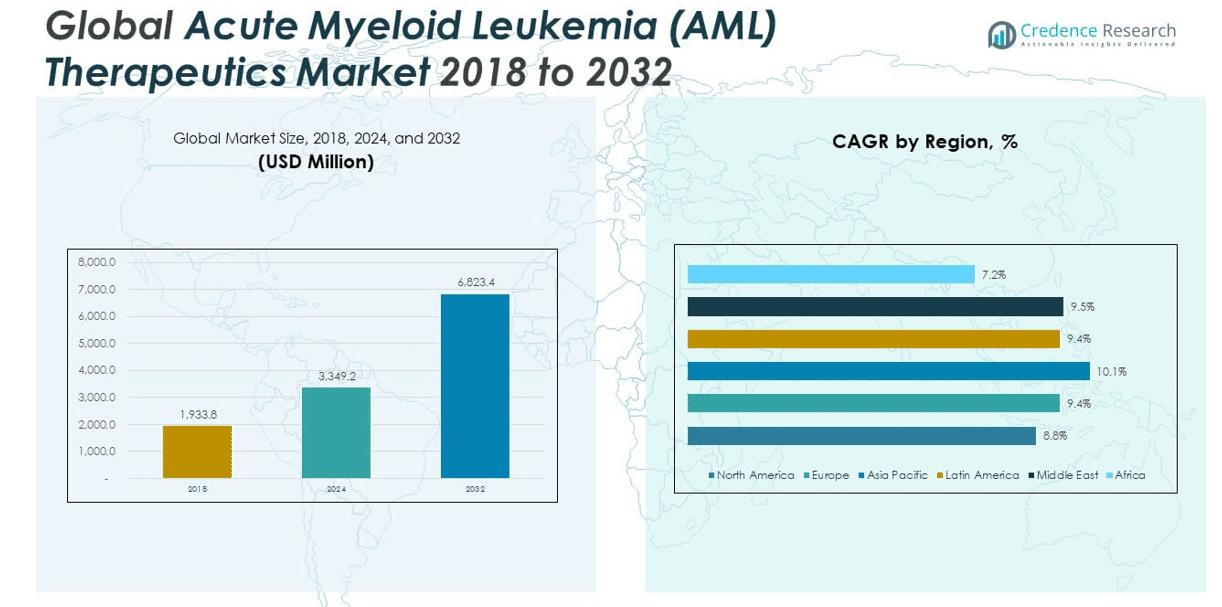
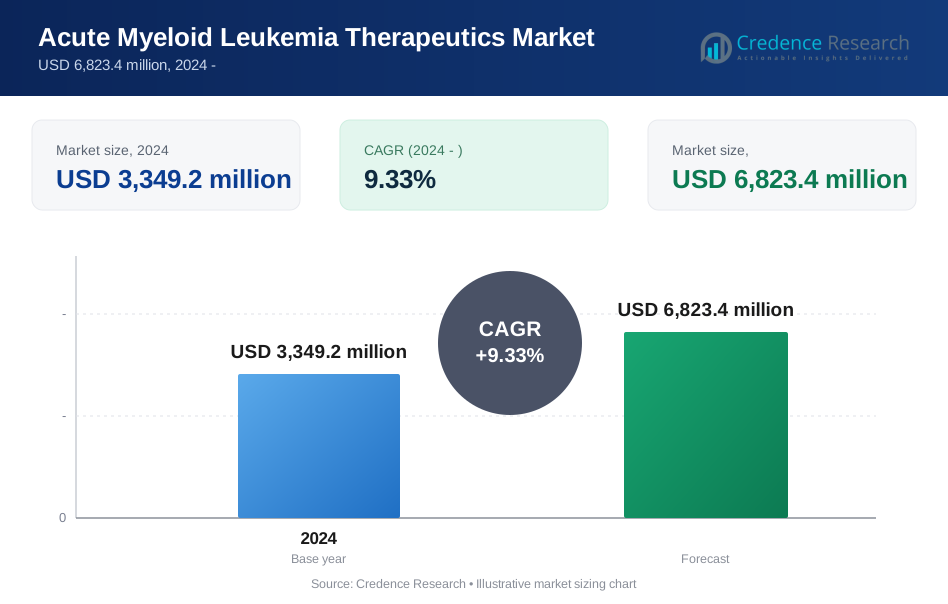
The Global Acute Myeloid Leukemia (AML) Therapeutics Market size was valued at USD 1,933.8 million in 2018 to USD 3,349.2 million in 2024 and is anticipated to reach USD 6,823.4 million by 2032, at a CAGR of 9.33% during the forecast period.
| REPORT ATTRIBUTE | DETAILS |
|---|---|
| Historical Period | 2020-2023 |
| Base Year | 2024 |
| Forecast Period | 2025-2032 |
| Acute Myeloid Leukemia (AML) Therapeutics Market Size 2024 | USD 3,349.2 million |
| Acute Myeloid Leukemia (AML) Therapeutics Market, CAGR | 9.33% |
| Acute Myeloid Leukemia (AML) Therapeutics Market Size 2032 | USD 6,823.4 million |
Focused investment in targeted therapies, ageing demographics, and shifting clinical preferences fuel market expansion. Pharmaceutical companies are advancing treatments like FLT3, IDH, and BCL‑2 inhibitors, translating molecular insights into precision care. Regulators have accelerated approvals, while diagnostics such as next‑generation sequencing and MRD monitoring improve patient stratification. Venture funding and licensing have surged, supporting innovation. Although chemotherapy persists, the momentum lies in oral targeted combinations that reduce hospitalization, enhance adherence, and prolong survival—particularly among frail and elderly patients. This evolving treatment ecosystem actively shapes the AML therapeutics landscape
North America currently leads AML therapeutics, underpinned by advanced healthcare infrastructure, high R&D investment, and early adoption of novel drugs. The U.S., in particular, dominates due to strong reimbursement policies, extensive clinical trial activity, and high prevalence among older adults. Asia‑Pacific is emerging rapidly, propelled by growing healthcare access, rising incidence, and supportive regulatory reforms. Europe maintains steady growth through collaborative research and pan‑regional frameworks. Meanwhile, Latin America and MEA are gaining momentum, driven by expanding diagnostic capabilities, increasing awareness, and gradual infrastructure improvements. This regional diversification reflects both maturity in developed markets and accelerating potential in emerging economies
Acute Myeloid Leukemia (AML) Therapeutics Market Insights:
- The Global AML Therapeutics Market was valued at USD 3,349.2 million in 2024 and is projected to reach USD 6,823.4 million by 2032, growing at a CAGR of 9.33%.
- Rising AML incidence, particularly among individuals over 60, is expanding the patient base and intensifying demand for age-specific therapeutic options.
- Advancements in molecular diagnostics and next-generation sequencing are enabling targeted treatment strategies based on precise genetic profiling.
- Regulatory bodies are accelerating drug approvals with fast-track and breakthrough designations, boosting early access to novel AML therapies.
- Strategic collaborations among pharma companies, biotech firms, and academic institutions are strengthening clinical pipelines and commercialization reach.
- Drug resistance and disease relapse, especially in patients with adverse cytogenetics, remain significant barriers to long-term remission and treatment durability.
- North America dominates the market due to advanced infrastructure and reimbursement systems, while Asia Pacific is emerging rapidly with rising access and policy support.
Acute Myeloid Leukemia (AML) Therapeutics Market Drivers:
Rising Incidence of AML and Expanding Patient Population Base:
The Global Acute Myeloid Leukemia (AML) Therapeutics Market is influenced by the growing number of newly diagnosed cases, especially among the aging population. AML incidence rises sharply with age, particularly in individuals over 60, who typically exhibit more aggressive disease biology. This demographic trend is expanding the patient pool and driving demand for effective therapies tailored to older patients with comorbidities.
- For instance, Pfizer’s Daurismo (glasdegib) plus low-dose cytarabine (LDAC) received FDA approval for use in older patients (≥75 years) or those with comorbidities ineligible for intensive chemotherapy.
Technological Advancements and New Drug Approvals Fuel Market Expansion:
The emergence of molecular diagnostics and next-generation sequencing is enabling precise AML subtype identification and mutation profiling. These innovations support the development and adoption of targeted therapies. Recent FDA approvals of novel agents such as FLT3 and IDH inhibitors have created a paradigm shift, allowing for customized treatment strategies and improved clinical outcomes.
- For instance, Astellas Pharma’s XOSPATA (gilteritinib), a FLT3 inhibitor, improved survival in relapsed/refractory FLT3-mutated AML in the phase III ADMIRAL trial.
Favorable Regulatory Support and Accelerated Approval Pathways:
Regulatory agencies are providing fast-track designations and breakthrough therapy statuses to AML drugs with high therapeutic potential. Such mechanisms help reduce time to market and provide patients with earlier access to innovative treatments. These incentives are encouraging pharmaceutical companies to invest in AML R&D, supporting market growth.
Collaborative Clinical Trials and Pharmaceutical Partnerships Increase Development Efficiency:
Strategic alliances between biotechnology firms, academic institutions, and pharma companies are facilitating robust clinical pipelines. These collaborations are helping diversify treatment modalities and enhance trial enrollment. Licensing deals and co-development agreements are also enabling global expansion and improved commercialization capabilities.
Acute Myeloid Leukemia (AML) Therapeutics Market Trends:
Personalized Therapies and Mutation-Specific Treatments Gain Traction:
The Global Acute Myeloid Leukemia (AML) Therapeutics Market is witnessing a shift toward precision medicine with treatments tailored to specific genetic abnormalities. FLT3, IDH1/2, and BCL-2 mutations are being exploited for targeted intervention, improving treatment outcomes and reducing systemic toxicity compared to traditional chemotherapy.
- For instance, Agios Pharmaceuticals’ IDHIFA (enasidenib) targets IDH2-mutant relapsed/refractory AML, delivering an overall response rate of 40.3% and a median duration of response of 5.8 months in clinical trials.
Growing Interest in Immunotherapeutic Approaches for AML:
While chemotherapy remains a frontline option, the market is showing increasing interest in immunotherapy. Monoclonal antibodies, immune checkpoint inhibitors, and bispecific T-cell engagers are being evaluated for their potential to harness the immune system to combat AML cells, especially in relapsed/refractory cases.
- For instance, Pfizer’s Mylotarg (gemtuzumab ozogamicin), an antibody-drug conjugate targeting CD33, added to front-line chemotherapy (in the ALFA-0701 phase III trial) led to a 34% reduction in risk of events (hazard ratio 0.66; p=0.006).
Adoption of Combination Regimens to Improve Survival Outcomes:
Combination therapies involving targeted agents, hypomethylating agents, or conventional chemotherapy are gaining clinical acceptance. These regimens aim to overcome resistance mechanisms and prolong remission durations. Ongoing trials are validating multiple drug synergies, which are expected to drive treatment evolution.
Rise in Outpatient and Home-Based Treatment Settings:
The healthcare landscape is gradually transitioning from inpatient to outpatient care, particularly for low-intensity regimens. Oral formulations and subcutaneous delivery methods are supporting home-based management for some patients, increasing treatment accessibility and reducing hospital burden.
Acute Myeloid Leukemia (AML) Therapeutics Market Challenges Analysis:
Persistent Drug Resistance and High Relapse Rates Undermine Long-Term Treatment Outcomes:
The Global Acute Myeloid Leukemia (AML) Therapeutics Market faces a critical challenge in managing relapse and resistance to treatment. Many patients, particularly those with high-risk cytogenetic abnormalities, experience limited or short-lived responses to current therapies. FLT3 and IDH inhibitors have improved early remission rates, but emerging resistance mechanisms often reduce their long-term effectiveness. Disease recurrence remains common, especially in older adults and those unfit for intensive chemotherapy. Limited success in eliminating minimal residual disease continues to hinder curative outcomes. The market must address the urgent need for more durable and adaptive treatment options to counter resistance and prolong survival. It depends heavily on innovative second-line therapies and novel mechanisms of action to reduce relapse rates.
High Treatment Costs and Unequal Access Restrict Market Expansion in Developing Regions:
The Global Acute Myeloid Leukemia (AML) Therapeutics Market also contends with economic barriers that restrict widespread adoption. Advanced treatments, such as targeted agents and immunotherapies, command high prices that challenge both patients and healthcare systems. In low- and middle-income countries, limited reimbursement structures and high out-of-pocket expenses reduce treatment accessibility. Delayed diagnosis and inadequate diagnostic infrastructure further worsen therapeutic outcomes in these regions. Access to precision medicine remains concentrated in high-income markets, creating disparities in clinical outcomes across geographies. It struggles to achieve global equity in care delivery without broader support for infrastructure development, pricing reform, and health policy alignment. Market growth remains uneven unless access barriers are addressed strategically.
Acute Myeloid Leukemia (AML) Therapeutics Market Opportunities:
Expansion of Targeted and Personalized Therapies Creates Pathways for Precision Medicine:
The Global Acute Myeloid Leukemia (AML) Therapeutics Market holds strong potential in expanding targeted and personalized treatment options. Advances in genomics and molecular profiling enable precise identification of mutations such as FLT3, IDH1/2, and TP53, opening avenues for mutation-specific drug development. It benefits from increasing investment in personalized regimens that enhance efficacy while minimizing toxicity. Companies focusing on companion diagnostics and biomarker-driven approaches can capture unmet clinical needs. Rising demand for less intensive, outpatient-compatible therapies among elderly patients strengthens the case for novel oral agents. This shift toward individualized care models supports broader adoption and improved clinical outcomes.
Opportunities Emerge from Growing Clinical Trial Pipelines and Regulatory Support:
The Global Acute Myeloid Leukemia (AML) Therapeutics Market stands to gain from a robust pipeline of investigational agents and global clinical trials. Accelerated approval mechanisms, orphan drug designations, and fast-track programs encourage rapid development of high-potential drugs. It sees increasing interest in combining existing therapies with novel agents, offering new strategies to overcome resistance. Pharmaceutical companies entering regional partnerships can expand their footprint in emerging markets. Rising awareness and early diagnosis also contribute to higher enrollment in clinical studies. These conditions support faster commercialization and long-term growth across diverse patient populations.
Acute Myeloid Leukemia (AML) Therapeutics Market Segmentation Analysis:
By Treatment Type
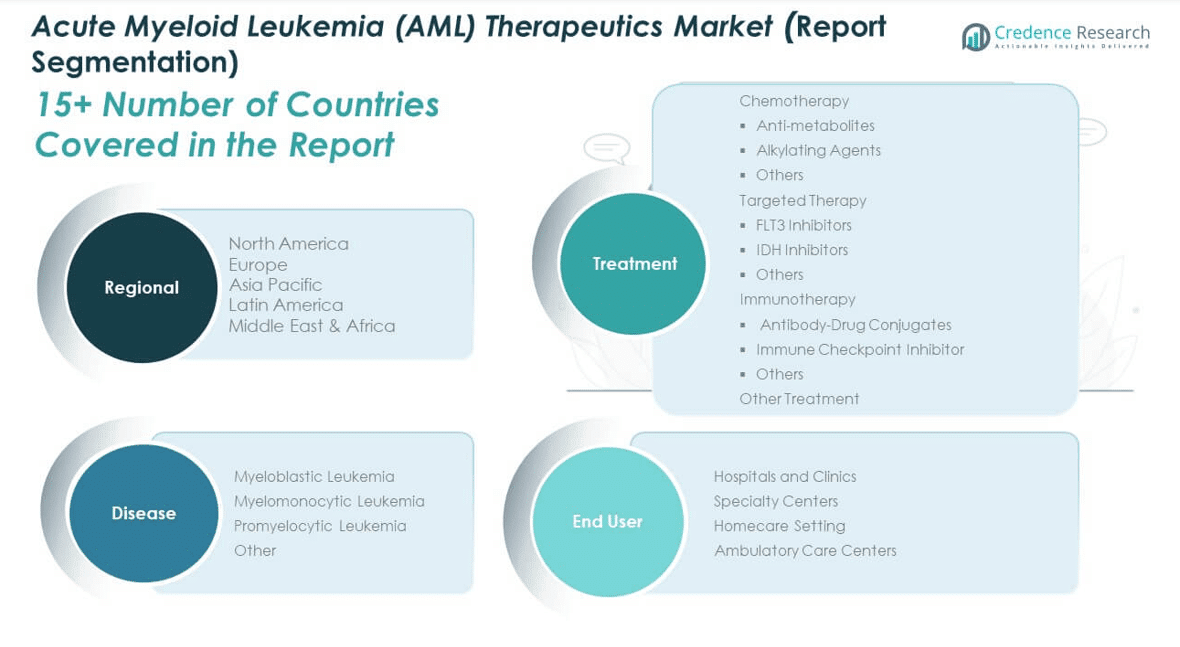
The Global Acute Myeloid Leukemia (AML) Therapeutics Market is segmented by treatment into chemotherapy, targeted therapy, immunotherapy, and other treatments. Chemotherapy remains widely used, especially anti-metabolites and alkylating agents, due to its established role in induction and consolidation phases. Targeted therapy is expanding rapidly, with FLT3 and IDH inhibitors becoming standard for mutation-specific subtypes. These therapies improve survival outcomes and reduce toxicity, especially in older or unfit patients. Immunotherapy is gaining traction, with antibody-drug conjugates and immune checkpoint inhibitors being explored for relapsed or refractory cases. Other treatments include supportive care approaches such as hypomethylating agents and investigational drugs in clinical trials.
- For instance, AbbVie and Genentech’s venetoclax (Venclexta) in combination with azacitidine received FDA approval after the VIALE-A trial showed a complete remission rate of 36.7% versus 17.9% for azacitidine alone in treatment-naïve AML patients ineligible for intensive chemotherapy.
By Disease Type
Based on disease subtype, the market includes myeloblastic leukemia, myelomonocytic leukemia, promyelocytic leukemia, and others. Myeloblastic leukemia holds the largest market share due to its high prevalence and the need for aggressive treatment strategies. Myelomonocytic leukemia presents unique treatment challenges due to overlapping features with chronic myelomonocytic leukemia. Promyelocytic leukemia has shown improved prognosis with the use of ATRA and arsenic trioxide, offering a targeted approach for this subtype. Other rare forms contribute modestly but represent opportunities for niche drug development.
- For instance, Teva’s Trisenox (arsenic trioxide), in combination with all-trans retinoic acid (ATRA), achieved a 2-year event-free survival rate of 97% in patients with newly diagnosed low- to intermediate-risk acute promyelocytic leukemia, as established in phase III clinical trials.
By End User
By end user, the market is divided into hospitals and clinics, specialty centers, homecare settings, and ambulatory care centers. Hospitals and clinics dominate due to access to diagnostic tools and advanced treatment infrastructure. Specialty centers are expanding with the rise of precision oncology and complex treatment regimens. Homecare settings are gradually increasing, supported by the availability of oral therapies and patient preference for home-based care. Ambulatory care centers are gaining relevance by offering cost-effective, outpatient-based therapeutic services for stable AML patients.
Segmentation:
By Treatment
- Chemotherapy (Anti-metabolites, Alkylating Agents, Others)
- Targeted Therapy (FLT3 Inhibitors, IDH Inhibitors, Others)
- Immunotherapy (Antibody-drug Conjugates, Immune Checkpoint Inhibitors, Others)
- Other Treatments
By Disease
- Myeloblastic Leukemia
- Myelomonocytic Leukemia
- Promyelocytic Leukemia
- Others
By End User
- Hospitals and Clinics
- Specialty Centers
- Homecare Settings
- Ambulatory Care Centers
By Region
- North America
- U.S.
- Canada
- Mexico
- Europe
- Germany
- France
- U.K.
- Italy
- Spain
- Rest of Europe
- Asia Pacific
- China
- Japan
- India
- South Korea
- South-east Asia
- Rest of Asia Pacific
- Latin America
- Brazil
- Argentina
- Rest of Latin America
- Middle East & Africa
- GCC Countries
- South Africa
- Rest of the Middle East and Africa
Regional Analysis:
North America
The North America Global Acute Myeloid Leukemia (AML) Therapeutics Market was valued at USD 1,045.13 million in 2024 and is projected to reach USD 2,047.01 million by 2032, growing at a CAGR of 8.8%. It dominates the global market due to strong R&D infrastructure, early access to novel therapies, and favorable reimbursement systems. The United States leads the region, supported by widespread insurance coverage, advanced diagnostic capabilities, and high treatment adoption across leading oncology centers.
Europe
The Europe Global Acute Myeloid Leukemia (AML) Therapeutics Market reached USD 732.03 million in 2024 and is expected to grow to USD 1,498.41 million by 2032 at a CAGR of 9.4%. It benefits from centralized healthcare systems, structured treatment protocols, and broad access to targeted therapies. Germany, France, and the United Kingdom are the key markets, driven by strong clinical research frameworks, government-funded healthcare, and rising public awareness of AML.
Asia Pacific
The Asia Pacific market stood at USD 869.83 million in 2024 and is forecast to reach USD 1,880.52 million by 2032, registering a CAGR of 10.1%. It is expanding rapidly due to growing investments in oncology infrastructure, increasing AML incidence, and greater availability of branded generics. China, Japan, and India lead the region, supported by national cancer control initiatives and improved affordability of targeted therapies.
Latin America
The Latin America AML therapeutics market was valued at USD 378.07 million in 2024 and is projected to grow to USD 773.77 million by 2032 at a CAGR of 9.4%. Brazil and Argentina are the primary contributors, benefiting from enhanced healthcare access and expanding treatment portfolios. Regional clinical trials and global partnerships are further supporting therapeutic adoption.
Middle East
In the Middle East, the market reached USD 182.43 million in 2024 and is estimated to grow to USD 375.97 million by 2032 at a CAGR of 9.5%. Countries in the Gulf Cooperation Council (GCC) are investing heavily in healthcare modernization, which includes the expansion of cancer treatment infrastructure. Improved healthcare policies and increased awareness are driving market development.
Africa
The Africa AML therapeutics market was valued at USD 141.67 million in 2024 and is forecast to reach USD 247.69 million by 2032, growing at a CAGR of 7.2%. It continues to face challenges such as limited infrastructure and low availability of approved drugs. However, support from NGOs and multinational healthcare collaborations is gradually improving access to diagnostics and treatment.
Key Player Analysis:
- Boehringer Ingelheim GmbH
- Abbott
- Bristol Myers Squibb Company
- Celegene Corporation
- Eli Lilly and Company
- Jazz Pharmaceuticals, Inc.
- Novartis AG
- Pfizer Inc.
- Eisai Co. Ltd.
- Other Key Players
Competitive Analysis:
The Global Acute Myeloid Leukemia (AML) Therapeutics Market features a competitive landscape driven by innovation, strategic collaborations, and regulatory approvals. Key players include Novartis AG, AbbVie Inc., Bristol Myers Squibb, Pfizer Inc., Daiichi Sankyo, and Astellas Pharma. These companies focus on expanding their portfolios through targeted therapies such as FLT3 and IDH inhibitors. It sees active pipeline development supported by clinical trials and licensing deals. Strategic mergers and acquisitions enable broader geographic reach and technological advancement. Companies invest heavily in next-generation therapeutics and personalized medicine approaches to gain market share. Competition intensifies as new entrants and biotech firms introduce novel agents and combination regimens aimed at overcoming resistance and improving long-term outcomes. The market remains dynamic with continuous R&D and regulatory activity shaping future competitive positioning.
Recent Developments:
- In April 2025, Pfizer highlighted ongoing research in oncology with new trial data presented at ASCO, including work related to innovative antibody-drug conjugates and immune checkpoint inhibitor combinations. However, as of July 2025, there has been no official launch, acquisition, or major partnership focused exclusively on AML therapeutics.
- In March 2025, Bristol Myers Squibb agreed to acquire its cell therapy partner 2seventy bio for approximately $286 million. This acquisition deepens BMS's capabilities and portfolio in cell therapy for hematologic cancers broadly, though the direct impact on AML therapeutics is not specified. The move solidifies Bristol Myers Squibb’s corporate strategy in the blood cancer domain, with a focus on expanding advanced therapies for serious hematologic conditions.All Celgene assets have been managed under BMS since their previous large-scale acquisition.
- In February 2025, Boehringer Ingelheim announced that its oncology portfolio is advancing with new agents, particularly in immuno-oncology. The company secured FDA priority review for zongertinib (BI 1810631), but this is not an AML-specific development. Boehringer Ingelheim also presented early data on novel therapies targeting the innate immune system, though these clinical candidates have not reached late-stage AML drug launches.No confirmed new AML product launches or acquisitions have been reported in 2025.
Market Concentration & Characteristics:
The Global Acute Myeloid Leukemia (AML) Therapeutics Market demonstrates moderate to high market concentration, with a few large pharmaceutical companies dominating the competitive landscape. It is characterized by high entry barriers due to complex regulatory requirements, intensive R&D costs, and the need for robust clinical trial data. The market is innovation-driven, with companies competing through novel targeted therapies and strategic collaborations. Patent protection and exclusivity periods shape competitive dynamics and pricing power. It also features a strong focus on precision medicine, supported by advancements in molecular diagnostics and biomarker development. Market characteristics include high unmet clinical needs, a growing elderly patient base, and increasing adoption of outpatient care models.
Report Coverage:
The research report offers an in-depth analysis based on treatment, disease type, and end user. It details leading market players, providing an overview of their business, product offerings, investments, revenue streams, and key applications. Additionally, the report includes insights into the competitive environment, SWOT analysis, current market trends, as well as the primary drivers and constraints. Furthermore, it discusses various factors that have driven market expansion in recent years. The report also explores market dynamics, regulatory scenarios, and technological advancements that are shaping the industry. It assesses the impact of external factors and global economic changes on market growth. Lastly, it provides strategic recommendations for new entrants and established companies to navigate the complexities of the market.
Future Outlook:
- Rising AML incidence among aging populations will continue to expand the treatment-eligible patient base globally.
- Targeted therapies and combination regimens will drive long-term market value through improved survival outcomes.
- Increased adoption of oral therapies will support outpatient treatment models and enhance patient adherence.
- Advancements in molecular diagnostics will enable broader use of precision medicine across AML subtypes.
- Regulatory incentives will accelerate the development and approval of high-potential, mutation-specific drugs.
- Emerging markets in Asia Pacific and Latin America will offer growth opportunities through expanded access and infrastructure.
- Strategic alliances between pharma companies and biotech firms will enhance pipeline depth and global reach.
- Development of second-line therapies will address resistance to FLT3, IDH, and other targeted agents.
- Integration of real-world evidence and digital platforms will improve clinical decision-making and trial efficiency.
- Continued focus on cost-effective treatment models will influence pricing strategies and reimbursement policies.
Request a Free Sample
Fill in your details and we'll send you a free sample report.
- Sample data tables & charts
- Research methodology
Need a Custom Version of This Report?
Tailor the scope, geography, or segments to your exact requirements.
- Custom geography or segment scope
- Direct access to our analyst team
Frequently Asked Questions
What is the current size of the Global Acute Myeloid Leukemia (AML) Therapeutics Market?
What are the key segments within the Global Acute Myeloid Leukemia (AML) Therapeutics Market?
What are some challenges faced by the Global Acute Myeloid Leukemia (AML) Therapeutics Market?
Who are the major players in the Global Acute Myeloid Leukemia (AML) Therapeutics Market?
Which region commanded the largest share of the Acute Myeloid Leukemia Therapeutics Market in 2025?
Table of Content
Chapter 1. Report Introduction
- 1.1 Report Description & Purpose
- 1.1.1 Report Title & Market Definition
- 1.1.2 Unique Selling Propositions (USP) & Key Differentiators
- 1.1.3 Value Proposition for Stakeholders
- 1.2 Research Objectives
- 1.2.1 Market Sizing Objectives (Volume & Revenue)
- 1.2.2 Segmentation Objectives
- 1.2.3 Competitive Intelligence Objectives
- 1.2.4 Forecast & Scenario Objectives
- 1.3 Report Scope
- 1.3.1 Acute Myeloid Leukemia Therapeutics Scope – Types & Subtypes Covered
- 1.3.2 Geographic Scope – Regions & Countries Covered
- 1.3.3 Historical Period, Base Year & Forecast Period (2024; forecast to the forecast period)
- 1.3.4 Inclusions & Exclusions
- 1.4 HS Code & Classification Framework
- 1.5 Currency, Units & Pricing Basis
- 1.6 Target Stakeholders
- 1.7 Limitations & Assumptions
Chapter 2. Executive Summary
- 2.1 Global Acute Myeloid Leukemia Therapeutics Market Snapshot
- 2.1.1 Market Size – Historical (2024) & Forecast (the forecast period) (2024: USD 3,349.2 million → forecast year: USD 6,823.4 million)
- 2.1.2 Volume & Revenue – Global Totals
- 2.1.3 Key Market Highlights – Top Five Facts
- 2.2 Acute Myeloid Leukemia Therapeutics Market Segmentation Snapshot
- 2.2.1 Market Split by Region – 2024 vs.
- 2.3 Competitive Snapshot
- 2.3.1 Top 10 Players by Revenue Share – 2024
- 2.3.2 Top 10 Players by Volume Share – 2024
- 2.3.3 Recent Strategic Developments (18-Month Summary)
- 2.4 Key Investment Highlights & Strategic Conclusions
Chapter 3. Acute Myeloid Leukemia Therapeutics Market Dynamics & Industry Analysis
- 3.1 Market Overview & Context
- 3.1.1 Acute Myeloid Leukemia Therapeutics Market Position in the Broader Automotive Value Chain
- 3.1.2 OEM vs. Replacement Market Dynamics
- 3.1.3 Market Maturity & Development Stage by Region
- 3.2 Acute Myeloid Leukemia Therapeutics Market Drivers
- 3.3 Acute Myeloid Leukemia Therapeutics Market Restraints & Challenges
- 3.4 Acute Myeloid Leukemia Therapeutics Market Opportunities
- 3.5 Porter's Five Forces Analysis
- 3.5.1 Threat of New Entrants
- 3.5.2 Bargaining Power of Suppliers
- 3.5.3 Bargaining Power of Buyers
- 3.5.4 Threat of Substitutes
- 3.5.5 Competitive Rivalry – Intensity Assessment
- 3.6 Acute Myeloid Leukemia Therapeutics Value Chain Analysis
- 3.6.1 Upstream – Raw Material/Input Suppliers
- 3.6.1.1 Raw Material/Input 1
- 3.6.1.2 Raw Material/Input 2
- 3.6.1.3 Raw Material/Input 3
- 3.6.2 Midstream – Production/Manufacturing/Service Delivery
- 3.6.2.1 Production/Process Overview
- 3.6.2.2 Key Facility Locations & Capacity by Manufacturer
- 3.6.3 Downstream – Distribution & End Consumer
- 3.6.3.1 Primary Channel – B2B/OEM
- 3.6.3.2 Secondary Channels – Dealer, Retail, Online, Direct
- 3.6.4 Value Chain Profitability Analysis
- 3.6.1 Upstream – Raw Material/Input Suppliers
- 3.7 PESTEL Analysis
- 3.7.1 Political Factors
- 3.7.2 Economic Factors
- 3.7.3 Social Factors
- 3.7.4 Technological Factors
- 3.7.5 Environmental Factors
- 3.7.6 Legal Factors
- 3.8 Acute Myeloid Leukemia Therapeutics Supply Chain Analysis
- 3.8.1 Raw Material/Input Supply Risk Assessment
- 3.8.2 Manufacturing Concentration Risk (Geographic Exposure)
- 3.8.3 Trade Disruption Impact Analysis
- 3.9 Regulatory & Policy Landscape
Note: The regulatory and policy landscape section covers regulations based on their applicability to the market, Acute Myeloid Leukemia Therapeutics category, geography, and scope of the study. Only regulatory frameworks with a material impact on operations, compliance, trade, sustainability, or market access are analyzed in detail.
Chapter 4. Key Investment Pockets & Opportunity Analysis
- 4.1 Acute Myeloid Leukemia Therapeutics Market Attractiveness Analysis
- 4.1.1 By Region – Investment Attractiveness Matrix (Volume × CAGR)
- 4.2 Absolute Revenue Growth Opportunity
- 4.2.1 By Region – Absolute USD Growth Through the forecast period
- 4.3 Incremental Volume Opportunity
- 4.3.1 By Region – Incremental Volume Through the forecast period
- 4.3.2 Segment – Incremental Volume
- 4.4 Emerging Submarket Opportunity Deep Dive (Subject to Applicability)
- 4.5 Emerging Market Opportunity Scorecards
- 4.5.1 United States
- 4.5.2 Europe
- 4.5.3 Asia
- 4.5.4 Middle East & Africa
Note: Emerging Market Opportunity Scorecards will be included based on relevance and strategic importance. Regions listed are indicative and may vary depending on data availability and market dynamics.
Chapter 5. Acute Myeloid Leukemia Therapeutics Import-Export Analysis & Trade Flows
- 5.1 Global Trade Overview
- 5.1.1 Global Export Value by Country (2024)
- 5.1.2 Global Export Volume by Country (2024)
- 5.1.3 Global Import Value by Country (2024)
- 5.1.4 Global Import Volume by Country (2024)
- 5.1.5 Net Trade Balance by Country (2024)
- 5.2 Export Analysis – Segment
- 5.2.1 Type 1 (HS Code)
- 5.2.2 Type 2 (HS Code)
- 5.2.3 Type 3 (HS Code)
- 5.2.4 Type 4 (HS Code)
- 5.2.5 Type 5 (HS Code)
- 5.3 Import Analysis – Segment
- 5.3.1 Type 1 (HS Code)
- 5.3.2 Type 2 (HS Code)
- 5.3.3 Type 3 (HS Code)
- 5.3.4 Type 4 (HS Code)
- 5.3.5 Type 5 (HS Code)
- 5.4 Average Unit Trade Prices
- 5.4.1 Average Export Price – Segment & Country
- 5.4.2 Average Import Price – Segment & Source Country
- 5.4.3 Price Trends (2024)
- 5.5 Key Trade Route Analysis
- 5.5.1 Trade Route 1
- 5.5.2 Trade Route 2
- 5.5.3 Trade Route 3
- 5.5.4 Trade Route 4
- 5.5.5 Trade Route 5
- 5.6 Trade Policy Impact Assessment
- 5.6.1 US Anti-Dumping & Section 301 Tariffs
- 5.6.2 EU Customs Union Impact
- 5.6.3 Major Free Trade Agreements
- 5.6.4 USMCA Rules of Origin
Note: Trade policy analysis will be included only where relevant to the Acute Myeloid Leukemia Therapeutics market.
Chapter 6. Competitive Landscape & Company Benchmarking
- 6.1 Acute Myeloid Leukemia Therapeutics Market Concentration & Structure
- 6.1.1 Herfindahl-Hirschman Index (HHI) – vs. 2024
- 6.1.2 Tier 1, Tier 2 & Tier 3 Market Structure
- 6.1.3 Global, Regional & Local Player Dynamics
- 6.2 Acute Myeloid Leukemia Therapeutics Market Share Analysis – 2024
- 6.2.1 Global Revenue Share by Company
- 6.2.2 Global Volume Share by Company
- 6.2.3 Regional Revenue Share
- 6.2.4 Market Share Evolution ( vs. 2024)
- 6.2.5 OEM Segment Share by Company
- 6.2.6 Replacement Segment Share by Company
- 6.3 Production/Delivery Capacity & Facility Analysis
- 6.3.1 Global Installed Capacity
- 6.3.2 Capacity Utilization Rates
- 6.3.3 Production/Output Volume
- 6.3.4 Facility Locations & Capacity Map
- 6.3.5 Planned Capacity Additions
- 6.4 Acute Myeloid Leukemia Therapeutics Competitive Benchmarking Matrix
- 6.4.1 Revenue, Volume, CAGR & Profitability Comparison
- 6.4.2 Channel Revenue Mix
- 6.4.3 Geographic Revenue Exposure
- 6.4.4 R&D Intensity
- 6.4.5 Sustainability Maturity
- 6.5 Strategic Developments in Acute Myeloid Leukemia Therapeutics (Last 24 Months)
- 6.5.1 Mergers, Acquisitions & Divestments
- 6.5.2 New Acute Myeloid Leukemia Therapeutics Launches
- 6.5.3 Facility Expansions
- 6.5.4 Strategic Alliances, Joint Ventures & Partnerships
- 6.5.5 Distribution Expansion & Market Entry
- 6.5.6 Sustainability & ESG Initiatives
- 6.6 Competitive Strategy Mapping
- 6.6.1 Leader, Challenger, Follower & Niche Classification
- 6.6.2 Pricing Strategy Comparison
- 6.6.3 Channel Strategy Matrix
Note: Strategic developments are included based on their materiality and the availability of reliable information.
Chapter 7. Global Acute Myeloid Leukemia Therapeutics Market – By Distribution Channel
- 7.1 Segment Overview
- 7.1.1 Volume & Revenue Split by Channel (2024 & )
- 7.1.2 Channel Mix Evolution (the forecast period)
Chapter 8. Regional Market Analysis – Global Overview
- 8.1 Global Regional Overview
- 8.1.1 Regional Volume Share
- 8.1.2 Regional Revenue Share
- 8.1.3 Regional Volume by Region
- 8.1.4 Regional Revenue by Region
- 8.1.5 Regional Forecast Through the forecast period
- 8.2 Cross-Regional Segment Analysis
- 8.2.1 By Distribution Channel
- 8.2.2 By Brand/Price Tier
Chapter 9. North America Acute Myeloid Leukemia Therapeutics Market
- 9.1 United States
- 9.2 Canada
- 9.3 Mexico
Chapter 10. Europe Acute Myeloid Leukemia Therapeutics Market
- 10.1 Germany
- 10.2 France
- 10.3 Italy
- 10.4 United Kingdom
- 10.5 Spain
- 10.6 Poland
- 10.7 Russia
- 10.8 Netherlands
- 10.9 Belgium
- 10.10 Sweden
- 10.11 Denmark
- 10.12 Norway
- 10.13 Rest of Europe
Chapter 11. Asia Pacific Acute Myeloid Leukemia Therapeutics Market
- 11.1 China
- 11.2 India
- 11.3 Japan
- 11.4 South Korea
- 11.5 Thailand
- 11.6 Indonesia
- 11.7 Vietnam
- 11.8 Malaysia
- 11.9 Australia
- 11.10 Rest of Asia Pacific
Chapter 12. Latin America Acute Myeloid Leukemia Therapeutics Market
- 12.1 Brazil
- 12.2 Argentina
- 12.3 Colombia
- 12.4 Chile
- 12.5 Rest of Latin America
Chapter 13. Middle East Acute Myeloid Leukemia Therapeutics Market
- 13.1 Saudi Arabia
- 13.2 United Arab Emirates
- 13.3 Turkey
- 13.4 Israel
- 13.5 Iran
- 13.6 Rest of the Middle East
Chapter 14. Africa Acute Myeloid Leukemia Therapeutics Market
- 14.1 South Africa
- 14.2 Egypt
- 14.3 Nigeria
- 14.4 Morocco
- 14.5 Rest of Africa
Chapter 15. Acute Myeloid Leukemia Therapeutics Company Profiles
- 15.1 [Company 01]
- 15.1.1 Company Overview
- 15.1.2 Key Management Personnel
- 15.1.3 Products & Services Portfolio
- 15.1.4 Financial Performance
- 15.1.5 Key Market Focus & Geographic Presence
- 15.1.6 Recent Developments & Strategic Initiatives
Note: The company profile list is preliminary and may change based on research findings, market developments, data availability, and client requirements.
Chapter 16. Appendices
- Appendix A – List of Abbreviations & Acronyms
- Appendix B – Industry Classification Code Reference – Full Series
- Appendix C – Production & Capacity Data Tables
- Appendix D – End-Use & Demand Base Tables
- Appendix E – Consumption & Replacement Rate Assumptions
- Appendix F – ASP Reference Tables
- Appendix G – Manufacturing & Facility Database
- Appendix H – Import-Export Data Tables
- Appendix I – Regulatory Summary Tables
- Appendix J – Primary Research Participant List (Anonymized)
- Appendix K – Primary Research Questionnaire Framework
- Appendix L – Data Sources & Bibliography
- Appendix M – Market Size Divergence & Source Comparison
Chapter 17. Research Methodology
- 17.1 Research Framework & Philosophy
- 17.2 Secondary Research – Sources, Hierarchy & Data Extraction
- 17.3 Data Modeling – Bottom-Up & Top-Down Market Sizing
- 17.4 Primary Research – Stakeholder Framework, LOI & Sample Sizes
- 17.5 Forecast Methodology – Regression, Scenario & Sensitivity Analysis
- 17.6 Quality Control – Four-Layer Validation Framework
- 17.7 Limitations & Standard Assumptions
- 17.8 Disclaimer
