
Aminophylline Market Overview:
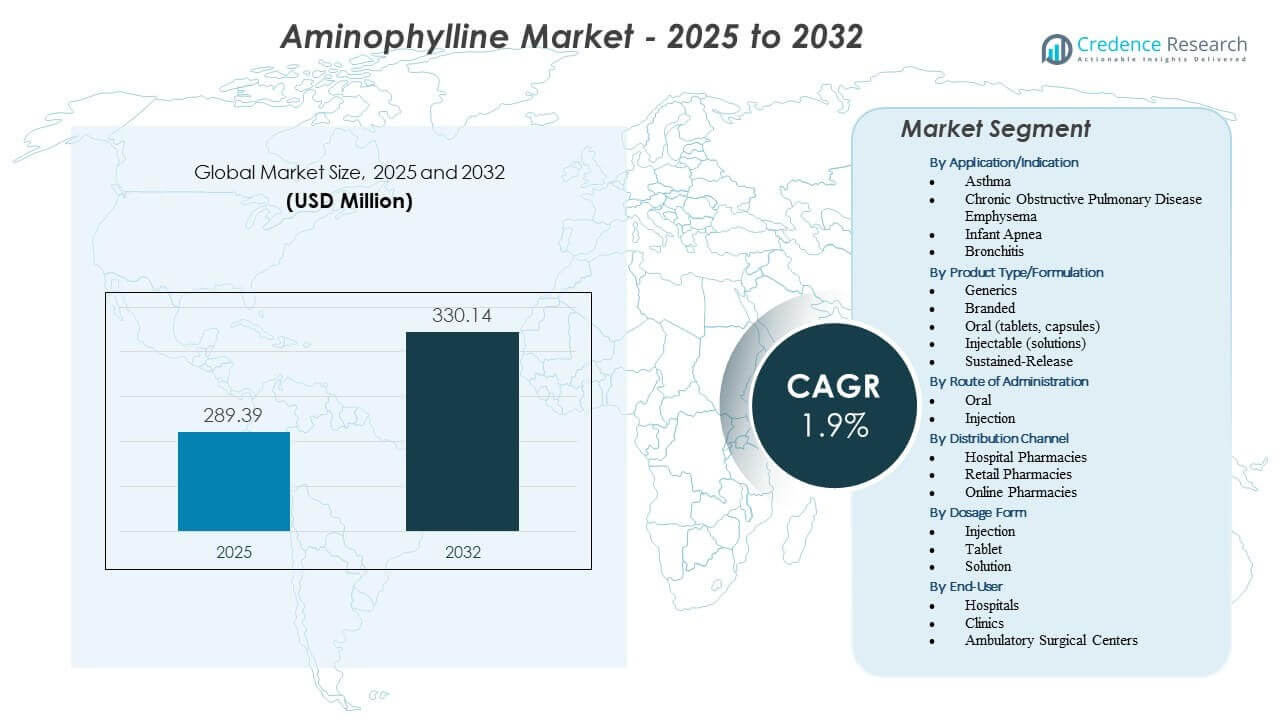
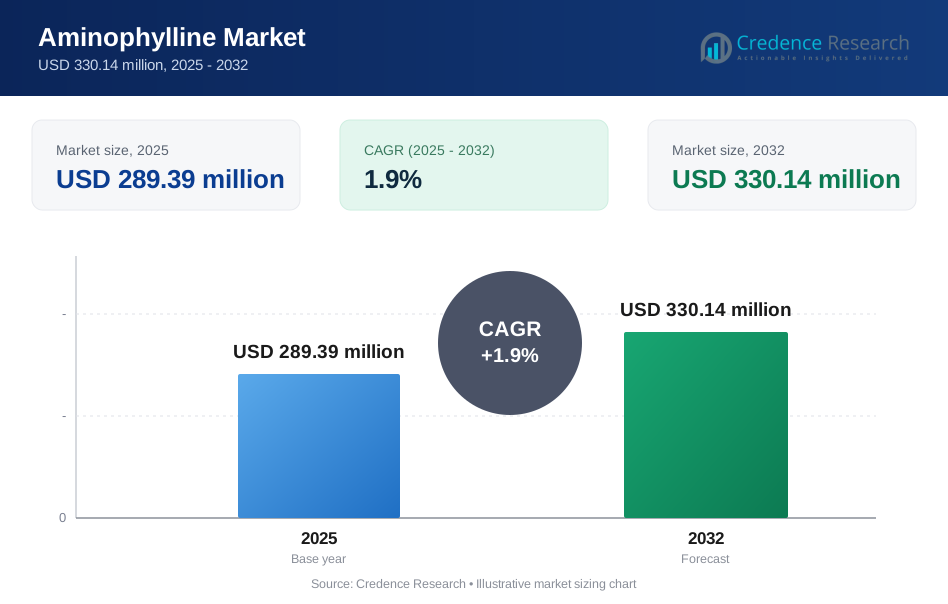
The Aminophylline Market is projected to grow from USD 289.39 million in 2025 to an estimated USD 330.14 million by 2032, with a compound annual growth rate (CAGR) of 1.9% from 2025 to 2032.
| REPORT ATTRIBUTE | DETAILS |
|---|---|
| Historical Period | 2020-2023 |
| Base Year | 2024 |
| Forecast Period | 2025-2032 |
| Aminophylline Market Size 2025 | USD 289.39 million |
| Aminophylline Market, CAGR | 1.9% |
| Aminophylline Market Size 2032 | USD 330.14 million |
Market growth is driven by rising cases of asthma, COPD, and acute bronchospasm that require rapid and reliable bronchodilation during emergencies. Hospitals continue to use aminophylline when inhaled therapies offer limited response, making it a critical adjunct in complex presentations. Increased pollution exposure and higher ICU admissions elevate demand across developing regions. Clinicians value its long-established therapeutic profile and predictable pharmacological action. Broader diagnostic coverage improves identification of severe airway obstruction, supporting ongoing need. Growing attention to steroid-resistant COPD also sustains clinical relevance for xanthine-based therapies.
Regionally, North America leads due to strong emergency care infrastructure and higher awareness of advanced respiratory management protocols. Europe maintains a stable presence supported by structured clinical use and wide availability of generic formulations. Asia Pacific is emerging rapidly as rising COPD and asthma cases expand clinical adoption across hospitals. Latin America shows growing uptake driven by improved access to critical care. Markets in the Middle East and Africa progress gradually as healthcare investment strengthens and essential medicines become more widely distributed.
Aminophylline Market Insights:
- The Aminophylline Market is projected to grow from USD 289.39 million in 2025 to USD 330.14 million by 2032, reflecting a steady 1.9% CAGR driven by its continued clinical relevance in acute respiratory management.
- Demand strengthens due to rising asthma and COPD cases, where aminophylline remains a key adjunct therapy for severe bronchospasm when inhaled bronchodilators provide limited benefit.
- Market restraints include safety concerns linked to narrow therapeutic ranges, the need for serum monitoring, and growing clinician preference for newer bronchodilators with fewer adverse effects.
- North America leads due to advanced emergency care infrastructure, while Europe maintains consistent adoption supported by widespread generic availability and established treatment protocols.
- Asia Pacific shows the fastest growth as COPD and asthma prevalence rises, supported by expanding hospital networks and improved access to essential respiratory medicines across developing countries.
Aminophylline Market Drivers
Rising Respiratory Disease Burden and Demand for Acute Bronchodilation Therapies
The Aminophylline Market benefits from growing cases of asthma and COPD that push hospitals to use fast bronchodilation therapies. Emergency teams rely on aminophylline when inhaled options fail to control severe bronchospasm. Clinicians value its ability to relax airway muscles quickly in critical settings. Rising pollution levels raise respiratory attacks, which strengthens demand across urban centers. It supports care protocols where adjunct bronchodilator therapy remains essential for complex cases. Hospitals integrate aminophylline into treatment paths for patients who show limited response to beta-agonists. ICU units prefer its rapid onset during life-threatening airway obstruction. Wider access to emergency care expands its role across developing countries.
Growing Clinical Preference for Adjunct Therapy in Severe Airflow Limitation
The Aminophylline Market gains momentum from physician preference for adjunct therapy in difficult-to-manage cases. Clinical teams combine aminophylline with inhaled corticosteroids to maximize airflow improvement. It supports treatment in patients with severe bronchoconstriction who need rapid stabilization. Evidence supporting its synergistic effects drives use in acute care decisions. Hospitals prioritize it when alternative bronchodilators deliver suboptimal outcomes. Expanded monitoring standards improve patient safety during intravenous use. Training programs build clinician familiarity with optimal dosing strategies. Broader awareness strengthens acceptance in emergency respiratory care.
- For instance, researchers affiliated with major respiratory science programs, including collaborations historically linked to GlaxoSmithKline (GSK), have published findings showing that methylxanthines such as theophylline can enhance corticosteroid activity by restoring HDAC2 expression in steroid-resistant COPD. This mechanism supports the therapeutic rationale for using aminophylline-class agents as adjuncts in select inflammatory airway conditions.
Expansion of Critical Care Infrastructure Across Developing Regions
The Aminophylline Market benefits from improved emergency and ICU capacity across emerging countries. Governments invest in respiratory care units, which increases demand for essential bronchodilator drugs. It supports care in public hospitals that face rising COPD admissions. Expanding ambulance networks raise the need for rapid-acting medications during transport. Improved diagnostic access leads to higher detection of severe airflow obstruction. Clinical guidelines across many regions still include aminophylline in acute protocols. Rural hospitals adopt it where advanced inhalation systems are limited. Growth in healthcare budgets strengthens availability across broader populations.
Increasing Adoption Supported by Cost Efficiency and Longstanding Clinical Use
The Aminophylline Market sees stable uptake due to its low cost and established clinical safety profile. Many facilities prefer proven drugs for high-acuity respiratory cases. It supports budget-constrained hospitals that require effective bronchodilators with predictable outcomes. Widespread availability increases its use across diverse care settings. Generic production keeps prices accessible for large patient groups. Long history of medical use builds clinician trust during emergency intervention. Ongoing research on xanthine derivatives reinforces clinical relevance. Demand maintains steady levels where resource gaps limit access to newer therapies.
- For instance, Teva Pharmaceutical Industries supplies generic aminophylline formulations that support cost-efficient respiratory care in price-sensitive markets. The company maintains a strong presence in global tender-driven procurement systems, helping hospitals secure reliable access to essential bronchodilator therapies.
Aminophylline Market Trends
Shift Toward Optimized Dosing Protocols and Improved Therapeutic Monitoring
The Aminophylline Market reflects a shift toward improved dosing precision supported by advanced monitoring tools. Hospitals adopt digital pumps for safer infusion control. It helps clinicians maintain therapeutic ranges with lower toxicity risk. Decision-support tools guide dose adjustments based on patient parameters. Many health systems update protocols to strengthen care consistency. Training programs help providers reduce adverse drug interactions. Adoption of standardized guidelines improves quality across regions. Research supports better understanding of drug-response variability.
Growing Integration of Aminophylline in COPD Exacerbation Management Pathways
The Aminophylline Market benefits from updated respiratory guidelines that highlight roles for adjunct bronchodilators. Care teams add aminophylline in cases with severe airflow restriction. It supports emergency relief when patients fail to improve with inhaled medicines. Hospitals include it in stepwise treatment plans for acute COPD flares. Research supports its value in specific patient cohorts needing rapid airway response. Multidisciplinary teams refine use patterns to minimize side effects. Wider patient monitoring strengthens safety across critical settings. Adoption rises in regions with rising COPD prevalence.
Increased Research Interest in Xanthine Derivatives and Combination Therapeutic Approaches
The Aminophylline Market aligns with renewed research into xanthine-based respiratory treatments. Universities study combination therapies to enhance airflow improvement. It supports exploration of synergistic effects with corticosteroids and beta-agonists. Data encourages interest in using legacy drugs with improved precision. Researchers analyze genetic factors influencing bronchodilator response. Pharmacology groups evaluate new formulations with better tolerability. Global studies highlight its potential use in select severe cases. Broader scientific interest maintains relevance in respiratory treatment research.
- For instance, peer-reviewed studies led by researchers at Imperial College London showed that low-dose theophylline, the active xanthine component in aminophylline, increased Histone Deacetylase-2 (HDAC2) activity by more than 50% in COPD cellular models, restoring corticosteroid sensitivity in steroid-resistant patients.
Wider Hospital Protocol Adoption in Emergency Respiratory Care to Standardize Rapid Relief
The Aminophylline Market gains from expanded hospital protocols focused on rapid stabilization. Emergency departments update clinical pathways to guide aminophylline use. It helps teams deliver quick relief in life-threatening bronchospasm. Standardized training improves dosing accuracy among critical care staff. Protocol alignment enhances uniformity across multi-hospital networks. Data tracking supports review of treatment outcomes. Hospitals refine guidance to ensure safe infusion rates. Wider dissemination strengthens clinical confidence.
- For instance, Becton, Dickinson and Company (BD) reports that its Alaris™ infusion pumps equipped with Guardrails® software reduce overall high-risk medication programming errors across hospital networks, improving safety for drugs such as aminophylline that require precise dosing control.
Aminophylline Market Challenges Analysis
Side Effects, Narrow Therapeutic Window, and Need for Skilled Monitoring
The Aminophylline Market faces challenges linked to its narrow therapeutic range, which raises safety concerns. Clinicians must monitor serum levels to avoid toxicity. It demands strong clinical oversight during infusion, limiting use in smaller hospitals. Side effects such as nausea and arrhythmia reduce clinician preference in mild cases. Drug interactions complicate treatment planning for complex patients. Fear of dosing errors lowers adoption among newer practitioners. The drug’s intensive monitoring needs restrict use in low-resource facilities. Regulatory pressure for safer alternatives influences prescribing behavior.
Competition From Newer Bronchodilators and Evolving Clinical Guidelines
The Aminophylline Market experiences pressure from modern bronchodilators that deliver fewer side effects. Many clinicians choose inhaled therapies with better safety profiles. It competes against drugs that require minimal monitoring. Evolving guidelines reduce routine use, especially in moderate asthma cases. Hospitals prioritize treatments with simpler workflows. Pharmaceutical innovation increases availability of targeted therapies. Reduced trust among younger clinicians limits growth. Uncertain reimbursement policies challenge procurement across developing regions.
Aminophylline Market Opportunities
Growing Need for Affordable Acute Bronchodilators in Low-Resource Healthcare Systems
The Aminophylline Market holds strong opportunities in regions seeking cost-effective respiratory solutions. Public hospitals rely on drugs that deliver rapid relief without complex device needs. It supports emergency care systems with limited access to advanced inhalation tools. Rising COPD and asthma rates create larger patient bases needing acute therapy. Expanded diagnostic access increases identification of severe cases. Governments prioritize essential medicines with proven outcomes. Training programs improve clinical confidence in safe dosing. Wider generic production improves availability across underserved areas.
Rising Potential for Formulation Innovation and Optimization of Adjunct Treatment Protocols
The Aminophylline Market benefits from potential innovation in formulation science. Researchers explore options to improve tolerability and simplify dosing. It supports development of controlled-release forms for more stable therapeutic levels. Hospitals show interest in protocols that integrate real-time monitoring tools. Digital infusion systems allow safer delivery during emergencies. Academic collaborations investigate combination regimens that enhance bronchodilation. Growing focus on severe airflow limitation strengthens research funding. Opportunities expand where legacy medicines support unmet clinical needs.
Aminophylline Market Segmentation Analysis:
By Application/Indication
The Aminophylline Market shows strong use across asthma and COPD due to frequent acute exacerbations that require rapid bronchodilation. It supports treatment for emphysema and bronchitis where airflow restriction demands fast intervention. Clinicians rely on aminophylline for infant apnea because it stimulates respiratory drive when other options fall short. Severe cases of respiratory failure and cystic fibrosis gain support from adjunct use in controlled settings. Hospitals integrate it into emergency protocols to stabilize patients with persistent bronchospasm. Wider diagnostic access raises identification of advanced respiratory disorders. Growth stays steady across regions with rising pollution burdens.
By Product Type/Formulation
The Aminophylline Market sees broad penetration of generics because they provide cost efficiency for high-volume hospital use. Branded products remain relevant where clinicians prefer established manufacturing standards. Oral tablets and capsules dominate chronic management needs, while injectables serve critical care units that require fast action. It supports sustained-release formats that offer extended therapeutic coverage. Rectal and topical formats remain niche but support specific clinical scenarios. Hospitals prefer flexible formulation availability to treat diverse respiratory conditions. Adoption varies with care protocols and procurement models.
By Route of Administration
The Aminophylline Market favors oral administration for routine therapy across outpatient settings. It supports injection routes during emergency care where rapid onset is required. Clinicians choose the route based on patient stability and symptom severity. Hospitals adopt both methods to maintain continuity across care stages. Rising ICU admissions elevate demand for injectable forms. Outpatient teams rely on oral formats for predictable dosing. Therapy patterns align with regional practice guidelines.
- For instance, intravenous aminophylline products supplied by leading manufacturers such as Hikma Pharmaceuticals reach therapeutic plasma levels significantly faster than oral formulations, supporting their preferred use in acute emergency settings.
By Distribution Channel
The Aminophylline Market is driven by hospital pharmacies because most administrations occur in acute care settings. It supports retail pharmacy sales for maintenance prescriptions. Online pharmacies grow with rising digital adoption but remain limited due to strict prescription control. Hospitals keep higher stock levels to meet unpredictable emergency needs. Clinics rely on nearby pharmacies for quick supply. Distribution strength depends on national drug policies. Market reach expands where electronic prescribing gains traction.
By Dosage Form
The Aminophylline Market includes injections for acute interventions, tablets for daily control, and solutions for flexible dosing needs. It supports rapid delivery in critical care while enabling steady maintenance therapy in stable patients. Hospitals use multiple dosage forms to manage diverse respiratory events. Clinics prefer tablets for ease of use. Emergency teams rely on injectable strengths for predictable response. Product access varies by region. Demand aligns with patient severity profiles.
- For instance, Sandoz has produced extended-release xanthine formulations designed to support longer dosing intervals, which improve adherence compared with immediate-release respiratory therapies according to published pharmacotherapy studies.
By End-User
The Aminophylline Market is dominated by hospitals due to the drug’s importance in emergency bronchodilation. Clinics support stable patient management through oral therapies. Ambulatory surgical centers use it for perioperative respiratory stabilization when indicated. It strengthens treatment readiness across all care environments. End-users vary procurement volumes based on patient flow. Hospitals maintain the highest use due to ICU dependence. Adoption trends follow respiratory disease prevalence.
Aminophylline Market Segmentation:
By Application/Indication
- Asthma
- Chronic Obstructive Pulmonary Disease (COPD)
- Emphysema
- Infant Apnea
- Bronchitis
- Others (e.g., respiratory failure, cystic fibrosis)
By Product Type/Formulation
- Generics
- Branded
- Oral (tablets, capsules)
- Injectable (solutions)
- Sustained-Release
- Others (rectal, topical)
By Route of Administration
- Oral
- Injection
By Distribution Channel
- Hospital Pharmacies
- Retail Pharmacies
- Online Pharmacies
By Dosage Form
- Injection
- Tablet
- Solution
By End-User
- Hospitals
- Clinics
- Ambulatory Surgical Centers
By Region
- North America
- U.S.
- Canada
- Mexico
- Europe
- Germany
- France
- U.K.
- Italy
- Spain
- Rest of Europe
- Asia Pacific
- China
- Japan
- India
- South Korea
- South-east Asia
- Rest of Asia Pacific
- Latin America
- Brazil
- Argentina
- Rest of Latin America
- Middle East & Africa
- GCC Countries
- South Africa
- Rest of the Middle East and Africa
Regional Analysis:
North America holds the largest share of the Aminophylline Market, supported by strong hospital infrastructure and high COPD and asthma prevalence. It benefits from advanced emergency care systems that treat frequent acute bronchospasm cases. Hospitals adopt intravenous aminophylline for rapid stabilization during severe respiratory distress. Clinical guidelines allow selective use in complex airway obstruction, which preserves steady demand. It sees higher utilization across ICU and emergency units where rapid bronchodilation remains essential. The region maintains an estimated 35% share driven by established healthcare capacity.
Europe follows with a solid 28% share, supported by structured respiratory treatment pathways and widespread availability of generic aminophylline. The market gains steady demand from countries with high chronic respiratory disease burdens. Hospitals rely on the drug for emergency interventions where inhaled therapies fail to deliver adequate response. It remains part of care protocols for severe airflow limitation across select clinical situations. Adoption varies due to regional preference for newer bronchodilators, yet legacy use remains stable. Growth aligns with rising pollution-linked respiratory conditions.
Asia-Pacific emerges as the fastest-growing region with nearly 25% share, driven by rising COPD and asthma incidence across densely populated countries. The Aminophylline Market benefits from expanding critical care infrastructure and higher investment in emergency services. Hospitals use injectable forms widely due to cost efficiency and rapid action. It gains traction in rural and semi-urban hospitals where advanced inhalation systems remain limited. Demand increases with rising diagnosis rates of severe respiratory disorders. Latin America and the Middle East & Africa together account for the remaining 12% share, supported by improving access to acute care facilities.
Key Player Analysis:
- Pfizer Inc.
- Merck KGaA
- Endo International
- Torque Pharma
- ACTIZA Pharmaceutical
- Omega Laboratories
- Shijiazhuang No.4 Pharmaceutical
- Wanbang Biopharmaceuticals
- Henan Huirun Pharmaceutical
- Guangxiang Pharmaceutical
- Aarti Pharmalabs
- CSPC Pharmaceutical Group
- Medline Industries
- Henry Schein
Competitive Analysis:
The Aminophylline Market shows moderate competition driven by generic manufacturers and a few branded product suppliers. Key players include Pfizer, Teva, Hikma Pharmaceuticals, Viatris, Sandoz, Abbott, and Fresenius Kabi, each offering varied formulations for hospital and retail channels. It gains stability from strong generic penetration, which keeps pricing competitive across global markets. Companies compete on manufacturing quality, regulatory compliance, and supply reliability. Hospitals prefer suppliers with consistent sterile injectable production standards. Market leaders strengthen positions through expanded distribution networks and long-term hospital contracts. Product differentiation remains limited, which increases pressure on cost efficiency and operational performance. Firms focus on maintaining quality certifications and ensuring uninterrupted supply to protect share in critical care settings.
Recent Developments:
- In May 2024, Torque Pharma expanded its respiratory drug line through a domestic distribution partnership aimed at improving hospital-level access to essential bronchodilator medications, including aminophylline injections.
Report Coverage:
The research report offers an in-depth analysis based on Application/Indication, Product Type/Formulation, Route of Administration, Distribution Channel, Dosage Form, End-User, and Regional. It details leading market players, providing an overview of their business, product offerings, investments, revenue streams, and key applications. Additionally, the report includes insights into the competitive environment, SWOT analysis, current market trends, as well as the primary drivers and constraints. Furthermore, it discusses various factors that have driven market expansion in recent years. The report also explores market dynamics, regulatory scenarios, and technological advancements that are shaping the industry. It assesses the impact of external factors and global economic changes on market growth. Lastly, it provides strategic recommendations for new entrants and established companies to navigate the complexities of the market.
Future Outlook:
- Demand is set to rise as hospitals continue to rely on aminophylline for acute bronchospasm when inhaled therapies show limited response.
- Broader integration into emergency care protocols will strengthen use across high-acuity respiratory cases.
- Growth will be supported by expanding ICU capacity and higher diagnosis rates for COPD and asthma in developing regions.
- Generic manufacturers will gain stronger positioning through quality improvements and wider distribution networks.
- Injectable formulations will see stable demand due to their role in rapid-response respiratory management.
- Digital infusion systems and better monitoring tools will improve dosing accuracy and enhance clinical confidence.
- Cost pressures will drive hospitals to prefer long-established therapies that deliver predictable outcomes.
- Research interest in xanthine-based combinations will support clinical relevance in selective patient groups.
- Market expansion will benefit from increasing access to emergency care in low-resource settings.
- Evolving treatment pathways will maintain the drug’s niche role despite competition from newer bronchodilators.
Request a Free Sample
Fill in your details and we'll send you a free sample report.
- Sample data tables & charts
- Research methodology
Need a Custom Version of This Report?
Tailor the scope, geography, or segments to your exact requirements.
- Custom geography or segment scope
- Direct access to our analyst team
Frequently Asked Questions
What is the current market size for the Aminophylline Market, and what is its projected size in 2032?
At what Compound Annual Growth Rate is the Aminophylline Market projected to grow between 2025 and 2032?
Which Aminophylline Market segment held the largest share in 2025?
What are the primary factors fueling the growth of the Aminophylline Market?
Who are the leading companies in the Aminophylline Market?
Which region commanded the largest share of the Aminophylline Market in 2025?
Table of Content
Chapter 1. Report Introduction
- 1.1 Report Description & Purpose
- 1.1.1 Report Title & Market Definition
- 1.1.2 Unique Selling Propositions (USP) & Key Differentiators
- 1.1.3 Value Proposition for Stakeholders
- 1.2 Research Objectives
- 1.2.1 Market Sizing Objectives (Volume & Revenue)
- 1.2.2 Segmentation Objectives
- 1.2.3 Competitive Intelligence Objectives
- 1.2.4 Forecast & Scenario Objectives
- 1.3 Report Scope
- 1.3.1 Aminophylline Scope – Types & Subtypes Covered
- 1.3.2 Geographic Scope – Regions & Countries Covered
- 1.3.3 Historical Period, Base Year & Forecast Period (2025; forecast to 2032)
- 1.3.4 Inclusions & Exclusions
- 1.4 HS Code & Classification Framework
- 1.5 Currency, Units & Pricing Basis
- 1.6 Target Stakeholders
- 1.7 Limitations & Assumptions
Chapter 2. Executive Summary
- 2.1 Global Aminophylline Market Snapshot
- 2.1.1 Market Size – Historical (2025) & Forecast (2025-2032) (2025: USD 289.39 million → 2032: USD 330.14 million)
- 2.1.2 Volume & Revenue – Global Totals
- 2.1.3 Key Market Highlights – Top Five Facts
- 2.2 Aminophylline Market Segmentation Snapshot
- 2.2.1 Market Split by Region – 2025 vs. 2032
- 2.3 Competitive Snapshot
- 2.3.1 Top 10 Players by Revenue Share – 2025
- 2.3.2 Top 10 Players by Volume Share – 2025
- 2.3.3 Recent Strategic Developments (18-Month Summary)
- 2.4 Key Investment Highlights & Strategic Conclusions
Chapter 3. Aminophylline Market Dynamics & Industry Analysis
- 3.1 Market Overview & Context
- 3.1.1 Aminophylline Market Position in the Broader Automotive Value Chain
- 3.1.2 OEM vs. Replacement Market Dynamics
- 3.1.3 Market Maturity & Development Stage by Region
- 3.2 Aminophylline Market Drivers
- 3.3 Aminophylline Market Restraints & Challenges
- 3.4 Aminophylline Market Opportunities
- 3.5 Porter's Five Forces Analysis
- 3.5.1 Threat of New Entrants
- 3.5.2 Bargaining Power of Suppliers
- 3.5.3 Bargaining Power of Buyers
- 3.5.4 Threat of Substitutes
- 3.5.5 Competitive Rivalry – Intensity Assessment
- 3.6 Aminophylline Value Chain Analysis
- 3.6.1 Upstream – Raw Material/Input Suppliers
- 3.6.1.1 Raw Material/Input 1
- 3.6.1.2 Raw Material/Input 2
- 3.6.1.3 Raw Material/Input 3
- 3.6.2 Midstream – Production/Manufacturing/Service Delivery
- 3.6.2.1 Production/Process Overview
- 3.6.2.2 Key Facility Locations & Capacity by Manufacturer
- 3.6.3 Downstream – Distribution & End Consumer
- 3.6.3.1 Primary Channel – B2B/OEM
- 3.6.3.2 Secondary Channels – Dealer, Retail, Online, Direct
- 3.6.4 Value Chain Profitability Analysis
- 3.6.1 Upstream – Raw Material/Input Suppliers
- 3.7 PESTEL Analysis
- 3.7.1 Political Factors
- 3.7.2 Economic Factors
- 3.7.3 Social Factors
- 3.7.4 Technological Factors
- 3.7.5 Environmental Factors
- 3.7.6 Legal Factors
- 3.8 Aminophylline Supply Chain Analysis
- 3.8.1 Raw Material/Input Supply Risk Assessment
- 3.8.2 Manufacturing Concentration Risk (Geographic Exposure)
- 3.8.3 Trade Disruption Impact Analysis
- 3.9 Regulatory & Policy Landscape
Note: The regulatory and policy landscape section covers regulations based on their applicability to the market, Aminophylline category, geography, and scope of the study. Only regulatory frameworks with a material impact on operations, compliance, trade, sustainability, or market access are analyzed in detail.
Chapter 4. Key Investment Pockets & Opportunity Analysis
- 4.1 Aminophylline Market Attractiveness Analysis
- 4.1.1 By Region – Investment Attractiveness Matrix (Volume × CAGR)
- 4.2 Absolute Revenue Growth Opportunity
- 4.2.1 By Region – Absolute USD Growth Through 2032
- 4.3 Incremental Volume Opportunity
- 4.3.1 By Region – Incremental Volume Through 2032
- 4.3.2 Segment – Incremental Volume
- 4.4 Emerging Submarket Opportunity Deep Dive (Subject to Applicability)
- 4.5 Emerging Market Opportunity Scorecards
- 4.5.1 United States
- 4.5.2 Europe
- 4.5.3 Asia
- 4.5.4 Middle East & Africa
Note: Emerging Market Opportunity Scorecards will be included based on relevance and strategic importance. Regions listed are indicative and may vary depending on data availability and market dynamics.
Chapter 5. Aminophylline Import-Export Analysis & Trade Flows
- 5.1 Global Trade Overview
- 5.1.1 Global Export Value by Country (2025)
- 5.1.2 Global Export Volume by Country (2025)
- 5.1.3 Global Import Value by Country (2025)
- 5.1.4 Global Import Volume by Country (2025)
- 5.1.5 Net Trade Balance by Country (2025)
- 5.2 Export Analysis – Segment
- 5.2.1 Type 1 (HS Code)
- 5.2.2 Type 2 (HS Code)
- 5.2.3 Type 3 (HS Code)
- 5.2.4 Type 4 (HS Code)
- 5.2.5 Type 5 (HS Code)
- 5.3 Import Analysis – Segment
- 5.3.1 Type 1 (HS Code)
- 5.3.2 Type 2 (HS Code)
- 5.3.3 Type 3 (HS Code)
- 5.3.4 Type 4 (HS Code)
- 5.3.5 Type 5 (HS Code)
- 5.4 Average Unit Trade Prices
- 5.4.1 Average Export Price – Segment & Country
- 5.4.2 Average Import Price – Segment & Source Country
- 5.4.3 Price Trends (2025)
- 5.5 Key Trade Route Analysis
- 5.5.1 Trade Route 1
- 5.5.2 Trade Route 2
- 5.5.3 Trade Route 3
- 5.5.4 Trade Route 4
- 5.5.5 Trade Route 5
- 5.6 Trade Policy Impact Assessment
- 5.6.1 US Anti-Dumping & Section 301 Tariffs
- 5.6.2 EU Customs Union Impact
- 5.6.3 Major Free Trade Agreements
- 5.6.4 USMCA Rules of Origin
Note: Trade policy analysis will be included only where relevant to the Aminophylline market.
Chapter 6. Competitive Landscape & Company Benchmarking
- 6.1 Aminophylline Market Concentration & Structure
- 6.1.1 Herfindahl-Hirschman Index (HHI) – vs. 2025
- 6.1.2 Tier 1, Tier 2 & Tier 3 Market Structure
- 6.1.3 Global, Regional & Local Player Dynamics
- 6.2 Aminophylline Market Share Analysis – 2025
- 6.2.1 Global Revenue Share by Company
- 6.2.2 Global Volume Share by Company
- 6.2.3 Regional Revenue Share
- 6.2.4 Market Share Evolution ( vs. 2025)
- 6.2.5 OEM Segment Share by Company
- 6.2.6 Replacement Segment Share by Company
- 6.3 Production/Delivery Capacity & Facility Analysis
- 6.3.1 Global Installed Capacity
- 6.3.2 Capacity Utilization Rates
- 6.3.3 Production/Output Volume
- 6.3.4 Facility Locations & Capacity Map
- 6.3.5 Planned Capacity Additions
- 6.4 Aminophylline Competitive Benchmarking Matrix
- 6.4.1 Revenue, Volume, CAGR & Profitability Comparison
- 6.4.2 Channel Revenue Mix
- 6.4.3 Geographic Revenue Exposure
- 6.4.4 R&D Intensity
- 6.4.5 Sustainability Maturity
- 6.5 Strategic Developments in Aminophylline (Last 24 Months)
- 6.5.1 Mergers, Acquisitions & Divestments
- 6.5.2 New Aminophylline Launches
- 6.5.3 Facility Expansions
- 6.5.4 Strategic Alliances, Joint Ventures & Partnerships
- 6.5.5 Distribution Expansion & Market Entry
- 6.5.6 Sustainability & ESG Initiatives
- 6.6 Competitive Strategy Mapping
- 6.6.1 Leader, Challenger, Follower & Niche Classification
- 6.6.2 Pricing Strategy Comparison
- 6.6.3 Channel Strategy Matrix
Note: Strategic developments are included based on their materiality and the availability of reliable information.
Chapter 7. Global Aminophylline Market – By Distribution Channel
- 7.1 Segment Overview
- 7.1.1 Volume & Revenue Split by Channel (2025 & 2032)
- 7.1.2 Channel Mix Evolution (2025-2032)
Chapter 8. Regional Market Analysis – Global Overview
- 8.1 Global Regional Overview
- 8.1.1 Regional Volume Share
- 8.1.2 Regional Revenue Share
- 8.1.3 Regional Volume by Region
- 8.1.4 Regional Revenue by Region
- 8.1.5 Regional Forecast Through 2032
- 8.2 Cross-Regional Segment Analysis
- 8.2.1 By Distribution Channel
- 8.2.2 By Brand/Price Tier
Chapter 9. North America Aminophylline Market
- 9.1 United States
- 9.2 Canada
- 9.3 Mexico
Chapter 10. Europe Aminophylline Market
- 10.1 Germany
- 10.2 France
- 10.3 Italy
- 10.4 United Kingdom
- 10.5 Spain
- 10.6 Poland
- 10.7 Russia
- 10.8 Netherlands
- 10.9 Belgium
- 10.10 Sweden
- 10.11 Denmark
- 10.12 Norway
- 10.13 Rest of Europe
Chapter 11. Asia Pacific Aminophylline Market
- 11.1 China
- 11.2 India
- 11.3 Japan
- 11.4 South Korea
- 11.5 Thailand
- 11.6 Indonesia
- 11.7 Vietnam
- 11.8 Malaysia
- 11.9 Australia
- 11.10 Rest of Asia Pacific
Chapter 12. Latin America Aminophylline Market
- 12.1 Brazil
- 12.2 Argentina
- 12.3 Colombia
- 12.4 Chile
- 12.5 Rest of Latin America
Chapter 13. Middle East Aminophylline Market
- 13.1 Saudi Arabia
- 13.2 United Arab Emirates
- 13.3 Turkey
- 13.4 Israel
- 13.5 Iran
- 13.6 Rest of the Middle East
Chapter 14. Africa Aminophylline Market
- 14.1 South Africa
- 14.2 Egypt
- 14.3 Nigeria
- 14.4 Morocco
- 14.5 Rest of Africa
Chapter 15. Aminophylline Company Profiles
- 15.1 [Company 01]
- 15.1.1 Company Overview
- 15.1.2 Key Management Personnel
- 15.1.3 Products & Services Portfolio
- 15.1.4 Financial Performance
- 15.1.5 Key Market Focus & Geographic Presence
- 15.1.6 Recent Developments & Strategic Initiatives
Note: The company profile list is preliminary and may change based on research findings, market developments, data availability, and client requirements.
Chapter 16. Appendices
- Appendix A – List of Abbreviations & Acronyms
- Appendix B – Industry Classification Code Reference – Full Series
- Appendix C – Production & Capacity Data Tables
- Appendix D – End-Use & Demand Base Tables
- Appendix E – Consumption & Replacement Rate Assumptions
- Appendix F – ASP Reference Tables
- Appendix G – Manufacturing & Facility Database
- Appendix H – Import-Export Data Tables
- Appendix I – Regulatory Summary Tables
- Appendix J – Primary Research Participant List (Anonymized)
- Appendix K – Primary Research Questionnaire Framework
- Appendix L – Data Sources & Bibliography
- Appendix M – Market Size Divergence & Source Comparison
Chapter 17. Research Methodology
- 17.1 Research Framework & Philosophy
- 17.2 Secondary Research – Sources, Hierarchy & Data Extraction
- 17.3 Data Modeling – Bottom-Up & Top-Down Market Sizing
- 17.4 Primary Research – Stakeholder Framework, LOI & Sample Sizes
- 17.5 Forecast Methodology – Regression, Scenario & Sensitivity Analysis
- 17.6 Quality Control – Four-Layer Validation Framework
- 17.7 Limitations & Standard Assumptions
- 17.8 Disclaimer
