
Market Overview:
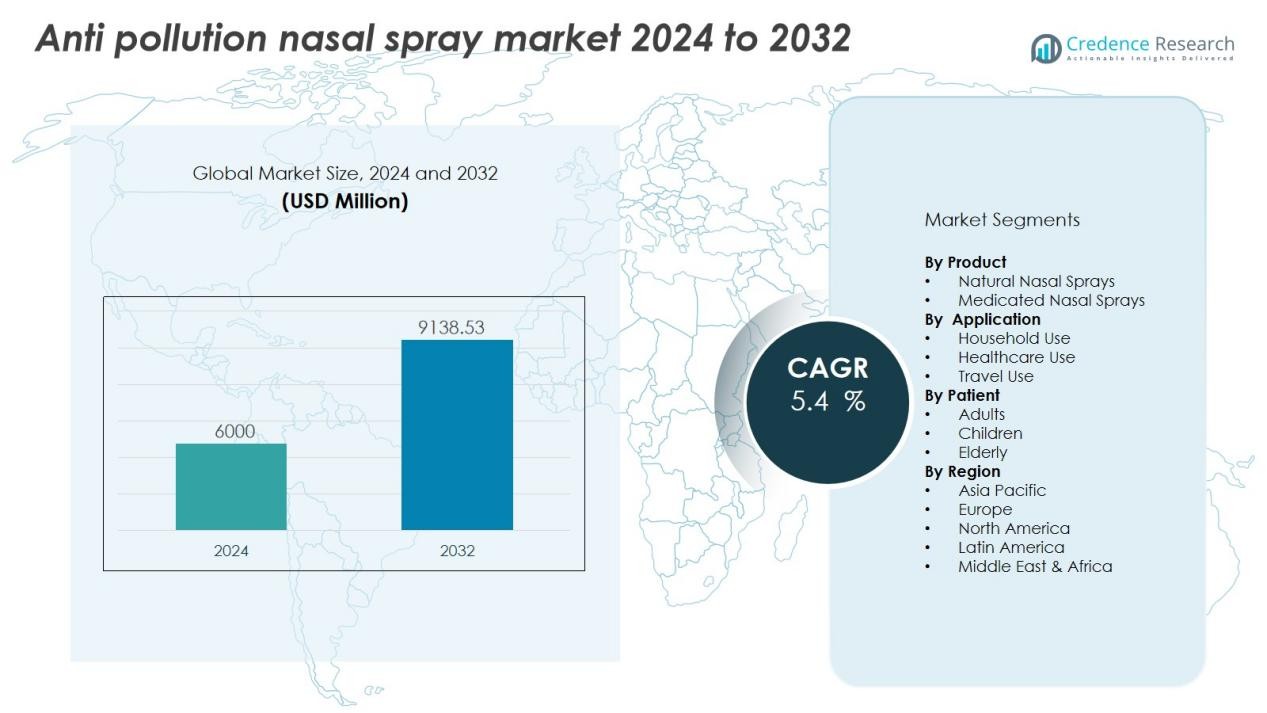
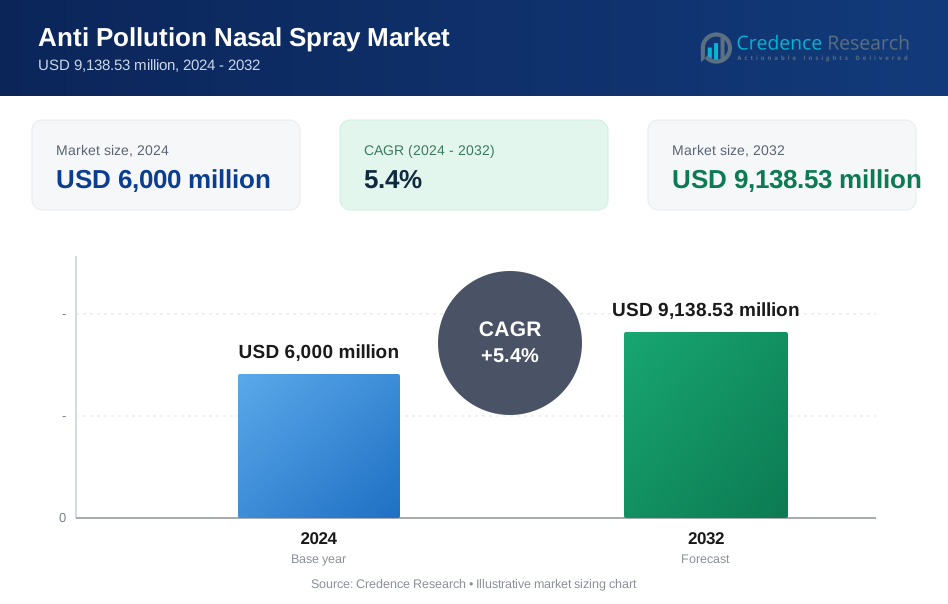
The Anti pollution nasal spray market size was valued at USD 6000 million in 2024 and is anticipated to reach USD 9138.53 million by 2032, at a CAGR of 5.4% during the forecast period.
| REPORT ATTRIBUTE | DETAILS |
|---|---|
| Historical Period | 2020-2023 |
| Base Year | 2024 |
| Forecast Period | 2025-2032 |
| Anti Pollution Nasal Spray Market Size 2024 | USD 6000 Million |
| Anti Pollution Nasal Spray Market, CAGR | 5.4% |
| Anti Pollution Nasal Spray Market Size 2032 | USD 9138.53 Million |
Key market drivers include growing urbanization, rising incidences of respiratory disorders, and increasing consumer inclination toward non-invasive preventive products. Expanding product availability through pharmacies and e-commerce channels, coupled with the introduction of natural and drug-free formulations, supports steady market expansion. Strategic investments by pharmaceutical and wellness brands in pollution-protection products further strengthen market penetration and consumer trust.
Regionally, North America dominates the market due to high pollution awareness, established healthcare infrastructure, and widespread product accessibility. Europe follows, driven by regulatory focus on air quality and a strong presence of wellness brands. The Asia-Pacific region is expected to witness the fastest growth, supported by rising pollution levels, rapid urbanization, and increasing consumer health consciousness in China, India, and Southeast Asia.
Market Insights:
- The Anti-Pollution Nasal Spray Market was valued at USD 4,350 million in 2018 and reached USD 6,000 million in 2024; it is projected to attain USD 9,138.53 million by 2032, expanding at a CAGR of 5.4% during the forecast period.
- North America holds a 36% share, driven by high pollution awareness, strong healthcare infrastructure, and advanced product accessibility across both retail and digital platforms.
- Europe accounts for 28% of the market, supported by eco-certified product demand, strict EU safety regulations, and a strong wellness brand presence.
- Asia-Pacific represents 25% of the global share and records the fastest growth, fueled by urbanization, rising pollution levels, and growing health consciousness in China, India, and Japan.
- Natural nasal sprays dominate with a 58% share due to consumer trust in herbal and drug-free products, while household applications lead with 45% owing to daily preventive usage across urban populations.
Market Drivers:
Rising Air Pollution Levels and Growing Respiratory Health Concerns
The Anti-Pollution Nasal Spray Market is driven by increasing exposure to pollutants and airborne toxins in major cities worldwide. Rising particulate matter (PM2.5 and PM10) levels have led to higher rates of allergies, sinusitis, and chronic respiratory conditions. Consumers seek preventive products that create a physical barrier against pollutants entering the nasal cavity. It benefits from heightened awareness of pollution-related health risks and growing preference for easy-to-use, drug-free protection solutions.
- For instance, Birmingham Biotech's NoriZite Nasal Spray, developed using carrageenan and gellan gum formulation, provides up to 6 times more surface coverage than standard nasal sprays and remains effective in the nasal cavity for 6 hours after application.
Increasing Adoption of Preventive Healthcare and Wellness Products
Consumers are shifting toward preventive healthcare to avoid long-term respiratory complications. The adoption of nasal sprays aligns with a broader trend toward wellness-oriented lifestyles, particularly in urban populations. Healthcare professionals recommend such sprays for frequent travelers and individuals in high-pollution areas. It gains traction as consumers seek affordable, convenient methods to maintain respiratory hygiene and reduce doctor visits.
- For instance, Bayer’s Afrin nasal spray is an over-the-counter (OTC) decongestant that is the #1 doctor and pharmacist-recommended brand in the US for temporary nasal congestion relief. Its active ingredient, oxymetazoline, is proven to start relieving nasal congestion within 5 to 10 minutes of use, with effects lasting up to 12 hours.
Product Innovation and Expansion of Natural Formulations
Manufacturers focus on developing natural, non-steroidal, and preservative-free nasal sprays that appeal to health-conscious buyers. Innovations using ingredients like sea salt, aloe vera, and herbal extracts enhance product safety and effectiveness. Companies invest in clinical validation to strengthen consumer confidence and brand loyalty. It benefits from evolving formulations that address both prevention and symptom relief while avoiding side effects associated with medicated sprays.
Rising Distribution Through Pharmacies and E-Commerce Channels
Expanding access through online and offline channels strengthens product visibility and sales growth. Retail pharmacies and digital platforms promote awareness through educational campaigns and discounts. E-commerce platforms play a key role in reaching younger, urban consumers who prioritize convenience and quick delivery. It experiences rising global demand supported by wider distribution networks and targeted marketing strategies.
Market Trends:
Growing Preference for Natural and Drug-Free Nasal Protection Solutions
The Anti-Pollution Nasal Spray Market is witnessing a strong shift toward natural, chemical-free formulations that emphasize safety and sustainability. Consumers prefer sprays containing herbal or mineral ingredients that form a physical barrier against pollutants without medicated side effects. Brands highlight preservative-free and hypoallergenic products to attract health-conscious and sensitive users. It benefits from expanding R&D focused on bio-based formulations that combine natural extracts with clinically proven efficacy. Manufacturers are promoting eco-friendly packaging and clean-label certifications to align with global wellness trends. The demand for holistic respiratory care products continues to rise, reflecting a broader lifestyle movement favoring natural protection over pharmaceutical intervention.
- For instance, Nasaleze PM Shield features a hydroxypropyl methylcellulose (HPMC) cellulose powder technology that forms a protective gel barrier in the nasal cavity, providing diffusion resistance to PM2.5 particles for up to 6 hours per application, creating a physically defensive layer without pharmacological intervention.
Integration of Technology and Expansion of Online Retail Channels
Technology integration is transforming how nasal spray products are marketed and distributed worldwide. Companies leverage digital platforms to provide real-time air quality updates and personalized protection recommendations, creating stronger brand engagement. Smart marketing tools and mobile health applications enhance consumer education about pollution defense. It experiences rising visibility through e-commerce channels offering doorstep delivery and subscription-based refills. Online retailers feature comparative reviews, increasing transparency and consumer confidence. Strategic partnerships between wellness brands and digital marketplaces strengthen global reach. The convergence of health technology, online sales, and environmental awareness continues to shape evolving market trends and consumer adoption patterns.
- For Instance, Philips had a notable collaboration with the independent app 'Air Matters', which provided real-time outdoor PM2.5 air quality data and remote control functionality for its range of connected consumer air purifiers.
Market Challenges Analysis:
Limited Consumer Awareness and Misconceptions About Product Efficacy
The Anti-Pollution Nasal Spray Market faces challenges due to limited awareness among consumers about the benefits and proper usage of nasal sprays. Many individuals underestimate the impact of air pollution on nasal health, reducing demand in non-urban regions. Misconceptions about chemical content and potential side effects discourage consistent usage. It struggles to reach new users who view sprays as short-term relief rather than preventive healthcare solutions. Lack of strong public health campaigns and inadequate product education in developing countries further restrict market growth. Effective awareness initiatives remain essential to expand product acceptance and long-term adoption.
Regulatory Hurdles and Price Sensitivity Across Emerging Markets
Stringent regulatory frameworks governing medical and wellness products create barriers for manufacturers entering new regions. Product approval processes differ across countries, leading to delays and high compliance costs. Small and mid-sized players often face difficulties maintaining profitability while meeting safety and labeling standards. It experiences slower market penetration in price-sensitive regions, where consumers prioritize cost over preventive care. Fluctuating raw material prices and limited insurance coverage for nasal sprays add further pressure. Streamlined regulations and affordable pricing strategies are critical to sustaining market expansion.
Market Opportunities:
Rising Demand in Developing Economies and Urban Centers
The Anti-Pollution Nasal Spray Market holds strong potential in rapidly urbanizing regions facing critical air quality issues. Emerging economies such as India, China, and Indonesia experience increasing consumer awareness of pollution-related health problems. Expanding middle-class populations with higher disposable income are investing more in personal health protection. It benefits from growing urban retail networks and improved healthcare accessibility. Government initiatives promoting air quality improvement and respiratory wellness also enhance product visibility. Collaborations with local healthcare providers and pharmacies can accelerate adoption in tier-two and tier-three cities.
Expansion Through Innovation and Product Differentiation
Technological advancement and innovation create multiple growth avenues for manufacturers. Companies are developing fast-acting, long-lasting barrier sprays with user-friendly applicators and portable packaging. Personalized formulations designed for sensitive users, children, and frequent travelers strengthen brand competitiveness. It gains traction through integration of digital health tools that track pollution exposure and recommend protective measures. Partnerships with wellness platforms and corporate health programs expand product reach. Growing demand for sustainable, natural, and certified organic nasal sprays continues to open new market segments globally.
Market Segmentation Analysis:
By Product
The Anti-Pollution Nasal Spray Market is segmented into natural nasal sprays and medicated nasal sprays. Natural variants dominate due to rising demand for herbal and chemical-free solutions among health-conscious consumers. These sprays use saline or plant-based formulations that create a protective barrier without pharmacological effects. Medicated sprays, containing active ingredients for symptom relief, maintain a steady share due to their effectiveness in treating acute irritation. It continues to see innovation in preservative-free formulations that balance safety and performance, appealing to both preventive and therapeutic users.
- For instance, Aurobindo Pharma Limited received FDA final approval in March 2024 for Mometasone Furoate Monohydrate Nasal Spray at 50 mcg/spray, an AB-rated generic formulation approved for treatment of nasal symptoms in seasonal and perennial allergic rhinitis and nasal polyp management in patients 18 years and older, demonstrating rapid therapeutic efficacy.
By Application
Based on application, the market is divided into household, healthcare, and travel use. Household applications lead the segment, driven by regular usage in pollution-prone urban environments. Healthcare settings use these sprays as supportive care for respiratory patients exposed to pollutants. The travel segment grows rapidly with increasing air travel and commuter populations exposed to dust and smog. It benefits from portable packaging and convenient usage suited to busy lifestyles.
- For instance, 3M's Filtrete offers various Room Air Purifiers with differing CADR (Clean Air Delivery Rate) values depending on the specific model and room size. The Filtrete medium room purifier (for up to 170 sq. ft. rooms) can have a smoke CADR of 107, while a large room model (for up to 290 sq. ft. rooms) can have a smoke CADR of 185.
By Patient Type
The market is segmented into adults, children, and elderly users. Adults form the largest user group due to higher exposure to outdoor pollution and workplace environments. Children’s sprays gain attention for their gentle, non-medicated formulations suitable for sensitive nasal passages. Elderly users adopt these products for respiratory comfort and preventive care. It records rising adoption across demographics with customized solutions for different age-related needs.
Segmentations:
By Product:
- Natural Nasal Sprays
- Medicated Nasal Sprays
By Application:
- Household Use
- Healthcare Use
- Travel Use
By Patient:
- Adults
- Children
- Elderly
By Region:
- North America
- U.S.
- Canada
- Mexico
- Europe
- Germany
- France
- U.K.
- Italy
- Spain
- Rest of Europe
- Asia Pacific
- China
- Japan
- India
- South Korea
- South-east Asia
- Rest of Asia Pacific
- Latin America
- Brazil
- Argentina
- Rest of Latin America
- Middle East & Africa
- GCC Countries
- South Africa
- Rest of the Middle East and Africa
Regional Analysis:
North America Leads with Strong Consumer Awareness and Product Availability
North America holds 36% of the global Anti-Pollution Nasal Spray Market in 2024, supported by advanced healthcare infrastructure and high awareness of air quality-related health risks. The United States drives regional growth through extensive retail distribution, online sales, and preventive healthcare adoption. Canada and Mexico contribute through expanding urban populations exposed to seasonal smog and industrial emissions. It benefits from strong brand presence, frequent product innovation, and FDA-compliant natural formulations. Marketing efforts targeting urban professionals and sensitive groups sustain steady consumption. Widespread use in daily hygiene routines reinforces regional leadership across the preventive wellness sector.
Europe Maintains Steady Growth with Focus on Natural Formulations and Regulations
Europe accounts for 28% of the global market in 2024, driven by consumer preference for eco-certified and organic nasal sprays. Countries such as Germany, France, and the United Kingdom lead adoption through health-focused retail networks and government initiatives addressing pollution control. It benefits from strict EU regulations promoting safe, chemical-free nasal products and transparency in ingredient labeling. Increasing public concern over particulate matter exposure sustains product demand. Major pharmaceutical companies and wellness brands collaborate to introduce clean-label nasal care solutions. E-commerce platforms and pharmacy chains expand accessibility, strengthening the region’s steady revenue growth.
Asia-Pacific Records Fastest Growth Due to Rising Urbanization and Air Pollution Levels
Asia-Pacific captures 25% of the global market in 2024 and is projected to achieve the highest growth rate through 2032. China, India, and Japan represent the largest markets, driven by severe air pollution and growing urban middle-class populations. It experiences strong consumer shift toward preventive respiratory care and affordable nasal protection products. Expanding healthcare access and local brand development further support regional penetration. Government-led air quality programs and awareness campaigns promote the use of protective nasal sprays. Increasing online availability through major e-commerce platforms enhances product reach across both metropolitan and semi-urban areas.
Key Player Analysis:
- AbbVie
- ADAPt Pharma
- Aurena Laboratories
- Bayer
- Cipla
- Reddy’s Laboratories
- EMERGENT
- GlaxoSmithKline
- J Pharmaceuticals
- Leeford Healthcare
- Novartis
- Pfizer
Competitive Analysis:
The Anti-Pollution Nasal Spray Market is moderately fragmented with several global and regional players competing on innovation, formulation quality, and pricing. Key companies include AbbVie, ADAPt Pharma, Aurena Laboratories, Bayer, Cipla, and Dr. Reddy’s Laboratories. These firms focus on expanding product portfolios featuring natural, preservative-free, and clinically validated formulations to strengthen brand credibility. It benefits from continuous research in nasal barrier technology and improved delivery systems. Strategic partnerships with healthcare providers and e-commerce platforms enhance distribution reach. Leading brands emphasize consumer education and air-quality awareness campaigns to expand adoption across urban populations. Competitive advantage increasingly depends on sustainable formulations, regulatory compliance, and strong retail visibility.
Recent Developments:
- In October 2025, AbbVie completed the acquisition of Gilgamesh Pharmaceuticals’ Bretisilocin, a novel investigational therapy for major depressive disorder.
- In July 2025, Corona Remedies acquired seven brands—including Noklot—from Bayer’s pharmaceutical division in India.
Report Coverage:
The research report offers an in-depth analysis based on Product, Application, Patient and Region. It details leading Market players, providing an overview of their business, product offerings, investments, revenue streams, and key applications. Additionally, the report includes insights into the competitive environment, SWOT analysis, current Market trends, as well as the primary drivers and constraints. Furthermore, it discusses various factors that have driven Market expansion in recent years. The report also explores Market dynamics, regulatory scenarios, and technological advancements that are shaping the industry. It assesses the impact of external factors and global economic changes on Market growth. Lastly, it provides strategic recommendations for new entrants and established companies to navigate the complexities of the Market.
Future Outlook:
- The Anti-Pollution Nasal Spray Market is expected to witness strong expansion driven by rising global air pollution and public health awareness.
- Manufacturers will invest in advanced barrier technologies offering longer protection and faster action.
- Natural and organic formulations will dominate future product development to meet consumer demand for chemical-free solutions.
- Pharmaceutical and wellness brands will collaborate to introduce hybrid products combining protection and therapeutic relief.
- Digital health platforms will support growth through personalized pollution alerts and usage recommendations.
- E-commerce will remain a primary distribution channel, enhancing accessibility across developing regions.
- New packaging innovations will focus on portability, recyclability, and user convenience.
- Clinical validation and safety certifications will become key factors influencing consumer trust and brand loyalty.
- Emerging markets in Asia-Pacific, Latin America, and the Middle East will provide major expansion opportunities through rising urbanization.
- Growing adoption among children and elderly groups will expand the user base, strengthening long-term market stability.
Request a Free Sample
Fill in your details and we'll send you a free sample report.
- Sample data tables & charts
- Research methodology
Need a Custom Version of This Report?
Tailor the scope, geography, or segments to your exact requirements.
- Custom geography or segment scope
- Direct access to our analyst team
Frequently Asked Questions
What is the current market size for the Anti-Pollution Nasal Spray Market, and what is its projected size in 2032?
At what Compound Annual Growth Rate is the Anti-Pollution Nasal Spray Market expected to grow between 2024 and 2032?
Which product segment held the largest share of the Anti-Pollution Nasal Spray Market in 2024?
What are the primary factors fueling the growth of the Anti-Pollution Nasal Spray Market?
Who are the leading companies in the Anti-Pollution Nasal Spray Market?
Which region commanded the largest share of the Anti-Pollution Nasal Spray Market in 2024?
Table of Content
Chapter 1. Report Introduction
- 1.1 Report Description & Purpose
- 1.1.1 Report Title & Market Definition
- 1.1.2 Unique Selling Propositions (USP) & Key Differentiators
- 1.1.3 Value Proposition for Stakeholders
- 1.2 Research Objectives
- 1.2.1 Market Sizing Objectives (Volume & Revenue)
- 1.2.2 Segmentation Objectives
- 1.2.3 Competitive Intelligence Objectives
- 1.2.4 Forecast & Scenario Objectives
- 1.3 Report Scope
- 1.3.1 Anti Pollution Nasal Spray Scope – Types & Subtypes Covered
- 1.3.2 Geographic Scope – Regions & Countries Covered
- 1.3.3 Historical Period, Base Year & Forecast Period (2024; forecast to 2032)
- 1.3.4 Inclusions & Exclusions
- 1.4 HS Code & Classification Framework
- 1.5 Currency, Units & Pricing Basis
- 1.6 Target Stakeholders
- 1.7 Limitations & Assumptions
Chapter 2. Executive Summary
- 2.1 Global Anti Pollution Nasal Spray Market Snapshot
- 2.1.1 Market Size – Historical (2024) & Forecast (2024-2032) (2024: USD 6,000 million → 2032: USD 9,138.53 million)
- 2.1.2 Volume & Revenue – Global Totals
- 2.1.3 Key Market Highlights – Top Five Facts
- 2.2 Anti Pollution Nasal Spray Market Segmentation Snapshot
- 2.2.1 Market Split by Region – 2024 vs. 2032
- 2.3 Competitive Snapshot
- 2.3.1 Top 10 Players by Revenue Share – 2024
- 2.3.2 Top 10 Players by Volume Share – 2024
- 2.3.3 Recent Strategic Developments (18-Month Summary)
- 2.4 Key Investment Highlights & Strategic Conclusions
Chapter 3. Anti Pollution Nasal Spray Market Dynamics & Industry Analysis
- 3.1 Market Overview & Context
- 3.1.1 Anti Pollution Nasal Spray Market Position in the Broader Automotive Value Chain
- 3.1.2 OEM vs. Replacement Market Dynamics
- 3.1.3 Market Maturity & Development Stage by Region
- 3.2 Anti Pollution Nasal Spray Market Drivers
- 3.3 Anti Pollution Nasal Spray Market Restraints & Challenges
- 3.4 Anti Pollution Nasal Spray Market Opportunities
- 3.5 Porter's Five Forces Analysis
- 3.5.1 Threat of New Entrants
- 3.5.2 Bargaining Power of Suppliers
- 3.5.3 Bargaining Power of Buyers
- 3.5.4 Threat of Substitutes
- 3.5.5 Competitive Rivalry – Intensity Assessment
- 3.6 Anti Pollution Nasal Spray Value Chain Analysis
- 3.6.1 Upstream – Raw Material/Input Suppliers
- 3.6.1.1 Raw Material/Input 1
- 3.6.1.2 Raw Material/Input 2
- 3.6.1.3 Raw Material/Input 3
- 3.6.2 Midstream – Production/Manufacturing/Service Delivery
- 3.6.2.1 Production/Process Overview
- 3.6.2.2 Key Facility Locations & Capacity by Manufacturer
- 3.6.3 Downstream – Distribution & End Consumer
- 3.6.3.1 Primary Channel – B2B/OEM
- 3.6.3.2 Secondary Channels – Dealer, Retail, Online, Direct
- 3.6.4 Value Chain Profitability Analysis
- 3.6.1 Upstream – Raw Material/Input Suppliers
- 3.7 PESTEL Analysis
- 3.7.1 Political Factors
- 3.7.2 Economic Factors
- 3.7.3 Social Factors
- 3.7.4 Technological Factors
- 3.7.5 Environmental Factors
- 3.7.6 Legal Factors
- 3.8 Anti Pollution Nasal Spray Supply Chain Analysis
- 3.8.1 Raw Material/Input Supply Risk Assessment
- 3.8.2 Manufacturing Concentration Risk (Geographic Exposure)
- 3.8.3 Trade Disruption Impact Analysis
- 3.9 Regulatory & Policy Landscape
Note: The regulatory and policy landscape section covers regulations based on their applicability to the market, Anti Pollution Nasal Spray category, geography, and scope of the study. Only regulatory frameworks with a material impact on operations, compliance, trade, sustainability, or market access are analyzed in detail.
Chapter 4. Key Investment Pockets & Opportunity Analysis
- 4.1 Anti Pollution Nasal Spray Market Attractiveness Analysis
- 4.1.1 By Region – Investment Attractiveness Matrix (Volume × CAGR)
- 4.2 Absolute Revenue Growth Opportunity
- 4.2.1 By Region – Absolute USD Growth Through 2032
- 4.3 Incremental Volume Opportunity
- 4.3.1 By Region – Incremental Volume Through 2032
- 4.3.2 Segment – Incremental Volume
- 4.4 Emerging Submarket Opportunity Deep Dive (Subject to Applicability)
- 4.5 Emerging Market Opportunity Scorecards
- 4.5.1 United States
- 4.5.2 Europe
- 4.5.3 Asia
- 4.5.4 Middle East & Africa
Note: Emerging Market Opportunity Scorecards will be included based on relevance and strategic importance. Regions listed are indicative and may vary depending on data availability and market dynamics.
Chapter 5. Anti Pollution Nasal Spray Import-Export Analysis & Trade Flows
- 5.1 Global Trade Overview
- 5.1.1 Global Export Value by Country (2024)
- 5.1.2 Global Export Volume by Country (2024)
- 5.1.3 Global Import Value by Country (2024)
- 5.1.4 Global Import Volume by Country (2024)
- 5.1.5 Net Trade Balance by Country (2024)
- 5.2 Export Analysis – Segment
- 5.2.1 Type 1 (HS Code)
- 5.2.2 Type 2 (HS Code)
- 5.2.3 Type 3 (HS Code)
- 5.2.4 Type 4 (HS Code)
- 5.2.5 Type 5 (HS Code)
- 5.3 Import Analysis – Segment
- 5.3.1 Type 1 (HS Code)
- 5.3.2 Type 2 (HS Code)
- 5.3.3 Type 3 (HS Code)
- 5.3.4 Type 4 (HS Code)
- 5.3.5 Type 5 (HS Code)
- 5.4 Average Unit Trade Prices
- 5.4.1 Average Export Price – Segment & Country
- 5.4.2 Average Import Price – Segment & Source Country
- 5.4.3 Price Trends (2024)
- 5.5 Key Trade Route Analysis
- 5.5.1 Trade Route 1
- 5.5.2 Trade Route 2
- 5.5.3 Trade Route 3
- 5.5.4 Trade Route 4
- 5.5.5 Trade Route 5
- 5.6 Trade Policy Impact Assessment
- 5.6.1 US Anti-Dumping & Section 301 Tariffs
- 5.6.2 EU Customs Union Impact
- 5.6.3 Major Free Trade Agreements
- 5.6.4 USMCA Rules of Origin
Note: Trade policy analysis will be included only where relevant to the Anti Pollution Nasal Spray market.
Chapter 6. Competitive Landscape & Company Benchmarking
- 6.1 Anti Pollution Nasal Spray Market Concentration & Structure
- 6.1.1 Herfindahl-Hirschman Index (HHI) – vs. 2024
- 6.1.2 Tier 1, Tier 2 & Tier 3 Market Structure
- 6.1.3 Global, Regional & Local Player Dynamics
- 6.2 Anti Pollution Nasal Spray Market Share Analysis – 2024
- 6.2.1 Global Revenue Share by Company
- 6.2.2 Global Volume Share by Company
- 6.2.3 Regional Revenue Share
- 6.2.4 Market Share Evolution ( vs. 2024)
- 6.2.5 OEM Segment Share by Company
- 6.2.6 Replacement Segment Share by Company
- 6.3 Production/Delivery Capacity & Facility Analysis
- 6.3.1 Global Installed Capacity
- 6.3.2 Capacity Utilization Rates
- 6.3.3 Production/Output Volume
- 6.3.4 Facility Locations & Capacity Map
- 6.3.5 Planned Capacity Additions
- 6.4 Anti Pollution Nasal Spray Competitive Benchmarking Matrix
- 6.4.1 Revenue, Volume, CAGR & Profitability Comparison
- 6.4.2 Channel Revenue Mix
- 6.4.3 Geographic Revenue Exposure
- 6.4.4 R&D Intensity
- 6.4.5 Sustainability Maturity
- 6.5 Strategic Developments in Anti Pollution Nasal Spray (Last 24 Months)
- 6.5.1 Mergers, Acquisitions & Divestments
- 6.5.2 New Anti Pollution Nasal Spray Launches
- 6.5.3 Facility Expansions
- 6.5.4 Strategic Alliances, Joint Ventures & Partnerships
- 6.5.5 Distribution Expansion & Market Entry
- 6.5.6 Sustainability & ESG Initiatives
- 6.6 Competitive Strategy Mapping
- 6.6.1 Leader, Challenger, Follower & Niche Classification
- 6.6.2 Pricing Strategy Comparison
- 6.6.3 Channel Strategy Matrix
Note: Strategic developments are included based on their materiality and the availability of reliable information.
Chapter 7. Global Anti Pollution Nasal Spray Market – By Distribution Channel
- 7.1 Segment Overview
- 7.1.1 Volume & Revenue Split by Channel (2024 & 2032)
- 7.1.2 Channel Mix Evolution (2024-2032)
Chapter 8. Regional Market Analysis – Global Overview
- 8.1 Global Regional Overview
- 8.1.1 Regional Volume Share
- 8.1.2 Regional Revenue Share
- 8.1.3 Regional Volume by Region
- 8.1.4 Regional Revenue by Region
- 8.1.5 Regional Forecast Through 2032
- 8.2 Cross-Regional Segment Analysis
- 8.2.1 By Distribution Channel
- 8.2.2 By Brand/Price Tier
Chapter 9. North America Anti Pollution Nasal Spray Market
- 9.1 United States
- 9.2 Canada
- 9.3 Mexico
Chapter 10. Europe Anti Pollution Nasal Spray Market
- 10.1 Germany
- 10.2 France
- 10.3 Italy
- 10.4 United Kingdom
- 10.5 Spain
- 10.6 Poland
- 10.7 Russia
- 10.8 Netherlands
- 10.9 Belgium
- 10.10 Sweden
- 10.11 Denmark
- 10.12 Norway
- 10.13 Rest of Europe
Chapter 11. Asia Pacific Anti Pollution Nasal Spray Market
- 11.1 China
- 11.2 India
- 11.3 Japan
- 11.4 South Korea
- 11.5 Thailand
- 11.6 Indonesia
- 11.7 Vietnam
- 11.8 Malaysia
- 11.9 Australia
- 11.10 Rest of Asia Pacific
Chapter 12. Latin America Anti Pollution Nasal Spray Market
- 12.1 Brazil
- 12.2 Argentina
- 12.3 Colombia
- 12.4 Chile
- 12.5 Rest of Latin America
Chapter 13. Middle East Anti Pollution Nasal Spray Market
- 13.1 Saudi Arabia
- 13.2 United Arab Emirates
- 13.3 Turkey
- 13.4 Israel
- 13.5 Iran
- 13.6 Rest of the Middle East
Chapter 14. Africa Anti Pollution Nasal Spray Market
- 14.1 South Africa
- 14.2 Egypt
- 14.3 Nigeria
- 14.4 Morocco
- 14.5 Rest of Africa
Chapter 15. Anti Pollution Nasal Spray Company Profiles
- 15.1 [Company 01]
- 15.1.1 Company Overview
- 15.1.2 Key Management Personnel
- 15.1.3 Products & Services Portfolio
- 15.1.4 Financial Performance
- 15.1.5 Key Market Focus & Geographic Presence
- 15.1.6 Recent Developments & Strategic Initiatives
Note: The company profile list is preliminary and may change based on research findings, market developments, data availability, and client requirements.
Chapter 16. Appendices
- Appendix A – List of Abbreviations & Acronyms
- Appendix B – Industry Classification Code Reference – Full Series
- Appendix C – Production & Capacity Data Tables
- Appendix D – End-Use & Demand Base Tables
- Appendix E – Consumption & Replacement Rate Assumptions
- Appendix F – ASP Reference Tables
- Appendix G – Manufacturing & Facility Database
- Appendix H – Import-Export Data Tables
- Appendix I – Regulatory Summary Tables
- Appendix J – Primary Research Participant List (Anonymized)
- Appendix K – Primary Research Questionnaire Framework
- Appendix L – Data Sources & Bibliography
- Appendix M – Market Size Divergence & Source Comparison
Chapter 17. Research Methodology
- 17.1 Research Framework & Philosophy
- 17.2 Secondary Research – Sources, Hierarchy & Data Extraction
- 17.3 Data Modeling – Bottom-Up & Top-Down Market Sizing
- 17.4 Primary Research – Stakeholder Framework, LOI & Sample Sizes
- 17.5 Forecast Methodology – Regression, Scenario & Sensitivity Analysis
- 17.6 Quality Control – Four-Layer Validation Framework
- 17.7 Limitations & Standard Assumptions
- 17.8 Disclaimer
