
ASEAN Automotive Bearings Market Overview:
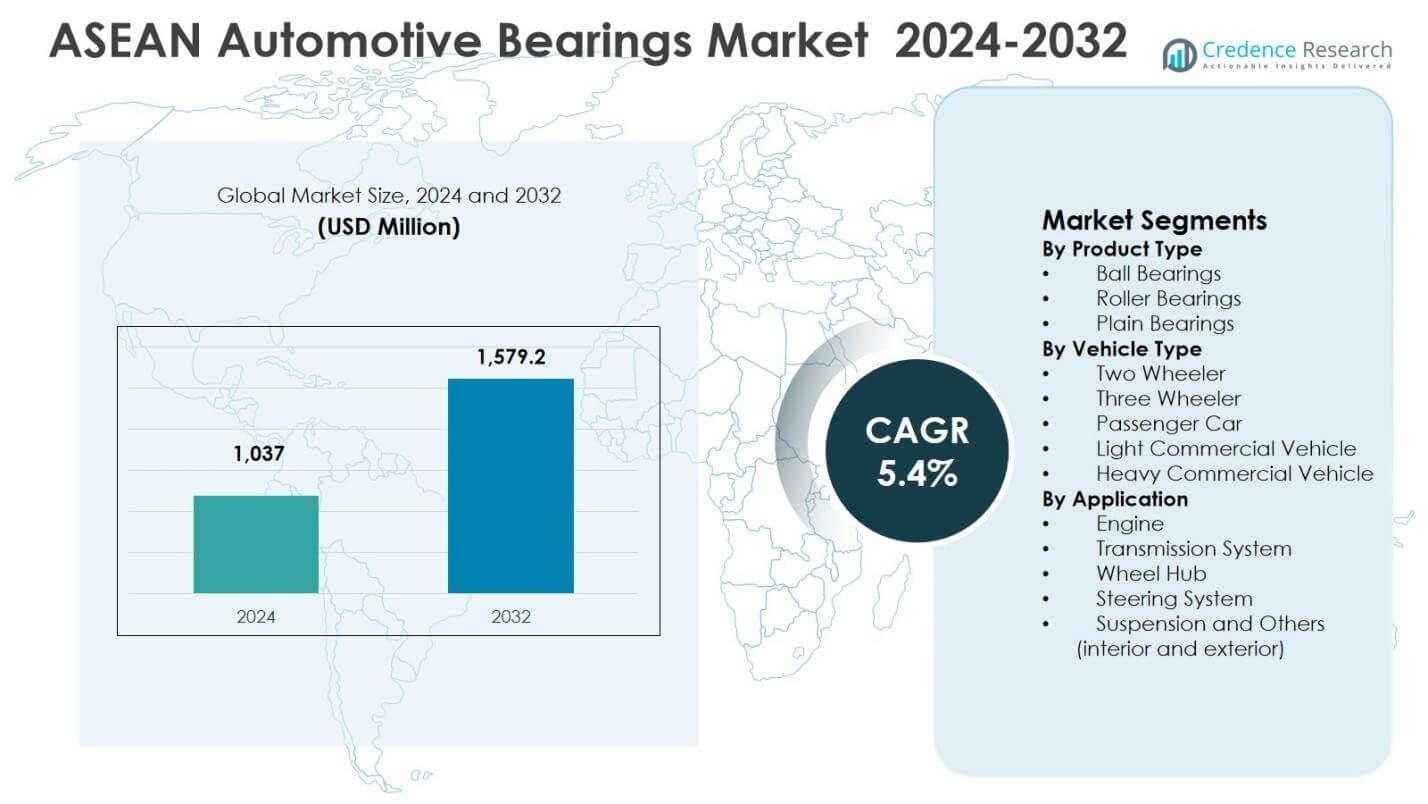
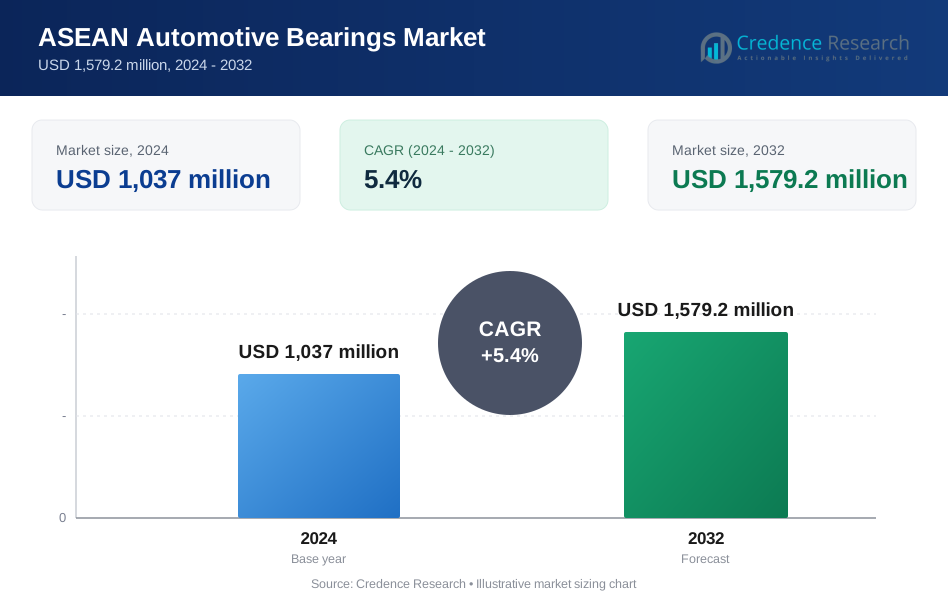
ASEAN Automotive Bearings market size was valued at USD 1,037 million in 2024 and is anticipated to reach USD 1,579.2 million by 2032, growing at a CAGR of 5.4% during the forecast period.
| REPORT ATTRIBUTE | DETAILS |
|---|---|
| Historical Period | 2020-2023 |
| Base Year | 2024 |
| Forecast Period | 2025-2032 |
| ASEAN Automotive Bearings Market Size 2024 | USD 1,037 million |
| ASEAN Automotive Bearings Market, CAGR | 5.4% |
| ASEAN Automotive Bearings Market Size 2032 | USD 1,579.2 million |
ASEAN Automotive Bearings Market Insights
- Market growth is driven by rising passenger car and two-wheeler production, expanding vehicle parc, and increasing replacement cycles, with ball bearings leading the product segment at 46% share due to wide usage in engines, transmissions, and wheel hubs.
- Key market trends include demand for low-friction and durable bearings and localization of manufacturing, while the competitive environment features global and regional players focusing on OEM tie-ups, aftermarket expansion, and cost-efficient product offerings.
- Market restraints include intense price competition from local suppliers, margin pressure due to raw material volatility, and gradual technology shifts reducing bearing usage in some powertrain applications.
- Regionally, Indonesia led with 32% market share, followed by Thailand at 27% and Malaysia at 14%, while the Philippines, Singapore, and the rest of ASEAN collectively contributed the remaining share, supported by growing aftermarket and infrastructure-led vehicle demand.
ASEAN Automotive Bearings Market Segmentation Analysis:
By Product Type
In the ASEAN Automotive Bearings market, ball bearings dominated the product-type segment, accounting for 46% market share in 2024, due to their extensive use in engines, transmissions, and wheel hubs across passenger and commercial vehicles. Their ability to handle moderate radial and axial loads, low friction performance, and cost efficiency supports widespread adoption. Roller bearings followed with a strong share driven by heavy-load applications in commercial vehicles, while plain bearings maintained steady demand in cost-sensitive and low-speed applications. Rising vehicle production and increasing preference for durability-focused components continue to reinforce ball bearing dominance.
- For instance, NSK’s deep-groove ball bearings are widely used in engine accessory systems and alternators across Asian passenger vehicles due to their low-noise, high-speed performance.
By Vehicle Type
Passenger cars represented the dominant vehicle-type segment in the ASEAN Automotive Bearings market, capturing 52% of total demand in 2024, supported by high production volumes in Thailand, Indonesia, and Malaysia. Growing urbanization, expanding middle-class populations, and increasing vehicle ownership continue to drive bearing consumption in this segment. Two-wheelers held a significant share due to their affordability and high sales in emerging ASEAN economies, while light and heavy commercial vehicles contributed steadily, supported by logistics expansion, infrastructure development, and regional trade growth.
- For instance, Toyota’s plants in Thailand and Indonesia produce popular models such as the Hilux and Innova, which integrate multiple ball and roller bearings in engines, wheel hubs, and transmissions to enhance durability and reduce friction.
By Application
Engine applications led the ASEAN Automotive Bearings market by application, accounting for 38% market share in 2024, owing to the extensive use of bearings in crankshafts, camshafts, and auxiliary engine components. High thermal resistance, load-handling capability, and durability requirements make engines the largest consumption area. Transmission systems and wheel hubs followed, supported by rising automatic transmission adoption and safety-driven wheel performance standards. Steering, suspension, and interior-exterior applications maintained consistent growth, driven by vehicle comfort upgrades and improved handling requirements across vehicle categories.
Key Growth Drivers
Expanding Automotive Production Across ASEAN
Expanding automotive production across ASEAN is a major driver for the automotive bearings market, supported by strong manufacturing activity in Thailand, Indonesia, Malaysia, and Vietnam. These countries function as regional hubs for passenger cars, two-wheelers, and commercial vehicles, serving both domestic consumption and exports. Rising investments by global OEMs, favorable government policies, and improving industrial infrastructure continue to boost vehicle output. Each vehicle integrates multiple bearings across engines, transmissions, wheel hubs, and steering systems, directly increasing bearing demand. Growing urbanization and rising disposable incomes further support vehicle ownership, ensuring sustained long-term growth for automotive bearings across the region.
- For instance, Thailand produced around 1.84 million vehicles in 2023, according to the Federation of Thai Industries, with each unit incorporating numerous bearings in engines, transmissions, wheel hubs, and steering systems.
Rising Aftermarket Demand and Growing Vehicle Parc
The increasing vehicle parc across ASEAN is driving strong aftermarket demand for automotive bearings. As vehicles age, bearings require frequent replacement due to wear from heat, load, and continuous operation. Countries such as Indonesia, Vietnam, and the Philippines are witnessing rising average vehicle age, strengthening replacement cycles. Growth in ride-hailing platforms, logistics fleets, and commercial transport accelerates component wear, further boosting aftermarket sales. This recurring demand provides revenue stability for bearing manufacturers and distributors, reducing dependence on new vehicle production cycles and strengthening market resilience.
- For instance, Indonesia’s vehicle population exceeded 26 million four-wheeled vehicles by 2023 (Gaikindo), and many units over 10 years old drive consistent demand for wheel hub and engine bearing replacements.
Infrastructure Development and Commercial Vehicle Growth
Large-scale infrastructure development across ASEAN significantly supports demand for commercial vehicles, driving automotive bearing consumption. Investments in roads, ports, industrial zones, and urban transport systems increase the need for light and heavy commercial vehicles. These vehicles require high-load, durable bearings for engines, axles, and wheel hubs, resulting in higher bearing value per unit. Expanding regional trade and e-commerce logistics further stimulate fleet expansion. As governments continue infrastructure-led growth strategies, sustained demand for commercial vehicles will support long-term bearing market growth.
Key Trends & Opportunities
Focus on Fuel Efficiency and Advanced Bearing Designs
Automakers across ASEAN increasingly focus on fuel efficiency and emission reduction, creating demand for advanced automotive bearings. Low-friction, lightweight, and precision-engineered bearings help reduce energy losses and improve vehicle performance. This trend encourages adoption of advanced materials, surface coatings, and optimized bearing geometries. Manufacturers investing in R&D and innovative designs gain opportunities to secure long-term OEM contracts. The push for efficiency-driven vehicle platforms will continue to support demand for technologically advanced bearing solutions across the region.
- For instance, SKF offers low-friction wheel hub and powertrain bearings that OEMs use globally to cut CO₂ emissions by reducing rolling resistance in chassis and driveline systems
Localization of Manufacturing and Regional Supply Chains
Localization of automotive component manufacturing presents strong growth opportunities in the ASEAN Automotive Bearings market. Governments promote domestic production through incentives, import duty reductions, and industrial corridor development. OEMs increasingly prefer regional suppliers to reduce logistics costs and supply chain risks. Establishing local manufacturing facilities, joint ventures, and technical partnerships allows bearing producers to meet volume, cost, and customization requirements. Localization also enhances responsiveness to regional market needs, strengthening supplier competitiveness.
- For instance, NTN has expanded its production footprint in Thailand and Indonesia, supplying hub and transmission bearings directly to Japanese and global OEMs operating in the region
Key Challenges
Price Sensitivity and Margin Pressure
Intense price competition remains a key challenge in the ASEAN Automotive Bearings market. Cost-sensitive OEMs and aftermarket buyers often prioritize affordability, pressuring margins for both global and regional manufacturers. The presence of low-cost local suppliers intensifies competition, particularly in the replacement segment. Rising raw material and energy costs further impact profitability. Maintaining product quality while controlling costs and optimizing operations is essential for sustaining margins in this competitive environment.
Transition Toward Electric Vehicles
The gradual shift toward electric vehicles poses a structural challenge for the automotive bearings market. EVs use fewer conventional bearings in engines and transmissions, potentially reducing demand over time. Although new opportunities exist in electric motors and e-axles, transitioning requires significant investment in new designs and manufacturing capabilities. Manufacturers must adapt product portfolios while continuing to serve internal combustion engine platforms. Balancing this transition without revenue disruption remains a critical challenge for market participants.
Regional Analysis
Indonesia
Indonesia accounted for 32% of the ASEAN Automotive Bearings market share in 2024, making it the largest regional contributor. Strong passenger car and two-wheeler production, supported by rising domestic demand and export-oriented manufacturing, drives bearing consumption across engines, transmissions, and wheel hubs. The country’s expanding vehicle parc and growing logistics sector significantly boost aftermarket demand. Government initiatives to strengthen local automotive manufacturing and component localization further support market growth. Increasing infrastructure development and commercial vehicle usage also contribute to steady demand for high-load and durable bearing solutions across multiple vehicle categories.
Thailand
Thailand held 27% market share in 2024, positioning it as the second-largest market for automotive bearings in ASEAN. The country serves as a major automotive manufacturing hub, particularly for passenger cars and pickup trucks, supplying both regional and global markets. High OEM presence and export-driven production sustain strong demand for precision bearings. Growth in commercial vehicle production, supported by logistics and trade activity, further strengthens market expansion. A well-developed supplier ecosystem and focus on quality manufacturing make Thailand a key market for both OEM and aftermarket bearing suppliers.
Malaysia
Malaysia represented 14% of the ASEAN Automotive Bearings market in 2024, driven by steady passenger car production and a strong aftermarket base. Domestic vehicle ownership remains high, supporting consistent replacement demand for bearings used in engines, wheel hubs, and steering systems. Government policies encouraging automotive modernization and component manufacturing strengthen local sourcing opportunities. The presence of regional assembly plants and growing demand for fuel-efficient vehicles further supports adoption of advanced bearing technologies. Malaysia’s balanced OEM and aftermarket structure ensures stable growth prospects within the regional market.
Philippines
The Philippines accounted for 9% market share in 2024, supported primarily by a growing vehicle parc and rising aftermarket demand. Increasing urbanization, expanding middle-income populations, and improving road infrastructure drive passenger car and commercial vehicle usage. Bearing demand is largely replacement-driven, particularly for wheel hubs, suspension, and engine components. Growth in logistics, public transportation, and construction activity further supports commercial vehicle bearing consumption. Although local manufacturing is limited, rising imports of automotive components and expanding service networks contribute to steady market expansion.
Singapore
Singapore held about 6% of the ASEAN Automotive Bearings market in 2024, driven mainly by aftermarket demand rather than large-scale vehicle production. High vehicle maintenance standards and strict safety regulations support consistent replacement of high-quality bearings. Demand is concentrated in premium passenger vehicles, commercial fleets, and specialized automotive applications. Singapore also functions as a regional distribution and trading hub, supporting bearing supply across neighboring ASEAN countries. Growth in logistics services and fleet management further sustains bearing demand, despite relatively lower vehicle volumes compared to manufacturing-focused markets.
Rest of ASEAN
The Rest of ASEAN region, including Vietnam, Cambodia, Laos, and Myanmar, collectively accounted for 12% market share in 2024. Rapid economic growth, rising vehicle ownership, and expanding automotive assembly activities particularly in Vietnam support bearing demand. Increasing infrastructure investments and logistics development drive commercial vehicle usage across these markets. While OEM production remains smaller compared to Indonesia and Thailand, the aftermarket segment shows strong growth due to aging vehicle fleets. Gradual industrialization and improving automotive ecosystems are expected to enhance long-term bearing consumption across the Rest of ASEAN.
ASEAN Automotive Bearings Market Segmentations:
By Product Type
- Ball Bearings
- Roller Bearings
- Plain Bearings
By Vehicle Type
- Two Wheeler
- Three Wheeler
- Passenger Car
- Light Commercial Vehicle
- Heavy Commercial Vehicle
By Application
- Engine
- Transmission System
- Wheel Hub
- Steering System
- Suspension and Others (interior and exterior)
By Geography
- Indonesia
- Malaysia
- Philippines
- Singapore
- Thailand
- Rest of ASEAN
Competitive Landscape
The ASEAN Automotive Bearings market features a moderately consolidated competitive landscape, characterized by the strong presence of global manufacturers alongside emerging regional players. Leading companies such as Schaeffler AG, JTEKT Corporation, AB SKF, NSK Ltd, NTN Bearing Corporation, and The Timken Company dominate the market through broad product portfolios, strong OEM relationships, and extensive aftermarket distribution networks across ASEAN countries. These players focus on high-performance ball and roller bearings tailored for passenger cars and commercial vehicles. Regional and mid-sized players including Minebea Mitsumi Inc., Nachi-Fujikoshi Corp., Fersa Group, CandU Group Ltd, and Metro Bearing and Automotive Limited enhance competition by offering cost-effective solutions and expanding local manufacturing and distribution capabilities. Strategic priorities across the market include localization of production, expansion of aftermarket presence, technology upgrades for fuel efficiency, and partnerships with regional OEMs, collectively intensifying competition while supporting steady market growth.
Key Player Analysis
- The Timken Company
- NSK Ltd
- Metro Bearing and Automotive Limited
- AB SKF
- JTEKT Corporation
- Fersa Group
- CandU Group Ltd
- NTN Bearing Corporation
- Minebea Mitsumi Inc.
- Nachi-Fujikoshi Corp.
Recent Developments
- In December 2025, JTEKT Corporation established new sales bases in Vietnam to strengthen its aftermarket business presence in the ASEAN region, expanding regional footprint for automotive bearings distribution.
- In October 2025, SKF launched “SKF Ventures”, a new initiative to accelerate innovation and unlock future growth opportunities in advanced bearing technologies, which may support automotive component development in ASEAN.
Report Coverage
The research report offers an in-depth analysis based on Product Type, Vehicle Type, Application, and Geography. It details leading market players, providing an overview of their business, product offerings, investments, revenue streams, and key applications. Additionally, the report includes insights into the competitive environment, SWOT analysis, current market trends, as well as the primary drivers and constraints. Furthermore, it discusses various factors that have driven market expansion in recent years. The report also explores market dynamics, regulatory scenarios, and technological advancements that are shaping the industry. It assesses the impact of external factors and global economic changes on market growth. Lastly, it provides strategic recommendations for new entrants and established companies to navigate the complexities of the market.
Future Outlook
- The Asean Automotive Bearings market is expected to maintain steady growth, supported by consistent vehicle production and rising replacement demand across major economies.
- Passenger car and two-wheeler segments will continue to generate the highest bearing volumes due to sustained urban mobility needs.
- Aftermarket demand will strengthen as the regional vehicle parc expands and average vehicle age increases.
- Localization of bearing manufacturing will increase to reduce supply chain risks and improve cost competitiveness.
- Ball and roller bearings will remain dominant due to their wide application across engines, transmissions, and wheel hubs.
- Demand from commercial vehicles will rise in line with infrastructure development and logistics expansion.
- Technological advancements will focus on low-friction, high-durability bearing solutions to improve vehicle efficiency.
- Strategic partnerships between bearing manufacturers and regional OEMs will intensify.
- Adoption of electric vehicles will gradually reshape bearing demand toward motor and drivetrain applications.
- Regional markets such as Indonesia and Thailand will continue to lead growth, while emerging ASEAN countries will gain importance over time.
Request a Free Sample
Fill in your details and we'll send you a free sample report.
- Sample data tables & charts
- Research methodology
Need a Custom Version of This Report?
Tailor the scope, geography, or segments to your exact requirements.
- Custom geography or segment scope
- Direct access to our analyst team
Frequently Asked Questions
What is the current market size for Asean Automotive Bearings market, and what is its projected size in 2032?
At what Compound Annual Growth Rate is the Asean Automotive Bearings market projected to grow between 2024 and 2032?
Which Asean Automotive Bearings market segment held the largest share in 2024?
What are the primary factors fueling the growth of the Asean Automotive Bearings market?
Who are the leading companies in the Asean Automotive Bearings market?
Which region commanded the largest share of the Asean Automotive Bearings market in 2024?
Table of Content
Chapter 1. Report Introduction
- 1.1 Report Description & Purpose
- 1.1.1 Report Title & Market Definition
- 1.1.2 Unique Selling Propositions (USP) & Key Differentiators
- 1.1.3 Value Proposition for Stakeholders
- 1.2 Research Objectives
- 1.2.1 Market Sizing Objectives (Volume & Revenue)
- 1.2.2 Segmentation Objectives
- 1.2.3 Competitive Intelligence Objectives
- 1.2.4 Forecast & Scenario Objectives
- 1.3 Report Scope
- 1.3.1 ASEAN Automotive Bearings Scope – Types & Subtypes Covered
- 1.3.2 Geographic Scope – Regions & Countries Covered
- 1.3.3 Historical Period, Base Year & Forecast Period (2024; forecast to 2032)
- 1.3.4 Inclusions & Exclusions
- 1.4 HS Code & Classification Framework
- 1.5 Currency, Units & Pricing Basis
- 1.6 Target Stakeholders
- 1.7 Limitations & Assumptions
Chapter 2. Executive Summary
- 2.1 Global ASEAN Automotive Bearings Market Snapshot
- 2.1.1 Market Size – Historical (2024) & Forecast (2024-2032) (2024: USD 1,037 million → 2032: USD 1,579.2 million)
- 2.1.2 Volume & Revenue – Global Totals
- 2.1.3 Key Market Highlights – Top Five Facts
- 2.2 ASEAN Automotive Bearings Market Segmentation Snapshot
- 2.2.1 Market Split by Region – 2024 vs. 2032
- 2.3 Competitive Snapshot
- 2.3.1 Top 10 Players by Revenue Share – 2024
- 2.3.2 Top 10 Players by Volume Share – 2024
- 2.3.3 Recent Strategic Developments (18-Month Summary)
- 2.4 Key Investment Highlights & Strategic Conclusions
Chapter 3. ASEAN Automotive Bearings Market Dynamics & Industry Analysis
- 3.1 Market Overview & Context
- 3.1.1 ASEAN Automotive Bearings Market Position in the Broader Automotive Value Chain
- 3.1.2 OEM vs. Replacement Market Dynamics
- 3.1.3 Market Maturity & Development Stage by Region
- 3.2 ASEAN Automotive Bearings Market Drivers
- 3.3 ASEAN Automotive Bearings Market Restraints & Challenges
- 3.4 ASEAN Automotive Bearings Market Opportunities
- 3.5 Porter's Five Forces Analysis
- 3.5.1 Threat of New Entrants
- 3.5.2 Bargaining Power of Suppliers
- 3.5.3 Bargaining Power of Buyers
- 3.5.4 Threat of Substitutes
- 3.5.5 Competitive Rivalry – Intensity Assessment
- 3.6 ASEAN Automotive Bearings Value Chain Analysis
- 3.6.1 Upstream – Raw Material/Input Suppliers
- 3.6.1.1 Raw Material/Input 1
- 3.6.1.2 Raw Material/Input 2
- 3.6.1.3 Raw Material/Input 3
- 3.6.2 Midstream – Production/Manufacturing/Service Delivery
- 3.6.2.1 Production/Process Overview
- 3.6.2.2 Key Facility Locations & Capacity by Manufacturer
- 3.6.3 Downstream – Distribution & End Consumer
- 3.6.3.1 Primary Channel – B2B/OEM
- 3.6.3.2 Secondary Channels – Dealer, Retail, Online, Direct
- 3.6.4 Value Chain Profitability Analysis
- 3.6.1 Upstream – Raw Material/Input Suppliers
- 3.7 PESTEL Analysis
- 3.7.1 Political Factors
- 3.7.2 Economic Factors
- 3.7.3 Social Factors
- 3.7.4 Technological Factors
- 3.7.5 Environmental Factors
- 3.7.6 Legal Factors
- 3.8 ASEAN Automotive Bearings Supply Chain Analysis
- 3.8.1 Raw Material/Input Supply Risk Assessment
- 3.8.2 Manufacturing Concentration Risk (Geographic Exposure)
- 3.8.3 Trade Disruption Impact Analysis
- 3.9 Regulatory & Policy Landscape
Note: The regulatory and policy landscape section covers regulations based on their applicability to the market, ASEAN Automotive Bearings category, geography, and scope of the study. Only regulatory frameworks with a material impact on operations, compliance, trade, sustainability, or market access are analyzed in detail.
Chapter 4. Key Investment Pockets & Opportunity Analysis
- 4.1 ASEAN Automotive Bearings Market Attractiveness Analysis
- 4.1.1 By Region – Investment Attractiveness Matrix (Volume × CAGR)
- 4.2 Absolute Revenue Growth Opportunity
- 4.2.1 By Region – Absolute USD Growth Through 2032
- 4.3 Incremental Volume Opportunity
- 4.3.1 By Region – Incremental Volume Through 2032
- 4.3.2 Segment – Incremental Volume
- 4.4 Emerging Submarket Opportunity Deep Dive (Subject to Applicability)
- 4.5 Emerging Market Opportunity Scorecards
- 4.5.1 United States
- 4.5.2 Europe
- 4.5.3 Asia
- 4.5.4 Middle East & Africa
Note: Emerging Market Opportunity Scorecards will be included based on relevance and strategic importance. Regions listed are indicative and may vary depending on data availability and market dynamics.
Chapter 5. ASEAN Automotive Bearings Import-Export Analysis & Trade Flows
- 5.1 Global Trade Overview
- 5.1.1 Global Export Value by Country (2024)
- 5.1.2 Global Export Volume by Country (2024)
- 5.1.3 Global Import Value by Country (2024)
- 5.1.4 Global Import Volume by Country (2024)
- 5.1.5 Net Trade Balance by Country (2024)
- 5.2 Export Analysis – Segment
- 5.2.1 Type 1 (HS Code)
- 5.2.2 Type 2 (HS Code)
- 5.2.3 Type 3 (HS Code)
- 5.2.4 Type 4 (HS Code)
- 5.2.5 Type 5 (HS Code)
- 5.3 Import Analysis – Segment
- 5.3.1 Type 1 (HS Code)
- 5.3.2 Type 2 (HS Code)
- 5.3.3 Type 3 (HS Code)
- 5.3.4 Type 4 (HS Code)
- 5.3.5 Type 5 (HS Code)
- 5.4 Average Unit Trade Prices
- 5.4.1 Average Export Price – Segment & Country
- 5.4.2 Average Import Price – Segment & Source Country
- 5.4.3 Price Trends (2024)
- 5.5 Key Trade Route Analysis
- 5.5.1 Trade Route 1
- 5.5.2 Trade Route 2
- 5.5.3 Trade Route 3
- 5.5.4 Trade Route 4
- 5.5.5 Trade Route 5
- 5.6 Trade Policy Impact Assessment
- 5.6.1 US Anti-Dumping & Section 301 Tariffs
- 5.6.2 EU Customs Union Impact
- 5.6.3 Major Free Trade Agreements
- 5.6.4 USMCA Rules of Origin
Note: Trade policy analysis will be included only where relevant to the ASEAN Automotive Bearings market.
Chapter 6. Competitive Landscape & Company Benchmarking
- 6.1 ASEAN Automotive Bearings Market Concentration & Structure
- 6.1.1 Herfindahl-Hirschman Index (HHI) – vs. 2024
- 6.1.2 Tier 1, Tier 2 & Tier 3 Market Structure
- 6.1.3 Global, Regional & Local Player Dynamics
- 6.2 ASEAN Automotive Bearings Market Share Analysis – 2024
- 6.2.1 Global Revenue Share by Company
- 6.2.2 Global Volume Share by Company
- 6.2.3 Regional Revenue Share
- 6.2.4 Market Share Evolution ( vs. 2024)
- 6.2.5 OEM Segment Share by Company
- 6.2.6 Replacement Segment Share by Company
- 6.3 Production/Delivery Capacity & Facility Analysis
- 6.3.1 Global Installed Capacity
- 6.3.2 Capacity Utilization Rates
- 6.3.3 Production/Output Volume
- 6.3.4 Facility Locations & Capacity Map
- 6.3.5 Planned Capacity Additions
- 6.4 ASEAN Automotive Bearings Competitive Benchmarking Matrix
- 6.4.1 Revenue, Volume, CAGR & Profitability Comparison
- 6.4.2 Channel Revenue Mix
- 6.4.3 Geographic Revenue Exposure
- 6.4.4 R&D Intensity
- 6.4.5 Sustainability Maturity
- 6.5 Strategic Developments in ASEAN Automotive Bearings (Last 24 Months)
- 6.5.1 Mergers, Acquisitions & Divestments
- 6.5.2 New ASEAN Automotive Bearings Launches
- 6.5.3 Facility Expansions
- 6.5.4 Strategic Alliances, Joint Ventures & Partnerships
- 6.5.5 Distribution Expansion & Market Entry
- 6.5.6 Sustainability & ESG Initiatives
- 6.6 Competitive Strategy Mapping
- 6.6.1 Leader, Challenger, Follower & Niche Classification
- 6.6.2 Pricing Strategy Comparison
- 6.6.3 Channel Strategy Matrix
Note: Strategic developments are included based on their materiality and the availability of reliable information.
Chapter 7. Global ASEAN Automotive Bearings Market – By Distribution Channel
- 7.1 Segment Overview
- 7.1.1 Volume & Revenue Split by Channel (2024 & 2032)
- 7.1.2 Channel Mix Evolution (2024-2032)
Chapter 8. Regional Market Analysis – Global Overview
- 8.1 Global Regional Overview
- 8.1.1 Regional Volume Share
- 8.1.2 Regional Revenue Share
- 8.1.3 Regional Volume by Region
- 8.1.4 Regional Revenue by Region
- 8.1.5 Regional Forecast Through 2032
- 8.2 Cross-Regional Segment Analysis
- 8.2.1 By Distribution Channel
- 8.2.2 By Brand/Price Tier
Chapter 9. North America ASEAN Automotive Bearings Market
- 9.1 United States
- 9.2 Canada
- 9.3 Mexico
Chapter 10. Europe ASEAN Automotive Bearings Market
- 10.1 Germany
- 10.2 France
- 10.3 Italy
- 10.4 United Kingdom
- 10.5 Spain
- 10.6 Poland
- 10.7 Russia
- 10.8 Netherlands
- 10.9 Belgium
- 10.10 Sweden
- 10.11 Denmark
- 10.12 Norway
- 10.13 Rest of Europe
Chapter 11. Asia Pacific ASEAN Automotive Bearings Market
- 11.1 China
- 11.2 India
- 11.3 Japan
- 11.4 South Korea
- 11.5 Thailand
- 11.6 Indonesia
- 11.7 Vietnam
- 11.8 Malaysia
- 11.9 Australia
- 11.10 Rest of Asia Pacific
Chapter 12. Latin America ASEAN Automotive Bearings Market
- 12.1 Brazil
- 12.2 Argentina
- 12.3 Colombia
- 12.4 Chile
- 12.5 Rest of Latin America
Chapter 13. Middle East ASEAN Automotive Bearings Market
- 13.1 Saudi Arabia
- 13.2 United Arab Emirates
- 13.3 Turkey
- 13.4 Israel
- 13.5 Iran
- 13.6 Rest of the Middle East
Chapter 14. Africa ASEAN Automotive Bearings Market
- 14.1 South Africa
- 14.2 Egypt
- 14.3 Nigeria
- 14.4 Morocco
- 14.5 Rest of Africa
Chapter 15. ASEAN Automotive Bearings Company Profiles
- 15.1 [Company 01]
- 15.1.1 Company Overview
- 15.1.2 Key Management Personnel
- 15.1.3 Products & Services Portfolio
- 15.1.4 Financial Performance
- 15.1.5 Key Market Focus & Geographic Presence
- 15.1.6 Recent Developments & Strategic Initiatives
Note: The company profile list is preliminary and may change based on research findings, market developments, data availability, and client requirements.
Chapter 16. Appendices
- Appendix A – List of Abbreviations & Acronyms
- Appendix B – Industry Classification Code Reference – Full Series
- Appendix C – Production & Capacity Data Tables
- Appendix D – End-Use & Demand Base Tables
- Appendix E – Consumption & Replacement Rate Assumptions
- Appendix F – ASP Reference Tables
- Appendix G – Manufacturing & Facility Database
- Appendix H – Import-Export Data Tables
- Appendix I – Regulatory Summary Tables
- Appendix J – Primary Research Participant List (Anonymized)
- Appendix K – Primary Research Questionnaire Framework
- Appendix L – Data Sources & Bibliography
- Appendix M – Market Size Divergence & Source Comparison
Chapter 17. Research Methodology
- 17.1 Research Framework & Philosophy
- 17.2 Secondary Research – Sources, Hierarchy & Data Extraction
- 17.3 Data Modeling – Bottom-Up & Top-Down Market Sizing
- 17.4 Primary Research – Stakeholder Framework, LOI & Sample Sizes
- 17.5 Forecast Methodology – Regression, Scenario & Sensitivity Analysis
- 17.6 Quality Control – Four-Layer Validation Framework
- 17.7 Limitations & Standard Assumptions
- 17.8 Disclaimer
