
Railway Aftermarket Market Overview:
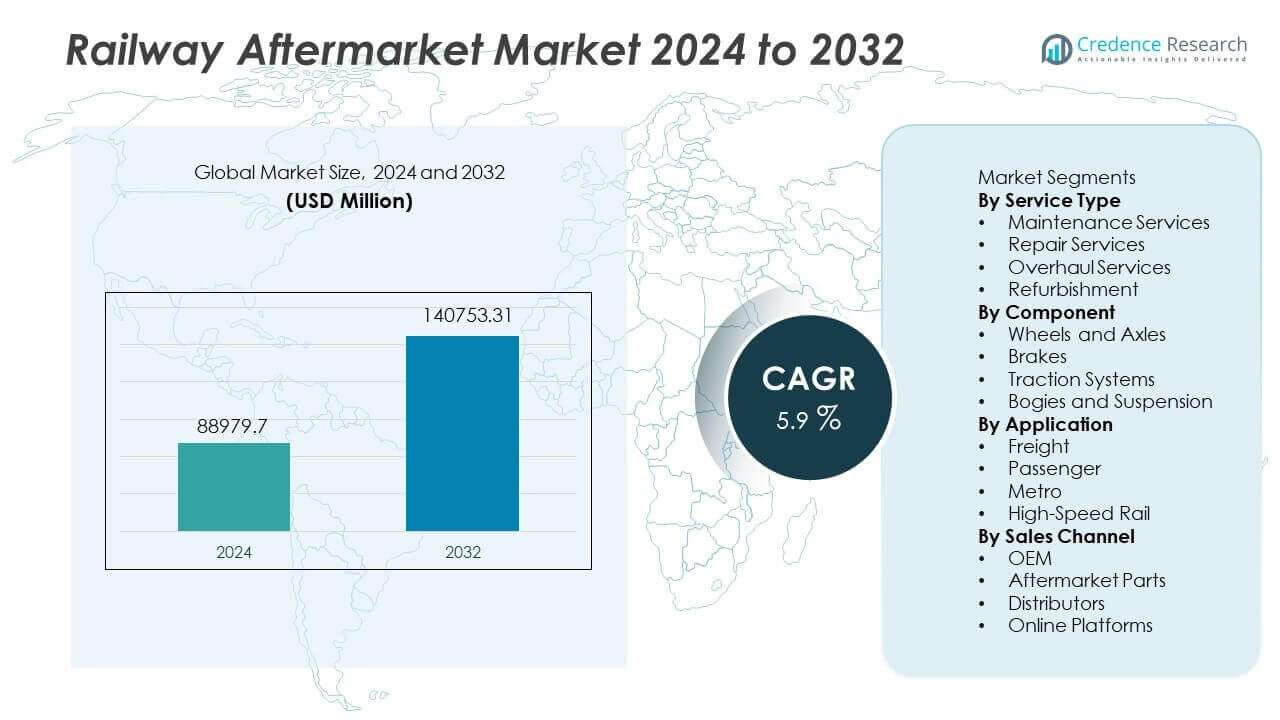
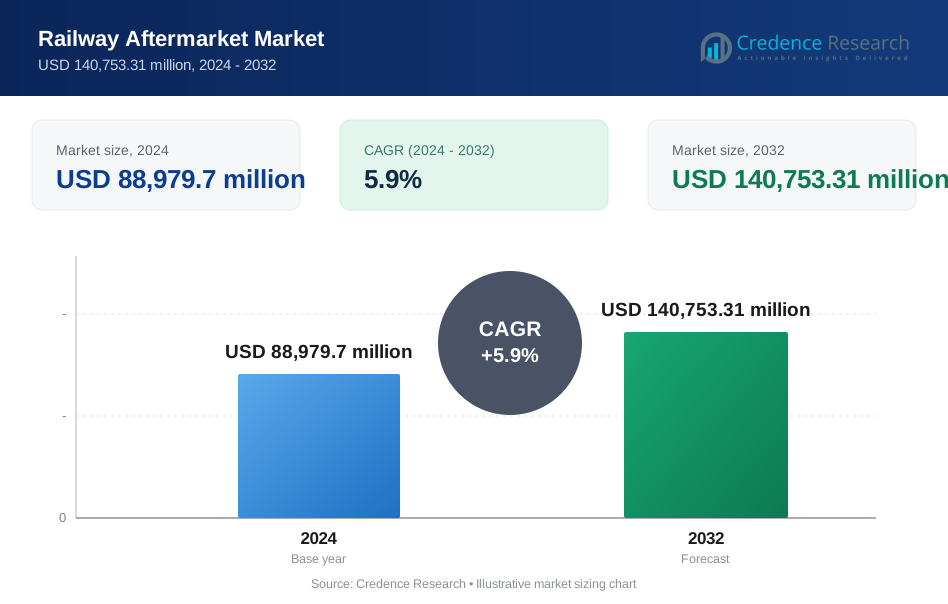
The global railway aftermarket market was valued at USD 88,979.7 million in 2024 and is projected to reach USD 140,753.31 million by 2032, expanding at a compound annual growth rate (CAGR) of 5.9% during the forecast period, according to Credence Research. This growth reflects sustained demand for maintenance, repair, overhaul, refurbishment and certified component replacement across freight, passenger, metro and high-speed rail fleets.
| REPORT ATTRIBUTE | DETAILS |
|---|---|
| Historical Period | 2020-2023 |
| Base Year | 2024 |
| Forecast Period | 2025-2032 |
| Railway Aftermarket Market Size 2024 | USD 88,979.7 million |
| Railway Aftermarket Market, CAGR | 5.9% |
| Railway Aftermarket Market Size 2032 | USD 140,753.31 million |
The global railway aftermarket market is characterized by the presence of established rail technology companies, rolling stock manufacturers, component suppliers and service specialists competing on certified parts, lifecycle support, digital diagnostics, refurbishment capabilities and long-term service contracts. Leading players focus on traction upgrades, brake system replacement, wheel and axle servicing, bogie maintenance, predictive maintenance and fleet modernization programs. Strategic priorities across the sector include lifecycle extension, condition-based monitoring, digital inspection platforms, energy-efficient component upgrades, safety compliance and long-term partnerships with national rail operators.
Strategic Market Insights
- Market growth is primarily driven by the need to extend rolling stock lifecycle, reduce replacement costs, improve fleet availability and comply with strict safety requirements across freight, passenger, metro and high-speed rail systems.
- Dominant industry trends highlight rising adoption of digital diagnostics, predictive maintenance, sensor monitoring and cloud analytics that help operators reduce unplanned downtime and improve operating efficiency across large rail networks.
- The competitive landscape is defined by major rail OEMs and component suppliers focusing on certified replacement parts, traction upgrades, braking improvements, refurbishment programs and long-term maintenance contracts with national rail operators.
- According to Credence Research regional mapping, Asia Pacific represents the largest market, accounting for a definitive 36% share due to expanding rail networks, growing metro projects, high-capacity freight corridors and rising maintenance spending across China and India.
Railway Aftermarket Market Segmentation Analysis
By Service Type
Data compiled by Credence Research confirms that maintenance services constitute the dominant service type, holding an estimated 42% market share. This leadership reflects strict rail safety rules, longer rolling stock operating life and growing use of scheduled inspections across freight, passenger and metro fleets. Rail operators increasingly invest in preventive maintenance, condition-based monitoring and digital diagnostics to keep rolling stock ready for service and reduce operational disruptions. Maintenance services also support asset availability targets, safety compliance and predictable fleet performance across high-usage networks.
Repair services hold a 28% share, driven by component wear caused by higher axle loads, frequent operations and demanding rail environments. Overhaul services account for 20% of the market, supported by aging fleets across mature rail networks and rising demand for structured lifecycle programs. Refurbishment holds a 10% share, driven by upgrades to interiors, comfort systems, air systems and onboard technologies. Together, these services reflect the industry’s increasing focus on lifecycle extension and downtime reduction.
Siemens Mobility reported more than 1,000 locomotives connected to its Railigent X analytics platform, which tracks component health using real-time diagnostics and records more than 30 million telemetry signals each day from European fleets.
By Component
Credence Research identifies brakes as the leading component segment, accounting for approximately 35% of global market share. Brakes dominate because they are critical to fleet safety, stopping control and operating reliability across freight, passenger, metro and high-speed rail applications. Heavy axle loads, frequent start-stop cycles and strict safety standards increase the need for certified brake components, periodic replacement and professional testing. Advanced braking systems are widely adopted to improve performance under varied speeds, loads and operating conditions.
Traction systems follow with a 26% share, supported by electrification programs, propulsion efficiency upgrades and modernization of aging fleets. Wheels and axles hold 22% of the market due to frequent replacement cycles linked to heavy-haul freight, high-mileage operations and wheel wear. Bogies and suspension represent 17% of the market, with demand driven by ride stability, vibration control and safety performance improvements. Growth across all component categories reflects lifecycle extension goals, strict technical standards and rising use of certified aftermarket parts.
Knorr-Bremse manufactures rail brake components across global facilities, including braking control units for metro and freight platforms, while its Munich facility uses test rigs capable of simulating speeds up to 350 kilometers per hour under European rail safety standards.
By Application
Freight remains the dominant application segment, accounting for an estimated 39% market share. This leadership is driven by long-haul cargo movement, heavy axle loads and frequent replacement cycles for wheels, brakes, traction components and suspension systems. Freight operators require durable aftermarket parts and scheduled maintenance programs to maintain fleet availability across mining, energy, agriculture and industrial corridors. Heavy-duty operations increase component stress, which strengthens demand for reliable aftermarket services and certified replacements.
Passenger rail holds a 29% share, supported by rising ridership, safety requirements and comfort-focused refurbishment programs. Metro applications account for 22% of the market, backed by urban transit expansion, short-interval operations and high start-stop stress on brakes and traction systems. High-speed rail represents 10% of the market, where advanced traction, braking and suspension upgrades are required to meet strict performance and safety standards. Across applications, operators continue to invest in professional aftermarket support to improve service reliability and extend fleet life.
By Sales Channel
OEMs represent a major sales channel in the railway aftermarket market because operators rely on original equipment manufacturers for certified components, technical documentation, warranty-backed service and complex system upgrades. OEM-backed services are especially important for braking systems, traction platforms, bogies and high-speed rail components where safety and regulatory compliance are critical. Long-term service agreements with OEMs help operators maintain predictable maintenance schedules and reduce operational risk.
Aftermarket parts suppliers serve operators seeking replacement components, repair kits and cost-efficient maintenance options. Distributors support regional availability of components and help smaller operators access certified parts across fragmented markets. Online platforms remain an emerging channel, mainly supporting standardized components, spare parts procurement and supplier discovery. Credence Research indicates that OEM and certified aftermarket channels will continue to dominate due to safety standards, fleet reliability requirements and increasing preference for traceable components.
Key Market Dynamics
Primary Market Drivers
Growing Need for Lifecycle Extension:
Rail operators face high capital costs for new rolling stock, which makes lifecycle extension a core commercial driver for the railway aftermarket market. Many networks extend asset life through scheduled servicing, controlled refurbishment, component replacement and periodic overhaul programs. Long-distance fleets require regular inspections to avoid unexpected downtime and safety risks. Rising axle loads increase wear on wheels, braking systems and suspension components. Operators also follow planned maintenance rules to meet service availability targets. Credence Research identifies lifecycle extension as one of the strongest drivers of long-term aftermarket spending across freight and passenger fleets. Alstom confirmed that its Fleet Support Centers monitored more than 15,000 rail vehicles through digital diagnostics in 2023, with analytics platforms recording 2 million condition events each month and enabling early detection of mechanical wear on passenger fleets.
Expansion of Freight and Metro Networks:
Expansion of freight corridors and metro systems is increasing demand for maintenance services, certified components and scheduled overhauls. Freight corridors handle heavy loads under long operating cycles, raising demand for wheel, axle, brake and traction system replacement. Urban population growth drives metro expansion across major cities, where trains operate at short intervals and face high start-stop stress. New routes, longer operating hours and higher passenger volumes increase maintenance intensity across rolling stock. Fleet expansion programs also create steady purchases of aftermarket parts and service contracts. CRRC delivered metro cars across global networks in 2023, including fleets for Shenzhen and Istanbul, while testing traction packages for high-density metro operations.
Shift Toward Digital and Predictive Maintenance:
The shift toward digital and predictive maintenance is transforming the railway aftermarket market. Rail operators adopt condition-based monitoring systems that track heat, braking pressure, wheel health, vibration and traction performance during service. Predictive tools help maintenance teams identify faults early and schedule repairs before failures occur. Cloud platforms allow depots, operators and service teams to share fleet health data in real time. These systems reduce unplanned stoppages, lower inspection costs and improve fleet availability. Credence Research indicates that digital maintenance will become a key differentiator for service providers as operators shift budgets from reactive repairs to predictive and condition-based service models.
Key Trends & Structural Opportunities
Adoption of Certified and High-Quality Replacement Parts:
Rail operators increasingly prefer certified and high-quality replacement parts due to strict safety rules covering braking, structure, speed and operational reliability. Higher axle weights and intensive service schedules increase wear, forcing faster replacement cycles for critical components. Certified parts reduce the risk of premature failure and support compliance with national and regional rail standards. Suppliers are also bundling certified parts with fitting, testing and service packages to reduce operator risk. This trend creates opportunities for global brands that can provide traceable, tested and standards-compliant components. Wabtec reported supplying certified brake units to global operators, including systems tested under UIC and EN rail standards, with endurance testing for brake modules conducted at its Piossasco facility in Italy.
Growth of Refurbishment and Interior Upgrades:
Refurbishment and interior upgrades are gaining momentum as operators seek to improve passenger comfort while avoiding early fleet retirement. Older passenger trains are being upgraded with improved seating, lighting, ventilation, flooring, infotainment systems and air-conditioning components. These programs help operators extend asset life, reduce capital expenditure and improve service quality. Urban and regional rail operators increasingly adopt standardized interior modules to simplify replacement and reduce maintenance complexity. Hitachi Rail confirmed maintenance contract extensions with various United Kingdom operators, continuing work across multiple passenger fleets and supporting reliability, availability and refurbishment programs.
Rising Demand for Data-Driven Service Contracts:
Railway operators are increasingly adopting data-driven service contracts that combine digital monitoring, predictive analytics, component replacement and performance-based maintenance. These contracts help operators improve fleet availability and reduce lifecycle costs. Service providers can use real-time fleet data to optimize repair schedules, forecast component replacement and reduce depot workload. This trend creates strong opportunities for OEMs and service specialists offering integrated platforms that connect diagnostics, parts supply and field service. Credence Research identifies data-driven service models as a structural opportunity because operators are prioritizing uptime, safety and predictable maintenance spending.
Industry Challenges
High Cost of Advanced Components:
Modern traction systems, braking modules, suspension systems and diagnostic technologies require advanced materials, electronics and specialized engineering. These components increase replacement costs and often require trained teams for installation, testing and validation. Many regional operators delay advanced component purchases to control budgets, which slows modernization and limits benefits linked to safety, efficiency and reliability. Cost pressure also affects older fleets, where operators may extend component use beyond optimal replacement cycles. This can raise long-term safety and service reliability risks.
Skill Gap in Modern Diagnostic and Repair Tasks:
Digital trains require skilled technicians trained in software diagnostics, sensor systems, predictive maintenance platforms, traction electronics and advanced braking technologies. Many depots lack updated training programs and specialized staff for modern repair tasks. Slow skill development increases the risk of incorrect fitting, longer downtime and delayed fault response. Some operators remain dependent on external teams for complex repair and diagnostic work, increasing service costs. Workforce development remains a major challenge for many rail networks pursuing digital maintenance and advanced fleet modernization.
Detailed Regional Analysis
| Region | Market Share (%) | Strategic Regional Catalysts & Insights |
| Asia Pacific | 36.0% | Global leader. Driven by expanding rail networks, high-capacity freight corridors, metro growth, electrification programs and rising maintenance spending across China and India. |
| Europe | 27.0% | Mature regional market. Supported by strict safety regulations, established high-speed operations, lifecycle extension programs, refurbishment demand and cross-border rail connectivity. |
| North America | 22.0% | Strong demand market. Driven by heavy-haul freight replacement cycles, high axle loads, predictive maintenance adoption and component upgrades across the United States and Canada. |
| Middle East & Africa | 8.0% | Emerging territory. Supported by new passenger and freight projects, Gulf rail investments, infrastructure diversification and gradual adoption of certified maintenance services. |
| Latin America | 7.0% | Developing regional market. Driven by freight networks serving mining and agriculture, metro expansion and overhaul programs across Brazil, Mexico and Chile. |
Asia Pacific leads the global railway aftermarket market with a 36% share, according to Credence Research. The region benefits from extensive freight corridors, expanding metro systems and rising maintenance spending across China and India. Government investments in high-capacity rail and urban mobility increase recurring demand for wheels, brakes, traction systems and refurbishment services. Dense metro networks require frequent maintenance cycles due to high passenger volumes and short-interval operations. Aging freight fleets also increase overhaul needs linked to industrial and mining activity. Rapid electrification programs further support traction system upgrades, helping the region maintain dominant aftermarket spending.
Europe holds 27% of the global railway aftermarket market, driven by long-established rail infrastructure, strict fleet safety regulations and advanced passenger networks. High-speed rail systems across France, Germany and Spain require regular traction, braking and safety system maintenance. Operators increasingly pursue refurbishment programs to modernize rolling stock, improve comfort and meet energy efficiency goals. Sustainability policies support lifecycle extension through planned inspections, overhauls and component upgrades. Rising cross-border rail connectivity also supports long-term aftermarket contracts focused on predictable fleet availability and regulatory compliance.
North America accounts for 22% of the global market, supported by heavy-haul freight operations across the United States and Canada. High axle loads and long-distance freight cycles create frequent replacement demand for wheels, brakes and traction-related components. Freight operators invest in predictive maintenance tools to reduce downtime and improve reliability across long corridors serving mining, energy and agricultural logistics. Passenger rail and commuter networks in major cities are also expanding modernization programs to meet service reliability goals. The region’s strong freight ecosystem continues to support steady aftermarket demand.
The Middle East & Africa region represents 8% of the global railway aftermarket market. Growth is supported by new rail network expansion, passenger projects and freight corridors linked with industrial development. Gulf countries are investing in modern passenger rail and metro systems, creating demand for high-quality braking, traction and maintenance services. African markets are expanding regional freight capacity, which increases long-term demand for wheels, axles and service support. Limited legacy infrastructure slows aftermarket maturity in some markets, but new projects create opportunities for global suppliers and trained service teams.
Latin America holds 7% of the global market, driven by freight-oriented networks serving mining, agriculture and industrial exports across Brazil, Mexico and Chile. Many operators focus on periodic overhaul programs to extend fleet life because new rolling stock remains costly. Expanding metro systems in major cities increase brake, traction and suspension maintenance needs under frequent start-stop operations. Regional operators increasingly adopt refurbishment to improve comfort and reliability in older passenger fleets. Limited domestic component production increases reliance on imported certified parts, supporting demand for global suppliers and distributors.
Competitive Landscape & Recent Developments
The railway aftermarket market is competitive and includes major rolling stock manufacturers, component suppliers, service providers and rail technology companies. Key players include Siemens Mobility, Alstom, Wabtec Corporation, Bombardier Transportation, Hitachi Rail, Knorr-Bremse AG, CRRC Corporation Limited, Stadler Rail, CAF Construcciones y Auxiliar de Ferrocarriles and Progress Rail. These companies compete through certified replacement parts, maintenance contracts, traction upgrades, brake systems, refurbishment packages and digital service platforms.
Market leaders focus on lifecycle extension services, predictive maintenance, remote diagnostics and digital inspection platforms that reduce downtime and improve rolling stock availability. Strategic partnerships with national rail operators help expand long-term service contracts, while refurbishment programs strengthen revenue from aging fleets. Key participants invest in high-quality components for heavy-haul freight, metro systems and high-speed rail operations. Regional players compete through cost-effective repair programs, certified fitting support and localized service capabilities. Continuous innovation in braking materials, sensor-enabled traction modules and validated refurbishment kits strengthens competitive positioning across global and regional aftermarket segments.
Recent Industry Developments (2025)
- In October 2025, Siemens Mobility showcased a broad portfolio of next-generation rail technologies and infrastructure solutions at an international railway exhibition in India.
- In May 2025, Wabtec Corporation, through its Advanced Technology Group, unveiled several new rail technology concepts at the Railway Interchange 2025 event in Indianapolis.
Request a Free Sample
Fill in your details and we'll send you a free sample report.
- Sample data tables & charts
- Research methodology
Need a Custom Version of This Report?
Tailor the scope, geography, or segments to your exact requirements.
- Custom geography or segment scope
- Direct access to our analyst team
Frequently Asked Questions
What is the current and projected size of the global railway aftermarket market?
What is the projected growth rate of the railway aftermarket industry over the forecast period?
Which service type holds the maximum market share within the railway aftermarket industry?
Which component segment dominates the railway aftermarket market?
Which application segment leads the railway aftermarket market?
Which region commands the highest market share in the global railway aftermarket space?
Table of Content
Chapter 1 Market Segmentation
- 1.1 Segmentation Framework
- 1.1.1 Product and Service Classification
- 1.1.2 Application and End-Use Classification
- 1.1.3 Technology and Solution Classification
- 1.1.4 Customer and Distribution Channel Classification
- 1.1.5 Geographic Segmentation
- 1.1.6 Market Segment Definitions and Boundaries
Chapter 2 Introduction
- 2.1 Report Objectives and Scope
- 2.2 Product Definition and Industry Terminology
- 2.3 Market Inclusions and Exclusions
- 2.4 Research Process
- 2.4.1 Primary Research and Expert Interviews
- 2.4.2 Secondary Research and Source Review
- 2.4.3 Top-Down and Bottom-Up Estimation
- 2.4.4 Data Triangulation and Verification
- 2.5 Market Size Measurement Basis
- 2.5.1 2024: USD 88,979.7 million → 2032: USD 140,753.31 million
- 2.6 Historical and Forecast Reference Periods
- 2.6.1 Base Year: 2024
- 2.6.2 Forecast Period: 2024-2032
- 2.7 Research Assumptions and Limitations
Chapter 3 Executive Summary
- 3.1 Market Snapshot and Key Findings
- 3.2 Base-Year Market Size, 2024
- 3.3 Forecast Market Size, 2032
- 3.4 Revenue and Volume Growth Outlook
- 3.5 Key Demand and Supply Indicators
- 3.6 Leading Market Segments
- 3.7 Fastest-Growing Market Opportunities
- 3.8 Regional Performance Highlights
- 3.9 Technology and Industry Transformation
- 3.10 Competitive Landscape Summary
- 3.11 Analyst View and Strategic Implications
Chapter 4 Global Railway Aftermarket Market Trends and Developments
- 4.1 Historical Industry Development
- 4.2 Recent Market Trends and Developments
- 4.3 Demand and Customer Behavior Trends
- 4.4 Technology and Product Innovation
- 4.5 Artificial Intelligence, Automation and Digitalization
- 4.6 Local Manufacturing and Supply Chain Realignment
- 4.7 Industry Partnerships, Mergers and Acquisitions
- 4.8 Sustainability and Circular Economy Developments
- 4.9 Government and Private Sector Investment Trends
- 4.10 Emerging Business Models and Commercialization
- 4.11 Industry Developments and Announcements
Chapter 5 Global Railway Aftermarket Market Production, Supply and Demand Analysis
- 5.1 Demand Trend and Consumption Analysis
- 5.2 Demand Forecast, 2024-2032
- 5.3 Production and Output Trend
- 5.4 Production and Output Forecast, 2024-2032
- 5.5 Installed Capacity and Capacity Utilization
- 5.6 Company-Wise Production Plants and Statistics
- 5.6.1 Installed Production Capacity
- 5.6.2 Actual Production
- 5.6.3 Planned Capacity and Expansion Targets
- 5.7 Supply Chain Structure and Procurement Trends
- 5.8 Supply-Demand Gap and Bottlenecks
- 5.9 Import Dependence and Sourcing Structure
- 5.10 Contract Manufacturing and Outsourcing
- 5.11 Regional Supply and Demand Concentration
Chapter 6 Global Railway Aftermarket Market Pricing Analysis
- 6.1 Pricing Structure and Measurement
- 6.2 Historical Pricing Trends
- 6.3 Pricing Outlook, 2024-2032
- 6.4 Average Selling Price and Unit Economics
- 6.5 Pricing by Product and Market Segment
- 6.6 Geographic Pricing Differences
- 6.7 Key Input, Energy, Labor and Logistics Costs
- 6.8 Contract Pricing and Purchasing Models
- 6.9 Pricing Sensitivity and Competitive Positioning
- 6.10 Price, Margin and Profitability Implications
Chapter 7 Global Railway Aftermarket Market Dynamics
- 7.1 Market Growth Drivers
- 7.1.1 Demand-Side Drivers
- 7.1.2 Technology and Innovation Drivers
- 7.1.3 Infrastructure and Investment Drivers
- 7.1.4 Regulatory and Policy Drivers
- 7.2 Market Restraints
- 7.2.1 Cost and Affordability Constraints
- 7.2.2 Technology and Adoption Barriers
- 7.2.3 Supply Chain and Operational Constraints
- 7.3 Market Challenges
- 7.3.1 Competitive Pressure and Margin Erosion
- 7.3.2 Skills, Infrastructure and Implementation Gaps
- 7.4 Emerging Market Opportunities
- 7.5 Market Dynamics Impact and Time-Horizon Assessment
Chapter 8 Global Railway Aftermarket Value Chain Analysis
- 8.1 Industry Value Chain Overview
- 8.2 Upstream Suppliers and Critical Inputs
- 8.3 Technology and Component Providers
- 8.4 Manufacturing or Service Delivery
- 8.5 Distribution, Channel Partners and Integrators
- 8.6 Downstream Applications and End Users
- 8.7 Value Addition and Profit Pools
- 8.8 Vertical Integration and Outsourcing
- 8.9 Supplier Concentration and Risk
- 8.10 Supply Chain Localization and Resilience
Chapter 9 Global Railway Aftermarket Market Regulations and Policies
- 9.1 Relevant Laws, Standards and Compliance Frameworks
- 9.2 Product, Service, Safety and Quality Requirements
- 9.3 Government Policies, Incentives and Subsidies
- 9.4 Imports, Exports and Trade Barriers
- 9.5 Public Procurement and Local Content Requirements
- 9.6 Environmental and Sustainability Compliance
- 9.7 Upcoming Policy Changes and Market Implications
Chapter 10 Global Railway Aftermarket Market Hotspots and Opportunities
- 10.1 Market Opportunity Mapping and Growth Hotspots
- 10.2 High-Growth Applications and Customer Groups
- 10.3 Underserved Markets and White-Space Opportunities
- 10.4 Emerging Technology and Product Opportunities
- 10.5 New Capacity and Investment Hotspots
- 10.6 Market Entry and Expansion Opportunities
- 10.7 Distribution and Partnership Opportunities
- 10.8 Near-Term and Long-Term Commercial Potential
- 10.9 Opportunity Attractiveness and Execution Risks
Chapter 11 Global Railway Aftermarket Market Outlook, 2024-2032
- 11.1 Market Size and Analysis
- 11.1.1 Revenue (Market Measurement: 2024: USD 88,979.7 million → 2032: USD 140,753.31 million)
- 11.1.2 Market Volume and Quantity Sold
- 11.1.3 Historical Market Size
- 11.1.4 Base-Year Market Size, 2024
- 11.2 Market Forecast, 2024-2032
- 11.2.1 Revenue Forecast to 2032
- 11.2.2 Volume Forecast to 2032
- 11.2.3 CAGR and Year-on-Year Growth
- 11.2.4 Incremental Revenue Opportunity
- 11.3 Forecast Assumptions and Scenario Analysis
- 11.3.1 Base-Case Forecast
- 11.3.2 Optimistic and Conservative Scenarios
- 11.3.3 Technology, Pricing and Policy Sensitivities
- 11.4 Market Attractiveness and Growth Outlook
Chapter 12 Global Railway Aftermarket Market Segmentation and Outlook
- 12.1 Segmentation Summary and Market Shares, 2024
- 12.2 Largest and Fastest-Growing Segments
- 12.3 Segment Growth Comparison
- 12.4 Segment Attractiveness and Priority Matrix
Chapter 13 Global Railway Aftermarket Geographic Market Outlook, 2024-2032
- 13.1 Regional Market Size and Share, 2024
- 13.2 Regional Market Forecast, 2024-2032
- 13.3 Regional Pricing, Production and Demand Differences
- 13.4 North America
- 13.4.1 United States
- 13.4.2 Canada
- 13.4.3 Mexico
- 13.5 Europe
- 13.5.1 Germany
- 13.5.2 France
- 13.5.3 Italy
- 13.5.4 United Kingdom
- 13.5.5 Spain
- 13.5.6 Poland
- 13.5.7 Russia
- 13.5.8 Netherlands
- 13.5.9 Belgium
- 13.5.10 Sweden
- 13.5.11 Denmark
- 13.5.12 Norway
- 13.5.13 Rest of Europe
- 13.6 Asia Pacific
- 13.6.1 China
- 13.6.2 India
- 13.6.3 Japan
- 13.6.4 South Korea
- 13.6.5 Thailand
- 13.6.6 Indonesia
- 13.6.7 Vietnam
- 13.6.8 Malaysia
- 13.6.9 Australia
- 13.6.10 Rest of Asia Pacific
- 13.7 Latin America
- 13.7.1 Brazil
- 13.7.2 Argentina
- 13.7.3 Colombia
- 13.7.4 Chile
- 13.7.5 Rest of Latin America
- 13.8 Middle East
- 13.8.1 Saudi Arabia
- 13.8.2 United Arab Emirates
- 13.8.3 Turkey
- 13.8.4 Israel
- 13.8.5 Iran
- 13.8.6 Rest of the Middle East
- 13.9 Africa
- 13.9.1 South Africa
- 13.9.2 Egypt
- 13.9.3 Nigeria
- 13.9.4 Morocco
- 13.9.5 Rest of Africa
- 13.10 Regional Investment, Policy and Supply Chain Differences
- 13.11 Regional Competitive Landscape
- 13.12 Geographic Growth Hotspots
Chapter 14 Global Railway Aftermarket Technology, Innovation and Sustainability Outlook
- 14.1 Technology Landscape and Maturity
- 14.2 Product, Process and Service Innovation
- 14.3 AI, Automation and Digital Tools in the Industry
- 14.4 Technology Adoption and Performance Benchmarking
- 14.5 Innovation Pipeline and R&D Investment
- 14.6 Patent and Intellectual Property Trends
- 14.7 Energy Efficiency and Resource Management
- 14.8 Sustainability, Recycling and Circularity
- 14.9 Technology Roadmap, 2024-2032
- 14.10 Risks of Obsolescence and Technology Substitution
Chapter 15 Global Railway Aftermarket Market Key Strategic Imperatives
- 15.1 Growth and Market Entry Priorities
- 15.2 High-Return Products and Segments
- 15.3 Pricing, Profitability and Cost Optimization
- 15.4 Technology Investment and Product Differentiation
- 15.5 Supply Chain Localization and Resilience
- 15.6 Distribution and Customer Acquisition
- 15.7 Partnership, Acquisition and Capacity Strategy
- 15.8 Regional Expansion Priorities
- 15.9 Short-, Medium- and Long-Term Actions
Chapter 16 Competition Outlook
- 16.1 Industry Competition Characteristics
- 16.2 Market Structure and Concentration
- 16.3 Market Share and Competitive Positioning, 2024
- 16.4 Company-Wise Revenue and Product Benchmarking
- 16.5 Production and Service Capacity Benchmarking
- 16.6 Technology, Pricing and Differentiation
- 16.7 Regional Footprint and Distribution Strength
- 16.8 Mergers, Acquisitions and Strategic Alliances
- 16.9 New Entrants and Competitive Threats
- 16.10 Porter's Five Forces and Industry Attractiveness
- 16.11 Competitive Outlook, 2024-2032
Chapter 17 Company Profiles
- 17.1 Company Coverage and Selection Criteria
- 17.2 Leading Market Participants – Standard Profile Structure
- 17.2.1 Business Description
- 17.2.2 Company Ownership and Geographic Presence
- 17.2.3 Product and Service Portfolio
- 17.2.4 Manufacturing and Operating Footprint
- 17.2.5 Production Capacity and Expansion Plans
- 17.2.6 Financial Performance and Investment
- 17.2.7 Market Share and Competitive Position
- 17.2.8 Technology and Innovation Capabilities
- 17.2.9 Strategic Alliances or Partnerships
- 17.2.10 Recent Developments
- 17.2.11 Growth Strategy and Outlook
- 17.3 Other Relevant Market Participants
Note: Every listed company is profiled on the structure shown under the first company. The company list is preliminary and may change based on research findings, market developments, data availability and client requirements.
Chapter 18 Disclaimer
- 18.1 Research and Forecast Disclaimer
- 18.2 Data Source and Estimation Limitations
Note: The depth of individual sections depends on data availability for this market. Volume, capacity, trade and other unit-based metrics are included where applicable.
