
Railway Maintenance Machinery Market Overview:
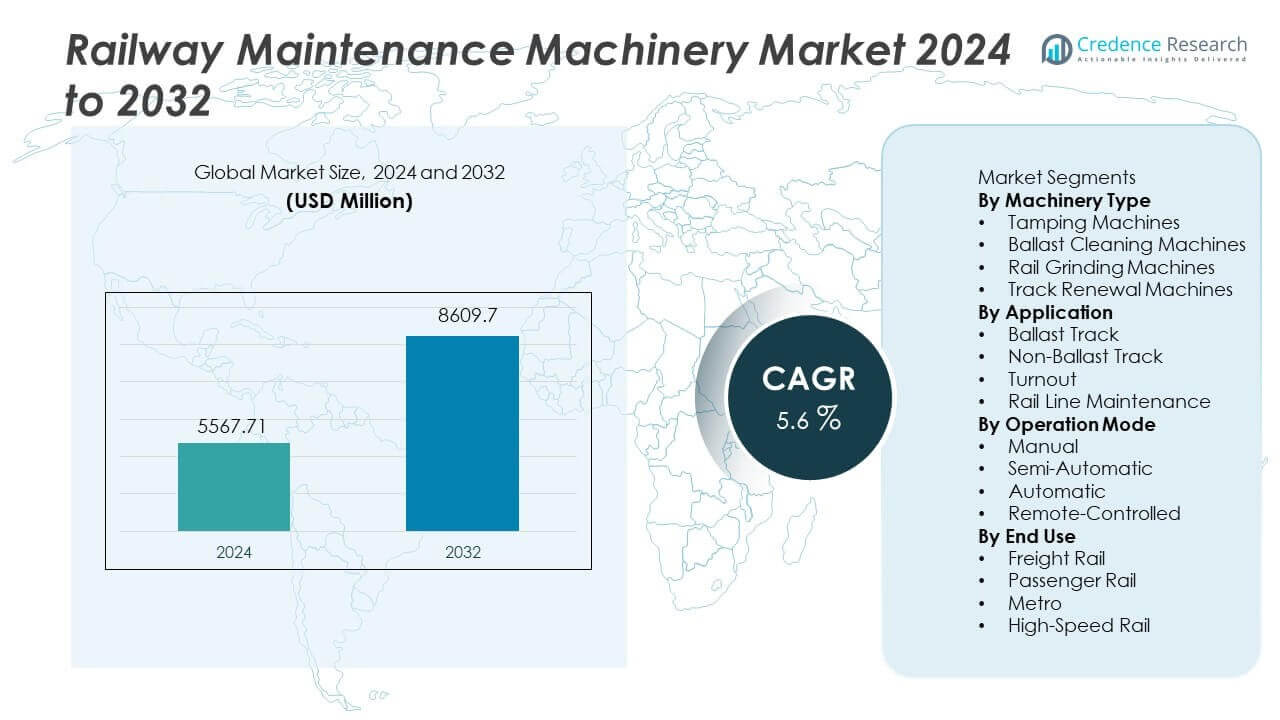
Railway Maintenance Machinery market size stood at USD 5,567.71 million in 2024 and is projected to reach USD 8,609.7 million by 2032, registering a CAGR of 5.6% during the forecast period.
| REPORT ATTRIBUTE | DETAILS |
|---|---|
| Historical Period | 2020-2023 |
| Base Year | 2024 |
| Forecast Period | 2025-2032 |
| Railway Maintenance Machinery Market Size 2024 | USD 5,567.71million |
| Railway Maintenance Machinery Market, CAGR | 5.6% |
| Railway Maintenance Machinery Market Size 2032 | USD 8,609.7 million |
Railway Maintenance Machinery Market Insights
- Tamping machines lead the machinery type segment with 37 percent share, driven by high demand for track stabilization and corrective alignment across heavy-load freight and high-speed passenger corridors under rising axle weights.
- Automation and remote-controlled operation remain key trends as operators adopt advanced alignment systems, predictive maintenance tools, and high-capacity grinding and ballast equipment that reduce downtime and improve network safety.
- Competitive intensity involves Plasser & Theurer, Harsco Rail, Loram, and CRRC focusing on automated tamping, heavy-duty grinding, and high-output ballast cleaning, while regional suppliers emphasize affordable machinery and refurbishment solutions.
- Asia Pacific accounts for 35 % share, followed by Europe at 28 % and North America at 22 %, driven by modernization programs, freight capacity expansion, and increased track renewal spending across major networks.
Railway Maintenance Machinery Market Segmentation Analysis:
By Machinery Type
Tamping machines lead this segment with 37% share, driven by their essential role in stabilizing tracks and restoring track geometry to ensure safe operations. Ballast cleaning machines hold 26% share due to growing demand for maintaining ballast quality under heavy freight traffic. Rail grinding machines account for 22% share, supported by higher usage in high-speed and metro networks that require smoother rail surfaces. Track renewal machines represent 15% share, driven by aging infrastructure across developed regions. The segment grows with rising capital spending on track reliability and long-term service continuity across freight and passenger corridors.
- For instance, Plasser & Theurer developed the Unimat 09-4x4/4S tamping machine equipped with four-rail lifting and lining units that allow continuous tamping at working speeds up to 2.4 km/h, improving alignment accuracy during major renewal work.
By Application
Ballast track dominates with 41% share because most global rail infrastructure relies on ballast-supported tracks that need frequent leveling, stabilization, and ballast cleaning. Non-ballast track applications hold 23% share, supported by high-speed and metro installations that use slab-based construction. Turnout accounts for 19% share, as switches and crossings need periodic alignment and geometry correction to reduce safety risks. Rail line maintenance represents 17% share driven by continuous upkeep demand across mainline and regional routes. The segment benefits from rising maintenance frequency due to heavier axle loads and increased train speeds.
- For instance, Strukton Rail deployed turnout grinding units capable of processing switch blades for a considerable distance, lowering wheel impact forces on high-speed junctions.
By Operation Mode
Automatic operation leads this segment with 32% share, driven by rising adoption of advanced control systems that improve precision and reduce manual labor, especially on high-capacity networks. Semi-automatic machines hold 29% share, supported by combined control functions suitable for mixed infrastructure. Manual equipment accounts for 24% share, mainly used in developing regions with limited automation budgets. Remote-controlled machinery represents 15% share, supported by safety-focused operations that allow workers to operate equipment away from active tracks. Demand for automated systems continues rising with improved productivity and fewer operational delays across freight and metro lines.
Key Growth Drivers
Increasing Track Modernization and Upgrades
Rail operators invest in modernization programs to improve rail safety, reduce downtime, and support higher train speeds. Heavy freight operations accelerate wear on track components, pushing operators to expand periodic maintenance cycles. Modern tamping and grinding equipment help maintain track geometry and surface quality. Governments invest in upgrading existing infrastructure instead of building new systems, improving long-term utilization of maintenance machinery. Large modernization plans across Asia and Europe continue supporting growth in heavy-duty machinery and automated alignment systems.
- For instance, Loram delivered rail grinding fleets with up to 128 grinding motors on a single train, enabling sustained corrective grinding over 1,600 km of track each year on heavy-haul routes.
Expansion of Freight and High-Speed Rail Networks
Rising freight transport pushes networks to adopt advanced renewal and ballast maintenance solutions that improve load capacity and prevent track distortion. High-speed projects require high-quality track grinding and alignment to maintain train stability and passenger safety. These networks rely on continuous track inspection and renewal, increasing demand for automatic tamping and ballast cleaning systems. Rail corridors supporting mining, energy, and industrial cargo also expand demand for heavy-capacity machinery across developing markets.
- For instance, Harsco Rail delivered ballast maintenance systems for heavy-haul mining networks in Australia, enabling efficient undercutting operations during maintenance periods.
Growing Focus on Operational Efficiency and Reduced Downtime
Operators depend on machinery that reduces track closure time and speeds up inspections. Automatic and remote-controlled systems reduce manual labor and improve safety during heavy operations. Predictive maintenance tools support planned track renewal programs with minimal service disruption. This trend encourages investment in advanced machinery that improves alignment quality and reduces long-term operating cost.
Key Trends & Opportunities
Shift Toward Automated and Remote-Controlled Machines
Automation improves precision and eliminates repeated manual tasks under heavy axle loads and high-speed conditions. Remote-controlled machinery reduces worker risk during ballast cleaning, grinding, and tamping operations in active rail zones. Automated solutions shorten maintenance cycles and reduce service interruption, especially on busy passenger corridors and metro networks. Operators adopt advanced alignment systems with integrated sensors that ensure continuous quality compliance.
- For instance, Robel Bahnbaumaschinen developed a maintenance system that includes features for automated work processes and performs precision track maintenance during slab-track maintenance.
Rising Demand for High-Capacity Track Renewal Systems
Aging rail infrastructure and urban expansion require large-scale track replacement and modernization. High-capacity machinery enables fast renewal programs for metro, freight, and high-speed applications. Government budgets support large-scale replacement to improve long-term network reliability. Many developing regions plan new metro and intercity projects, driving machinery demand.
- For instance, CRRC designs various types of track machinery and maintenance equipment for use in China and worldwide, including rail grinding trains and other operation cars designed for high power and efficiency. This equipment is widely used in railway infrastructure and the mine industry to perform essential maintenance functions.
Key Challenges
High Maintenance Cost of Advanced Machinery
Advanced tamping, grinding, and ballast cleaning equipment require high upfront investment and specialized maintenance. Limited budgets in developing regions slow adoption of automated machinery. Operators continue using older systems to reduce capital spending, delaying modernization and risking higher long-term maintenance costs.
Shortage of Skilled Workforce for Modern Machines
Advanced maintenance systems require trained operators and technicians who understand automated alignment, sensor integration, and predictive maintenance. Many operators lack skilled teams, slowing technology adoption. Workforce training becomes essential to achieve full benefit of high-capacity machinery.
Regional Analysis
Asia Pacific
Asia Pacific leads the Railway Maintenance Machinery market with 35% share, supported by rapid expansion of freight corridors, metro construction, and high-speed rail projects across China, Japan, and India. Governments invest heavily in infrastructure upgrades that require regular track renewal, tamping, ballast cleaning, and grinding operations. Rapid urbanization increases metro and regional rail maintenance cycles. Rising axle loads and freight-intensive corridors drive demand for high-capacity machinery and automated alignment systems. Local manufacturers expand product supply, while global vendors strengthen presence through service partnerships and modernization programs across the region.
Europe
Europe holds 28% share, driven by well-established rail infrastructure and strict maintenance standards across national rail operators. High-speed networks in Germany, France, and Spain require advanced machinery for continuous alignment and surface correction. Growing focus on lifecycle extension encourages investment in tamping and grinding equipment that support long-distance operations. Sustainability policies promote predictive maintenance and efficient renewal practices. Modernization initiatives increase adoption of automated and remote-controlled machinery across major corridors.
North America
North America accounts for 22% share, driven by heavy-haul freight networks across the United States and Canada. Rail operators invest in track leveling, ballast handling, and high-capacity grinding machinery to handle frequent axle stress and long-distance operations. Industry demand for downtime reduction and faster maintenance supports adoption of advanced tamping systems. Freight expansion and industrial development increase periodic renewal needs. Investments rise in automated equipment that improves service continuity across high-traffic corridors.
Middle East and Africa
Middle East and Africa represent 8% share, supported by new rail corridors and metro initiatives across the Gulf region and emerging infrastructure networks in Africa. Modernization programs demand track renewal machinery and automated tamping solutions designed for harsh operating environments. Skill limitations slow adoption in some countries, but investments in infrastructure expansion increase long-term demand. Regional suppliers partner with global vendors to introduce advanced machinery and service offerings.
Latin America
Latin America holds 7% share, driven by freight-oriented networks serving mining, agriculture, and industrial sectors in Brazil, Mexico, and Chile. Operators invest in track stabilization and renewal machinery to improve reliability under heavy commodity flows. Metro system expansion increases demand for grinding and tamping solutions in dense urban corridors. Limited domestic manufacturing supports opportunities for international suppliers. Investments in modernization and network expansion continue to support gradual adoption of advanced machinery.
Railway Maintenance Machinery Market Segmentations:
By Machinery Type
- Tamping Machines
- Ballast Cleaning Machines
- Rail Grinding Machines
- Track Renewal Machines
By Application
- Ballast Track
- Non-Ballast Track
- Turnout
- Rail Line Maintenance
By Operation Mode
- Manual
- Semi-Automatic
- Automatic
- Remote-Controlled
By End Use
- Freight Rail
- Passenger Rail
- Metro
- High-Speed Rail
By Geography
- North America
- U.S.
- Canada
- Mexico
- Europe
- Germany
- France
- U.K.
- Italy
- Spain
- Rest of Europe
- Asia Pacific
- China
- Japan
- India
- South Korea
- South-east Asia
- Rest of Asia Pacific
- Latin America
- Brazil
- Argentina
- Rest of Latin America
- Middle East & Africa
- GCC Countries
- South Africa
- Rest of the Middle East and Africa
Key Player Analysis
- Plasser & Theurer
- Harsco Rail
- Loram Maintenance of Way
- Robel Bahnbaumaschinen
- Strukton Rail
- Gemac Engineering
- CRRC Corporation
- Geismar
- Schweerbau International
- Vossloh Rail Services
Recent Developments
- In March 2025, L&T Technology Services launched TrackEi™, an AI-powered railway track inspection solution. Built on NVIDIA Jetson™, it uses edge AI and machine vision to detect defects in real time and enable predictive maintenance, enhancing railway safety, reliability, and operational efficiency globally.
- In 2025, Loram Maintenance of Way has expanded and continues to expand its use of real-time analytics and inspection technologies to support data-driven, predictive maintenance, moving away from traditional interval-based schedules.
Report Coverage
The research report offers an in-depth analysis based on Machinery Type, Application, Operation Mode, End Use and Geography. It details leading market players, providing an overview of their business, product offerings, investments, revenue streams, and key applications. Additionally, the report includes insights into the competitive environment, SWOT analysis, current market trends, as well as the primary drivers and constraints. Furthermore, it discusses various factors that have driven market expansion in recent years. The report also explores market dynamics, regulatory scenarios, and technological advancements that are shaping the industry. It assesses the impact of external factors and global economic changes on market growth. Lastly, it provides strategic recommendations for new entrants and established companies to navigate the complexities of the market.
Future Outlook
- Automation will expand across tamping, grinding, and ballast cleaning operations.
- Predictive maintenance will become central to planned track renewal cycles.
- Remote-controlled systems will improve worker safety on active rail lines.
- High-speed projects will increase demand for precise alignment machinery.
- Freight growth will drive heavy-duty renewal and stabilization equipment needs.
- Digital alignment tools will support faster inspection and corrective actions.
- Modernization programs will encourage adoption of high-capacity machinery.
- Lifecycle service contracts will grow across national rail operators.
- Refurbished equipment demand will rise in developing rail markets.
- Sustainability goals will push machinery designed for reduced resource use.
Request a Free Sample
Fill in your details and we'll send you a free sample report.
- Sample data tables & charts
- Research methodology
Need a Custom Version of This Report?
Tailor the scope, geography, or segments to your exact requirements.
- Custom geography or segment scope
- Direct access to our analyst team
Frequently Asked Questions
What is the current market size for the Railway Maintenance Machinery market, and what is its projected size in 2032?
At what Compound Annual Growth Rate is the Railway Maintenance Machinery market projected to grow between 2024 and 2032?
Which Railway Maintenance Machinery market segment held the largest share in 2024?
What are the primary factors fueling the growth of the Railway Maintenance Machinery market?
Who are the leading companies in the Railway Maintenance Machinery market?
Which region commanded the largest share of the Railway Maintenance Machinery market in 2024?
Table of Content
Chapter 1. Report Introduction
- 1.1 Report Description & Purpose
- 1.1.1 Report Title & Market Definition
- 1.1.2 Unique Selling Propositions (USP) & Key Differentiators
- 1.1.3 Value Proposition for Stakeholders
- 1.2 Research Objectives
- 1.2.1 Market Sizing Objectives (Volume & Revenue)
- 1.2.2 Segmentation Objectives
- 1.2.3 Competitive Intelligence Objectives
- 1.2.4 Forecast & Scenario Objectives
- 1.3 Report Scope
- 1.3.1 Railway Maintenance Machinery Scope – Types & Subtypes Covered
- 1.3.2 Geographic Scope – Regions & Countries Covered
- 1.3.3 Historical Period, Base Year & Forecast Period (2024; forecast to 2032)
- 1.3.4 Inclusions & Exclusions
- 1.4 HS Code & Classification Framework
- 1.5 Currency, Units & Pricing Basis
- 1.6 Target Stakeholders
- 1.7 Limitations & Assumptions
Chapter 2. Executive Summary
- 2.1 Global Railway Maintenance Machinery Market Snapshot
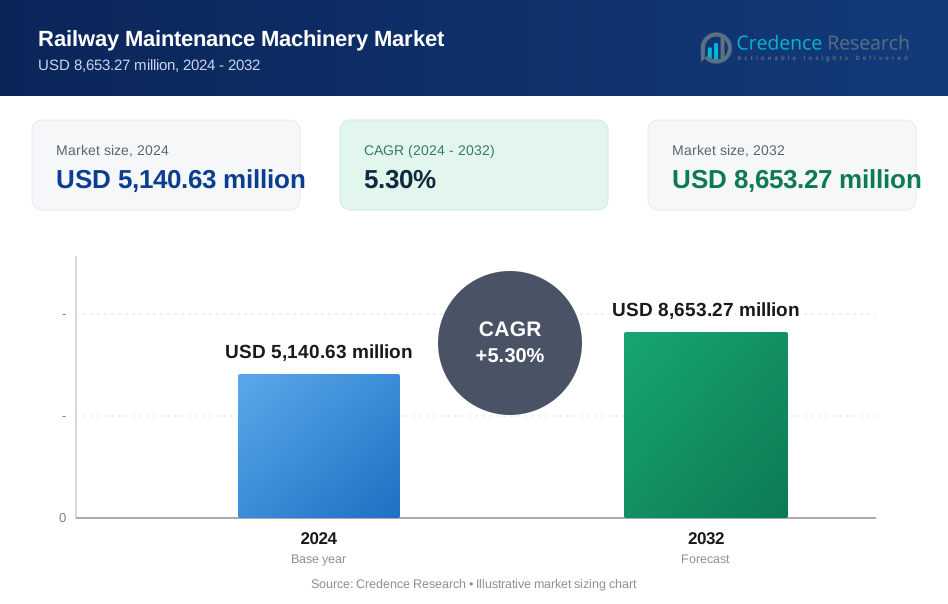
- 2.1.1 Market Size – Historical (2024) & Forecast (2024-2032) (2024: USD 5,140.63 million → 2032: USD 8,653.27 million)
- 2.1.2 Volume & Revenue – Global Totals
- 2.1.3 Key Market Highlights – Top Five Facts
- 2.2 Railway Maintenance Machinery Market Segmentation Snapshot
- 2.2.1 Market Split by Region – 2024 vs. 2032
- 2.3 Competitive Snapshot
- 2.3.1 Top 10 Players by Revenue Share – 2024
- 2.3.2 Top 10 Players by Volume Share – 2024
- 2.3.3 Recent Strategic Developments (18-Month Summary)
- 2.4 Key Investment Highlights & Strategic Conclusions
Chapter 3. Railway Maintenance Machinery Market Dynamics & Industry Analysis
- 3.1 Market Overview & Context
- 3.1.1 Railway Maintenance Machinery Market Position in the Broader Automotive Value Chain
- 3.1.2 OEM vs. Replacement Market Dynamics
- 3.1.3 Market Maturity & Development Stage by Region
- 3.2 Railway Maintenance Machinery Market Drivers
- 3.3 Railway Maintenance Machinery Market Restraints & Challenges
- 3.4 Railway Maintenance Machinery Market Opportunities
- 3.5 Porter's Five Forces Analysis
- 3.5.1 Threat of New Entrants
- 3.5.2 Bargaining Power of Suppliers
- 3.5.3 Bargaining Power of Buyers
- 3.5.4 Threat of Substitutes
- 3.5.5 Competitive Rivalry – Intensity Assessment
- 3.6 Railway Maintenance Machinery Value Chain Analysis
- 3.6.1 Upstream – Raw Material/Input Suppliers
- 3.6.1.1 Raw Material/Input 1
- 3.6.1.2 Raw Material/Input 2
- 3.6.1.3 Raw Material/Input 3
- 3.6.2 Midstream – Production/Manufacturing/Service Delivery
- 3.6.2.1 Production/Process Overview
- 3.6.2.2 Key Facility Locations & Capacity by Manufacturer
- 3.6.3 Downstream – Distribution & End Consumer
- 3.6.3.1 Primary Channel – B2B/OEM
- 3.6.3.2 Secondary Channels – Dealer, Retail, Online, Direct
- 3.6.4 Value Chain Profitability Analysis
- 3.6.1 Upstream – Raw Material/Input Suppliers
- 3.7 PESTEL Analysis
- 3.7.1 Political Factors
- 3.7.2 Economic Factors
- 3.7.3 Social Factors
- 3.7.4 Technological Factors
- 3.7.5 Environmental Factors
- 3.7.6 Legal Factors
- 3.8 Railway Maintenance Machinery Supply Chain Analysis
- 3.8.1 Raw Material/Input Supply Risk Assessment
- 3.8.2 Manufacturing Concentration Risk (Geographic Exposure)
- 3.8.3 Trade Disruption Impact Analysis
- 3.9 Regulatory & Policy Landscape
Note: The regulatory and policy landscape section covers regulations based on their applicability to the market, Railway Maintenance Machinery category, geography, and scope of the study. Only regulatory frameworks with a material impact on operations, compliance, trade, sustainability, or market access are analyzed in detail.
Chapter 4. Key Investment Pockets & Opportunity Analysis
- 4.1 Railway Maintenance Machinery Market Attractiveness Analysis
- 4.1.1 By Region – Investment Attractiveness Matrix (Volume × CAGR)
- 4.2 Absolute Revenue Growth Opportunity
- 4.2.1 By Region – Absolute USD Growth Through 2032
- 4.3 Incremental Volume Opportunity
- 4.3.1 By Region – Incremental Volume Through 2032
- 4.3.2 Segment – Incremental Volume
- 4.4 Emerging Submarket Opportunity Deep Dive (Subject to Applicability)
- 4.5 Emerging Market Opportunity Scorecards
- 4.5.1 United States
- 4.5.2 Europe
- 4.5.3 Asia
- 4.5.4 Middle East & Africa
Note: Emerging Market Opportunity Scorecards will be included based on relevance and strategic importance. Regions listed are indicative and may vary depending on data availability and market dynamics.
Chapter 5. Railway Maintenance Machinery Import-Export Analysis & Trade Flows
- 5.1 Global Trade Overview
- 5.1.1 Global Export Value by Country (2024)
- 5.1.2 Global Export Volume by Country (2024)
- 5.1.3 Global Import Value by Country (2024)
- 5.1.4 Global Import Volume by Country (2024)
- 5.1.5 Net Trade Balance by Country (2024)
- 5.2 Export Analysis – Segment
- 5.2.1 Type 1 (HS Code)
- 5.2.2 Type 2 (HS Code)
- 5.2.3 Type 3 (HS Code)
- 5.2.4 Type 4 (HS Code)
- 5.2.5 Type 5 (HS Code)
- 5.3 Import Analysis – Segment
- 5.3.1 Type 1 (HS Code)
- 5.3.2 Type 2 (HS Code)
- 5.3.3 Type 3 (HS Code)
- 5.3.4 Type 4 (HS Code)
- 5.3.5 Type 5 (HS Code)
- 5.4 Average Unit Trade Prices
- 5.4.1 Average Export Price – Segment & Country
- 5.4.2 Average Import Price – Segment & Source Country
- 5.4.3 Price Trends (2024)
- 5.5 Key Trade Route Analysis
- 5.5.1 Trade Route 1
- 5.5.2 Trade Route 2
- 5.5.3 Trade Route 3
- 5.5.4 Trade Route 4
- 5.5.5 Trade Route 5
- 5.6 Trade Policy Impact Assessment
- 5.6.1 US Anti-Dumping & Section 301 Tariffs
- 5.6.2 EU Customs Union Impact
- 5.6.3 Major Free Trade Agreements
- 5.6.4 USMCA Rules of Origin
Note: Trade policy analysis will be included only where relevant to the Railway Maintenance Machinery market.
Chapter 6. Competitive Landscape & Company Benchmarking
- 6.1 Railway Maintenance Machinery Market Concentration & Structure
- 6.1.1 Herfindahl-Hirschman Index (HHI) – vs. 2024
- 6.1.2 Tier 1, Tier 2 & Tier 3 Market Structure
- 6.1.3 Global, Regional & Local Player Dynamics
- 6.2 Railway Maintenance Machinery Market Share Analysis – 2024
- 6.2.1 Global Revenue Share by Company
- 6.2.2 Global Volume Share by Company
- 6.2.3 Regional Revenue Share
- 6.2.4 Market Share Evolution ( vs. 2024)
- 6.2.5 OEM Segment Share by Company
- 6.2.6 Replacement Segment Share by Company
- 6.3 Production/Delivery Capacity & Facility Analysis
- 6.3.1 Global Installed Capacity
- 6.3.2 Capacity Utilization Rates
- 6.3.3 Production/Output Volume
- 6.3.4 Facility Locations & Capacity Map
- 6.3.5 Planned Capacity Additions
- 6.4 Railway Maintenance Machinery Competitive Benchmarking Matrix
- 6.4.1 Revenue, Volume, CAGR & Profitability Comparison
- 6.4.2 Channel Revenue Mix
- 6.4.3 Geographic Revenue Exposure
- 6.4.4 R&D Intensity
- 6.4.5 Sustainability Maturity
- 6.5 Strategic Developments in Railway Maintenance Machinery (Last 24 Months)
- 6.5.1 Mergers, Acquisitions & Divestments
- 6.5.2 New Railway Maintenance Machinery Launches
- 6.5.3 Facility Expansions
- 6.5.4 Strategic Alliances, Joint Ventures & Partnerships
- 6.5.5 Distribution Expansion & Market Entry
- 6.5.6 Sustainability & ESG Initiatives
- 6.6 Competitive Strategy Mapping
- 6.6.1 Leader, Challenger, Follower & Niche Classification
- 6.6.2 Pricing Strategy Comparison
- 6.6.3 Channel Strategy Matrix
Note: Strategic developments are included based on their materiality and the availability of reliable information.
Chapter 7. Global Railway Maintenance Machinery Market – By Distribution Channel
- 7.1 Segment Overview
- 7.1.1 Volume & Revenue Split by Channel (2024 & 2032)
- 7.1.2 Channel Mix Evolution (2024-2032)
Chapter 8. Regional Market Analysis – Global Overview
- 8.1 Global Regional Overview
- 8.1.1 Regional Volume Share
- 8.1.2 Regional Revenue Share
- 8.1.3 Regional Volume by Region
- 8.1.4 Regional Revenue by Region
- 8.1.5 Regional Forecast Through 2032
- 8.2 Cross-Regional Segment Analysis
- 8.2.1 By Distribution Channel
- 8.2.2 By Brand/Price Tier
Chapter 9. North America Railway Maintenance Machinery Market
- 9.1 United States
- 9.2 Canada
- 9.3 Mexico
Chapter 10. Europe Railway Maintenance Machinery Market
- 10.1 Germany
- 10.2 France
- 10.3 Italy
- 10.4 United Kingdom
- 10.5 Spain
- 10.6 Poland
- 10.7 Russia
- 10.8 Netherlands
- 10.9 Belgium
- 10.10 Sweden
- 10.11 Denmark
- 10.12 Norway
- 10.13 Rest of Europe
Chapter 11. Asia Pacific Railway Maintenance Machinery Market
- 11.1 China
- 11.2 India
- 11.3 Japan
- 11.4 South Korea
- 11.5 Thailand
- 11.6 Indonesia
- 11.7 Vietnam
- 11.8 Malaysia
- 11.9 Australia
- 11.10 Rest of Asia Pacific
Chapter 12. Latin America Railway Maintenance Machinery Market
- 12.1 Brazil
- 12.2 Argentina
- 12.3 Colombia
- 12.4 Chile
- 12.5 Rest of Latin America
Chapter 13. Middle East Railway Maintenance Machinery Market
- 13.1 Saudi Arabia
- 13.2 United Arab Emirates
- 13.3 Turkey
- 13.4 Israel
- 13.5 Iran
- 13.6 Rest of the Middle East
Chapter 14. Africa Railway Maintenance Machinery Market
- 14.1 South Africa
- 14.2 Egypt
- 14.3 Nigeria
- 14.4 Morocco
- 14.5 Rest of Africa
Chapter 15. Railway Maintenance Machinery Company Profiles
- 15.1 [Company 01]
- 15.1.1 Company Overview
- 15.1.2 Key Management Personnel
- 15.1.3 Products & Services Portfolio
- 15.1.4 Financial Performance
- 15.1.5 Key Market Focus & Geographic Presence
- 15.1.6 Recent Developments & Strategic Initiatives
Note: The company profile list is preliminary and may change based on research findings, market developments, data availability, and client requirements.
Chapter 16. Appendices
- Appendix A – List of Abbreviations & Acronyms
- Appendix B – Industry Classification Code Reference – Full Series
- Appendix C – Production & Capacity Data Tables
- Appendix D – End-Use & Demand Base Tables
- Appendix E – Consumption & Replacement Rate Assumptions
- Appendix F – ASP Reference Tables
- Appendix G – Manufacturing & Facility Database
- Appendix H – Import-Export Data Tables
- Appendix I – Regulatory Summary Tables
- Appendix J – Primary Research Participant List (Anonymized)
- Appendix K – Primary Research Questionnaire Framework
- Appendix L – Data Sources & Bibliography
- Appendix M – Market Size Divergence & Source Comparison
Chapter 17. Research Methodology
- 17.1 Research Framework & Philosophy
- 17.2 Secondary Research – Sources, Hierarchy & Data Extraction
- 17.3 Data Modeling – Bottom-Up & Top-Down Market Sizing
- 17.4 Primary Research – Stakeholder Framework, LOI & Sample Sizes
- 17.5 Forecast Methodology – Regression, Scenario & Sensitivity Analysis
- 17.6 Quality Control – Four-Layer Validation Framework
- 17.7 Limitations & Standard Assumptions
- 17.8 Disclaimer
