
| REPORT ATTRIBUTE | DETAILS |
|---|---|
| Historical Period | 2019-2022 |
| Base Year | 2023 |
| Forecast Period | 2024-2032 |
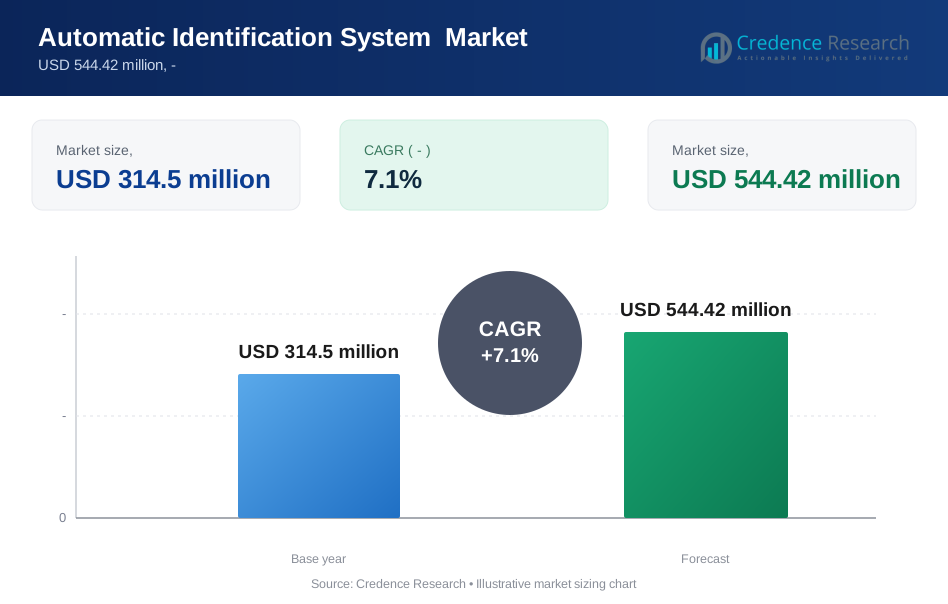
| Automatic Identification System (AIS) market Size 2024 | USD 314.5 million |
| Automatic Identification System (AIS) market, CAGR | 7.1% |
| Automatic Identification System (AIS) market Size 2032 | USD 544.42 million |
Market Overview:
The Automatic Identification System (AIS) market, in 2024, the market was valued at approximately USD 314.5 million and is projected to grow every year rapidly and in 2032 the value will be projected USD 544.42 million at a compound annual growth rate (CAGR) of 7.1% from 2024 to 2032. This growth is driven by the increasing demand for enhanced maritime safety, greater regulatory requirements, and technological advancements in identification systems for tracking vessels and improving navigation. The AIS market's growth is further fueled by rising concerns about maritime security and the growing adoption of AIS in both commercial and recreational maritime sectors.
Several key drivers are influencing the growth of the AIS market. The increasing need for accurate and real-time vessel tracking, driven by the growing global shipping industry and rising trade activities, plays a crucial role in propelling market demand. Furthermore, the global push for safer maritime operations, in line with international regulations, such as the International Maritime Organization (IMO) standards, has significantly contributed to the adoption of AIS technology. Additionally, the integration of AIS with other technologies like radar and satellite communication is driving the development of more advanced solutions, enhancing the system's efficiency and reliability. The growing emphasis on environmental monitoring and fuel management further adds to the market's expansion.
Regionally, North America and Europe dominate the AIS market, accounting for a significant share of the global revenue due to the presence of established maritime industries, strict regulations, and the high adoption of advanced maritime technologies. However, the Asia-Pacific region is expected to witness the highest growth rate during the forecast period, driven by the rapidly expanding maritime trade, increasing port activities, and significant investments in maritime safety systems. Latin America and the Middle East also present promising growth opportunities for the AIS market.
Market Drivers:
Increasing Maritime Safety and Security:
One of the primary drivers of the Automatic Identification System (AIS) market is the growing need for enhanced maritime safety and security. For instance, the global maritime trade volume reached approximately 11 billion tons in 2020, reflecting a steady increase in shipping activities. As global maritime trade increases, the risk of collisions and accidents at sea also rises. AIS technology allows real-time tracking of vessels, enabling better situational awareness and reducing the potential for accidents. By improving vessel identification and navigation, AIS contributes significantly to preventing maritime incidents, thus bolstering safety measures on a global scale.
Regulatory Requirements and Compliance:
Stringent regulations set forth by international maritime authorities, such as the International Maritime Organization (IMO), are driving the widespread adoption of AIS technology. For instance, the IMO's SOLAS (Safety of Life at Sea) convention mandates that vessels over 300 gross tonnage must be equipped with AIS transponders. The IMO's mandates, including the SOLAS (Safety of Life at Sea) convention, require vessels to be equipped with AIS transponders to ensure better vessel tracking and collision avoidance. Compliance with these regulations has become a critical factor for vessel operators, pushing the demand for AIS solutions to meet safety standards and ensure smooth operations within the global shipping industry.
Integration with Advanced Technologies:
The integration of AIS with advanced technologies like radar, satellite communication, and Geographic Information Systems (GIS) is a significant driver for the market. For instance, the adoption of satellite-based AIS, which extends tracking capabilities to remote and open ocean areas, saw significant growth, with over 200,000 vessels being monitored globally in 2022.These integrations enhance the overall functionality of AIS by providing more comprehensive tracking data and improving its effectiveness in various weather and operational conditions. As these systems become increasingly interconnected, the efficiency and accuracy of AIS systems improve, making them indispensable in modern maritime operations, which in turn accelerates market growth.
Growth in Global Maritime Trade:
The expanding global maritime trade is another key driver fueling the demand for AIS systems. For instance, the global container shipping market recorded a volume of over 800 million TEUs (Twenty-foot Equivalent Units) in 2020, showcasing the extensive scale of shipping activities. As international shipping volumes continue to increase, the need for efficient and secure vessel tracking becomes more critical. With growing shipping activities, particularly in emerging markets like Asia-Pacific, AIS technology plays a crucial role in managing the increasing complexity of maritime logistics and operations, further driving its adoption in both commercial and recreational sectors.
Market Trends:
Integration with Internet of Things (IoT):
A significant trend in the Automatic Identification System (AIS) market is the integration of AIS technology with the Internet of Things (IoT). For instance, the use of IoT in the maritime sector is projected to grow at an annual rate of 10%, enhancing connectivity and operational efficiency. This integration enables more seamless communication between vessels, port authorities, and other maritime assets. By connecting AIS to IoT devices, operators can obtain real-time data not only on vessel location but also on other parameters such as engine performance, fuel efficiency, and cargo conditions. This trend enhances operational efficiency, reduces costs, and improves overall maritime safety and monitoring capabilities.
Advancements in Satellite-Based AIS:
Satellite-based AIS is another key trend shaping the market. For instance, the global adoption rate of satellite AIS technology has increased, with companies like ORBCOMM and exactEarth monitoring over 400,000 vessels annually. Traditional AIS relies on terrestrial communication networks, which can be limited in remote or offshore areas. Satellite-based AIS overcomes these limitations by providing global coverage, enabling real-time vessel tracking in the most remote locations. This trend is especially important for improving maritime surveillance and security, as it allows authorities to monitor vessels on a global scale. As satellite networks become more advanced and cost-effective, the adoption of satellite-based AIS is expected to rise significantly.
Adoption of Enhanced Analytics and Big Data:
The use of advanced analytics and big data in conjunction with AIS technology is increasingly gaining traction. For instance, maritime big data analytics is estimated to grow by 12% annually, driven by the need for optimized operations and compliance. By collecting large volumes of data from AIS systems, maritime operators and regulatory authorities can generate actionable insights to optimize vessel routing, fuel consumption, and maintenance schedules. The adoption of predictive analytics is helping to reduce operational risks, improve decision-making, and ensure compliance with international regulations. This trend is pushing AIS technology beyond traditional vessel tracking, making it a critical tool for operational optimization in the maritime industry.
Growth in Automated and Autonomous Vessels:
The rise of automated and autonomous vessels is influencing the AIS market, as these vessels require advanced tracking and navigation technologies. For instance, the autonomous shipping market is expected to grow by 7% annually, with significant investments in R&D.AIS is integral in ensuring these vessels operate safely and efficiently in shared waters, providing key data for collision avoidance and coordination with manned ships. As the industry continues to explore autonomous maritime solutions, AIS technology will play an essential role in ensuring safe, automated vessel operations and supporting the growing trend of unmanned ships.
Market Challenges Analysis:
High Initial Implementation Costs:
One of the primary challenges in the Automatic Identification System (AIS) market is the high initial cost associated with the implementation of AIS equipment and systems. For many smaller shipping companies or operators in emerging markets, the upfront investment required to install and maintain AIS hardware, including transponders and satellite communication systems, can be prohibitive. While the long-term benefits of enhanced safety, compliance, and operational efficiency are clear, the cost barrier remains a significant challenge for widespread adoption, particularly in cost-sensitive segments of the maritime industry.
Regulatory and Standardization Issues:
Another challenge facing the AIS market is the complexity of regulatory compliance and the lack of standardization across regions. Different maritime authorities and regions may have varying regulations regarding AIS usage, data transmission, and system requirements, making it difficult for global operators to ensure uniform compliance. Additionally, the ongoing evolution of regulatory frameworks, especially with emerging technologies like satellite AIS, often requires system upgrades, which can be costly and time-consuming. The absence of global standardization in AIS technology can lead to interoperability issues, further complicating system integration and operation.
Data Privacy and Security Concerns:
As AIS technology becomes more integrated with advanced tracking systems and IoT devices, concerns regarding data privacy and cybersecurity are rising. Since AIS transmits real-time vessel data, it can be vulnerable to cyber-attacks and unauthorized access, potentially exposing sensitive information about ship routes, cargo, and operations. This poses a risk not only to the operators but also to the security of global shipping lanes. As the frequency and sophistication of cyber threats increase, ensuring robust data protection measures within AIS systems is becoming an ongoing challenge for both service providers and regulators.
Technological Limitations in Remote Areas:
Despite advancements in satellite-based AIS, technological limitations in remote and offshore areas still pose challenges. In regions with limited satellite coverage or unreliable communication infrastructure, AIS systems may not perform as effectively as expected, leading to gaps in vessel tracking and monitoring. In such areas, ensuring continuous and accurate data transmission becomes more challenging, which can undermine the overall effectiveness of AIS technology for enhancing maritime safety and security.
Market Segmentation Analysis:
By Class Analysis
The Automatic Identification System (AIS) market is segmented by class into Class A and Class B systems. Class A AIS is primarily used for large commercial vessels, as it offers higher transmission power, enabling long-range communication. It is mandated by regulations for vessels engaged in international voyages. Class B systems, on the other hand, are designed for smaller vessels, such as recreational boats and fishing vessels. These systems have lower power output and are more cost-effective, making them suitable for non-commercial use while still providing essential tracking and safety features.
By Component Analysis
AIS systems are composed of several critical components, including transponders, receivers, antennas, and software. Transponders are the most vital component, as they facilitate the transmission and reception of vessel identification and positional data. The software segment, which processes and analyzes the data received, is also growing in importance as AIS integrates with other navigation and communication technologies, such as radar and satellite systems.
By Platform Analysis
AIS systems are deployed across multiple platforms, including maritime, land-based, and satellite-based platforms. Maritime platforms dominate the market, as the primary application of AIS is for ship-to-ship and ship-to-shore communication. Satellite-based AIS is rapidly gaining traction, providing global coverage and overcoming the limitations of terrestrial systems, especially in remote or offshore regions.
By Application Analysis
AIS has diverse applications, including collision avoidance, vessel tracking, and maritime safety. The commercial shipping industry is the largest application segment, followed by recreational boating, fishing, and offshore oil and gas operations. The increasing demand for safety and regulatory compliance across these industries is driving the growth of AIS adoption.
Segmentations:
By Class Analysis
- Class A
- Class B
By Component Analysis
- Transponders
- Receivers
- Antennas
- Software
By Platform Analysis
- Maritime
- Land-based
- Satellite-based
By Application Analysis
- Collision Avoidance
- Vessel Tracking
- Maritime Safety
- Commercial Shipping
- Recreational Boating
- Fishing
- Offshore Oil and Gas Operations
By Region
- North America
- U.S.
- Canada
- Mexico
- Europe
- Germany
- France
- U.K.
- Italy
- Spain
- Rest of Europe
- Asia Pacific
- China
- Japan
- India
- South Korea
- South-east Asia
- Rest of Asia Pacific
- Latin America
- Brazil
- Argentina
- Rest of Latin America
- Middle East & Africa
- GCC Countries
- South Africa
- Rest of the Middle East and Africa
Regional Analysis:
North America
North America holds a significant share of the global AIS market, accounting for approximately 30% of the market revenue. For instance, the United States Coast Guard (USCG) enforces strict AIS regulations to enhance maritime safety and security. The region's dominance is primarily driven by its advanced maritime infrastructure, stringent regulatory standards, and the presence of leading shipping companies. The United States, with its robust shipping industry and strong maritime security initiatives, plays a critical role in this growth. The implementation of AIS in both commercial shipping and recreational boating, alongside increased government investments in maritime safety technologies, is further boosting the adoption of AIS in the region.
Europe
Europe is another major player in the AIS market, holding a market share of around 28%. For instance, the European Maritime Safety Agency (EMSA) mandates the use of AIS on vessels to improve maritime safety and environmental protection. The region’s extensive network of ports, a high number of commercial vessels, and a commitment to maritime safety regulations contribute to this strong position. Countries such as the United Kingdom, Germany, and Norway have implemented strict AIS regulations for all vessels, driving the demand for advanced AIS solutions. Additionally, Europe’s growing focus on environmental sustainability in maritime operations is accelerating the integration of AIS with other technologies, such as satellite systems, to enhance operational efficiency and environmental monitoring.
Asia-Pacific
The Asia-Pacific (APAC) region is expected to experience the highest growth rate in the AIS market. For instance, China’s Maritime Safety Administration (MSA) has issued guidelines mandating AIS installation on a wide range of vessels to enhance navigational safety, with a projected CAGR of 9% during the forecast period. This growth is fueled by the expanding maritime trade, increasing number of vessels, and rising investments in maritime infrastructure, particularly in countries like China, Japan, and India. APAC’s emerging markets are rapidly adopting AIS technology to ensure vessel safety, regulatory compliance, and operational optimization. The region’s expanding focus on improving port and shipping logistics, along with the growing demand for satellite-based AIS solutions, is driving the market's expansion.
Latin America
Latin America holds a smaller portion of the AIS market, contributing around 7%. For instance, Brazil has implemented AIS systems along its extensive coastline to monitor and manage maritime traffic. However, the region's demand for AIS solutions is expected to rise due to increasing maritime activities and a focus on safety in the Caribbean and South American countries. As nations invest in modernizing their maritime operations and adhere to global regulations, the AIS market in Latin America is poised for steady growth.
Middle East & Africa
The Middle East & Africa (MEA) region represents a modest market share of approximately 5%, For instance, the UAE has adopted AIS technology to support its extensive oil and gas maritime operations, with varying demand for AIS technology across different countries. The demand is increasing in nations with significant oil and gas maritime operations, such as the UAE and Saudi Arabia. Although the market in MEA is still in its nascent stage, growth is expected as the region strengthens its maritime regulations and infrastructure development.
Key Player Analysis:
- Furuno Electric Co. Ltd (Japan)
- Japan Radio Co. Ltd. (Japan)
- Saab AB (Sweden)
- True Heading AB (Sweden)
- N.S. Systems AB (Sweden)
- Wartsila OYJ Abp (Finland)
- ExactEarth Ltd (Canada)
- Orbcomm Inc. (U.S.)
- Garmin Ltd (U.S.)
- Kongsberg Gruppen ASA (Norway)
- ComNav Marine Ltd (Canada)
- L3Hariss Technologies Inc. (U.S.)
Competitive Analysis:
The Automatic Identification System (AIS) market is highly competitive, with several key players dominating the landscape. For instance, Furuno Electric Co. Ltd. reported a revenue of over $1.2 billion in 2022, highlighting its significant presence in the market. Leading companies such as Furuno Electric Co. Ltd., Garmin Ltd., Raymarine, Kongsberg Gruppen, and Mitsubishi Heavy Industries provide a broad range of AIS solutions, from hardware to integrated software systems. These companies leverage advanced technologies like satellite communication, radar integration, and data analytics to enhance the functionality of AIS systems. Competition in the market is driven by continuous technological advancements, regulatory compliance requirements, and the growing demand for maritime safety and operational efficiency. Companies are increasingly focusing on expanding their product portfolios through research and development (R&D) investments to cater to the diverse needs of commercial shipping, recreational boating, and offshore industries. Strategic partnerships, acquisitions, and collaborations are also common strategies used by market players to strengthen their market position and expand their customer base. As a result, the AIS market remains dynamic and innovation-driven.
Recent Developments:
- In April 2024, The Maritime Rescue and Safety Society (SASEMAR) under the Spanish Ministry of Transport and Sustainable Mobility selected Cellnex Spain to ensure maritime safety in Spain. Furthermore, Cellnex secured another contract with Maritime Rescue for the Automatic Identification System (AIS) data service. The coverage areas for satellite AIS have been expanded with the addition of a new web map service offering global coverage. The contract, which is valued at nearly USD 6.4 million and spans five years, demonstrates Cellnex's pivotal role in enhancing maritime safety infrastructure in Spain.
- In February 2024, Steadicopter, an Israeli company, added an automatic identification system to the payload of its Black Eagle 50H, a remotely unmanned air vehicle (RUAV) – the first hybrid-powered unmanned helicopter and the newest model in its RUAV family. The addition of the AIS enables maritime unmanned helicopter operators to identify ships better and focus on those that pose a threat. The AIS is carried by this advanced unmanned helicopter in addition to an electro-optic system and maritime radar.
- In February 2024, Spire Global, Inc., a leading global provider of space-based data, analytics, and space services, has been awarded two framework contracts by the European Maritime Safety Agency with a maximum overall budget of USD 9 million. Spire would provide space-based automatic identification system (SAT-AIS) data services for ship tracking for four years, including real-time, standard, and high-density backup SAT-AIS.
- In June 2023, Smart Eye, a company specializing in the development of Driver Monitoring System (DMS) technology for the automotive industry, entered into a contract with Linde, a German vehicle logistics company, for its AIS product, which comprises a comprehensive hardware and software DMS for aftermarket installation in vehicle fleets.
Market Concentration & Characteristics:
The Automatic Identification System (AIS) market exhibits moderate concentration, with a few key players holding a significant market share while numerous smaller firms contribute to market diversity. Major companies, including Furuno Electric Co. Ltd., Garmin Ltd., and Raymarine, dominate the market, leveraging their strong brand presence, extensive product portfolios, and technological expertise to cater to a broad customer base. However, the market also benefits from the presence of smaller, specialized firms that focus on niche applications and innovative solutions. The characteristics of the AIS market include rapid technological advancements, driven by the increasing integration of satellite systems, data analytics, and IoT capabilities. Market players are also influenced by stringent regulatory standards that dictate product development and compliance. As the maritime industry increasingly focuses on safety, environmental sustainability, and operational efficiency, the AIS market continues to evolve, with a competitive landscape driven by innovation, strategic collaborations, and customer-centric solutions.
Report Coverage:
The research report offers an in-depth analysis based on By Class Analysis, By Component Analysis, By Platform Analysis and By Application Analysis. It details leading market players, providing an overview of their business, product offerings, investments, revenue streams, and key applications. Additionally, the report includes insights into the competitive environment, SWOT analysis, current market trends, as well as the primary drivers and constraints. Furthermore, it discusses various factors that have driven market expansion in recent years. The report also explores market dynamics, regulatory scenarios, and technological advancements that are shaping the industry. It assesses the impact of external factors and global economic changes on market growth. Lastly, it provides strategic recommendations for new entrants and established companies to navigate the complexities of the market.
Future Outlook:
- The AIS market is expected to witness continued growth, driven by increasing maritime safety concerns and regulatory requirements for vessel tracking.
- Technological advancements, including the integration of AIS with satellite systems and IoT devices, will enhance the accuracy and efficiency of tracking and monitoring.
- Rising global trade and the expansion of the shipping industry will further fuel demand for AIS solutions to ensure vessel safety and operational optimization.
- The growing trend toward automated and autonomous vessels will increase the need for advanced AIS technology for collision avoidance and safe navigation.
- The adoption of satellite-based AIS will see significant growth, providing global coverage and overcoming the limitations of traditional terrestrial-based systems.
- Regulatory bodies, such as the International Maritime Organization (IMO), will continue to implement stringent guidelines, further driving the market demand for compliant AIS solutions.
- The Asia-Pacific region is expected to experience the highest growth rate, as emerging markets invest in modern maritime infrastructure and safety systems.
- As environmental regulations become more stringent, AIS technology will be integrated with other systems to monitor fuel efficiency and environmental impact.
- Increased investments in research and development will lead to more advanced, cost-effective, and user-friendly AIS products, expanding the market to smaller and non-commercial vessels.
- The growing need for cybersecurity solutions in maritime operations will drive the development of more secure AIS systems to protect critical vessel and navigation data.
Request a Free Sample
Fill in your details and we'll send you a free sample report.
- Sample data tables & charts
- Research methodology
Need a Custom Version of This Report?
Tailor the scope, geography, or segments to your exact requirements.
- Custom geography or segment scope
- Direct access to our analyst team
Frequently Asked Questions
What is the current size of the Automatic Identification System (AIS) Market?
What factors are driving the growth of the Automatic Identification System (AIS) Market?
What are the key segments within the Automatic Identification System (AIS) Market?
Who are the major players in the Automatic Identification System (AIS) Market?
Which segment is leading the market share?
Table of Content
Chapter 1. Report Introduction
- 1.1 Report Description & Purpose
- 1.1.1 Report Title & Market Definition
- 1.1.2 Unique Selling Propositions (USP) & Key Differentiators
- 1.1.3 Value Proposition for Stakeholders
- 1.2 Research Objectives
- 1.2.1 Market Sizing Objectives (Volume & Revenue)
- 1.2.2 Segmentation Objectives
- 1.2.3 Competitive Intelligence Objectives
- 1.2.4 Forecast & Scenario Objectives
- 1.3 Report Scope
- 1.3.1 Automatic Identification System Scope – Types & Subtypes Covered
- 1.3.2 Geographic Scope – Regions & Countries Covered
- 1.3.3 Historical Period, Base Year & Forecast Period (the historical period; forecast to the forecast period)
- 1.3.4 Inclusions & Exclusions
- 1.4 HS Code & Classification Framework
- 1.5 Currency, Units & Pricing Basis
- 1.6 Target Stakeholders
- 1.7 Limitations & Assumptions
Chapter 2. Executive Summary
- 2.1 Global Automatic Identification System Market Snapshot
- 2.1.1 Market Size – Historical (the historical period) & Forecast (the forecast period) (base year: USD 314.5 million → forecast year: USD 544.42 million)
- 2.1.2 Volume & Revenue – Global Totals
- 2.1.3 Key Market Highlights – Top Five Facts
- 2.2 Automatic Identification System Market Segmentation Snapshot
- 2.2.1 Market Split by Region – vs.
- 2.3 Competitive Snapshot
- 2.3.1 Top 10 Players by Revenue Share –
- 2.3.2 Top 10 Players by Volume Share –
- 2.3.3 Recent Strategic Developments (18-Month Summary)
- 2.4 Key Investment Highlights & Strategic Conclusions
Chapter 3. Automatic Identification System Market Dynamics & Industry Analysis
- 3.1 Market Overview & Context
- 3.1.1 Automatic Identification System Market Position in the Broader Automotive Value Chain
- 3.1.2 OEM vs. Replacement Market Dynamics
- 3.1.3 Market Maturity & Development Stage by Region
- 3.2 Automatic Identification System Market Drivers
- 3.3 Automatic Identification System Market Restraints & Challenges
- 3.4 Automatic Identification System Market Opportunities
- 3.5 Porter's Five Forces Analysis
- 3.5.1 Threat of New Entrants
- 3.5.2 Bargaining Power of Suppliers
- 3.5.3 Bargaining Power of Buyers
- 3.5.4 Threat of Substitutes
- 3.5.5 Competitive Rivalry – Intensity Assessment
- 3.6 Automatic Identification System Value Chain Analysis
- 3.6.1 Upstream – Raw Material/Input Suppliers
- 3.6.1.1 Raw Material/Input 1
- 3.6.1.2 Raw Material/Input 2
- 3.6.1.3 Raw Material/Input 3
- 3.6.2 Midstream – Production/Manufacturing/Service Delivery
- 3.6.2.1 Production/Process Overview
- 3.6.2.2 Key Facility Locations & Capacity by Manufacturer
- 3.6.3 Downstream – Distribution & End Consumer
- 3.6.3.1 Primary Channel – B2B/OEM
- 3.6.3.2 Secondary Channels – Dealer, Retail, Online, Direct
- 3.6.4 Value Chain Profitability Analysis
- 3.6.1 Upstream – Raw Material/Input Suppliers
- 3.7 PESTEL Analysis
- 3.7.1 Political Factors
- 3.7.2 Economic Factors
- 3.7.3 Social Factors
- 3.7.4 Technological Factors
- 3.7.5 Environmental Factors
- 3.7.6 Legal Factors
- 3.8 Automatic Identification System Supply Chain Analysis
- 3.8.1 Raw Material/Input Supply Risk Assessment
- 3.8.2 Manufacturing Concentration Risk (Geographic Exposure)
- 3.8.3 Trade Disruption Impact Analysis
- 3.9 Regulatory & Policy Landscape
Note: The regulatory and policy landscape section covers regulations based on their applicability to the market, Automatic Identification System category, geography, and scope of the study. Only regulatory frameworks with a material impact on operations, compliance, trade, sustainability, or market access are analyzed in detail.
Chapter 4. Key Investment Pockets & Opportunity Analysis
- 4.1 Automatic Identification System Market Attractiveness Analysis
- 4.1.1 By Region – Investment Attractiveness Matrix (Volume × CAGR)
- 4.2 Absolute Revenue Growth Opportunity
- 4.2.1 By Region – Absolute USD Growth Through the forecast period
- 4.3 Incremental Volume Opportunity
- 4.3.1 By Region – Incremental Volume Through the forecast period
- 4.3.2 Segment – Incremental Volume
- 4.4 Emerging Submarket Opportunity Deep Dive (Subject to Applicability)
- 4.5 Emerging Market Opportunity Scorecards
- 4.5.1 United States
- 4.5.2 Europe
- 4.5.3 Asia
- 4.5.4 Middle East & Africa
Note: Emerging Market Opportunity Scorecards will be included based on relevance and strategic importance. Regions listed are indicative and may vary depending on data availability and market dynamics.
Chapter 5. Automatic Identification System Import-Export Analysis & Trade Flows
- 5.1 Global Trade Overview
- 5.1.1 Global Export Value by Country (the historical period)
- 5.1.2 Global Export Volume by Country (the historical period)
- 5.1.3 Global Import Value by Country (the historical period)
- 5.1.4 Global Import Volume by Country (the historical period)
- 5.1.5 Net Trade Balance by Country (the historical period)
- 5.2 Export Analysis – Segment
- 5.2.1 Type 1 (HS Code)
- 5.2.2 Type 2 (HS Code)
- 5.2.3 Type 3 (HS Code)
- 5.2.4 Type 4 (HS Code)
- 5.2.5 Type 5 (HS Code)
- 5.3 Import Analysis – Segment
- 5.3.1 Type 1 (HS Code)
- 5.3.2 Type 2 (HS Code)
- 5.3.3 Type 3 (HS Code)
- 5.3.4 Type 4 (HS Code)
- 5.3.5 Type 5 (HS Code)
- 5.4 Average Unit Trade Prices
- 5.4.1 Average Export Price – Segment & Country
- 5.4.2 Average Import Price – Segment & Source Country
- 5.4.3 Price Trends (the historical period)
- 5.5 Key Trade Route Analysis
- 5.5.1 Trade Route 1
- 5.5.2 Trade Route 2
- 5.5.3 Trade Route 3
- 5.5.4 Trade Route 4
- 5.5.5 Trade Route 5
- 5.6 Trade Policy Impact Assessment
- 5.6.1 US Anti-Dumping & Section 301 Tariffs
- 5.6.2 EU Customs Union Impact
- 5.6.3 Major Free Trade Agreements
- 5.6.4 USMCA Rules of Origin
Note: Trade policy analysis will be included only where relevant to the Automatic Identification System market.
Chapter 6. Competitive Landscape & Company Benchmarking
- 6.1 Automatic Identification System Market Concentration & Structure
- 6.1.1 Herfindahl-Hirschman Index (HHI) – vs.
- 6.1.2 Tier 1, Tier 2 & Tier 3 Market Structure
- 6.1.3 Global, Regional & Local Player Dynamics
- 6.2 Automatic Identification System Market Share Analysis –
- 6.2.1 Global Revenue Share by Company
- 6.2.2 Global Volume Share by Company
- 6.2.3 Regional Revenue Share
- 6.2.4 Market Share Evolution ( vs. )
- 6.2.5 OEM Segment Share by Company
- 6.2.6 Replacement Segment Share by Company
- 6.3 Production/Delivery Capacity & Facility Analysis
- 6.3.1 Global Installed Capacity
- 6.3.2 Capacity Utilization Rates
- 6.3.3 Production/Output Volume
- 6.3.4 Facility Locations & Capacity Map
- 6.3.5 Planned Capacity Additions
- 6.4 Automatic Identification System Competitive Benchmarking Matrix
- 6.4.1 Revenue, Volume, CAGR & Profitability Comparison
- 6.4.2 Channel Revenue Mix
- 6.4.3 Geographic Revenue Exposure
- 6.4.4 R&D Intensity
- 6.4.5 Sustainability Maturity
- 6.5 Strategic Developments in Automatic Identification System (Last 24 Months)
- 6.5.1 Mergers, Acquisitions & Divestments
- 6.5.2 New Automatic Identification System Launches
- 6.5.3 Facility Expansions
- 6.5.4 Strategic Alliances, Joint Ventures & Partnerships
- 6.5.5 Distribution Expansion & Market Entry
- 6.5.6 Sustainability & ESG Initiatives
- 6.6 Competitive Strategy Mapping
- 6.6.1 Leader, Challenger, Follower & Niche Classification
- 6.6.2 Pricing Strategy Comparison
- 6.6.3 Channel Strategy Matrix
Note: Strategic developments are included based on their materiality and the availability of reliable information.
Chapter 7. Global Automatic Identification System Market – By Distribution Channel
- 7.1 Segment Overview
- 7.1.1 Volume & Revenue Split by Channel ( & )
- 7.1.2 Channel Mix Evolution (the forecast period)
Chapter 8. Regional Market Analysis – Global Overview
- 8.1 Global Regional Overview
- 8.1.1 Regional Volume Share
- 8.1.2 Regional Revenue Share
- 8.1.3 Regional Volume by Region
- 8.1.4 Regional Revenue by Region
- 8.1.5 Regional Forecast Through the forecast period
- 8.2 Cross-Regional Segment Analysis
- 8.2.1 By Distribution Channel
- 8.2.2 By Brand/Price Tier
Chapter 9. North America Automatic Identification System Market
- 9.1 United States
- 9.2 Canada
- 9.3 Mexico
Chapter 10. Europe Automatic Identification System Market
- 10.1 Germany
- 10.2 France
- 10.3 Italy
- 10.4 United Kingdom
- 10.5 Spain
- 10.6 Poland
- 10.7 Russia
- 10.8 Netherlands
- 10.9 Belgium
- 10.10 Sweden
- 10.11 Denmark
- 10.12 Norway
- 10.13 Rest of Europe
Chapter 11. Asia Pacific Automatic Identification System Market
- 11.1 China
- 11.2 India
- 11.3 Japan
- 11.4 South Korea
- 11.5 Thailand
- 11.6 Indonesia
- 11.7 Vietnam
- 11.8 Malaysia
- 11.9 Australia
- 11.10 Rest of Asia Pacific
Chapter 12. Latin America Automatic Identification System Market
- 12.1 Brazil
- 12.2 Argentina
- 12.3 Colombia
- 12.4 Chile
- 12.5 Rest of Latin America
Chapter 13. Middle East Automatic Identification System Market
- 13.1 Saudi Arabia
- 13.2 United Arab Emirates
- 13.3 Turkey
- 13.4 Israel
- 13.5 Iran
- 13.6 Rest of the Middle East
Chapter 14. Africa Automatic Identification System Market
- 14.1 South Africa
- 14.2 Egypt
- 14.3 Nigeria
- 14.4 Morocco
- 14.5 Rest of Africa
Chapter 15. Automatic Identification System Company Profiles
- 15.1 [Company 01]
- 15.1.1 Company Overview
- 15.1.2 Key Management Personnel
- 15.1.3 Products & Services Portfolio
- 15.1.4 Financial Performance
- 15.1.5 Key Market Focus & Geographic Presence
- 15.1.6 Recent Developments & Strategic Initiatives
Note: The company profile list is preliminary and may change based on research findings, market developments, data availability, and client requirements.
Chapter 16. Appendices
- Appendix A – List of Abbreviations & Acronyms
- Appendix B – Industry Classification Code Reference – Full Series
- Appendix C – Production & Capacity Data Tables
- Appendix D – End-Use & Demand Base Tables
- Appendix E – Consumption & Replacement Rate Assumptions
- Appendix F – ASP Reference Tables
- Appendix G – Manufacturing & Facility Database
- Appendix H – Import-Export Data Tables
- Appendix I – Regulatory Summary Tables
- Appendix J – Primary Research Participant List (Anonymized)
- Appendix K – Primary Research Questionnaire Framework
- Appendix L – Data Sources & Bibliography
- Appendix M – Market Size Divergence & Source Comparison
Chapter 17. Research Methodology
- 17.1 Research Framework & Philosophy
- 17.2 Secondary Research – Sources, Hierarchy & Data Extraction
- 17.3 Data Modeling – Bottom-Up & Top-Down Market Sizing
- 17.4 Primary Research – Stakeholder Framework, LOI & Sample Sizes
- 17.5 Forecast Methodology – Regression, Scenario & Sensitivity Analysis
- 17.6 Quality Control – Four-Layer Validation Framework
- 17.7 Limitations & Standard Assumptions
- 17.8 Disclaimer
