
Watch, Clock, Measuring Device Market Overview:
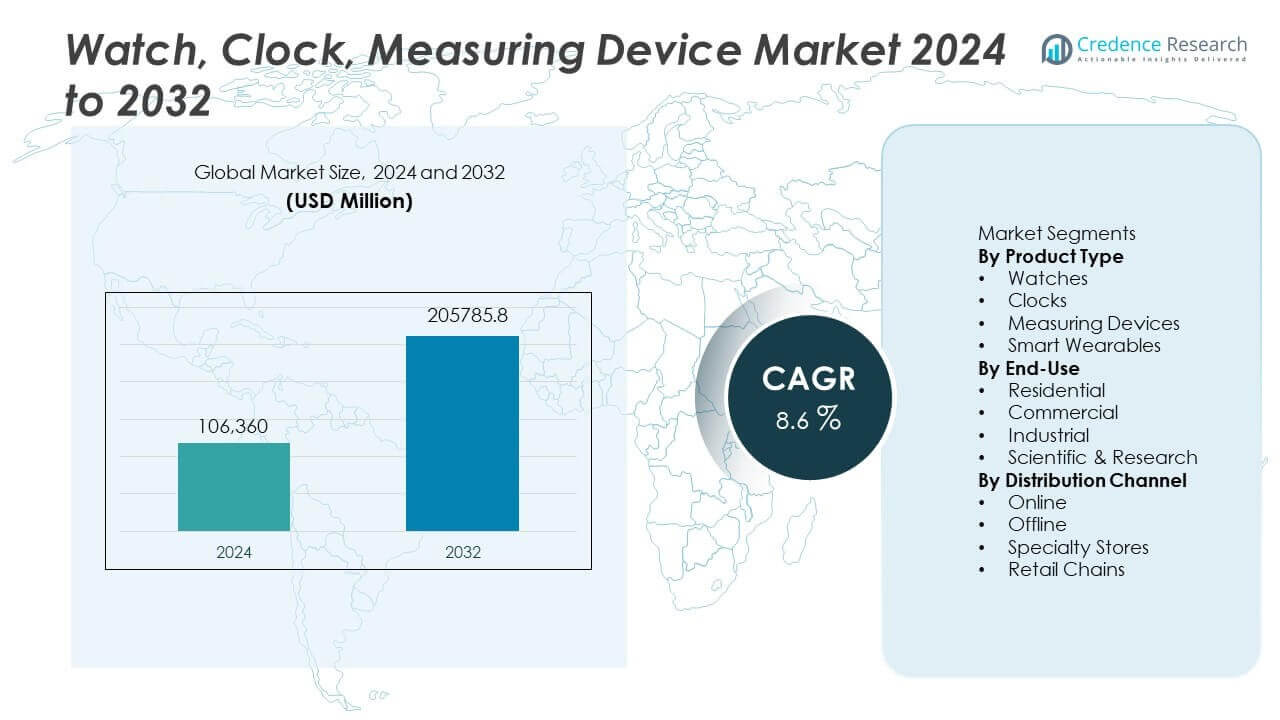
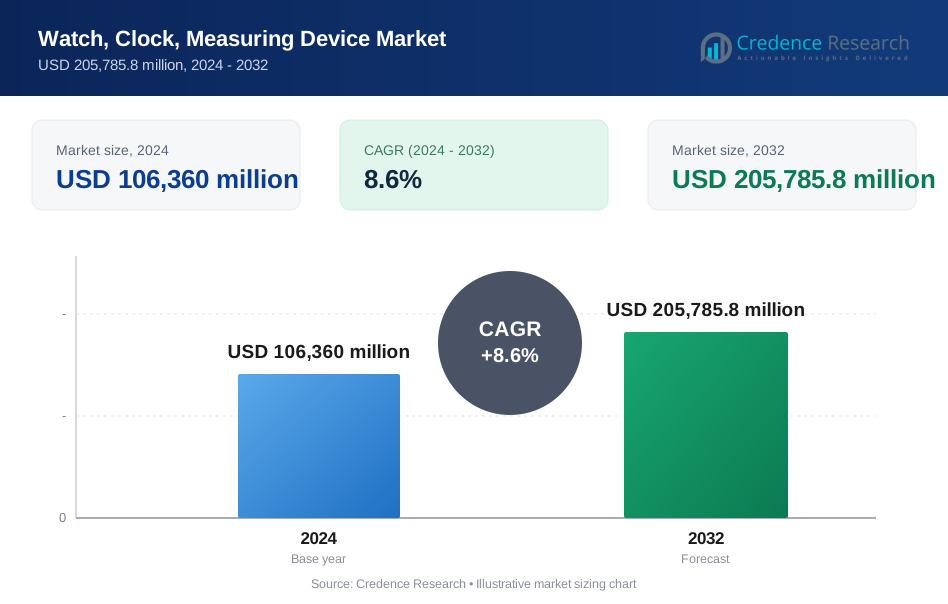
The Watch, Clock, Measuring Device market size was valued at USD 106,360 million in 2024 and is projected to reach USD 205,785.8 million by 2032, growing at a CAGR of 8.6% during the forecast period.
| REPORT ATTRIBUTE | DETAILS |
|---|---|
| Historical Period | 2020-2023 |
| Base Year | 2024 |
| Forecast Period | 2025-2032 |
| Watch, Clock, Measuring Device Market Size 2024 | USD 106,360 million |
| Watch, Clock, Measuring Device Market, CAGR | 8.6% |
| Watch, Clock, Measuring Device Market Size 2032 | USD 205,785.8 million |
Watch, Clock, Measuring Device Market Insights
- Growth is driven by rising demand for fashion watches, luxury timepieces, smart wearables, and high-precision measuring devices used across residential, commercial, and industrial settings.
- Smart technology adoption, health-tracking features, digital measuring tools, and advanced materials shape market trends, supported by expanding consumer interest in connected and multifunctional products.
- Leading brands compete through product design, technology upgrades, strong retail networks, and brand positioning, while intense price competition and counterfeit goods challenge revenue performance.
- Asia Pacific holds 30 percent share driven by high production and rising consumer spending, followed by North America at 33 percent and Europe at 28 percent, while watches lead the product type segment with 46 percent share due to strong lifestyle demand and premium brand influence.
Watch, Clock, Measuring Device Market Segmentation Analysis:
By Product Type
Watches command the largest share of the Watch, Clock, Measuring Device market at 46%, driven by strong demand for fashion-oriented timepieces, premium luxury brands, and affordable daily-wear products. Growing interest in smart features, personalization, and advanced materials strengthens customer engagement across diverse price segments. Clocks and traditional measuring devices hold steady demand in residential and commercial use, supported by durability and decorative value. Smart wearables continue to gain momentum as health tracking, connectivity, and digital functions influence buying decisions. Expanding consumer spending and brand diversification support long-term product growth.
- For instance, Garmin introduced multi-band GNSS technology to its Fēnix series, which utilizes dual-frequency signals to significantly improve tracking accuracy in challenging environments.
By End-Use
Residential applications lead the market with a 54% share, supported by continued consumer preference for personal timekeeping devices, home décor clocks, and daily-use measuring tools. Watches play a key role in lifestyle and fashion identity, driving repeat purchases and brand loyalty. Commercial environments follow with strong demand for clocks, timing systems, and measuring devices across offices, retail spaces, and hospitality settings. Industrial and scientific research users rely on high-precision measurement tools for quality control, calibration, and testing functions. Expanding technology adoption strengthens demand across all end-use categories.
- For instance, Citizen installs synchronized time systems in commercial buildings and public facilities throughout Japan to ensure accurate and uniform timing across large-scale infrastructures.
By Distribution Channel
Offline retail holds a 59% share of the market, led by strong demand for in-store purchasing, physical product evaluation, and value-added services such as fitting and repair. Specialty stores and retail chains maintain customer trust through brand diversity and product assurance. Online channels continue to expand due to wider selection, discount pricing, and growing consumer comfort with digital purchasing. E-commerce also supports niche brands and global accessibility. The blend of physical and digital distribution strengthens market reach and supports rising consumer expectations for convenience and product variety.
Key Growth Drivers
Growing Consumer Demand for Smart and Connected Wearables
Demand for smart wearables continues to rise as consumers seek devices offering health tracking, communication features, fitness monitoring, and real-time data access. Advancements in sensors, connectivity, and battery performance enhance product value and encourage rapid replacement cycles. Strong adoption among younger demographics and fitness-focused users supports volume growth. Integration with mobile apps, cloud dashboards, and wireless platforms creates additional utility. Expanding lifestyle and wellness awareness further accelerates uptake and strengthens long-term market momentum across developed and emerging regions.
- For instance, Fitbit logged a substantial number of active users through its connected wearable ecosystem.
Expansion of Fashion and Luxury Watch Market
Premium and luxury watch brands continue to drive significant market value through strong craftsmanship, brand heritage, and exclusivity. Rising disposable income and growing interest in collectible timepieces support high-end demand. Fashion watches maintain broad consumer appeal, supported by design diversity, trend-driven styles, and accessible pricing. Influencer marketing, retail collaborations, and digital advertising enhance visibility and strengthen customer engagement. The combination of aspirational branding and mass-market accessibility reinforces sustained watch category dominance within the market.
- For instance, TAG Heuer partnered with a diverse group of global influencers and brand ambassadors to expand its online presence and increase engagement.
Increasing Use of Precision Measuring Devices in Industrial and Scientific Fields
Industrial and scientific sectors continue to embrace precision measurement tools for testing, calibration, inspection, and quality control. Growing manufacturing complexity, higher accuracy requirements, and tighter product standards drive adoption of advanced measuring devices. Sectors such as automotive, aerospace, electronics, and research institutions rely on reliable measurement data to improve performance and reduce error risk. Digital measuring instruments and automated tools enhance speed and efficiency, supporting strong market growth. Technological progress and regulatory compliance needs reinforce long-term demand across industrial environments.
Key Trends & Opportunities
Rising Adoption of Digital Timekeeping and Smart Displays
Digital clocks and timekeeping devices offer new opportunities as homes, offices, and commercial spaces shift toward automated and connected environments. Smart displays combine time functions with communication, media control, and environmental data, enhancing user experience. Growing interest in home automation and IoT ecosystems expands product placement. Integration with voice assistants, wireless controls, and cloud-based platforms strengthens convenience and personalization. These advancements reshape traditional timekeeping categories and open new revenue pathways for manufacturers and retailers.
- For instance, Lenovo provides smart display models that integrate with cloud-based services to facilitate features such as automated scheduling and routine management.
Expansion of Online and Omnichannel Retail
Online and omnichannel retail formats continue to reshape market distribution, offering wider product access and stronger price transparency. Digital platforms support customer reviews, visual detail, and direct brand engagement, driving faster decision-making and repeat purchases. E-commerce expands market reach for small and premium brands, improving global product availability. Retailers integrate in-store pickup, virtual try-on tools, and personalized promotions to improve consumer convenience. This shift creates ongoing growth potential and allows faster response to shifting consumer preferences.
- For instance, Fossil recorded a significant volume of online product interactions through its brand-owned portals and mobile apps.
Key Challenges
High Competition from Low-Cost and Counterfeit Products
Fierce competition from low-cost and counterfeit products challenges brand value and profit margins. Unauthorized copies reduce customer confidence and weaken loyalty, particularly in luxury and premium categories. Lower production quality also creates performance inconsistencies that damage market reputation. Manufacturers must invest in authentication technology, supply chain security, and consumer education to mitigate risks. Balancing pricing strategy and brand protection remains a core challenge across retail channels.
Technological Obsolescence and Short Product Life Cycles
Rapid technology change increases product turnover, leading to shorter replacement cycles and high development pressure for manufacturers. Consumers expect updated features, software compatibility, and improved durability, requiring continuous R&D investment. Devices without modern functions risk losing relevance, particularly within wearable and measuring segments. Frequent model changes increase cost and operational complexity across manufacturing and retail networks. Managing innovation speed while maintaining production efficiency remains a key industry challenge.
Regional Analysis
North America
North America holds a 33% share of the Watch, Clock, Measuring Device market, supported by strong consumer spending, widespread smartwatch adoption, and high penetration of premium watch brands. The United States drives regional demand through growing interest in connected devices, health monitoring features, and digital measuring tools. Retail expansion, fitness trends, and high replacement cycles strengthen market growth. Industrial and commercial sectors also support demand for advanced measurement instruments used in testing and calibration. Continuous product innovation, brand diversification, and strong online retail presence further reinforce the region’s leadership position.
Europe
Europe accounts for a 28% share of the market, driven by strong luxury watch heritage, high fashion consciousness, and consistent demand for decorative clocks and measuring tools. Countries including Switzerland, Germany, and the United Kingdom play key roles in product design, manufacturing, and export activity. Smartwatch adoption continues to increase as consumers prioritize health tracking and digital convenience. Industrial users rely on precision tools for quality control and research applications. Sustained interest in craftsmanship, sustainability, and design-led innovation supports long-term growth across consumer and commercial segments.
Asia Pacific
Asia Pacific holds a 30% share and remains the fastest-growing region due to large manufacturing capacity, expanding middle-class spending, and rising demand for both traditional and smart wearable devices. China, Japan, and India lead production and consumption activity across watches, clocks, and measuring instruments. Strong retail expansion, urbanization, and digital adoption support market growth. Industrial use of precision measuring equipment continues to rise as manufacturing activity scales across electronics, automotive, and engineering sectors. Increasing brand competition and product accessibility reinforce long-term expansion across the region.
Latin America
Latin America holds a 5% share of the market, supported by growing consumer interest in fashion watches, affordable smart devices, and decorative clocks. Brazil and Mexico lead demand through expanding retail distribution and rising household spending. Industrial growth drives additional adoption of measurement tools across manufacturing and construction sectors. While economic cycles influence buying power, digital retail channels and brand diversification enhance product reach. Consumer preference for value-based and mid-range products continues to shape market direction.
Middle East and Africa
The Middle East and Africa represent a 4% share of the market, driven by rising consumer interest in branded watches, smart wearables, and decorative clocks. Gulf countries show stronger demand due to higher purchasing power and expanding retail networks. Industrial and research users adopt measuring devices for testing and inspection applications across growing infrastructure and manufacturing activities. Africa continues to develop as retail access improves and awareness increases. Growth remains steady as digital connectivity and lifestyle trends expand across urban centers.
Watch, Clock, Measuring Device Market Segmentations:
By Product Type
- Watches
- Clocks
- Measuring Devices
- Smart Wearables
By End-Use
- Residential
- Commercial
- Industrial
- Scientific & Research
By Distribution Channel
- Online
- Offline
- Specialty Stores
- Retail Chains
By Geography
- North America
- U.S.
- Canada
- Mexico
- Europe
- Germany
- France
- U.K.
- Italy
- Spain
- Rest of Europe
- Asia Pacific
- China
- Japan
- India
- South Korea
- South-east Asia
- Rest of Asia Pacific
- Latin America
- Brazil
- Argentina
- Rest of Latin America
- Middle East & Africa
- GCC Countries
- South Africa
- Rest of the Middle East and Africa
Competitive Landscape
Competitive landscape analysis highlights major companies including Rolex, Casio, Seiko, Apple Inc., Garmin Ltd., Citizen Watch Co. Ltd., TAG Heuer, Omega SA, Fossil Group, and Fitbit. The market reflects strong product diversity, ranging from luxury mechanical timepieces to mass-market watches, smart wearables, digital clocks, and precision measuring devices. Leading brands compete through design innovation, advanced technology, heritage value, and strong retail presence across global markets. Smartwatch and wearable segments continue to expand as technology-driven players enhance connectivity, health tracking, and battery performance. Traditional watchmakers focus on craftsmanship, premium materials, and brand identity to sustain value growth. Competitive strategies include product customization, online distribution, and brand collaborations, supported by expanding aftersales and service programs. As digital transformation accelerates, companies strengthen supply chains, manufacturing efficiency, and sustainability practices to maintain market relevance and long-term customer loyalty.
Key Player Analysis
- Rolex
- Casio
- Seiko
- Apple Inc.
- Garmin Ltd.
- Citizen Watch Co. Ltd.
- TAG Heuer
- Omega SA
- Fossil Group
- Fitbit (Google LLC)
Recent Developments
- In March 2025, Garmin models appeared among key smartwatch trends in market coverage, with fitness & health tracking driving demand.
- In November 2024, Seiko released a limited edition Prospex Solar Speedtimer European Exclusive with a matte burgundy dial and solar movement.
Report Coverage
The research report offers an in-depth analysis based on Product Type, End-Use, Distribution Channel and Geography. It details leading market players, providing an overview of their business, product offerings, investments, revenue streams, and key applications. Additionally, the report includes insights into the competitive environment, SWOT analysis, current market trends, as well as the primary drivers and constraints. Furthermore, it discusses various factors that have driven market expansion in recent years. The report also explores market dynamics, regulatory scenarios, and technological advancements that are shaping the industry. It assesses the impact of external factors and global economic changes on market growth. Lastly, it provides strategic recommendations for new entrants and established companies to navigate the complexities of the market.
Future Outlook
- Smart wearables will continue gaining market share as features expand.
- Luxury watch demand will remain strong due to brand value and craftsmanship.
- Digital measuring devices will see rising adoption in industrial applications.
- Health monitoring functions will drive new product development in wearables.
- Online retail growth will increase product accessibility and price transparency.
- Sustainability and material innovation will shape product design strategies.
- Personalization and custom styling will enhance consumer engagement.
- Emerging markets will show faster growth as incomes and retail networks expand.
- Hybrid watches will gain traction by blending analog design with smart features.
- Advanced sensors and connectivity upgrades will improve device performance.
Request a Free Sample
Fill in your details and we'll send you a free sample report.
- Sample data tables & charts
- Research methodology
Need a Custom Version of This Report?
Tailor the scope, geography, or segments to your exact requirements.
- Custom geography or segment scope
- Direct access to our analyst team
Frequently Asked Questions
What is the current market size for Watch, Clock, Measuring Device market, and what is its projected size in 2032?
At what Compound Annual Growth Rate is the Watch, Clock, Measuring Device market projected to grow between 2024 and 2032?
Which Watch, Clock, Measuring Device market segment held the largest share in 2024?
What are the primary factors fueling the growth of the Watch, Clock, Measuring Device market?
Who are the leading companies in the Watch, Clock, Measuring Device market?
Which region commanded the largest share of the Watch, Clock, Measuring Device market in 2024?
Table of Content
Chapter 1. Report Introduction
- 1.1 Report Description & Purpose
- 1.1.1 Report Title & Market Definition
- 1.1.2 Unique Selling Propositions (USP) & Key Differentiators
- 1.1.3 Value Proposition for Stakeholders
- 1.2 Research Objectives
- 1.2.1 Market Sizing Objectives (Volume & Revenue)
- 1.2.2 Segmentation Objectives
- 1.2.3 Competitive Intelligence Objectives
- 1.2.4 Forecast & Scenario Objectives
- 1.3 Report Scope
- 1.3.1 Watch, Clock, Measuring Device Scope – Types & Subtypes Covered
- 1.3.2 Geographic Scope – Regions & Countries Covered
- 1.3.3 Historical Period, Base Year & Forecast Period (2024; forecast to 2032)
- 1.3.4 Inclusions & Exclusions
- 1.4 HS Code & Classification Framework
- 1.5 Currency, Units & Pricing Basis
- 1.6 Target Stakeholders
- 1.7 Limitations & Assumptions
Chapter 2. Executive Summary
- 2.1 Global Watch, Clock, Measuring Device Market Snapshot
- 2.1.1 Market Size – Historical (2024) & Forecast (2024-2032) (2024: USD 106,360 million → 2032: USD 205,785.8 million)
- 2.1.2 Volume & Revenue – Global Totals
- 2.1.3 Key Market Highlights – Top Five Facts
- 2.2 Watch, Clock, Measuring Device Market Segmentation Snapshot
- 2.2.1 Market Split by Region – 2024 vs. 2032
- 2.3 Competitive Snapshot
- 2.3.1 Top 10 Players by Revenue Share – 2024
- 2.3.2 Top 10 Players by Volume Share – 2024
- 2.3.3 Recent Strategic Developments (18-Month Summary)
- 2.4 Key Investment Highlights & Strategic Conclusions
Chapter 3. Watch, Clock, Measuring Device Market Dynamics & Industry Analysis
- 3.1 Market Overview & Context
- 3.1.1 Watch, Clock, Measuring Device Market Position in the Broader Automotive Value Chain
- 3.1.2 OEM vs. Replacement Market Dynamics
- 3.1.3 Market Maturity & Development Stage by Region
- 3.2 Watch, Clock, Measuring Device Market Drivers
- 3.3 Watch, Clock, Measuring Device Market Restraints & Challenges
- 3.4 Watch, Clock, Measuring Device Market Opportunities
- 3.5 Porter's Five Forces Analysis
- 3.5.1 Threat of New Entrants
- 3.5.2 Bargaining Power of Suppliers
- 3.5.3 Bargaining Power of Buyers
- 3.5.4 Threat of Substitutes
- 3.5.5 Competitive Rivalry – Intensity Assessment
- 3.6 Watch, Clock, Measuring Device Value Chain Analysis
- 3.6.1 Upstream – Raw Material/Input Suppliers
- 3.6.1.1 Raw Material/Input 1
- 3.6.1.2 Raw Material/Input 2
- 3.6.1.3 Raw Material/Input 3
- 3.6.2 Midstream – Production/Manufacturing/Service Delivery
- 3.6.2.1 Production/Process Overview
- 3.6.2.2 Key Facility Locations & Capacity by Manufacturer
- 3.6.3 Downstream – Distribution & End Consumer
- 3.6.3.1 Primary Channel – B2B/OEM
- 3.6.3.2 Secondary Channels – Dealer, Retail, Online, Direct
- 3.6.4 Value Chain Profitability Analysis
- 3.6.1 Upstream – Raw Material/Input Suppliers
- 3.7 PESTEL Analysis
- 3.7.1 Political Factors
- 3.7.2 Economic Factors
- 3.7.3 Social Factors
- 3.7.4 Technological Factors
- 3.7.5 Environmental Factors
- 3.7.6 Legal Factors
- 3.8 Watch, Clock, Measuring Device Supply Chain Analysis
- 3.8.1 Raw Material/Input Supply Risk Assessment
- 3.8.2 Manufacturing Concentration Risk (Geographic Exposure)
- 3.8.3 Trade Disruption Impact Analysis
- 3.9 Regulatory & Policy Landscape
Note: The regulatory and policy landscape section covers regulations based on their applicability to the market, Watch, Clock, Measuring Device category, geography, and scope of the study. Only regulatory frameworks with a material impact on operations, compliance, trade, sustainability, or market access are analyzed in detail.
Chapter 4. Key Investment Pockets & Opportunity Analysis
- 4.1 Watch, Clock, Measuring Device Market Attractiveness Analysis
- 4.1.1 By Region – Investment Attractiveness Matrix (Volume × CAGR)
- 4.2 Absolute Revenue Growth Opportunity
- 4.2.1 By Region – Absolute USD Growth Through 2032
- 4.3 Incremental Volume Opportunity
- 4.3.1 By Region – Incremental Volume Through 2032
- 4.3.2 Segment – Incremental Volume
- 4.4 Emerging Submarket Opportunity Deep Dive (Subject to Applicability)
- 4.5 Emerging Market Opportunity Scorecards
- 4.5.1 United States
- 4.5.2 Europe
- 4.5.3 Asia
- 4.5.4 Middle East & Africa
Note: Emerging Market Opportunity Scorecards will be included based on relevance and strategic importance. Regions listed are indicative and may vary depending on data availability and market dynamics.
Chapter 5. Watch, Clock, Measuring Device Import-Export Analysis & Trade Flows
- 5.1 Global Trade Overview
- 5.1.1 Global Export Value by Country (2024)
- 5.1.2 Global Export Volume by Country (2024)
- 5.1.3 Global Import Value by Country (2024)
- 5.1.4 Global Import Volume by Country (2024)
- 5.1.5 Net Trade Balance by Country (2024)
- 5.2 Export Analysis – Segment
- 5.2.1 Type 1 (HS Code)
- 5.2.2 Type 2 (HS Code)
- 5.2.3 Type 3 (HS Code)
- 5.2.4 Type 4 (HS Code)
- 5.2.5 Type 5 (HS Code)
- 5.3 Import Analysis – Segment
- 5.3.1 Type 1 (HS Code)
- 5.3.2 Type 2 (HS Code)
- 5.3.3 Type 3 (HS Code)
- 5.3.4 Type 4 (HS Code)
- 5.3.5 Type 5 (HS Code)
- 5.4 Average Unit Trade Prices
- 5.4.1 Average Export Price – Segment & Country
- 5.4.2 Average Import Price – Segment & Source Country
- 5.4.3 Price Trends (2024)
- 5.5 Key Trade Route Analysis
- 5.5.1 Trade Route 1
- 5.5.2 Trade Route 2
- 5.5.3 Trade Route 3
- 5.5.4 Trade Route 4
- 5.5.5 Trade Route 5
- 5.6 Trade Policy Impact Assessment
- 5.6.1 US Anti-Dumping & Section 301 Tariffs
- 5.6.2 EU Customs Union Impact
- 5.6.3 Major Free Trade Agreements
- 5.6.4 USMCA Rules of Origin
Note: Trade policy analysis will be included only where relevant to the Watch, Clock, Measuring Device market.
Chapter 6. Competitive Landscape & Company Benchmarking
- 6.1 Watch, Clock, Measuring Device Market Concentration & Structure
- 6.1.1 Herfindahl-Hirschman Index (HHI) – vs. 2024
- 6.1.2 Tier 1, Tier 2 & Tier 3 Market Structure
- 6.1.3 Global, Regional & Local Player Dynamics
- 6.2 Watch, Clock, Measuring Device Market Share Analysis – 2024
- 6.2.1 Global Revenue Share by Company
- 6.2.2 Global Volume Share by Company
- 6.2.3 Regional Revenue Share
- 6.2.4 Market Share Evolution ( vs. 2024)
- 6.2.5 OEM Segment Share by Company
- 6.2.6 Replacement Segment Share by Company
- 6.3 Production/Delivery Capacity & Facility Analysis
- 6.3.1 Global Installed Capacity
- 6.3.2 Capacity Utilization Rates
- 6.3.3 Production/Output Volume
- 6.3.4 Facility Locations & Capacity Map
- 6.3.5 Planned Capacity Additions
- 6.4 Watch, Clock, Measuring Device Competitive Benchmarking Matrix
- 6.4.1 Revenue, Volume, CAGR & Profitability Comparison
- 6.4.2 Channel Revenue Mix
- 6.4.3 Geographic Revenue Exposure
- 6.4.4 R&D Intensity
- 6.4.5 Sustainability Maturity
- 6.5 Strategic Developments in Watch, Clock, Measuring Device (Last 24 Months)
- 6.5.1 Mergers, Acquisitions & Divestments
- 6.5.2 New Watch, Clock, Measuring Device Launches
- 6.5.3 Facility Expansions
- 6.5.4 Strategic Alliances, Joint Ventures & Partnerships
- 6.5.5 Distribution Expansion & Market Entry
- 6.5.6 Sustainability & ESG Initiatives
- 6.6 Competitive Strategy Mapping
- 6.6.1 Leader, Challenger, Follower & Niche Classification
- 6.6.2 Pricing Strategy Comparison
- 6.6.3 Channel Strategy Matrix
Note: Strategic developments are included based on their materiality and the availability of reliable information.
Chapter 7. Global Watch, Clock, Measuring Device Market – By Distribution Channel
- 7.1 Segment Overview
- 7.1.1 Volume & Revenue Split by Channel (2024 & 2032)
- 7.1.2 Channel Mix Evolution (2024-2032)
Chapter 8. Regional Market Analysis – Global Overview
- 8.1 Global Regional Overview
- 8.1.1 Regional Volume Share
- 8.1.2 Regional Revenue Share
- 8.1.3 Regional Volume by Region
- 8.1.4 Regional Revenue by Region
- 8.1.5 Regional Forecast Through 2032
- 8.2 Cross-Regional Segment Analysis
- 8.2.1 By Distribution Channel
- 8.2.2 By Brand/Price Tier
Chapter 9. North America Watch, Clock, Measuring Device Market
- 9.1 United States
- 9.2 Canada
- 9.3 Mexico
Chapter 10. Europe Watch, Clock, Measuring Device Market
- 10.1 Germany
- 10.2 France
- 10.3 Italy
- 10.4 United Kingdom
- 10.5 Spain
- 10.6 Poland
- 10.7 Russia
- 10.8 Netherlands
- 10.9 Belgium
- 10.10 Sweden
- 10.11 Denmark
- 10.12 Norway
- 10.13 Rest of Europe
Chapter 11. Asia Pacific Watch, Clock, Measuring Device Market
- 11.1 China
- 11.2 India
- 11.3 Japan
- 11.4 South Korea
- 11.5 Thailand
- 11.6 Indonesia
- 11.7 Vietnam
- 11.8 Malaysia
- 11.9 Australia
- 11.10 Rest of Asia Pacific
Chapter 12. Latin America Watch, Clock, Measuring Device Market
- 12.1 Brazil
- 12.2 Argentina
- 12.3 Colombia
- 12.4 Chile
- 12.5 Rest of Latin America
Chapter 13. Middle East Watch, Clock, Measuring Device Market
- 13.1 Saudi Arabia
- 13.2 United Arab Emirates
- 13.3 Turkey
- 13.4 Israel
- 13.5 Iran
- 13.6 Rest of the Middle East
Chapter 14. Africa Watch, Clock, Measuring Device Market
- 14.1 South Africa
- 14.2 Egypt
- 14.3 Nigeria
- 14.4 Morocco
- 14.5 Rest of Africa
Chapter 15. Watch, Clock, Measuring Device Company Profiles
- 15.1 [Company 01]
- 15.1.1 Company Overview
- 15.1.2 Key Management Personnel
- 15.1.3 Products & Services Portfolio
- 15.1.4 Financial Performance
- 15.1.5 Key Market Focus & Geographic Presence
- 15.1.6 Recent Developments & Strategic Initiatives
Note: The company profile list is preliminary and may change based on research findings, market developments, data availability, and client requirements.
Chapter 16. Appendices
- Appendix A – List of Abbreviations & Acronyms
- Appendix B – Industry Classification Code Reference – Full Series
- Appendix C – Production & Capacity Data Tables
- Appendix D – End-Use & Demand Base Tables
- Appendix E – Consumption & Replacement Rate Assumptions
- Appendix F – ASP Reference Tables
- Appendix G – Manufacturing & Facility Database
- Appendix H – Import-Export Data Tables
- Appendix I – Regulatory Summary Tables
- Appendix J – Primary Research Participant List (Anonymized)
- Appendix K – Primary Research Questionnaire Framework
- Appendix L – Data Sources & Bibliography
- Appendix M – Market Size Divergence & Source Comparison
Chapter 17. Research Methodology
- 17.1 Research Framework & Philosophy
- 17.2 Secondary Research – Sources, Hierarchy & Data Extraction
- 17.3 Data Modeling – Bottom-Up & Top-Down Market Sizing
- 17.4 Primary Research – Stakeholder Framework, LOI & Sample Sizes
- 17.5 Forecast Methodology – Regression, Scenario & Sensitivity Analysis
- 17.6 Quality Control – Four-Layer Validation Framework
- 17.7 Limitations & Standard Assumptions
- 17.8 Disclaimer
