
Over-the-Top (OTT) Market Overview:
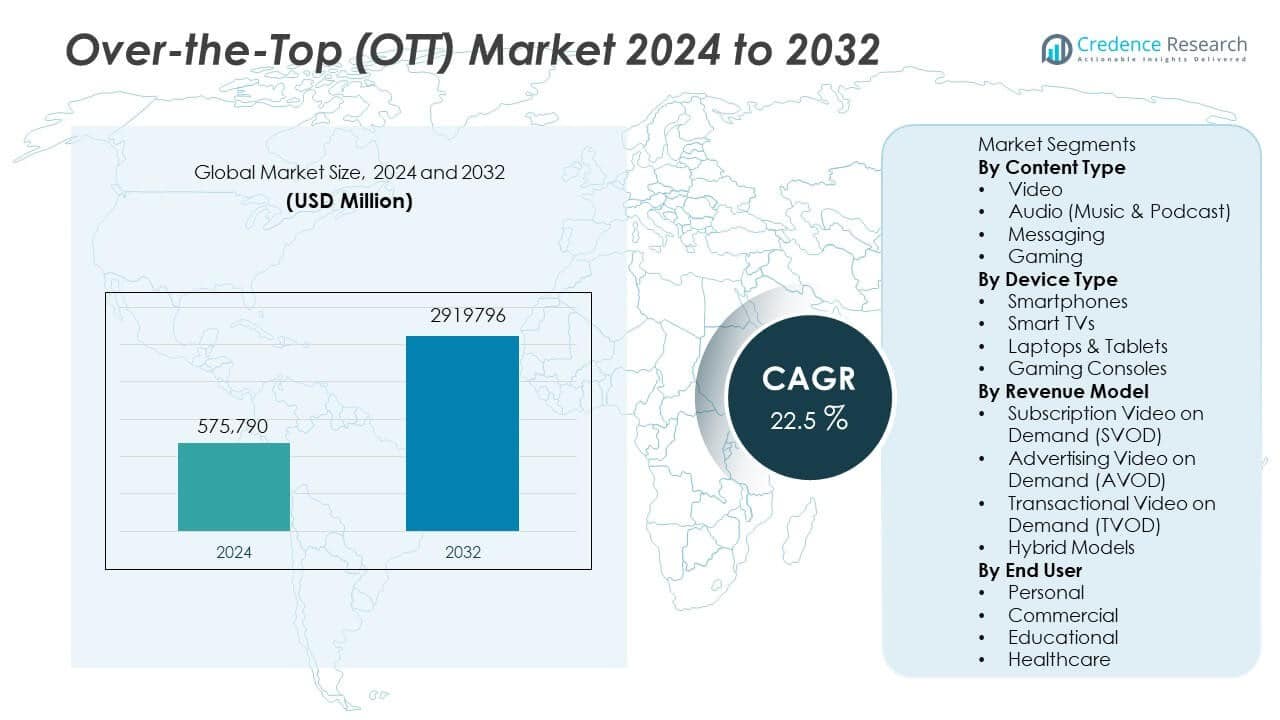
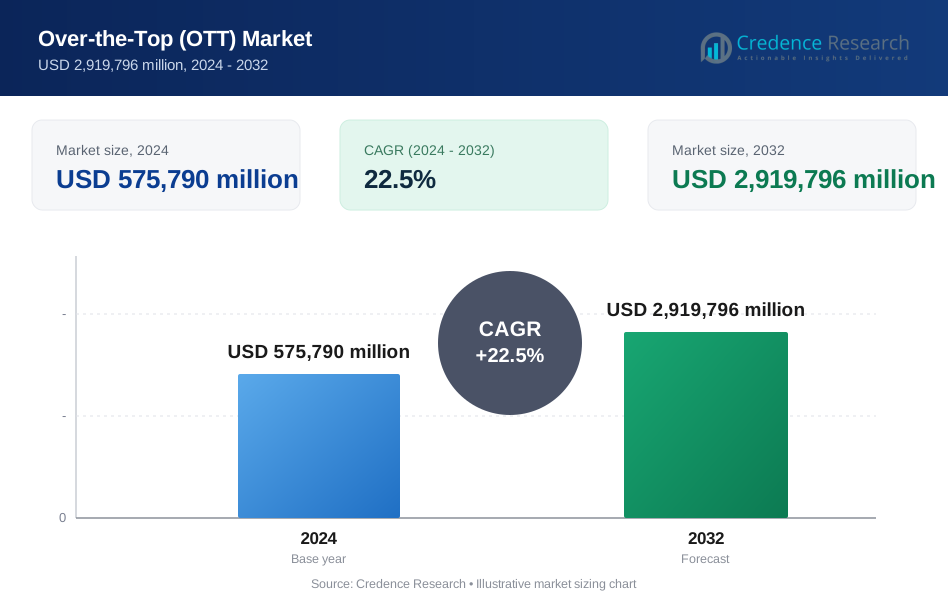
The Over-the-Top (OTT) market size was valued at USD 575,790 million in 2024 and is projected to reach USD 2,919,796 million by 2032, reflecting a CAGR of 22.5% during the forecast period.
| REPORT ATTRIBUTE | DETAILS |
|---|---|
| Historical Period | 2020-2023 |
| Base Year | 2024 |
| Forecast Period | 2025-2032 |
| Over-the-Top (OTT) Market Size 2024 | USD 575,790 million |
| Over-the-Top (OTT) Market , CAGR | 22.5% |
| Over-the-Top (OTT) Market Size 2032 | USD 2,919,796 million |
Over-the-Top (OTT) Market Insights
- Strong demand for on-demand and personalised content drives growth, supported by the video segment, which leads with a 71% share due to premium streaming libraries and original productions.
- Market trends reflect rapid adoption of smart TVs, subscription bundles, and 4K streaming, while telecom partnerships and mobile-first viewing continue to expand user reach and engagement.
- Competition intensifies as leading platforms invest in exclusive content, multilingual catalogs, and hybrid monetisation models, while licensing costs and churn management remain key restraints.
- North America holds a 39% share, followed by Asia Pacific at 28% and Europe at 27%, supported by strong digital infrastructure, high streaming frequency, and growing regional content demand across global markets.
Over-the-Top (OTT) Market Segmentation Analysis:
By Content Type
Video dominates the content type segment with a 71% share, driven by rising demand for on-demand streaming, original productions, and multilingual libraries. Platforms expand premium content offerings, supported by strong investments in movies, web series, and live sports. Audio services continue to grow through music subscriptions and podcast streaming, while messaging apps maintain relevance through instant communication and media sharing. Gaming content benefits from interactive experiences and cloud-based access. The video segment leads due to global audience engagement, wide device compatibility, and strong monetization potential.
- For instance, Spotify increased its monthly active users and premium subscriber base in Q3 2024, hosting an extensive catalog of songs and millions of podcasts on its platform.
By Device Type
Smartphones lead the device type segment with a 49% share, supported by rising mobile broadband usage, improved streaming quality, and strong app-based subscriptions. Smart TVs show rapid growth due to large-screen viewing, 4K support, and integrated OTT interfaces. Laptops and tablets remain important for multi-screen access, especially among younger users. Gaming consoles gain traction through high-performance streaming and bundled content offers. The smartphone segment remains dominant due to high penetration, portability, and increased mobile video consumption across urban and rural audiences.
- For instance, Apple shipments grew in 2025, supported by a significant user base of students and young professionals who utilize the devices for both productivity and media consumption.
By Revenue Model
Subscription video on demand (SVOD) dominates the revenue model segment with a 54% share, supported by strong user preference for ad-free viewing, exclusive content, and flexible plans. Advertising video on demand (AVOD) shows fast growth due to wide free access and rising digital ad spending. Transactional video on demand (TVOD) attracts users seeking specific pay-per-title access, while hybrid models combine subscription, advertising, and transaction benefits. The SVOD segment leads due to high retention rates, strong content value, and expanding subscription bases across global markets.
Key Growth Drivers
Rising Demand for On-Demand and Personalized Content
Demand for flexible, on-demand entertainment continues to fuel OTT expansion. Viewers prefer instant access to movies, series, sports, and documentaries without scheduling limits. Personalization tools enhance user experience through tailored recommendations, multilingual libraries, and genre-based suggestions. Streaming platforms invest heavily in original productions to increase retention and reduce content dependency. Global audiences shift toward connected viewing across mobile and smart TV screens, strengthening long-term platform engagement. These factors drive subscription growth and support wider user adoption across age groups and regions.
- For instance, Amazon Prime Video released a diverse slate of original titles, supported by a production budget that fueled an extensive collection of scripted and unscripted content.
Increasing Internet Penetration and Smartphone Usage
Improved broadband reach and rising smartphone ownership significantly expand OTT streaming capability. Faster 4G and 5G networks support HD and 4K content delivery with reduced buffering. Affordable mobile data plans and bundled telecom packages drive mass accessibility across urban and rural markets. Mobile-first viewing habits strengthen app-based streaming as users shift from traditional television. Telecom partnerships accelerate subscriber acquisition, while enhanced device compatibility ensures broad market reach. Strong mobile engagement continues to anchor total platform usage and global viewing hours.
- For instance, YouTube confirmed that billions of logged-in monthly users watch Shorts, while viewers worldwide stream hundreds of millions of hours of content on television screens every day.
Growth in Subscription Models and Digital Payments
Subscription models strengthen OTT value through flexible pricing, ad-free viewing, and exclusive releases. Digital wallets, auto-renewal billing, and secure gateways simplify payment processes and reduce churn. Multi-device access and easy cancellation policies build confidence among diverse user groups. Subscription bundles, discounts, and regional content packages improve affordability and retention. These advantages support strong recurring revenue streams and long-term financial stability. Platforms continue expanding subscriber bases by combining premium content access with personalised recommendations.
Key Trends & Opportunities
Rise of Regional Content and Original Productions
Regional storytelling gains momentum as platforms expand language libraries and locally produced originals. Audiences show strong preference for culturally relevant themes, boosting engagement and watch time. Regional creators benefit from increased visibility and cross-market appeal. This trend strengthens market penetration and subscriber conversion in emerging economies. Exclusive content launches support brand differentiation and reduce reliance on licensed titles. Growing success of local films, series, and documentaries expands investment opportunities and enhances long-term platform value.
- For instance, Disney+ Hotstar streamed content in several regional languages, including original programming produced across India and Southeast Asia.
Expansion of Smart TV and Connected Device Adoption
Smart TV usage accelerates as consumers shift toward immersive home viewing experiences. Built-in OTT integrations simplify platform access without external devices. Growth in gaming consoles, streaming sticks, and connected media boxes expands multi-screen possibilities. Higher adoption of large-screen formats increases demand for HD and 4K streaming. These developments enhance user engagement and boost subscription appeal. Expanded connected device ecosystems continue to shape platform strategy and advertising opportunities.
- For instance, Roku reported a record number of streaming households, delivering well over one hundred billion streaming hours across TV and connected devices.
Key Challenges
Content Licensing Costs and Profitability Pressures
OTT platforms face rising content and production costs, especially for premium titles and exclusive streaming rights. Intense competition increases bidding pressure, reducing profit margins. User sensitivity to subscription pricing limits price flexibility. Maintaining large content libraries demands significant investment and continuous renewal. Smaller platforms struggle to compete against global players with larger budgets. Balancing cost control with content depth remains a core industry challenge.
Data Privacy, Piracy, and Content Security Risks
OTT growth is challenged by rising piracy, illegal downloads, and account sharing, which reduce revenue potential. Data security concerns and cyber threats impact user trust and platform credibility. Strengthening digital rights management increases operational complexity and cost. Regulations continue to evolve, requiring stronger compliance frameworks. Ensuring secure streaming environments remains critical to protect brand integrity and subscriber loyalty.
Regional Analysis
North America
North America holds a 39% share of the OTT market, driven by strong broadband infrastructure, high digital spending, and early platform adoption. The United States leads usage through premium content libraries, subscription bundles, and smart device penetration. Investments in original programming and exclusive licensing strengthen engagement across diverse demographics. Cord-cutting trends support rapid migration from pay TV to streaming platforms. Strong advertising demand boosts AVOD growth, while subscription models maintain audience loyalty. Continuous expansion of 4K and interactive content enhances viewing experience, supporting long-term market leadership.
Europe
Europe accounts for a 27% share of the OTT market, supported by strong broadband access, diverse language offerings, and increasing digital media consumption. Major markets such as the United Kingdom, Germany, France, and Italy drive subscription expansion and original content investment. Regulatory initiatives improve data privacy and user transparency, supporting platform reliability and retention. Demand grows across AVOD and SVOD formats as consumers shift from traditional broadcasting to flexible digital viewing. Local content partnerships and regional storytelling strengthen audience connection and subscription value.
Asia Pacific
Asia Pacific leads global growth with a 28% share of the OTT market, supported by rising smartphone adoption, strong mobile data accessibility, and expanding regional content libraries. India, China, Japan, and South Korea drive platform penetration through multilingual programming and affordable subscription models. Increasing demand for short-form videos, live sports, and entertainment fuels sustained engagement. Telecom collaborations enhance subscription reach and affordability. Urban expansion and improving network infrastructure continue to open new user segments, solidifying the region’s growth momentum.
Latin America
Latin America holds a 4% share, supported by expanding digital connectivity and rising consumer interest in subscription and ad-supported streaming. Brazil, Mexico, and Argentina lead adoption through growing smart device usage and higher digital content exposure. Local productions and regional language programming enhance platform relevance and retention. Economic fluctuations influence subscription spending, but AVOD models support wider audience access. Growing mobile streaming encourages increased daily watch time across young user groups.
Middle East & Africa
Middle East and Africa represent a 2% share, reflecting early-stage streaming adoption supported by rising mobile penetration and expanding entertainment demand. Gulf nations lead regional growth with premium subscription spending and strong smart TV usage. Local content development accelerates audience expansion and cultural alignment. Infrastructure development and wider internet access open new opportunities across emerging markets. AVOD models gain traction among price-sensitive user groups, strengthening long-term platform prospects.
Over-the-Top (OTT) Market Segmentations:
By Content Type
- Video
- Audio (Music & Podcast)
- Messaging
- Gaming
By Device Type
- Smartphones
- Smart TVs
- Laptops & Tablets
- Gaming Consoles
By Revenue Model
- Subscription Video on Demand (SVOD)
- Advertising Video on Demand (AVOD)
- Transactional Video on Demand (TVOD)
- Hybrid Models
By End User
- Personal
- Commercial
- Educational
- Healthcare
By Geography
- North America
- U.S.
- Canada
- Mexico
- Europe
- Germany
- France
- U.K.
- Italy
- Spain
- Rest of Europe
- Asia Pacific
- China
- Japan
- India
- South Korea
- South-east Asia
- Rest of Asia Pacific
- Latin America
- Brazil
- Argentina
- Rest of Latin America
- Middle East & Africa
- GCC Countries
- South Africa
- Rest of the Middle East and Africa
Competitive Landscape
Competitive landscape analysis highlights key players including Netflix, Amazon Prime Video, Disney+, Hulu, HBO Max, YouTube, Apple TV+, Paramount+, Peacock, and SonyLIV. The market remains highly competitive, shaped by content investment, subscription pricing, platform experience, and device integration. Major players strengthen user retention through original programming, exclusive licensing, and multilingual libraries. Advertising-based models expand revenue reach, while subscription bundles and telecom partnerships improve affordability and access. Technology enhancements, including 4K streaming, AI-driven recommendations, and cloud infrastructure, support high-quality user experience. Regional players compete through cultural relevance and local storytelling, while global platforms expand geographic footprints. Competitive priorities include reducing churn, increasing content diversity, and scaling viewership. Industry momentum continues to shift toward hybrid monetisation strategies, combining subscription and advertising to maximise profitability.
Key Player Analysis
- Netflix
- Amazon Prime Video
- Disney+
- Hulu
- HBO Max
- YouTube
- Apple TV+
- Paramount+
- Peacock
- SonyLIV
Report Coverage
The research report offers an in-depth analysis based on Content Type, Device Type, Revenue Model, End User and Geography. It details leading market players, providing an overview of their business, product offerings, investments, revenue streams, and key applications. Additionally, the report includes insights into the competitive environment, SWOT analysis, current market trends, as well as the primary drivers and constraints. Furthermore, it discusses various factors that have driven market expansion in recent years. The report also explores market dynamics, regulatory scenarios, and technological advancements that are shaping the industry. It assesses the impact of external factors and global economic changes on market growth. Lastly, it provides strategic recommendations for new entrants and established companies to navigate the complexities of the market.
Future Outlook
- Global streaming demand will continue rising across all age groups.
- Regional content production will accelerate to strengthen audience engagement.
- Hybrid monetisation models will gain preference over single-format pricing.
- Smart TV and connected device usage will increase streaming time.
- Platform collaborations with telecom providers will boost user access.
- Higher investments in original programming will shape competitive advantage.
- Adoption of 4K, 8K, and immersive formats will rise with network expansion.
- Data analytics will improve personalisation and retention strategies.
- Regulatory focus on content, advertising, and data privacy will intensify.
- Live sports, gaming, and interactive streaming will create new growth streams.
Request a Free Sample
Fill in your details and we'll send you a free sample report.
- Sample data tables & charts
- Research methodology
Need a Custom Version of This Report?
Tailor the scope, geography, or segments to your exact requirements.
- Custom geography or segment scope
- Direct access to our analyst team
Frequently Asked Questions
What is the current market size for Over-the-Top (OTT) market, and what is its projected size in 2032?
At what Compound Annual Growth Rate is the Over-the-Top (OTT) market projected to grow between 2024 and 2032?
Which Over-the-Top (OTT) market segment held the largest share in 2024?
What are the primary factors fueling the growth of the Over-the-Top (OTT) market?
Who are the leading companies in the Over-the-Top (OTT) market?
Which region commanded the largest share of the Over-the-Top (OTT) market in 2024?
Table of Content
Chapter 1. Report Introduction
- 1.1 Report Description & Purpose
- 1.1.1 Report Title & Market Definition
- 1.1.2 Unique Selling Propositions (USP) & Key Differentiators
- 1.1.3 Value Proposition for Stakeholders
- 1.2 Research Objectives
- 1.2.1 Market Sizing Objectives (Volume & Revenue)
- 1.2.2 Segmentation Objectives
- 1.2.3 Competitive Intelligence Objectives
- 1.2.4 Forecast & Scenario Objectives
- 1.3 Report Scope
- 1.3.1 Over-the-Top (OTT) Scope – Types & Subtypes Covered
- 1.3.2 Geographic Scope – Regions & Countries Covered
- 1.3.3 Historical Period, Base Year & Forecast Period (2024; forecast to 2032)
- 1.3.4 Inclusions & Exclusions
- 1.4 HS Code & Classification Framework
- 1.5 Currency, Units & Pricing Basis
- 1.6 Target Stakeholders
- 1.7 Limitations & Assumptions
Chapter 2. Executive Summary
- 2.1 Global Over-the-Top (OTT) Market Snapshot
- 2.1.1 Market Size – Historical (2024) & Forecast (2024-2032) (2024: USD 575,790 million → 2032: USD 2,919,796 million)
- 2.1.2 Volume & Revenue – Global Totals
- 2.1.3 Key Market Highlights – Top Five Facts
- 2.2 Over-the-Top (OTT) Market Segmentation Snapshot
- 2.2.1 Market Split by Region – 2024 vs. 2032
- 2.3 Competitive Snapshot
- 2.3.1 Top 10 Players by Revenue Share – 2024
- 2.3.2 Top 10 Players by Volume Share – 2024
- 2.3.3 Recent Strategic Developments (18-Month Summary)
- 2.4 Key Investment Highlights & Strategic Conclusions
Chapter 3. Over-the-Top (OTT) Market Dynamics & Industry Analysis
- 3.1 Market Overview & Context
- 3.1.1 Over-the-Top (OTT) Market Position in the Broader Automotive Value Chain
- 3.1.2 OEM vs. Replacement Market Dynamics
- 3.1.3 Market Maturity & Development Stage by Region
- 3.2 Over-the-Top (OTT) Market Drivers
- 3.3 Over-the-Top (OTT) Market Restraints & Challenges
- 3.4 Over-the-Top (OTT) Market Opportunities
- 3.5 Porter's Five Forces Analysis
- 3.5.1 Threat of New Entrants
- 3.5.2 Bargaining Power of Suppliers
- 3.5.3 Bargaining Power of Buyers
- 3.5.4 Threat of Substitutes
- 3.5.5 Competitive Rivalry – Intensity Assessment
- 3.6 Over-the-Top (OTT) Value Chain Analysis
- 3.6.1 Upstream – Raw Material/Input Suppliers
- 3.6.1.1 Raw Material/Input 1
- 3.6.1.2 Raw Material/Input 2
- 3.6.1.3 Raw Material/Input 3
- 3.6.2 Midstream – Production/Manufacturing/Service Delivery
- 3.6.2.1 Production/Process Overview
- 3.6.2.2 Key Facility Locations & Capacity by Manufacturer
- 3.6.3 Downstream – Distribution & End Consumer
- 3.6.3.1 Primary Channel – B2B/OEM
- 3.6.3.2 Secondary Channels – Dealer, Retail, Online, Direct
- 3.6.4 Value Chain Profitability Analysis
- 3.6.1 Upstream – Raw Material/Input Suppliers
- 3.7 PESTEL Analysis
- 3.7.1 Political Factors
- 3.7.2 Economic Factors
- 3.7.3 Social Factors
- 3.7.4 Technological Factors
- 3.7.5 Environmental Factors
- 3.7.6 Legal Factors
- 3.8 Over-the-Top (OTT) Supply Chain Analysis
- 3.8.1 Raw Material/Input Supply Risk Assessment
- 3.8.2 Manufacturing Concentration Risk (Geographic Exposure)
- 3.8.3 Trade Disruption Impact Analysis
- 3.9 Regulatory & Policy Landscape
Note: The regulatory and policy landscape section covers regulations based on their applicability to the market, Over-the-Top (OTT) category, geography, and scope of the study. Only regulatory frameworks with a material impact on operations, compliance, trade, sustainability, or market access are analyzed in detail.
Chapter 4. Key Investment Pockets & Opportunity Analysis
- 4.1 Over-the-Top (OTT) Market Attractiveness Analysis
- 4.1.1 By Region – Investment Attractiveness Matrix (Volume × CAGR)
- 4.2 Absolute Revenue Growth Opportunity
- 4.2.1 By Region – Absolute USD Growth Through 2032
- 4.3 Incremental Volume Opportunity
- 4.3.1 By Region – Incremental Volume Through 2032
- 4.3.2 Segment – Incremental Volume
- 4.4 Emerging Submarket Opportunity Deep Dive (Subject to Applicability)
- 4.5 Emerging Market Opportunity Scorecards
- 4.5.1 United States
- 4.5.2 Europe
- 4.5.3 Asia
- 4.5.4 Middle East & Africa
Note: Emerging Market Opportunity Scorecards will be included based on relevance and strategic importance. Regions listed are indicative and may vary depending on data availability and market dynamics.
Chapter 5. Over-the-Top (OTT) Import-Export Analysis & Trade Flows
- 5.1 Global Trade Overview
- 5.1.1 Global Export Value by Country (2024)
- 5.1.2 Global Export Volume by Country (2024)
- 5.1.3 Global Import Value by Country (2024)
- 5.1.4 Global Import Volume by Country (2024)
- 5.1.5 Net Trade Balance by Country (2024)
- 5.2 Export Analysis – Segment
- 5.2.1 Type 1 (HS Code)
- 5.2.2 Type 2 (HS Code)
- 5.2.3 Type 3 (HS Code)
- 5.2.4 Type 4 (HS Code)
- 5.2.5 Type 5 (HS Code)
- 5.3 Import Analysis – Segment
- 5.3.1 Type 1 (HS Code)
- 5.3.2 Type 2 (HS Code)
- 5.3.3 Type 3 (HS Code)
- 5.3.4 Type 4 (HS Code)
- 5.3.5 Type 5 (HS Code)
- 5.4 Average Unit Trade Prices
- 5.4.1 Average Export Price – Segment & Country
- 5.4.2 Average Import Price – Segment & Source Country
- 5.4.3 Price Trends (2024)
- 5.5 Key Trade Route Analysis
- 5.5.1 Trade Route 1
- 5.5.2 Trade Route 2
- 5.5.3 Trade Route 3
- 5.5.4 Trade Route 4
- 5.5.5 Trade Route 5
- 5.6 Trade Policy Impact Assessment
- 5.6.1 US Anti-Dumping & Section 301 Tariffs
- 5.6.2 EU Customs Union Impact
- 5.6.3 Major Free Trade Agreements
- 5.6.4 USMCA Rules of Origin
Note: Trade policy analysis will be included only where relevant to the Over-the-Top (OTT) market.
Chapter 6. Competitive Landscape & Company Benchmarking
- 6.1 Over-the-Top (OTT) Market Concentration & Structure
- 6.1.1 Herfindahl-Hirschman Index (HHI) – vs. 2024
- 6.1.2 Tier 1, Tier 2 & Tier 3 Market Structure
- 6.1.3 Global, Regional & Local Player Dynamics
- 6.2 Over-the-Top (OTT) Market Share Analysis – 2024
- 6.2.1 Global Revenue Share by Company
- 6.2.2 Global Volume Share by Company
- 6.2.3 Regional Revenue Share
- 6.2.4 Market Share Evolution ( vs. 2024)
- 6.2.5 OEM Segment Share by Company
- 6.2.6 Replacement Segment Share by Company
- 6.3 Production/Delivery Capacity & Facility Analysis
- 6.3.1 Global Installed Capacity
- 6.3.2 Capacity Utilization Rates
- 6.3.3 Production/Output Volume
- 6.3.4 Facility Locations & Capacity Map
- 6.3.5 Planned Capacity Additions
- 6.4 Over-the-Top (OTT) Competitive Benchmarking Matrix
- 6.4.1 Revenue, Volume, CAGR & Profitability Comparison
- 6.4.2 Channel Revenue Mix
- 6.4.3 Geographic Revenue Exposure
- 6.4.4 R&D Intensity
- 6.4.5 Sustainability Maturity
- 6.5 Strategic Developments in Over-the-Top (OTT) (Last 24 Months)
- 6.5.1 Mergers, Acquisitions & Divestments
- 6.5.2 New Over-the-Top (OTT) Launches
- 6.5.3 Facility Expansions
- 6.5.4 Strategic Alliances, Joint Ventures & Partnerships
- 6.5.5 Distribution Expansion & Market Entry
- 6.5.6 Sustainability & ESG Initiatives
- 6.6 Competitive Strategy Mapping
- 6.6.1 Leader, Challenger, Follower & Niche Classification
- 6.6.2 Pricing Strategy Comparison
- 6.6.3 Channel Strategy Matrix
Note: Strategic developments are included based on their materiality and the availability of reliable information.
Chapter 7. Global Over-the-Top (OTT) Market – By Distribution Channel
- 7.1 Segment Overview
- 7.1.1 Volume & Revenue Split by Channel (2024 & 2032)
- 7.1.2 Channel Mix Evolution (2024-2032)
Chapter 8. Regional Market Analysis – Global Overview
- 8.1 Global Regional Overview
- 8.1.1 Regional Volume Share
- 8.1.2 Regional Revenue Share
- 8.1.3 Regional Volume by Region
- 8.1.4 Regional Revenue by Region
- 8.1.5 Regional Forecast Through 2032
- 8.2 Cross-Regional Segment Analysis
- 8.2.1 By Distribution Channel
- 8.2.2 By Brand/Price Tier
Chapter 9. North America Over-the-Top (OTT) Market
- 9.1 United States
- 9.2 Canada
- 9.3 Mexico
Chapter 10. Europe Over-the-Top (OTT) Market
- 10.1 Germany
- 10.2 France
- 10.3 Italy
- 10.4 United Kingdom
- 10.5 Spain
- 10.6 Poland
- 10.7 Russia
- 10.8 Netherlands
- 10.9 Belgium
- 10.10 Sweden
- 10.11 Denmark
- 10.12 Norway
- 10.13 Rest of Europe
Chapter 11. Asia Pacific Over-the-Top (OTT) Market
- 11.1 China
- 11.2 India
- 11.3 Japan
- 11.4 South Korea
- 11.5 Thailand
- 11.6 Indonesia
- 11.7 Vietnam
- 11.8 Malaysia
- 11.9 Australia
- 11.10 Rest of Asia Pacific
Chapter 12. Latin America Over-the-Top (OTT) Market
- 12.1 Brazil
- 12.2 Argentina
- 12.3 Colombia
- 12.4 Chile
- 12.5 Rest of Latin America
Chapter 13. Middle East Over-the-Top (OTT) Market
- 13.1 Saudi Arabia
- 13.2 United Arab Emirates
- 13.3 Turkey
- 13.4 Israel
- 13.5 Iran
- 13.6 Rest of the Middle East
Chapter 14. Africa Over-the-Top (OTT) Market
- 14.1 South Africa
- 14.2 Egypt
- 14.3 Nigeria
- 14.4 Morocco
- 14.5 Rest of Africa
Chapter 15. Over-the-Top (OTT) Company Profiles
- 15.1 [Company 01]
- 15.1.1 Company Overview
- 15.1.2 Key Management Personnel
- 15.1.3 Products & Services Portfolio
- 15.1.4 Financial Performance
- 15.1.5 Key Market Focus & Geographic Presence
- 15.1.6 Recent Developments & Strategic Initiatives
Note: The company profile list is preliminary and may change based on research findings, market developments, data availability, and client requirements.
Chapter 16. Appendices
- Appendix A – List of Abbreviations & Acronyms
- Appendix B – Industry Classification Code Reference – Full Series
- Appendix C – Production & Capacity Data Tables
- Appendix D – End-Use & Demand Base Tables
- Appendix E – Consumption & Replacement Rate Assumptions
- Appendix F – ASP Reference Tables
- Appendix G – Manufacturing & Facility Database
- Appendix H – Import-Export Data Tables
- Appendix I – Regulatory Summary Tables
- Appendix J – Primary Research Participant List (Anonymized)
- Appendix K – Primary Research Questionnaire Framework
- Appendix L – Data Sources & Bibliography
- Appendix M – Market Size Divergence & Source Comparison
Chapter 17. Research Methodology
- 17.1 Research Framework & Philosophy
- 17.2 Secondary Research – Sources, Hierarchy & Data Extraction
- 17.3 Data Modeling – Bottom-Up & Top-Down Market Sizing
- 17.4 Primary Research – Stakeholder Framework, LOI & Sample Sizes
- 17.5 Forecast Methodology – Regression, Scenario & Sensitivity Analysis
- 17.6 Quality Control – Four-Layer Validation Framework
- 17.7 Limitations & Standard Assumptions
- 17.8 Disclaimer
