
| REPORT ATTRIBUTE | DETAILS |
|---|---|
| Historical Period | 2020-2023 |
| Base Year | 2024 |
| Forecast Period | 2025-2032 |
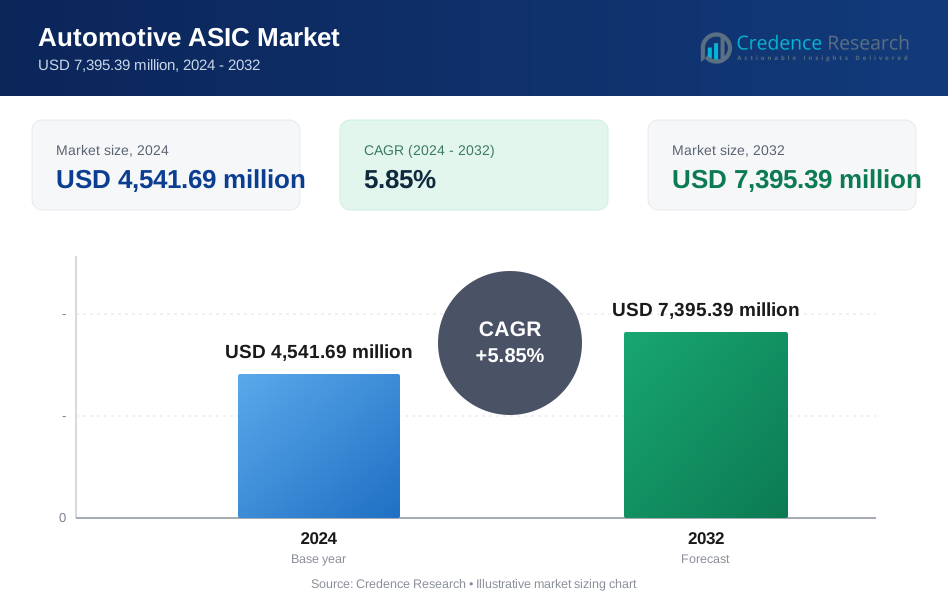
| Automotive ASIC Market Size 2024 | USD 4,541.69 Million |
| Automotive ASIC Market , CAGR | 5.85 % |
| Automotive ASIC Market Size 2032 | USD 7,395.39 Million |
Market Overview
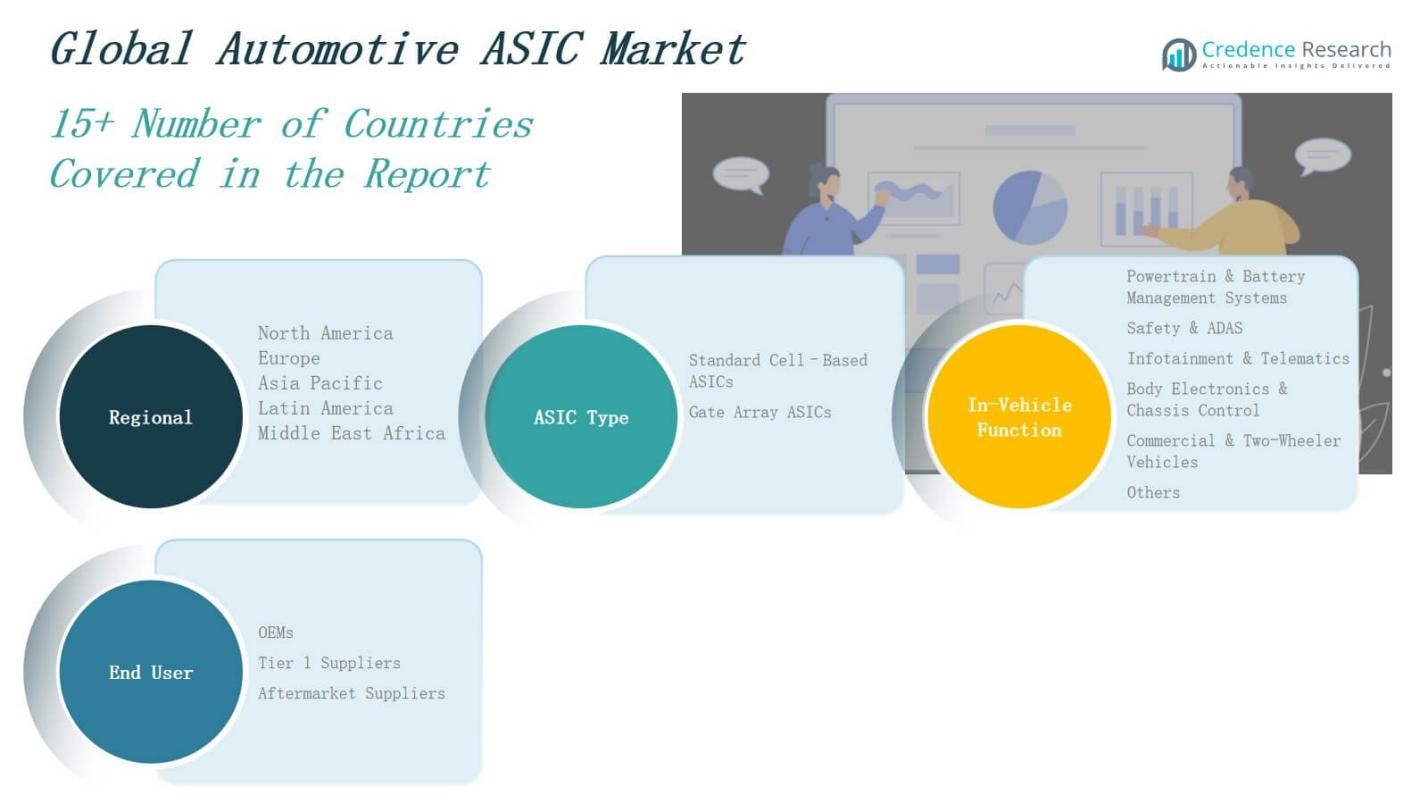
The Automotive ASIC Market size was valued at USD 3,124.48 million in 2018 to USD 4,541.69 million in 2024 and is anticipated to reach USD 7,395.39 million by 2032, at a CAGR of 5.85 % during the forecast period.
The Automotive ASIC Market is driven by the growing demand for advanced driver-assistance systems (ADAS), autonomous driving technologies, and electrification of vehicles. Original Equipment Manufacturers (OEMs) increasingly integrate application-specific integrated circuits to enhance vehicle safety, power efficiency, and real-time data processing. ASICs support critical functionalities such as lane departure warning, adaptive cruise control, battery management systems, and infotainment. The rapid adoption of electric vehicles (EVs) and hybrid models has intensified the need for energy-efficient and compact chips capable of handling complex powertrain and sensor operations. Trends shaping the market include the transition toward 5nm and 3nm process nodes for higher performance and lower power consumption, along with the emergence of domain-specific SoCs that consolidate multiple functions onto a single chip. Automakers and semiconductor firms are collaborating to develop custom ASICs that meet automotive-grade reliability standards and support OTA (over-the-air) updates. The shift toward software-defined vehicles further accelerates demand for flexible, high-performance ASIC solutions.
The Automotive ASIC Market spans six key regions: North America, Europe, Asia Pacific, Latin America, Middle East, and Africa. Asia Pacific holds the largest market share due to high vehicle production and strong EV adoption in China, Japan, and South Korea. Europe and North America follow, driven by strict regulatory standards and strong OEM presence. Latin America, the Middle East, and Africa show steady growth, supported by emerging smart mobility initiatives and rising vehicle demand. Key players operating across these regions include Renesas Electronics, STMicroelectronics, Broadcom, Texas Instruments, Samsung Electronics, Bosch, ON Semiconductor, Marvell Technology, NXP Semiconductors, Analog Devices, Infineon Technologies, and Microchip Technology. These companies focus on advanced ASIC solutions for applications such as ADAS, EV power management, infotainment, and autonomous driving. They maintain strong regional partnerships to address evolving automotive requirements and expand their global reach.
Market Insights
- The Automotive ASIC Market was valued at USD 3,124.48 million in 2018, reached USD 4,541.69 million in 2024, and is projected to hit USD 7,395.39 million by 2032, growing at a CAGR of 5.85%.
- Growing adoption of ADAS and autonomous driving features by OEMs is boosting demand for custom ASICs across all vehicle segments.
- Electrification of vehicles increases the need for ASICs in powertrain, energy conversion, and battery management systems with high voltage tolerance.
- Rising integration of infotainment, V2X communication, and AI-based connectivity functions supports rapid deployment of ASICs in next-gen vehicles.
- Challenges such as high development costs, long design cycles, and limited access to foundry capacity restrict market entry and scale for smaller players.
- Asia Pacific holds the largest market share, followed by Europe and North America, while Latin America, the Middle East, and Africa show gradual growth.
- Key players include Renesas, STMicroelectronics, Broadcom, Texas Instruments, Bosch, Samsung Electronics, ON Semiconductor, NXP, Analog Devices, Infineon, Marvell, and Microchip.
Market Drivers
Rising Demand for Advanced Driver-Assistance Systems (ADAS)
The Automotive ASIC Market is driven by the increasing integration of ADAS technologies across all vehicle classes. Automakers rely on ASICs to enable real-time data processing for features like automatic emergency braking, adaptive cruise control, and lane-keeping assistance. These systems require dedicated, high-performance chips to process inputs from radar, cameras, and LiDAR. ASICs support faster signal interpretation and decision-making capabilities. The growing emphasis on vehicle safety and regulatory mandates pushes manufacturers to adopt ASIC-based ADAS solutions. It continues to attract investment from OEMs and Tier 1 suppliers.
- For instance, Nissan announced its ProPILOT AD system, set for release by 2027, which will integrate 3D mapping, high-resolution radar, and AI-based predictive algorithms to deliver semi-autonomous driving capabilities in both urban and highway environments.
Electrification of Vehicles and Battery Management Needs
The global shift toward electric vehicles (EVs) is accelerating demand in the Automotive ASIC Market. EVs depend on custom ASICs to manage power conversion, energy distribution, and battery health monitoring. These chips are optimized for high-voltage environments and efficient power utilization. Manufacturers use ASICs to improve thermal performance and reduce energy losses across the drivetrain. It also supports regenerative braking and real-time diagnostics, enabling safer and more efficient EV operations. Growing investments in EV platforms fuel the need for specialized semiconductor solutions.
- For instance, Tesla’s Model 3 uses advanced ASIC-based battery management systems to monitor cell voltages and temperatures in real time, ensuring optimal battery performance and safety.
Growing Complexity in In-Vehicle Infotainment and Connectivity
The Automotive ASIC Market is experiencing strong growth due to rising consumer expectations for intelligent infotainment systems and vehicle connectivity. ASICs provide the processing power needed to integrate multimedia, navigation, and voice control into a seamless user experience. They also manage data flow across vehicle networks, supporting V2X communication and smartphone integration. Automakers leverage ASICs to deliver fast boot times, high-definition displays, and AI-driven interfaces. It ensures minimal latency and consistent performance across multiple applications. Expanding software ecosystems further increase chip customization demand.
Shift Toward Autonomous and Software-Defined Vehicles
The move toward autonomous driving and software-defined architectures is reshaping the Automotive ASIC Market. Advanced ASICs are required to process vast volumes of sensor data and execute real-time decision-making algorithms. These chips enable critical functions such as sensor fusion, object detection, and motion planning. It provides the computational backbone for Level 3 and above autonomy. OEMs collaborate with semiconductor firms to design ASICs tailored to autonomous driving stacks. Increasing vehicle intelligence demands robust, scalable, and power-efficient chipsets.
Market Trends
Integration of AI and Machine Learning in Automotive Applications
The Automotive ASIC Market is witnessing a strong trend toward embedding AI and machine learning capabilities into chip architectures. These intelligent ASICs support advanced use cases such as driver behavior analysis, predictive maintenance, and personalized infotainment. Automakers implement AI-enabled ASICs to process real-time data from various sensors, enabling faster and more accurate decision-making in dynamic environments. It also helps enhance driver safety, route optimization, and in-cabin user experience. The shift toward intelligent mobility platforms reinforces the demand for AI-centric ASIC solutions.
- For instance, BMW utilizes predictive maintenance powered by AI algorithms in its vehicles, monitoring components such as batteries and brakes to alert drivers and service centers before failures occur, thereby reducing downtime and improving reliability.
Migration to Advanced Semiconductor Process Nodes (5nm and 3nm)
The trend toward miniaturization and higher performance is driving the Automotive ASIC Market toward advanced semiconductor nodes like 5nm and 3nm. These nodes enable greater transistor density, improved power efficiency, and higher computational throughput. Automakers and chipmakers are collaborating to develop ASICs that meet stringent thermal and power requirements in compact automotive environments. It allows manufacturers to pack more features into smaller form factors. The move to smaller nodes also improves system responsiveness in time-critical applications such as ADAS and autonomous driving.
- For instance, Renesas introduced the R-Car X5H, the industry’s first automotive multi-domain SoC built on TSMC’s 3nm process. This platform delivers secure, high-performance processing for multiple automotive domains, leveraging the N3A process optimized for automotive reliability and power efficiency.
Emergence of Domain Controllers and Centralized Vehicle Architectures
The adoption of domain-specific and centralized computing architectures is reshaping chip design in the Automotive ASIC Market. OEMs are shifting from traditional distributed ECUs toward domain controllers that manage entire vehicle subsystems through fewer but more powerful chips. ASICs are central to this transformation by consolidating processing tasks and reducing component complexity. It supports faster communication between systems and reduces latency. This trend aligns with the push toward software-defined vehicles and future-ready, scalable vehicle platforms with OTA update capability.
Expansion of Vehicle-to-Everything (V2X) Communication Capabilities
The Automotive ASIC Market is evolving with the integration of V2X communication technologies into custom chips. V2X enables vehicles to communicate with each other, infrastructure, and pedestrians, requiring real-time data processing and ultra-low latency. ASICs are being designed to support 5G, DSRC, and C-V2X standards within a unified chip platform. It ensures compatibility across global automotive networks and enhances situational awareness. This trend supports the advancement of connected mobility and paves the way for safer and more efficient transportation systems.
Market Challenges Analysis
High Development Costs and Long Design Cycles
The Automotive ASIC Market faces significant challenges due to the high costs associated with design, prototyping, and validation of application-specific chips. ASIC development requires extensive investment in EDA tools, IP licensing, and foundry access, often running into tens of millions of dollars. Design cycles are long and complex, especially when chips must meet strict automotive-grade reliability and safety standards. It makes rapid innovation difficult and increases financial risk for smaller players. Any design flaw or recall can lead to costly delays. This challenge limits ASIC adoption among cost-sensitive vehicle segments.
Supply Chain Disruptions and Foundry Constraints
The Automotive ASIC Market remains vulnerable to global semiconductor supply chain disruptions and limited foundry capacity. Automotive-grade chips compete with consumer electronics for wafer allocation, creating bottlenecks during high demand cycles. It constrains production timelines and affects OEM delivery schedules. Ensuring consistent quality and automotive-specific certifications from foundries further complicates procurement. The market also depends heavily on a few advanced node suppliers, increasing exposure to geopolitical risks. These supply-side issues continue to challenge production scalability and timely deployment.
Market Opportunities
Expansion of Electric Vehicle and Battery Management Applications
The Automotive ASIC Market offers strong growth opportunities through the rapid global expansion of electric vehicles. EV platforms demand custom ASICs for high-efficiency power management, onboard charging, and real-time battery diagnostics. These chips play a central role in optimizing battery life, ensuring safety, and enhancing overall vehicle range. It enables automakers to improve energy efficiency while reducing the size and cost of electronic control units. Government incentives for EV adoption accelerate investment in ASIC-based EV systems. Rising EV penetration opens long-term prospects for tailored semiconductor innovation.
Adoption of Autonomous Driving and Connected Infrastructure
The increasing deployment of autonomous vehicles and intelligent transport systems creates new opportunities for the Automotive ASIC Market. Autonomous functions such as object recognition, sensor fusion, and motion planning rely on high-performance, application-specific chips. It supports real-time processing of LiDAR, radar, and camera data across multiple domains. Expanding smart city infrastructure and V2X networks further drive demand for connectivity-focused ASICs. Strategic partnerships between automakers and semiconductor companies fuel joint development of purpose-built ASIC platforms. These advancements position ASICs as core enablers of next-generation mobility.
Market Segmentation Analysis:
By ASIC Type
The Automotive ASIC Market includes two primary categories: Standard Cell–Based ASICs and Gate Array ASICs. Standard Cell–Based ASICs dominate due to their flexibility in design and suitability for complex, high-performance automotive applications. These ASICs offer better power efficiency and faster processing speeds, making them ideal for ADAS and EV powertrain systems. Gate Array ASICs hold a smaller share but appeal to applications with lower customization needs and shorter design cycles. It continues to see advancements in design tools and manufacturing integration.
- For instance, Renesas Electronics supplies standard cell–based ASICs for Toyota’s hybrid vehicles, optimizing power management in electric powertrains and contributing to improved energy efficiency and battery life.
By In-Vehicle Function
The Automotive ASIC Market segments in-vehicle functions into Powertrain & Battery Management Systems, Safety & ADAS, Infotainment & Telematics, Body Electronics & Chassis Control, Commercial & Two-Wheeler Vehicles, and Others. Safety & ADAS lead in demand due to increasing vehicle safety mandates and consumer expectations. Powertrain & Battery Management follows closely, driven by the EV shift. Infotainment & Telematics segments are expanding with connected car trends. It supports broader ASIC deployment across core vehicle domains.
- For instance, Tata Motors has integrated over 500,000 vehicles onto its Connected Vehicle Platform (CVP), offering real-time diagnostics, navigation, and remote updates across commercial, passenger, and electric vehicles.
By End User
The Automotive ASIC Market serves OEMs, Tier 1 Suppliers, and Aftermarket Suppliers. OEMs hold the largest market share by integrating ASICs into new vehicle platforms to support electrification and autonomous features. Tier 1 Suppliers contribute significantly by co-developing and supplying ASIC modules for critical vehicle systems. Aftermarket Suppliers represent a smaller but growing segment, driven by demand for electronic upgrades and replacements in existing vehicles. It reflects rising adoption across all stages of the automotive value chain.
Segments:
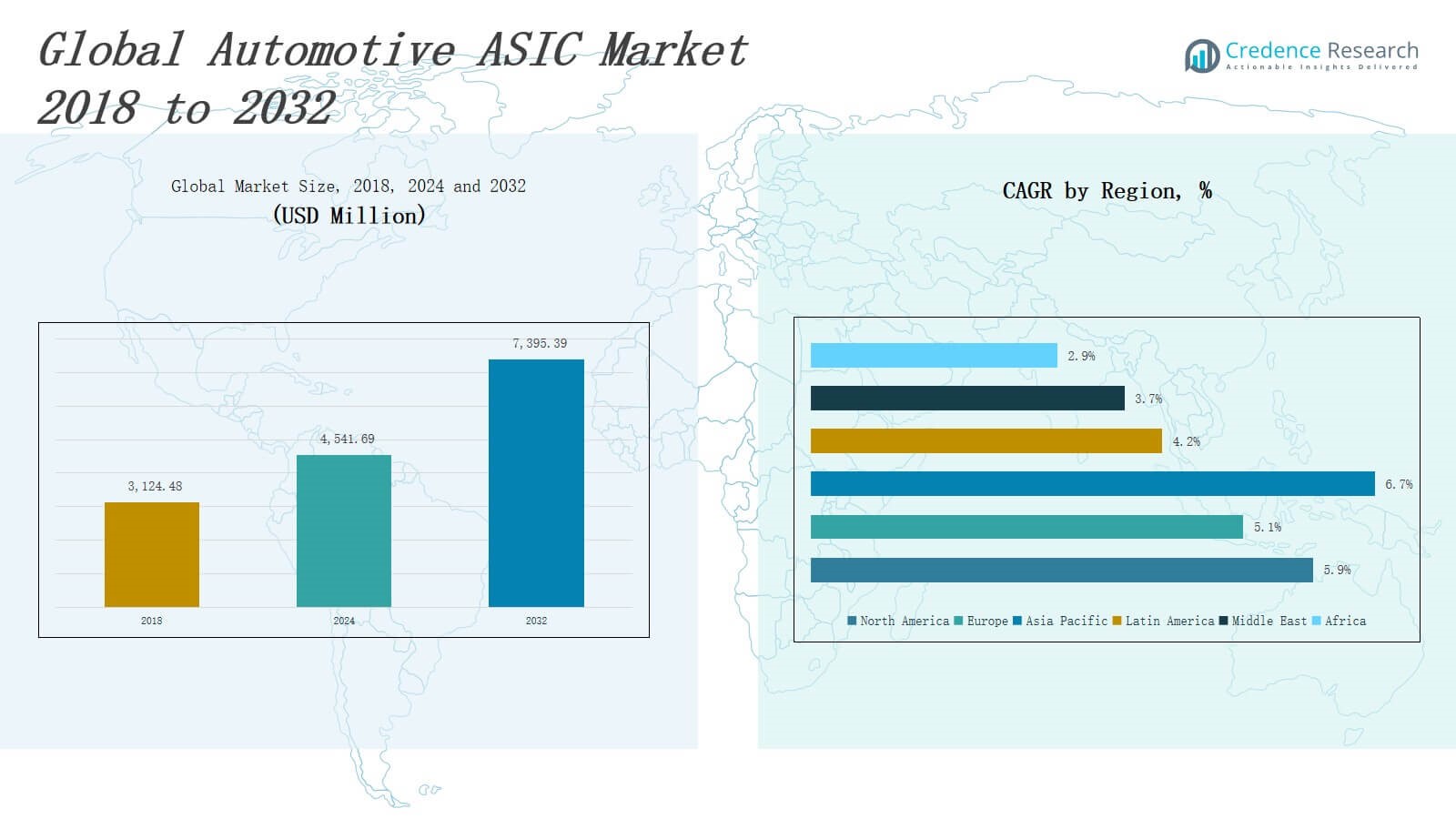
Based on ASIC Type
- Standard Cell–Based ASICs
- Gate Array ASICs
Based on In-Vehicle Function
- Powertrain & Battery Management Systems
- Safety & ADAS
- Infotainment & Telematics
- Body Electronics & Chassis Control
- Commercial & Two-Wheeler Vehicles
- Others
Based on End User
- OEMs
- Tier 1 Suppliers
- Aftermarket Suppliers
Based on Region
North America
- U.S., Canada, Mexico
Europe
- UK, France, Germany, Italy, Spain, Russia, Rest of Europe
Asia Pacific
- China, Japan, South Korea, India, Australia, Southeast Asia, Rest of Asia Pacific
Latin America
- Brazil, Argentina, Rest of Latin America
Middle East
- GCC Countries, Israel, Turkey, Rest of Middle East
Africa
- South Africa, Egypt, Rest of Africa
Regional Analysis
North America
The North America Automotive ASIC Market size was valued at USD 585.34 million in 2018 to USD 830.24 million in 2024 and is anticipated to reach USD 1,360.79 million by 2032, at a CAGR of 5.9% during the forecast period. The region accounts for a significant market share, driven by high adoption of advanced driver-assistance systems and electric vehicles. The United States leads regional demand with substantial investments in autonomous vehicle development and EV platforms. It benefits from a strong ecosystem of automotive OEMs and semiconductor companies, particularly in California and Michigan. Tier 1 suppliers actively collaborate with chip manufacturers to meet evolving vehicle standards. Rising focus on vehicle safety and connected technologies sustains demand across multiple in-vehicle functions.
Europe
The Europe Automotive ASIC Market size was valued at USD 953.69 million in 2018 to USD 1,339.81 million in 2024 and is anticipated to reach USD 2,063.33 million by 2032, at a CAGR of 5.1% during the forecast period. Europe holds a strong share of the global market due to stringent emissions regulations and strong EV penetration across countries like Germany, France, and the Netherlands. OEMs in the region increasingly deploy ASICs in battery management, ADAS, and infotainment systems. It benefits from automotive innovation hubs and partnerships between automotive and semiconductor firms. The European Union’s focus on autonomous driving and digital mobility reinforces long-term demand. Regulatory support for sustainable transport boosts deployment of ASIC-based solutions.
Asia Pacific
The Asia Pacific Automotive ASIC Market size was valued at USD 1,303.97 million in 2018 to USD 1,968.71 million in 2024 and is anticipated to reach USD 3,410.12 million by 2032, at a CAGR of 6.7% during the forecast period. Asia Pacific leads the global market with the largest share, supported by high vehicle production volumes and rapid electrification across China, Japan, and South Korea. It serves as a manufacturing hub for both vehicles and semiconductor components. Government incentives and local sourcing policies promote EV adoption and ASIC integration. Major automotive players are scaling ADAS and connected vehicle deployment, expanding ASIC usage in embedded control units. Domestic chipmakers increasingly invest in automotive-grade ASICs to reduce import dependency.
Latin America
The Latin America Automotive ASIC Market size was valued at USD 140.99 million in 2018 to USD 202.27 million in 2024 and is anticipated to reach USD 289.72 million by 2032, at a CAGR of 4.2% during the forecast period. Brazil and Mexico dominate regional demand, driven by the growth of local automotive manufacturing and export industries. The market is at a nascent stage but shows steady adoption of digital control units in passenger and commercial vehicles. It sees growing interest from global Tier 1 suppliers aiming to expand regional footprints. Increased demand for in-vehicle infotainment and emission compliance systems supports ASIC deployment. Partnerships with foreign semiconductor firms aid technology transfer and localized innovation.
Middle East
The Middle East Automotive ASIC Market size was valued at USD 90.99 million in 2018 to USD 121.34 million in 2024 and is anticipated to reach USD 168.00 million by 2032, at a CAGR of 3.7% during the forecast period. Demand in this region is rising steadily, led by investments in smart mobility and connected transport infrastructure. Countries like the UAE and Saudi Arabia are integrating intelligent vehicle technologies in line with smart city initiatives. It witnesses increasing demand for ASICs in fleet management, commercial EVs, and premium passenger vehicles. Local production remains limited, but reliance on global imports meets current needs. The market favors ASICs that support V2X communication and autonomous pilot functions.
Africa
The Africa Automotive ASIC Market size was valued at USD 49.50 million in 2018 to USD 79.32 million in 2024 and is anticipated to reach USD 103.42 million by 2032, at a CAGR of 2.9% during the forecast period. Africa holds the smallest share in the global market due to limited automotive manufacturing and low EV penetration. However, urbanization and rising middle-class income drive gradual adoption of ASIC-powered features in newer vehicle models. It sees demand in safety and body electronics, particularly in South Africa and Egypt. Import-driven automotive markets create opportunities for OEMs offering smart vehicle systems. Regional governments begin exploring smart mobility initiatives, laying groundwork for future ASIC integration.
Key Player Analysis
- Renesas Electronics
- STMicroelectronics
- Broadcom
- Texas Instruments
- Samsung Electronics
- Bosch
- ON Semiconductor
- Marvell Technology
- NXP Semiconductors
- Analog Devices
- Infineon Technologies
- Microchip Technology
Competitive Analysis
The Automotive ASIC Market features intense competition among global semiconductor leaders focused on innovation, scalability, and automotive-grade reliability. Key players include Renesas Electronics, STMicroelectronics, Broadcom, Texas Instruments, Samsung Electronics, Bosch, ON Semiconductor, Marvell Technology, NXP Semiconductors, Analog Devices, Infineon Technologies, and Microchip Technology. These companies invest heavily in R&D to develop ASICs tailored for electric vehicles, ADAS, and autonomous systems. Strategic collaborations with OEMs and Tier 1 suppliers help accelerate design cycles and ensure compliance with functional safety standards. The Automotive ASIC Market is defined by rapid technological advancements, with companies racing to integrate AI, support next-gen process nodes, and deliver low-power, high-performance chips. It sees increasing interest in vertical integration and custom silicon development to gain competitive advantage in performance and cost efficiency. Market leaders differentiate through design expertise, supply chain capabilities, and ecosystem partnerships aligned with the evolving needs of software-defined vehicles.
Recent Developments
- In March 2025, SEALSQ partnered with IC’ALPS to integrate post-quantum secure cryptographic IP into automotive ASICs designed for functional safety under ISO 26262 standards.
- In January 2025, NXP Semiconductors announced the acquisition of TTTech Auto for USD 625 million to enhance its automotive safety middleware and semiconductor portfolio.
- In June 2025, Cyient Semiconductors formed a partnership with MIPS to co-develop RISC-V-based custom ASICs for intelligent automotive power management and safety applications.
- In March 2025, Infineon showcased new microcontroller innovations—including TriCore-based AURIX, AIROC Wi‑Fi, and PSOC MCUs—highlighting RISC-V adoption and enhanced device security at Embedded World.
Market Concentration & Characteristics
The Automotive ASIC Market exhibits moderate to high market concentration, with a few dominant players controlling a significant share of global revenue. Key participants such as Renesas, NXP Semiconductors, STMicroelectronics, and Infineon Technologies lead the competitive landscape through technological innovation, established OEM relationships, and robust global supply chains. The market favors long-term contracts and co-development agreements with automakers and Tier 1 suppliers. It is characterized by high entry barriers due to complex design requirements, stringent automotive safety standards, and capital-intensive fabrication processes. The growing importance of ADAS, EV systems, and software-defined vehicle architectures has increased the need for high-performance, energy-efficient ASICs. The market supports both standardized and custom ASIC solutions depending on the vehicle platform and application. Demand continues to rise for chips optimized for AI processing, power management, and sensor integration. It remains innovation-driven and increasingly influenced by partnerships between automakers and semiconductor firms to meet evolving automotive performance benchmarks.
Report Coverage
The research report offers an in-depth analysis based on ASIC Type, In-Vehicle Function, End-User and Geography. It details leading market players, providing an overview of their business, product offerings, investments, revenue streams, and key applications. Additionally, the report includes insights into the competitive environment, SWOT analysis, current market trends, as well as the primary drivers and constraints. Furthermore, it discusses various factors that have driven market expansion in recent years. The report also explores market dynamics, regulatory scenarios, and technological advancements that are shaping the industry. It assesses the impact of external factors and global economic changes on market growth. Lastly, it provides strategic recommendations for new entrants and established companies to navigate the complexities of the market.
Future Outlook
- Demand for automotive ASICs will increase with the expansion of autonomous driving technologies across passenger and commercial vehicles.
- OEMs will prioritize custom ASIC development to support software-defined vehicle platforms and centralized computing architectures.
- Electric vehicle growth will drive the need for advanced power management and battery monitoring ASICs.
- Integration of AI and machine learning in vehicles will boost adoption of ASICs optimized for high-speed data processing.
- Infotainment and connectivity systems will continue to evolve, requiring ASICs with enhanced multimedia and communication capabilities.
- Tier 1 suppliers will expand partnerships with semiconductor firms to co-develop vehicle-specific ASIC solutions.
- Regional chip production will grow as countries invest in semiconductor manufacturing to reduce import dependency.
- Design innovation will focus on reducing chip size, improving energy efficiency, and meeting automotive safety standards.
- Supply chain diversification will become critical to manage foundry limitations and geopolitical risks.
- Standardization of automotive ASIC interfaces will improve interoperability and accelerate integration across multiple platforms.
Request a Free Sample
Fill in your details and we'll send you a free sample report.
- Sample data tables & charts
- Research methodology
Need a Custom Version of This Report?
Tailor the scope, geography, or segments to your exact requirements.
- Custom geography or segment scope
- Direct access to our analyst team
Frequently Asked Questions
What is the current size of the Automotive ASIC Market?
What factors are driving the growth of the Automotive ASIC Market?
What are the key segments within the Automotive ASIC Market?
What are some challenges faced by the Automotive ASIC Market?
Who are the major players in the Automotive ASIC Market?
Table of Content
Chapter 1. Report Introduction
- 1.1 Report Description & Purpose
- 1.1.1 Report Title & Market Definition
- 1.1.2 Unique Selling Propositions (USP) & Key Differentiators
- 1.1.3 Value Proposition for Stakeholders
- 1.2 Research Objectives
- 1.2.1 Market Sizing Objectives (Volume & Revenue)
- 1.2.2 Segmentation Objectives
- 1.2.3 Competitive Intelligence Objectives
- 1.2.4 Forecast & Scenario Objectives
- 1.3 Report Scope
- 1.3.1 Automotive ASIC Scope – Types & Subtypes Covered
- 1.3.2 Geographic Scope – Regions & Countries Covered
- 1.3.3 Historical Period, Base Year & Forecast Period (2024; forecast to 2032)
- 1.3.4 Inclusions & Exclusions
- 1.4 HS Code & Classification Framework
- 1.5 Currency, Units & Pricing Basis
- 1.6 Target Stakeholders
- 1.7 Limitations & Assumptions
Chapter 2. Executive Summary
- 2.1 Global Automotive ASIC Market Snapshot
- 2.1.1 Market Size – Historical (2024) & Forecast (2024-2032) (2024: USD 4,541.69 million → 2032: USD 7,395.39 million)
- 2.1.2 Volume & Revenue – Global Totals
- 2.1.3 Key Market Highlights – Top Five Facts
- 2.2 Automotive ASIC Market Segmentation Snapshot
- 2.2.1 Market Split by Region – 2024 vs. 2032
- 2.3 Competitive Snapshot
- 2.3.1 Top 10 Players by Revenue Share – 2024
- 2.3.2 Top 10 Players by Volume Share – 2024
- 2.3.3 Recent Strategic Developments (18-Month Summary)
- 2.4 Key Investment Highlights & Strategic Conclusions
Chapter 3. Automotive ASIC Market Dynamics & Industry Analysis
- 3.1 Market Overview & Context
- 3.1.1 Automotive ASIC Market Position in the Broader Automotive Value Chain
- 3.1.2 OEM vs. Replacement Market Dynamics
- 3.1.3 Market Maturity & Development Stage by Region
- 3.2 Automotive ASIC Market Drivers
- 3.3 Automotive ASIC Market Restraints & Challenges
- 3.4 Automotive ASIC Market Opportunities
- 3.5 Porter's Five Forces Analysis
- 3.5.1 Threat of New Entrants
- 3.5.2 Bargaining Power of Suppliers
- 3.5.3 Bargaining Power of Buyers
- 3.5.4 Threat of Substitutes
- 3.5.5 Competitive Rivalry – Intensity Assessment
- 3.6 Automotive ASIC Value Chain Analysis
- 3.6.1 Upstream – Raw Material/Input Suppliers
- 3.6.1.1 Raw Material/Input 1
- 3.6.1.2 Raw Material/Input 2
- 3.6.1.3 Raw Material/Input 3
- 3.6.2 Midstream – Production/Manufacturing/Service Delivery
- 3.6.2.1 Production/Process Overview
- 3.6.2.2 Key Facility Locations & Capacity by Manufacturer
- 3.6.3 Downstream – Distribution & End Consumer
- 3.6.3.1 Primary Channel – B2B/OEM
- 3.6.3.2 Secondary Channels – Dealer, Retail, Online, Direct
- 3.6.4 Value Chain Profitability Analysis
- 3.6.1 Upstream – Raw Material/Input Suppliers
- 3.7 PESTEL Analysis
- 3.7.1 Political Factors
- 3.7.2 Economic Factors
- 3.7.3 Social Factors
- 3.7.4 Technological Factors
- 3.7.5 Environmental Factors
- 3.7.6 Legal Factors
- 3.8 Automotive ASIC Supply Chain Analysis
- 3.8.1 Raw Material/Input Supply Risk Assessment
- 3.8.2 Manufacturing Concentration Risk (Geographic Exposure)
- 3.8.3 Trade Disruption Impact Analysis
- 3.9 Regulatory & Policy Landscape
Note: The regulatory and policy landscape section covers regulations based on their applicability to the market, Automotive ASIC category, geography, and scope of the study. Only regulatory frameworks with a material impact on operations, compliance, trade, sustainability, or market access are analyzed in detail.
Chapter 4. Key Investment Pockets & Opportunity Analysis
- 4.1 Automotive ASIC Market Attractiveness Analysis
- 4.1.1 By Region – Investment Attractiveness Matrix (Volume × CAGR)
- 4.2 Absolute Revenue Growth Opportunity
- 4.2.1 By Region – Absolute USD Growth Through 2032
- 4.3 Incremental Volume Opportunity
- 4.3.1 By Region – Incremental Volume Through 2032
- 4.3.2 Segment – Incremental Volume
- 4.4 Emerging Submarket Opportunity Deep Dive (Subject to Applicability)
- 4.5 Emerging Market Opportunity Scorecards
- 4.5.1 United States
- 4.5.2 Europe
- 4.5.3 Asia
- 4.5.4 Middle East & Africa
Note: Emerging Market Opportunity Scorecards will be included based on relevance and strategic importance. Regions listed are indicative and may vary depending on data availability and market dynamics.
Chapter 5. Automotive ASIC Import-Export Analysis & Trade Flows
- 5.1 Global Trade Overview
- 5.1.1 Global Export Value by Country (2024)
- 5.1.2 Global Export Volume by Country (2024)
- 5.1.3 Global Import Value by Country (2024)
- 5.1.4 Global Import Volume by Country (2024)
- 5.1.5 Net Trade Balance by Country (2024)
- 5.2 Export Analysis – Segment
- 5.2.1 Type 1 (HS Code)
- 5.2.2 Type 2 (HS Code)
- 5.2.3 Type 3 (HS Code)
- 5.2.4 Type 4 (HS Code)
- 5.2.5 Type 5 (HS Code)
- 5.3 Import Analysis – Segment
- 5.3.1 Type 1 (HS Code)
- 5.3.2 Type 2 (HS Code)
- 5.3.3 Type 3 (HS Code)
- 5.3.4 Type 4 (HS Code)
- 5.3.5 Type 5 (HS Code)
- 5.4 Average Unit Trade Prices
- 5.4.1 Average Export Price – Segment & Country
- 5.4.2 Average Import Price – Segment & Source Country
- 5.4.3 Price Trends (2024)
- 5.5 Key Trade Route Analysis
- 5.5.1 Trade Route 1
- 5.5.2 Trade Route 2
- 5.5.3 Trade Route 3
- 5.5.4 Trade Route 4
- 5.5.5 Trade Route 5
- 5.6 Trade Policy Impact Assessment
- 5.6.1 US Anti-Dumping & Section 301 Tariffs
- 5.6.2 EU Customs Union Impact
- 5.6.3 Major Free Trade Agreements
- 5.6.4 USMCA Rules of Origin
Note: Trade policy analysis will be included only where relevant to the Automotive ASIC market.
Chapter 6. Competitive Landscape & Company Benchmarking
- 6.1 Automotive ASIC Market Concentration & Structure
- 6.1.1 Herfindahl-Hirschman Index (HHI) – vs. 2024
- 6.1.2 Tier 1, Tier 2 & Tier 3 Market Structure
- 6.1.3 Global, Regional & Local Player Dynamics
- 6.2 Automotive ASIC Market Share Analysis – 2024
- 6.2.1 Global Revenue Share by Company
- 6.2.2 Global Volume Share by Company
- 6.2.3 Regional Revenue Share
- 6.2.4 Market Share Evolution ( vs. 2024)
- 6.2.5 OEM Segment Share by Company
- 6.2.6 Replacement Segment Share by Company
- 6.3 Production/Delivery Capacity & Facility Analysis
- 6.3.1 Global Installed Capacity
- 6.3.2 Capacity Utilization Rates
- 6.3.3 Production/Output Volume
- 6.3.4 Facility Locations & Capacity Map
- 6.3.5 Planned Capacity Additions
- 6.4 Automotive ASIC Competitive Benchmarking Matrix
- 6.4.1 Revenue, Volume, CAGR & Profitability Comparison
- 6.4.2 Channel Revenue Mix
- 6.4.3 Geographic Revenue Exposure
- 6.4.4 R&D Intensity
- 6.4.5 Sustainability Maturity
- 6.5 Strategic Developments in Automotive ASIC (Last 24 Months)
- 6.5.1 Mergers, Acquisitions & Divestments
- 6.5.2 New Automotive ASIC Launches
- 6.5.3 Facility Expansions
- 6.5.4 Strategic Alliances, Joint Ventures & Partnerships
- 6.5.5 Distribution Expansion & Market Entry
- 6.5.6 Sustainability & ESG Initiatives
- 6.6 Competitive Strategy Mapping
- 6.6.1 Leader, Challenger, Follower & Niche Classification
- 6.6.2 Pricing Strategy Comparison
- 6.6.3 Channel Strategy Matrix
Note: Strategic developments are included based on their materiality and the availability of reliable information.
Chapter 7. Global Automotive ASIC Market – By Distribution Channel
- 7.1 Segment Overview
- 7.1.1 Volume & Revenue Split by Channel (2024 & 2032)
- 7.1.2 Channel Mix Evolution (2024-2032)
Chapter 8. Regional Market Analysis – Global Overview
- 8.1 Global Regional Overview
- 8.1.1 Regional Volume Share
- 8.1.2 Regional Revenue Share
- 8.1.3 Regional Volume by Region
- 8.1.4 Regional Revenue by Region
- 8.1.5 Regional Forecast Through 2032
- 8.2 Cross-Regional Segment Analysis
- 8.2.1 By Distribution Channel
- 8.2.2 By Brand/Price Tier
Chapter 9. North America Automotive ASIC Market
- 9.1 United States
- 9.2 Canada
- 9.3 Mexico
Chapter 10. Europe Automotive ASIC Market
- 10.1 Germany
- 10.2 France
- 10.3 Italy
- 10.4 United Kingdom
- 10.5 Spain
- 10.6 Poland
- 10.7 Russia
- 10.8 Netherlands
- 10.9 Belgium
- 10.10 Sweden
- 10.11 Denmark
- 10.12 Norway
- 10.13 Rest of Europe
Chapter 11. Asia Pacific Automotive ASIC Market
- 11.1 China
- 11.2 India
- 11.3 Japan
- 11.4 South Korea
- 11.5 Thailand
- 11.6 Indonesia
- 11.7 Vietnam
- 11.8 Malaysia
- 11.9 Australia
- 11.10 Rest of Asia Pacific
Chapter 12. Latin America Automotive ASIC Market
- 12.1 Brazil
- 12.2 Argentina
- 12.3 Colombia
- 12.4 Chile
- 12.5 Rest of Latin America
Chapter 13. Middle East Automotive ASIC Market
- 13.1 Saudi Arabia
- 13.2 United Arab Emirates
- 13.3 Turkey
- 13.4 Israel
- 13.5 Iran
- 13.6 Rest of the Middle East
Chapter 14. Africa Automotive ASIC Market
- 14.1 South Africa
- 14.2 Egypt
- 14.3 Nigeria
- 14.4 Morocco
- 14.5 Rest of Africa
Chapter 15. Automotive ASIC Company Profiles
- 15.1 [Company 01]
- 15.1.1 Company Overview
- 15.1.2 Key Management Personnel
- 15.1.3 Products & Services Portfolio
- 15.1.4 Financial Performance
- 15.1.5 Key Market Focus & Geographic Presence
- 15.1.6 Recent Developments & Strategic Initiatives
Note: The company profile list is preliminary and may change based on research findings, market developments, data availability, and client requirements.
Chapter 16. Appendices
- Appendix A – List of Abbreviations & Acronyms
- Appendix B – Industry Classification Code Reference – Full Series
- Appendix C – Production & Capacity Data Tables
- Appendix D – End-Use & Demand Base Tables
- Appendix E – Consumption & Replacement Rate Assumptions
- Appendix F – ASP Reference Tables
- Appendix G – Manufacturing & Facility Database
- Appendix H – Import-Export Data Tables
- Appendix I – Regulatory Summary Tables
- Appendix J – Primary Research Participant List (Anonymized)
- Appendix K – Primary Research Questionnaire Framework
- Appendix L – Data Sources & Bibliography
- Appendix M – Market Size Divergence & Source Comparison
Chapter 17. Research Methodology
- 17.1 Research Framework & Philosophy
- 17.2 Secondary Research – Sources, Hierarchy & Data Extraction
- 17.3 Data Modeling – Bottom-Up & Top-Down Market Sizing
- 17.4 Primary Research – Stakeholder Framework, LOI & Sample Sizes
- 17.5 Forecast Methodology – Regression, Scenario & Sensitivity Analysis
- 17.6 Quality Control – Four-Layer Validation Framework
- 17.7 Limitations & Standard Assumptions
- 17.8 Disclaimer
