
Market Overview
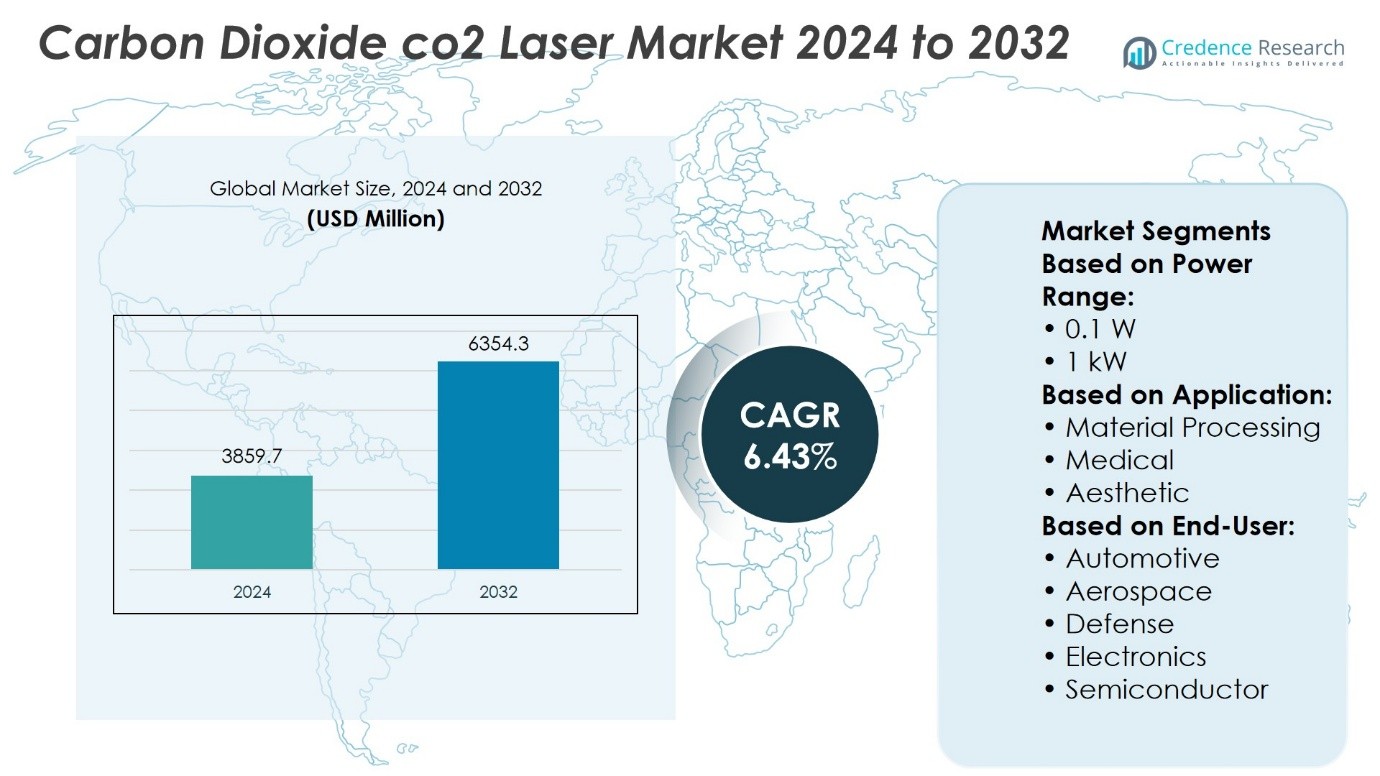
Carbon Dioxide CO2 Laser Market size was valued at USD 3859.7 million in 2024 and is anticipated to reach USD 6354.3 million by 2032, at a CAGR of 6.43% during the forecast period.
| REPORT ATTRIBUTE | DETAILS |
|---|---|
| Historical Period | 2020-2024 |
| Base Year | 2024 |
| Forecast Period | 2025-2032 |
| Carbon Dioxide CO2 Laser Market Size 2024 | USD 3859.7 Million |
| Carbon Dioxide CO2 Laser Market, CAGR | 6.43% |
| Carbon Dioxide CO2 Laser Market Size 2032 | USD 6354.3 Million |
The Carbon Dioxide CO₂ Laser Market grows on the strength of rising demand in medical, industrial, and packaging applications, supported by its precision, versatility, and energy efficiency. It benefits from increasing adoption in minimally invasive surgeries, high-speed material processing, and automated production lines. Advancements in beam quality, compact system design, and cooling technologies enhance performance and reduce operational costs. It aligns with sustainability goals through energy-efficient models and reduced material waste. Growing use in emerging applications such as microfabrication, aerospace components, and semiconductor processing, combined with integration of IoT-enabled monitoring, shapes the market’s evolving trends and long-term growth trajectory.
The Carbon Dioxide CO₂ Laser Market shows strong presence across North America, Europe, Asia-Pacific, Latin America, and the Middle East & Africa, with North America and Europe leading in technological adoption and industrial applications. Asia-Pacific experiences rapid growth driven by manufacturing expansion and healthcare investments. Key players operate globally, offering advanced CO₂ laser solutions tailored to diverse sectors. Competitive positioning focuses on innovation, automation integration, and regional market penetration to address industry-specific requirements and maintain a strong global footprint.
Market Insights
- The Carbon Dioxide CO₂ Laser Market was valued at USD 3,859.7 million in 2024 and is projected to reach USD 6,354.3 million by 2032, growing at a CAGR of 6.43%.
- Rising demand from medical, industrial, and packaging sectors drives adoption due to precision, versatility, and efficiency.
- Increasing integration with automated production lines and IoT-enabled monitoring shapes technological advancements.
- Competition focuses on innovation, product customization, and automation compatibility to strengthen global positioning.
- High capital and maintenance costs, along with competition from alternative laser technologies, restrain growth in cost-sensitive markets.
- North America and Europe lead in technological adoption, while Asia-Pacific grows rapidly with manufacturing expansion and healthcare investments.
- Global players leverage regional market penetration strategies to address specific industry needs and maintain a competitive edge.
Market Drivers
Growing Demand from Medical and Aesthetic Applications
The Carbon Dioxide CO₂ Laser Market benefits from rising adoption in dermatology, surgery, and aesthetic procedures. It enables precise tissue removal, minimal bleeding, and faster recovery times, making it a preferred choice for healthcare providers. Hospitals and clinics increasingly integrate advanced CO₂ laser systems for skin resurfacing, scar revision, and tumor excision. It supports growing demand for non-invasive and minimally invasive treatments across diverse patient groups. Advances in fractional CO₂ laser technology enhance treatment accuracy and patient comfort. Strong demand from both developed and emerging healthcare markets sustains the segment’s momentum.
- For instance, LightScalpel’s surgical CO₂ laser systems have enabled vaporization of soft‑tissue targets with an ablation depth of 400–500 micrometers, allowing clinicians to remove skin lesions with microscale accuracy.
Advancements in Industrial Material Processing
Industrial applications contribute significantly to the Carbon Dioxide CO₂ Laser Market through its role in cutting, engraving, and welding materials. It offers high efficiency in processing metals, plastics, glass, and ceramics for sectors such as automotive, electronics, and packaging. Manufacturers adopt CO₂ lasers to achieve superior edge quality, high precision, and reduced waste in production lines. It supports automation initiatives by integrating seamlessly with robotic systems and CNC machinery. Innovations in high-power CO₂ laser sources extend their suitability for thicker material processing. Growing use in additive manufacturing and 3D printing expands its industrial relevance.
- For instance, in 2024, manufacturers across 89 countries installed over 132,800 CO₂ laser cutting machines, reflecting strong global uptake in industrial material processing.
Rising Adoption in Food and Beverage Packaging
The Carbon Dioxide CO₂ Laser Market gains traction in food and beverage labeling, marking, and perforation processes. It enables high-speed, contactless operations that maintain packaging integrity while delivering consistent quality. It helps manufacturers comply with traceability and labeling regulations by producing permanent, legible markings. Adoption grows due to its ability to mark on a wide range of substrates including paper, plastics, and films. Integration into high-throughput packaging lines increases productivity and operational efficiency. Demand strengthens with the expansion of packaged food markets globally.
Technological Innovations Enhancing Performance and Efficiency
The Carbon Dioxide CO₂ Laser Market advances through innovations that improve beam quality, energy efficiency, and operational lifespan. It benefits from compact designs, user-friendly interfaces, and enhanced cooling systems that reduce maintenance needs. Manufacturers invest in R&D to develop systems with higher power stability and lower operational costs. It aligns with sustainability goals by reducing energy consumption and material waste. Integration with IoT and AI-driven monitoring enhances predictive maintenance and process optimization. Such developments expand the scope of CO₂ laser applications across industries.
Market Trends
Increasing Integration with Digital and Automated Systems
The Carbon Dioxide CO₂ Laser Market witnesses a trend toward integration with advanced automation and digital control platforms. It aligns with the need for precision and repeatability in industrial processes. Manufacturers develop systems compatible with CNC machines, robotics, and automated production lines. It enables real-time adjustments, reducing downtime and improving throughput. Digital monitoring tools enhance process control and traceability in regulated sectors. This shift supports efficiency gains in industries such as automotive, electronics, and medical device manufacturing.
- For instance, Domino Printing Sciences PLC, known for its CO₂ laser coders and automation controllers, maintains operations across over 120 countries and employs approximately 2.8 million work hours annually dedicated to maintaining and integrating their laser systems into automated production line.
Growing Popularity of Compact and Portable Designs
The Carbon Dioxide CO₂ Laser Market shows a rising preference for compact, portable, and space-efficient equipment. It addresses space constraints in clinics, workshops, and small manufacturing units. Manufacturers design systems with integrated cooling, modular components, and reduced footprint without sacrificing output quality. It supports flexible deployment in diverse environments, from mobile medical units to remote industrial sites. Lightweight designs expand accessibility for small and medium-sized enterprises. This trend aligns with the increasing need for mobility and adaptability in operations.
- For instance, in 2024, Trumpf’s new compact CO₂ laser module manufacturing plant in Ditzingen, Germany, expanded by 68,000 square meters, an area akin to more than nine soccer fields, enabling production of 5.4 million compact modules annually.
Advancements in Energy Efficiency and Sustainability
The Carbon Dioxide CO₂ Laser Market evolves with innovations aimed at reducing energy consumption and operational costs. It incorporates improved beam delivery systems, energy recovery modules, and advanced cooling technologies. Manufacturers focus on developing eco-friendly solutions that meet strict environmental standards. It reduces waste and extends the service life of components through optimized system design. Energy-efficient models attract industries seeking to lower operational footprints. This trend strengthens adoption in markets prioritizing sustainable manufacturing practices.
Expansion into Emerging and Niche Applications
The Carbon Dioxide CO₂ Laser Market expands into specialized areas such as biomedical research, microfabrication, and aerospace component processing. It supports intricate applications requiring high precision and controlled heat input. Manufacturers tailor systems for niche needs, such as engraving microstructures or processing advanced composites. It enables breakthroughs in fields that demand extreme accuracy and minimal material alteration. Growth in such applications opens new revenue streams for equipment providers. This diversification enhances the market’s resilience to demand fluctuations in traditional sectors.
Market Challenges Analysis
High Capital and Maintenance Costs Limiting Adoption
The Carbon Dioxide CO₂ Laser Market faces constraints due to the high initial investment and ongoing maintenance requirements of advanced systems. It demands specialized components, precise alignment, and dedicated cooling infrastructure, which increase operational expenses. Small and medium-sized enterprises often find it challenging to justify the expenditure without clear short-term returns. It also requires skilled technicians for installation, calibration, and servicing, adding to labor costs. Frequent use in demanding industrial environments accelerates wear on optics and consumables. This cost burden slows adoption in cost-sensitive sectors, especially in emerging economies.
Operational Limitations and Intense Competitive Pressure
The Carbon Dioxide CO₂ Laser Market contends with operational challenges such as lower efficiency when processing reflective metals and susceptibility to thermal lensing effects. It may require supplementary equipment or alternative laser types for certain applications, increasing complexity for end users. Rapid advancements in fiber laser technology intensify competition, offering higher efficiency and reduced maintenance in some use cases. It puts pressure on manufacturers to continuously innovate while maintaining price competitiveness. The need to comply with evolving safety and environmental regulations further adds to product development timelines and costs. This combination of technical and market pressures tests the long-term competitiveness of CO₂ laser systems.
Market Opportunities
Expansion into High-Growth Medical and Aesthetic Segments
The Carbon Dioxide CO₂ Laser Market holds strong potential in the medical and aesthetic sectors where demand for precision-based treatments is rising. It offers advantages in dermatology, cosmetic surgery, and dental procedures, where minimal invasiveness and high accuracy are critical. Hospitals and specialty clinics increasingly seek advanced CO₂ laser systems for scar revision, skin resurfacing, and soft tissue surgeries. It supports the shift toward outpatient and same-day procedures, which improves patient turnover and efficiency. Technological advancements in fractional laser modes expand treatment options while reducing recovery time. This segment presents a scalable growth avenue supported by rising healthcare investments and patient awareness.
Adoption in Advanced Industrial and Emerging Applications
The Carbon Dioxide CO₂ Laser Market has opportunities in industrial manufacturing, aerospace, and electronics production where high-precision cutting and engraving are essential. It can address emerging needs in microfabrication, semiconductor processing, and composite material shaping. Integration with automated production lines and IoT-enabled monitoring enhances productivity and predictive maintenance capabilities. It meets the demand for complex geometries and high-quality surface finishes in next-generation products. Expanding applications in additive manufacturing and customized component production create further revenue potential. Strategic innovation in specialized laser sources tailored for niche markets can secure competitive advantages for manufacturers.
Market Segmentation Analysis:
By Power Range
The Carbon Dioxide CO₂ Laser Market is segmented into < 0.1 W, 0.1 – 1 kW, and > 1 kW categories, each serving distinct application requirements. The < 0.1 W segment caters to precision-focused tasks such as medical diagnostics, microfabrication, and research applications. It offers low thermal impact, making it ideal for delicate materials. The 0.1 – 1 kW range dominates in medium-scale industrial operations, supporting cutting, engraving, and welding in manufacturing lines. This range balances power efficiency with versatility, serving multiple industries from electronics to packaging. The > 1 kW segment addresses heavy-duty industrial uses, including thick metal cutting and large-scale fabrication in automotive and aerospace production. Its high-power capacity ensures faster processing speeds and greater penetration in demanding environments.
- For instance, the DIAMOND C/Cx Series CO₂ lasers by Coherent deliver 20 W to 120 W in low-power operation modes, making them suited for high-precision engraving and scoring on delicate substrates like thin plastics or textiles.
By Application
The market is categorized into material processing, medical and aesthetic, defense and military, and others such as telecom. Material processing holds a significant share, driven by demand in cutting, engraving, drilling, and marking across metals, plastics, and composites. Medical and aesthetic applications utilize CO₂ lasers for dermatological treatments, dental surgery, and precise tissue removal. It enables reduced recovery times and minimal invasiveness in surgical procedures. Defense and military use includes target designation, range finding, and precision machining of defense components. The telecom sector applies CO₂ lasers in optical fiber manufacturing and component processing, supporting high-speed communication networks.
- For instance, according to global market data, over 18.7 million CO₂ laser units were in circulation in 2024, reflecting their widespread role in material processing tasks across industries.
By End User
End users include automotive, aerospace and defense, electronics and semiconductor, metal, packaging, and textiles. The automotive sector uses CO₂ lasers for body panel cutting, welding, and intricate component fabrication. In aerospace and defense, it supports machining of lightweight alloys and composite materials for aircraft and weapon systems. Electronics and semiconductor manufacturers rely on it for precise micro-cutting, wafer scribing, and component marking. The metal industry applies high-power CO₂ lasers for structural fabrication and finishing processes. Packaging companies use CO₂ lasers for high-speed perforation, coding, and marking on diverse substrates. The textiles sector integrates laser systems for pattern cutting, fabric engraving, and customized design production with high repeatability.
Segments:
Based on Power Range:
- 1 W
- 1 kW
Based on Application:
- Material Processing
- Medical
- Aesthetic
Based on End-User:
- Automotive
- Aerospace
- Defense
- Electronics
- Semiconductor
Based on the Geography:
- North America
- U.S.
- Canada
- Mexico
- Europe
- Germany
- France
- U.K.
- Italy
- Spain
- Rest of Europe
- Asia Pacific
- China
- Japan
- India
- South Korea
- South-east Asia
- Rest of Asia Pacific
- Latin America
- Brazil
- Argentina
- Rest of Latin America
- Middle East & Africa
- GCC Countries
- South Africa
- Rest of the Middle East and Africa
Regional Analysis
North America
North America holds approximately 32% of the Carbon Dioxide CO₂ Laser Market, driven by its strong industrial base, advanced healthcare infrastructure, and high adoption of precision manufacturing technologies. The United States leads the region with widespread use in automotive, aerospace, defense, and medical applications. It benefits from a mature manufacturing ecosystem that actively integrates CO₂ laser systems into automated production lines. The medical sector in North America shows increasing demand for CO₂ laser devices in dermatology, cosmetic procedures, and minimally invasive surgeries. Defense and aerospace manufacturers deploy high-power CO₂ lasers for precision machining of critical components. Canada contributes through industrial automation in automotive parts production and healthcare applications, supported by favorable government investments in technology modernization.
Europe
Europe accounts for around 28% of the market, supported by its strong engineering capabilities, regulatory emphasis on manufacturing efficiency, and robust automotive and aerospace industries. Germany leads with extensive use of CO₂ lasers in metal fabrication, automotive assembly, and advanced material processing. The UK and France show significant adoption in defense and medical sectors, particularly in surgical lasers and high-precision tooling. Italy and Spain contribute through applications in packaging, textiles, and customized design production. The region’s stringent quality and environmental regulations encourage the adoption of energy-efficient laser systems. European manufacturers also focus on research and development, leading to innovations in high-power CO₂ lasers for industrial and medical uses.
Asia-Pacific
Asia-Pacific holds about 26% of the Carbon Dioxide CO₂ Laser Market, with rapid industrialization, expanding manufacturing capacity, and growing healthcare investments driving adoption. China leads the region with extensive use in electronics, semiconductor production, automotive manufacturing, and packaging industries. Japan and South Korea contribute significantly through high-precision electronics fabrication and medical device manufacturing. India shows fast-growing adoption due to infrastructure expansion and increasing healthcare modernization. The region benefits from cost-competitive manufacturing and a rising focus on export-oriented production. Technological advancements from regional manufacturers enhance the competitiveness of Asia-Pacific in both global and domestic markets.
Latin America
Latin America accounts for roughly 8% of the market, driven by growing adoption in packaging, automotive parts production, and healthcare services. Brazil leads the region with strong demand from its manufacturing and medical industries. Mexico benefits from its role as an automotive and electronics manufacturing hub, with CO₂ lasers integrated into assembly and marking processes. Argentina and Chile show gradual uptake in packaging and textiles applications. Regional growth is supported by increasing investments in industrial automation and modernization of production facilities.
Middle East & Africa
The Middle East & Africa hold around 6% of the Carbon Dioxide CO₂ Laser Market, with adoption primarily concentrated in the Gulf Cooperation Council (GCC) countries and South Africa. The UAE and Saudi Arabia invest in advanced manufacturing technologies, including CO₂ lasers, to diversify their economies beyond oil. It finds use in defense manufacturing, architectural applications, and high-end packaging solutions. South Africa leads in the African market through mining equipment manufacturing and medical laser adoption in private healthcare facilities. Gradual industrial development and infrastructure projects create opportunities for broader adoption of CO₂ laser systems across the region.
Key Player Analysis
- Jiatai Laser Technology (China)
- LancerFab Tech (India)
- Amada (Japan)
- Messer Technogas (Germany)
- Bystronic (Switzerland)
- Scantech Laser (China)
- Mazak Corporation (Japan)
- Prima Industrie (Italy)
- TrumpF (Germany
- Epilog Laser (U.S.)
Competitive Analysis
The Carbon Dioxide CO₂ Laser Market key companies include Jiatai Laser Technology (China), LancerFab Tech (India), Amada (Japan), Messer Technogas (Germany), Bystronic (Switzerland), Scantech Laser (China), Mazak Corporation (Japan), Prima Industrie (Italy), and TrumpF (Germany). The Carbon Dioxide CO₂ Laser Market operates in a competitive environment characterized by rapid technological advancements and a diverse range of product offerings. Manufacturers focus on developing high-performance systems that deliver superior beam quality, energy efficiency, and reliability across industrial, medical, and specialized applications. Competition is driven by innovation in automation compatibility, compact system design, and advanced cooling technologies that reduce maintenance requirements. Companies invest in research and development to enhance operational precision and extend equipment lifespan, meeting the evolving needs of sectors such as automotive, aerospace, electronics, and healthcare. Strategic priorities include expanding global distribution networks, entering emerging markets, and offering tailored solutions to meet specific industry requirements. The competitive landscape continues to evolve as firms integrate IoT-enabled monitoring, AI-driven process control, and sustainable design features to align with modern production and regulatory demands.
Recent Developments
- In February 2025, Jiatai Laser showcased its latest high-speed, high-precision laser cutting machines, including the BV Series Laser Tube Cutting Machine, at the IMATECH 2025 exhibition in Izmir, Turkey.
- In November 2024, Laser Photonics Corporation announced the start of a research and development project aimed at industrial laser solutions for semiconductor marking, wafer scribing, and pharmaceutical tablet drilling.
- In June 2024, Luxinar, a leader in laser technology, is happy to announce the release of its newest CO2 laser source OEM series. A 450W sealed CO2 laser source with a small footprint, the OEM 45iE is perfect for installations with limited space.
- In January 2024, a collaborative effort between TRUMPF, ASML, and ZEISS resulted in the development of a high-power CO₂ laser system, reaching over 120 kW peak power. This laser system is capable of processing more than 100 substrates per hour, marking a significant advancement in both industrial and scientific applications
Market Concentration & Characteristics
The Carbon Dioxide CO₂ Laser Market displays a moderately concentrated structure, with a mix of global leaders and regionally dominant manufacturers competing across multiple application segments. It features established players with extensive technological expertise, robust distribution networks, and strong brand recognition, alongside emerging companies that focus on cost-effective and specialized solutions. The market is characterized by high entry barriers due to capital-intensive manufacturing, precision engineering requirements, and the need for skilled technical expertise. It serves diverse industries, including automotive, aerospace, electronics, medical, and packaging, each with specific performance and regulatory demands. Technological differentiation, such as improved beam quality, energy efficiency, and system integration capabilities, plays a critical role in securing competitive advantage. It experiences steady innovation driven by industrial automation trends, increasing adoption in medical procedures, and expanding use in niche applications such as microfabrication and telecommunications. The market’s competitive dynamics are shaped by product customization, after-sales service capabilities, and the ability to meet strict quality and environmental standards in global markets.
Report Coverage
The research report offers an in-depth analysis based on Power Range, Application, End-User and Geography. It details leading market players, providing an overview of their business, product offerings, investments, revenue streams, and key applications. Additionally, the report includes insights into the competitive environment, SWOT analysis, current market trends, as well as the primary drivers and constraints. Furthermore, it discusses various factors that have driven market expansion in recent years. The report also explores market dynamics, regulatory scenarios, and technological advancements that are shaping the industry. It assesses the impact of external factors and global economic changes on market growth. Lastly, it provides strategic recommendations for new entrants and established companies to navigate the complexities of the market.
Future Outlook
- The market will see increased adoption in minimally invasive medical and aesthetic procedures.
- Manufacturers will focus on improving energy efficiency and extending system lifespan.
- Demand will grow for compact and portable CO₂ laser systems across industries.
- Integration with automation and digital monitoring platforms will expand.
- Use in high-precision industrial cutting and engraving will continue to rise.
- Emerging economies will offer strong growth opportunities through industrial modernization.
- Development of eco-friendly laser solutions will align with stricter environmental regulations.
- Adoption in aerospace and advanced material processing will strengthen.
- Customization for niche applications such as microfabrication will increase.
- Strategic collaborations and technology partnerships will shape competitive positioning.

Request a Free Sample
Fill in your details and we'll send you a free sample report.
- Sample data tables & charts
- Research methodology
Market Dynamics
Growing Demand from Medical and Aesthetic Applications
CO₂ lasers are increasingly used in dermatology, surgery, and aesthetic procedures due to their precision, minimal invasiveness, and ability to reduce recovery times. Hospitals and clinics are adopting advanced CO₂ laser systems for skin resurfacing, scar revision, and tumor excision, supporting strong growth in both developed and emerging healthcare markets.
Advancements in Industrial Material Processing
Industrial sectors such as automotive, electronics, and packaging rely on CO₂ lasers for high-precision cutting, engraving, and welding. The integration of CO₂ lasers with automated production lines and robotic systems enhances efficiency, reduces waste, and supports the trend toward smart manufacturing.
Rising Adoption in Food and Beverage Packaging
CO₂ lasers enable high-speed, contactless marking, perforation, and labeling on a variety of packaging materials, helping manufacturers comply with traceability regulations and maintain packaging integrity. The expansion of global packaged food markets further drives demand for these laser systems.
Technological Innovations Enhancing Performance and Efficiency
Continuous R&D investment has led to improvements in beam quality, compact system design, and energy efficiency. Innovations such as IoT-enabled monitoring and advanced cooling systems reduce operational costs and maintenance needs, making CO₂ lasers more attractive across industries.
Expansion into Emerging and Niche Applications
CO₂ lasers are finding new uses in microfabrication, aerospace component processing, and semiconductor manufacturing, where high precision and controlled heat input are critical. This diversification into specialized applications opens new revenue streams and strengthens market resilience.
Need a Custom Version of This Report?
Tailor the scope, geography, or segments to your exact requirements.
- Custom geography or segment scope
- Direct access to our analyst team
Frequently Asked Questions
What is the current market size for Carbon Dioxide CO₂ Laser Market, and what is its projected size in 2032?
At what Compound Annual Growth Rate is the Carbon Dioxide CO₂ Laser Market projected to grow between 2025 and 2032?
Which Carbon Dioxide CO₂ Laser Market segment held the largest share in 2024?
What are the primary factors fueling the growth of the Carbon Dioxide CO₂ Laser Market?
Who are the leading companies in the Carbon Dioxide CO₂ Laser Market?
Which region commanded the largest share of the Carbon Dioxide CO₂ Laser Market in 2024?
Table of Content
Chapter 1 Market Segmentation
- 1.1 Segmentation Framework
- 1.1.1 Product and Service Classification
- 1.1.2 Application and End-Use Classification
- 1.1.3 Technology and Solution Classification
- 1.1.4 Customer and Distribution Channel Classification
- 1.1.5 Geographic Segmentation
- 1.1.6 Market Segment Definitions and Boundaries
- 1.2 By End-User
- 1.2.1 Automotive
- 1.2.2 Aerospace and Defense
- 1.2.3 Electronics and Semiconductor
- 1.2.4 Metal
- 1.2.5 Packaging
- 1.2.6 Textiles
- 1.3 By Application
- 1.3.1 Material Processing
- 1.3.2 Medical
- 1.3.3 Aesthetic
- 1.3.4 Defense and Military
- 1.3.5 Telecom
- 1.4 By Power Range
- 1.4.1 < 0.1 W
- 1.4.2 0.1 – 1 kW
- 1.4.3 > 1 kW
Chapter 2 Introduction
- 2.1 Report Objectives and Scope
- 2.2 Product Definition and Industry Terminology
- 2.3 Market Inclusions and Exclusions
- 2.4 Research Process
- 2.4.1 Primary Research and Expert Interviews
- 2.4.2 Secondary Research and Source Review
- 2.4.3 Top-Down and Bottom-Up Estimation
- 2.4.4 Data Triangulation and Verification
- 2.5 Market Size Measurement Basis
- 2.5.1 2024: USD 3,859.7 million → 2032: USD 6,354.3 million
- 2.6 Historical and Forecast Reference Periods
- 2.6.1 Base Year: 2024
- 2.6.2 Forecast Period: 2024-2032
- 2.7 Research Assumptions and Limitations
Chapter 3 Executive Summary
- 3.1 Market Snapshot and Key Findings
- 3.2 Base-Year Market Size, 2024
- 3.3 Forecast Market Size, 2032
- 3.4 Revenue and Volume Growth Outlook
- 3.5 Key Demand and Supply Indicators
- 3.6 Leading Market Segments
- 3.7 Fastest-Growing Market Opportunities
- 3.8 Regional Performance Highlights
- 3.9 Technology and Industry Transformation
- 3.10 Competitive Landscape Summary
- 3.11 Analyst View and Strategic Implications
Chapter 4 Global Carbon Dioxide (CO₂) Laser Market Trends and Developments
- 4.1 Historical Industry Development
- 4.2 Recent Market Trends and Developments
- 4.3 Demand and Customer Behavior Trends
- 4.4 Technology and Product Innovation
- 4.5 Artificial Intelligence, Automation and Digitalization
- 4.6 Local Manufacturing and Supply Chain Realignment
- 4.7 Industry Partnerships, Mergers and Acquisitions
- 4.8 Sustainability and Circular Economy Developments
- 4.9 Government and Private Sector Investment Trends
- 4.10 Emerging Business Models and Commercialization
- 4.11 Industry Developments and Announcements
Chapter 5 Global Carbon Dioxide (CO₂) Laser Market Production, Supply and Demand Analysis
- 5.1 Demand Trend and Consumption Analysis
- 5.2 Demand Forecast, 2024-2032
- 5.3 Production and Output Trend
- 5.4 Production and Output Forecast, 2024-2032
- 5.5 Installed Capacity and Capacity Utilization
- 5.6 Company-Wise Production Plants and Statistics
- 5.6.1 Installed Production Capacity
- 5.6.2 Actual Production
- 5.6.3 Planned Capacity and Expansion Targets
- 5.7 Supply Chain Structure and Procurement Trends
- 5.8 Supply-Demand Gap and Bottlenecks
- 5.9 Import Dependence and Sourcing Structure
- 5.10 Contract Manufacturing and Outsourcing
- 5.11 Regional Supply and Demand Concentration
Chapter 6 Global Carbon Dioxide (CO₂) Laser Market Pricing Analysis
- 6.1 Pricing Structure and Measurement
- 6.2 Historical Pricing Trends
- 6.3 Pricing Outlook, 2024-2032
- 6.4 Average Selling Price and Unit Economics
- 6.5 Pricing by Product and Market Segment
- 6.6 Geographic Pricing Differences
- 6.7 Key Input, Energy, Labor and Logistics Costs
- 6.8 Contract Pricing and Purchasing Models
- 6.9 Pricing Sensitivity and Competitive Positioning
- 6.10 Price, Margin and Profitability Implications
Chapter 7 Global Carbon Dioxide (CO₂) Laser Market Dynamics
- 7.1 Market Growth Drivers
- 7.1.1 Demand-Side Drivers
- 7.1.2 Technology and Innovation Drivers
- 7.1.3 Infrastructure and Investment Drivers
- 7.1.4 Regulatory and Policy Drivers
- 7.2 Market Restraints
- 7.2.1 Cost and Affordability Constraints
- 7.2.2 Technology and Adoption Barriers
- 7.2.3 Supply Chain and Operational Constraints
- 7.3 Market Challenges
- 7.3.1 Competitive Pressure and Margin Erosion
- 7.3.2 Skills, Infrastructure and Implementation Gaps
- 7.4 Emerging Market Opportunities
- 7.5 Market Dynamics Impact and Time-Horizon Assessment
Chapter 8 Global Carbon Dioxide (CO₂) Laser Value Chain Analysis
- 8.1 Industry Value Chain Overview
- 8.2 Upstream Suppliers and Critical Inputs
- 8.3 Technology and Component Providers
- 8.4 Manufacturing or Service Delivery
- 8.5 Distribution, Channel Partners and Integrators
- 8.6 Downstream Applications and End Users
- 8.7 Value Addition and Profit Pools
- 8.8 Vertical Integration and Outsourcing
- 8.9 Supplier Concentration and Risk
- 8.10 Supply Chain Localization and Resilience
Chapter 9 Global Carbon Dioxide (CO₂) Laser Market Regulations and Policies
- 9.1 Relevant Laws, Standards and Compliance Frameworks
- 9.2 Product, Service, Safety and Quality Requirements
- 9.3 Government Policies, Incentives and Subsidies
- 9.4 Imports, Exports and Trade Barriers
- 9.5 Public Procurement and Local Content Requirements
- 9.6 Environmental and Sustainability Compliance
- 9.7 Upcoming Policy Changes and Market Implications
Chapter 10 Global Carbon Dioxide (CO₂) Laser Market Hotspots and Opportunities
- 10.1 Market Opportunity Mapping and Growth Hotspots
- 10.2 High-Growth Applications and Customer Groups
- 10.3 Underserved Markets and White-Space Opportunities
- 10.4 Emerging Technology and Product Opportunities
- 10.5 New Capacity and Investment Hotspots
- 10.6 Market Entry and Expansion Opportunities
- 10.7 Distribution and Partnership Opportunities
- 10.8 Near-Term and Long-Term Commercial Potential
- 10.9 Opportunity Attractiveness and Execution Risks
Chapter 11 Global Carbon Dioxide (CO₂) Laser Market Outlook, 2024-2032
- 11.1 Market Size and Analysis
- 11.1.1 Revenue (Market Measurement: 2024: USD 3,859.7 million → 2032: USD 6,354.3 million)
- 11.1.2 Market Volume and Quantity Sold
- 11.1.3 Historical Market Size
- 11.1.4 Base-Year Market Size, 2024
- 11.2 Market Forecast, 2024-2032
- 11.2.1 Revenue Forecast to 2032
- 11.2.2 Volume Forecast to 2032
- 11.2.3 CAGR and Year-on-Year Growth
- 11.2.4 Incremental Revenue Opportunity
- 11.3 Forecast Assumptions and Scenario Analysis
- 11.3.1 Base-Case Forecast
- 11.3.2 Optimistic and Conservative Scenarios
- 11.3.3 Technology, Pricing and Policy Sensitivities
- 11.4 Market Attractiveness and Growth Outlook
Chapter 12 Global Carbon Dioxide (CO₂) Laser Market Segmentation and Outlook
- 12.1 Segmentation Summary and Market Shares, 2024
- 12.2 Largest and Fastest-Growing Segments
- 12.3 By End-User - Market Size and Forecast, 2024-2032
- 12.3.1 Segment Definition and Scope
- 12.3.2 Historical Market Size
- 12.3.3 Revenue Forecast, 2024-2032
- 12.3.4 Volume Forecast, 2024-2032
- 12.3.5 Base-Year Market Share, 2024
- 12.3.6 Segment CAGR and Growth Drivers
- 12.3.7 Subsegment Market Size and Forecast
- 12.3.7.1 Automotive
- 12.3.7.2 Aerospace and Defense
- 12.3.7.3 Electronics and Semiconductor
- 12.3.7.4 Metal
- 12.3.7.5 Packaging
- 12.3.7.6 Textiles
- 12.3.8 Subsegment Pricing and Adoption Trends
- 12.3.9 Leading Suppliers and Competition
- 12.3.10 Regional Demand and Opportunities
- 12.4 By Application - Market Size and Forecast, 2024-2032
- 12.4.1 Segment Definition and Scope
- 12.4.2 Historical Market Size
- 12.4.3 Revenue Forecast, 2024-2032
- 12.4.4 Volume Forecast, 2024-2032
- 12.4.5 Base-Year Market Share, 2024
- 12.4.6 Segment CAGR and Growth Drivers
- 12.4.7 Subsegment Market Size and Forecast
- 12.4.7.1 Material Processing
- 12.4.7.2 Medical
- 12.4.7.3 Aesthetic
- 12.4.7.4 Defense and Military
- 12.4.7.5 Telecom
- 12.4.8 Subsegment Pricing and Adoption Trends
- 12.4.9 Leading Suppliers and Competition
- 12.4.10 Regional Demand and Opportunities
- 12.5 By Power Range - Market Size and Forecast, 2024-2032
- 12.5.1 Segment Definition and Scope
- 12.5.2 Historical Market Size
- 12.5.3 Revenue Forecast, 2024-2032
- 12.5.4 Volume Forecast, 2024-2032
- 12.5.5 Base-Year Market Share, 2024
- 12.5.6 Segment CAGR and Growth Drivers
- 12.5.7 Subsegment Market Size and Forecast
- 12.5.7.1 < 0.1 W
- 12.5.7.2 0.1 – 1 kW
- 12.5.7.3 > 1 kW
- 12.5.8 Subsegment Pricing and Adoption Trends
- 12.5.9 Leading Suppliers and Competition
- 12.5.10 Regional Demand and Opportunities
- 12.6 Segment Growth Comparison
- 12.7 Segment Attractiveness and Priority Matrix
Chapter 13 Global Carbon Dioxide (CO₂) Laser End-Use and Application Market Outlook
- 13.1 End-Use Industry and Customer Demand Structure
- 13.2 Leading Applications and Customer Groups
- 13.3 End-Use Market Size, Share and Forecast
- 13.4 Major End-Use Industry Deep Dives
- 13.4.1 Customer Requirements and Use Cases
- 13.4.2 Demand and Replacement Cycles
- 13.4.3 Technical and Regulatory Considerations
- 13.4.4 Purchasing and Procurement Models
- 13.4.5 Leading Vendors and Distribution Channels
- 13.4.6 Forecast and Commercial Opportunities
- 13.5 Emerging Applications and Cross-Segment Demand
- 13.6 End-Use Industry Investment Priorities
Chapter 14 Global Carbon Dioxide (CO₂) Laser Geographic Market Outlook, 2024-2032
- 14.1 Regional Market Size and Share, 2024
- 14.2 Regional Market Forecast, 2024-2032
- 14.3 Regional Pricing, Production and Demand Differences
- 14.4 North America
- 14.4.1 United States
- 14.4.2 Canada
- 14.4.3 Mexico
- 14.5 Europe
- 14.5.1 Germany
- 14.5.2 France
- 14.5.3 Italy
- 14.5.4 United Kingdom
- 14.5.5 Spain
- 14.5.6 Poland
- 14.5.7 Russia
- 14.5.8 Netherlands
- 14.5.9 Belgium
- 14.5.10 Sweden
- 14.5.11 Denmark
- 14.5.12 Norway
- 14.5.13 Rest of Europe
- 14.6 Asia Pacific
- 14.6.1 China
- 14.6.2 India
- 14.6.3 Japan
- 14.6.4 South Korea
- 14.6.5 Thailand
- 14.6.6 Indonesia
- 14.6.7 Vietnam
- 14.6.8 Malaysia
- 14.6.9 Australia
- 14.6.10 Rest of Asia Pacific
- 14.7 Latin America
- 14.7.1 Brazil
- 14.7.2 Argentina
- 14.7.3 Colombia
- 14.7.4 Chile
- 14.7.5 Rest of Latin America
- 14.8 Middle East
- 14.8.1 Saudi Arabia
- 14.8.2 United Arab Emirates
- 14.8.3 Turkey
- 14.8.4 Israel
- 14.8.5 Iran
- 14.8.6 Rest of the Middle East
- 14.9 Africa
- 14.9.1 South Africa
- 14.9.2 Egypt
- 14.9.3 Nigeria
- 14.9.4 Morocco
- 14.9.5 Rest of Africa
- 14.10 Regional Investment, Policy and Supply Chain Differences
- 14.11 Regional Competitive Landscape
- 14.12 Geographic Growth Hotspots
Chapter 15 Global Carbon Dioxide (CO₂) Laser Technology, Innovation and Sustainability Outlook
- 15.1 Technology Landscape and Maturity
- 15.2 Product, Process and Service Innovation
- 15.3 AI, Automation and Digital Tools in the Industry
- 15.4 Technology Adoption and Performance Benchmarking
- 15.5 Innovation Pipeline and R&D Investment
- 15.6 Patent and Intellectual Property Trends
- 15.7 Energy Efficiency and Resource Management
- 15.8 Sustainability, Recycling and Circularity
- 15.9 Technology Roadmap, 2024-2032
- 15.10 Risks of Obsolescence and Technology Substitution
Chapter 16 Global Carbon Dioxide (CO₂) Laser Market Key Strategic Imperatives
- 16.1 Growth and Market Entry Priorities
- 16.2 High-Return Products and Segments
- 16.3 Pricing, Profitability and Cost Optimization
- 16.4 Technology Investment and Product Differentiation
- 16.5 Supply Chain Localization and Resilience
- 16.6 Distribution and Customer Acquisition
- 16.7 Partnership, Acquisition and Capacity Strategy
- 16.8 Regional Expansion Priorities
- 16.9 Short-, Medium- and Long-Term Actions
Chapter 17 Competition Outlook
- 17.1 Industry Competition Characteristics
- 17.2 Market Structure and Concentration
- 17.3 Market Share and Competitive Positioning, 2024
- 17.4 Company-Wise Revenue and Product Benchmarking
- 17.5 Production and Service Capacity Benchmarking
- 17.6 Technology, Pricing and Differentiation
- 17.7 Regional Footprint and Distribution Strength
- 17.8 Mergers, Acquisitions and Strategic Alliances
- 17.9 New Entrants and Competitive Threats
- 17.10 Porter's Five Forces and Industry Attractiveness
- 17.11 Competitive Outlook, 2024-2032
Chapter 18 Company Profiles
- 18.1 Company Coverage and Selection Criteria
- 18.2 Jiatai Laser Technology
- 18.2.1 Business Description
- 18.2.2 Company Ownership and Geographic Presence
- 18.2.3 Product and Service Portfolio
- 18.2.4 Manufacturing and Operating Footprint
- 18.2.5 Production Capacity and Expansion Plans
- 18.2.6 Financial Performance and Investment
- 18.2.7 Market Share and Competitive Position
- 18.2.8 Technology and Innovation Capabilities
- 18.2.9 Strategic Alliances or Partnerships
- 18.2.10 Recent Developments
- 18.2.11 Growth Strategy and Outlook
- 18.3 LancerFab Tech
- 18.4 Amada
- 18.5 Messer Technogas
- 18.6 Bystronic
- 18.7 Scantech Laser
- 18.8 Mazak Corporation
- 18.9 Prima Industrie
- 18.10 Trumpf
- 18.11 Epilog Laser
- 18.12 Other Relevant Market Participants
Note: Every listed company is profiled on the structure shown under the first company. The company list is preliminary and may change based on research findings, market developments, data availability and client requirements.
Chapter 19 Disclaimer
- 19.1 Research and Forecast Disclaimer
- 19.2 Data Source and Estimation Limitations
Note: The depth of individual sections depends on data availability for this market. Volume, capacity, trade and other unit-based metrics are included where applicable.

