
Market Overview:
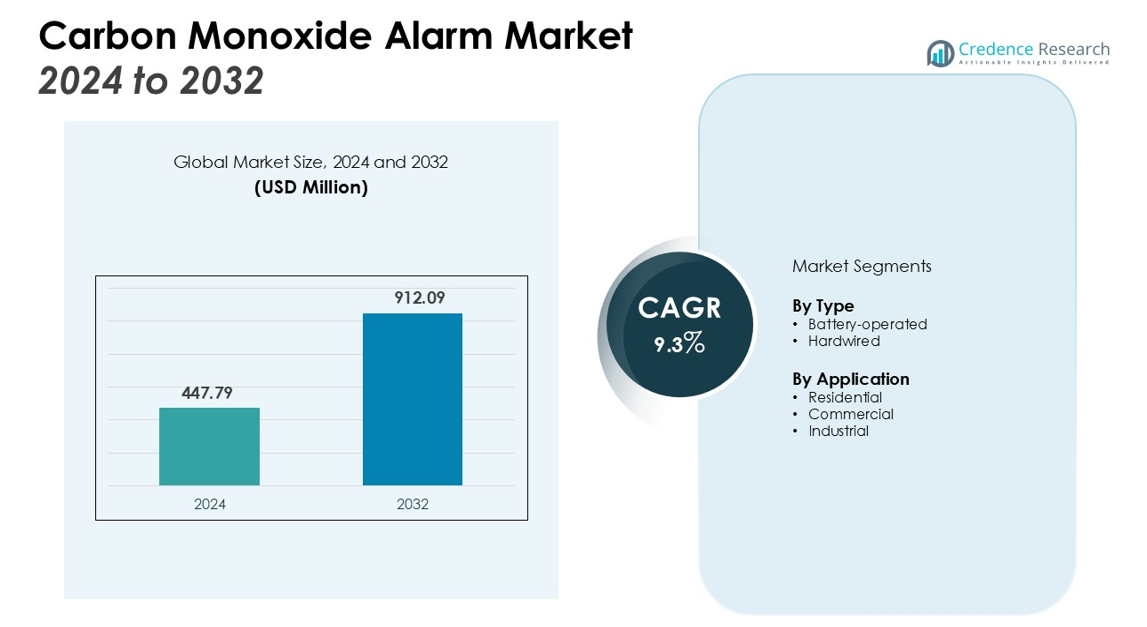
The Carbon Monoxide Alarm Market size was valued at USD 447.79 million in 2024 and is anticipated to reach USD 912.09 million by 2032, at a CAGR of 9.3% during the forecast period (2024-2032).
| REPORT ATTRIBUTE | DETAILS |
|---|---|
| Historical Period | 2020-2023 |
| Base Year | 2024 |
| Forecast Period | 2025-2032 |
| Carbon Monoxide Alarm Market Size 2024 | USD 447.79 million |
| Carbon Monoxide Alarm Market, CAGR | 9.3% |
| Carbon Monoxide Alarm Market Size 2032 | USD 912.09 million |
Key drivers of market growth include stringent government regulations promoting the installation of safety devices in homes and commercial buildings. Growing public awareness about the dangers of carbon monoxide and the increasing prevalence of CO-related incidents are further pushing the demand for reliable alarm systems. Technological innovations, such as integration with smart home systems and IoT connectivity, are also contributing to the market’s expansion, making the alarms more effective and user-friendly.
Regionally, North America holds the largest share of the Carbon Monoxide Alarm Market due to stringent safety standards and widespread adoption of safety devices. The European market is witnessing steady growth, driven by regulations that mandate the installation of CO alarms in residential buildings. The Asia Pacific region is expected to experience the highest growth rate during the forecast period, fueled by rapid urbanization, rising awareness, and the expanding construction industry.
Market Insights:
- The Carbon Monoxide Alarm Market was valued at USD 447.79 million in 2024 and is expected to reach USD 912.09 million by 2032, growing at a CAGR of 9.3%.
- Stringent government regulations and increasing public awareness about CO risks are key drivers for the market’s growth.
- North America holds the largest market share due to strict safety standards and widespread adoption of CO alarms.
- Technological advancements, such as smart home integration and IoT connectivity, are boosting the demand for advanced CO alarm systems.
- High initial costs and ongoing maintenance concerns present challenges for market adoption, particularly in price-sensitive regions.
- Rising awareness about carbon monoxide risks, especially in households with fuel-burning appliances, is driving demand for CO alarms.
- Emerging markets, especially in Asia-Pacific, present significant opportunities due to urbanization, increasing awareness, and rising disposable incomes.
Market Drivers:
Stringent Government Regulations and Safety Standards
The implementation of stringent government regulations significantly drives the growth of the Carbon Monoxide Alarm Market. Many countries have established strict safety standards that mandate the installation of carbon monoxide alarms in residential, commercial, and industrial properties. These regulations are designed to protect residents from the dangers of CO poisoning and have led to the widespread adoption of alarm systems across various sectors. The growing awareness and enforcement of these safety laws ensure a steady demand for high-quality carbon monoxide alarms.
- For instance, in January 2022, the U.S. Department of Housing and Urban Development (HUD) began enforcing a rule requiring the installation of CO alarms in all its public housing units, with the devices needing to meet the UL 2034 standard for safety and performance.
Increasing Incidence of Carbon Monoxide Poisoning
The rising number of carbon monoxide poisoning cases acts as a key driver for the Carbon Monoxide Alarm Market. In many instances, carbon monoxide, a colorless and odorless gas, can cause fatal accidents when it accumulates in poorly ventilated areas. The growing awareness of the risks associated with CO poisoning is prompting individuals and businesses to install alarms to ensure the safety of inhabitants. This rising awareness about the potential hazards of CO has boosted demand for effective and reliable detection systems.
- For instance, Honeywell's 5800 Combo detector utilizes an advanced electrochemical sensor to monitor CO by-products and triggers a built-in 85 dB piezo sounder upon detection, providing a loud and immediate alert to occupants.
Technological Advancements and Integration with Smart Homes
Technological advancements have propelled the growth of the Carbon Monoxide Alarm Market. The integration of carbon monoxide alarms with smart home systems has enhanced the effectiveness and convenience of these devices. Modern alarms now offer features such as remote monitoring, connectivity with smartphones, and integration with other home safety systems. These technological upgrades not only improve user experience but also contribute to increased demand in the residential and commercial sectors.
Growing Awareness of Health and Safety Risks
An increasing focus on health and safety risks plays a pivotal role in the growth of the Carbon Monoxide Alarm Market. Rising consumer awareness about the potential dangers of carbon monoxide, especially in homes with fuel-burning appliances, is pushing demand for detection systems. Public awareness campaigns and media coverage on the dangers of CO exposure are significantly driving consumers to adopt preventive measures, ensuring the continued growth of the market.
Market Trends:
Smart Home Integration and IoT Connectivity in Carbon Monoxide Alarms
The integration of carbon monoxide alarms with smart home technology is one of the leading trends in the market. Consumers are increasingly looking for interconnected home safety systems, and carbon monoxide alarms are being developed with advanced IoT features. These alarms now offer connectivity with smartphones, allowing users to monitor the status of their devices remotely. Real-time alerts and notifications, coupled with remote control features, have enhanced the value proposition of these devices, driving their adoption. As smart homes continue to gain popularity, the demand for carbon monoxide alarms equipped with smart capabilities is expected to rise steadily.
- For instance, the Owl Smart Sensor provides comprehensive monitoring by using its single device to detect 5 different threats, including carbon monoxide, smoke, motion, sound, and changes in temperature or humidity.
Growing Focus on Multi-Functionality and User-Friendly Designs
The demand for multifunctional, user-friendly carbon monoxide alarms is increasing in both residential and commercial sectors. Manufacturers are focusing on creating alarms that serve multiple purposes, such as combining CO detection with smoke or gas detection in a single device. This trend caters to consumers seeking cost-effective solutions without compromising on safety. Additionally, innovations in design have made these alarms more compact and aesthetically pleasing, making them more appealing for installation in various home or office settings. The emphasis on ease of installation and low maintenance further enhances their appeal, especially in new construction projects or home renovations.
- For instance, Honeywell's SD365CO combination detector accurately identifies fire and CO conditions by using four distinct sensing technologies: photoelectric, infrared, heat, and CO. This multi-criteria approach is supported by a CO cell with a 10-year lifespan.
Market Challenges Analysis:
High Initial Cost and Maintenance Concerns
One of the significant challenges facing the Carbon Monoxide Alarm Market is the high initial cost of advanced alarm systems. High-quality CO alarms with integrated features like smart technology or multi-functional capabilities come at a premium, which may deter some consumers, especially in price-sensitive regions. These devices often require regular maintenance, including battery replacements or updates to software, adding to their total cost over time. As a result, cost-conscious consumers may opt for lower-end models that lack advanced functionalities, potentially limiting market growth in certain segments.
Lack of Awareness and Misconceptions About CO Risks
The market also faces challenges due to a lack of awareness and misconceptions about carbon monoxide risks. Many individuals still do not fully understand the dangers of carbon monoxide or the importance of alarm systems in mitigating these risks. Some consumers may underestimate the need for CO detection or may ignore safety standards due to the perceived complexity or cost of installation. This gap in awareness can limit the market's potential, particularly in regions with lower levels of safety regulation enforcement. Efforts to educate the public about CO hazards and the benefits of using alarms will be essential for overcoming this challenge.
Market Opportunities:
Expanding Adoption of Smart Homes and IoT Technology
The growing adoption of smart home technology presents a significant opportunity for the Carbon Monoxide Alarm Market. As more consumers invest in interconnected home automation systems, the demand for smart CO alarms that integrate with other devices is expected to rise. These alarms can provide real-time updates, remote monitoring, and enhanced safety features, making them a valuable addition to smart homes. The trend towards automation and IoT connectivity opens the door for manufacturers to offer more advanced, multifunctional alarm systems, catering to the evolving preferences of tech-savvy consumers.
Increasing Safety Awareness in Developing Regions
Another key opportunity for growth lies in raising safety awareness in developing regions. As urbanization increases and more people move into homes with fuel-based appliances, the risk of carbon monoxide poisoning becomes more prevalent. Educating these populations on the dangers of CO exposure and the importance of installing alarms can drive market growth. Governments in emerging economies are also beginning to implement stricter safety regulations, further increasing the demand for reliable CO alarms. By targeting these regions with tailored marketing campaigns and affordable solutions, companies can tap into a growing market.
Market Segmentation Analysis:
By Type
The market is primarily segmented into battery-operated and hardwired carbon monoxide alarms. Battery-operated alarms dominate the market due to their ease of installation and affordability. These alarms are typically used in residential and commercial spaces, offering flexibility and portability. Hardwired CO alarms are preferred for new construction or renovations, as they are directly connected to the electrical system and provide a continuous power source. Both types are equipped with advanced sensors, but the preference for battery-operated models continues to drive demand in various sectors.
- For instance, First Alert's battery-operated CO400 alarm is equipped with an advanced electrochemical sensor and produces an 85-decibel siren, which is audible at a distance of 10 feet, to alert occupants to the presence of carbon monoxide.
By Application
The application segment includes residential, commercial, and industrial sectors. Residential applications hold the largest market share, driven by increasing awareness of carbon monoxide risks and growing regulatory mandates for CO alarm installations. Commercial applications, particularly in offices, retail spaces, and hospitality, are witnessing growth due to stringent safety regulations and the need to protect employees and customers. The industrial sector, including manufacturing plants and warehouses, is also a key segment, where CO alarms are required to ensure safety in environments that use fuel-based machinery. The demand in these segments is expected to increase as regulations become more stringent and public awareness of safety standards grows.
- For instance, GasDog provides industrial-grade fixed CO detectors that can monitor carbon monoxide concentrations up to 1,000 ppm, ensuring worker safety in high-risk industrial environments.
Segmentations:
By Type
- Battery-operated
- Hardwired
By Application
- Residential
- Commercial
- Industrial
By Region
- North America
- U.S.
- Canada
- Mexico
- Europe
- UK
- France
- Germany
- Italy
- Spain
- Russia
- Rest of Europe
- Asia Pacific
- China
- Japan
- South Korea
- India
- Australia
- Southeast Asia
- Rest of Asia Pacific
- Latin America
- Brazil
- Argentina
- Rest of Latin America
- Middle East
- GCC Countries
- Israel
- Turkey
- Rest of Middle East
- Africa
- South Africa
- Egypt
- Rest of Africa
Regional Analysis:
North America: Market Dominance Driven by Strict Safety Regulations
North America holds the largest share of the Carbon Monoxide Alarm Market, accounting for 40%. The region benefits from strict safety regulations and widespread consumer awareness. In the U.S., nearly 96% of households with fuel-burning appliances are equipped with CO alarms, ensuring high demand. The presence of key manufacturers and robust infrastructure further strengthens market growth. As safety standards continue to evolve, the demand for advanced, smart CO alarms will keep growing.
Europe: Strong Regulatory Support and Growing Awareness
Europe commands a significant portion of the Carbon Monoxide Alarm Market, contributing 30%. The region benefits from stringent regulations and a growing focus on consumer safety. Countries like the UK and Germany have adopted strong CO alarm laws for residential and commercial sectors. Increased consumer education on the dangers of carbon monoxide and the rise of smart home devices have further fueled demand. As regulatory support strengthens, market growth is expected to continue.
Asia-Pacific: Rapid Expansion Due to Urbanization
Asia-Pacific holds a growing share of the Carbon Monoxide Alarm Market, representing 20%. The region's rapid urbanization, increasing construction activities, and rising disposable incomes contribute to this growth. Countries such as China and India are experiencing heightened awareness about carbon monoxide risks, driving demand for CO alarms. With increasing infrastructure development and stricter safety regulations, the market is expected to expand at a robust pace in the coming years.
Key Player Analysis:
- Aico
- First Alert
- Siemens
- BRK Brands
- HOCHIKI Corporation
- Universal Security Instruments, Inc.
- System Sensor Corporation
- FireAngel
- Honeywell International Inc.
- X-Sense
Competitive Analysis:
The Carbon Monoxide Alarm Market is highly competitive, with key players like Honeywell, Kidde, First Alert, and BRK Brands dominating through strong brand recognition, extensive distribution, and continuous innovation. These companies offer a variety of CO alarm products for residential, commercial, and industrial sectors, often integrating advanced technologies such as smart home compatibility and IoT connectivity. Emerging players like X-Sense and Universal Security Instruments are gaining market share by focusing on affordability and ease of use. Technological advancements, such as improved sensor sensitivity and longer lifespans, are essential for differentiating products. Strategic partnerships, like the collaboration between Ring and Kidde, are expanding product offerings and market reach. As the demand for smarter, more integrated safety solutions grows, companies must innovate to meet evolving consumer needs and regulatory requirements, ensuring their position in the market.
Recent Developments:
- In March 2025, First Alert launched a new smart smoke and carbon monoxide alarm designed to integrate with Google Home, positioned as a replacement for the Nest Protect device, retailing at $129.99 with both hardwired and battery-operated options available.
- In April 2025, Siemens acquired Dotmatics, a life sciences R&D software provider, for $5.1 billion, expanding its AI-powered software portfolio in the life sciences sector.
- In June 2024, Hochiki Corporation partnered with Telguard to release the FireNET Comm 5G communicator, a cellular communication solution aimed at replacing traditional telephone line communications.
Report Coverage:
The research report offers an in-depth analysis based on Type, Application and Region. It details leading market players, providing an overview of their business, product offerings, investments, revenue streams, and key applications. Additionally, the report includes insights into the competitive environment, SWOT analysis, current market trends, as well as the primary drivers and constraints. Furthermore, it discusses various factors that have driven market expansion in recent years. The report also explores market dynamics, regulatory scenarios, and technological advancements that are shaping the industry. It assesses the impact of external factors and global economic changes on market growth. Lastly, it provides strategic recommendations for new entrants and established companies to navigate the complexities of the market.
Future Outlook:
- The demand for carbon monoxide alarms is expected to rise as awareness of CO risks continues to grow globally.
- Increasing regulatory pressure, particularly in residential and commercial sectors, will drive widespread adoption of CO alarm systems.
- Smart home integration will play a pivotal role in expanding the market, as consumers seek more interconnected safety solutions.
- Technological advancements will lead to more accurate and sensitive CO detection systems, improving alarm effectiveness.
- The integration of CO alarms with other home safety devices, such as smoke detectors, will become more common.
- The growing trend of DIY home safety installations will boost the demand for battery-operated CO alarms.
- Emerging markets in Asia-Pacific will see significant growth due to rapid urbanization, increasing disposable incomes, and rising safety awareness.
- Consumer preference for multifunctional, easy-to-install, and low-maintenance devices will continue to shape product development.
- Market players will focus on cost-effective solutions to cater to price-sensitive segments, without compromising safety features.
- Partnerships and collaborations between technology companies and safety device manufacturers will enhance product offerings, further expanding the market.

Request a Free Sample
Fill in your details and we'll send you a free sample report.
- Sample data tables & charts
- Research methodology
Market Dynamics
Stringent Government Regulations and Safety Standards
Many countries have implemented strict regulations mandating the installation of carbon monoxide alarms in residential, commercial, and industrial buildings, directly driving market demand as compliance becomes a legal requirement.
Increasing Incidence of Carbon Monoxide Poisoning
Rising awareness of the dangers and increasing cases of carbon monoxide poisoning are prompting both individuals and organizations to invest in reliable CO alarm systems to protect occupants and comply with safety norms.
Technological Advancements and Smart Home Integration
The integration of CO alarms with smart home systems and IoT connectivity is making these devices more effective, user-friendly, and attractive to tech-savvy consumers, thereby expanding the market.
Growing Awareness of Health and Safety Risks
Public education campaigns and media coverage about the risks of carbon monoxide exposure, especially in homes with fuel-burning appliances, are increasing consumer demand for CO alarms as a preventive safety measure.
Expanding Construction and Urbanization in Emerging Markets
Rapid urbanization and growth in the construction sector, particularly in Asia-Pacific, are increasing the number of buildings requiring CO alarms, while rising disposable incomes and regulatory improvements further boost adoption.
Need a Custom Version of This Report?
Tailor the scope, geography, or segments to your exact requirements.
- Custom geography or segment scope
- Direct access to our analyst team
Frequently Asked Questions
What is the current market size for Carbon Monoxide Alarm, and what is its projected size in 2032?
At what Compound Annual Growth Rate is the Carbon Monoxide Alarm market projected to grow between 2024 and 2032?
Which Carbon Monoxide Alarm market segment held the largest share in 2024?
What are the primary factors fueling the growth of the Carbon Monoxide Alarm market?
5Who are the leading companies in the Carbon Monoxide Alarm market?
Table of Content
Chapter 1 Market Segmentation
- 1.1 Segmentation Framework
- 1.1.1 Product and Service Classification
- 1.1.2 Application and End-Use Classification
- 1.1.3 Technology and Solution Classification
- 1.1.4 Customer and Distribution Channel Classification
- 1.1.5 Geographic Segmentation
- 1.1.6 Market Segment Definitions and Boundaries
- 1.2 By Type
- 1.2.1 Battery-operated
- 1.2.2 Hardwired
- 1.3 By Technology
- 1.3.1 Standalone Alarms
- 1.3.2 Smart/Connected Alarms
- 1.3.3 Combination Alarms (CO + Smoke/Gas)
- 1.4 By Application
- 1.4.1 Residential
- 1.4.2 Commercial
- 1.4.3 Industrial
Chapter 2 Introduction
- 2.1 Report Objectives and Scope
- 2.2 Product Definition and Industry Terminology
- 2.3 Market Inclusions and Exclusions
- 2.4 Research Process
- 2.4.1 Primary Research and Expert Interviews
- 2.4.2 Secondary Research and Source Review
- 2.4.3 Top-Down and Bottom-Up Estimation
- 2.4.4 Data Triangulation and Verification
- 2.5 Market Size Measurement Basis
- 2.5.1 2024: USD 447.79 million → 2032: USD 912.09 million
- 2.6 Historical and Forecast Reference Periods
- 2.6.1 Base Year: 2024
- 2.6.2 Forecast Period: 2024-2032
- 2.7 Research Assumptions and Limitations
Chapter 3 Executive Summary
- 3.1 Market Snapshot and Key Findings
- 3.2 Base-Year Market Size, 2024
- 3.3 Forecast Market Size, 2032
- 3.4 Revenue and Volume Growth Outlook
- 3.5 Key Demand and Supply Indicators
- 3.6 Leading Market Segments
- 3.7 Fastest-Growing Market Opportunities
- 3.8 Regional Performance Highlights
- 3.9 Technology and Industry Transformation
- 3.10 Competitive Landscape Summary
- 3.11 Analyst View and Strategic Implications
Chapter 4 Global Carbon Monoxide Alarm Market Trends and Developments
- 4.1 Historical Industry Development
- 4.2 Recent Market Trends and Developments
- 4.3 Demand and Customer Behavior Trends
- 4.4 Technology and Product Innovation
- 4.5 Artificial Intelligence, Automation and Digitalization
- 4.6 Local Manufacturing and Supply Chain Realignment
- 4.7 Industry Partnerships, Mergers and Acquisitions
- 4.8 Sustainability and Circular Economy Developments
- 4.9 Government and Private Sector Investment Trends
- 4.10 Emerging Business Models and Commercialization
- 4.11 Industry Developments and Announcements
Chapter 5 Global Carbon Monoxide Alarm Market Production, Supply and Demand Analysis
- 5.1 Demand Trend and Consumption Analysis
- 5.2 Demand Forecast, 2024-2032
- 5.3 Production and Output Trend
- 5.4 Production and Output Forecast, 2024-2032
- 5.5 Installed Capacity and Capacity Utilization
- 5.6 Company-Wise Production Plants and Statistics
- 5.6.1 Installed Production Capacity
- 5.6.2 Actual Production
- 5.6.3 Planned Capacity and Expansion Targets
- 5.7 Supply Chain Structure and Procurement Trends
- 5.8 Supply-Demand Gap and Bottlenecks
- 5.9 Import Dependence and Sourcing Structure
- 5.10 Contract Manufacturing and Outsourcing
- 5.11 Regional Supply and Demand Concentration
Chapter 6 Global Carbon Monoxide Alarm Market Pricing Analysis
- 6.1 Pricing Structure and Measurement
- 6.2 Historical Pricing Trends
- 6.3 Pricing Outlook, 2024-2032
- 6.4 Average Selling Price and Unit Economics
- 6.5 Pricing by Product and Market Segment
- 6.6 Geographic Pricing Differences
- 6.7 Key Input, Energy, Labor and Logistics Costs
- 6.8 Contract Pricing and Purchasing Models
- 6.9 Pricing Sensitivity and Competitive Positioning
- 6.10 Price, Margin and Profitability Implications
Chapter 7 Global Carbon Monoxide Alarm Market Dynamics
- 7.1 Market Growth Drivers
- 7.1.1 Demand-Side Drivers
- 7.1.2 Technology and Innovation Drivers
- 7.1.3 Infrastructure and Investment Drivers
- 7.1.4 Regulatory and Policy Drivers
- 7.2 Market Restraints
- 7.2.1 Cost and Affordability Constraints
- 7.2.2 Technology and Adoption Barriers
- 7.2.3 Supply Chain and Operational Constraints
- 7.3 Market Challenges
- 7.3.1 Competitive Pressure and Margin Erosion
- 7.3.2 Skills, Infrastructure and Implementation Gaps
- 7.4 Emerging Market Opportunities
- 7.5 Market Dynamics Impact and Time-Horizon Assessment
Chapter 8 Global Carbon Monoxide Alarm Value Chain Analysis
- 8.1 Industry Value Chain Overview
- 8.2 Upstream Suppliers and Critical Inputs
- 8.3 Technology and Component Providers
- 8.4 Manufacturing or Service Delivery
- 8.5 Distribution, Channel Partners and Integrators
- 8.6 Downstream Applications and End Users
- 8.7 Value Addition and Profit Pools
- 8.8 Vertical Integration and Outsourcing
- 8.9 Supplier Concentration and Risk
- 8.10 Supply Chain Localization and Resilience
Chapter 9 Global Carbon Monoxide Alarm Market Regulations and Policies
- 9.1 Relevant Laws, Standards and Compliance Frameworks
- 9.2 Product, Service, Safety and Quality Requirements
- 9.3 Government Policies, Incentives and Subsidies
- 9.4 Imports, Exports and Trade Barriers
- 9.5 Public Procurement and Local Content Requirements
- 9.6 Environmental and Sustainability Compliance
- 9.7 Data Protection, AI and Cybersecurity Compliance
- 9.8 Upcoming Policy Changes and Market Implications
Chapter 10 Global Carbon Monoxide Alarm Market Hotspots and Opportunities
- 10.1 Market Opportunity Mapping and Growth Hotspots
- 10.2 High-Growth Applications and Customer Groups
- 10.3 Underserved Markets and White-Space Opportunities
- 10.4 Emerging Technology and Product Opportunities
- 10.5 New Capacity and Investment Hotspots
- 10.6 Market Entry and Expansion Opportunities
- 10.7 Distribution and Partnership Opportunities
- 10.8 Near-Term and Long-Term Commercial Potential
- 10.9 Opportunity Attractiveness and Execution Risks
Chapter 11 Global Carbon Monoxide Alarm Market Outlook, 2024-2032
- 11.1 Market Size and Analysis
- 11.1.1 Revenue (Market Measurement: 2024: USD 447.79 million → 2032: USD 912.09 million)
- 11.1.2 Market Volume and Quantity Sold
- 11.1.3 Historical Market Size
- 11.1.4 Base-Year Market Size, 2024
- 11.2 Market Forecast, 2024-2032
- 11.2.1 Revenue Forecast to 2032
- 11.2.2 Volume Forecast to 2032
- 11.2.3 CAGR and Year-on-Year Growth
- 11.2.4 Incremental Revenue Opportunity
- 11.3 Forecast Assumptions and Scenario Analysis
- 11.3.1 Base-Case Forecast
- 11.3.2 Optimistic and Conservative Scenarios
- 11.3.3 Technology, Pricing and Policy Sensitivities
- 11.4 Market Attractiveness and Growth Outlook
Chapter 12 Global Carbon Monoxide Alarm Market Segmentation and Outlook
- 12.1 Segmentation Summary and Market Shares, 2024
- 12.2 Largest and Fastest-Growing Segments
- 12.3 By Type - Market Size and Forecast, 2024-2032
- 12.3.1 Segment Definition and Scope
- 12.3.2 Historical Market Size
- 12.3.3 Revenue Forecast, 2024-2032
- 12.3.4 Volume Forecast, 2024-2032
- 12.3.5 Base-Year Market Share, 2024
- 12.3.6 Segment CAGR and Growth Drivers
- 12.3.7 Subsegment Market Size and Forecast
- 12.3.7.1 Battery-operated
- 12.3.7.2 Hardwired
- 12.3.8 Subsegment Pricing and Adoption Trends
- 12.3.9 Leading Suppliers and Competition
- 12.3.10 Regional Demand and Opportunities
- 12.4 By Technology - Market Size and Forecast, 2024-2032
- 12.4.1 Segment Definition and Scope
- 12.4.2 Historical Market Size
- 12.4.3 Revenue Forecast, 2024-2032
- 12.4.4 Volume Forecast, 2024-2032
- 12.4.5 Base-Year Market Share, 2024
- 12.4.6 Segment CAGR and Growth Drivers
- 12.4.7 Subsegment Market Size and Forecast
- 12.4.7.1 Standalone Alarms
- 12.4.7.2 Smart/Connected Alarms
- 12.4.7.3 Combination Alarms (CO + Smoke/Gas)
- 12.4.8 Subsegment Pricing and Adoption Trends
- 12.4.9 Leading Suppliers and Competition
- 12.4.10 Regional Demand and Opportunities
- 12.5 By Application - Market Size and Forecast, 2024-2032
- 12.5.1 Segment Definition and Scope
- 12.5.2 Historical Market Size
- 12.5.3 Revenue Forecast, 2024-2032
- 12.5.4 Volume Forecast, 2024-2032
- 12.5.5 Base-Year Market Share, 2024
- 12.5.6 Segment CAGR and Growth Drivers
- 12.5.7 Subsegment Market Size and Forecast
- 12.5.7.1 Residential
- 12.5.7.2 Commercial
- 12.5.7.3 Industrial
- 12.5.8 Subsegment Pricing and Adoption Trends
- 12.5.9 Leading Suppliers and Competition
- 12.5.10 Regional Demand and Opportunities
- 12.6 Segment Growth Comparison
- 12.7 Segment Attractiveness and Priority Matrix
Chapter 13 Global Carbon Monoxide Alarm End-Use and Application Market Outlook
- 13.1 End-Use Industry and Customer Demand Structure
- 13.2 Leading Applications and Customer Groups
- 13.3 End-Use Market Size, Share and Forecast
- 13.4 Major End-Use Industry Deep Dives
- 13.4.1 Customer Requirements and Use Cases
- 13.4.2 Demand and Replacement Cycles
- 13.4.3 Technical and Regulatory Considerations
- 13.4.4 Purchasing and Procurement Models
- 13.4.5 Leading Vendors and Distribution Channels
- 13.4.6 Forecast and Commercial Opportunities
- 13.5 Emerging Applications and Cross-Segment Demand
- 13.6 End-Use Industry Investment Priorities
Chapter 14 Global Carbon Monoxide Alarm Geographic Market Outlook, 2024-2032
- 14.1 Regional Market Size and Share, 2024
- 14.2 Regional Market Forecast, 2024-2032
- 14.3 Regional Pricing, Production and Demand Differences
- 14.4 North America
- 14.4.1 United States
- 14.4.2 Canada
- 14.4.3 Mexico
- 14.5 Europe
- 14.5.1 Germany
- 14.5.2 France
- 14.5.3 Italy
- 14.5.4 United Kingdom
- 14.5.5 Spain
- 14.5.6 Poland
- 14.5.7 Russia
- 14.5.8 Netherlands
- 14.5.9 Belgium
- 14.5.10 Sweden
- 14.5.11 Denmark
- 14.5.12 Norway
- 14.5.13 Rest of Europe
- 14.6 Asia Pacific
- 14.6.1 China
- 14.6.2 India
- 14.6.3 Japan
- 14.6.4 South Korea
- 14.6.5 Thailand
- 14.6.6 Indonesia
- 14.6.7 Vietnam
- 14.6.8 Malaysia
- 14.6.9 Australia
- 14.6.10 Rest of Asia Pacific
- 14.7 Latin America
- 14.7.1 Brazil
- 14.7.2 Argentina
- 14.7.3 Colombia
- 14.7.4 Chile
- 14.7.5 Rest of Latin America
- 14.8 Middle East
- 14.8.1 Saudi Arabia
- 14.8.2 United Arab Emirates
- 14.8.3 Turkey
- 14.8.4 Israel
- 14.8.5 Iran
- 14.8.6 Rest of the Middle East
- 14.9 Africa
- 14.9.1 South Africa
- 14.9.2 Egypt
- 14.9.3 Nigeria
- 14.9.4 Morocco
- 14.9.5 Rest of Africa
- 14.10 Regional Investment, Policy and Supply Chain Differences
- 14.11 Regional Competitive Landscape
- 14.12 Geographic Growth Hotspots
Chapter 15 Global Carbon Monoxide Alarm Technology, Innovation and Sustainability Outlook
- 15.1 Technology Landscape and Maturity
- 15.2 Product, Process and Service Innovation
- 15.3 AI, Automation and Digital Tools in the Industry
- 15.4 Technology Adoption and Performance Benchmarking
- 15.5 Innovation Pipeline and R&D Investment
- 15.6 Patent and Intellectual Property Trends
- 15.7 Energy Efficiency and Resource Management
- 15.8 Sustainability, Recycling and Circularity
- 15.9 Technology Roadmap, 2024-2032
- 15.10 Risks of Obsolescence and Technology Substitution
Chapter 16 Global Carbon Monoxide Alarm Market Key Strategic Imperatives
- 16.1 Growth and Market Entry Priorities
- 16.2 High-Return Products and Segments
- 16.3 Pricing, Profitability and Cost Optimization
- 16.4 Technology Investment and Product Differentiation
- 16.5 Supply Chain Localization and Resilience
- 16.6 Distribution and Customer Acquisition
- 16.7 Partnership, Acquisition and Capacity Strategy
- 16.8 Regional Expansion Priorities
- 16.9 Short-, Medium- and Long-Term Actions
Chapter 17 Competition Outlook
- 17.1 Industry Competition Characteristics
- 17.2 Market Structure and Concentration
- 17.3 Market Share and Competitive Positioning, 2024
- 17.4 Company-Wise Revenue and Product Benchmarking
- 17.5 Production and Service Capacity Benchmarking
- 17.6 Technology, Pricing and Differentiation
- 17.7 Regional Footprint and Distribution Strength
- 17.8 Mergers, Acquisitions and Strategic Alliances
- 17.9 New Entrants and Competitive Threats
- 17.10 Porter's Five Forces and Industry Attractiveness
- 17.11 Competitive Outlook, 2024-2032
Chapter 18 Company Profiles
- 18.1 Company Coverage and Selection Criteria
- 18.2 Honeywell International Inc.
- 18.2.1 Business Description
- 18.2.2 Company Ownership and Geographic Presence
- 18.2.3 Product and Service Portfolio
- 18.2.4 Manufacturing and Operating Footprint
- 18.2.5 Production Capacity and Expansion Plans
- 18.2.6 Financial Performance and Investment
- 18.2.7 Market Share and Competitive Position
- 18.2.8 Technology and Innovation Capabilities
- 18.2.9 Strategic Alliances or Partnerships
- 18.2.10 Recent Developments
- 18.2.11 Growth Strategy and Outlook
- 18.3 First Alert
- 18.4 BRK Brands
- 18.5 Aico
- 18.6 Siemens
- 18.7 HOCHIKI Corporation
- 18.8 Universal Security Instruments, Inc.
- 18.9 System Sensor Corporation
- 18.10 FireAngel
- 18.11 X-Sense
- 18.12 Other Relevant Market Participants
Note: Every listed company is profiled on the structure shown under the first company. The company list is preliminary and may change based on research findings, market developments, data availability and client requirements.
Chapter 19 Disclaimer
- 19.1 Research and Forecast Disclaimer
- 19.2 Data Source and Estimation Limitations
Note: The depth of individual sections depends on data availability for this market. Volume, capacity, trade and other unit-based metrics are included where applicable.

