
Market Overview:
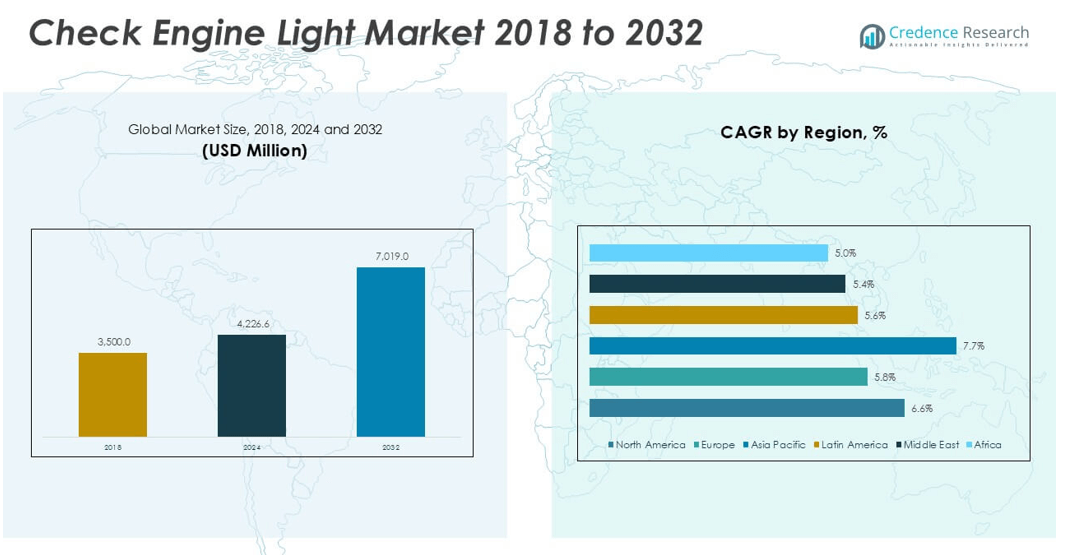
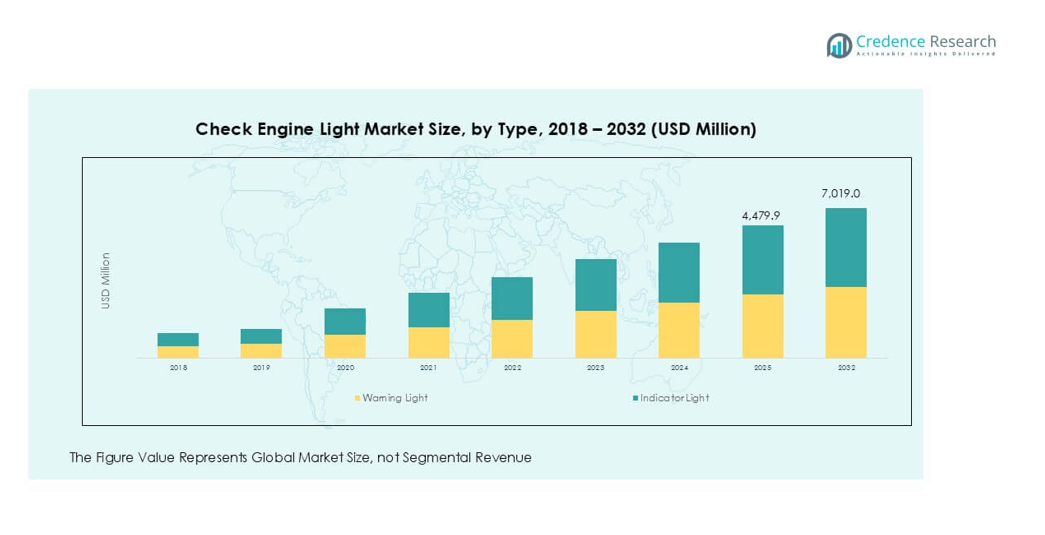
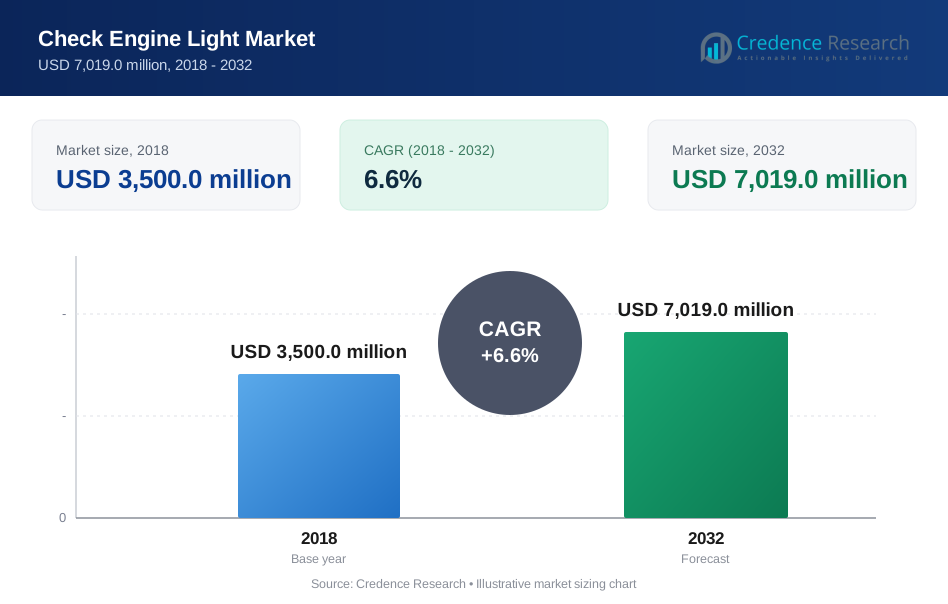
The Global Check Engine Light Market size was valued at USD 3,500.0 million in 2018 to USD 4,226.6 million in 2024 and is anticipated to reach USD 7,019.0 million by 2032, at a CAGR of 6.6% during the forecast period.
| REPORT ATTRIBUTE | DETAILS |
|---|---|
| Historical Period | 2020-2023 |
| Base Year | 2024 |
| Forecast Period | 2025-2032 |
| Check Engine Light Market Size 2024 | USD 4,226.6 million |
| Check Engine Light Market, CAGR | 6.6% |
| Check Engine Light Market Size 2032 | USD 7,019.0 million |
The key drivers of market expansion include growing awareness about the importance of vehicle health monitoring, increasing vehicle ownership, and the integration of sophisticated electronic systems in modern vehicles. Moreover, the rising demand for vehicle diagnostics among consumers and fleet operators is fostering the growth of the CEL market. Technological advancements such as the incorporation of real-time monitoring and predictive diagnostics are also contributing to the market’s growth. The growing trend of electric vehicles (EVs) and their unique diagnostic needs is also expected to further fuel the demand for check engine light systems, especially in North America and Europe.
Regionally, North America holds the largest market share due to the high vehicle ownership rate and stringent emission regulations in countries like the U.S. Europe also contributes significantly to the CEL market, driven by government mandates on emission standards and increased vehicle inspections. The Asia-Pacific region is expected to witness the highest growth rate, supported by the rising automotive production and increasing vehicle fleet in countries like China and India. Additionally, the rapid adoption of connected and autonomous vehicles in the region will further boost the demand for advanced diagnostic systems.
Market Insights:
- The Global Check Engine Light Market was valued at USD 3,500 million in 2018, expected to reach USD 7,019 million by 2032, growing at a CAGR of 6.6%.
- Real-time monitoring and predictive diagnostics are driving the demand for advanced check engine light systems in modern vehicles.
- Increasing vehicle ownership, especially in North America and Europe, is significantly boosting the demand for vehicle health monitoring tools.
- Stricter environmental regulations around vehicle emissions are propelling the need for advanced diagnostics systems in North America and Europe.
- The growing adoption of electric and hybrid vehicles is fueling the demand for specialized diagnostic tools for these vehicles.
- North America holds the largest market share, while the Asia-Pacific region is expected to experience the highest growth rate due to expanding automotive production.
- Rising consumer awareness and expanding aftermarket services are driving the adoption of advanced check engine light systems, particularly in emerging markets.
Market Drivers:
Increasing Vehicle Ownership and Demand for Diagnostics
The growing number of vehicles on the road directly drives the demand for vehicle health monitoring systems like the Global Check Engine Light (CEL) market. More vehicles require regular maintenance and diagnostics, fostering a need for efficient and accurate monitoring. This trend is particularly prominent in regions with high vehicle ownership, such as North America and Europe. Consumers and fleet operators alike seek solutions that enable early detection of engine issues, thus reducing maintenance costs and improving vehicle performance.
- For instance, Bosch is a leader in this area, having produced over 23 billion Micro-Electro-Mechanical Systems (MEMS) sensors that are fundamental to modern vehicle diagnostics.
Technological Advancements in Vehicle Electronics
Technological progress in automotive electronics has played a crucial role in expanding the Global Check Engine Light market. Modern vehicles now incorporate sophisticated sensors and onboard diagnostic systems that can detect a wide range of issues in real time. These advancements allow for predictive diagnostics, helping users address potential engine problems before they lead to significant breakdowns. As vehicles become more electronically integrated, the demand for reliable diagnostic tools increases.
Rising Environmental Regulations and Emission Standards
Governments worldwide are enforcing stricter emission regulations and environmental standards. These regulations drive the adoption of diagnostic tools that help vehicles comply with legal requirements. The Global Check Engine Light market benefits from this shift as manufacturers and vehicle owners adopt solutions that monitor engine performance and emissions. Stricter vehicle inspection protocols, especially in North America and Europe, further propel the need for comprehensive diagnostic systems.
- For instance, modern diagnostic testers like the Bosch KTS 350 feature a built-in Ethernet interface that achieves data transfer speeds up to 100 times faster than previous CAN technology.
Shift Toward Electric and Hybrid Vehicles
The growing adoption of electric and hybrid vehicles also contributes to the market’s growth. These vehicles rely on complex electrical systems that require specialized diagnostics, which further fuels the demand for check engine lights and diagnostic tools. The shift to these eco-friendly vehicles requires advanced monitoring capabilities, leading to the development and expansion of new technologies in the CEL market.
Market Trends:
Integration of Advanced Diagnostics and Real-Time Monitoring
One significant trend in the Global Check Engine Light market is the increasing integration of advanced diagnostics systems that provide real-time monitoring. Modern vehicles are equipped with sensors and onboard diagnostic tools that offer continuous health assessments, allowing for early detection of potential engine issues. These technologies help drivers and fleet operators address problems before they escalate, reducing downtime and maintenance costs. The growing demand for real-time monitoring systems is also fueling the development of more sophisticated check engine light solutions, which enhance the overall performance and longevity of vehicles. Consumers are increasingly looking for systems that provide detailed insights into vehicle health, driving the adoption of such technologies.
- For instance, Bosch's ADS 525X diagnostic scan tool can perform an all-systems DTC (Diagnostic Trouble Code) scan in under 60 seconds on average, with some vehicles taking 30 seconds or less. This provides ultra-fast and comprehensive real-time DTC diagnostics.
Growth of Electric and Autonomous Vehicles Impacting CEL Market
The rise of electric and autonomous vehicles is another key trend shaping the Global Check Engine Light market. These vehicles require unique diagnostic solutions to monitor their complex electrical and autonomous systems. As the automotive industry shifts towards more eco-friendly and technologically advanced vehicles, the demand for specialized diagnostic tools grows. Electric vehicles, in particular, rely heavily on battery management systems and powertrains, requiring precise monitoring and diagnostics. Autonomous vehicles, with their reliance on artificial intelligence and advanced sensors, demand highly specialized systems for maintaining vehicle health. These developments are pushing the CEL market to adapt and innovate to meet the unique needs of electric and autonomous vehicles.
- For instance, Tesla's battery management system is engineered to handle complex thermal and electrical interactions, managing charge rates of up to 250 kW during V3 Supercharging while maintaining precise voltage and temperature control.
Market Challenges Analysis:
Complexity of Modern Vehicle Systems
One of the major challenges facing the Global Check Engine Light market is the increasing complexity of modern vehicle systems. As vehicles become more technologically advanced, they incorporate a growing number of sensors, control units, and electronic components. This complexity makes it more difficult to create universal diagnostic tools that can efficiently cover all systems. The need for specialized check engine light solutions for different vehicle types, including electric and autonomous vehicles, is increasing. Manufacturers must continuously update and adapt their technologies to keep up with these evolving automotive innovations.
Compatibility and Standardization Issues
Another challenge for the Global Check Engine Light market is the lack of standardization across different vehicle models and manufacturers. Many vehicles have proprietary diagnostic systems, making it difficult for check engine lights and diagnostic tools to provide consistent performance across various brands. This lack of compatibility increases costs for both vehicle owners and service providers, who must invest in multiple diagnostic tools to cover a wide range of vehicles. The absence of standardized protocols complicates the development of universally applicable diagnostic solutions, limiting the growth potential of the CEL market.
Market Opportunities:
Growing Demand for Electric and Hybrid Vehicles
The rise of electric and hybrid vehicles presents significant opportunities for the Global Check Engine Light market. These vehicles rely on complex electrical systems and batteries, which require specialized diagnostics tools for effective maintenance and performance monitoring. As the adoption of electric vehicles continues to increase, there will be a growing need for advanced check engine lights that can monitor these unique systems. Manufacturers have the opportunity to develop specialized diagnostic solutions tailored to electric and hybrid vehicles, creating new revenue streams and expanding the market.
Advancements in Diagnostic Technology and AI Integration
Another opportunity for growth in the Global Check Engine Light market lies in the integration of artificial intelligence (AI) and machine learning technologies. These advancements can enable more accurate and predictive diagnostics, providing vehicle owners and service providers with deeper insights into engine health. By incorporating AI, diagnostic systems can identify patterns and predict potential failures before they occur, enhancing vehicle reliability and reducing maintenance costs. The increasing demand for AI-powered diagnostics solutions creates a significant market opportunity for companies to innovate and lead in the evolving automotive landscape.
Market Segmentation Analysis:
By Type:
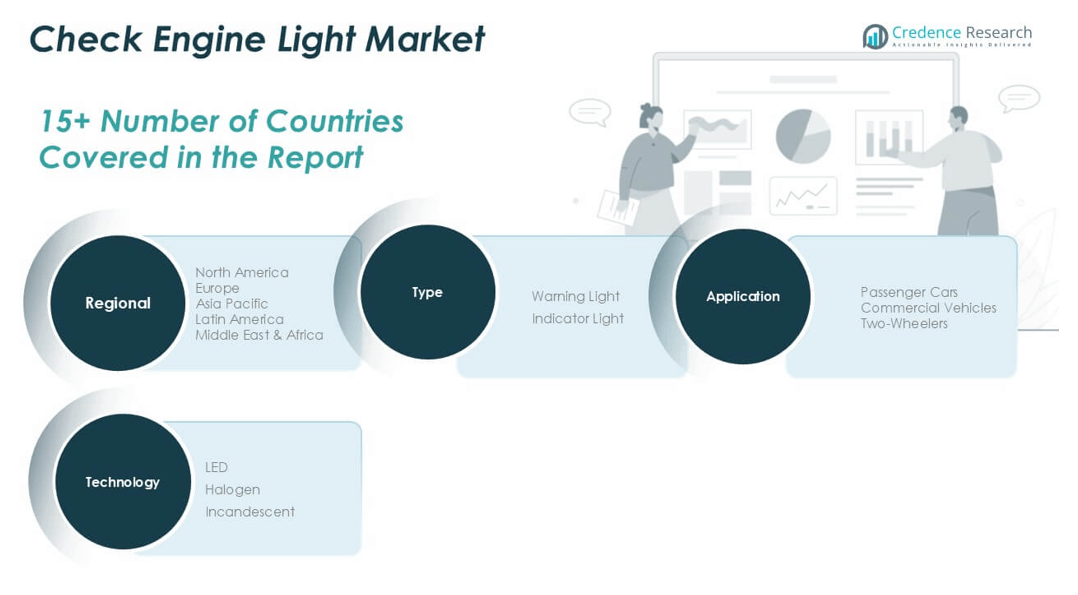
The global check engine light market is primarily segmented into intermittent and continuous types. Intermittent check engine lights indicate minor engine issues that can be resolved promptly, whereas continuous check engine lights signal more severe problems requiring immediate attention. Intermittent lights dominate the market due to their widespread use in passenger vehicles and commercial fleets. Continuous lights are gaining traction as they offer advanced diagnostics, aligning with the increasing demand for precision in vehicle maintenance.
- For instance, BMW's On-Board Diagnostics (OBD) system can register the specific trouble code P0456, which indicates a very small leak in the fuel vapor system, allowing a technician to address a minor issue that might only trigger the light intermittently.
By Application:
The market is divided into passenger cars, commercial vehicles, and two-wheelers. Passenger cars hold the largest share, driven by high production volumes and consumer demand for advanced vehicle diagnostics. Commercial vehicles follow, with a growing emphasis on fleet management and maintenance efficiency. Two-wheelers are emerging as a significant segment, particularly in regions with high motorcycle usage, where compact and cost-effective diagnostic solutions are sought.
- For instance, the ANCEL X6 diagnostic scanner enhances the service of passenger cars like those from Ford by providing access to a database containing thousands of manufacturer-specific trouble codes, enabling precise identification of faults beyond generic OBD2 readings.
By Technology:
Technological advancements have led to the development of LED, halogen, and incandescent check engine lights. LED lights are gaining popularity due to their energy efficiency, longer lifespan, and faster response times. Halogen lights remain prevalent in cost-sensitive applications, offering a balance between performance and affordability. Incandescent lights are less common but still utilized in older vehicle models due to their simplicity and low cost. The shift towards LED technology is evident, reflecting the broader trend of adopting energy-efficient solutions in automotive lighting.
Segmentations:
By Type
- Warning Light
- Indicator Light
- Passenger Cars
- Commercial Vehicles
- Two-Wheelers
- LED
- Halogen
- Incandescent
- North America
- U.S.
- Canada
- Mexico
- Europe
- UK
- France
- Germany
- Italy
- Spain
- Russia
- Belgium
- Netherlands
- Austria
- Sweden
- Poland
- Denmark
- Switzerland
- Rest of Europe
- Asia Pacific
- China
- Japan
- South Korea
- India
- Australia
- Thailand
- Indonesia
- Vietnam
- Malaysia
- Philippines
- Taiwan
- Rest of Asia Pacific
- Latin America
- Brazil
- Argentina
- Peru
- Chile
- Colombia
- Rest of Latin America
- Middle East
- UAE
- KSA
- Israel
- Turkey
- Iran
- Rest of Middle East
- Africa
- Egypt
- Nigeria
- Algeria
- Morocco
- Rest of Africa
Regional Analysis:
North America Check Engine Light Market
The North America Check Engine Light market size was valued at USD 1,176 million in 2018 to USD 1,401.5 million in 2024 and is anticipated to reach USD 2,323.5 million by 2032, at a CAGR of 6.6% during the forecast period. North America holds the largest market share in the Global Check Engine Light market, driven by the high vehicle ownership rate and the presence of stringent emission regulations in the U.S. The region benefits from a well-established automotive industry and a strong demand for advanced vehicle diagnostics solutions. The increasing adoption of electric vehicles (EVs) and hybrid models also supports market growth, as these vehicles require specialized check engine light systems. The rapid technological advancements in automotive electronics further contribute to the region’s dominance, with manufacturers focusing on improving vehicle health monitoring and predictive diagnostics. A robust aftermarket service network and consumer awareness of vehicle maintenance needs strengthen the market's position in North America.
Europe Check Engine Light Market
The Europe Check Engine Light market size was valued at USD 878.5 million in 2018 to USD 1,017.6 million in 2024 and is anticipated to reach USD 1,591.6 million by 2032, at a CAGR of 5.8% during the forecast period. Europe accounts for a significant share of the Global Check Engine Light market due to the stringent emission standards enforced across the region. The market is bolstered by high consumer awareness of vehicle maintenance, as well as increasing regulatory pressures related to environmental sustainability. The demand for advanced diagnostic tools that can monitor complex engine and emissions systems is driving market growth, especially in countries like Germany and France. The rise of electric and hybrid vehicles, which require specialized diagnostics, further contributes to market expansion. Europe’s automotive innovation and focus on emission compliance create substantial opportunities for the CEL market to thrive.
Asia Pacific Check Engine Light Market
The Asia Pacific Check Engine Light market size was valued at USD 995.8 million in 2018 to USD 1,248.3 million in 2024 and is anticipated to reach USD 2,252.6 million by 2032, at a CAGR of 7.7% during the forecast period. The Asia Pacific region is expected to witness the highest growth in the Global Check Engine Light market. The rapid expansion of automotive production in countries such as China, India, and Japan, coupled with an increasing vehicle fleet, significantly drives the demand for advanced diagnostic tools. Growing environmental awareness and stringent government regulations around vehicle emissions and safety are also contributing factors. The rise of electric vehicles and the increasing focus on vehicle health monitoring across the region add to the market’s growth potential. As automotive technology continues to evolve, the demand for high-performance check engine light systems is expected to increase steadily, further strengthening the market in Asia Pacific.
Latin America Check Engine Light Market
The Latin America Check Engine Light market size was valued at USD 217 million in 2018 to USD 259.5 million in 2024 and is anticipated to reach USD 399.2 million by 2032, at a CAGR of 5.6% during the forecast period. Latin America is witnessing steady growth in the Global Check Engine Light market due to the growing automotive industry, especially in Brazil and Mexico. The rising number of vehicle registrations and increasing urbanization in the region are key drivers of demand for vehicle health monitoring systems. Moreover, the market benefits from expanding aftermarket service networks, which cater to the increasing vehicle fleet in the region. Regulatory changes aimed at reducing emissions and improving vehicle performance also contribute to market growth. While the adoption of electric vehicles is still in its early stages, it is expected to accelerate, further driving the need for specialized diagnostic systems in the coming years.
Middle East Check Engine Light Market
The Middle East Check Engine Light market size was valued at USD 143.5 million in 2018 to USD 163.1 million in 2024 and is anticipated to reach USD 246.4 million by 2032, at a CAGR of 5.4% during the forecast period. The Middle East market for check engine lights is growing steadily, driven by the increasing vehicle ownership in the region and the demand for better vehicle diagnostics. The adoption of advanced vehicle technologies and the need for compliance with emissions standards, especially in countries like the UAE and Saudi Arabia, are also boosting the market. Additionally, the growing preference for luxury vehicles and the expanding number of vehicles in service contribute to the market's growth. As the region's automotive sector continues to evolve, the demand for effective vehicle health monitoring solutions is expected to rise.
Africa Check Engine Light Market
The Africa Check Engine Light market size was valued at USD 89.2 million in 2018 to USD 136.5 million in 2024 and is anticipated to reach USD 205.7 million by 2032, at a CAGR of 5.0% during the forecast period. The Africa Check Engine Light market is experiencing gradual growth due to increasing vehicle ownership and the growing automotive sector in key countries such as South Africa, Nigeria, and Egypt. The demand for vehicle health monitoring systems is rising as vehicle fleets expand across the region. However, challenges related to infrastructure and consumer awareness may slow the growth rate in certain markets. Despite these challenges, the market presents significant growth opportunities, particularly with the rise of mobile diagnostics and the growing focus on vehicle maintenance and safety. The increased adoption of vehicles equipped with advanced diagnostic systems, along with rising concerns about environmental impact, is expected to support the market's growth over the forecast period.
Key Player Analysis:
- Bosch
- Denso Corporation
- General Motors
- Ford Motor Company
- Toyota Industries
- Valeo
- Hella
- Continental AG
- Magneti Marelli
- Aisin Seiki Co. Ltd.
- Nippon Seiki Co. Ltd.
Competitive Analysis:
The global check engine light market is highly competitive, with key players such as OSRAM, Hella, Yeolight Technology, and Magneti Marelli leading the industry. These companies focus on product innovation, strategic partnerships, and expanding their market presence to meet the increasing demand for advanced automotive lighting solutions. North America dominates the market, driven by strong automotive manufacturing and technological advancements, while Europe and Asia Pacific also contribute significantly, with tailored products for regional preferences. The competitive strategies of these firms emphasize improving product performance, energy efficiency, and meeting evolving environmental regulations. Through continuous research and development, these players enhance their offerings, fostering sustained growth in the market.
Recent Developments:
- In January 2025, the SAIC-GM joint venture announced its plan to launch a next-generation integrated vehicle architecture in China China, which will support various powertrains such as BEV, PHEV, and REEV systems.
- In April 2025, Denso established a strategic partnership with Horizon Robotics to produce advanced integrated driving assistance solutions for the Chinese market.
- In June 2025, Bosch Power Tools announced the launch of more than 15 new products, including an 18V medium crown construction stapler and an 18V hammer drill/driver.
Report Coverage:
The research report offers an in-depth analysis based on Type, Application, Technology and Region. It details leading market players, providing an overview of their business, product offerings, investments, revenue streams, and key applications. Additionally, the report includes insights into the competitive environment, SWOT analysis, current market trends, as well as the primary drivers and constraints. Furthermore, it discusses various factors that have driven market expansion in recent years. The report also explores market dynamics, regulatory scenarios, and technological advancements that are shaping the industry. It assesses the impact of external factors and global economic changes on market growth. Lastly, it provides strategic recommendations for new entrants and established companies to navigate the complexities of the market.
Future Outlook:
- The global check engine light market is expected to see continued innovation with more advanced diagnostic features.
- LED technology will increasingly dominate due to its energy efficiency, longer lifespan, and faster response times.
- Growing consumer demand for smart and automated vehicle maintenance solutions will drive market growth.
- The rise in connected vehicles and IoT integration will lead to more sophisticated engine monitoring systems.
- The expansion of electric and hybrid vehicles will introduce new opportunities for check engine light applications.
- Regulatory pressures for improved vehicle safety and emission control will encourage the adoption of advanced check engine light technologies.
- Increased vehicle production in emerging markets, particularly in Asia Pacific, will boost market demand.
- Fleet management solutions will lead to more widespread use of check engine lights in commercial vehicles.
- Technological advancements in the automotive sector, such as AI and machine learning, will improve the accuracy of diagnostics.
- Manufacturers will focus on developing cost-effective yet high-performance solutions to cater to both premium and budget vehicles.
Request a Free Sample
Fill in your details and we'll send you a free sample report.
- Sample data tables & charts
- Research methodology
Need a Custom Version of This Report?
Tailor the scope, geography, or segments to your exact requirements.
- Custom geography or segment scope
- Direct access to our analyst team
Frequently Asked Questions
What is the current market size for the Global Check Engine Light, and what is its projected size in 2032?
At what Compound Annual Growth Rate is the Global Check Engine Light market projected to grow between 2024 and 2032?
What are the primary factors fueling the growth of the Global Check Engine Light market?
Who are the leading companies in the Global Check Engine Light market?
Table of Content
Chapter 1. Report Introduction
- 1.1 Report Description & Purpose
- 1.1.1 Report Title & Market Definition
- 1.1.2 Unique Selling Propositions (USP) & Key Differentiators
- 1.1.3 Value Proposition for Stakeholders
- 1.2 Research Objectives
- 1.2.1 Market Sizing Objectives (Volume & Revenue) (Volume Where Applicable)
- 1.2.2 Segmentation Objectives
- 1.2.3 Competitive Intelligence Objectives
- 1.2.4 Forecast & Scenario Objectives
- 1.3 Report Scope
- 1.3.1 Check Engine Light Scope – Segments & Subsegments Covered
- 1.3.2 Geographic Scope – Regions & Countries Covered
- 1.3.3 Historical Period, Base Year & Forecast Period (2018; forecast to 2032)
- 1.3.4 Inclusions & Exclusions
- 1.4 Industry Classification & Applicable Codes
- 1.5 Currency, Measurement Units & Valuation Basis
- 1.6 Target Stakeholders
- 1.7 Limitations & Assumptions
Chapter 2. Executive Summary
- 2.1 Global Check Engine Light Market Snapshot
- 2.1.1 Market Size – Historical (2018) & Forecast (2018-2032) (2018: USD 3,500.0 million → 2032: USD 7,019.0 million)
- 2.1.2 Volume & Revenue – Global Totals (Volume Where Applicable)
- 2.1.3 Key Market Highlights – Top Five Facts
- 2.2 Check Engine Light Market Segmentation Snapshot
- 2.2.1 Market Split by Region – 2018 vs. 2032
- 2.3 Competitive Snapshot
- 2.3.1 Top 10 Players by Revenue Share – 2018
- 2.3.2 Top 10 Players by Volume Share – 2018 (Volume Where Applicable)
- 2.3.3 Recent Strategic Developments (18-Month Summary)
- 2.4 Key Investment Highlights & Strategic Conclusions
Chapter 3. Check Engine Light Market Dynamics & Industry Analysis
- 3.1 Market Overview & Context
- 3.1.1 Check Engine Light Market Position in the Broader Industry Value Chain
- 3.1.2 Demand Structure & Purchasing Dynamics
- 3.1.3 Market Maturity & Development Stage by Region
- 3.2 Check Engine Light Market Drivers
- 3.3 Check Engine Light Market Restraints & Challenges
- 3.4 Check Engine Light Market Opportunities
- 3.5 Porter's Five Forces Analysis
- 3.5.1 Threat of New Entrants
- 3.5.2 Bargaining Power of Suppliers
- 3.5.3 Bargaining Power of Buyers
- 3.5.4 Threat of Substitutes
- 3.5.5 Competitive Rivalry – Intensity Assessment
- 3.6 Check Engine Light Value Chain Analysis
- 3.6.1 Upstream – Key Inputs, Resources & Suppliers
- 3.6.1.1 Key Input/Resource 1
- 3.6.1.2 Key Input/Resource 2
- 3.6.1.3 Key Input/Resource 3
- 3.6.2 Midstream – Core Operations & Value Creation
- 3.6.2.1 Operating Model & Process Overview
- 3.6.2.2 Key Operating Locations & Capabilities by Company
- 3.6.3 Downstream – Market Channels & End Users
- 3.6.3.1 Direct Sales & Customer Engagement Channels
- 3.6.3.2 Indirect Sales, Intermediaries & Partner Channels
- 3.6.4 Value Chain Profitability Analysis
- 3.6.1 Upstream – Key Inputs, Resources & Suppliers
- 3.7 PESTEL Analysis
- 3.7.1 Political Factors
- 3.7.2 Economic Factors
- 3.7.3 Social Factors
- 3.7.4 Technological Factors
- 3.7.5 Environmental Factors
- 3.7.6 Legal Factors
- 3.8 Check Engine Light Supply Chain Analysis
- 3.8.1 Critical Input & Resource Availability Risk Assessment
- 3.8.2 Supplier & Operational Concentration Risk (Geographic Exposure)
- 3.8.3 Supply & Service Disruption Impact Analysis
- 3.9 Regulatory & Policy Landscape
Note: The regulatory and policy landscape section covers regulations based on their applicability to the market, Check Engine Light category, geography, and scope of the study. Only regulatory frameworks with a material impact on operations, compliance, trade, sustainability, or market access are analyzed in detail.
Chapter 4. Key Investment Pockets & Opportunity Analysis
- 4.1 Check Engine Light Market Attractiveness Analysis
- 4.1.1 By Region – Investment Attractiveness Matrix (Market Size × CAGR)
- 4.2 Absolute Revenue Growth Opportunity
- 4.2.1 By Region – Absolute Revenue Growth Through 2032
- 4.3 Incremental Demand Opportunity
- 4.3.1 By Region – Incremental Demand Through 2032
- 4.3.2 Segment – Incremental Demand
- 4.4 Emerging Submarket Opportunity Deep Dive (Subject to Applicability)
- 4.5 Priority Market Opportunity Scorecards
- 4.5.1 United States
- 4.5.2 Europe
- 4.5.3 Asia
- 4.5.4 Middle East & Africa
Note: Priority market opportunity scorecards reflect the geographic scope and strategic relevance of the study. Listed markets are indicative and may be adapted to the industry.
Chapter 5. Check Engine Light Cross-Border Trade & Market Access Analysis
- 5.1 International Trade & Cross-Border Activity Overview
- 5.1.1 Global Export Value by Country (2018)
- 5.1.2 Global Export Volume by Country (2018) (Volume Where Applicable)
- 5.1.3 Global Import Value by Country (2018)
- 5.1.4 Global Import Volume by Country (2018) (Volume Where Applicable)
- 5.1.5 Net Trade Balance by Country (2018)
- 5.2 Export Analysis – Segment
- 5.2.1 Category 1 (Applicable Classification Code)
- 5.2.2 Category 2 (Applicable Classification Code)
- 5.2.3 Category 3 (Applicable Classification Code)
- 5.2.4 Category 4 (Applicable Classification Code)
- 5.2.5 Category 5 (Applicable Classification Code)
- 5.3 Import Analysis – Segment
- 5.3.1 Category 1 (Applicable Classification Code)
- 5.3.2 Category 2 (Applicable Classification Code)
- 5.3.3 Category 3 (Applicable Classification Code)
- 5.3.4 Category 4 (Applicable Classification Code)
- 5.3.5 Category 5 (Applicable Classification Code)
- 5.4 Cross-Border Pricing & Transaction Benchmarks
- 5.4.1 Export Pricing – Segment & Country
- 5.4.2 Import Pricing – Segment & Source Country
- 5.4.3 Price Trends (2018)
- 5.5 Key Cross-Border Trade & Delivery Routes
- 5.5.1 Cross-Border Trade/Delivery Route 1
- 5.5.2 Cross-Border Trade/Delivery Route 2
- 5.5.3 Cross-Border Trade/Delivery Route 3
- 5.5.4 Cross-Border Trade/Delivery Route 4
- 5.5.5 Cross-Border Trade/Delivery Route 5
- 5.6 Trade Policy & Market Access Impact Assessment
- 5.6.1 Tariff & Non-Tariff Barriers
- 5.6.2 Regional Trade & Economic Integration Frameworks
- 5.6.3 Bilateral & Multilateral Trade Agreements
- 5.6.4 Cross-Border Operating, Licensing & Localization Requirements
Note: This chapter applies where cross-border trade or delivery is relevant to Check Engine Light. Goods, services, and digital offerings are assessed using applicable classifications and transaction measures. Import-export volumes, trade balances, and route analyses are included only where meaningful to the market.
Chapter 6. Competitive Landscape & Company Benchmarking
- 6.1 Check Engine Light Market Concentration & Structure
- 6.1.1 Herfindahl-Hirschman Index (HHI) – vs. 2018
- 6.1.2 Leading, Mid-Sized & Emerging Player Structure
- 6.1.3 Global, Regional & Local Player Dynamics
- 6.2 Check Engine Light Market Share Analysis – 2018
- 6.2.1 Global Revenue Share by Company
- 6.2.2 Global Volume Share by Company (Volume Where Applicable)
- 6.2.3 Regional Revenue Share
- 6.2.4 Market Share Evolution ( vs. 2018)
- 6.2.5 Company Market Share by Key Segment
- 6.2.6 Company Market Share by Customer Group
- 6.3 Operating Scale, Capacity & Infrastructure Analysis
- 6.3.1 Global Operating Scale & Supply Capacity
- 6.3.2 Resource Utilization & Operating Efficiency
- 6.3.3 Output, Service Delivery & Activity Metrics
- 6.3.4 Operating Footprint & Infrastructure Map
- 6.3.5 Planned Operational & Capacity Expansion
- 6.4 Check Engine Light Competitive Benchmarking Matrix
- 6.4.1 Revenue, Growth, Profitability & Operating Metric Comparison
- 6.4.2 Channel Revenue Mix
- 6.4.3 Geographic Revenue Exposure
- 6.4.4 R&D Intensity
- 6.4.5 Sustainability Maturity
- 6.5 Strategic Developments in Check Engine Light (Last 24 Months)
- 6.5.1 Mergers, Acquisitions & Divestments
- 6.5.2 New Products, Services & Solutions in Check Engine Light
- 6.5.3 Operational & Infrastructure Expansions
- 6.5.4 Strategic Alliances, Joint Ventures & Partnerships
- 6.5.5 Distribution Expansion & Market Entry
- 6.5.6 Sustainability & ESG Initiatives
- 6.6 Competitive Strategy Mapping
- 6.6.1 Leader, Challenger, Follower & Niche Classification
- 6.6.2 Pricing Strategy Comparison
- 6.6.3 Channel Strategy Matrix
Note: Strategic developments are included based on their materiality and the availability of reliable information.
Chapter 7. Global Check Engine Light Market – By Sales & Delivery Channel
- 7.1 Segment Overview
- 7.1.1 Volume & Revenue Split by Channel (2018 & 2032) (Volume Where Applicable)
- 7.1.2 Channel Mix Evolution (2018-2032)
Chapter 8. Regional Market Analysis – Global Overview
- 8.1 Global Regional Overview
- 8.1.1 Regional Volume Share (Volume Where Applicable)
- 8.1.2 Regional Revenue Share
- 8.1.3 Regional Volume by Region (Volume Where Applicable)
- 8.1.4 Regional Revenue by Region
- 8.1.5 Regional Forecast Through 2032
- 8.2 Cross-Regional Segment Analysis
- 8.2.1 By Sales & Delivery Channel
- 8.2.2 By Competitive Positioning & Price Tier
Chapter 9. North America Check Engine Light Market
- 9.1 United States
- 9.2 Canada
- 9.3 Mexico
Chapter 10. Europe Check Engine Light Market
- 10.1 Germany
- 10.2 France
- 10.3 Italy
- 10.4 United Kingdom
- 10.5 Spain
- 10.6 Poland
- 10.7 Russia
- 10.8 Netherlands
- 10.9 Belgium
- 10.10 Sweden
- 10.11 Denmark
- 10.12 Norway
- 10.13 Rest of Europe
Chapter 11. Asia Pacific Check Engine Light Market
- 11.1 China
- 11.2 India
- 11.3 Japan
- 11.4 South Korea
- 11.5 Thailand
- 11.6 Indonesia
- 11.7 Vietnam
- 11.8 Malaysia
- 11.9 Australia
- 11.10 Rest of Asia Pacific
Chapter 12. Latin America Check Engine Light Market
- 12.1 Brazil
- 12.2 Argentina
- 12.3 Colombia
- 12.4 Chile
- 12.5 Rest of Latin America
Chapter 13. Middle East Check Engine Light Market
- 13.1 Saudi Arabia
- 13.2 United Arab Emirates
- 13.3 Turkey
- 13.4 Israel
- 13.5 Iran
- 13.6 Rest of the Middle East
Chapter 14. Africa Check Engine Light Market
- 14.1 South Africa
- 14.2 Egypt
- 14.3 Nigeria
- 14.4 Morocco
- 14.5 Rest of Africa
Chapter 15. Check Engine Light Company Profiles
- 15.1 [Company 01]
- 15.1.1 Company Overview
- 15.1.2 Key Management Personnel
- 15.1.3 Products & Services Portfolio
- 15.1.4 Financial Performance
- 15.1.5 Key Market Focus & Geographic Presence
- 15.1.6 Recent Developments & Strategic Initiatives
Note: The company profile list is preliminary and may change based on research findings, market developments, data availability, and client requirements.
Chapter 16. Appendices
- Appendix A – List of Abbreviations & Acronyms
- Appendix B – Industry Classification Code Reference – Full Series
- Appendix C – Supply, Output & Operating Capacity Data Tables
- Appendix D – End-Use & Demand Base Tables
- Appendix E – Demand, Adoption & Usage Assumptions
- Appendix F – Pricing & Revenue Metric Reference Tables
- Appendix G – Company Operations & Infrastructure Database
- Appendix H – Cross-Border Trade & Activity Data Tables (Where Applicable)
- Appendix I – Regulatory Summary Tables
- Appendix J – Primary Research Participant List (Anonymized)
- Appendix K – Primary Research Questionnaire Framework
- Appendix L – Data Sources & Bibliography
- Appendix M – Market Size Divergence & Source Comparison
Chapter 17. Research Methodology
- 17.1 Research Framework & Philosophy
- 17.2 Secondary Research – Sources, Hierarchy & Data Extraction
- 17.3 Data Modeling – Bottom-Up & Top-Down Market Sizing
- 17.4 Primary Research – Stakeholder Framework, LOI & Sample Sizes
- 17.5 Forecast Methodology – Regression, Scenario & Sensitivity Analysis
- 17.6 Quality Control – Four-Layer Validation Framework
- 17.7 Limitations & Standard Assumptions
- 17.8 Disclaimer
