
Chronic Obstructive Pulmonary Disease Drugs Market Overview:
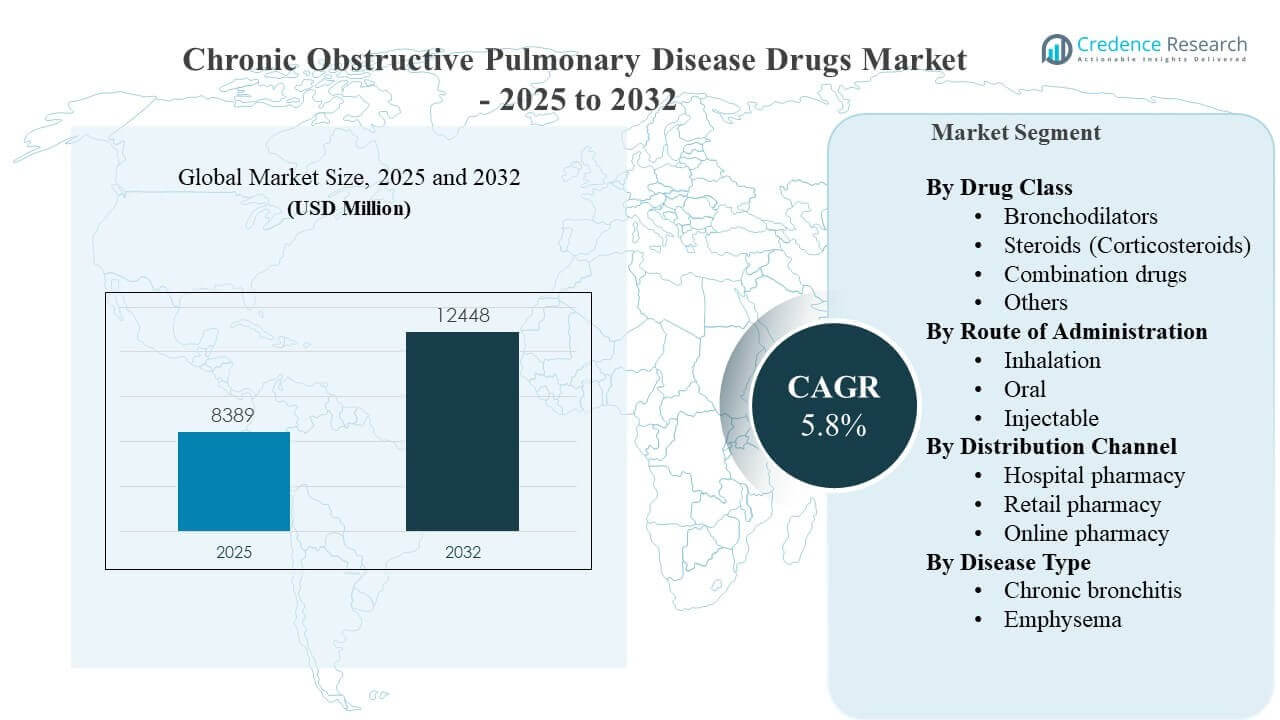
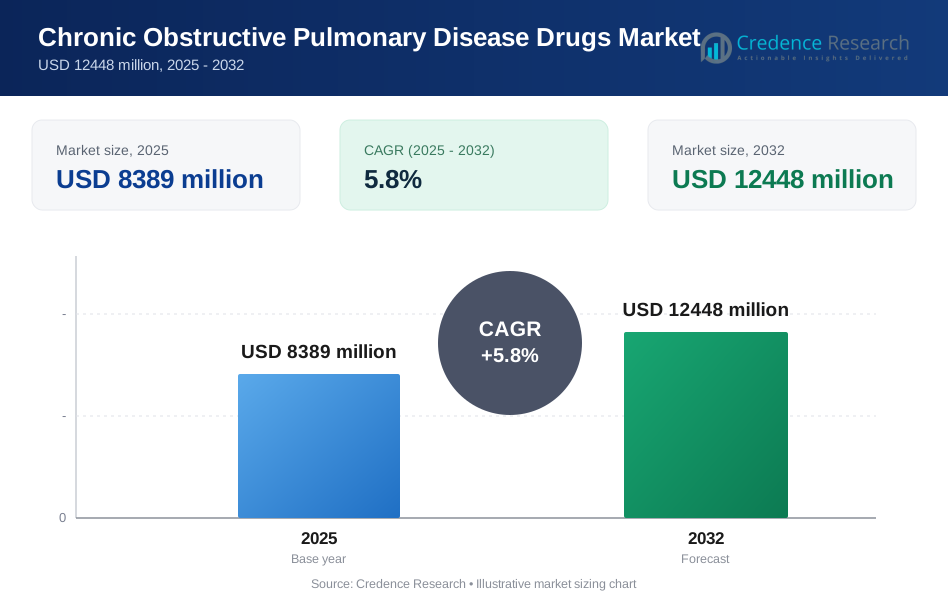
The global Chronic Obstructive Pulmonary Disease Drugs Market size was estimated at USD 8389 million in 2025 and is expected to reach USD 12448 million by 2032, growing at a CAGR of 5.8% from 2025 to 2032. The global Chronic Obstructive Pulmonary Disease Drugs Market growth is supported by sustained demand for maintenance therapies that reduce exacerbations and improve symptom control across moderate-to-severe patient populations. The global Chronic Obstructive Pulmonary Disease Drugs Market expansion is also influenced by broader access to inhaled maintenance regimens and step-up therapy adoption across major healthcare systems.
| REPORT ATTRIBUTE | DETAILS |
|---|---|
| Historical Period | 2020-2024 |
| Base Year | 2025 |
| Forecast Period | 2026-2032 |
| Chronic Obstructive Pulmonary Disease Drugs Market Size 2025 | USD 8389 million |
| Chronic Obstructive Pulmonary Disease Drugs Market, CAGR | 5.8% |
| Chronic Obstructive Pulmonary Disease Drugs Market Size 2032 | USD 12448 million |
Key Market Trends & Insights
- North America accounted for 36.8% in 2025, supported by higher diagnosis rates, broader access to branded inhalers, and established respiratory care pathways.
- Europe captured 27.4% in 2025, driven by structured guideline-based prescribing and stable reimbursement coverage for long-term maintenance therapy.
- Bronchodilators led with 39.2% share in 2025, reflecting continued reliance on airflow improvement and symptom relief as the backbone of COPD pharmacotherapy.
- Inhalation dominated with 70.4% share in 2025, supported by targeted lung delivery, faster onset, and reduced systemic exposure compared with systemic routes.
- Retail pharmacy held 52.8% share in 2025, reflecting chronic refill behavior and decentralized dispensing for long-term maintenance regimens.
Segment Analysis
The Chronic Obstructive Pulmonary Disease Drugs Market is structured around maintenance-focused therapies where long-term symptom control and exacerbation reduction determine prescribing behavior and product switching. The Chronic Obstructive Pulmonary Disease Drugs Market demand is reinforced by the high prevalence of chronic therapy use, where convenience, device familiarity, and dosing frequency influence adherence and persistence. The Chronic Obstructive Pulmonary Disease Drugs Market competition is shaped by differentiation across bronchodilator classes, fixed-dose combinations, and inhaler platforms that improve usability and reduce handling errors.
The Chronic Obstructive Pulmonary Disease Drugs Market also reflects pathway-driven escalation, where patients may transition from monotherapy to dual therapy and then to combination regimens based on symptom burden and exacerbation history. The Chronic Obstructive Pulmonary Disease Drugs Market adoption is supported by clinician preference for inhalation-based delivery and by a refill-centric distribution model that favors retail access. The Chronic Obstructive Pulmonary Disease Drugs Market product positioning frequently emphasizes ease of use, adherence support, and consistent real-world outcomes in reducing exacerbations.
By Drug Class Insights
Bronchodilators accounted for the largest share of 39.2% in 2025. Bronchodilators remain the first-line foundation for symptom relief and airflow improvement across COPD severity stages. Bronchodilator-based regimens are frequently paired with other agents to strengthen maintenance control and reduce the burden of breathlessness and activity limitation. Bronchodilator leadership is also supported by broad clinical familiarity and sustained utilization in both initial and step-up therapy pathways.
By Route of Administration Insights
Inhalation accounted for the largest share of 70.4% in 2025. Inhalation remains the preferred route because pulmonary delivery enables localized drug action and reduces systemic exposure compared with oral alternatives. Inhalation-based therapy aligns with maintenance needs where daily control is required and where device improvements can support adherence. Inhalation dominance is further supported by the availability of multiple inhaler formats and combination options that simplify dosing and encourage persistence.
By Distribution Channel Insights
Retail pharmacy accounted for the largest share of 52.8% in 2025. Retail pharmacy leadership reflects the chronic refill pattern of COPD maintenance therapy and convenient access for long-term patients. Retail channels support continuous therapy supply and facilitate switching within formularies as payers update preferred products. Retail pharmacy dominance is reinforced by patient preference for local availability, routine refills, and broad dispensing networks.
By Disease Type Insights
Chronic bronchitis and emphysema both influence treatment planning through differences in symptom patterns, exacerbation risk, and clinical assessment of airflow limitation. Chronic bronchitis-linked exacerbation profiles can support the use of maintenance escalation strategies where symptom control requires consistent therapy. Emphysema-related burden supports ongoing maintenance use where quality-of-life improvements and breathlessness reduction are prioritized. Phenotype-driven care pathways continue to encourage therapy optimization and adherence support across both disease types.
Chronic Obstructive Pulmonary Disease Drugs Market Drivers
Rising COPD burden and long-term maintenance demand
The Chronic Obstructive Pulmonary Disease Drugs Market is driven by sustained COPD prevalence that requires long-term symptom control and maintenance therapy. The Chronic Obstructive Pulmonary Disease Drugs Market benefits from increasing diagnosis and follow-up care in primary and specialty settings. The Chronic Obstructive Pulmonary Disease Drugs Market demand increases as patients remain on chronic regimens to reduce exacerbations and stabilize daily functioning. The Chronic Obstructive Pulmonary Disease Drugs Market also gains from therapy escalation practices that expand use of combination maintenance options.
Strong clinical reliance on bronchodilator-centered therapy
The Chronic Obstructive Pulmonary Disease Drugs Market growth is supported by widespread reliance on bronchodilators as a core therapy class for COPD management. The Chronic Obstructive Pulmonary Disease Drugs Market adoption is reinforced by clinical familiarity and guideline-driven use across COPD severity categories. The Chronic Obstructive Pulmonary Disease Drugs Market continues to expand as bronchodilators are used alone or as anchors for dual and triple therapy pathways. The Chronic Obstructive Pulmonary Disease Drugs Market benefits from broad prescribing continuity in maintenance regimens.
- For instance, Boehringer Ingelheim’s SPIRIVA (tiotropium) reduced COPD exacerbations by 35%, lowered exacerbation days by 37%, and led to 34% fewer antibiotic courses in a one-year study of 1,010 patients.
Dominance of inhalation delivery and device-driven adherence
The Chronic Obstructive Pulmonary Disease Drugs Market is supported by the preference for inhalation delivery due to targeted lung action and therapy efficiency. The Chronic Obstructive Pulmonary Disease Drugs Market benefits when device usability improves adherence and reduces technique-related errors. The Chronic Obstructive Pulmonary Disease Drugs Market expands with increased access to inhalation devices and patient education that supports correct use. The Chronic Obstructive Pulmonary Disease Drugs Market also gains from product differentiation based on inhaler platform convenience and dosing schedules.
- For instance, AstraZeneca’s Breztri Aerosphere showed a 76 mL improvement in trough FEV1 and a 90 mL improvement in FEV1 AUC0–3 over 24 weeks versus dual ICS/LABA therapy, highlighting measurable lung function gains from inhalation-based delivery.
Refill-centric access and pharmacy distribution strength
The Chronic Obstructive Pulmonary Disease Drugs Market is driven by the refill-based nature of maintenance therapy, which supports high dispensing volumes through established channels. The Chronic Obstructive Pulmonary Disease Drugs Market benefits from widespread retail pharmacy access, which enables ongoing therapy continuity. The Chronic Obstructive Pulmonary Disease Drugs Market growth is supported by pharmacy-led adherence programs and prescription refill management. The Chronic Obstructive Pulmonary Disease Drugs Market also gains from expanded distribution models that improve access and reduce therapy interruption.
Chronic Obstructive Pulmonary Disease Drugs Market Challenges
The Chronic Obstructive Pulmonary Disease Drugs Market faces challenges related to adherence variability and inhaler technique errors, which reduce real-world effectiveness and increase switching. The Chronic Obstructive Pulmonary Disease Drugs Market is also constrained by payer and formulary pressures that influence brand selection and can limit continuity for some patients. The Chronic Obstructive Pulmonary Disease Drugs Market experiences access gaps in price-sensitive settings where maintenance therapy uptake is limited by affordability. The Chronic Obstructive Pulmonary Disease Drugs Market must also address diagnostic under-coverage that delays initiation and reduces treated population depth.
- For instance, Propeller Health’s connected inhaler program in COPD reported mean maintenance inhaler adherence of 62% over 90 days in a 663-patient study, while INCA-based assessments cited in a recent review found that only 17% and 6% of participants in two monitored cohorts achieved the commonly used adherence threshold of at least 80%, highlighting how device use quality and persistence remain major barriers to real-world treatment effectiveness.
The Chronic Obstructive Pulmonary Disease Drugs Market is challenged by product differentiation complexity where multiple inhaler options increase decision burden for clinicians and patients. The Chronic Obstructive Pulmonary Disease Drugs Market may experience competition from generics and therapeutic substitution that compress pricing and reduces premium positioning. The Chronic Obstructive Pulmonary Disease Drugs Market is further affected by supply chain variability and device availability issues in selected countries. The Chronic Obstructive Pulmonary Disease Drugs Market also faces outcomes scrutiny as payers increasingly demand evidence of reduced exacerbations and improved quality of life.
Chronic Obstructive Pulmonary Disease Drugs Market Trends and Opportunities
The Chronic Obstructive Pulmonary Disease Drugs Market is seeing trends toward simplified maintenance regimens that support adherence, including broader use of fixed-dose combinations. The Chronic Obstructive Pulmonary Disease Drugs Market opportunity increases as inhaler platforms evolve with improved usability, dose tracking, and patient-friendly designs. The Chronic Obstructive Pulmonary Disease Drugs Market is also shaped by therapy optimization approaches that align escalation with symptom burden and exacerbation risk. The Chronic Obstructive Pulmonary Disease Drugs Market benefits from growing emphasis on real-world outcomes and patient-reported improvement.
- For instance, GSK’s single-inhaler triple therapy Trelegy Ellipta showed a statistically significant 34% reduction in COPD hospitalizations versus Anoro Ellipta in the 10,355-patient IMPACT trial, while the study also tracked health-related quality-of-life outcomes over 52 weeks, reinforcing the value of simplified escalation pathways tied to exacerbation risk.
The Chronic Obstructive Pulmonary Disease Drugs Market opportunity expands through broader access initiatives and differentiated positioning in emerging markets where diagnosis and maintenance penetration are improving. The Chronic Obstructive Pulmonary Disease Drugs Market is influenced by channel expansion through online and home-delivery models that improve refill convenience. The Chronic Obstructive Pulmonary Disease Drugs Market can benefit from integrated care programs that reduce exacerbations and hospitalizations, strengthening the role of maintenance therapy. The Chronic Obstructive Pulmonary Disease Drugs Market is also likely to see continued innovation in delivery and add-on approaches that support competitive differentiation.
Regional Insights
North America
North America accounted for 36.8% in 2025 and remains the largest regional contributor due to higher diagnosis rates, structured respiratory care pathways, and broad access to maintenance inhalers. The Chronic Obstructive Pulmonary Disease Drugs Market in North America benefits from strong specialist engagement and refill continuity for long-term patients. The Chronic Obstructive Pulmonary Disease Drugs Market in North America is supported by established payer coverage frameworks that sustain uptake of maintenance regimens. The Chronic Obstructive Pulmonary Disease Drugs Market in North America also reflects strong demand for inhalation-based therapy options and combination regimens.
Europe
Europe captured 27.4% in 2025, supported by guideline-based prescribing, stable reimbursement, and widespread primary and specialty respiratory care. The Chronic Obstructive Pulmonary Disease Drugs Market in Europe is shaped by national formulary strategies and cost-effectiveness assessments that guide product selection. The Chronic Obstructive Pulmonary Disease Drugs Market in Europe also benefits from consistent follow-up care and maintenance therapy continuity. The Chronic Obstructive Pulmonary Disease Drugs Market in Europe continues to support adoption of inhaled therapies aligned with long-term disease management.
Asia Pacific
Asia Pacific represented 23.9% in 2025 and is supported by improving diagnosis, healthcare access expansion, and rising availability of maintenance therapies in high-volume markets. The Chronic Obstructive Pulmonary Disease Drugs Market in Asia Pacific is influenced by urbanization-linked respiratory burden and expanding respiratory specialty capacity. The Chronic Obstructive Pulmonary Disease Drugs Market in Asia Pacific benefits from growing retail pharmacy coverage and improving affordability pathways in select countries. The Chronic Obstructive Pulmonary Disease Drugs Market in Asia Pacific also reflects increasing use of inhalation-based therapies as access improves.
Latin America
Latin America accounted for 6.4% in 2025, supported by increasing diagnosis and gradually improving access to maintenance therapies in larger economies. The Chronic Obstructive Pulmonary Disease Drugs Market in Latin America is shaped by reimbursement variability and affordability sensitivity that influences therapy continuity. The Chronic Obstructive Pulmonary Disease Drugs Market in Latin America benefits from retail dispensing networks that support refills where access is available. The Chronic Obstructive Pulmonary Disease Drugs Market in Latin America remains constrained by uneven specialist coverage and under-diagnosis in some settings.
Middle East & Africa
Middle East & Africa accounted for 5.5% in 2025, supported by improving access in higher-income healthcare systems and gradual adoption of maintenance inhalers through hospital and retail channels. The Chronic Obstructive Pulmonary Disease Drugs Market in Middle East & Africa remains influenced by affordability gaps and limited diagnostic depth in several countries. The Chronic Obstructive Pulmonary Disease Drugs Market in Middle East & Africa benefits from expanding pharmacy infrastructure in select markets. The Chronic Obstructive Pulmonary Disease Drugs Market in Middle East & Africa continues to require broader care pathway strengthening to improve treated population penetration.
Competitive Landscape
The Chronic Obstructive Pulmonary Disease Drugs Market is moderately consolidated, with competition centered on inhaled maintenance portfolios, device ecosystems, and differentiated combination regimens that aim to reduce exacerbations and improve daily symptom control. The Chronic Obstructive Pulmonary Disease Drugs Market leaders compete through lifecycle management, reformulations, inhaler platform differentiation, and evidence-generation strategies that support payer access and guideline alignment. The Chronic Obstructive Pulmonary Disease Drugs Market competition also reflects pricing and formulary dynamics that influence switching and preferred product status.
GSK (GlaxoSmithKline) participates in the Chronic Obstructive Pulmonary Disease Drugs Market through established respiratory portfolios and ongoing lifecycle strategies that strengthen maintenance therapy positioning. The Chronic Obstructive Pulmonary Disease Drugs Market presence of GSK is supported by commercialization scale, broad channel access, and continued investment in respiratory pipeline assets. The Chronic Obstructive Pulmonary Disease Drugs Market strategy for leading participants commonly emphasizes evidence development, adherence support, and product differentiation through inhaler usability and dosing convenience.
The industry research and growth report includes detailed analyses of the competitive landscape of the market and information about key companies, including:
- GSK (GlaxoSmithKline)
- AstraZeneca
- Boehringer Ingelheim
- Novartis
- Teva Pharmaceutical Industries
- Chiesi Farmaceutici
- Viatris / Mylan
- Pfizer
- Merck & Co.
- Roche
Qualitative and quantitative analysis of companies has been conducted to help clients understand the wider business environment as well as the strengths and weaknesses of key industry players. Data is qualitatively analyzed to categorize companies as pure play, category-focused, industry-focused, and diversified; it is quantitatively analyzed to categorize companies as dominant, leading, strong, tentative, and weak.
Recent Developments
- In March 2025, Sanofi and Regeneron announced that Japan’s Ministry of Health, Labour and Welfare approved Dupixent (dupilumab) for adults with COPD whose disease is not adequately controlled with existing therapy, making it the first biologic medicine approved for COPD in Japan.
- In May 2025, GSK announced that the U.S. FDA approved Nucala (mepolizumab) as an add-on maintenance treatment for adults with inadequately controlled COPD and an eosinophilic phenotype, expanding GSK’s respiratory portfolio in COPD.
- In July 2025, GSK entered into an agreement with Hengrui Pharma that included an exclusive worldwide license for HRS-9821, a potential best-in-class PDE3/4 inhibitor in clinical development for COPD, as part of a broader multi-program partnership.
- In July 2025, Merck announced a definitive agreement to acquire Verona Pharma, a company focused on respiratory diseases, to add Ohtuvayre (ensifentrine), a first-in-class COPD maintenance treatment, to its cardio-pulmonary portfolio.
Report Scope
| Report Attribute | Details |
| Market size value in 2025 | USD 8,389 million |
| Revenue forecast in 2032 | USD 12,448 million |
| Growth rate (CAGR) | 5.8% (2025–2032) |
| Base year | 2025 |
| Forecast period | 2026–2032 |
| Quantitative units | USD million |
| Segments covered | By Drug Class Outlook; By Route of Administration Outlook; By Distribution Channel Outlook; By Disease Type Outlook (optional) |
| Regional scope | North America, Europe, Asia Pacific, Latin America, Middle East & Africa |
| Key companies profiled | GSK (GlaxoSmithKline); AstraZeneca; Boehringer Ingelheim; Novartis; Teva Pharmaceutical Industries; Chiesi Farmaceutici; Viatris / Mylan; Pfizer; Merck & Co.; Roche |
| No. of Pages | 326 |
Segmentation
BY DRUG CLASS
- Bronchodilators
- Steroids (Corticosteroids)
- Combination drugs
- Others
BY ROUTE OF ADMINISTRATION
- Inhalation
- Oral
- Injectable
BY DISTRIBUTION CHANNEL
- Hospital pharmacy
- Retail pharmacy
- Online pharmacy
BY DISEASE TYPE
- Chronic bronchitis
- Emphysema
BY REGION
- North America
- U.S.
- Canada
- Mexico
- Europe
- Germany
- France
- U.K.
- Italy
- Spain
- Rest of Europe
- Asia Pacific
- China
- Japan
- India
- South Korea
- South-east Asia
- Rest of Asia Pacific
- Latin America
- Brazil
- Argentina
- Rest of Latin America
- Middle East & Africa
- GCC Countries
- South Africa
- Rest of the Middle East and Africa
Request a Free Sample
Fill in your details and we'll send you a free sample report.
- Sample data tables & charts
- Research methodology
Need a Custom Version of This Report?
Tailor the scope, geography, or segments to your exact requirements.
- Custom geography or segment scope
- Direct access to our analyst team
Frequently Asked Questions
What is the market size of the Chronic Obstructive Pulmonary Disease Drugs Market in 2025 and its forecast for 2032?
What is the CAGR of the Chronic Obstructive Pulmonary Disease Drugs Market during 2025–2032?
Which is the largest segment in the Chronic Obstructive Pulmonary Disease Drugs Market?
What factors are driving growth in the Chronic Obstructive Pulmonary Disease Drugs Market?
Who are the leading companies in the Chronic Obstructive Pulmonary Disease Drugs Market?
Which region leads the Chronic Obstructive Pulmonary Disease Drugs Market?
Table of Content
Chapter 1. Report Introduction
- 1.1 Report Description & Purpose
- 1.1.1 Report Title & Market Definition
- 1.1.2 Unique Selling Propositions (USP) & Key Differentiators
- 1.1.3 Value Proposition for Stakeholders
- 1.2 Research Objectives
- 1.2.1 Market Sizing Objectives (Volume & Revenue)
- 1.2.2 Segmentation Objectives
- 1.2.3 Competitive Intelligence Objectives
- 1.2.4 Forecast & Scenario Objectives
- 1.3 Report Scope
- 1.3.1 Chronic Obstructive Pulmonary Disease Drugs Scope – Types & Subtypes Covered
- 1.3.2 Geographic Scope – Regions & Countries Covered
- 1.3.3 Historical Period, Base Year & Forecast Period (2025; forecast to 2032)
- 1.3.4 Inclusions & Exclusions
- 1.4 HS Code & Classification Framework
- 1.5 Currency, Units & Pricing Basis
- 1.6 Target Stakeholders
- 1.7 Limitations & Assumptions
Chapter 2. Executive Summary
- 2.1 Global Chronic Obstructive Pulmonary Disease Drugs Market Snapshot
- 2.1.1 Market Size – Historical (2025) & Forecast (2025-2032) (2025: USD 8389 million → 2032: USD 12448 million)
- 2.1.2 Volume & Revenue – Global Totals
- 2.1.3 Key Market Highlights – Top Five Facts
- 2.2 Chronic Obstructive Pulmonary Disease Drugs Market Segmentation Snapshot
- 2.2.1 Market Split by Region – 2025 vs. 2032
- 2.3 Competitive Snapshot
- 2.3.1 Top 10 Players by Revenue Share – 2025
- 2.3.2 Top 10 Players by Volume Share – 2025
- 2.3.3 Recent Strategic Developments (18-Month Summary)
- 2.4 Key Investment Highlights & Strategic Conclusions
Chapter 3. Chronic Obstructive Pulmonary Disease Drugs Market Dynamics & Industry Analysis
- 3.1 Market Overview & Context
- 3.1.1 Chronic Obstructive Pulmonary Disease Drugs Market Position in the Broader Automotive Value Chain
- 3.1.2 OEM vs. Replacement Market Dynamics
- 3.1.3 Market Maturity & Development Stage by Region
- 3.2 Chronic Obstructive Pulmonary Disease Drugs Market Drivers
- 3.3 Chronic Obstructive Pulmonary Disease Drugs Market Restraints & Challenges
- 3.4 Chronic Obstructive Pulmonary Disease Drugs Market Opportunities
- 3.5 Porter's Five Forces Analysis
- 3.5.1 Threat of New Entrants
- 3.5.2 Bargaining Power of Suppliers
- 3.5.3 Bargaining Power of Buyers
- 3.5.4 Threat of Substitutes
- 3.5.5 Competitive Rivalry – Intensity Assessment
- 3.6 Chronic Obstructive Pulmonary Disease Drugs Value Chain Analysis
- 3.6.1 Upstream – Raw Material/Input Suppliers
- 3.6.1.1 Raw Material/Input 1
- 3.6.1.2 Raw Material/Input 2
- 3.6.1.3 Raw Material/Input 3
- 3.6.2 Midstream – Production/Manufacturing/Service Delivery
- 3.6.2.1 Production/Process Overview
- 3.6.2.2 Key Facility Locations & Capacity by Manufacturer
- 3.6.3 Downstream – Distribution & End Consumer
- 3.6.3.1 Primary Channel – B2B/OEM
- 3.6.3.2 Secondary Channels – Dealer, Retail, Online, Direct
- 3.6.4 Value Chain Profitability Analysis
- 3.6.1 Upstream – Raw Material/Input Suppliers
- 3.7 PESTEL Analysis
- 3.7.1 Political Factors
- 3.7.2 Economic Factors
- 3.7.3 Social Factors
- 3.7.4 Technological Factors
- 3.7.5 Environmental Factors
- 3.7.6 Legal Factors
- 3.8 Chronic Obstructive Pulmonary Disease Drugs Supply Chain Analysis
- 3.8.1 Raw Material/Input Supply Risk Assessment
- 3.8.2 Manufacturing Concentration Risk (Geographic Exposure)
- 3.8.3 Trade Disruption Impact Analysis
- 3.9 Regulatory & Policy Landscape
Note: The regulatory and policy landscape section covers regulations based on their applicability to the market, Chronic Obstructive Pulmonary Disease Drugs category, geography, and scope of the study. Only regulatory frameworks with a material impact on operations, compliance, trade, sustainability, or market access are analyzed in detail.
Chapter 4. Key Investment Pockets & Opportunity Analysis
- 4.1 Chronic Obstructive Pulmonary Disease Drugs Market Attractiveness Analysis
- 4.1.1 By Region – Investment Attractiveness Matrix (Volume × CAGR)
- 4.2 Absolute Revenue Growth Opportunity
- 4.2.1 By Region – Absolute USD Growth Through 2032
- 4.3 Incremental Volume Opportunity
- 4.3.1 By Region – Incremental Volume Through 2032
- 4.3.2 Segment – Incremental Volume
- 4.4 Emerging Submarket Opportunity Deep Dive (Subject to Applicability)
- 4.5 Emerging Market Opportunity Scorecards
- 4.5.1 United States
- 4.5.2 Europe
- 4.5.3 Asia
- 4.5.4 Middle East & Africa
Note: Emerging Market Opportunity Scorecards will be included based on relevance and strategic importance. Regions listed are indicative and may vary depending on data availability and market dynamics.
Chapter 5. Chronic Obstructive Pulmonary Disease Drugs Import-Export Analysis & Trade Flows
- 5.1 Global Trade Overview
- 5.1.1 Global Export Value by Country (2025)
- 5.1.2 Global Export Volume by Country (2025)
- 5.1.3 Global Import Value by Country (2025)
- 5.1.4 Global Import Volume by Country (2025)
- 5.1.5 Net Trade Balance by Country (2025)
- 5.2 Export Analysis – Segment
- 5.2.1 Type 1 (HS Code)
- 5.2.2 Type 2 (HS Code)
- 5.2.3 Type 3 (HS Code)
- 5.2.4 Type 4 (HS Code)
- 5.2.5 Type 5 (HS Code)
- 5.3 Import Analysis – Segment
- 5.3.1 Type 1 (HS Code)
- 5.3.2 Type 2 (HS Code)
- 5.3.3 Type 3 (HS Code)
- 5.3.4 Type 4 (HS Code)
- 5.3.5 Type 5 (HS Code)
- 5.4 Average Unit Trade Prices
- 5.4.1 Average Export Price – Segment & Country
- 5.4.2 Average Import Price – Segment & Source Country
- 5.4.3 Price Trends (2025)
- 5.5 Key Trade Route Analysis
- 5.5.1 Trade Route 1
- 5.5.2 Trade Route 2
- 5.5.3 Trade Route 3
- 5.5.4 Trade Route 4
- 5.5.5 Trade Route 5
- 5.6 Trade Policy Impact Assessment
- 5.6.1 US Anti-Dumping & Section 301 Tariffs
- 5.6.2 EU Customs Union Impact
- 5.6.3 Major Free Trade Agreements
- 5.6.4 USMCA Rules of Origin
Note: Trade policy analysis will be included only where relevant to the Chronic Obstructive Pulmonary Disease Drugs market.
Chapter 6. Competitive Landscape & Company Benchmarking
- 6.1 Chronic Obstructive Pulmonary Disease Drugs Market Concentration & Structure
- 6.1.1 Herfindahl-Hirschman Index (HHI) – vs. 2025
- 6.1.2 Tier 1, Tier 2 & Tier 3 Market Structure
- 6.1.3 Global, Regional & Local Player Dynamics
- 6.2 Chronic Obstructive Pulmonary Disease Drugs Market Share Analysis – 2025
- 6.2.1 Global Revenue Share by Company
- 6.2.2 Global Volume Share by Company
- 6.2.3 Regional Revenue Share
- 6.2.4 Market Share Evolution ( vs. 2025)
- 6.2.5 OEM Segment Share by Company
- 6.2.6 Replacement Segment Share by Company
- 6.3 Production/Delivery Capacity & Facility Analysis
- 6.3.1 Global Installed Capacity
- 6.3.2 Capacity Utilization Rates
- 6.3.3 Production/Output Volume
- 6.3.4 Facility Locations & Capacity Map
- 6.3.5 Planned Capacity Additions
- 6.4 Chronic Obstructive Pulmonary Disease Drugs Competitive Benchmarking Matrix
- 6.4.1 Revenue, Volume, CAGR & Profitability Comparison
- 6.4.2 Channel Revenue Mix
- 6.4.3 Geographic Revenue Exposure
- 6.4.4 R&D Intensity
- 6.4.5 Sustainability Maturity
- 6.5 Strategic Developments in Chronic Obstructive Pulmonary Disease Drugs (Last 24 Months)
- 6.5.1 Mergers, Acquisitions & Divestments
- 6.5.2 New Chronic Obstructive Pulmonary Disease Drugs Launches
- 6.5.3 Facility Expansions
- 6.5.4 Strategic Alliances, Joint Ventures & Partnerships
- 6.5.5 Distribution Expansion & Market Entry
- 6.5.6 Sustainability & ESG Initiatives
- 6.6 Competitive Strategy Mapping
- 6.6.1 Leader, Challenger, Follower & Niche Classification
- 6.6.2 Pricing Strategy Comparison
- 6.6.3 Channel Strategy Matrix
Note: Strategic developments are included based on their materiality and the availability of reliable information.
Chapter 7. Global Chronic Obstructive Pulmonary Disease Drugs Market – By Distribution Channel
- 7.1 Segment Overview
- 7.1.1 Volume & Revenue Split by Channel (2025 & 2032)
- 7.1.2 Channel Mix Evolution (2025-2032)
Chapter 8. Regional Market Analysis – Global Overview
- 8.1 Global Regional Overview
- 8.1.1 Regional Volume Share
- 8.1.2 Regional Revenue Share
- 8.1.3 Regional Volume by Region
- 8.1.4 Regional Revenue by Region
- 8.1.5 Regional Forecast Through 2032
- 8.2 Cross-Regional Segment Analysis
- 8.2.1 By Distribution Channel
- 8.2.2 By Brand/Price Tier
Chapter 9. North America Chronic Obstructive Pulmonary Disease Drugs Market
- 9.1 United States
- 9.2 Canada
- 9.3 Mexico
Chapter 10. Europe Chronic Obstructive Pulmonary Disease Drugs Market
- 10.1 Germany
- 10.2 France
- 10.3 Italy
- 10.4 United Kingdom
- 10.5 Spain
- 10.6 Poland
- 10.7 Russia
- 10.8 Netherlands
- 10.9 Belgium
- 10.10 Sweden
- 10.11 Denmark
- 10.12 Norway
- 10.13 Rest of Europe
Chapter 11. Asia Pacific Chronic Obstructive Pulmonary Disease Drugs Market
- 11.1 China
- 11.2 India
- 11.3 Japan
- 11.4 South Korea
- 11.5 Thailand
- 11.6 Indonesia
- 11.7 Vietnam
- 11.8 Malaysia
- 11.9 Australia
- 11.10 Rest of Asia Pacific
Chapter 12. Latin America Chronic Obstructive Pulmonary Disease Drugs Market
- 12.1 Brazil
- 12.2 Argentina
- 12.3 Colombia
- 12.4 Chile
- 12.5 Rest of Latin America
Chapter 13. Middle East Chronic Obstructive Pulmonary Disease Drugs Market
- 13.1 Saudi Arabia
- 13.2 United Arab Emirates
- 13.3 Turkey
- 13.4 Israel
- 13.5 Iran
- 13.6 Rest of the Middle East
Chapter 14. Africa Chronic Obstructive Pulmonary Disease Drugs Market
- 14.1 South Africa
- 14.2 Egypt
- 14.3 Nigeria
- 14.4 Morocco
- 14.5 Rest of Africa
Chapter 15. Chronic Obstructive Pulmonary Disease Drugs Company Profiles
- 15.1 [Company 01]
- 15.1.1 Company Overview
- 15.1.2 Key Management Personnel
- 15.1.3 Products & Services Portfolio
- 15.1.4 Financial Performance
- 15.1.5 Key Market Focus & Geographic Presence
- 15.1.6 Recent Developments & Strategic Initiatives
Note: The company profile list is preliminary and may change based on research findings, market developments, data availability, and client requirements.
Chapter 16. Appendices
- Appendix A – List of Abbreviations & Acronyms
- Appendix B – Industry Classification Code Reference – Full Series
- Appendix C – Production & Capacity Data Tables
- Appendix D – End-Use & Demand Base Tables
- Appendix E – Consumption & Replacement Rate Assumptions
- Appendix F – ASP Reference Tables
- Appendix G – Manufacturing & Facility Database
- Appendix H – Import-Export Data Tables
- Appendix I – Regulatory Summary Tables
- Appendix J – Primary Research Participant List (Anonymized)
- Appendix K – Primary Research Questionnaire Framework
- Appendix L – Data Sources & Bibliography
- Appendix M – Market Size Divergence & Source Comparison
Chapter 17. Research Methodology
- 17.1 Research Framework & Philosophy
- 17.2 Secondary Research – Sources, Hierarchy & Data Extraction
- 17.3 Data Modeling – Bottom-Up & Top-Down Market Sizing
- 17.4 Primary Research – Stakeholder Framework, LOI & Sample Sizes
- 17.5 Forecast Methodology – Regression, Scenario & Sensitivity Analysis
- 17.6 Quality Control – Four-Layer Validation Framework
- 17.7 Limitations & Standard Assumptions
- 17.8 Disclaimer
