
CircRNA Synthesis Market Overview:
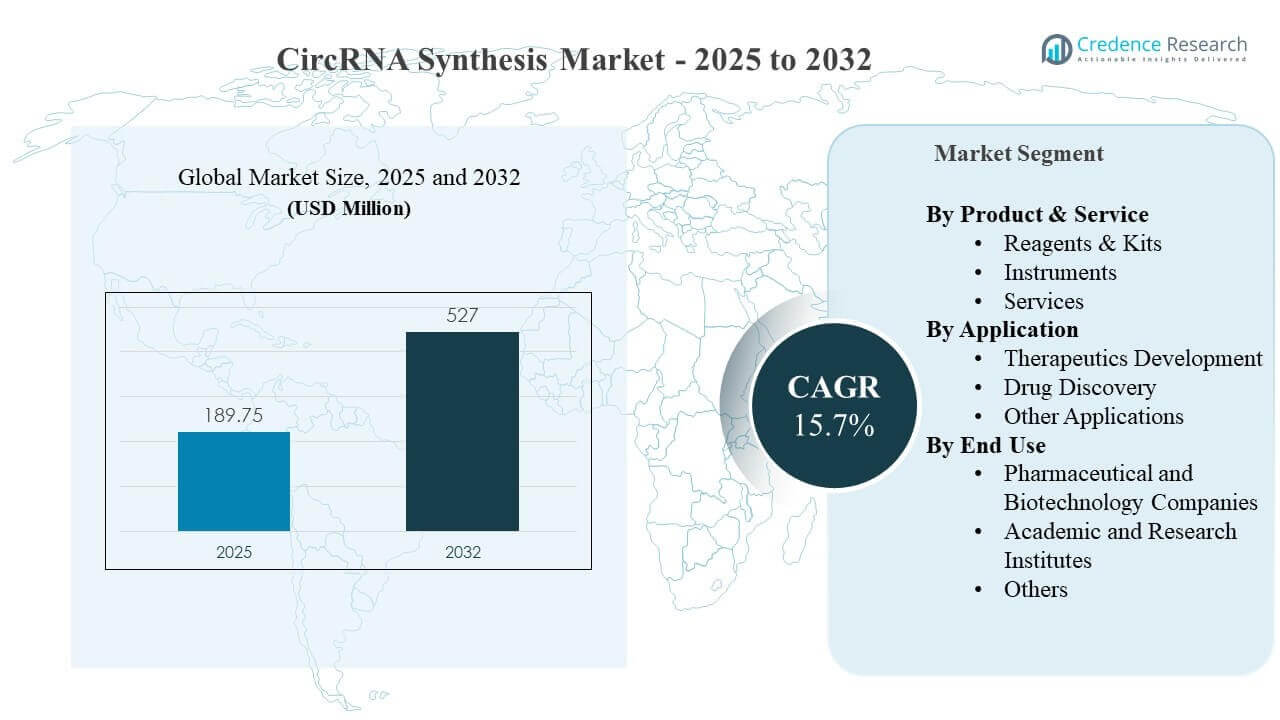
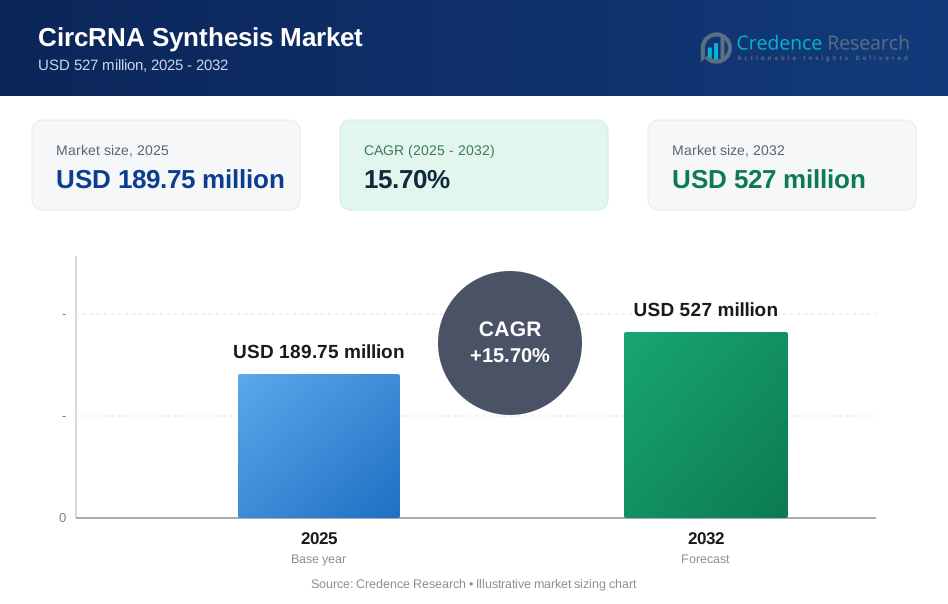
The global CircRNA Synthesis Market size was estimated at USD 189.75 million in 2025 and is expected to reach USD 527 million by 2032, growing at a CAGR of 15.7% from 2025 to 2032, following the required structure in your prompt file. The strongest growth driver is the accelerating adoption of circular RNA constructs in advanced therapeutics programs, where improved RNA stability and sustained expression profiles increase demand for reliable synthesis workflows across discovery and development. CircRNA Synthesis Market expansion is also supported by broader RNA platform investments across established biopharma and emerging biotech ecosystems.
| REPORT ATTRIBUTE | DETAILS |
|---|---|
| Historical Period | 2020-2024 |
| Base Year | 2025 |
| Forecast Period | 2026-2032 |
| CircRNA Synthesis Market Size 2025 | USD 189.75 million |
| CircRNA Synthesis Market, CAGR | 15.7% |
| CircRNA Synthesis Market Size 2032 | USD 527 million |
Key Market Trends & Insights
- CircRNA Synthesis Market is projected to expand from USD 189.75 million in 2025 to USD 527 million by 2032, reflecting a 15.7% CAGR over 2025–2032.
- North America accounted for the largest regional share of 42.8% in 2025, reflecting concentration of RNA-therapy R&D and commercial procurement in the region.
- Reagents & Kits accounted for the largest share of 44.6% in 2025, supported by recurring consumable demand across circularization, purification, and QC workflows.
- Therapeutics Development held the largest application share of 61.2% in 2025, driven by expanding use of circRNA constructs for vaccine, oncology, and rare-disease research pipelines.
- Pharmaceutical and Biotechnology Companies represented the largest end-use share of 56.8% in 2025, reflecting higher spend intensity and outsourcing requirements for complex synthesis.
Segment Analysis
CircRNA Synthesis Market demand is shaped by two procurement patterns: high-frequency purchases of workflow-critical consumables and an increasing preference for outsourcing specialized steps. Reagents and kits remain central because circRNA synthesis requires multiple steps such as template preparation, circularization, purification, and verification, and each step drives repeat consumption. Instruments contribute through analytical validation and process standardization, especially where buyers aim to improve reproducibility and documentation.
Application demand is anchored in therapeutics development, where circRNA stability and potential for longer-lived expression support use in next-generation RNA modalities. Drug discovery demand is supported by broader exploratory use of synthetic circRNAs for target validation and screening models, especially when programs require rapid design iterations. Other applications include method development, academic hypothesis testing, and platform benchmarking.
End-use trends indicate biopharma buyers increasingly pursue integrated offerings that combine design support, synthesis execution, purification, and quality checks. Academic and research institutes expand adoption as tools become more accessible and as collaborations with biotech translate basic research into preclinical programs. Other end users participate through translational research, platform services, and early-stage proof-of-concept projects.
By Product & Service Insights
Reagents & Kits accounted for the largest share of 44.6% in 2025. Reagents & Kits lead because circRNA synthesis workflows require consistent enzymes, buffers, circularization reagents, and purification inputs across repeated experimental cycles. Reagents & Kits also benefit from standardized protocols that improve reproducibility across labs and reduce batch-to-batch variability concerns. Service providers frequently bundle proprietary consumables into service delivery, which further sustains reagent demand alongside outsourcing growth.
By Application Insights
Therapeutics Development accounted for the largest share of 61.2% in 2025. Therapeutics Development leads because circRNA constructs are evaluated for improved stability and sustained protein expression, which aligns with therapeutic modality needs across multiple disease areas. Therapeutics Development programs also demand higher-quality synthesis and tighter quality controls, which increases spend per project relative to exploratory work. Therapeutics Development activity is reinforced by platform-level investments where circRNA is assessed alongside other RNA formats for performance and manufacturability.
By End Use Insights
Pharmaceutical and Biotechnology Companies accounted for the largest share of 56.8% in 2025. Pharmaceutical and Biotechnology Companies lead because pipeline programs require scalable synthesis, consistent characterization, and rapid iteration across multiple constructs and indications. Pharmaceutical and Biotechnology Companies also adopt outsourcing models to access specialized expertise for circularization, purification, and quality verification steps. Pharmaceutical and Biotechnology Companies typically maintain higher procurement budgets and prioritize standardized documentation, which increases demand for validated workflows and supplier reliability.
CircRNA Synthesis Market Drivers
Expansion of RNA therapeutics pipelines and platform diversification
CircRNA Synthesis Market growth is supported by expanding RNA-based therapeutic pipelines that include exploration of circular RNA for stability and sustained expression advantages. CircRNA Synthesis Market adoption rises when therapeutic programs require multiple construct iterations, rapid turnaround, and reproducible synthesis outcomes. CircRNA Synthesis Market demand also benefits from platform diversification trends in which developers evaluate multiple RNA formats to optimize performance for different indications. CircRNA Synthesis Market purchasing increases as programs move from feasibility studies into preclinical development with higher quality expectations.
- For instance, Orna Therapeutics screened thousands of IRES elements across multiple primary human cell types using its FoRCE platform, ultimately enabling its lead oRNA program ORN-101 to achieve tumor eradication in mouse models at 10–20-fold lower doses than earlier construct versions demonstrating how iterative construct diversification across multiple RNA formats directly drives demand for high-throughput, reproducible synthesis capacity.
Increasing outsourcing of complex synthesis and characterization steps
CircRNA Synthesis Market demand strengthens as buyers outsource specialized workflow steps such as circularization optimization, purification strategy selection, and verification testing. CircRNA Synthesis Market service uptake is reinforced by the need to shorten timelines and reduce internal method-development burden. CircRNA Synthesis Market suppliers that provide integrated design-to-QC offerings reduce operational friction for customers managing multiple candidates. CircRNA Synthesis Market growth is further supported when outsourcing converts fixed costs into variable costs aligned to pipeline milestones.
Rising need for standardized, reproducible workflows across research settings
CircRNA Synthesis Market expansion is driven by the need for standardized and reproducible workflows across labs, particularly where programs require cross-site comparability. CircRNA Synthesis Market buyers prioritize kits and validated processes that reduce variability across runs and improve experimental confidence. CircRNA Synthesis Market instrument utilization supports documentation and validation of synthesis outcomes through analytical confirmation steps. CircRNA Synthesis Market procurement strengthens as organizations formalize quality procedures and strengthen traceability requirements.
Greater accessibility of synthesis toolkits and vendor ecosystems
CircRNA Synthesis Market growth is enabled by broader availability of commercial toolkits, catalog reagents, and customizable service menus that simplify adoption. CircRNA Synthesis Market demand increases when suppliers lower technical barriers through protocols, troubleshooting support, and modular workflow options. CircRNA Synthesis Market expansion is supported by vendor ecosystems that combine materials, instruments, and services for end-to-end execution. CircRNA Synthesis Market adoption accelerates as more buyers gain confidence that circRNA synthesis can be implemented without extensive in-house specialization.
- For instance, GenScript structured its circRNA synthesis offering as a modular service menu with off-the-shelf construct options for fast delivery, insert sequence lengths from 100 bp to 4 kb, and batch scales from 200 µg to 10 mg with entry-level pricing starting at $800 per 25 µg allowing academic labs and early-stage biotechs to access functional circRNA without developing internal IVT or HPLC purification capability.
CircRNA Synthesis Market Challenges
CircRNA Synthesis Market faces technical challenges related to achieving consistent circularization efficiency, minimizing impurities, and validating product integrity across different sequence designs. CircRNA Synthesis Market buyers often encounter variability risks when scaling from exploratory synthesis to more controlled workflows, which can increase repeat work and costs. CircRNA Synthesis Market complexity also increases when workflows must be adapted for different constructs, as optimization requirements can be sequence-specific. CircRNA Synthesis Market growth can be constrained when teams lack experienced staff to design robust protocols and interpret characterization results.
- For instance, TRIC-V2 circularization experiments showed that extending stem length from 5 bp (V1.0) to 25 bp raised circularization efficiency to 97.8% at 8 minutes with a yield of 74.8%, yet further extending the external guide sequence beyond 40 nucleotides produced no measurable gain demonstrating that each nucleotide-level design decision can have non-linear effects on outcome, requiring re-optimization per construct.
CircRNA Synthesis Market also experiences operational and procurement constraints tied to quality expectations and supply continuity for specialized reagents. CircRNA Synthesis Market projects can face delays when lead times for critical enzymes, purification materials, or verification tools increase. CircRNA Synthesis Market adoption in smaller labs can be limited by budget constraints, particularly when workflows require both consumables and instruments. CircRNA Synthesis Market suppliers must balance customization needs with standardized delivery models, which can pressure margins and delivery timelines.
CircRNA Synthesis Market Trends and Opportunities
CircRNA Synthesis Market trends indicate rising demand for integrated offerings that combine construct design guidance, synthesis execution, purification, and verification within a single vendor workflow. CircRNA Synthesis Market customers increasingly prefer partners that can support iterative design cycles and provide consistent documentation for internal reviews. CircRNA Synthesis Market opportunity expands as service models mature and as buyers seek predictable turnaround times across multiple projects. CircRNA Synthesis Market suppliers can differentiate through standardized QC packages and scalable production options aligned to development stages.
- For instance, GenScript offers custom circRNA synthesis for insert sequences from 100 bp to 4 kb with delivery in 3 weeks, and the company reports typical circularization efficiency of 60% to 90% along with HPLC purification yields of around 20% to 40%.
CircRNA Synthesis Market opportunity is also supported by expanding adoption beyond early research into more structured preclinical workflows where repeatability and traceability become central. CircRNA Synthesis Market vendors can expand by offering modular product bundles that match buyer maturity, from entry-level kits to advanced purification and analytics support. CircRNA Synthesis Market growth can benefit from education-led commercialization such as protocols, training, and application notes that reduce adoption friction. CircRNA Synthesis Market regional opportunity strengthens as Asia Pacific ecosystems expand and as collaboration networks increase cross-border demand.
Regional Insights
North America
North America held a 42.8% share of CircRNA Synthesis Market revenue in 2025. North America demand is supported by higher concentration of RNA-therapeutics programs, established procurement budgets, and strong adoption of outsourcing for specialized synthesis steps. North America also benefits from dense supplier ecosystems that support faster iteration cycles and service availability.
Europe
Europe accounted for 31.9% of CircRNA Synthesis Market revenue in 2025. Europe demand is supported by strong academic research bases and established biopharma clusters that sustain both consumable purchases and service utilization. Europe also shows structured adoption through collaborations that translate early research into applied development programs.
Asia Pacific
Asia Pacific represented 23.6% of CircRNA Synthesis Market revenue in 2025. Asia Pacific growth is supported by expanding biotechnology ecosystems, increasing R&D intensity, and rising demand for accessible synthesis toolkits and scalable service options. Asia Pacific also benefits from growing cross-border collaborations and increased investment in RNA platform technologies.
Latin America
Latin America accounted for 1.1% of CircRNA Synthesis Market revenue in 2025. Latin America adoption remains early-stage, with demand concentrated in selected research hubs where RNA and advanced therapeutics activity is expanding. Latin America opportunity is linked to improving research infrastructure and broader access to outsourced synthesis services.
Middle East & Africa
Middle East and Africa accounted for 0.6% of CircRNA Synthesis Market revenue in 2025. Middle East and Africa activity remains nascent, with adoption primarily linked to specialized research centers and emerging innovation programs. Middle East and Africa growth potential depends on expanding translational research capacity and procurement accessibility.
Competitive Landscape
CircRNA Synthesis Market competition includes a mix of catalog reagent suppliers, custom synthesis specialists, and multi-omics service platforms that compete on turnaround time, synthesis reliability, and documentation quality. CircRNA Synthesis Market differentiation is increasingly shaped by end-to-end workflow coverage, where vendors bundle design support, circularization optimization, purification, and verification. CircRNA Synthesis Market participants also compete through breadth of catalog offerings and the ability to support both discovery-scale and more controlled development-stage requirements. CircRNA Synthesis Market buyers commonly evaluate vendors on reproducibility, technical support depth, and capability to customize workflows for different constructs.
GenScript is positioned as a prominent provider across research tools and custom services that can support RNA-adjacent workflows through synthesis capabilities, workflow guidance, and standardized delivery processes. GenScript can benefit from cross-selling opportunities where customers procure reagents and services together to reduce workflow fragmentation. GenScript differentiation typically centers on service execution capability and the ability to support multiple stages of R&D from exploratory work through more structured development needs. GenScript also competes by offering technical support and process standardization that reduces adoption friction for complex synthesis workflows.
The industry research and growth report includes detailed analyses of the competitive landscape of the market and information about key companies, including:
- GenScript
- Azenta / GENEWIZ
- Creative Biogene
- Creative Biolabs
- LGC Biosearch Technologies
- SBS Genetech
- Applied Biological Materials (abm)
- Amerigo Scientific
- BOC Sciences
- GeneCopoeia
- Guangzhou Geneseed Biotech
- VectorBuilder
- Thermo Fisher Scientific
Qualitative and quantitative analysis of companies has been conducted to help clients understand the wider business environment as well as the strengths and weaknesses of key industry players. Data is qualitatively analyzed to categorize companies as pure play, category-focused, industry-focused, and diversified; it is quantitatively analyzed to categorize companies as dominant, leading, strong, tentative, and weak.
Recent Developments
- In December 2025, uBriGene Biosciences and Circurna announced a strategic partnership to accelerate the development and manufacturing of circular RNA/LNP therapeutics. In this collaboration, uBriGene agreed to support process and analytical development, scale-up, and GMP production, while Circurna contributes its proprietary circRNA platform to move programs toward the clinic.
- In June 2025, Circio Holding ASA and NeoRegen Biotech expanded their ongoing partnership by signing a second Material Transfer Agreement to move their circular RNA delivery collaboration into the in vivo preclinical stage. The update centers on combining Circio’s circVec expression platform with NeoRegen’s NICT delivery technology to validate targeted and durable intracellular delivery for future therapeutic development.
- In May 2025, Altamira Therapeutics announced a collaboration agreement with an undisclosed partner to evaluate its CycloPhore platform for delivering circular RNA payloads. The company said the project will test the platform in vitro and in vivo, and the partner may later negotiate a licensing agreement to develop and commercialize circRNA nanoparticles.
Report Scope
| Report Attribute | Details |
| Market size value in 2025 | USD 189.75 million |
| Revenue forecast in 2032 | USD 527 million |
| Growth rate (CAGR) | 15.7% (2025–2032) |
| Base year | 2025 |
| Forecast period | 2026–2032 |
| Quantitative units | USD million |
| Segments covered | By Product & Service Outlook: Reagents & Kits, Instruments, Services; By Application Outlook: Therapeutics Development, Drug Discovery, Other Applications; By End Use Outlook: Pharmaceutical and Biotechnology Companies, Academic and Research Institutes, Others |
| Regional scope | North America, Europe, Asia Pacific, Latin America, Middle East & Africa |
| Key companies profiled | GenScript; Azenta / GENEWIZ; Creative Biogene; Creative Biolabs; LGC Biosearch Technologies; SBS Genetech; Applied Biological Materials (abm); Amerigo Scientific; BOC Sciences; GeneCopoeia; Guangzhou Geneseed Biotech; VectorBuilder; Thermo Fisher Scientific |
| No. of Pages | 324 |
Segmentation
By Product & Service
- Reagents & Kits
- Instruments
- Services
By Application
- Therapeutics Development
- Drug Discovery
- Other Applications
By End Use
- Pharmaceutical and Biotechnology Companies
- Academic and Research Institutes
- Others
By Region
- North America
- U.S.
- Canada
- Mexico
- Europe
- Germany
- France
- U.K.
- Italy
- Spain
- Rest of Europe
- Asia Pacific
- China
- Japan
- India
- South Korea
- South-east Asia
- Rest of Asia Pacific
- Latin America
- Brazil
- Argentina
- Rest of Latin America
- Middle East & Africa
- GCC Countries
- South Africa
- Rest of the Middle East and Africa
Request a Free Sample
Fill in your details and we'll send you a free sample report.
- Sample data tables & charts
- Research methodology
Need a Custom Version of This Report?
Tailor the scope, geography, or segments to your exact requirements.
- Custom geography or segment scope
- Direct access to our analyst team
Frequently Asked Questions
What is the market size and forecast for the CircRNA Synthesis Market?
What is the CAGR for the CircRNA Synthesis Market?
What is the largest segment in the CircRNA Synthesis Market?
What are the key growth factors for the CircRNA Synthesis Market?
Which companies are profiled in the CircRNA Synthesis Market?
Which region leads the CircRNA Synthesis Market?
Table of Content
Chapter 1. Report Introduction
- 1.1 Report Description & Purpose
- 1.1.1 Report Title & Market Definition
- 1.1.2 Unique Selling Propositions (USP) & Key Differentiators
- 1.1.3 Value Proposition for Stakeholders
- 1.2 Research Objectives
- 1.2.1 Market Sizing Objectives (Volume & Revenue)
- 1.2.2 Segmentation Objectives
- 1.2.3 Competitive Intelligence Objectives
- 1.2.4 Forecast & Scenario Objectives
- 1.3 Report Scope
- 1.3.1 CircRNA Synthesis Scope – Types & Subtypes Covered
- 1.3.2 Geographic Scope – Regions & Countries Covered
- 1.3.3 Historical Period, Base Year & Forecast Period (2025; forecast to 2032)
- 1.3.4 Inclusions & Exclusions
- 1.4 HS Code & Classification Framework
- 1.5 Currency, Units & Pricing Basis
- 1.6 Target Stakeholders
- 1.7 Limitations & Assumptions
Chapter 2. Executive Summary
- 2.1 Global CircRNA Synthesis Market Snapshot
- 2.1.1 Market Size – Historical (2025) & Forecast (2025-2032) (2025: USD 189.75 million → 2032: USD 527 million)
- 2.1.2 Volume & Revenue – Global Totals
- 2.1.3 Key Market Highlights – Top Five Facts
- 2.2 CircRNA Synthesis Market Segmentation Snapshot
- 2.2.1 Market Split by Region – 2025 vs. 2032
- 2.3 Competitive Snapshot
- 2.3.1 Top 10 Players by Revenue Share – 2025
- 2.3.2 Top 10 Players by Volume Share – 2025
- 2.3.3 Recent Strategic Developments (18-Month Summary)
- 2.4 Key Investment Highlights & Strategic Conclusions
Chapter 3. CircRNA Synthesis Market Dynamics & Industry Analysis
- 3.1 Market Overview & Context
- 3.1.1 CircRNA Synthesis Market Position in the Broader Automotive Value Chain
- 3.1.2 OEM vs. Replacement Market Dynamics
- 3.1.3 Market Maturity & Development Stage by Region
- 3.2 CircRNA Synthesis Market Drivers
- 3.3 CircRNA Synthesis Market Restraints & Challenges
- 3.4 CircRNA Synthesis Market Opportunities
- 3.5 Porter's Five Forces Analysis
- 3.5.1 Threat of New Entrants
- 3.5.2 Bargaining Power of Suppliers
- 3.5.3 Bargaining Power of Buyers
- 3.5.4 Threat of Substitutes
- 3.5.5 Competitive Rivalry – Intensity Assessment
- 3.6 CircRNA Synthesis Value Chain Analysis
- 3.6.1 Upstream – Raw Material/Input Suppliers
- 3.6.1.1 Raw Material/Input 1
- 3.6.1.2 Raw Material/Input 2
- 3.6.1.3 Raw Material/Input 3
- 3.6.2 Midstream – Production/Manufacturing/Service Delivery
- 3.6.2.1 Production/Process Overview
- 3.6.2.2 Key Facility Locations & Capacity by Manufacturer
- 3.6.3 Downstream – Distribution & End Consumer
- 3.6.3.1 Primary Channel – B2B/OEM
- 3.6.3.2 Secondary Channels – Dealer, Retail, Online, Direct
- 3.6.4 Value Chain Profitability Analysis
- 3.6.1 Upstream – Raw Material/Input Suppliers
- 3.7 PESTEL Analysis
- 3.7.1 Political Factors
- 3.7.2 Economic Factors
- 3.7.3 Social Factors
- 3.7.4 Technological Factors
- 3.7.5 Environmental Factors
- 3.7.6 Legal Factors
- 3.8 CircRNA Synthesis Supply Chain Analysis
- 3.8.1 Raw Material/Input Supply Risk Assessment
- 3.8.2 Manufacturing Concentration Risk (Geographic Exposure)
- 3.8.3 Trade Disruption Impact Analysis
- 3.9 Regulatory & Policy Landscape
Note: The regulatory and policy landscape section covers regulations based on their applicability to the market, CircRNA Synthesis category, geography, and scope of the study. Only regulatory frameworks with a material impact on operations, compliance, trade, sustainability, or market access are analyzed in detail.
Chapter 4. Key Investment Pockets & Opportunity Analysis
- 4.1 CircRNA Synthesis Market Attractiveness Analysis
- 4.1.1 By Region – Investment Attractiveness Matrix (Volume × CAGR)
- 4.2 Absolute Revenue Growth Opportunity
- 4.2.1 By Region – Absolute USD Growth Through 2032
- 4.3 Incremental Volume Opportunity
- 4.3.1 By Region – Incremental Volume Through 2032
- 4.3.2 Segment – Incremental Volume
- 4.4 Emerging Submarket Opportunity Deep Dive (Subject to Applicability)
- 4.5 Emerging Market Opportunity Scorecards
- 4.5.1 United States
- 4.5.2 Europe
- 4.5.3 Asia
- 4.5.4 Middle East & Africa
Note: Emerging Market Opportunity Scorecards will be included based on relevance and strategic importance. Regions listed are indicative and may vary depending on data availability and market dynamics.
Chapter 5. CircRNA Synthesis Import-Export Analysis & Trade Flows
- 5.1 Global Trade Overview
- 5.1.1 Global Export Value by Country (2025)
- 5.1.2 Global Export Volume by Country (2025)
- 5.1.3 Global Import Value by Country (2025)
- 5.1.4 Global Import Volume by Country (2025)
- 5.1.5 Net Trade Balance by Country (2025)
- 5.2 Export Analysis – Segment
- 5.2.1 Type 1 (HS Code)
- 5.2.2 Type 2 (HS Code)
- 5.2.3 Type 3 (HS Code)
- 5.2.4 Type 4 (HS Code)
- 5.2.5 Type 5 (HS Code)
- 5.3 Import Analysis – Segment
- 5.3.1 Type 1 (HS Code)
- 5.3.2 Type 2 (HS Code)
- 5.3.3 Type 3 (HS Code)
- 5.3.4 Type 4 (HS Code)
- 5.3.5 Type 5 (HS Code)
- 5.4 Average Unit Trade Prices
- 5.4.1 Average Export Price – Segment & Country
- 5.4.2 Average Import Price – Segment & Source Country
- 5.4.3 Price Trends (2025)
- 5.5 Key Trade Route Analysis
- 5.5.1 Trade Route 1
- 5.5.2 Trade Route 2
- 5.5.3 Trade Route 3
- 5.5.4 Trade Route 4
- 5.5.5 Trade Route 5
- 5.6 Trade Policy Impact Assessment
- 5.6.1 US Anti-Dumping & Section 301 Tariffs
- 5.6.2 EU Customs Union Impact
- 5.6.3 Major Free Trade Agreements
- 5.6.4 USMCA Rules of Origin
Note: Trade policy analysis will be included only where relevant to the CircRNA Synthesis market.
Chapter 6. Competitive Landscape & Company Benchmarking
- 6.1 CircRNA Synthesis Market Concentration & Structure
- 6.1.1 Herfindahl-Hirschman Index (HHI) – vs. 2025
- 6.1.2 Tier 1, Tier 2 & Tier 3 Market Structure
- 6.1.3 Global, Regional & Local Player Dynamics
- 6.2 CircRNA Synthesis Market Share Analysis – 2025
- 6.2.1 Global Revenue Share by Company
- 6.2.2 Global Volume Share by Company
- 6.2.3 Regional Revenue Share
- 6.2.4 Market Share Evolution ( vs. 2025)
- 6.2.5 OEM Segment Share by Company
- 6.2.6 Replacement Segment Share by Company
- 6.3 Production/Delivery Capacity & Facility Analysis
- 6.3.1 Global Installed Capacity
- 6.3.2 Capacity Utilization Rates
- 6.3.3 Production/Output Volume
- 6.3.4 Facility Locations & Capacity Map
- 6.3.5 Planned Capacity Additions
- 6.4 CircRNA Synthesis Competitive Benchmarking Matrix
- 6.4.1 Revenue, Volume, CAGR & Profitability Comparison
- 6.4.2 Channel Revenue Mix
- 6.4.3 Geographic Revenue Exposure
- 6.4.4 R&D Intensity
- 6.4.5 Sustainability Maturity
- 6.5 Strategic Developments in CircRNA Synthesis (Last 24 Months)
- 6.5.1 Mergers, Acquisitions & Divestments
- 6.5.2 New CircRNA Synthesis Launches
- 6.5.3 Facility Expansions
- 6.5.4 Strategic Alliances, Joint Ventures & Partnerships
- 6.5.5 Distribution Expansion & Market Entry
- 6.5.6 Sustainability & ESG Initiatives
- 6.6 Competitive Strategy Mapping
- 6.6.1 Leader, Challenger, Follower & Niche Classification
- 6.6.2 Pricing Strategy Comparison
- 6.6.3 Channel Strategy Matrix
Note: Strategic developments are included based on their materiality and the availability of reliable information.
Chapter 7. Global CircRNA Synthesis Market – By Distribution Channel
- 7.1 Segment Overview
- 7.1.1 Volume & Revenue Split by Channel (2025 & 2032)
- 7.1.2 Channel Mix Evolution (2025-2032)
Chapter 8. Regional Market Analysis – Global Overview
- 8.1 Global Regional Overview
- 8.1.1 Regional Volume Share
- 8.1.2 Regional Revenue Share
- 8.1.3 Regional Volume by Region
- 8.1.4 Regional Revenue by Region
- 8.1.5 Regional Forecast Through 2032
- 8.2 Cross-Regional Segment Analysis
- 8.2.1 By Distribution Channel
- 8.2.2 By Brand/Price Tier
Chapter 9. North America CircRNA Synthesis Market
- 9.1 United States
- 9.2 Canada
- 9.3 Mexico
Chapter 10. Europe CircRNA Synthesis Market
- 10.1 Germany
- 10.2 France
- 10.3 Italy
- 10.4 United Kingdom
- 10.5 Spain
- 10.6 Poland
- 10.7 Russia
- 10.8 Netherlands
- 10.9 Belgium
- 10.10 Sweden
- 10.11 Denmark
- 10.12 Norway
- 10.13 Rest of Europe
Chapter 11. Asia Pacific CircRNA Synthesis Market
- 11.1 China
- 11.2 India
- 11.3 Japan
- 11.4 South Korea
- 11.5 Thailand
- 11.6 Indonesia
- 11.7 Vietnam
- 11.8 Malaysia
- 11.9 Australia
- 11.10 Rest of Asia Pacific
Chapter 12. Latin America CircRNA Synthesis Market
- 12.1 Brazil
- 12.2 Argentina
- 12.3 Colombia
- 12.4 Chile
- 12.5 Rest of Latin America
Chapter 13. Middle East CircRNA Synthesis Market
- 13.1 Saudi Arabia
- 13.2 United Arab Emirates
- 13.3 Turkey
- 13.4 Israel
- 13.5 Iran
- 13.6 Rest of the Middle East
Chapter 14. Africa CircRNA Synthesis Market
- 14.1 South Africa
- 14.2 Egypt
- 14.3 Nigeria
- 14.4 Morocco
- 14.5 Rest of Africa
Chapter 15. CircRNA Synthesis Company Profiles
- 15.1 [Company 01]
- 15.1.1 Company Overview
- 15.1.2 Key Management Personnel
- 15.1.3 Products & Services Portfolio
- 15.1.4 Financial Performance
- 15.1.5 Key Market Focus & Geographic Presence
- 15.1.6 Recent Developments & Strategic Initiatives
Note: The company profile list is preliminary and may change based on research findings, market developments, data availability, and client requirements.
Chapter 16. Appendices
- Appendix A – List of Abbreviations & Acronyms
- Appendix B – Industry Classification Code Reference – Full Series
- Appendix C – Production & Capacity Data Tables
- Appendix D – End-Use & Demand Base Tables
- Appendix E – Consumption & Replacement Rate Assumptions
- Appendix F – ASP Reference Tables
- Appendix G – Manufacturing & Facility Database
- Appendix H – Import-Export Data Tables
- Appendix I – Regulatory Summary Tables
- Appendix J – Primary Research Participant List (Anonymized)
- Appendix K – Primary Research Questionnaire Framework
- Appendix L – Data Sources & Bibliography
- Appendix M – Market Size Divergence & Source Comparison
Chapter 17. Research Methodology
- 17.1 Research Framework & Philosophy
- 17.2 Secondary Research – Sources, Hierarchy & Data Extraction
- 17.3 Data Modeling – Bottom-Up & Top-Down Market Sizing
- 17.4 Primary Research – Stakeholder Framework, LOI & Sample Sizes
- 17.5 Forecast Methodology – Regression, Scenario & Sensitivity Analysis
- 17.6 Quality Control – Four-Layer Validation Framework
- 17.7 Limitations & Standard Assumptions
- 17.8 Disclaimer
