
Market Overview:
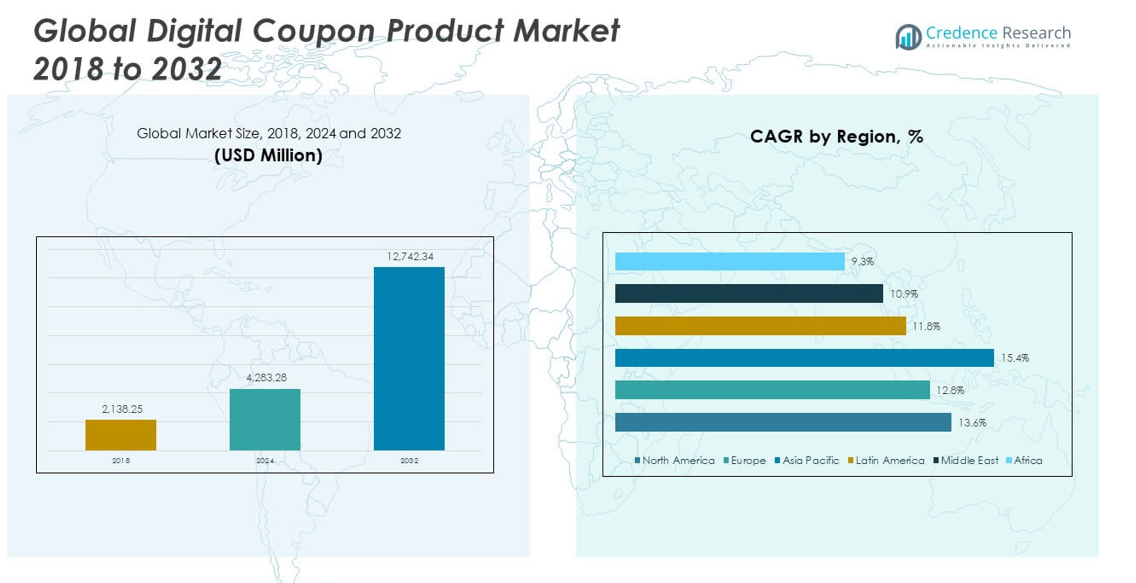
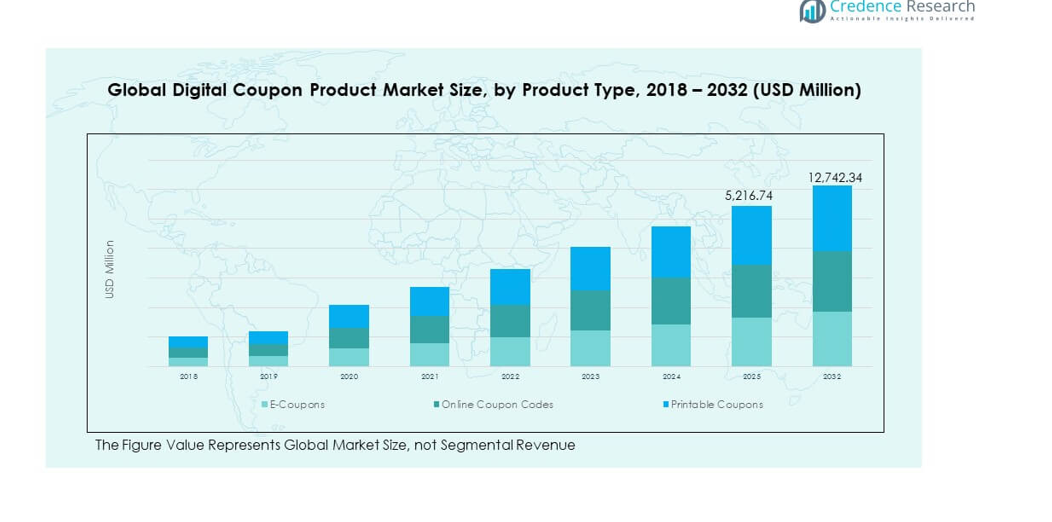
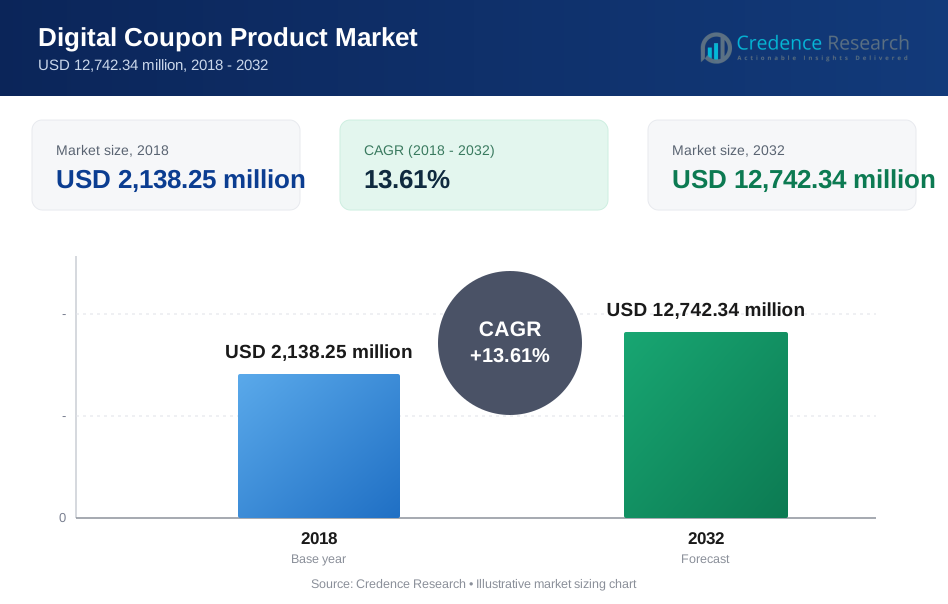
The Global Digital Coupon Product Market size was valued at USD 2,138.25 million in 2018 to USD 4,283.28 million in 2024 and is anticipated to reach USD 12,742.34 million by 2032, at a CAGR of 13.61% during the forecast period.
| REPORT ATTRIBUTE | DETAILS |
|---|---|
| Historical Period | 2020-2023 |
| Base Year | 2024 |
| Forecast Period | 2025-2032 |
| Digital Coupon Product Market Size 2024 | USD 4,283.28 million |
| Digital Coupon Product Market, CAGR | 13.61% |
| Digital Coupon Product Market Size 2032 | USD 12,742.34 million |
The market is expanding rapidly due to rising smartphone adoption and increasing internet penetration, which make digital coupon distribution seamless. Retailers and brands are embracing digital coupons to attract and retain customers through personalized promotions. Growing consumer preference for contactless transactions and real-time discounts is also driving adoption. Integration of advanced technologies like AI and data analytics allows companies to deliver targeted offers, improving redemption rates and customer loyalty.
Geographically, North America leads due to strong digital infrastructure and widespread e-commerce penetration. Europe follows, driven by high consumer adoption of online shopping and strict promotional regulations. Asia-Pacific emerges as the fastest-growing region, supported by expanding digital payment ecosystems and a young, tech-savvy population. Latin America and the Middle East & Africa are gradually adopting digital coupon systems, aided by improving mobile connectivity and rising awareness among retailers.
Market Insights:
- The Global Digital Coupon Product Market was valued at USD 2,138.25 million in 2018, reached USD 4,283.28 million in 2024, and is projected to attain USD 12,742.34 million by 2032, growing at a CAGR of 13.61%.
- North America leads with 43.7% share in 2024, driven by advanced retail infrastructure, e-commerce penetration, and strong consumer adoption of mobile-first solutions.
- Europe follows with 27.4% share, supported by high online shopping activity and regulatory-driven adoption of structured promotional strategies. Asia Pacific holds 20.8% share, boosted by rapid urbanization, rising disposable incomes, and digital wallet expansion.
- Asia Pacific emerges as the fastest-growing region, driven by its young tech-savvy population, strong e-commerce platforms, and supportive digital payment policies.
- Among segments, E-Coupons dominate with nearly 46% share in 2024, followed by Online Coupon Codes at around 33%, while Printable Coupons account for the remaining 21% of the market.
Market Drivers:
Rising Smartphone Penetration and Internet Connectivity Driving Coupon Adoption:
The Global Digital Coupon Product Market benefits from the steady rise in smartphone users and growing internet penetration. Consumers now prefer mobile-first solutions that allow instant access to promotional offers and discounts. It encourages brands to distribute coupons through mobile apps, e-wallets, and online platforms. Retailers take advantage of high engagement levels by offering location-based deals and personalized offers. Widespread 4G and 5G coverage further supports real-time coupon redemption. E-commerce platforms integrate coupons into their apps, enhancing consumer convenience. It helps bridge the gap between online and offline retail channels. Digital connectivity makes coupon marketing scalable and cost-efficient for businesses.
- For instance, Coupontools offers features like mobile coupon directories and gamified coupons, contributing to enhanced engagement, while its platform provides live analytics on open, claim, and redeem rates for campaigns, enabling marketers to optimize digital coupon effectiveness in real-time. E-commerce platforms integrate coupons into their apps, enhancing consumer convenience.
Growing Consumer Preference for Contactless Transactions and Cashless Payments:
Changing consumer payment behavior supports growth in the Global Digital Coupon Product Market. Consumers increasingly prefer contactless methods, aligning with wider adoption of digital wallets and QR-based payments. It enables seamless coupon redemption at both online and offline retail points. Retailers adopt digital vouchers to meet demand for quick and safe transactions. Customers value security and speed when redeeming discounts in-store or online. Pandemic-led behavioral shifts accelerated the move away from paper coupons. Cashless ecosystems in developed and emerging regions encourage broad usage of digital coupons. It strengthens consumer trust in digital reward systems. Retailers recognize this demand and invest in digital coupon integration.
- For instance, Vouchery.io’s AI-powered coupon management platform supports QR code scanning for in-store mobile redemption and real-time fraud detection, enhancing secure transactions and promotion performance visibility for retailers. It strengthens consumer trust in digital reward systems. Retailers recognize this demand and invest in digital coupon integration.
Increased Focus on Customer Engagement and Personalized Promotions:
The Global Digital Coupon Product Market thrives on the need for deeper consumer engagement. Retailers use data-driven strategies to personalize coupon offerings for individual shoppers. AI and machine learning enhance targeting accuracy, improving redemption rates. It allows businesses to reward loyalty and influence purchase decisions. Personalized promotions help brands retain competitive advantage in crowded markets. Retailers deliver coupons based on shopping history, browsing behavior, or geographic location. Consumers find value in tailored rewards that match their preferences. Such strategies increase customer satisfaction and strengthen brand loyalty. It positions digital coupons as a strategic tool for modern retail marketing.
Integration of Advanced Analytics and Retail Ecosystems Enhancing Effectiveness:
Advanced analytics tools support the rapid growth of the Global Digital Coupon Product Market. Retailers rely on consumer insights to forecast demand and optimize campaigns. It helps businesses design coupons that maximize engagement and drive conversions. Integrated ecosystems connect e-commerce, point-of-sale, and payment systems. This integration ensures smooth coupon issuance and redemption. Retailers use performance tracking to measure campaign success in real-time. Coupon usage data supports better product pricing and inventory management. It improves marketing ROI while reducing distribution costs. Integration of predictive analytics positions digital coupons as critical in retail innovation.
Market Trends:
Emergence of Omni-Channel Coupon Distribution Across Multiple Retail Platforms:
The Global Digital Coupon Product Market is witnessing an omni-channel shift in coupon delivery. Retailers combine physical stores, websites, and mobile apps to deliver unified promotions. It creates consistent consumer experiences across diverse channels. Customers receive offers through SMS, email, mobile apps, and social media. Retailers maximize reach by aligning online and offline strategies. Brands leverage omni-channel promotions to influence buying decisions at multiple touchpoints. It boosts redemption rates while ensuring better tracking of consumer behavior. Businesses achieve wider exposure while maintaining brand consistency. Omni-channel couponing is becoming the standard for competitive digital marketing.
- For instance, Mezzofy’s cloud-based coupon platform enables seamless issuance, distribution, and acceptance of digital coupons across various platforms including in-app and physical stores, with their system designed to allow consumers to transfer coupons easily to friends and family, enhancing omni-channel distribution effectiveness. Brands leverage omni-channel promotions to influence buying decisions at multiple touchpoints.
Growing Adoption of AI-Driven Coupon Personalization and Predictive Targeting:
The Global Digital Coupon Product Market is evolving through AI-powered personalization. Retailers deploy machine learning to analyze consumer behavior and deliver precise offers. It helps brands predict purchase intent and increase redemption probability. Real-time targeting ensures that offers reach consumers at the right moment. Retailers save costs by limiting broad, untargeted campaigns. AI-enabled segmentation refines promotions by age, location, and shopping frequency. Consumers respond positively to tailored offers aligned with lifestyle preferences. It transforms coupons from generic discounts into strategic loyalty tools. AI-driven targeting is setting new standards in coupon marketing effectiveness.
- For instance, Open Loyalty’s Q2 2025 update introduced AI-powered features such as leaderboards and badges improving engagement tracking, while Vouchery’s platform provides 1:1 segmented incentives using machine learning to optimize promotional effectiveness and reduce coupon fraud. It transforms coupons from generic discounts into strategic loyalty tools. AI-driven targeting is setting new standards in coupon marketing effectiveness.
Integration of Blockchain for Transparency and Fraud Prevention in Coupon Systems:
The Global Digital Coupon Product Market is embracing blockchain to secure transactions. Retailers adopt decentralized systems to prevent coupon duplication and fraud. It ensures transparent tracking of coupon issuance and redemption. Blockchain-based platforms enhance trust among businesses and consumers. Retailers can monitor coupon lifecycles with real-time verification. It reduces revenue losses and boosts security in promotional campaigns. Technology also supports interoperability across multiple retail and payment systems. Retailers find value in fraud-resistant coupon ecosystems that maintain consumer confidence. Blockchain adoption is positioning digital coupons as safer and more reliable.
Increased Use of Gamification and Interactive Rewards to Drive Engagement:
The Global Digital Coupon Product Market benefits from gamification trends. Retailers design interactive promotions that reward consumer participation. It includes spin-the-wheel offers, referral rewards, and instant-win coupons. Such formats enhance customer engagement and encourage repeat purchases. Brands use gamification to build excitement and strengthen loyalty. Interactive experiences improve brand recall and differentiate offers in competitive markets. It enables retailers to create deeper consumer relationships. Gamification also boosts coupon redemption by adding entertainment value. This trend signals a shift toward experience-driven digital marketing.
Market Challenges Analysis:
Security Concerns and Rising Incidences of Coupon Misuse in Retail Ecosystems:
The Global Digital Coupon Product Market faces challenges related to security and misuse. Coupon fraud, duplication, and unauthorized distribution create financial risks for businesses. It undermines retailer confidence and reduces campaign efficiency. Consumers may lose trust if redemption systems fail or errors occur. Retailers invest heavily in technology to reduce such risks, raising operational costs. Cyber threats targeting coupon platforms increase vulnerability for businesses. It complicates adoption in markets with weaker digital security frameworks. Fraud prevention requires collaboration between retailers, payment providers, and technology vendors. Addressing these concerns is essential for sustained growth and acceptance.
Fragmented Technology Adoption and Limited Infrastructure in Developing Regions:
The Global Digital Coupon Product Market encounters barriers in regions with low digital readiness. Lack of robust mobile networks and payment ecosystems restrict adoption. It hinders coupon delivery and redemption in emerging economies. Small retailers often lack resources to integrate digital systems effectively. Consumer awareness remains limited in underdeveloped markets. Retailers face difficulties aligning technology platforms across regions. High costs of implementation reduce participation from smaller businesses. It creates disparities in adoption between mature and emerging markets. Overcoming infrastructure gaps is critical for unlocking the full global potential.
Market Opportunities:
Expansion Through Integration with E-Commerce and Mobile Payment Ecosystems:
The Global Digital Coupon Product Market holds significant opportunities in linking with e-commerce and mobile payments. Retailers align coupons with digital wallets, online marketplaces, and app-based shopping. It simplifies redemption and boosts transaction volumes. E-commerce growth offers new avenues for targeted promotions. Mobile-first strategies ensure greater reach among tech-savvy consumers. Retailers enhance loyalty by offering discounts tied to payment methods. Integration supports global scalability of coupon campaigns. It strengthens cross-border retail partnerships and unlocks new growth channels.
Rising Demand in Emerging Markets with Growing Digital Infrastructure:
The Global Digital Coupon Product Market gains opportunities from expanding digital networks in emerging economies. Retailers benefit from rising smartphone penetration and improved internet coverage. It fosters greater adoption of mobile coupons among younger demographics. Retailers introduce cost-effective promotions to attract value-conscious consumers. Governments encourage digital payments, further supporting coupon adoption. Rising disposable incomes in developing countries boost spending power. It allows businesses to expand coupon campaigns across untapped markets. Emerging economies represent long-term growth drivers for the digital coupon industry.
Market Segmentation Analysis:
By Type
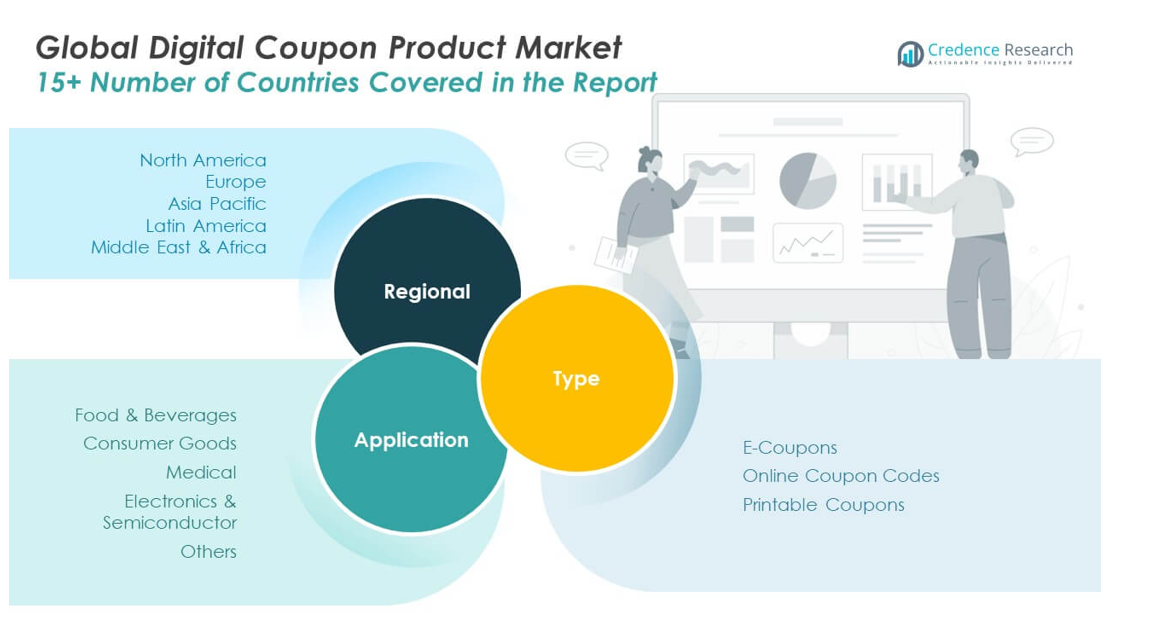
The Global Digital Coupon Product Market is segmented into e-coupons, online coupon codes, and printable coupons. E-coupons dominate due to their seamless integration with mobile wallets and retail apps, offering convenience and higher redemption rates. Online coupon codes follow, driven by strong e-commerce adoption and widespread use in digital campaigns. Printable coupons hold a smaller share but remain relevant among traditional retailers and consumers with limited digital access. It continues to shift toward mobile-first solutions as retailers prioritize digital engagement and security.
- For instance, data show that digital coupons achieve average redemption rates of 7% or higher in e-commerce, significantly outperforming paper coupons, with mobile redemption rates increasing by 63% since 2020 and over 70% of digital coupons redeemed via smartphones, illustrating the preference for e-coupons integrated into digital wallets.
By Application
The Global Digital Coupon Product Market by application includes food and beverages, consumer goods, medical, electronics and semiconductor, and others. Food and beverages represent the largest segment, supported by high-frequency consumer purchases and demand for value-driven promotions. Consumer goods follow, with retailers using coupons to build loyalty and increase repeat sales. The medical segment grows with increasing use of coupons for over-the-counter drugs and healthcare products. Electronics and semiconductor benefit from coupons tied to online retail platforms offering discounts on high-value products. Other applications, including lifestyle and personal care, contribute to steady expansion by appealing to diverse consumer groups. It reflects broad adoption across industries, supported by evolving retail strategies and consumer demand for savings.
- For instance, Woobox’s platform supports various campaign formats including coupons, giveaways, and quizzes, which can be effective for consumer engagement across sectors such as retail and lifestyle.
Segmentation:
- By Type
- E-Coupons
- Online Coupon Codes
- Printable Coupons
- By Application
- Food & Beverages
- Consumer Goods
- Medical
- Electronics & Semiconductor
- Others
- By Region
- North America
- S.
- Canada
- Mexico
- Europe
- UK
- France
- Germany
- Italy
- Spain
- Russia
- Rest of Europe
- Asia Pacific
- China
- Japan
- South Korea
- India
- Australia
- Southeast Asia
- Rest of Asia Pacific
- Latin America
- Brazil
- Argentina
- Rest of Latin America
- Middle East
- GCC Countries
- Israel
- Turkey
- Rest of Middle East
- Africa
- South Africa
- Egypt
- Rest of Africa
- North America
Regional Analysis:
North America
The North America Global Digital Coupon Product Market size was valued at USD 943.69 million in 2018 to USD 1,870.96 million in 2024 and is anticipated to reach USD 5,581.21 million by 2032, at a CAGR of 13.6% during the forecast period. North America holds the largest regional share, accounting for about 43.7% of the 2024 market. The region leads due to advanced retail infrastructure, strong e-commerce penetration, and widespread smartphone adoption. It benefits from high digital literacy and consumer openness to cashless payments. Retailers integrate coupon platforms with loyalty programs to retain customers. Leading players use advanced analytics and AI to drive personalized promotions. Regulatory clarity in data usage strengthens adoption of digital coupon systems. It remains a hub for innovation and sets industry standards for global expansion.
Europe
The Europe Global Digital Coupon Product Market size was valued at USD 607.53 million in 2018 to USD 1,173.17 million in 2024 and is anticipated to reach USD 3,286.19 million by 2032, at a CAGR of 12.8% during the forecast period. Europe represents nearly 27.4% of the 2024 market share. The region is shaped by strong consumer demand for online shopping and advanced retail systems. Retailers actively use digital coupons in food, consumer goods, and electronics. The presence of leading multinational retail brands accelerates growth. High regulatory standards around data privacy influence coupon strategies. Consumers respond positively to targeted discounts linked with loyalty programs. Cross-border digital coupon campaigns are gaining traction in the EU market. It remains one of the most structured and regulated markets for coupon adoption.
Asia Pacific
The Asia Pacific Global Digital Coupon Product Market size was valued at USD 411.28 million in 2018 to USD 892.98 million in 2024 and is anticipated to reach USD 3,008.73 million by 2032, at a CAGR of 15.4% during the forecast period. Asia Pacific accounts for 20.8% of the 2024 market share and is the fastest-growing region. Rising smartphone adoption and expanding digital payment ecosystems drive market growth. It benefits from large populations in China, India, and Southeast Asia. E-commerce platforms dominate coupon distribution in the region. Younger consumers actively engage with mobile-first promotions. Governments support digital payment adoption, creating favorable growth conditions. Regional players expand aggressively to capture the growing consumer base. It is positioned to outpace other regions in long-term market expansion.
Latin America
The Latin America Global Digital Coupon Product Market size was valued at USD 96.72 million in 2018 to USD 191.24 million in 2024 and is anticipated to reach USD 500.61 million by 2032, at a CAGR of 11.8% during the forecast period. Latin America contributes around 4.5% to the 2024 global market share. Growth is driven by improving internet access and smartphone adoption. It benefits from rising middle-class spending and demand for value-based promotions. Retailers and e-commerce players introduce coupon programs to attract cost-conscious buyers. Brazil and Mexico dominate the regional landscape with high coupon activity. Payment integration challenges still limit seamless adoption in some markets. Regional innovation is focused on mobile apps and retail partnerships. It shows steady growth potential supported by rising digital transformation.
Middle East
The Middle East Global Digital Coupon Product Market size was valued at USD 53.96 million in 2018 to USD 97.78 million in 2024 and is anticipated to reach USD 239.91 million by 2032, at a CAGR of 10.9% during the forecast period. The region represents 2.3% of the 2024 market share. Strong retail investments and the growth of e-commerce platforms drive adoption. GCC countries lead, supported by high digital penetration and consumer purchasing power. It benefits from demand for modern retail solutions among urban consumers. Retailers adopt digital coupons to attract younger demographics. Regional growth is slowed by uneven digital infrastructure in some countries. Partnerships between retailers and fintech companies improve coupon integration. It is gradually building momentum as a niche but growing market.
Africa
The Africa Global Digital Coupon Product Market size was valued at USD 25.07 million in 2018 to USD 57.16 million in 2024 and is anticipated to reach USD 125.69 million by 2032, at a CAGR of 9.3% during the forecast period. Africa holds about 1.3% of the 2024 market share, making it the smallest regional contributor. Growth is supported by rising mobile adoption and digital wallet penetration. It benefits from increasing awareness of e-commerce platforms among younger populations. Retailers use coupons to attract consumers in urban centers. Infrastructure limitations and low banking penetration slow overall expansion. South Africa and Egypt are the primary markets with notable activity. Retailers experiment with SMS-based coupon campaigns due to limited internet access. It presents long-term opportunities as digital ecosystems mature across the continent.
Key Player Analysis:
- Mezzofy
- Coupontools
- Venngage Inc.
- Coupon Carrier
- Open Loyalty
- Woobox
- Vouchery
- Allerin
- Vouchermatic
- One
Competitive Analysis:
The Global Digital Coupon Product Market features intense competition shaped by established technology providers, retail solution developers, and emerging startups. Companies such as Mezzofy, Coupontools, Venngage, and Talon.One differentiate through innovative platforms, seamless integration, and advanced analytics. It drives competitiveness through personalized promotions, omni-channel delivery, and fraud prevention technologies. Global players strengthen positions by expanding regional footprints and forming alliances with retailers and payment providers. Smaller firms target niche markets with specialized couponing solutions. The competitive landscape is marked by a mix of consolidation strategies, innovative launches, and partnerships. It continues to evolve as players invest in customer engagement technologies.
Recent Developments:
- In August 2025, Coupontools emphasized its innovative digital coupon platform capabilities, including gamified coupons like spin & win and scratch & win, and introduced a mobile coupon directory and digital loyalty cards. The platform supports seamless customer engagement through various integrations and advanced analytics, helping businesses to attract and retain customers effectively.
- In April 2025, Mezzofy (Hong Kong) Limited entered into an exclusive strategic partnership with Treasure Global Inc., granting Treasure Global the sole distribution rights for Mezzofy's digital coupon platform in Malaysia. This cloud-based Coupon-as-a-Service platform has already facilitated over USD 40 billion in digital coupon transactions across 15 markets and is positioned to generate USD 2 to 4 million in recurring annual revenue within its first year of rollout in Malaysia.
- Venngage Inc. reported revenue growth in 2024, reaching USD 3.5 million, reflecting increasing adoption of its infographic and visual communication tools globally. This steady growth underlines Venngage's continued expansion and strengthening user base.
Report Coverage:
The research report offers an in-depth analysis based on type and application. It details leading market players, providing an overview of their business, product offerings, investments, revenue streams, and key applications. Additionally, the report includes insights into the competitive environment, SWOT analysis, current market trends, as well as the primary drivers and constraints. Furthermore, it discusses various factors that have driven market expansion in recent years. The report also explores market dynamics, regulatory scenarios, and technological advancements that are shaping the industry. It assesses the impact of external factors and global economic changes on market growth. Lastly, it provides strategic recommendations for new entrants and established companies to navigate the complexities of the market.
Future Outlook:
- Rising demand for mobile-first coupon solutions will redefine customer engagement.
- AI-powered personalization will strengthen redemption rates across retail platforms.
- Integration with digital wallets will expand adoption in urban markets.
- Blockchain-enabled systems will enhance security and reduce coupon fraud.
- Retailers will increase investment in omni-channel coupon campaigns.
- E-commerce partnerships will create wider reach for digital promotions.
- Asia Pacific will emerge as the fastest-growing hub for coupon adoption.
- Cross-border coupon interoperability will become a strategic focus.
- Data-driven insights will optimize campaign ROI and strengthen loyalty programs.
- Emerging economies will unlock long-term opportunities with expanding digital infrastructure.
Request a Free Sample
Fill in your details and we'll send you a free sample report.
- Sample data tables & charts
- Research methodology
Need a Custom Version of This Report?
Tailor the scope, geography, or segments to your exact requirements.
- Custom geography or segment scope
- Direct access to our analyst team
Frequently Asked Questions
What is the current market size for Global Digital Coupon Product Market, and what is its projected size in 2032?
At what Compound Annual Growth Rate is the Global Digital Coupon Product Market projected to grow between 2025 and 2032?
Which Global Digital Coupon Product Market segment held the largest share in 2024?
What are the primary factors fueling the growth of the Global Digital Coupon Product Market?
Who are the leading companies in the Global Digital Coupon Product Market?
Table of Content
Chapter 1. Report Introduction
- 1.1 Report Description & Purpose
- 1.1.1 Report Title & Market Definition
- 1.1.2 Unique Selling Propositions (USP) & Key Differentiators
- 1.1.3 Value Proposition for Stakeholders
- 1.2 Research Objectives
- 1.2.1 Market Sizing Objectives (Volume & Revenue)
- 1.2.2 Segmentation Objectives
- 1.2.3 Competitive Intelligence Objectives
- 1.2.4 Forecast & Scenario Objectives
- 1.3 Report Scope
- 1.3.1 Digital Coupon Product Scope – Types & Subtypes Covered
- 1.3.2 Geographic Scope – Regions & Countries Covered
- 1.3.3 Historical Period, Base Year & Forecast Period (2018; forecast to 2032)
- 1.3.4 Inclusions & Exclusions
- 1.4 HS Code & Classification Framework
- 1.5 Currency, Units & Pricing Basis
- 1.6 Target Stakeholders
- 1.7 Limitations & Assumptions
Chapter 2. Executive Summary
- 2.1 Global Digital Coupon Product Market Snapshot
- 2.1.1 Market Size – Historical (2018) & Forecast (2018-2032) (2018: USD 2,138.25 million → 2032: USD 12,742.34 million)
- 2.1.2 Volume & Revenue – Global Totals
- 2.1.3 Key Market Highlights – Top Five Facts
- 2.2 Digital Coupon Product Market Segmentation Snapshot
- 2.2.1 Market Split by Region – 2018 vs. 2032
- 2.3 Competitive Snapshot
- 2.3.1 Top 10 Players by Revenue Share – 2018
- 2.3.2 Top 10 Players by Volume Share – 2018
- 2.3.3 Recent Strategic Developments (18-Month Summary)
- 2.4 Key Investment Highlights & Strategic Conclusions
Chapter 3. Digital Coupon Product Market Dynamics & Industry Analysis
- 3.1 Market Overview & Context
- 3.1.1 Digital Coupon Product Market Position in the Broader Automotive Value Chain
- 3.1.2 OEM vs. Replacement Market Dynamics
- 3.1.3 Market Maturity & Development Stage by Region
- 3.2 Digital Coupon Product Market Drivers
- 3.3 Digital Coupon Product Market Restraints & Challenges
- 3.4 Digital Coupon Product Market Opportunities
- 3.5 Porter's Five Forces Analysis
- 3.5.1 Threat of New Entrants
- 3.5.2 Bargaining Power of Suppliers
- 3.5.3 Bargaining Power of Buyers
- 3.5.4 Threat of Substitutes
- 3.5.5 Competitive Rivalry – Intensity Assessment
- 3.6 Digital Coupon Product Value Chain Analysis
- 3.6.1 Upstream – Raw Material/Input Suppliers
- 3.6.1.1 Raw Material/Input 1
- 3.6.1.2 Raw Material/Input 2
- 3.6.1.3 Raw Material/Input 3
- 3.6.2 Midstream – Production/Manufacturing/Service Delivery
- 3.6.2.1 Production/Process Overview
- 3.6.2.2 Key Facility Locations & Capacity by Manufacturer
- 3.6.3 Downstream – Distribution & End Consumer
- 3.6.3.1 Primary Channel – B2B/OEM
- 3.6.3.2 Secondary Channels – Dealer, Retail, Online, Direct
- 3.6.4 Value Chain Profitability Analysis
- 3.6.1 Upstream – Raw Material/Input Suppliers
- 3.7 PESTEL Analysis
- 3.7.1 Political Factors
- 3.7.2 Economic Factors
- 3.7.3 Social Factors
- 3.7.4 Technological Factors
- 3.7.5 Environmental Factors
- 3.7.6 Legal Factors
- 3.8 Digital Coupon Product Supply Chain Analysis
- 3.8.1 Raw Material/Input Supply Risk Assessment
- 3.8.2 Manufacturing Concentration Risk (Geographic Exposure)
- 3.8.3 Trade Disruption Impact Analysis
- 3.9 Regulatory & Policy Landscape
Note: The regulatory and policy landscape section covers regulations based on their applicability to the market, Digital Coupon Product category, geography, and scope of the study. Only regulatory frameworks with a material impact on operations, compliance, trade, sustainability, or market access are analyzed in detail.
Chapter 4. Key Investment Pockets & Opportunity Analysis
- 4.1 Digital Coupon Product Market Attractiveness Analysis
- 4.1.1 By Region – Investment Attractiveness Matrix (Volume × CAGR)
- 4.2 Absolute Revenue Growth Opportunity
- 4.2.1 By Region – Absolute USD Growth Through 2032
- 4.3 Incremental Volume Opportunity
- 4.3.1 By Region – Incremental Volume Through 2032
- 4.3.2 Segment – Incremental Volume
- 4.4 Emerging Submarket Opportunity Deep Dive (Subject to Applicability)
- 4.5 Emerging Market Opportunity Scorecards
- 4.5.1 United States
- 4.5.2 Europe
- 4.5.3 Asia
- 4.5.4 Middle East & Africa
Note: Emerging Market Opportunity Scorecards will be included based on relevance and strategic importance. Regions listed are indicative and may vary depending on data availability and market dynamics.
Chapter 5. Digital Coupon Product Import-Export Analysis & Trade Flows
- 5.1 Global Trade Overview
- 5.1.1 Global Export Value by Country (2018)
- 5.1.2 Global Export Volume by Country (2018)
- 5.1.3 Global Import Value by Country (2018)
- 5.1.4 Global Import Volume by Country (2018)
- 5.1.5 Net Trade Balance by Country (2018)
- 5.2 Export Analysis – Segment
- 5.2.1 Type 1 (HS Code)
- 5.2.2 Type 2 (HS Code)
- 5.2.3 Type 3 (HS Code)
- 5.2.4 Type 4 (HS Code)
- 5.2.5 Type 5 (HS Code)
- 5.3 Import Analysis – Segment
- 5.3.1 Type 1 (HS Code)
- 5.3.2 Type 2 (HS Code)
- 5.3.3 Type 3 (HS Code)
- 5.3.4 Type 4 (HS Code)
- 5.3.5 Type 5 (HS Code)
- 5.4 Average Unit Trade Prices
- 5.4.1 Average Export Price – Segment & Country
- 5.4.2 Average Import Price – Segment & Source Country
- 5.4.3 Price Trends (2018)
- 5.5 Key Trade Route Analysis
- 5.5.1 Trade Route 1
- 5.5.2 Trade Route 2
- 5.5.3 Trade Route 3
- 5.5.4 Trade Route 4
- 5.5.5 Trade Route 5
- 5.6 Trade Policy Impact Assessment
- 5.6.1 US Anti-Dumping & Section 301 Tariffs
- 5.6.2 EU Customs Union Impact
- 5.6.3 Major Free Trade Agreements
- 5.6.4 USMCA Rules of Origin
Note: Trade policy analysis will be included only where relevant to the Digital Coupon Product market.
Chapter 6. Competitive Landscape & Company Benchmarking
- 6.1 Digital Coupon Product Market Concentration & Structure
- 6.1.1 Herfindahl-Hirschman Index (HHI) – vs. 2018
- 6.1.2 Tier 1, Tier 2 & Tier 3 Market Structure
- 6.1.3 Global, Regional & Local Player Dynamics
- 6.2 Digital Coupon Product Market Share Analysis – 2018
- 6.2.1 Global Revenue Share by Company
- 6.2.2 Global Volume Share by Company
- 6.2.3 Regional Revenue Share
- 6.2.4 Market Share Evolution ( vs. 2018)
- 6.2.5 OEM Segment Share by Company
- 6.2.6 Replacement Segment Share by Company
- 6.3 Production/Delivery Capacity & Facility Analysis
- 6.3.1 Global Installed Capacity
- 6.3.2 Capacity Utilization Rates
- 6.3.3 Production/Output Volume
- 6.3.4 Facility Locations & Capacity Map
- 6.3.5 Planned Capacity Additions
- 6.4 Digital Coupon Product Competitive Benchmarking Matrix
- 6.4.1 Revenue, Volume, CAGR & Profitability Comparison
- 6.4.2 Channel Revenue Mix
- 6.4.3 Geographic Revenue Exposure
- 6.4.4 R&D Intensity
- 6.4.5 Sustainability Maturity
- 6.5 Strategic Developments in Digital Coupon Product (Last 24 Months)
- 6.5.1 Mergers, Acquisitions & Divestments
- 6.5.2 New Digital Coupon Product Launches
- 6.5.3 Facility Expansions
- 6.5.4 Strategic Alliances, Joint Ventures & Partnerships
- 6.5.5 Distribution Expansion & Market Entry
- 6.5.6 Sustainability & ESG Initiatives
- 6.6 Competitive Strategy Mapping
- 6.6.1 Leader, Challenger, Follower & Niche Classification
- 6.6.2 Pricing Strategy Comparison
- 6.6.3 Channel Strategy Matrix
Note: Strategic developments are included based on their materiality and the availability of reliable information.
Chapter 7. Global Digital Coupon Product Market – By Distribution Channel
- 7.1 Segment Overview
- 7.1.1 Volume & Revenue Split by Channel (2018 & 2032)
- 7.1.2 Channel Mix Evolution (2018-2032)
Chapter 8. Regional Market Analysis – Global Overview
- 8.1 Global Regional Overview
- 8.1.1 Regional Volume Share
- 8.1.2 Regional Revenue Share
- 8.1.3 Regional Volume by Region
- 8.1.4 Regional Revenue by Region
- 8.1.5 Regional Forecast Through 2032
- 8.2 Cross-Regional Segment Analysis
- 8.2.1 By Distribution Channel
- 8.2.2 By Brand/Price Tier
Chapter 9. North America Digital Coupon Product Market
- 9.1 United States
- 9.2 Canada
- 9.3 Mexico
Chapter 10. Europe Digital Coupon Product Market
- 10.1 Germany
- 10.2 France
- 10.3 Italy
- 10.4 United Kingdom
- 10.5 Spain
- 10.6 Poland
- 10.7 Russia
- 10.8 Netherlands
- 10.9 Belgium
- 10.10 Sweden
- 10.11 Denmark
- 10.12 Norway
- 10.13 Rest of Europe
Chapter 11. Asia Pacific Digital Coupon Product Market
- 11.1 China
- 11.2 India
- 11.3 Japan
- 11.4 South Korea
- 11.5 Thailand
- 11.6 Indonesia
- 11.7 Vietnam
- 11.8 Malaysia
- 11.9 Australia
- 11.10 Rest of Asia Pacific
Chapter 12. Latin America Digital Coupon Product Market
- 12.1 Brazil
- 12.2 Argentina
- 12.3 Colombia
- 12.4 Chile
- 12.5 Rest of Latin America
Chapter 13. Middle East Digital Coupon Product Market
- 13.1 Saudi Arabia
- 13.2 United Arab Emirates
- 13.3 Turkey
- 13.4 Israel
- 13.5 Iran
- 13.6 Rest of the Middle East
Chapter 14. Africa Digital Coupon Product Market
- 14.1 South Africa
- 14.2 Egypt
- 14.3 Nigeria
- 14.4 Morocco
- 14.5 Rest of Africa
Chapter 15. Digital Coupon Product Company Profiles
- 15.1 [Company 01]
- 15.1.1 Company Overview
- 15.1.2 Key Management Personnel
- 15.1.3 Products & Services Portfolio
- 15.1.4 Financial Performance
- 15.1.5 Key Market Focus & Geographic Presence
- 15.1.6 Recent Developments & Strategic Initiatives
Note: The company profile list is preliminary and may change based on research findings, market developments, data availability, and client requirements.
Chapter 16. Appendices
- Appendix A – List of Abbreviations & Acronyms
- Appendix B – Industry Classification Code Reference – Full Series
- Appendix C – Production & Capacity Data Tables
- Appendix D – End-Use & Demand Base Tables
- Appendix E – Consumption & Replacement Rate Assumptions
- Appendix F – ASP Reference Tables
- Appendix G – Manufacturing & Facility Database
- Appendix H – Import-Export Data Tables
- Appendix I – Regulatory Summary Tables
- Appendix J – Primary Research Participant List (Anonymized)
- Appendix K – Primary Research Questionnaire Framework
- Appendix L – Data Sources & Bibliography
- Appendix M – Market Size Divergence & Source Comparison
Chapter 17. Research Methodology
- 17.1 Research Framework & Philosophy
- 17.2 Secondary Research – Sources, Hierarchy & Data Extraction
- 17.3 Data Modeling – Bottom-Up & Top-Down Market Sizing
- 17.4 Primary Research – Stakeholder Framework, LOI & Sample Sizes
- 17.5 Forecast Methodology – Regression, Scenario & Sensitivity Analysis
- 17.6 Quality Control – Four-Layer Validation Framework
- 17.7 Limitations & Standard Assumptions
- 17.8 Disclaimer
