
Market Overview:
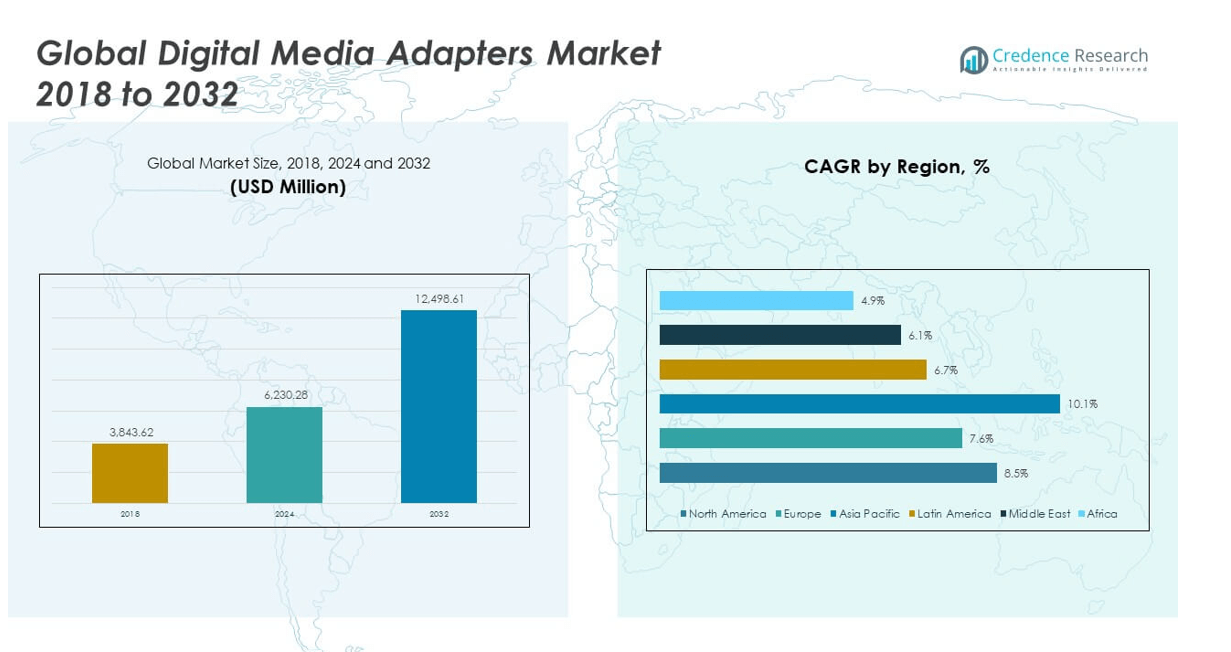
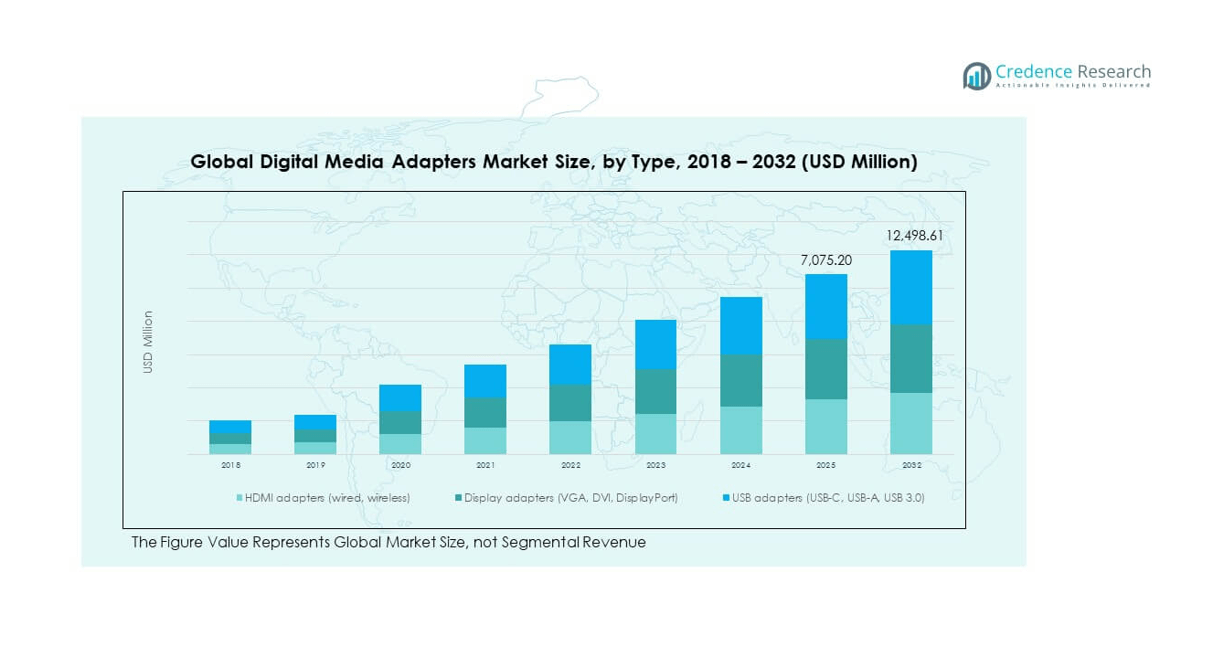
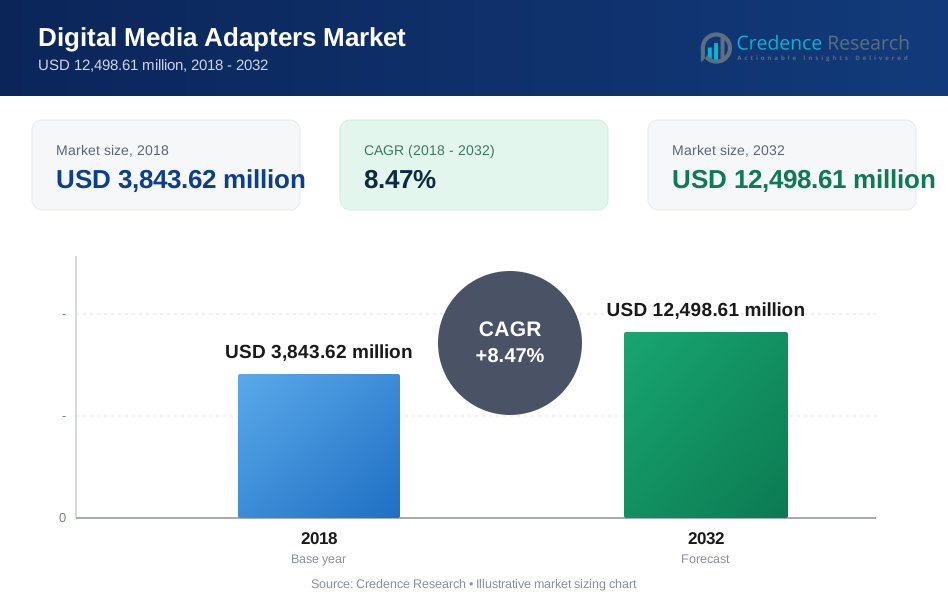
The Global Digital Media Adapters Market size was valued at USD 3,843.62 million in 2018 to USD 6,230.28 million in 2024 and is anticipated to reach USD 12,498.61 million by 2032, at a CAGR of 8.47% during the forecast period.
| REPORT ATTRIBUTE | DETAILS |
|---|---|
| Historical Period | 2020-2023 |
| Base Year | 2024 |
| Forecast Period | 2025-2032 |
| Digital Media Adapters Market Size 2024 | USD 6,230.28 million |
| Digital Media Adapters Market, CAGR | 8.47% |
| Digital Media Adapters Market Size 2032 | USD 12,498.61 million |
Growth in this market is driven by the rising demand for seamless connectivity between digital devices and smart entertainment systems. Consumers seek user-friendly solutions for streaming, multimedia sharing, and cross-platform compatibility. The increase in adoption of smart TVs, streaming devices, and home entertainment systems has fueled demand. Advances in wireless technologies, combined with a surge in high-quality digital content, support adoption across households and commercial setups. Companies are focusing on innovation to enhance device integration and ensure compatibility with emerging platforms.
Regionally, North America leads due to high adoption of advanced consumer electronics, strong internet infrastructure, and the presence of global technology providers. Europe follows, supported by increasing demand for smart home systems and strong innovation in connected devices. Asia-Pacific is emerging as the fastest-growing region, driven by rising disposable incomes, urbanization, and expanding consumer interest in digital entertainment across China, India, and Southeast Asia. Latin America and the Middle East & Africa are gradually adopting digital media adapters as broadband penetration and consumer demand for connected solutions expand.
Market Insights:
- The Global Digital Media Adapters Market size was valued at USD 3,843.62 million in 2018, reached USD 6,230.28 million in 2024, and is projected to hit USD 12,498.61 million by 2032, registering a CAGR of 8.47%.
- North America held the largest share at 32% in 2024, supported by advanced broadband infrastructure, high spending on home entertainment, and strong presence of leading technology firms.
- Europe accounted for 20% of the market in 2024, driven by demand for smart home systems and regulatory focus on energy-efficient digital devices, while Asia Pacific followed with 25% share, reflecting growing adoption in China, Japan, and India.
- Asia Pacific is the fastest-growing region with 10.1% CAGR, fueled by urbanization, rising disposable incomes, and expanding streaming platforms across emerging economies.
- By type, HDMI adapters accounted for nearly 48% of the market in 2024, followed by USB adapters at 32%, with both segments benefiting from strong demand for streaming, gaming, and cross-device connectivity.
Market Drivers:
Growing Demand for Seamless Connectivity Across Devices:
The Global Digital Media Adapters Market is propelled by the increasing need for seamless connectivity among smart devices. Consumers expect uninterrupted streaming and multimedia transfer between televisions, smartphones, and laptops. Rising adoption of smart TVs and high-definition streaming platforms has made adapters essential in modern households. Companies respond with products that ensure faster transfer speeds and minimal latency. Wireless technologies such as Wi-Fi 6 and Bluetooth advancements enhance connectivity. These innovations create greater user convenience and efficiency in device integration. Businesses leverage compatibility features to build stronger consumer trust. It continues to support broader adoption across both personal and professional environments.
- For instance, Roku’s 2025 Streaming Stick Plus supports 4K resolution and HDR with improved faster app launch times. It is similar in size to competing sticks and features Wi-Fi 5, not Wi-Fi 6, and lacks Bluetooth for audio connectivity. It offers enhanced wireless streaming performance, but minimal lag is dependent on internet speed and network conditions.
Increasing Popularity of Smart Entertainment Systems:
Rising interest in smart home entertainment is creating consistent demand for adapters. Streaming platforms dominate viewing habits, making device integration a priority for users. Consumers expect a smooth transition between offline storage and online streaming services. High-resolution content such as 4K and 8K formats has intensified the need for efficient adapters. Manufacturers focus on compact, energy-efficient designs to meet evolving consumer expectations. The market benefits from increasing affordability of smart TVs and projectors. These trends align with higher disposable incomes across developing economies. It allows adapters to play a central role in the digital entertainment ecosystem.
- For instance, Apple’s recent $500 million initiative with MP Materials includes the production of advanced rare earth magnets, made from 100% recycled materials, that will be used in Apple products such as iPhones, Macs, and Apple Watch. This helps secure a domestic supply chain for critical components while supporting U.S. manufacturing.
Rising Consumer Shift Toward Cord-Free Solutions:
The market is strongly influenced by a growing preference for wireless experiences. Consumers avoid clutter and value convenience, leading to higher demand for cordless adapters. Businesses introduce plug-and-play models that reduce setup complexities. Wireless protocols enable smoother connections without frequent manual configurations. The popularity of portable streaming devices further accelerates wireless adoption. Consumers favor compact designs that offer flexibility in small living spaces. Cord-free solutions address the mobility needs of younger demographics. It strengthens the role of adapters in meeting modern connectivity expectations.
Expanding Commercial Applications in Professional Spaces:
Commercial environments are adopting digital media adapters for presentations, collaborative work, and training. Offices integrate adapters to simplify connections between laptops, projectors, and conferencing systems. Educational institutions also employ them to enhance teaching methods and digital learning. Rising use in retail environments supports interactive displays and consumer engagement. Healthcare facilities benefit from adapters for data sharing and visualization tools. This expansion beyond homes broadens revenue opportunities for vendors. Growing demand for high-quality audiovisual experiences in business settings reinforces adoption. It establishes adapters as an essential tool in commercial digital ecosystems.
Market Trends:
Integration of Artificial Intelligence for Enhanced Media Experience:
The Global Digital Media Adapters Market is witnessing AI integration that optimizes user experience. Smart algorithms automatically adjust resolution, latency, and bandwidth allocation. These improvements deliver seamless streaming quality even under limited connectivity. Devices with AI features personalize recommendations and content synchronization. Vendors use AI-driven diagnostics to ensure device longevity and performance. Enhanced automation reduces manual interventions and improves adaptability across platforms. AI also strengthens cybersecurity features within adapters. It creates an advanced ecosystem that enhances consumer satisfaction and device utility.
- For instance, Netgear’s acquisition of Exium in 2025 added AI-driven Secure Access Service Edge (SASE) cybersecurity and networking management to their solutions, enabling automated network security with adaptive performance monitoring, reducing manual IT interventions. Enhanced automation reduces manual interventions and improves adaptability across platforms.
Development of Compact Multi-Functional Adapters:
The market is experiencing a trend toward compact and multifunctional devices. Vendors focus on reducing size while incorporating multiple input and output ports. Consumers demand space-saving solutions that still offer wide compatibility. Innovations enable integration with gaming consoles, smart TVs, and VR devices. Multi-port adapters support higher resolution displays without compromising quality. Portability becomes an added advantage for professionals and travellers. This trend strengthens consumer adoption across diverse demographic groups. It redefines consumer expectations of adaptability and performance.
- For instance, Roku's 2025 lineup includes streaming sticks that offer full HD and 4K HDR streaming. While the devices are compact and functional, independent tests and reviews find noticeable differences in performance compared to Amazon's latest Fire TV sticks. Reviewers often cite Roku's interface as feeling faster and simpler for navigation, while Amazon's Fire TV sticks sometimes feature speedier app launching and voice controls, especially with deeper Alexa integration.
Growing Adoption of Cloud-Based Streaming Support:
Cloud-driven entertainment is pushing manufacturers to design adapters with enhanced compatibility. Consumers increasingly access media content via cloud platforms rather than local storage. Adapters now include built-in features to synchronize with cloud servers efficiently. This trend aligns with the expansion of subscription-based streaming services. Businesses benefit from offering consumers access to content anytime and anywhere. Enhanced network support ensures minimal buffering during cloud access. Cloud integration also provides scalability for future media consumption needs. It makes adapters a critical link in delivering cloud-based entertainment services.
Advancements in Eco-Friendly and Energy-Efficient Technologies:
Environmental awareness is shaping product development in this market. Companies introduce adapters that consume less energy and meet sustainability standards. Energy-efficient chipsets reduce heat generation and extend device life. Eco-friendly packaging further aligns with consumer preferences. Manufacturers invest in recyclable components to reduce carbon footprints. These green strategies enhance brand reputation and consumer loyalty. Government regulations also encourage sustainable practices in electronics. It creates new opportunities for differentiation and competitive positioning in the market.
Market Challenges Analysis:
Compatibility Issues with Rapidly Evolving Devices:
The Global Digital Media Adapters Market faces challenges due to compatibility concerns. Rapidly evolving devices introduce frequent upgrades in connection protocols. Manufacturers must constantly update adapters to maintain relevance. This adds cost pressures and slows product release cycles. Consumers face frustration when adapters fail to connect seamlessly with new hardware. Lack of standardized regulations across industries further complicates the issue. Vendors struggle to balance affordability with advanced technical features. It continues to restrict smooth consumer adoption and creates replacement concerns.
Price Sensitivity and Strong Competition in Emerging Markets:
Intense competition creates challenges in sustaining profit margins for vendors. Low-cost alternatives from local manufacturers often attract price-sensitive consumers. Premium products face difficulty in penetrating developing economies. Vendors need strong differentiation strategies to justify higher price points. Marketing costs and distribution challenges further increase financial pressure. Consumers also hesitate to replace adapters frequently due to cost. These factors limit expansion potential in emerging markets. It underscores the need for innovation-driven growth strategies and brand loyalty.
Market Opportunities:
Rising Expansion of Smart Homes and Connected Ecosystems:
The Global Digital Media Adapters Market benefits from the rising adoption of smart homes. Consumers invest in interconnected devices that demand efficient adapters. Vendors can leverage this shift to introduce products that integrate seamlessly with IoT networks. The expansion of 5G networks supports better connectivity and faster streaming. Smart appliances, home theaters, and surveillance systems all require reliable adapters. Companies offering solutions that support multiple device ecosystems gain a competitive edge. It unlocks significant potential across developed and emerging economies.
Emergence of Advanced Applications Beyond Home Entertainment:
Opportunities extend beyond households into industries like healthcare, retail, and education. Healthcare facilities can use adapters for real-time imaging and secure data sharing. Retail environments benefit from digital signage and interactive displays powered by adapters. Educational institutions are adopting digital solutions for remote and hybrid learning models. Offices also continue to rely on adapters for conferencing and collaboration. This diversification ensures consistent demand across multiple sectors. It positions adapters as integral components in future digital ecosystems.
Market Segmentation Analysis:
By Type
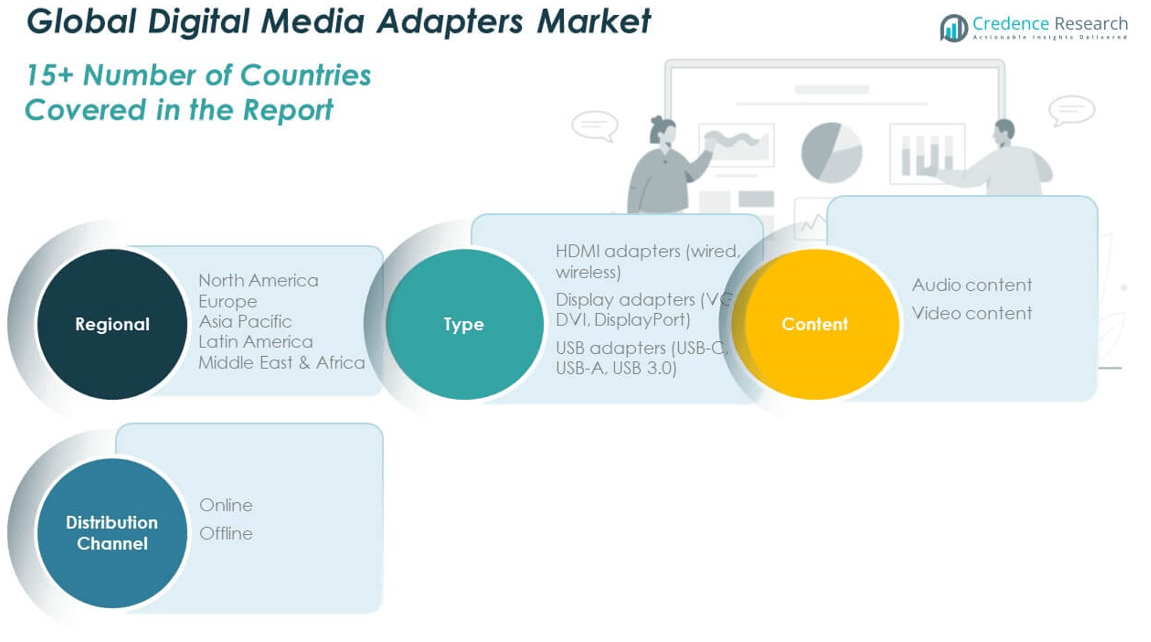
The Global Digital Media Adapters Market is segmented into HDMI, Display, and USB adapters. HDMI adapters, both wired and wireless, dominate demand due to widespread adoption in smart TVs, projectors, and gaming systems. Display adapters, including VGA, DVI, and DisplayPort, retain relevance for legacy systems and professional display applications. USB adapters, covering USB-C, USB-A, and USB 3.0, gain traction with rising use in laptops, tablets, and mobile devices. It continues to evolve as multi-port and high-speed standards shape consumer choices.
- For instance, many new adapters and cables using the USB 3.2 Gen 2 standard support data transfer speeds up to 10 Gbps via the USB-C port, which enables faster connectivity between compatible devices.
By Content
Segmentation by content highlights audio and video applications. Video content holds the larger share, driven by streaming platforms, home entertainment, and corporate presentation needs. The surge in high-definition and 4K/8K video further strengthens demand for advanced adapters. Audio content supports growth in music streaming, digital speakers, and wireless sound systems. It ensures compatibility across multimedia ecosystems where performance and sound quality are critical.
- For instance, advanced adapters integrated with AI-based audio enhancement algorithms enable real-time sound adjustment and noise cancellation, improving user experience with wireless speakers and headphones.
By Distribution Channel
The market distribution divides into online and offline channels. Online channels are gaining momentum due to e-commerce platforms, wider product availability, and consumer preference for convenience. Competitive pricing and extensive product comparisons strengthen digital sales. Offline channels remain important for customers seeking in-store trials, immediate purchases, and technical support. It reflects balanced growth across both channels, ensuring access for diverse consumer needs.
Segmentation:
By Type
- HDMI Adapters (Wired, Wireless)
- Display Adapters (VGA, DVI, DisplayPort)
- USB Adapters (USB-C, USB-A, USB 3.0)
By Content
- Audio Content
- Video Content
By Distribution Channel
- Online
- Offline
By Region
- North America
- U.S.
- Canada
- Mexico
- Europe
- UK
- France
- Germany
- Italy
- Spain
- Russia
- Belgium
- Netherlands
- Austria
- Sweden
- Poland
- Denmark
- Switzerland
- Rest of Europe
- Asia Pacific
- China
- Japan
- South Korea
- India
- Australia
- Thailand
- Indonesia
- Vietnam
- Malaysia
- Philippines
- Taiwan
- Rest of Asia Pacific
- Latin America
- Brazil
- Argentina
- Peru
- Chile
- Colombia
- Rest of Latin America
- Middle East
- UAE
- KSA
- Israel
- Turkey
- Iran
- Rest of Middle East
- Africa
- Egypt
- Nigeria
- Algeria
- Morocco
- Rest of Africa
Regional Analysis:
North America
The North America Digital Media Adapters Market size was valued at USD 1,677.12 million in 2018 to USD 2,690.27 million in 2024 and is anticipated to reach USD 5,411.96 million by 2032, at a CAGR of 8.5% during the forecast period. North America accounts for nearly 32% share of the Global Digital Media Adapters Market. The region benefits from strong adoption of smart TVs, advanced entertainment systems, and widespread broadband infrastructure. U.S. consumers drive demand with high spending on home entertainment and gaming solutions. Canada follows with growing interest in digital connectivity in both households and commercial spaces. Technology leaders in the region continuously invest in wireless protocols and AI-based media enhancements. The presence of major global companies strengthens product availability and innovation. It reflects steady growth as digital transformation continues to dominate consumer lifestyles and professional workspaces.
Europe
The Europe Digital Media Adapters Market size was valued at USD 1,073.70 million in 2018 to USD 1,676.68 million in 2024 and is anticipated to reach USD 3,163.62 million by 2032, at a CAGR of 7.6% during the forecast period. Europe contributes nearly 20% share to the Global Digital Media Adapters Market. The region’s growth is supported by strong consumer adoption of smart home solutions and increasing penetration of streaming platforms. Germany, the UK, and France lead with high demand for premium adapters in home and professional environments. Southern and Eastern Europe contribute to growth with rising digital adoption in emerging economies. Strong regulatory focus on sustainability encourages energy-efficient adapter designs. Vendors expand offerings to meet diverse preferences across professional and consumer segments. It reinforces Europe’s position as a key market with stable and innovation-driven expansion.
Asia Pacific
The Asia Pacific Digital Media Adapters Market size was valued at USD 762.36 million in 2018 to USD 1,336.27 million in 2024 and is anticipated to reach USD 3,026.16 million by 2032, at a CAGR of 10.1% during the forecast period. Asia Pacific holds nearly 25% share of the Global Digital Media Adapters Market. China, India, Japan, and South Korea are major contributors, supported by rising middle-class incomes and rapid urbanization. Strong demand for smart TVs, mobile devices, and streaming platforms accelerates adoption. Expanding broadband infrastructure supports the region’s digital ecosystem. The affordability of adapters aligns well with consumer price sensitivity in emerging economies. Japan and South Korea lead in technological innovation, driving advanced wireless and AI-enabled solutions. It establishes Asia Pacific as the fastest-growing region with diverse opportunities across consumer and commercial applications.
Latin America
The Latin America Digital Media Adapters Market size was valued at USD 173.86 million in 2018 to USD 278.16 million in 2024 and is anticipated to reach USD 491.03 million by 2032, at a CAGR of 6.7% during the forecast period. Latin America contributes about 4% share to the Global Digital Media Adapters Market. Brazil dominates the region, driven by increasing adoption of digital entertainment and online platforms. Mexico and Argentina also contribute with rising urban populations and growing internet access. Consumers show preference for affordable, multifunctional adapters in residential setups. Vendors face challenges due to economic volatility and uneven broadband penetration. Nonetheless, demand continues to rise with growing digital transformation initiatives. It indicates steady but modest growth supported by regional consumer adoption.
Middle East
The Middle East Digital Media Adapters Market size was valued at USD 105.10 million in 2018 to USD 155.37 million in 2024 and is anticipated to reach USD 261.70 million by 2032, at a CAGR of 6.1% during the forecast period. The region accounts for nearly 2% share of the Global Digital Media Adapters Market. GCC countries dominate due to high adoption of premium entertainment systems and strong disposable incomes. Israel and Turkey contribute with increasing use of smart devices and streaming platforms. Demand grows in commercial spaces including offices, retail, and hospitality sectors. Vendors expand distribution networks to reach a diverse consumer base. Rising investments in smart city projects further support adoption. It reflects gradual yet steady growth driven by modernization and lifestyle upgrades.
Africa
The Africa Digital Media Adapters Market size was valued at USD 51.47 million in 2018 to USD 93.53 million in 2024 and is anticipated to reach USD 144.13 million by 2032, at a CAGR of 4.9% during the forecast period. Africa contributes around 1% share to the Global Digital Media Adapters Market. South Africa leads adoption due to better infrastructure and growing digital lifestyles. Nigeria, Kenya, and Egypt show rising demand with expanding internet penetration. Affordability remains a challenge, limiting adoption in price-sensitive markets. Vendors target entry-level products to meet consumer needs in developing economies. Growth is further supported by increasing smartphone penetration and rising demand for streaming content. It underlines gradual but expanding opportunities across African markets.
Key Player Analysis:
- Roku Inc.
- Apple Inc.
- Google LLC
- com, Inc.
- Netgear, Inc.
- Cisco Systems, Inc.
- Samsung Electronics Co., Ltd.
- Magna-Tech Electronic Co., Inc.
- TP-Link Technologies Co., Ltd.
- Belkin International, Inc.
Competitive Analysis:
The Global Digital Media Adapters Market is characterized by strong competition among established technology companies and emerging regional vendors. Leading players such as Apple, Google, Amazon, and Roku dominate through wide product portfolios and strong distribution channels. These companies focus on continuous innovation, integrating wireless connectivity, AI features, and compatibility with multiple devices. Mid-tier players emphasize affordability and niche applications to secure market presence. Partnerships and regional expansions further intensify competition. It demonstrates a balance between premium brands capturing urban consumers and local players targeting cost-sensitive markets. The competitive environment encourages rapid innovation and differentiation strategies.
Recent Developments:
- In July 2025, Apple Inc. announced a $500 million commitment to MP Materials to support the production of recycled rare earth magnets in the United States. This partnership involves building a new recycling facility for processing recycled elements, aiming to strengthen supply chains and support domestic magnet production for Apple devices.
- In June 2025, Roku Inc. launched its 2025 Select, Plus, and Pro Series televisions in the United States. These updated models offer users seamless setup, faster performance, superior picture quality, and features like a built-in remote finder, marking an advancement in Roku’s hardware designed for an enhanced viewing experience.
- In June 2025, Amazon.com, Inc. introduced several innovative products including Amazon Transform, an AI-driven service to accelerate infrastructure migration and modernization. Additionally, Amazon expanded its ad-supported reach in the U.S. to over 300 million monthly users as part of its aggressive growth in entertainment and advertising technologies.
- In June 2025, Netgear, Inc. announced its acquisition of cybersecurity company Exium to enhance its cloud-based networking and security solutions tailored to small and medium enterprises. This acquisition supports Netgear’s goal to offer an integrated system combining networking and security under one platform for easier deployment and management.
Report Coverage:
The research report offers an in-depth analysis based on type, content, and distribution channel. It details leading market players, providing an overview of their business, product offerings, investments, revenue streams, and key applications. Additionally, the report includes insights into the competitive environment, SWOT analysis, current market trends, as well as the primary drivers and constraints. Furthermore, it discusses various factors that have driven market expansion in recent years. The report also explores market dynamics, regulatory scenarios, and technological advancements that are shaping the industry. It assesses the impact of external factors and global economic changes on market growth. Lastly, it provides strategic recommendations for new entrants and established companies to navigate the complexities of the market.
Future Outlook:
- Growing adoption of wireless connectivity will redefine consumer demand.
- AI-enabled adapters will improve personalization and efficiency.
- Expansion of streaming platforms will strengthen video-focused demand.
- Rising use in offices and education will widen applications.
- Compact and multi-port devices will gain consumer preference.
- Cloud compatibility will become a key feature of future designs.
- Sustainability concerns will drive energy-efficient product innovation.
- Strong growth in Asia Pacific will reshape global market balance.
- Partnerships between device manufacturers and content providers will expand.
- Commercial adoption in healthcare and retail will add new revenue streams.
Request a Free Sample
Fill in your details and we'll send you a free sample report.
- Sample data tables & charts
- Research methodology
Need a Custom Version of This Report?
Tailor the scope, geography, or segments to your exact requirements.
- Custom geography or segment scope
- Direct access to our analyst team
Frequently Asked Questions
What is the current market size for Global Digital Media Adapters Market, and what is its projected size in 2032?
At what Compound Annual Growth Rate is the Global Digital Media Adapters Market projected to grow between 2025 and 2032?
Which Global Digital Media Adapters Market segment held the largest share in 2024?
What are the primary factors fueling the growth of the Global Digital Media Adapters Market?
Who are the leading companies in the Global Digital Media Adapters Market?
Table of Content
Chapter 1. Report Introduction
- 1.1 Report Description & Purpose
- 1.1.1 Report Title & Market Definition
- 1.1.2 Unique Selling Propositions (USP) & Key Differentiators
- 1.1.3 Value Proposition for Stakeholders
- 1.2 Research Objectives
- 1.2.1 Market Sizing Objectives (Volume & Revenue)
- 1.2.2 Segmentation Objectives
- 1.2.3 Competitive Intelligence Objectives
- 1.2.4 Forecast & Scenario Objectives
- 1.3 Report Scope
- 1.3.1 Digital Media Adapters Scope – Types & Subtypes Covered
- 1.3.2 Geographic Scope – Regions & Countries Covered
- 1.3.3 Historical Period, Base Year & Forecast Period (2018; forecast to 2032)
- 1.3.4 Inclusions & Exclusions
- 1.4 HS Code & Classification Framework
- 1.5 Currency, Units & Pricing Basis
- 1.6 Target Stakeholders
- 1.7 Limitations & Assumptions
Chapter 2. Executive Summary
- 2.1 Global Digital Media Adapters Market Snapshot
- 2.1.1 Market Size – Historical (2018) & Forecast (2018-2032) (2018: USD 3,843.62 million → 2032: USD 12,498.61 million)
- 2.1.2 Volume & Revenue – Global Totals
- 2.1.3 Key Market Highlights – Top Five Facts
- 2.2 Digital Media Adapters Market Segmentation Snapshot
- 2.2.1 Market Split by Region – 2018 vs. 2032
- 2.3 Competitive Snapshot
- 2.3.1 Top 10 Players by Revenue Share – 2018
- 2.3.2 Top 10 Players by Volume Share – 2018
- 2.3.3 Recent Strategic Developments (18-Month Summary)
- 2.4 Key Investment Highlights & Strategic Conclusions
Chapter 3. Digital Media Adapters Market Dynamics & Industry Analysis
- 3.1 Market Overview & Context
- 3.1.1 Digital Media Adapters Market Position in the Broader Automotive Value Chain
- 3.1.2 OEM vs. Replacement Market Dynamics
- 3.1.3 Market Maturity & Development Stage by Region
- 3.2 Digital Media Adapters Market Drivers
- 3.3 Digital Media Adapters Market Restraints & Challenges
- 3.4 Digital Media Adapters Market Opportunities
- 3.5 Porter's Five Forces Analysis
- 3.5.1 Threat of New Entrants
- 3.5.2 Bargaining Power of Suppliers
- 3.5.3 Bargaining Power of Buyers
- 3.5.4 Threat of Substitutes
- 3.5.5 Competitive Rivalry – Intensity Assessment
- 3.6 Digital Media Adapters Value Chain Analysis
- 3.6.1 Upstream – Raw Material/Input Suppliers
- 3.6.1.1 Raw Material/Input 1
- 3.6.1.2 Raw Material/Input 2
- 3.6.1.3 Raw Material/Input 3
- 3.6.2 Midstream – Production/Manufacturing/Service Delivery
- 3.6.2.1 Production/Process Overview
- 3.6.2.2 Key Facility Locations & Capacity by Manufacturer
- 3.6.3 Downstream – Distribution & End Consumer
- 3.6.3.1 Primary Channel – B2B/OEM
- 3.6.3.2 Secondary Channels – Dealer, Retail, Online, Direct
- 3.6.4 Value Chain Profitability Analysis
- 3.6.1 Upstream – Raw Material/Input Suppliers
- 3.7 PESTEL Analysis
- 3.7.1 Political Factors
- 3.7.2 Economic Factors
- 3.7.3 Social Factors
- 3.7.4 Technological Factors
- 3.7.5 Environmental Factors
- 3.7.6 Legal Factors
- 3.8 Digital Media Adapters Supply Chain Analysis
- 3.8.1 Raw Material/Input Supply Risk Assessment
- 3.8.2 Manufacturing Concentration Risk (Geographic Exposure)
- 3.8.3 Trade Disruption Impact Analysis
- 3.9 Regulatory & Policy Landscape
Note: The regulatory and policy landscape section covers regulations based on their applicability to the market, Digital Media Adapters category, geography, and scope of the study. Only regulatory frameworks with a material impact on operations, compliance, trade, sustainability, or market access are analyzed in detail.
Chapter 4. Key Investment Pockets & Opportunity Analysis
- 4.1 Digital Media Adapters Market Attractiveness Analysis
- 4.1.1 By Region – Investment Attractiveness Matrix (Volume × CAGR)
- 4.2 Absolute Revenue Growth Opportunity
- 4.2.1 By Region – Absolute USD Growth Through 2032
- 4.3 Incremental Volume Opportunity
- 4.3.1 By Region – Incremental Volume Through 2032
- 4.3.2 Segment – Incremental Volume
- 4.4 Emerging Submarket Opportunity Deep Dive (Subject to Applicability)
- 4.5 Emerging Market Opportunity Scorecards
- 4.5.1 United States
- 4.5.2 Europe
- 4.5.3 Asia
- 4.5.4 Middle East & Africa
Note: Emerging Market Opportunity Scorecards will be included based on relevance and strategic importance. Regions listed are indicative and may vary depending on data availability and market dynamics.
Chapter 5. Digital Media Adapters Import-Export Analysis & Trade Flows
- 5.1 Global Trade Overview
- 5.1.1 Global Export Value by Country (2018)
- 5.1.2 Global Export Volume by Country (2018)
- 5.1.3 Global Import Value by Country (2018)
- 5.1.4 Global Import Volume by Country (2018)
- 5.1.5 Net Trade Balance by Country (2018)
- 5.2 Export Analysis – Segment
- 5.2.1 Type 1 (HS Code)
- 5.2.2 Type 2 (HS Code)
- 5.2.3 Type 3 (HS Code)
- 5.2.4 Type 4 (HS Code)
- 5.2.5 Type 5 (HS Code)
- 5.3 Import Analysis – Segment
- 5.3.1 Type 1 (HS Code)
- 5.3.2 Type 2 (HS Code)
- 5.3.3 Type 3 (HS Code)
- 5.3.4 Type 4 (HS Code)
- 5.3.5 Type 5 (HS Code)
- 5.4 Average Unit Trade Prices
- 5.4.1 Average Export Price – Segment & Country
- 5.4.2 Average Import Price – Segment & Source Country
- 5.4.3 Price Trends (2018)
- 5.5 Key Trade Route Analysis
- 5.5.1 Trade Route 1
- 5.5.2 Trade Route 2
- 5.5.3 Trade Route 3
- 5.5.4 Trade Route 4
- 5.5.5 Trade Route 5
- 5.6 Trade Policy Impact Assessment
- 5.6.1 US Anti-Dumping & Section 301 Tariffs
- 5.6.2 EU Customs Union Impact
- 5.6.3 Major Free Trade Agreements
- 5.6.4 USMCA Rules of Origin
Note: Trade policy analysis will be included only where relevant to the Digital Media Adapters market.
Chapter 6. Competitive Landscape & Company Benchmarking
- 6.1 Digital Media Adapters Market Concentration & Structure
- 6.1.1 Herfindahl-Hirschman Index (HHI) – vs. 2018
- 6.1.2 Tier 1, Tier 2 & Tier 3 Market Structure
- 6.1.3 Global, Regional & Local Player Dynamics
- 6.2 Digital Media Adapters Market Share Analysis – 2018
- 6.2.1 Global Revenue Share by Company
- 6.2.2 Global Volume Share by Company
- 6.2.3 Regional Revenue Share
- 6.2.4 Market Share Evolution ( vs. 2018)
- 6.2.5 OEM Segment Share by Company
- 6.2.6 Replacement Segment Share by Company
- 6.3 Production/Delivery Capacity & Facility Analysis
- 6.3.1 Global Installed Capacity
- 6.3.2 Capacity Utilization Rates
- 6.3.3 Production/Output Volume
- 6.3.4 Facility Locations & Capacity Map
- 6.3.5 Planned Capacity Additions
- 6.4 Digital Media Adapters Competitive Benchmarking Matrix
- 6.4.1 Revenue, Volume, CAGR & Profitability Comparison
- 6.4.2 Channel Revenue Mix
- 6.4.3 Geographic Revenue Exposure
- 6.4.4 R&D Intensity
- 6.4.5 Sustainability Maturity
- 6.5 Strategic Developments in Digital Media Adapters (Last 24 Months)
- 6.5.1 Mergers, Acquisitions & Divestments
- 6.5.2 New Digital Media Adapters Launches
- 6.5.3 Facility Expansions
- 6.5.4 Strategic Alliances, Joint Ventures & Partnerships
- 6.5.5 Distribution Expansion & Market Entry
- 6.5.6 Sustainability & ESG Initiatives
- 6.6 Competitive Strategy Mapping
- 6.6.1 Leader, Challenger, Follower & Niche Classification
- 6.6.2 Pricing Strategy Comparison
- 6.6.3 Channel Strategy Matrix
Note: Strategic developments are included based on their materiality and the availability of reliable information.
Chapter 7. Global Digital Media Adapters Market – By Distribution Channel
- 7.1 Segment Overview
- 7.1.1 Volume & Revenue Split by Channel (2018 & 2032)
- 7.1.2 Channel Mix Evolution (2018-2032)
Chapter 8. Regional Market Analysis – Global Overview
- 8.1 Global Regional Overview
- 8.1.1 Regional Volume Share
- 8.1.2 Regional Revenue Share
- 8.1.3 Regional Volume by Region
- 8.1.4 Regional Revenue by Region
- 8.1.5 Regional Forecast Through 2032
- 8.2 Cross-Regional Segment Analysis
- 8.2.1 By Distribution Channel
- 8.2.2 By Brand/Price Tier
Chapter 9. North America Digital Media Adapters Market
- 9.1 United States
- 9.2 Canada
- 9.3 Mexico
Chapter 10. Europe Digital Media Adapters Market
- 10.1 Germany
- 10.2 France
- 10.3 Italy
- 10.4 United Kingdom
- 10.5 Spain
- 10.6 Poland
- 10.7 Russia
- 10.8 Netherlands
- 10.9 Belgium
- 10.10 Sweden
- 10.11 Denmark
- 10.12 Norway
- 10.13 Rest of Europe
Chapter 11. Asia Pacific Digital Media Adapters Market
- 11.1 China
- 11.2 India
- 11.3 Japan
- 11.4 South Korea
- 11.5 Thailand
- 11.6 Indonesia
- 11.7 Vietnam
- 11.8 Malaysia
- 11.9 Australia
- 11.10 Rest of Asia Pacific
Chapter 12. Latin America Digital Media Adapters Market
- 12.1 Brazil
- 12.2 Argentina
- 12.3 Colombia
- 12.4 Chile
- 12.5 Rest of Latin America
Chapter 13. Middle East Digital Media Adapters Market
- 13.1 Saudi Arabia
- 13.2 United Arab Emirates
- 13.3 Turkey
- 13.4 Israel
- 13.5 Iran
- 13.6 Rest of the Middle East
Chapter 14. Africa Digital Media Adapters Market
- 14.1 South Africa
- 14.2 Egypt
- 14.3 Nigeria
- 14.4 Morocco
- 14.5 Rest of Africa
Chapter 15. Digital Media Adapters Company Profiles
- 15.1 [Company 01]
- 15.1.1 Company Overview
- 15.1.2 Key Management Personnel
- 15.1.3 Products & Services Portfolio
- 15.1.4 Financial Performance
- 15.1.5 Key Market Focus & Geographic Presence
- 15.1.6 Recent Developments & Strategic Initiatives
Note: The company profile list is preliminary and may change based on research findings, market developments, data availability, and client requirements.
Chapter 16. Appendices
- Appendix A – List of Abbreviations & Acronyms
- Appendix B – Industry Classification Code Reference – Full Series
- Appendix C – Production & Capacity Data Tables
- Appendix D – End-Use & Demand Base Tables
- Appendix E – Consumption & Replacement Rate Assumptions
- Appendix F – ASP Reference Tables
- Appendix G – Manufacturing & Facility Database
- Appendix H – Import-Export Data Tables
- Appendix I – Regulatory Summary Tables
- Appendix J – Primary Research Participant List (Anonymized)
- Appendix K – Primary Research Questionnaire Framework
- Appendix L – Data Sources & Bibliography
- Appendix M – Market Size Divergence & Source Comparison
Chapter 17. Research Methodology
- 17.1 Research Framework & Philosophy
- 17.2 Secondary Research – Sources, Hierarchy & Data Extraction
- 17.3 Data Modeling – Bottom-Up & Top-Down Market Sizing
- 17.4 Primary Research – Stakeholder Framework, LOI & Sample Sizes
- 17.5 Forecast Methodology – Regression, Scenario & Sensitivity Analysis
- 17.6 Quality Control – Four-Layer Validation Framework
- 17.7 Limitations & Standard Assumptions
- 17.8 Disclaimer
